
- Home
- »
- Clinical Diagnostics
- »
-
Mass Spectrometry Market Size & Share Report, 2026-2033GVR Report cover

Mass Spectrometry Market (2026 - 2033) Size, Share & Trends Analysis Report By Product (Instruments, Consumables & Services), By Application (Proteomics, Metabolomics), By Technology, By End Use, By Region, And Segment Forecasts
Market Size, 2025
$7.3BMarket Estimate, 2026
$7.9BMarket Forecast, 2033
$13.2BCAGR, 2026–2033
7.6%Mass Spectrometry Market Summary
The global mass spectrometry market size was estimated at USD 7.3 billion in 2025 and is projected to grow from USD 7.9 billion in 2026 to USD 13.2 billion by 2033, growing at a CAGR of 7.6% from 2026 to 2033. The market in North America dominated with a revenue share of 43.0% in 2025. Increasing R&D in the pharmaceutical and biotechnology industries is expected to drive the adoption of mass spectrometers.
 Source: Grand View Research, IR Documents, Primary Interviews, Paid DatabasesTo learn more about this report,
 Download Free Sample Report
 Key Market Trends & Insights
- Based on product: The instrument segment led the market with the largest revenue share of 66.8% in 2025.
- Based on technology: The Quadrupole Liquid Chromatography-Mass Spectrometry segment led the market with the largest revenue share of 37.4% in 2025.
- Based on application: The proteomics segment led the market with the largest revenue share of 46.2% in 2025.
- Based on end use: The pharmaceutical & biotechnology companies segment led the market with the largest revenue share of 45.4% in 2025.
Regional Highlights
- Largest regional market: North America (43.0% revenue share, 2025)
- By country: The China held the largest market share in 2025.
Market Size & Forecast
- Market size in 2025: USD 7.3 Billion
- Estimated market size in 2026: USD 7.9 Billion
- Projected market size by 2033: USD 13.2 Billion
- CAGR (2026-2033): 7.6%
Three ways to get this report
Buy it, customize it, or ask a question.Ask an Analyst
Analyst response in 1 business day
- AccessReport author, directly
- Reply timeWithin 1 working day
- No sales callDirect answer only
- FormatEmail reply
- CostFree, no cost
Get the Full Report
What the study covers
- FormatsPDF · Excel · Dashboard
- Timeline2026–2033 annual, 2025 base
- Coverage20+ countries, 5 regions
- Companies10+ key players profiled
Customize the Report
20% free customization
- IncludeCountries, segments, points
- TailorTo your product definition
- ExtendDeeper competitor detail
- OrA fully bespoke study
- Turnaround5–10 working days
 To learn more about this report, Download Free Sample Report
Moreover, advancements in proteomics research and the rapid growth of biomedical research are other factors contributing to market growth. Recent technology trends in the mass spectrometry (MS) market include the integration of artificial intelligence (AI) for data analysis, enhancing the speed and accuracy of results. In addition, developing high-resolution mass spectrometers, such as Orbitrap and Q-TOF systems, enables improved sensitivity and the analysis of complex samples.Market Dynamics
The mass spectrometry market is driven by rising demand in pharmaceuticals, proteomics, environmental testing, and food safety. Growth factors include technological advances, precision medicine, and regulatory compliance. Challenges include high instrument costs, skilled labor shortages, and maintenance complexity. Emerging opportunities lie in clinical diagnostics, portable systems, and AI-enabled data analysis.
Strong growth in pharmaceutical and biotechnology research and development is a key driver of the mass spectrometry market. As pharmaceutical companies expand their drug discovery pipelines, there is an increasing need for advanced analytical technologies to identify and characterize new drug candidates, study biological systems, and evaluate drug behavior. Mass spectrometry addresses these requirements due to its high sensitivity, accuracy, and ability to analyze complex molecular structures. The growing development of biologics, such as monoclonal antibodies, vaccines, and gene therapies, is further strengthening market demand. These large and complex molecules require detailed structural and compositional analysis, where mass spectrometry plays a critical role. In addition, the growing focus on proteomics, genomics, and biomarker research in biotechnology is accelerating the adoption of mass spectrometry for protein identification and disease mechanism studies.
The shift toward personalized medicine is also supporting market expansion, as it relies on precise molecular profiling to develop targeted therapies and evaluate individual patient responses. Furthermore, stricter regulatory requirements for drug safety, quality control, and clinical testing are driving the adoption of highly sensitive and reliable analytical tools, such as mass spectrometry, across pharmaceutical workflows. Recent advancements in analytical instrumentation further reinforce this growth trend. In June 2025, Thermo Fisher Scientific launched next-generation mass spectrometers, including Orbitrap Astral Zoom and Orbitrap Excedion Pro, at ASMS 2025. These systems are designed to significantly enhance speed, sensitivity, and analytical performance, enabling more detailed and efficient analysis in biopharma and omics research. This development reflects the industry’s increasing focus on improving analytical capabilities to support complex drug discovery and biotechnology applications. It further strengthens the role of mass spectrometry as a critical enabling technology in pharmaceutical and biotechnology R&D, thereby contributing to sustained market growth.
High capital and operational costs are a key restraint in the mass spectrometry market as they limit the adoption of these systems across many end-use industries. Mass spectrometers require a very high initial investment, which includes the cost of the instrument, supporting equipment, installation, and laboratory setup. In many cases, additional infrastructure, such as controlled environments, a stable power supply, and vibration-free spaces, is also required, further increasing the overall setup cost. This makes it difficult for small and medium-sized laboratories, academic institutes, and healthcare facilities with limited budgets to adopt these technologies. In addition to the high purchase cost, the operational expenses of mass spectrometry systems are also significant. Regular use of consumables such as reagents, gases, columns, and calibration standards adds to recurring costs. Moreover, these instruments require frequent maintenance, servicing, and occasional repairs to ensure accurate performance, which increases long-term expenditure. Skilled professionals are also needed to operate and maintain the systems, which increases labor costs. Due to these financial challenges, many end users prefer alternative and less expensive analytical techniques for routine testing. This reduces overall mass spectrometry penetration, particularly in cost-sensitive regions and applications. Therefore, high capital investment combined with ongoing operational costs may act as a major barrier to the widespread growth of the mass spectrometry market.
The expansion of precision medicine and biomarker-based healthcare presents a significant growth opportunity for the mass spectrometry market. Precision medicine focuses on supporting treatment strategies based on an individual’s genetic, molecular, and clinical profile. This approach relies on accurate, high-resolution analytical technologies to identify and quantify biomarkers that indicate disease presence, progression, or response to therapy. Mass spectrometry plays a central role in this ecosystem due to its ability to provide highly sensitive, specific, and multiplexed analysis of complex biological samples. As healthcare systems are shifting toward early diagnosis, personalized treatment, and predictive healthcare models, the demand for advanced biomarker discovery and validation tools is rising. In September 2025, Quest Diagnostics launched an advanced pharmacogenomics (PGx), designed to support personalized medicine through genetic testing that guides drug selection and dosing. This increases the adoption of mass spectrometers in clinical diagnostics, pharmaceutical research, and translational medicine.
In biomarker-based healthcare, proteins, metabolites, and other molecular signatures must be detected at very low concentrations with high accuracy. Mass spectrometry enables this level of precision, making it essential for applications such as oncology, rare disease diagnosis, and therapeutic monitoring. For instance, in cancer care, biomarker profiling helps in selecting targeted therapies, thereby improving patient outcomes while reducing unnecessary treatments. Furthermore, the growing integration of omics technologies (proteomics, metabolomics, and genomics) into routine healthcare is further strengthening the role of mass spectrometry. As healthcare continues to move toward data-driven and individualized approaches, mass spectrometers are expected to remain a core enabling technology, thereby driving sustained market expansion.
Market Concentration & Characteristics
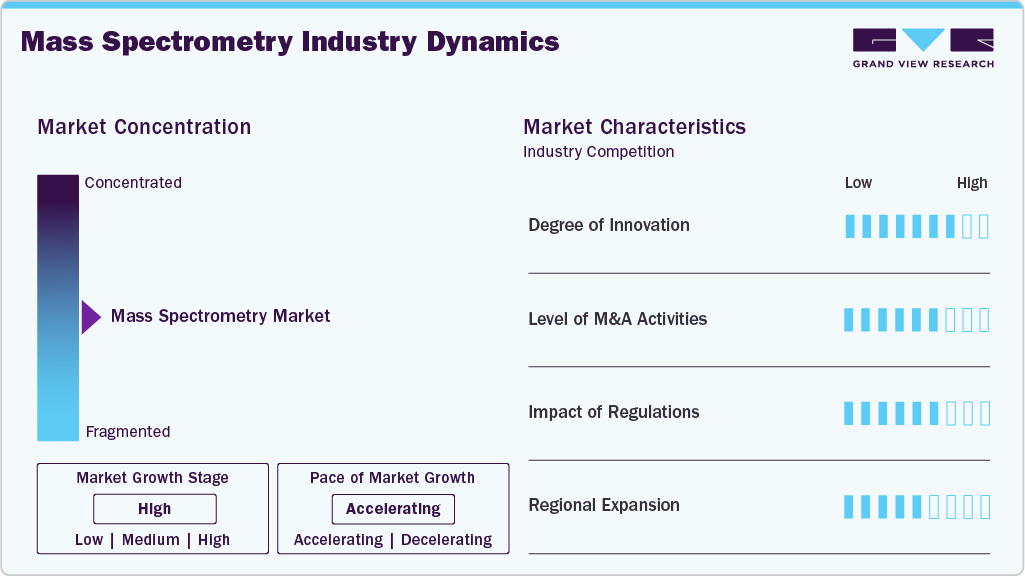
The mass spectrometry industry demonstrates a high degree of innovation, driven by advancements in high-resolution instruments, hybrid mass spectrometry systems, and integration with artificial intelligence and automation. Key developments include the evolution of quadrupole LC-MS, Orbitrap, and time-of-flight (TOF) platforms that deliver improved sensitivity, resolution, and faster analytical throughput. Companies are increasingly focusing on AI-enabled spectral interpretation, automated sample preparation, and cloud-based data analytics to enhance laboratory efficiency and reduce turnaround times. In addition, innovations in single-cell proteomics, metabolomics, and multi-omics workflows are expanding the scope of application for mass spectrometry in clinical research, drug discovery, and precision medicine. These technological advancements are expected to significantly strengthen adoption across pharmaceutical, biotechnology, and clinical diagnostics laboratories.
The mass spectrometry industry is witnessing active merger and acquisition activity as major players seek to strengthen their portfolios in analytical instrumentation, life sciences tools, and bioanalytical services. Strategic acquisitions are primarily focused on expanding capabilities in high-resolution mass spectrometry, chromatography-mass spectrometry integration, and software-driven data analytics.
 To learn more about this report, Download Free Sample Report
 Regulatory frameworks significantly influence the mass spectrometry industry, particularly in clinical diagnostics, pharmaceutical quality control, and food safety testing. Regulatory agencies such as the U.S. FDA, EMA, and other global authorities enforce strict guidelines on analytical validation, reproducibility, and data integrity for mass spectrometry-based methods used in regulated environments. Compliance with Good Laboratory Practice (GLP) and Good Manufacturing Practice (GMP) standards is essential for pharmaceutical and clinical applications, increasing development and operational requirements for laboratories. While these regulations may extend validation timelines, they also enhance market credibility by ensuring accuracy, traceability, and reliability of analytical results.
Regional expansion in the mass spectrometry industry is being driven by growing investments in pharmaceutical R&D, expanding biotechnology sectors, and increasing adoption of advanced analytical technologies across emerging economies. North America and Europe continue to dominate due to strong research infrastructure and early technology adoption, while Asia-Pacific is emerging as a high-growth region supported by expanding contract research organizations (CROs), government funding, and modernization of analytical laboratories.
Analyst Perspective
The mass spectrometry market is expected to witness steady growth, driven by increasing demand for precision diagnostics, drug discovery, proteomics, and environmental testing. Technological advancements, including high-resolution and hybrid platforms, are enhancing analytical accuracy and workflow efficiency. However, high instrument costs and regulatory complexities may restrict adoption in emerging economies. Market leaders are likely to strengthen positions through innovation, acquisitions, and integrated analytical ecosystems, while niche players focus on specialized applications.
Product Insights
Based on product , the instrument segment led the market with the largest revenue share of 66.8% in 2025., driven by the presence of numerous companies offering a wide range of mass spectrometry instruments. Major market players offer a wide range of instruments for various applications. For instance, in June 2025, SCIEX introduced the ZenoTOF 8600 mass spectrometry system, setting a new benchmark for accurate mass quantitation at the ASMS Annual Conference. The platform enhances sensitivity and analytical throughput for complex bioanalytical and clinical research workflows.
The consumables & services segment is projected to grow at the fastest CAGR of 8.93% over the forecast period, driven by increasing demand from academic institutions and research centers. For instance, Shimadzu Corporation offers a comprehensive range of consumables designed to support most mass spectrometry applications. Similarly, AB Sciex Pte. Ltd. offers an extensive range of custom-designed reagents and consumables through its iChemistry Solutions brand to enhance the performance of spectrometers and improve productivity, sensitivity, & data precision.
Technology Insights
Based on technology, the Quadrupole Liquid Chromatography-Mass Spectrometry segment led the market with the largest revenue share of 37.4% in 2025. Demand for this technology has grown significantly over the past few years due to its advantages. Manufacturers are developing advanced instruments to ensure compliance with these regulations, which require more accurate and reliable data for drug testing and safety assessments. For instance, in June 2025, Waters Corporation introduced the Xevo TQ Absolute XR Mass Spectrometer in the U.S., setting a new benchmark for robustness and sensitivity in high-throughput laboratories. The system enhances triple quadrupole LC-MS performance, delivering improved trace-level quantification, higher operational efficiency, and reduced downtime for pharmaceutical and PFAS testing applications.
The Fourier Transform - Mass Spectrometry (FT-MS) is the fastest-growing segment and is expected to grow at a CAGR of 9.41% over the forecast period. The growth in the pharmaceutical and biotechnology industries is a major driver for FT-MS. Researchers require advanced mass spectrometry techniques to analyze large biomolecules like proteins and nucleic acids, leading to a rising demand for FT-MS in drug development and biomarker discovery. The ability of FT-MS to handle large, complex molecules with high accuracy fuels its market growth. For instance, in May 2025, Chalmers University of Technology inaugurated a state-of-the-art FT-ICR mass spectrometry-based chemical imaging facility under the WISE initiative, aimed at advancing sustainable materials research and enabling ultra-high-resolution molecular analysis of complex systems. This development highlights the growing investment in FT-MS infrastructure to support next-generation molecular and materials research.
Application Insights
Based on application, the proteomics segment led the market with the largest revenue share of 46.2% in 2025. Mass spectrometry-based proteomics research is a comprehensive technique for quantitative profiling of proteins and studying protein-protein interactions. Mass spectrometry enables detailed studies of protein expression, modifications, and interactions, essential for unraveling complex biological processes. For instance, in January 2026, Northeastern University’s Mass Spectrometry Facility (USA) received a USD 2.2 million infrastructure grant to establish a single-cell proteomics platform. The upgrade includes deployment of advanced mass spectrometry instrumentation and an integrated workflow pipeline designed to measure proteins at single-cell resolution, enabling deeper investigation of cellular heterogeneity and disease mechanisms.
 To learn more about this report, Download Free Sample Report
 Metabolomics is projected to be the fastest-growing segment over the forecast period, driven by the wide range of applications of mass spectrometry in cancer screening and diagnosis. MS is the primary analytical technique utilized for metabolomics, as it enables the identification of numerous metabolites. Various research institutions employ mass spectrometry for metabolomics studies. For instance, a study published in March 2025, by the Journal of Neurodevelopmental Disorders investigated fetal and early-life metabolomic alterations using GC-MS-based metabolomics in children with ASD, highlighting disrupted carbohydrate metabolism as a potential early biomarker pathway for neurodevelopmental disorders.
End Use Insights
Based on end use, the pharmaceutical & biotechnology companies segment led the market with the largest revenue share of 45.4% in 2025. due to the extensive adoption of protein sequencing by mass spectrometry in the pharmaceutical industry for drug discovery and development. Furthermore, an increase in partnerships between key players in proteomics to advance biopharma and precision medicine research IS driving segment growth. For instance, in February 2025, Alamar Biosciences expanded access to its ultra-sensitive proteomics ecosystem by launching its Certified Service Provider (CSP) Program, enabling biopharmaceutical and academic researchers to use its NULISA high-sensitivity protein detection platform for biomarker discovery and precision proteomics.
The government & academic institutions segment is expected to grow rapidly over the forecast period, driven by rising healthcare expenditure, increased government funding for research, and the growing role of mass spectrometry techniques in disease surveillance and epidemiological research. For instance, in April 2024, Sheffield Hallam University is part of a consortium that has received nearly USD 66.94 million in government funding to enhance the UK's mass spectrometry capabilities through the Critical Mass UK (C-MASS) project.
Regional Insights
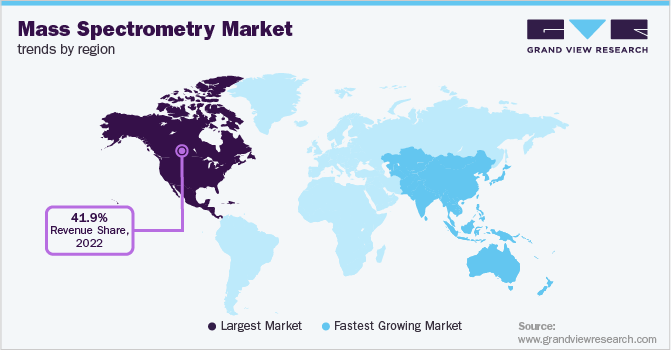
North America dominated the mass spectrometry market with the largest revenue share of 43.0% in 2025, driven by the presence of key market players, established academic institutions, pharmaceutical companies, and research centers, coupled with robust funding opportunities for R&D in biotechnology and drug discovery & development. In addition, increasing government support also fuels market growth. For instance, UniProt, a free resource for protein sequencing and functional information, is supported by multiple government institutions, such as the National Eye Institute (NEI), the National Heart, Lung, and Blood Institute, and the National Human Genome Research Institute (NHGRI).
 To learn more about this report, Download Free Sample Report
 U.S. Mass Spectrometry Market Trends
The mass spectrometry market in the U.S. held the largest share in the North America region in 2025., driven by technological advancements, growing demand from the pharmaceutical & biotechnology industry, increasing expenditure on drug discovery & development, and rising adoption of this technique in disease diagnostics. Moreover, robust funding in proteomics and related fields is expected to create multiple growth opportunities in the market. For instance, in August 2020, the National Institutes of Health (NIH) granted USD 10.6 million to the University of Arkansas for Medical Sciences (UAMS) to expand its proteomics resource.
Europe Mass Spectrometry Market Trends
The mass spectrometry market in Europe is experiencing significant growth due to rising demand in pharmaceuticals, biotechnology, and environmental testing. This growth can be attributed to the strong presence of pharmaceutical, biopharmaceutical, and biotechnology companies, coupled with the robust healthcare infrastructure and increased R&D spending in drug discovery & development. In addition, companies are launching new devices and consumables, thereby leveraging their market presence. For instance, in January 2025, Roche launched the cobas Mass Spec solution in Germany, bringing automated mass spectrometry into routine clinical laboratories across Europe.
The UK mass spectrometry market is expected to grow significantly, driven by established R&D infrastructure and increasing government investments. Furthermore, companies are organizing workshops and conferences to encourage professionals working in scientific fields to update their understanding of spectrometric techniques and applications, and to enhance the knowledge & skills necessary for advancements in research and industry practices.
The mass spectrometry market in Germany is experiencing significant growth due to favorable government regulations, advanced biotechnology R&D infrastructure, and a rising number of drug approvals. Innovations in spectrometry technology, increasing partnerships between academics & organizations, and increasing government funding to develop innovative spectrometry products are further contributing to market growth.
Asia Pacific Mass Spectrometry Market Trends
The mass spectrometry market in the Asia Pacific is expected to grow at the fastest CAGR over the forecast period. The market witnesses substantial product launches, mergers and acquisitions, collaborations, and partnerships. In addition, several government research grants are available. For instance, in developing countries like India, the government focuses on developing healthcare and biotechnology infrastructure through initiatives such as Make in India and BIRAC.
China mass spectrometry market is growing at a lucrative rate, driven by an increase in biotechnology, precision medicine, and translational research in the country. Although the country is relatively new to translational medicine, the market is expected to grow rapidly.
Latin America Mass Spectrometry Market Trends
The mass spectrometry market in Latin America exhibits strong growth potential, driven by favorable government policies that support increased funding for research activities. In addition, the stability of national governments across the region has improved considerably over the past few years, and governments have entered into agreements that foster liberal trade. With growing support for healthcare and a rising proportion of the middle class, consumer demand for advanced diagnostics & research is expected to increase.
Middle East and Africa Mass Spectrometry Market Trends
The mass spectrometry market in MEA is growing due to technological advancements and the increasing application of mass spectrometric techniques across various sectors. The rising demand for MS in pharmaceuticals, environmental testing, and food safety drives market growth. Countries such as South Africa, the United Arab Emirates, and Saudi Arabia are witnessing significant R&D investments.
Saudi Arabia mass spectrometry market is driven by government initiatives, rising healthcare expenditure, and technological advancements. In addition, the Saudi government is actively developing its biotechnology R&D infrastructure to address various challenges and leverage opportunities in health, agriculture, & industrial biotechnology.
Key Mass Spectrometry Company Insights
The market is highly competitive due to several strategic initiatives, such as new product launches, mergers and acquisitions, and regional expansion, undertaken by key players to expand their global footprint. Companies are diversifying their product portfolios to address a broader range of applications. This includes developing specialized MS systems tailored for specific industries.
Key Mass Spectrometry Companies:
The following key companies have been profiled for this study on the mass spectrometry market.
-
Agilent Technologies, Inc.
-
Danaher Corporation (SCIEX)
-
Waters Corporation
-
Bruker Corporation
-
Shimadzu Corporation
-
PerkinElmer, Inc.
-
Rigaku Corporation
-
LECO Corporation
-
JEOL Ltd.
Competitive Benchmarking
Category
Operating Strategies
Competitive Edge
Weakness
Established Players (Thermo Fisher Scientific, Inc., Agilent Technologies, Inc., Danaher Corporation (SCIEX), Waters Corporation, Bruker Corporation, Shimadzu Corporation)
Mature players focus on integrated analytical ecosystems by combining instruments, software, and consumables. They continuously invest in high-resolution and hybrid mass spectrometry technologies while expanding portfolios through acquisitions, partnerships, and strategic collaborations.
These companies benefit from a strong global installed base across pharmaceutical, biotechnology, and clinical laboratories. Their strengths include highly precise, validated, and regulatory-compliant instruments, alongside robust R&D capabilities that drive innovation and product
Mature players face challenges such as high instrument and maintenance costs, which limit adoption in price-sensitive markets. Complex product ecosystems require skilled operators, and regulatory approvals often lengthen commercialization timelines.
Emerging Players (PerkinElmer, Inc., Rigaku Corporation, LECO Corporation, JEOL Ltd.)
Emerging players emphasize niche applications such as material science, petrochemicals, and industrial testing. They focus on developing cost-efficient, application-specific solutions and expand market reach through regional partnerships and distributor networks.
Their advantages include greater flexibility in customization, competitive pricing, and strong positioning in specialized analytical and industrial applications where tailored solutions are valued.
Emerging players often struggle with limited global presence, lower brand recognition, and smaller financial resources for large-scale R&D. Additionally, restricted service infrastructure can hinder customer support and market expansion.
Recent Developments
-
In May 2026, Agilent Technologies Inc. announced the launch of the Agilent 9500 Triple Quadrupole ICP-MS, a next-generation inductively coupled plasma mass spectrometry system designed to simplify the transition from single-quadrupole to triple-quadrupole ICP-MS technology. The system aims to support laboratories in performing advanced trace elemental analysis with improved analytical capabilities and operational efficiency.
-
In May 2025, Agilent Technologies Inc. showcased its intelligent LC/MS and GC/MS innovations at the 73rd ASMS Conference in Baltimore, Maryland. The company highlighted advanced mass spectrometry solutions designed to enhance laboratory efficiency, sustainability, and productivity. These innovations reinforce Agilent’s leadership in analytical and clinical laboratory technologies across pharmaceuticals, diagnostics, life sciences, environmental, and food safety sectors globally.
-
In July 2025, Waters Corporation launched Charge Detection Mass Spectrometry (CDMS) technology to accelerate the development of next-generation biotherapeutics. The innovation enhances characterization of large and complex biomolecules, improving accuracy, sensitivity, and analytical performance.
Mass Spectrometry Market Report Scope
Report Attribute
Details
Market size value in 2025
USD 7.3 billion
Market size value in 2026
USD 7.9 billion
Revenue forecast in 2033
USD 13.2 billion
Growth rate
CAGR of 7.6% from 2026 to 2033
Historical data
2021 - 2024
Forecast period
2026 - 2033
Quantitative units
Revenue in USD million/billion and CAGR from 2026 to 2033
Report coverage
Revenue forecast, company ranking, competitive landscape, growth factors, and trends
Segments covered
Product, technology, application, end use, region
Regional scope
North America; Europe; Asia Pacific; Latin America; MEA
Country scope
U.S.; Canada; Mexico; Germany; UK; France; Italy; Spain; Norway; Denmark; Sweden; China; Japan; India; South Korea; Australia; Thailand; Brazil; Argentina; Saudi Arabia; South Africa; UAE; Kuwait
Key companies profiled
Thermo Fisher Scientific, Inc.; Agilent Technologies, Inc. Danaher Corporation (SCIEX); Waters Corporation; Bruker Corporation; Shimadzu Corporation; PerkinElmer, Inc.; Rigaku Corporation; LECO Corporation; JEOL Ltd.
Customization scope
Free report customization (equivalent up to 8 analysts' working days) with purchase. Addition or alteration to country, regional & segment scope.
Pricing and purchase options
Avail customized purchase options to meet your exact research needs. Explore purchase options
Global Mass Spectrometry Market Report Segmentation
This report forecasts revenue growth and provides an analysis of the latest trends in each of the sub-segments from 2021 to 2033. For this report, Grand View Research has segmented the global mass spectrometry market based on:
-
Product Outlook (Revenue, USD Billion, 2021 - 2033)
-
Instruments
-
Consumables & Services
-
-
Technology Outlook (Revenue, USD Billion, 2021 - 2033)
-
Quadrupole Liquid Chromatography-Mass Spectrometry
-
Gas Chromatography-Mass Spectrometry (GC-MS)
-
Fourier Transform-Mass Spectrometry (FT-MS)
-
Time-of-Flight Mass Spectrometry (TOFMS)
-
Matrix-Assisted Laser Desorption/Ionization-Time-of-Flight Mass Spectrometry (MALDI-TOF)
-
Magnetic Sector Mass Spectrometry
-
Others
-
-
Application Outlook (Revenue, USD Billion, 2021 - 2033)
-
Proteomics
-
Metabolomics
-
Glycomics
-
Others
-
-
End Use Outlook (Revenue, USD Billion, 2021 - 2033)
-
Government & Academic Institutions
-
Pharmaceutical & Biotechnology Companies
-
Others
-
-
Regional Outlook (Revenue, USD Billion, 2021 - 2033)
-
North America
-
U.S.
-
Canada
-
Mexico
-
-
Europe
-
UK
-
Germany
-
France
-
Italy
-
Spain
-
Denmark
-
Sweden
-
Norway
-
-
Asia Pacific
-
Japan
-
China
-
India
-
Australia
-
South Korea
-
Thailand
-
-
Latin America
-
Brazil
-
Argentina
-
-
Middle East and Africa (MEA)
-
South Africa
-
Saudi Arabia
-
UAE
-
Kuwait
-
-
Research Methodology
(a) Segment Definition
Segment - Product
Revenue capture definition
Instruments
Mass spectrometry instruments include analyzers, detectors, ion sources, and software used for molecular analysis. Revenue is generated through upfront equipment sales, upgrades, leasing, and system installations across laboratories.
Consumables & Services
Consumables & services include columns, reagents, calibration standards, maintenance, repairs, and training. Revenue is generated through recurring purchases, service contracts, technical support, and instrument maintenance subscriptions.
Segment - Technology
Revenue capture definition
Quadrupole Liquid Chromatography
-Mass Spectrometry (LC-MS)
Combines liquid chromatography with quadrupole mass spectrometry to separate and analyze complex compounds. Revenue is generated through instrument sales, pharmaceutical testing demand, software upgrades, and maintenance contracts.
Gas Chromatography-
Mass Spectrometry (GC-MS)
Integrates gas chromatography with mass spectrometry for volatile compound analysis in environmental, food, and forensic testing. Revenue comes from instrument purchases, consumables, service agreements, and laboratory adoption.
Fourier Transform-
Mass Spectrometry (FT-MS)
High-resolution technology enabling precise molecular characterization, widely used in proteomics and metabolomics. Revenue is generated through premium instrument pricing, research funding, specialized software, and after-sales servicing.
Time-of-Flight
Mass Spectrometry (TOFMS)
Measures ion mass based on flight time, offering rapid and accurate analysis. Revenue is generated through equipment sales, diagnostic applications, industrial testing, and recurring maintenance services.
Matrix Assisted Laser Desorption
/Ionization-Time-of-Flight (MALDI-TOF)
Uses laser ionization for analyzing biomolecules, particularly in microbiology and clinical diagnostics. Revenue arises from healthcare adoption, instrument sales, consumables, software licensing, and service contracts.
Magnetic Sector Mass Spectrometry
Employs magnetic fields for highly accurate isotope and elemental analysis in research and geochemistry. Revenue is generated through high-value instrument installations, niche scientific demand, and technical servicing.
Others
Includes ion trap, orbitrap, and hybrid technologies serving specialized analytical applications. Revenue is generated through niche product sales, technological innovation, customized solutions, and recurring support services.
Segment - Application
Revenue capture definition
Proteomics
Proteomics involves studying proteins, their structures, and functions using mass spectrometry for biomarker discovery and drug development. Revenue is generated through pharmaceutical research demand, instrument sales, and analytical services.
Metabolomics
Metabolomics analyzes small molecules and metabolic changes in biological systems for disease research and personalized medicine. Revenue comes from research funding, diagnostic applications, consumables, and instrument adoption.
Glycomics
Glycomics studies glycans and carbohydrate structures to understand biological processes and therapeutic development. Revenue is generated through biopharmaceutical research, specialized instruments, reagents, and laboratory testing services.
Others
Includes lipidomics, genomics, environmental analysis, and food testing applications. Revenue is generated through diversified research use, industrial quality control, diagnostic expansion, and recurring service contracts.
Segment – End Use
Revenue capture definition
Government & Academic Institutions
Government agencies and academic institutions use mass spectrometry for scientific research, environmental monitoring, and forensic studies. Revenue is generated through public research grants, institutional procurement, and long-term service agreements.
Pharmaceutical & Biotechnology Companies
Pharmaceutical and biotechnology companies utilize mass spectrometry for drug discovery, biomarker identification, and quality control. Revenue comes from large-scale instrument purchases, consumables demand, software licensing, and service contracts.
Others
Includes food testing laboratories, clinical diagnostics, environmental agencies, and chemical industries. Revenue is generated through industrial quality testing, regulatory compliance needs, recurring consumable purchases, and maintenance services.
(b) Estimation ModelThe research methodology for the mass spectrometry market combines primary and secondary research to ensure accurate market insights. Secondary research includes company reports, industry publications, scientific journals, and regulatory databases. Primary research involves interviews with manufacturers, distributors, industry experts, and end users to validate findings. Market sizing is estimated using top-down and bottom-up approaches, supported by data triangulation and trend analysis for forecasting.
Delivered Customizations
This report has been delivered with the following In-depth customizations
Client Request
Customization Delivered
Value Adds
Identification of high-growth opportunities in the mass spectrometry ecosystem
Assessed growth potential across instruments, consumables, software, and services by application area, laboratory type, and purchasing behavior.
Helped prioritize revenue pockets with higher recurring demand and long-term scalability.
Technology adoption analysis across clinical and research workflows
Evaluated adoption trends for LC-MS, GC-MS, MALDI-TOF, ICP-MS, and hybrid systems across pharmaceutical, clinical, proteomics, food testing, and environmental laboratories.
Enabled clients to identify faster-growing workflow transitions and underpenetrated adoption areas.
Competitive intelligence and benchmarking
Compared leading companies on innovation pipeline, installed base, automation integration, regional presence, pricing strategy, and regulatory positioning.
Supported competitor tracking, market positioning, and partnership assessment initiatives.
Workflow and automation assessment
Analyzed the shift toward high-throughput, automated, and AI-assisted mass spectrometry workflows including sample preparation and data interpretation integration.
Highlighted operational efficiency opportunities and next-generation laboratory transformation trends.
End-user demand mapping
Segmented demand across pharmaceutical & biotechnology companies, CROs, hospitals, diagnostic laboratories, academic institutes, and industrial testing facilities.
Provided visibility into high-value customer groups and procurement intensity patterns.
Frequently Asked Questions About This Report
Some key players operating in the mass spectrometry market include Thermo Fisher Scientific, Inc.; Agilent Technologies, Inc.; Danaher Corporation; Waters Corporation; Bruker Corporation; Shimadzu Corporation; PerkinElmer, Inc.; Rigaku Corporation; LECO Corporation; JEOL Ltd.
Key factors that are driving the mass spectrometry market growth include increasing spending on drug discovery and development, along with the increase in the prevalence of chronic diseases and the need for the development of new diagnostic techniques
The global mass spectrometry market size was estimated at USD 7.3 billion in 2025 and is expected to reach USD 7.9 billion in 2026.
The global mass spectrometry market is expected to grow at a compound annual growth rate of 7.6% from 2026 to 2033 to reach USD 13.2 billion by 2033.
North America dominated the mass spectrometry market with a share of 43.0% in 2025. This is attributable to the presence of well-established research institutes and R&D plants of various pharmaceutical companies.
Asia Pacific is the fastest-growing region over the forecast period.
Based on technology, the Quadrupole Liquid Chromatography-Mass Spectrometry segment led the market with the largest revenue share of 37.4% in 2025.
Based on application, the proteomics segment led the market with the largest revenue share of 46.2% in 2025.
Based on product, the instrument segment led the market with the largest revenue share of 66.8% in 2025
About the Author(s)
Clinical Diagnostics Research Team
Healthcare · Clinical DiagnosticsThis report was authored by the clinical diagnostics research team at Grand View Research - comprising two research analysts, one senior research analyst, and one industry expert - with specialized expertise in the clinical diagnostics segment of the healthcare industry. All findings are based on proprietary healthcare databases, executive interviews, and regulatory analysis, subject to internal peer review prior to publication.
Last Updated:
Speak to Analyst

Customize this report to your needs - add regions, segments, or data points, with 20% free customization.
Or view our licence options:


ISO 9001:2015 & 27001:2022 Certified
We are GDPR and CCPA compliant! Your transaction & personal information is safe and secure. For more details, please read our privacy policy.


