
- Home
- »
- Sensors & Controls
- »
-
Radio Frequency Components Market Size Report, 2033GVR Report cover
![Radio Frequency Components Market (2026 - 2033)Report]()
Radio Frequency Components Market (2026 - 2033)
Size, Share & Trends Analysis Report By Product (Filters, Duplexers, RF Amplifiers, RF Switches), By Application (Consumer Electronics, Military, Automotive), By Region, And Segment Forecasts
Market Size, 2025
$47.3BMarket Estimate, 2026
$53.4BMarket Forecast, 2033
$136.4BCAGR, 2026–2033
14.3%Radio Frequency Components Market Summary
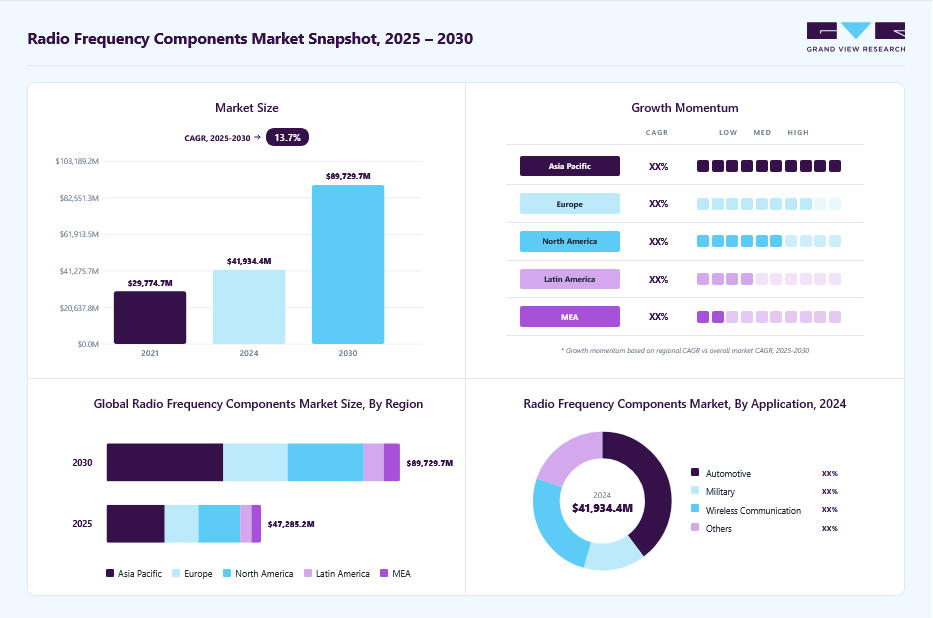
The global radio frequency components market size was valued at USD 47.3 billion in 2025 and is projected to grow from USD 53.4 billion in 2026 to USD 136.4 billion by 2033, at a CAGR of 14.3% from 2026 to 2033. Asia Pacific dominated the market, accounting for a revenue share of 37.0% in 2025. The market is driven by the rapid expansion of 5G network infrastructure, increasing adoption of RF devices in smartphones and connected consumer electronics, rising deployment of Internet of Things (IoT) devices across industrial and commercial sectors, growing demand for automotive radar systems and advanced driver assistance systems (ADAS), increasing investments in aerospace and defense communication systems, and continuous advancements in wireless communication technologies and RF front-end solutions.
Key Market Trends & Insights
- By product: Filters segment dominated the market, with a revenue share of over 23% in 2025.
- By application: Consumer electronics segment held the largest revenue share in 2025.
Regional Highlights
- Largest regional market: Asia Pacific (37.0% revenue share, 2025)
- By country: The U.S. held the largest market share in 2025.
Market Size & Forecast
- Market size in 2025: USD 47.3 Billion
- Estimated market size in 2026: USD 53.4 Billion
- Projected market size by 2033: USD 136.4 Billion
- CAGR (2026-2033): 14.3%
Continuous innovations and advancements in mobile handset technology owing to the continuing transition from 2G, and 3G to 4G/LTE, LTE-Advanced, LTE-Advanced Pro, and 5G lead to the rising need for maximizing power efficiency and spectrum range of mobile devices. This, in turn, is expected to spur the demand for radio frequency (RF) components during the forecast period. According to The World Bank Group, as of 2023, one-third of the global population still does not have access to the internet. With growing internet penetration, the RF components market is expected to grow significantly over the forecast period.
In July 2024, Smiths Interconnect launched a "Mini-Lock Connector" for mission-critical applications requiring reliable high-frequency connectivity. This connector operates up to 110 GHz, enabling faster speeds and reduced downtime. Its robust locking mechanism ensures a stable connection even under extreme vibration and shock, making it suitable for satellites, space flights, radars, unmanned vehicles, and military applications. Designed for harsh environments, it functions in temperatures from -65°C to +165°C. The compact and lightweight connector supports advancements in global connectivity by improving data transfer in demanding applications. Smiths Interconnect emphasizes its commitment to innovation and serving customer needs in frontier industries.
IoT solutions require enhanced wireless connectivity, thereby driving the need for new and advanced radio frequency components. Moreover, increasing sales of smartphones owing to constant product development remains a prominent feature of the market. New smartphones offering improved performance, biosensors, long battery life, and more AI features, and the increasing popularity of low-end smartphones in emerging countries will boost the radio frequency components industry. Thus, the requirement of low-power ICs for maximizing battery life and reducing charging time in smartphones is expected to spur the demand for radio frequency components. Increasing adoption of IoT across industrial, residential, and consumer applications is also expected to impel the radio frequency components demand.
Furthermore, a number of applications and products, such as home robots, smart wearables, self-driving cars, and smart manufacturing solutions and tools, are being integrated with IoT technologies, leading to an increased scope of usage for the radio frequency component. However, the requirement for features, such as longer battery life, low-power wireless connections, and diversified sensors, in these products and applications are pushing radio frequency component manufacturers and solution designers to focus more on technological developments in their deliverables. Owing to the aforementioned factors, the radio frequency component industry is anticipated to attain significant growth in the years to come.
The need for broadband services and better speeds for mobile internet connectivity is driving technological breakthroughs in the sectors of wireless and cellular mobile communication, including the deployment and development stages of 5G networks. Moreover, the 5G network offers a wider coverage area and lower latency than the previous generations, similar to the new generation’s internet connectivity. Due to the necessity for low-frequency and tall antenna macro cell sites for greater area coverage brought on by the introduction of 5G networks in wireless communication, radio frequency components will become more and more common.
The radio frequency components industry is anticipated to be affected by an increase in raw material prices. Silicon wafers, a range of chemicals, and photoresist materials are among the main raw materials utilized in the manufacture of radio frequency components. Due to the scarcity of these raw materials as a result of rising manufacturer demand, there have been price adjustments and delivery delays across the whole market. For instance, the cost of silicon wafers has increased as a result of the semiconductor industry's increased demand.
Market Dynamics
The radio frequency components market is experiencing robust growth driven by the accelerating deployment of 5G network infrastructure and the increasing integration of RF components across smartphones, connected devices, and communication equipment. Rising adoption of RF front-end modules, filters, amplifiers, and antennas in consumer electronics is supporting sustained market expansion. The growing use of wireless communication technologies, Internet of Things (IoT) devices, and industrial connectivity solutions is further increasing demand for advanced radio frequency solutions. In addition, expanding applications of automotive radar systems, vehicle-to-everything (V2X) communication, and advanced driver assistance systems (ADAS) are creating new growth opportunities for market participants. Continuous innovation in semiconductor technologies and increasing investments in aerospace, defense, and next-generation communication networks are expected to strengthen the long-term outlook of the radio frequency components market.
The increasing deployment of AI-enabled wireless infrastructure and private 5G networks is emerging as a key growth driver for the radio frequency components industry. Enterprises across manufacturing, logistics, healthcare, and smart city applications are investing heavily in dedicated wireless networks to improve connectivity, automation, and operational efficiency. This trend is generating strong demand for advanced RF power amplifiers, RF switches, duplexers, and antenna tuning solutions. The expansion of edge computing architectures is further accelerating the need for high-performance radio frequency hardware capable of supporting low-latency communication. As organizations prioritize reliable and secure wireless connectivity, demand for next-generation RF semiconductor devices continues to increase.
The rapid evolution of network architectures is also encouraging telecom operators to upgrade existing communication infrastructure with advanced RF front-end technologies. Growing investments in network densification and spectrum optimization are creating opportunities for manufacturers of high-frequency RF modules and signal processing components. In addition, increasing adoption of Open RAN and software-defined networking frameworks is driving demand for flexible and energy-efficient radio frequency solutions. Semiconductor companies are introducing highly integrated RF chipsets to support enhanced network performance and capacity requirements. These developments are expected to sustain long-term growth across the radio frequency components market.
The growing complexity of modern wireless devices is creating significant challenges for the radio frequency components market. As communication systems support multiple frequency bands, higher data transmission speeds, and advanced connectivity standards, RF component integration has become increasingly sophisticated. Manufacturers must balance performance, power efficiency, signal integrity, and miniaturization within limited device footprints. These requirements increase product development costs and extend design validation cycles. Consequently, market participants face mounting pressure to deliver high-performance solutions while maintaining competitive pricing.
Thermal management has also emerged as a critical concern for RF component manufacturers. Higher operating frequencies and increased power densities generate substantial heat, which can negatively impact system reliability and signal performance. Addressing these challenges often requires advanced packaging technologies and specialized materials, increasing production complexity. Additionally, stringent testing and certification requirements can delay product commercialization and increase time-to-market. These factors may limit adoption among cost-sensitive end users and constrain overall market expansion.
The rapid expansion of satellite communication networks and non-terrestrial network (NTN) infrastructure presents a significant opportunity for the radio frequency components market. Governments and private enterprises are investing in low-Earth orbit (LEO) satellite constellations to improve global connectivity and bridge digital coverage gaps. This trend is increasing demand for high-frequency RF transceivers, beamforming modules, low-noise amplifiers, and advanced signal conditioning technologies. Growing reliance on satellite-enabled broadband services is creating new revenue streams for RF device manufacturers. The integration of terrestrial and satellite communication networks is expected to further accelerate adoption of advanced radio frequency technologies.
Furthermore, increasing deployment of satellite-based connectivity for aviation, maritime, defense, and remote industrial operations is expanding the addressable market for specialized RF solutions. Advances in phased-array antenna systems and high-frequency spectrum utilization enabling improved communication performance across non-terrestrial environments. The growing commercialization of space-based communication infrastructure is encouraging innovation in RF materials, packaging, and semiconductor design. Industry participants are actively developing products optimized for harsh operating conditions and long-distance signal transmission. As satellite communication becomes an integral part of future connectivity ecosystems, the demand for advanced radio frequency components is expected to rise substantially.
Market Concentration & Characteristics
The radio frequency components market demonstrates a moderately concentrated competitive landscape, with leading suppliers leveraging expertise in gallium arsenide (GaAs), gallium nitride (GaN), and advanced semiconductor fabrication technologies to strengthen their market positions. Major manufacturers maintain significant advantages through vertically integrated supply chains, proprietary intellectual property portfolios, and long-standing relationships with original equipment manufacturers (OEMs). The market continues to witness strategic investments in high-frequency signal transmission solutions, enabling participants to address evolving performance requirements across next-generation connectivity platforms. Despite the presence of dominant global players, numerous specialized vendors compete in niche applications, contributing to a healthy level of market fragmentation and technological differentiation.

The industry is characterized by a high degree of innovation, driven by continuous advancements in millimeter-wave technology, beamforming architectures, and high-band spectrum utilization. Merger and acquisition activity remains moderate as companies seek to expand product portfolios, strengthen semiconductor capabilities, and enhance access to emerging application areas. Regulatory standards governing electromagnetic compatibility, spectrum allocation, and communication performance play a significant role in shaping product development and commercialization strategies. Furthermore, limited availability of direct substitutes and growing demand from telecommunications equipment providers, network infrastructure developers, and connected device manufacturers continue to reinforce the long-term growth trajectory of the radio frequency components market.
Analyst Perspective
The radio frequency components market is positioned for sustained growth, driven by the rapid expansion of 5G infrastructure, increasing adoption of RF front-end modules, and rising demand for high-speed wireless connectivity across industries. Growing investments in millimeter-wave technology, satellite communication systems, and private wireless networks are creating new opportunities for component manufacturers. The automotive sector is emerging as a key growth avenue, supported by the increasing integration of automotive radar, connected vehicle technologies, and advanced communication systems. In addition, advancements in compound semiconductors, including gallium nitride (GaN) and gallium arsenide (GaAs), are enhancing RF performance and enabling next-generation applications. As demand for reliable signal transmission, spectrum efficiency, and high-frequency communication continues to rise, the radio frequency components market is expected to witness strong innovation and long-term revenue expansion.
Product Insights
The segment has been filters, duplexers, RF amplifiers, RF switches, modulators and demodulators, mixers and synthesizers, and others. Based on product, the Filters segment led the market with the largest revenue share of over 23% in 2025. Filters play a critical role in the RF components market, shaping the performance and efficiency of wireless communication systems. These components are essential for managing signal quality, reducing interference, enhancing reception, and complying with regulatory requirements. The widespread adoption of wireless technologies across various industries has propelled the demand for advanced RF filters. The increasing demand for high-speed data transmission, especially with the advent of 5G technology, necessitates efficient filters to manage the spectrum effectively. Filters enable efficient utilization of available bandwidth, ensuring seamless connectivity and improved spectrum efficiency. They help in channelizing the radio spectrum, avoiding overlap, and reducing interference.
The RF amplifiers segment is estimated to exhibit at a rapid CAGR over the forecast period, which is primarily attributed to rapid growth in the user base of mobile devices and 4G LTE networks. The proliferation of IoT devices demands efficient and power-conscious RF amplifiers for reliable connectivity. These amplifiers enable seamless data transfer and communication between various IoT devices. Moreover, the growing adoption of 5G networks globally has significantly fueled the demand for RF amplifiers. 5G technology demands higher frequency bands and better amplification capabilities, driving the need for advanced RF amplifiers that can operate effectively within these bands. The adoption of RF amplifiers in the market continues to grow in response to the increasing demand for faster and more reliable wireless communication, advancements in technology, and the widespread integration of IoT and 5G technologies. The versatility and critical role of RF amplifiers across diverse industries are driving their adoption and innovation in the market.
Application Insights
Based on application, the market has been divided into automotive consumer electronics, military, and wireless communication. Based on application, the consumer electronics segment led the market with the largest revenue share of over 63% in 2025. Over the projected period, the segment is also anticipated to experience significant expansion. This could be attributable to increasing consumer electronics expenditure and rising disposable income on items like smartphones, tablets, laptops, smart wearable notebooks, and smart home accessories.
The demand for consumer electronics products is also being driven by the widespread use of IoT technologies and technical innovations like the integration of AI features (control/voice recognition) in set-top boxes and TVs. Furthermore, government mandates for the installation of set-top boxes in a number of countries are estimated to fuel the segment growth further. The automotive sector is also anticipated to witness rapid growth owing to increasing demand for connectivity features, such as navigation systems, Bluetooth, location trackers, music systems, and central locking systems, in vehicles. An increasing number of automation solution installations in vehicles is also expected to drive the product demand in this segment.

The wireless communication segment is expected to grow at the fastest CAGR of 13.4% during the forecast period. The adoption of radio frequency (RF) components in wireless communication has been pivotal in shaping the modern world. RF components serve as the backbone of wireless communication systems, enabling seamless connectivity across diverse applications. RF components are fundamental to wireless networks, enabling the transmission and reception of signals. In cellular networks such as 2G, 3G, 4G, and 5G, RF components ensure efficient data transfer with a smooth communication experience for users. RF technology plays a crucial role in satellite communication systems. Satellites use RF components for uplink and downlink communication, facilitating television broadcasting, internet access in remote areas, weather forecasting, and global positioning through Global Navigation Satellite Systems (GNSS) such as GPS.
Regional Insights
North America accounted for a significant revenue share of over 26.0% in the global radio frequency components market in 2025, owing to the ever-increasing demand for wireless communication technologies. The rapid evolution of wireless communication technologies, such as 5G networks, the Internet of Things (IoT), and smart devices, has been a significant factor driving the market growth. As these technologies continue to revolutionize various industries, the demand for high-performance RF components, such as filters, amplifiers, and antennas, has surged.
U.S. Radio Frequency Components Market Trends
The radio frequency components market in the U.S. held the largest share in the North America region in 2025. RF components are integral in a wide range of applications, including wireless communication, aerospace, defense, healthcare, and the Internet of Things (IoT), making them essential in the increasingly connected world. One of the primary drivers of the RF components market is the relentless expansion of wireless technologies. In addition, the growing use of electronic devices in the daily lives of consumers, ranging from smartphones and tablets to smart home appliances, has led to an ever-increasing demand for RF components.
Asia Pacific Radio Frequency Components Market Trends
The radio frequency components market in Asia Pacific held the largest revenue share of 37.29% in 2024. The growth is ascribed to increasing demand for radio frequency components in consumer electronics applications. Growing adoption of power amplifiers and duplexers for use in a wide range of devices such as mobile phones, tablets, and laptops & notebooks, among others. The Radio frequency components are used for frequency up and down conversion. The radio frequency down converter converts the radio frequency signal to a baseband signal for use in GSM. The demand for radio frequency components in the Asia Pacific region for consumer electronics applications is anticipated to grow exponentially, owing to the increasing adoption of radio frequency components due to their ability to provide or control coverage with some kind of antenna or transmission system.

China Radio Frequency Components Market Trends
The China radio frequency components market is driven by increasing investments in baseband processing platforms, expanding deployment of massive MIMO architectures, and growing demand for high-performance connectivity solutions across commercial and industrial sectors. The rapid adoption of small cell networks and advanced spectrum utilization technologies is accelerating the need for sophisticated signal transmission and reception components. Rising production of smart manufacturing equipment and connected industrial systems is creating sustained demand for RF transceivers, surface acoustic wave (SAW) devices, and bulk acoustic wave (BAW) technologies. The expansion of electric vehicles and intelligent mobility solutions is further supporting the integration of high-frequency communication modules in transportation infrastructure.
India Radio Frequency Components Market Trends
The radio frequency components market in India is rapidly growing owing to its large labor pool and developing technological infrastructure for the electronics manufacturing sector. According to The World Bank Group, the total labor force in India reached over 523 million in 2022. Moreover, lower labor costs compared to China have led to growing investments in India, making it one of the most promising contenders to the Chinese electronic manufacturing sector. The Indian government and private companies are taking initiatives to develop the country’s electronic manufacturing industry.
Europe Radio Frequency Components Market Trends
The radio frequency components market in Europe is expected to grow at the fastest CAGR of 13.8% during the forecast period. The automotive sector is playing a significant role in driving the growth of the market in Europe. RF technology integration in modern vehicles is vital for advanced driver assistance systems, infotainment, and vehicle-to-vehicle communication. As the automotive industry continues its evolution toward autonomous and connected vehicles, the demand for RF components is expected to continue to increase. The electric vehicle (EV) industry in Europe is at the forefront of technological innovation, and RF components play a crucial role in enhancing the performance, safety, and connectivity of electric vehicles. For instance, as per the GVR analysis in Q1 2023, Europe witnessed a year-on-year increase of more than 13% in the sales of electric vehicles.
The UK radio frequency components market is dynamic and thriving, driven by several key factors that contribute to its growth and significance on both the national and global levels. The UK is renowned for its aerospace and defense industries, which heavily rely on RF components for radar systems, satellite communication, electronic warfare, and navigation. As national security requirements evolve and technology advances, there is a consistent demand for cutting-edge RF technology.
Key Radio Frequency Components Company Insights
Some of the key players operating in the industry include Texas Instruments; and NXP Semiconductors.; among others.
-
An extensive portfolio of innovative and high-performance RF solutions is allowing Texas Instruments Incorporated (TI) to take the lead in the global market. The company specializes in RF integrated circuits, transceivers, amplifiers, and power management solutions. The company’s strength lies in its strong commitment to research and development, leading to cutting-edge technologies addressing the evolving needs of 5G, IoT, and wireless communication systems. A customer-centric approach and global presence are also allowing it to command a leading position in the market.
-
NXP Semiconductors is known for its advanced RF solutions catering to automotive, IoT, and industrial applications. The company’s comprehensive product offerings and focus on emerging technologies, such as 5G and IoT, further bolster its leadership position. The company’s commitment to sustainable and innovative solutions also ensures it remains at the forefront of the market, meeting the evolving demands for connectivity and communication across various industries and industry verticals.
MACOM Technology Solutions Holdings, Inc. and Tippmann Group are some of the emerging companies in the global market
-
MACOM offers a diverse range of RF components, including amplifiers, mixers, switches, attenuators, and other semiconductor devices. Their product portfolio is designed to meet the demanding requirements of applications such as telecommunications, aerospace, defense, and industrial markets. With a global presence, MACOM has established itself as a key player in the market. Their components are integral to the development and deployment of communication systems, radar systems, satellite communication, and other applications where RF technology is fundamental.
-
IQE plc specializes in semiconductor technology, particularly in the field of compound semiconductors. Their expertise extends to the design and manufacture of semiconductor materials that are crucial for RF components used in diverse applications. The semiconductor materials offered by IQE plc find applications in various markets, including telecommunications, data communications, aerospace, defense, and consumer electronics. Their contributions to RF technology support the development of advanced communication systems and devices.
Key Radio Frequency Components Companies:
The following are the leading companies in the radio frequency (RF) components market.
-
Broadcom, Inc.
-
Fujitsu Limited
-
IQE plc
-
NXP Semiconductors
-
Renesas Electronics Corporation
-
Murata Manufacturing Co. Limited
-
Taiwan Semiconductor Manufacturing Co. Limited
-
Texas Instruments, Inc.
-
TDK Corporation
-
ROHM Co., Ltd
-
Toshiba Electronics Devices & Storage Corporation
-
United Monolithic Semiconductors
-
MACOM Technology Solutions Holdings, Inc.
-
WIN Semiconductors
-
SV Microwave (Amphenol Corporation)
-
Wolfspeed, Inc.
-
Qorvo, Inc
-
Analog Devices, Inc
-
Marki Microwave, Inc.
-
Knowles Corporation
-
Skyworks Solutions, Inc.
-
Gotmic AB
Competitive Benchmarking
Operating Strategies
Competitive Edge
Weaknesses
Mature Players: Broadcom Inc., Murata Manufacturing Co., Ltd., Qorvo, Inc., Skyworks Solutions, Inc., and NXP Semiconductors
- Mature players focus on expanding RF front-end solutions, strengthening 5G and automotive portfolios, and securing long-term partnerships with major OEMs. Their strategies emphasize product integration, manufacturing efficiency, and continuous technology upgrades.
- Their strength lies in extensive patent portfolios, large-scale production capabilities, and established global customer relationships. Strong brand recognition and diversified product offerings support their leadership across the radio frequency components market.
- High operational costs and reliance on mature end-user segments can limit growth flexibility. Large organizational structures may also slow adaptation to emerging technology opportunities.
Emerging Players: Wolfspeed, Inc., WIN Semiconductors, MACOM Technology Solutions Holdings, Inc., Marki Microwave, Inc., and Gotmic AB
- Emerging players concentrate on specialized RF technologies, compound semiconductors, millimeter-wave solutions, and high-performance communication applications. Their strategies prioritize innovation, niche market expansion, and rapid product commercialization.
- Their competitive advantage comes from technical expertise, focused product development, and faster innovation cycles. Agile business models enable quick responses to evolving customer and industry requirements.
- Limited manufacturing scale and smaller customer networks can restrict market reach. Lower financial resources compared to established competitors may also constrain expansion initiatives and R&D investments.
Recent Development
-
In October 2024, CG Power, part of the Murugappa Group, acquired Renesas' RF components business for USD 36 million, entering the semiconductor design sector. The acquisition includes IP, tangible assets, and select employees in areas like semiconductor design, marketing, and applications.
-
In August 2024, General Dynamics received an USD 88.5 million order from the U.S. Navy to build AN/USC-61(C) maritime software-defined radios for ships and submarines. These multifunction radios offer various waveforms and multi-level security, including NSA Type 1 encryption across HF, VHF, UHF line-of-sight, and UHF SATCOM bands. The contract covers digital modular radio (DMR) systems, high-frequency distribution amplifier group components, and spare parts.
-
In August 2023, MACOM acquired Wolfspeed's Radio Frequency Business for USD 25 million. As per the agreement, MACOM will take ownership of a wafer fabrication facility located in North Carolina, expected to be operational within approximately two years following the closing. In addition, MACOM will gain access to over 1,400 patents linked to the RF business, along with design teams, relevant product development assets, and production capabilities situated in California and Malaysia.
-
In June 2023, Broadcom, Inc. introduced four RF front-end modules designed to power routers compliant with Wi-Fi 7, the latest wireless networking standard. These modules are versatile and can be utilized in the construction of Wi-Fi Access Points (APs) as well. APs are essential devices used by enterprises to enable wireless connectivity within their office spaces. The newly launched modules are finely tuned for optimal performance in Wi-Fi 7 routers and access points. At the launch, the company presented four modules, each with distinct configurations.
-
In April 2023, Renesas Electronics Corporation launched its new wireless microcontroller incorporating Bluetooth 5.3 low energy, utilizing its 22-nanometer process technology. This innovative technology aims to deliver essential features such as Radio Frequency (RF) while effectively reducing power consumption. Leveraging a more compact die area for equivalent functionality, these diminutive chips offer comparable performance while achieving greater integration of peripherals and memory.
Radio Frequency Components Market Report Scope
Report Attribute
Details
Market size in 2025
USD 47.3 billion
Estimated market size in 2026
USD 53.4 billion
Projected market size by 2033
USD 136.4 billion
Growth rate
CAGR of 14.3% from 2026 to 2033
Base year for estimation
2025
Historical data
2021 - 2024
Forecast period
2026 - 2033
Quantitative units
Revenue in USD million/billion and CAGR from 2026 to 2033
Report coverage
Revenue forecast, company ranking, competitive landscape, growth factors, and trends
Segments covered
Product, application, region
Regional scope
North America; Europe; Asia Pacific; Latin America; MEA
Country scope
U.S.; Canada; Mexico; Germany; UK; France; China; Japan; India; South Korea; Australia; Brazil; Saudi Arabia; South Africa; UAE
Key companies profiled
Broadcom, Inc.; Fujitsu Limited; IQE plc; NXP Semiconductors; Renesas Electronics Corporation; Murata Manufacturing Co. Limited; Taiwan Semiconductor Manufacturing Co. Limited; Texas Instruments, Inc.; TDK Corporation; ROHM Co., Ltd; Toshiba Electronics Devices & Storage Corporation; United Monolithic Semiconductors; MACOM Technology Solutions Holdings, Inc.; WIN Semiconductors; SV Microwave (Amphenol Corporation); Wolfspeed, Inc.; Qorvo, Inc.; Analog Devices, Inc.; Marki Microwave, Inc.; Knowles Corporation; Skyworks Solutions, Inc.; Gotmic AB
Customization scope
Free report customization (equivalent up to 8 analysts' working days) with purchase. Addition or alteration to country, regional & segment scope.
Pricing and purchase options
Avail customized purchase options to meet your exact research needs. Explore purchase options
Global Radio Frequency Components Market Report Segmentation
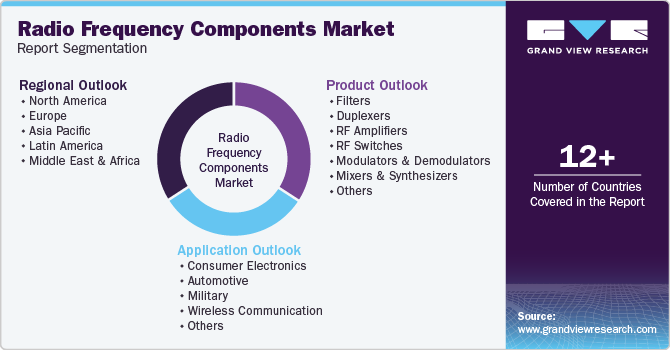
This report forecasts revenue growth on global, regional, and country levels and provides an analysis of the latest industry trends in each of the sub-segments from 2021 to 2033. For this study, Grand View Research has segmented the global radio frequency components market report based on product, application, and region:
-
Product Outlook (Revenue, USD Million, 2021 - 2033)
-
Filters
-
Duplexers
-
RF Amplifiers
-
RF Switches
-
Modulators and Demodulators
-
Mixers and Synthesizers
-
Others
-
-
Application Outlook (Revenue, USD Million, 2021 - 2033)
-
Consumer Electronics
-
Mobile Phones
-
Tablets
-
Smart TVs & Set-top Boxes.
-
Laptops & Notebooks
-
Others
-
-
Automotive
-
Military
-
Wireless Communication
-
Others
-
-
Regional Outlook (Revenue, USD Million, 2021 - 2033)
-
North America
-
U.S.
-
Canada
-
Mexico
-
-
Europe
-
UK
-
Germany
-
France
-
-
Asia Pacific
-
China
-
India
-
Japan
-
South Korea
-
Australia
-
-
Latin America
-
Brazil
-
-
Middle East and Africa
-
KSA
-
UAE
-
South Africa
-
-
Research Methodology
The radio frequency components market figures in this report are based on a proven research process that combines executive interviews with secondary research from proprietary databases, company filings, and recognized regulatory and institutional sources. Market size is built through value-chain sizing - reconciling supply-side and demand-side estimates - and triangulated with bottom-up and top-down approaches. Every estimate passes multiple levels of expert validation before publication, with each radio frequency components segment quantified using the revenue-capture definitions in the table below.
Segment Definition
Segment - Product
Revenue capture definition
Filters
RF filters are components designed to selectively allow desired frequency signals to pass while suppressing unwanted frequencies and interference. They are widely used in wireless devices and communication infrastructure to improve signal quality and network performance.
Duplexers
Duplexers enable simultaneous transmission and reception of signals through a shared antenna while operating on different frequency bands. These components are essential in cellular networks and wireless communication systems to maximize spectrum efficiency.
RF Amplifiers
RF amplifiers increase the strength of radio frequency signals before transmission or after reception. They play a critical role in extending communication range, improving signal clarity, and supporting high-speed data transfer.
RF Switches
RF switches route radio signals between different signal paths within electronic systems. Their functionality supports frequency selection, antenna switching, and efficient signal management across communication devices.
Modulators and Demodulators
These components convert digital or analog information into RF signals for transmission and recover the original information at the receiving end. They form a fundamental part of wireless communication, broadcasting, and networking equipment.
Mixers and Synthesizers
Mixers combine multiple frequencies to generate new signal frequencies, while synthesizers produce stable frequency outputs required for communication systems. Together, they support frequency conversion and signal generation across RF applications.
Others
The others segment includes antennas, couplers, attenuators, oscillators, tuners, and other supporting RF devices. These products contribute to signal transmission, reception, measurement, and overall system optimization.
Segment - Application
Revenue capture definition
Consumer Electronics
This segment encompasses RF components utilized in personal electronic devices such as smartphones, laptops, wearables, and smart home products. Demand is driven by increasing connectivity requirements and advancements in wireless technologies.
Automotive
Automotive applications integrate RF technologies into connected vehicles, navigation systems, vehicle-to-everything (V2X) communication, and advanced safety features. Growing vehicle electrification and intelligent mobility trends continue to expand adoption.
Military
Military systems rely on radio frequency technologies for secure communications, electronic warfare, surveillance, radar operations, and navigation systems. Performance reliability and operation in harsh environments are key requirements within this segment.
Wireless Communication
This application area covers telecom infrastructure, cellular networks, broadband services, satellite communication, and enterprise wireless systems. RF components are critical for enabling efficient signal transmission and network connectivity.
Others
The other applications include healthcare, industrial automation, aerospace, energy, and smart infrastructure deployments. These sectors utilize RF technologies to support monitoring, sensing, control, and communication functions.
Segment - Consumer Electronics
Revenue capture definition
Mobile Phones
Mobile phones represent devices that utilize RF technologies for voice communication, mobile internet access, and wireless connectivity. Increasing adoption of advanced cellular standards continues to drive RF content per device.
Tablets
Tablets incorporate radio frequency components to enable cellular connectivity, Wi-Fi communication, Bluetooth functionality, and location-based services. Their portable design requires compact and highly integrated RF architectures.
Smart TVs & Set-top Boxes.
Smart TVs and set-top boxes employ RF technologies to support wireless streaming, internet connectivity, content delivery, and multimedia communication. Demand is increasing alongside growth in connected home entertainment ecosystems.
Laptops & Notebooks
Laptops and notebooks utilize RF modules for Wi-Fi, Bluetooth, mobile broadband, and emerging wireless connectivity standards. The transition toward AI-enabled and always-connected computing devices is supporting segment growth.
Others
This category includes wearables, gaming consoles, smart speakers, AR/VR devices, and connected home products. These devices increasingly depend on RF solutions to deliver seamless wireless communication and enhanced user experiences.
Estimation Model
Layer Name
Key Questions
Description
Connected Electronics & Communication Infrastructure Layer
Where are radio frequency components deployed?
Identify industries and applications utilizing RF technologies, including smartphones, consumer electronics, telecom infrastructure, automotive electronics, aerospace & defense systems, industrial IoT, healthcare equipment, and satellite communication platforms. This layer establishes the total addressable demand base for RF components.
Wireless Connectivity Adoption Layer
Which devices and systems require RF-enabled connectivity?
Apply adoption rates of 5G-enabled smartphones, connected vehicles, wireless communication equipment, Wi-Fi devices, IoT endpoints, radar systems, and satellite terminals. This layer measures the expansion of wireless connectivity across end-use sectors and devices.
RF Component Penetration Layer
What types of RF components are integrated into connected systems?
Assess penetration levels of RF filters, duplexers, power amplifiers, RF switches, modulators, demodulators, mixers, synthesizers, antennas, and RF front-end modules across target applications. This layer captures component intensity and content value per device or communication system.
Radio Frequency Components Revenue Realization Layer
How much revenue is generated from RF component deployment?
Estimate market revenue by multiplying unit shipments of RF-enabled devices and infrastructure equipment by average RF content value per system. The calculation incorporates component pricing, technology complexity, semiconductor integration levels, frequency-band requirements, and value-added RF subsystem revenues to derive the total radio frequency components market size.
Delivered Customizations
This report has been delivered with the following In-depth customizations
Client Request
Customization Delivered
Value Adds
Radio Frequency Components Technology Adoption & Growth Assessment
Performed a comprehensive analysis of radio frequency components market trends, including 5G infrastructure deployment, RF front-end module adoption, millimeter-wave technologies, compound semiconductors, satellite communication systems, advanced wireless connectivity, and next-generation network architectures across major industry verticals.
This assessment enables stakeholders to identify high-growth technology segments, evaluate evolving RF technology adoption trends, prioritize product development initiatives, and strengthen competitive positioning within the rapidly advancing radio frequency components market.
Industry-Specific Radio Frequency Components Deployment Analysis
Assessed demand for radio frequency components across consumer electronics, wireless communication, automotive, aerospace & defense, industrial automation, and healthcare sectors, including signal transmission systems, radar technologies, connectivity modules, and high-frequency communication applications.
Provides strategic insights into industry-specific deployment patterns, technology requirements, and long-term revenue opportunities, supporting market expansion planning and targeted growth strategies.
Advanced Connectivity & Next-Generation Communication Opportunity Assessment
Evaluated adoption trends for private 5G networks, satellite broadband infrastructure, vehicle-to-everything (V2X) communication, IoT connectivity platforms, high-frequency spectrum utilization, and emerging wireless communication technologies across global markets.
Supports investment and innovation strategies by identifying emerging connectivity opportunities, accelerating commercialization roadmaps, and enabling data-driven decision-making in high-growth segments of the radio frequency components market.
Frequently Asked Questions About This Report
The global radio frequency components market size was estimated at USD 47.3 billion in 2025 and is expected to reach USD 53.4 billion in 2026.
The global radio frequency (RF) components market is expected to grow at a compound annual growth rate of 14.3% from 2026 to 2033, reaching USD 136.4 million by 2033.
Some key players operating in the RF components market include Broadcom, Inc.; Fujitsu Limited; International Quantum Epitaxy Plc; NXP Semiconductors N.V.; Renesas Electronics Corporation; Murata Manufacturing Co. Limited; Taiwan Semiconductor Manufacturing Co. Limited; Texas Instruments, Inc.; and TDK Corporation.
Key factors that are driving the market growth include rising need for maximizing power efficiency and spectrum range of the mobile devices considering steady transition to next-generation network technologies.
Consumer electronics segment held the largest revenue share in 2025.
The filters segment dominated the radio-frequency components market, accounting for over 23.0% of the market in 2025. This is attributable to which is primarily attributed to rapid growth in the user base of mobile devices and 4G LTE networks.
Asia Pacific dominated the market with over 37% revenue share in 2025, driven by rapid 5G deployment, expanding electronics manufacturing, and rising demand for wireless connectivity.
About the Author(s)
Sensors & Controls Research Team
Semiconductors & Electronics · Sensors & ControlsThis report was authored by the sensors & controls research team at Grand View Research - comprising two research analysts, one senior research analyst, and one industry expert - with specialized expertise in the sensors & controls segment of the semiconductors & electronics industry. All findings are based on proprietary semiconductors & electronics databases, executive interviews, and regulatory analysis, subject to internal peer review prior to publication.
Last Updated:
Speak to Analyst


Customize this report to your needs — add regions, segments, or data points, with 20% free customization.
Or view our licence options:


ISO 9001:2015 & 27001:2022 Certified
We are GDPR and CCPA compliant! Your transaction & personal information is safe and secure. For more details, please read our privacy policy.


