Six Trends Reshaping What Consumers Buy, Why They Buy It and How Beauty Companies Need to Respond
The prediction
Beauty is moving from treating visible symptoms toward maintaining skin, hair and body health over time. Anti-ageing is gradually becoming longevity; cosmetics are converging with nutrition, diagnostics, aesthetics, metabolic health and preventive wellness.
This is the strongest cross-source trend in the research, variously framed as Metabolic Beauty, Longevity, and Beauty + Wellness convergence.
Data highlights
Consumer survey evidence shows that 86% of Indian adults surveyed believe a healthy diet is as important as beauty products to enhancing beauty. 70% of Spanish adults believe beauty supplements can help slow visible signs of ageing, while 78% of Brazilian adults want more scientific evidence behind beauty claims.
Consumer conversation is moving in the same direction, wherein the online conversation tracking recorded growth across specific keywords:
The ingestible opportunity is becoming meaningful commercially. Online beauty-supplement sales increased 8% in 2025; the U.S. and China accounted for 86% of monitored sales. Beauty-centric supplement sales online reached USD 1.1 billion, representing a 14% CAGR since 2022, while beauty-positioned health products grew four percentage points faster than the broader consumer-health market in 2025.
Hair is becoming part of the same healthspan conversation. In the U.S., hair serums grew almost 60% in H1 2026, alongside increasing demand for scalp-focused products.
Who is influencing it?
Dermatologists, aesthetic physicians, nutrition specialists, longevity experts, trichologists, health creators and GLP-1 conversations are displacing the traditional beauty influencer as the only source of authority.
The consumer is learning a new vocabulary: barrier repair, peptides, mitochondrial health, metabolic health, inflammation, microbiome, collagen preservation and cellular ageing.
Companies catching the trend
L’Oréal’s Cell BioPrint analyses skin biological ageing using a cheek swab, imaging and questionnaire before recommending personalized skincare.
Estée Lauder’s investment in 111SKIN is even more explicit. CEO Stéphane de La Faverie said skincare is entering a phase shaped by the convergence of procedures, longevity and beauty. 111SKIN emerged from post-procedure skin recovery and combines clinical positioning with products priced from roughly USD 50 to USD 1,000.
Unilever has built Wellbeing alongside conventional beauty through Nutrafol, OLLY and Liquid I.V.; its 2025 Beauty & Wellbeing business generated Euro 12.8 billion and underlying growth of 4.3%, with Wellbeing growing double digits.
Voice of C-Suite
“What we have done is, over the course of our introduction of wellness, is that we have really focused on four strategic pillars. The first one is around nutrition and supplements, the second one is intimate care, third is rest and relax, and the fourth is essential routine. We are trying to not be everything to everyone. We are really focused on these four primary categories and bringing the best of these categories to life for a consumer. We are learning very quickly from the insights that we have gained from the stores that we have expanded in right now, and also our expanded assortment in our marketplace online. I do believe that this could be one of our next big pillar categories of continued growth. It does not cannibalize on the existing sales, and it also could help a trip frequency purchase, very similar to how our services does and our stores too.” Kecia Steelman CEO, Ulta Beauty
Beauty companies will increasingly sell systems rather than SKUs: diagnosis + topical care + ingestibles + devices + professional treatment + monitoring.
The prediction
The next phase of clean and clinical beauty is less about what a formula does not contain and more about what a company can prove that it does.
Ingredient transparency, efficacy testing, dermatological credibility, biotechnology and verified sourcing are converging into a new definition of trust.
Why now?
Beauty consumers now have unprecedented access to ingredient education. TikTok, dermatologists, Reddit, ingredient databases and skincare communities have reduced the information advantage historically held by brands.
This shift can be described as “Clean Reimagined”: the transition from “free-from” language toward ingredient integrity, independent verification and substantiated performance. Roughly one-third of deodorants carry clean claims in 2026, approximately equal to the prevalence of functional claims.
Meanwhile, search-trend data show exosomes among the most-searched ingredients and indicate that searches related to hyperpigmentation jumped almost 1,000% in September, while peptides, ceramides, niacinamide and urea showed sustained interest.
Consumer take
The consumer is becoming less impressed by scientific vocabulary alone.
The finding that 78% of surveyed Brazilian adults want more scientific evidence behind beauty claims captures the transition: “clinical” is increasingly a requirement to substantiate a proposition, not merely a premium-sounding marketing term.
Companies catching the trend
L’Oréal has doubled down on dermatological beauty and science-led acquisitions. It acquired dermatologist-founded Korean brand Dr.G specifically around demand for scientifically developed, effective and accessible skincare; it also acquired a majority interest in clinical skincare brand Medik8.
Estée Lauder’s 111SKIN investment similarly connects medical expertise, next-generation actives and clinical substantiation.
Unilever describes science-led premium innovation as a central growth mechanism across Dove, Vaseline and K18. K18’s biotech-led positioning also illustrates how treatment language is migrating from facial skincare into haircare.
C-suite signal
L’Oréal CEO Nicolas Hieronimus attributes the company’s H1 2026 outperformance to two main engines: innovation and market-beating e-commerce growth. L’Oréal generated Euro 23.77 billion in H1 sales, with adjusted like-for-like growth of 6.5%.
“Our success is driven by two pillars, breakthrough innovations and white space expansion. Looking ahead, we'll continue to build on these strengths by advancing science-based innovation and capturing additional growth opportunities across categories and markets……In Brazil, our Derma business delivered an impressive growth rate of 71% in the second quarter. Eucerin has assumed the number three position, and the epigenetic serum has become the number one anti-age product in the dermacosmetics market.” Vincent Warnery CEO, Beiersdorf
Claims architecture will become a strategic capability. Brands will increasingly need to explain:
What Works > How It Works > How it Was Tested > For Whom it Works > What Evidence Supports the Claim
The prediction
Texture, fragrance, sound, packaging and physical experience are moving from decorative attributes to functional elements of the beauty proposition.
The trend is variously framed as Sensorial Synergy, Emotional Micro-indulgence, and a continuing Fragrance Renaissance.
Data highlights
Online conversations around fragrances associated with improving mood grew 39%.
Commercial performance supports this. U.S. prestige fragrance grew 6% in H1 2026 despite flat units; average prices rose 5%, while higher-concentration eau de parfum and perfume formats recorded double-digit growth. Mass fragrance grew 15% in value and 7% in units.
Companies catching the trend
Formulation developers are introducing jelly creams, mochi-like cleansing foams, hybrid textures and fragrance concepts designed around emotional and tactile experience, reflecting the idea that wellness is becoming a baseline expectation rather than a standalone vertical.
Estée Lauder reported 10% fragrance growth in FY2026, led by Le Labo, TOM FORD and KILIAN PARIS, while opening 33 net new freestanding fragrance stores globally.
L’Oréal completed its acquisition of Creed in March 2026 alongside long-term beauty licences for Bottega Veneta and Balenciaga, strengthening its exposure to high-end fragrance.
Fragrance could become a much broader mood-management ecosystem, while skincare and bodycare increasingly compete on tactile satisfaction as well as clinical efficacy.
The prediction
AI will become embedded throughout the beauty value chain, but the more synthetic the system becomes, the more valuable recognizably human signals become.
That makes AI adoption and the human-authenticity movement complementary trends rather than opposites.
Data highlights
Consumer data indicate that 49% of consumers are already receiving beauty recommendations from generative AI, while more than half are exploring AI-enabled shopping tools.
At the same time, survey evidence finds strong resistance to removing people from the experience:
82% of UK adults familiar with AI prefer a human customer-service representative to an AI chatbot; 70% of UK consumers under 45 say AI makes them value human-made things more; 76% of U.S. adults believe technology should be accompanied by human support; and 76% of Chinese beauty consumers want brands to disclose when AI was used in making a product
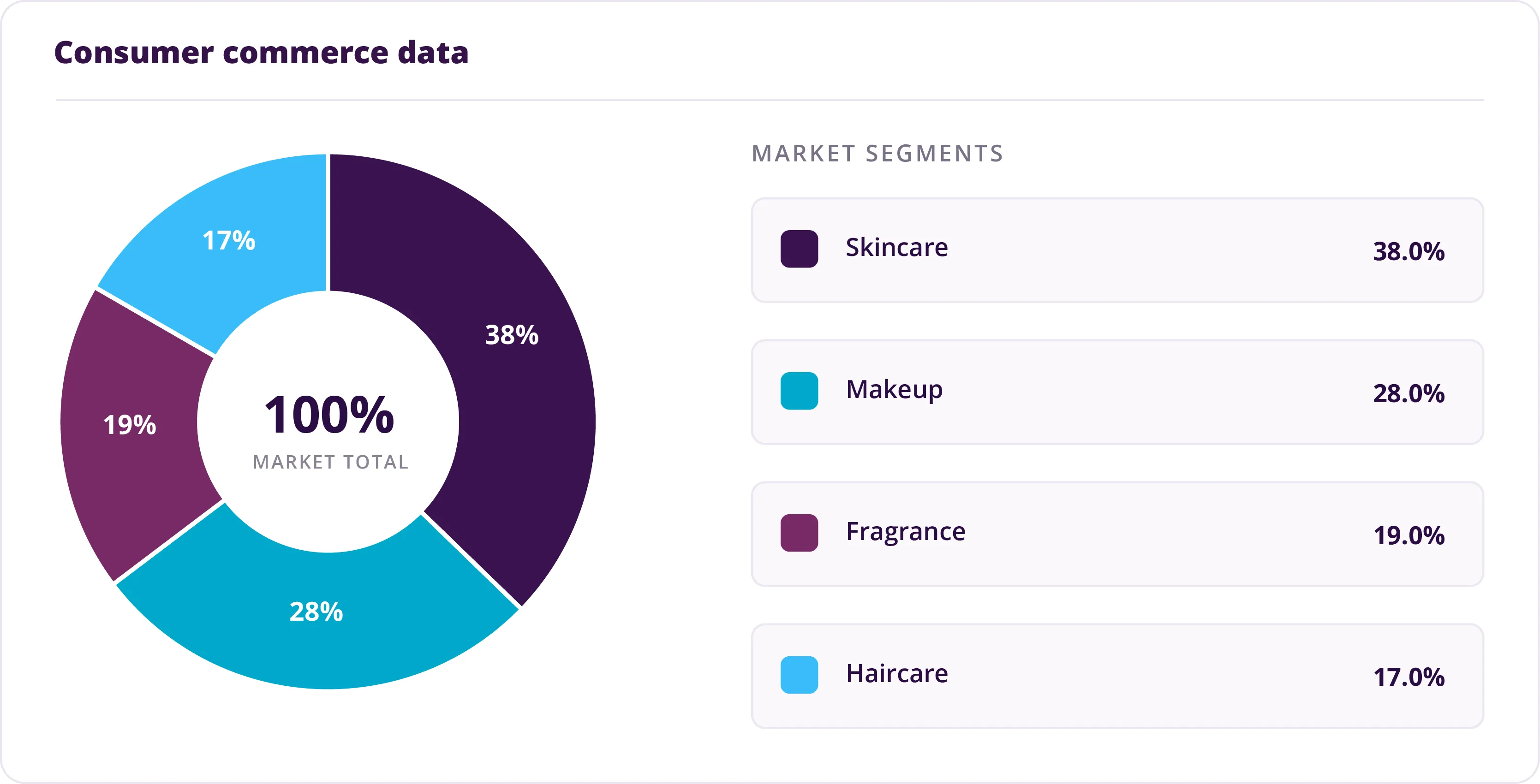
Consumer commerce data indicate:
That is the fundamental tension.
Who is influencing it?
AI recommendation engines and social algorithms are increasingly determining what consumers see. But dermatologists, founders, formulators, creators, artists and communities continue to determine what consumers trust.
Companies catching the trend
L’Oréal is applying AI across the organization while defining it as an “augmentation” of humans, not a replacement for them. Hieronimus says automation should free employees from repetitive work so they can focus on creation, invention and research.
Estée Lauder is moving beyond conventional search toward AI discoverability. In 2026 it partnered with Profound around generative-engine optimization, reflecting the emerging need for beauty brands to appear accurately in AI-generated recommendations.
Coty has gone even further in its FY2027 strategy: management explicitly says it is optimizing brand visibility and recommendation across AI platforms.
Consumer implication
AI will likely win where it removes friction: shade matching, diagnostics, recommendations, replenishment and customer support triage.
Humanity will win where consumers seek reassurance, taste, creativity and identity.
The strongest model may therefore be:
AI backstage + humans frontstage
The prediction
Discovery, validation and purchase are becoming one event.
TikTok Shop, livestreams, affiliate creators, Amazon, social search and AI recommendations mean consumers no longer need to move through the traditional sequence of awareness → consideration → research → retailer → transaction.
Data highlights
- 53% of consumers purchase via social platforms.
- 22% have bought directly through TikTok Shop.
- In China, livestreaming drives around 70% of beauty sales on platforms such as Douyin.
- E-commerce is growing six times faster than in-store beauty sales.
Global K-beauty value sales increased:
+53% year on year +131% over two years
TikTok Shop searches for K-beauty in the UK increased 125% during 2025, while K-beauty value sales on TikTok Shop across the U.S., UK, Spain and Germany increased 430% year on year
Beauty represents 46% of FMCG value sales on TikTok Shop. By Q1 2026, TikTok Shop ranked among the leading online beauty retailers in the U.S. and several major European countries, while roughly 30% of its beauty buyers had not purchased beauty online during the prior year.
Marketplace tracking estimates that TikTok Shop generated USD 662.2 million in U.S. beauty GMV in Q2 2026 alone:
Companies catching the trend
Tarte demonstrates that creator commerce is not limited to digital-native start-ups. It operates tens of thousands of TikTok affiliates, commissions around 15–20% and weekly livestreams; a Q2 analysis estimated that it held 11.6% of TikTok Shop U.S. makeup GMV.
Estée Lauder expanded to 13 brands across 11 Amazon markets and 12 brands across nine TikTok Shop markets during FY2026.
L’Oréal’s e-commerce grew double digits in H1 2026: almost twice as fast as the market and accounted for more than 50% of its North Asia sales.
C-suite signal
Hieronimus explicitly describes e-commerce as “the industry’s most dynamic channel.”
The strategic implication is bigger than e-commerce share: shelf space is being replaced by share of algorithm.
Beauty brands will need to optimize simultaneously for retailer search, TikTok, Amazon, Google, creators and AI answer engines.
The prediction
K-beauty should no longer be treated as a passing trend.
Asia is increasingly functioning as a global innovation engine, with K-beauty currently the most visible expression and J-beauty, C-beauty and other regional ecosystems contributing different approaches to science, format, culture and commerce.
This trend is increasingly described as the Asian Wave: regional innovation moving into global demand.
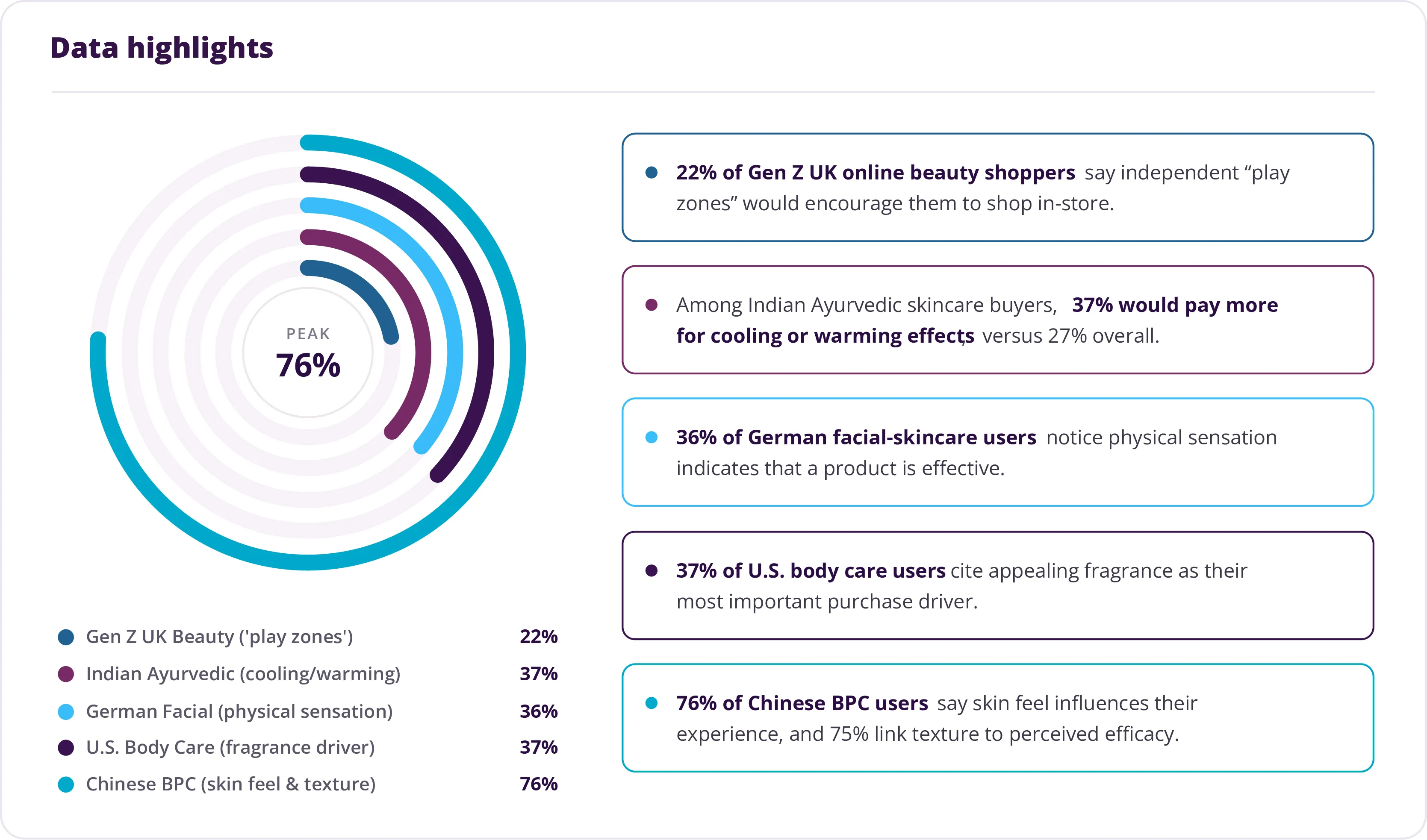
Data highlights22% of Gen Z UK online beauty shoppers say independent “play zones” would encourage them to shop in-store.
76% of Chinese BPC users say skin feel influences their experience, and 75% link texture to perceived efficacy.37% of U.S. body care users cite appealing fragrance as their most important purchase consideration.36% of German facial-skincare users notice physical sensation indicates that a product is working. Among Indian Ayurvedic skincare buyers, 37% would pay more for cooling or warming effects, versus 27% overall
Geographically, the expansion is broad:
- Western Europe: +58%
- Brazil: +135%
- Middle East e-commerce: +76%
- Canada: USD 164 million in 2025, +57%
- North America: e-commerce represents 76% of K-beauty sales
- Korean brands already represent roughly 10% of European online skincare, rising to 15–20% in Italy, Spain and France.
Why is it working?
K-beauty combines rapid development cycles + distinctive formats + visible efficacy + ingredient literacy + accessible pricing + social-native distribution.
It has normalized Centella asiatica, PDRN, snail mucin, ampoules, essences, hydrogel formats and barrier-first skincare far beyond Korea.
The advantage is not merely Korean culture
Companies catching the trend
L’Oréal acquired dermatologist-founded Dr.G and is now globalizing it. Hieronimus said in 2026 that the company is using the K-beauty wave to roll Dr.G out globally; H1 results show launches already underway in China and Southeast Asia.
L’Oréal also already owns Korean makeup brand 3CE, whose Southeast Asian expansion is contributing to growth.
Independent brands such as Medicube and Skin1004 now rank alongside long-established multinational skincare names in online popularity measures, illustrating how digital commerce has dramatically shortened the time required for a regional brand to become internationally visible.
The long-term legacy may not be that every consumer buys Korean products. It may be that every global beauty company is forced to operate more like the Korean beauty ecosystem — faster, more ingredient-led, format-driven and digitally connected.


