
- Home
- »
- Beauty & Personal Care
- »
-
U.S. Hair Serum Market Size And Share Report, 2026-2033GVR Report cover

U.S. Hair Serum Market (2026 - 2033)
Size, Share & Trends Analysis Report By Product, By Price Tier, By End User, By Distribution Channel, By Product x End User, Product x Price Tier, Product x Distribution Channel And Segment Forecasts
Market Size, 2025
$305.2MMarket Estimate, 2026
$317.7MMarket Forecast, 2033
$473.6MCAGR, 2026–2033
5.9%U.S. Hair Serum Market Summary
The U.S. hair serum market size was valued at USD 305.2 million in 2025 and is projected to grow from USD 317.7 million in 2026 to USD 473.6 million by 2033, at a CAGR of 5.9% from 2026 to 2033. The market is driven by growing consumer focus on hair health, scalp care, and damage prevention, alongside rising awareness of concerns such as frizz, dryness, hair fall, and heat or chemical damage.
Key Market Trends & Insights
- By product: The hair treatment serum led the market with a share of 64.5% in 2025.
- By price tier: The mid-range hair serum led the industry with a share of 35.8% in 2025.
- By end user: The hair treatment serum for women led the market with a revenue share of 74.9% in 2025.
- By distribution channel: The hypermarkets & supermarkets segment is expected to reach the fastest CAGR during the forecast period.
Market Size & Forecast
- Market size in 2025: USD 305.2 Million
- Estimated market size in 2026: USD 317.7 Million
- Projected market size by 2033: USD 473.6 Million
- CAGR (2026–2033): 5.9%
GVR research-powered AIAsk Prism AI about the U.S. hair serum marketGet cited answers from GVR research on market growth, segments, regulations and forecasts.Start with✓ Source-linked answers ✓ Market-specific context ✓ Traceable figuresExplore Prism AI ↗
Increased adoption of at-home haircare routines, premium and specialized formulations, and social-media-driven beauty trends is further encouraging consumers to incorporate targeted hair serums into their daily haircare regimens. Growing adoption of leave-in and treatment-oriented hair products is driving demand for serums. According to YouGov’s August 2025 U.S. survey of 1,236 adults, 18% of Americans use serums, masks, or leave-in products, rising to 25% among adults aged 18–34 and 31% among women. The same survey found that 66% of Americans cite hygiene and upkeep as reasons for caring for their hair, while women are particularly likely to seek healthier or better-looking hair, at 72% versus 42% for men.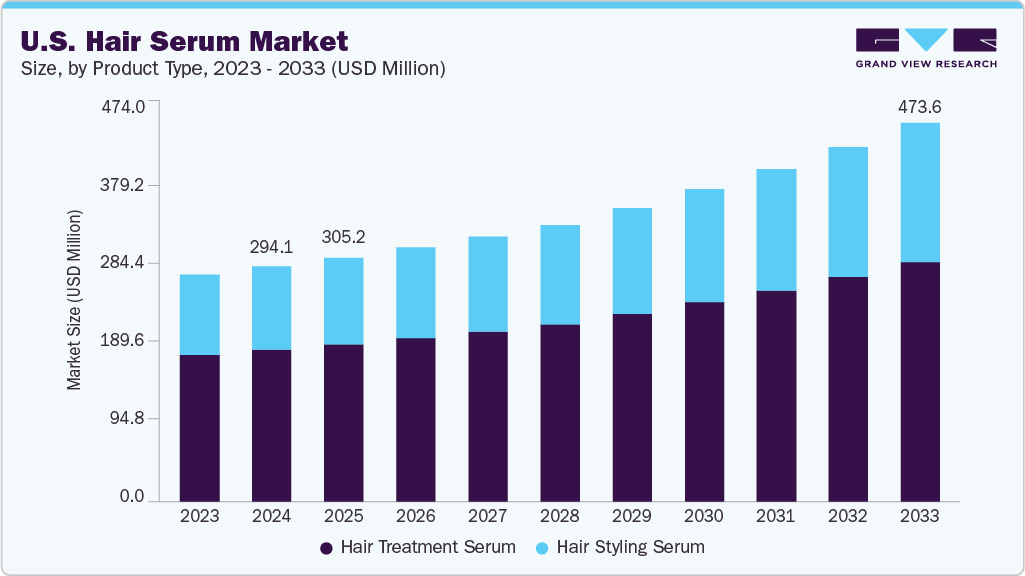 Source: Grand View Research, IR Documents, Primary Interviews, Paid DatabasesTo learn more about this report,
 Download Free Sample Report
Growing attention to scalp and hair health is creating demand for products positioned around specific concerns rather than basic styling. In April 2025, Prose launched its Custom Scalp Serum after reporting that 60% of U.S. women identify as having a sensitive scalp. The serum was formulated with 85+ factors that address individual scalp needs and environmental conditions, demonstrating the growing commercialization of concern-specific scalp care in everyday hair-care routines.
Major Trends in the U.S. Hair Serum Market
Trends
Description
Scalp-focused serums are becoming a distinct product segment
- In January 2026, Allure highlighted a shift toward scalp products designed for more targeted delivery and therapeutic benefits, with ingredients such as niacinamide, salicylic acid, caffeine, and rosemary increasingly appearing in scalp-focused formulations.
- In October 2025, Obagi Medical also launched its Nu-Cil BioStim Scalp Serum, combining biotin, amino acids, peptides, B vitamins, nutrients, and phytoactives in a leave-in scalp treatment.
Rising ingredient awareness and digital discovery are reshaping hair-serum purchasing.
- According to YouGov’s March 2026 U.S. survey, 54% of Americans had searched online for information about product ingredients or safety, while 54% had researched ingredient labels.
- Digital channels are also expanding beauty-product discovery; YouGov reported in March 2025 that 15% of U.S. adults had purchased beauty products through Instagram and 7% through TikTok, highlighting the growing role of social platforms in product discovery and purchase.
Specialized serums for textured, curly, and coily hair are expanding
- In February 2026, haircare expanded into Target with five new products designed specifically for waves, curls, coils, and frizz; the company cited an independent study in which 79% of respondents said it was difficult to find products tailored to their specific hair type and needs.
- In March 2025, Ouidad launched its Curl Miracle Treatment, a serum targeting frizz, humidity, moisture retention, shine, and curl definition specifically for curly hair.
Market Dynamics
Consumers are increasingly purchasing hair products online for convenience and replenishment. Circana reported that hair was the only U.S. prestige beauty category in which online channels accounted for the majority of retail sales in 2025, with convenience followed by replenishment as the leading reasons consumers purchase hair products online. The channel shift has continued into 2026, with prestige hair care sales increasing 11% and units rising 8% in H1 2026, while hair treatments remained the primary growth driver, with hair serum sales increasing nearly 60%. This combination of strong category growth and established online purchasing behavior supports continued e-commerce demand for hair serums, particularly as repeat-use products.
Consumers have a wide range of hair-care formats that offer benefits similar to those of hair serums, including hair oils, leave-in conditioners, masks, creams, and styling treatments. This overlap is also evident in recent product launches. In January 2025, L’Oréal Paris highlighted that hair oils and serums can offer similar benefits as leave-in products, while brands such as Dyson and Neqi have expanded their U.S. hair-care ranges with oils, leave-in conditioners, masks, and other treatment formats positioned around overlapping benefits such as smoothing, nourishment, shine, frizz control, and protection. This broad choice of substitute formats can reduce the need for consumers to add a separate serum to an existing hair-care routine.
The widening gap between prestige performance and consumer price sensitivity creates an opportunity for hair-serum brands to offer premium-looking or treatment-oriented products at more accessible price points. Circana reported in October 2025 that mass-market beauty was gaining momentum as consumers sought high-performing products at accessible prices, while masstige beauty brands offering premium benefits at mass-market prices were recording double-digit growth. This suggests an opportunity for hair-serum brands to combine stronger efficacy claims and elevated positioning with prices that remain accessible to value-conscious consumers.
Analyst Perspective
The U.S. market is shifting toward targeted treatment and need-state formulations, addressing hair fall, scalp health, damage repair, hydration, frizz, and smoothing. Innovation is increasingly focused on specialized ingredients, hair-type-specific solutions, and multifunctional serums, while premium formulations and digital-first brands are expanding category choice. Competition from hair oils, leave-in conditioners, and masks also makes efficacy and formulation differentiation increasingly important.
U.S. Retail & Consumer Intelligence
-
Hair serum is currently outperforming the broader prestige hair category.
-
Circana's H1 2026 data indicate that hair serum sales grew by nearly 60%, compared with 11% growth for prestige hair overall, highlighting particularly strong consumer and retail momentum for the serum segment. This provides direct U.S. category-level evidence for the continued expansion of hair serums.
-
-
Sustainability is beginning to influence U.S. hair-care product formats.
-
SPINS data for the 52 weeks ending May 18, 2025, showed serum-bar dollar sales increasing 31%, while dollar sales of hair-care products using plastic packaging declined 4%. This shift in format and packaging preferences is relevant to hair-serum brands as they evaluate product formats and packaging strategies.
-
-
AI is entering beauty-product discovery:
-
NIQ reported in July 2026 that 49% of shoppers had already received beauty-product recommendations from generative AI platforms, while more than half expressed interest in AI-powered shopping tools. This is broader beauty rather than hair-specific, so I would use it only if you want a forward-looking consumer-intelligence point.
-
Consumer Insights
 To learn more about this report, Download Free Sample Report
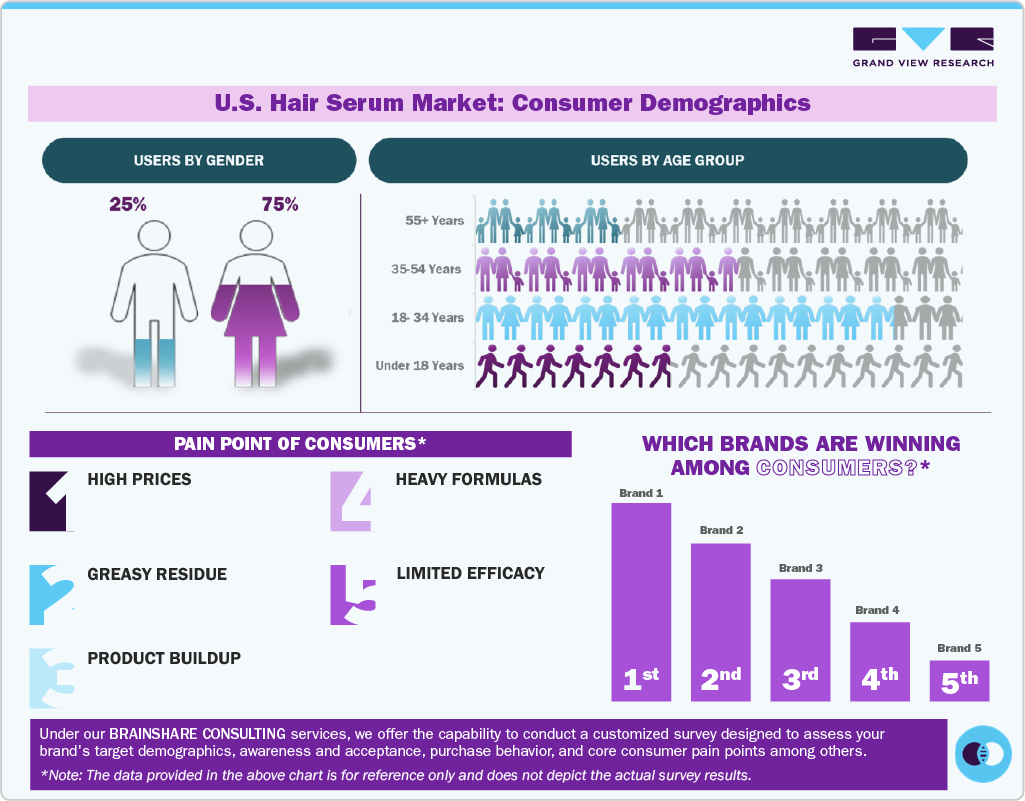
Users by Gender
-
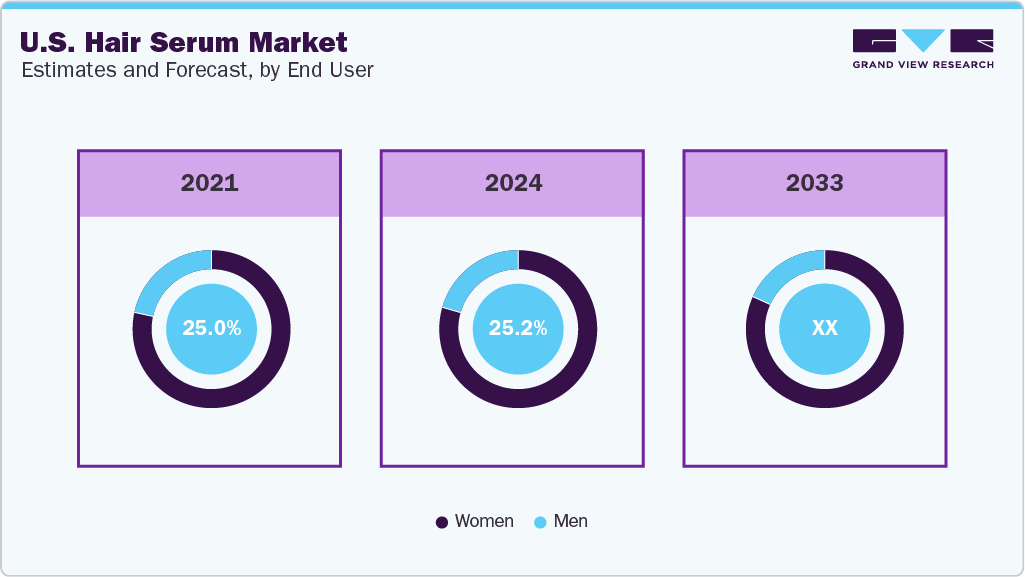
Female users account for an estimated 75% of the U.S. hair-serum user base, reflecting substantially higher adoption of serum, mask, and leave-in products among women.
-
Male users account for approximately 25%, indicating a smaller but established consumer base for hair-serum products.
Users by Age Group
-
18–34 years: This is the core consumer group for hair serums, reflecting stronger adoption of leave-in and treatment-oriented products among younger adults. The segment also has greater exposure to ingredient-led hair care, social-media beauty content, and newer scalp- and hair-treatment formats.
-
35–54 years: This group represents a substantial secondary consumer base, with demand supported by greater emphasis on hair condition, damage repair, frizz management, thinning concerns, and maintenance-oriented treatments.
-
55+ years: Demand is more concentrated around functional hair-care needs, including dryness, thinning, scalp health, and maintaining hair quality, rather than trend-driven styling alone.
-
Under 18 years: Teenagers represent a relatively limited portion of the overall serum market, with usage concentrated around styling, frizz control, and basic hair maintenance. The segment is not large enough to materially alter the overall demographic profile of the category.
Pain Points of Consumers
-
High Prices - Premium serums can limit adoption among price-sensitive consumers.
-
Greasy Residue - Heavy or oily textures can discourage frequent use.
-
Product Buildup - Layering serums with other hair products can leave hair feeling weighed down, leading to consumer dissatisfaction.
-
Heavy Formulas - Consumers with fine or low-density hair may prefer lightweight formulations.
-
Limited Efficacy - Consumers may question results when visible improvements take time or vary by hair type.
Product Insights
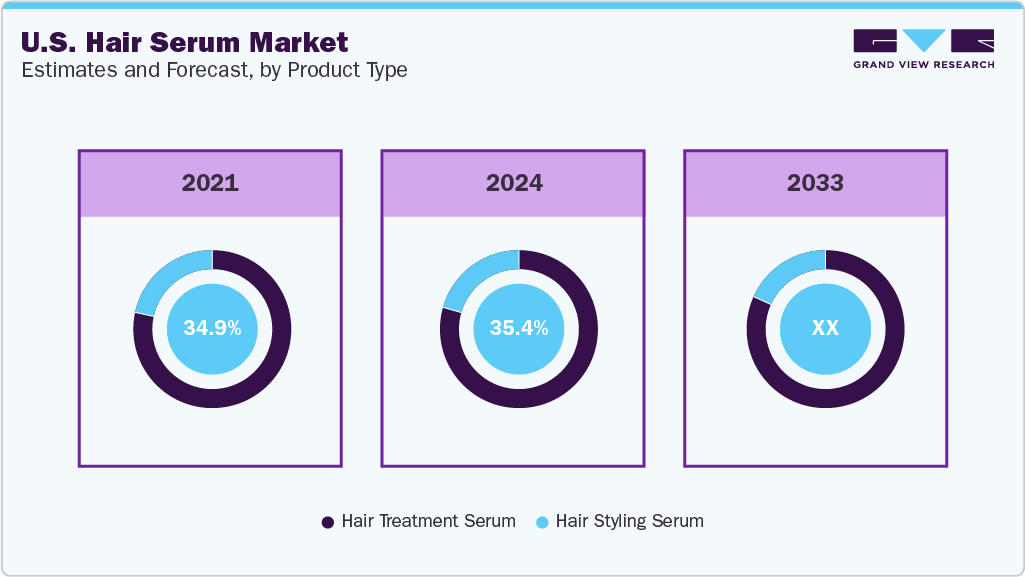
The hair treatment serum dominated the U.S. market with a 64.5% revenue share in 2025, supported by growing demand for targeted hair repair, strengthening, nourishment, and damage-control products. The segment is also benefiting from increased product innovation around bond repair and hair restoration. In June 2025, COSRX launched its Peptide-132 hair-care range in the U.S., including a bonding oil serum designed for damaged, frizz-prone hair, reflecting the expansion of treatment serums into more specialized repair applications.
The hair fall control serum sub-segment dominated the hair treatment serum segment with a 32.5% revenue share in 2025, driven by consumer focus on hair thinning, shedding, and scalp health. Brands are increasingly introducing targeted, efficacy-oriented products to address these concerns. In June 2025, VERB launched its Density Peptide Hair Serum as part of a collection targeting hair thinning and shedding, and reported results from a 20-week clinical study, including reduced visible fallout among participants.
 To learn more about this report, Download Free Sample Report
The hair styling serum is projected to be the fastest-growing product segment, with a 6.3% CAGR from 2026 to 2033, supported by demand for multifunctional products that combine styling performance with frizz control, shine, conditioning, and heat protection. Recent product launches increasingly position serums as everyday styling and finishing products rather than styling-only treatments. In 2025, Garnier expanded its styling portfolio with its Sleek & Stay Heat-Activated Serum, targeting smooth, sleek hair and styling performance.
Within the hair styling serum segment, smoothing and straightening is expected to be the fastest-growing sub-segment, registering a 6.8% CAGR from 2026 to 2033, supported by demand for frizz control, smoother texture, shine, and polished hair finishes. L’Oréal Paris’ 2025 U.S. launch of the Elvive Glycolic + Gloss collection, including a High Shine Leave-In Serum, reflects continued product development around smoothness and gloss-oriented styling benefits.
Price Tier Insights
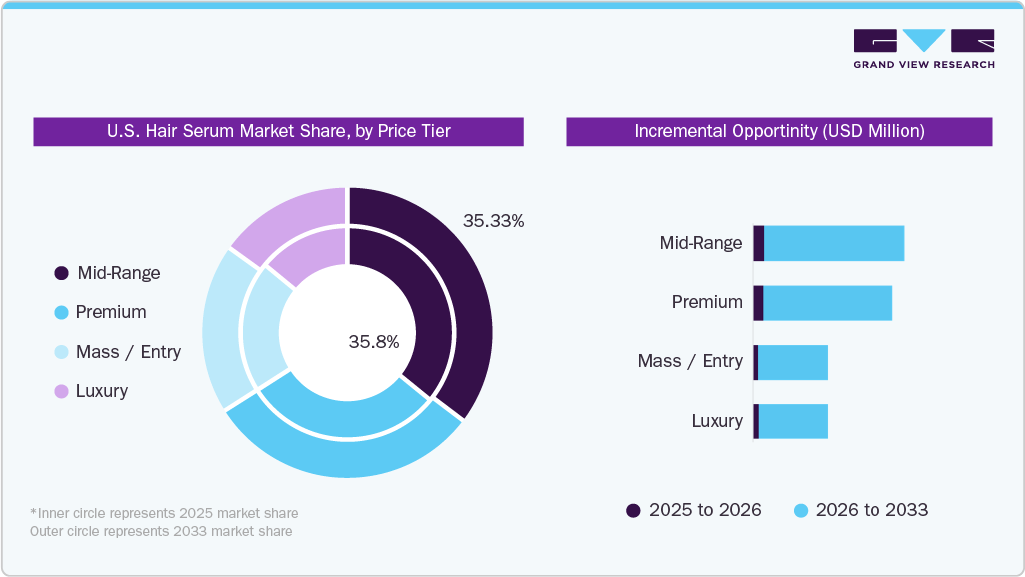
Mid-range hair serum accounted for 35.8% revenue market share in 2025, making it the largest price tier. Supported by brands expanding targeted serum offerings at more accessible price points. In February 2025, L’Oréal Paris launched its Elvive Growth Booster Scalp Serum, priced at $38 and formulated with an Aminexil-based Growth & Strength Complex, niacinamide, and ginger extract to address hair thinning and hair fall, illustrating the expansion of treatment-oriented serum products beyond premium price points.
 To learn more about this report, Download Free Sample Report
Luxury hair serum is projected to be the fastest-growing price tier at a 7.2% CAGR from 2026 to 2033, driven by consumer interest in specialized formulations and ingredient-led efficacy. In 2026, NIQ reported that U.S. hair-care products containing glycolic acid grew 171%, hyaluronic acid 53%, and peptides 19%, reflecting rising demand for differentiated, active-ingredient-based hair-care products that support premium positioning.
End User Insights
Women's serum accounted for 74.9% market revenue in 2025, supported by women’s greater focus on maintaining hair appearance across concerns such as breakage, frizz, dryness, and hair density. In January 2025, Sienna Naturals launched its Density Nourishing Actives Scalp Serum, a water-based formula with biotin and rosemary designed to support hair density and edge care, reflecting the growing availability of targeted serum solutions addressing women-specific hair-maintenance needs.
 To learn more about this report, Download Free Sample Report
Men's serum is projected to grow at a 6.0% CAGR from 2026 to 2033, supported by a stronger focus on scalp-specific concerns. Attest’s 2025 U.S. hair-care research found that 47% of men identified scalp health as a top hair concern, compared with 22% of women, creating a distinct demand base for targeted scalp and hair-growth serums.
Distribution Channel Insights
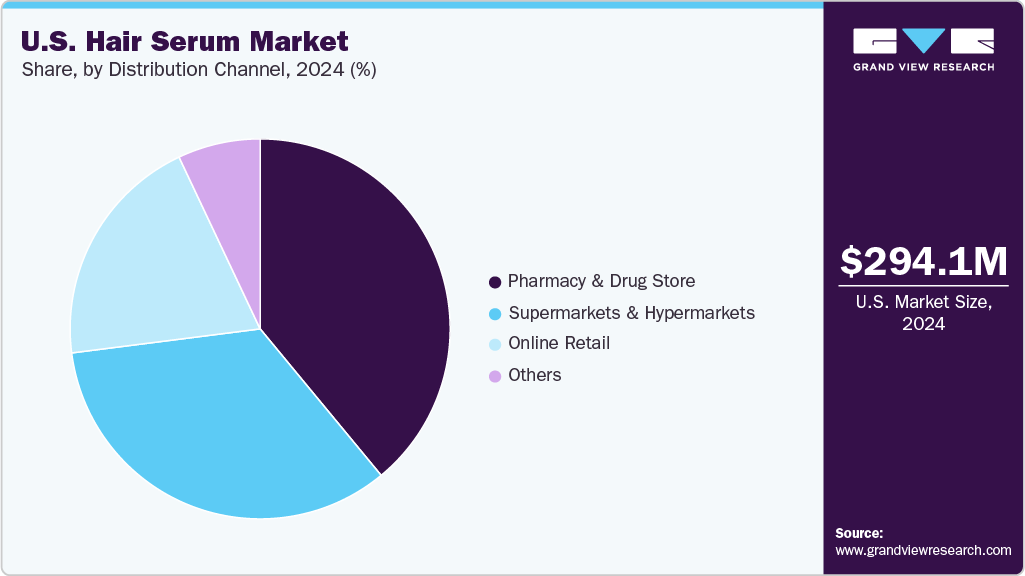
Sales of hair serums through online retail held a 31.9% revenue share in 2025, supported by the convenience of home delivery, repeat ordering, and the increasing integration of e-commerce into everyday consumer-goods purchasing. P&G reported that global e-commerce sales increased 12% in fiscal 2025, reaching 19% of total company sales, underscoring the growing importance of digital purchasing across daily-use categories, including Hair Care. At the retailer level, Walmart U.S. e-commerce contributed 2.9 percentage points to fiscal 2025 comparable sales, with substantially all U.S. stores offering same-day pickup and delivery. Unilever has also identified digital commerce as one of its seven strategic growth priorities, reinforcing the importance of online channels for beauty and personal-care products.
 To learn more about this report, Download Free Sample Report
The hypermarkets & supermarkets segment is anticipated to witness a CAGR of 5.8% from 2026 to 2033. The growth is driven by frequent replenishment and broad assortments across mass and mid-range price points. Walmart U.S. operated 4,605 stores in fiscal 2025, with Supercenters averaging approximately 178,000 sq. ft. Walmart U.S. generated $462.4 billion in fiscal 2025 net sales, while comparable sales increased 4.8%, driven by higher transactions and unit volumes, particularly in grocery and health and wellness. P&G also positions hair care as a daily-use category spanning multiple price tiers, reinforcing the relevance of large-format retailers for hair-serum distribution.
Cross-Segmentation Analysis
The study provides a detailed cross-segmentation analysis of the U.S. market to assess differences in demand across products, price tiers, and end users. Beyond individual segment analysis, the report evaluates hair treatment and styling serums across mass, mid-range, premium, and luxury price tiers, providing a granular view of how treatment-oriented and styling-focused products are positioned at different price points. The analysis also cross-segments hair treatment and hair styling serums by end user, enabling assessment of differences in product demand between male and female consumers. These cross-segment insights help identify premiumization opportunities, treatment- and styling-led growth areas, end-user-specific demand, and opportunities for brands to expand targeted formulations across price tiers and product categories.
Key U.S. Hair Serum Company Insights
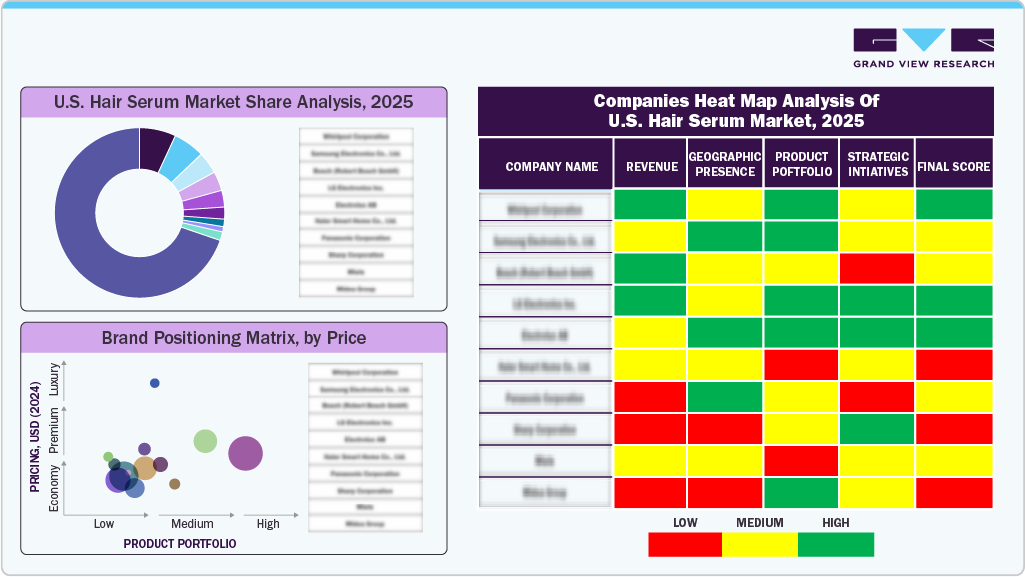
The market is moderately fragmented, with competition distributed across established beauty and personal-care companies, prestige and specialized hair-care brands, and emerging consumer-focused players. The market includes companies offering hair treatment and styling serums across mass, mid-range, premium, and luxury price points, with competition shaped by brand recognition, product breadth, formulation and ingredient positioning, efficacy claims, pricing, innovation, and retail and online distribution reach.
-
Established Beauty & Personal-Care Companies: L’Oréal, Procter & Gamble, Unilever, Kao, and Estée Lauder compete through broad hair-care portfolios, extensive retail distribution, established brand recognition, and the ability to introduce serum products across multiple price tiers.
-
Prestige & Specialized Hair-Care Brands: Kérastase, Olaplex, Moroccanoil, Briogeo, and Living Proof compete through specialized formulations, premium ingredients, treatment-focused positioning, and strong presence across specialty beauty retailers, salons, and direct-to-consumer channels.
-
Consumer-Focused & Emerging Players: Mielle, Vegamour, The Ordinary, OUAI, and Act + Acre target specific consumer needs through ingredient-led formulations, targeted scalp and hair treatments, social-media-driven discovery, and focused online or specialty distribution.
 To learn more about this report, Download Free Sample Report
Key U.S. Hair Serum Companies
The following key companies have been profiled for this study on the U.S. hair serum market:
-
L’Oréal S.A.
-
Procter & Gamble Company
-
Unilever PLC
-
Henkel AG & Co. KGaA
-
Kao Corporation
-
Moroccanoil, Inc.
-
Olaplex Holdings, Inc.
-
The Estée Lauder Companies Inc.
-
John Paul Mitchell Systems
-
Briogeo Hair Care
Recently Closed Transactions
Acquirer
Henkel
Year
2026Target
OLAPLEX
Transaction / Target Category
Approx. $1.4B acquisition; premium, science-led hair repair and treatment
Strategic Rationale
Strengthens Henkel’s premium hair-care portfolio and treatment capabilities
Implication for U.S. Hair Serum Competitive Landscape
Increases competition in premium, treatment-oriented, and efficacy-led hair serums
Acquirer
Henkel
Year
2026Target
Not Your Mother’s
Transaction / Target Category
U.S. hair-care and styling brand; approx. €190M 2025 sales
Strategic Rationale
Expands Henkel’s consumer hair-care and styling presence in the U.S.
Implication for U.S. Hair Serum Competitive Landscape
Strengthens competition across mass and mid-range styling and treatment serums
Competitive Benchmarking
Category
Operating Strategies
Competitive Edge
Weakness
Established Players (L’Oréal S.A.; Procter & Gamble Company; Unilever PLC; Henkel AG & Co. KGaA; Kao Corporation; Moroccanoil, Inc.)
- Expand serum portfolios across hair treatment and styling needs, including hair fall, scalp care, repair, hydration, smoothing, frizz control, and heat protection.
- Strengthen distribution across mass retailers, drugstores, specialty beauty retailers, salons, marketplaces, and DTC channels while investing in ingredient-led innovation and targeted formulations.
- Use established brands and cross-category portfolios to introduce new serum formats and premium offerings.
- Strong brand recognition, broad product portfolios, established retailer relationships, and extensive distribution provide significant market reach.
- Greater R&D, manufacturing, and marketing resources support continuous product innovation and large-scale launches.
- The ability to operate across multiple price tiers allows participation in both mainstream and premium serum demand.
- Large portfolios can make differentiation more difficult as specialized brands target narrower hair concerns and consumer groups.
- Larger organizational structures may limit the speed of response to emerging niche trends.
- Significant spending on advertising, promotions, innovation, and retail placement can increase cost pressures.
Emerging Players (Olaplex Holdings, Inc.; The Estée Lauder Companies Inc.; John Paul Mitchell Systems; Briogeo Hair Care)
- Focus on specialized serum propositions addressing specific needs such as hair repair, scalp health, hair thinning, hydration, damage prevention, and frizz control.
- Leverage DTC, social media, creator-led discovery, specialty beauty retailers, salons, and online marketplaces to build awareness and consumer engagement.
- Differentiate through specialized ingredients, targeted formulations, efficacy claims, and premium or clean-positioned product concepts.
- Focused brand positioning enables a stronger association with specific hair concerns and formulation benefits.
- Digital and specialty channels provide opportunities to build engaged consumer communities and introduce products without requiring extensive mass-market infrastructure.
- Specialist expertise can support differentiated premium and treatment-oriented positioning.
- Lower scale and brand awareness relative to diversified consumer-goods companies can constrain national penetration.
- Greater dependence on digital discovery and specialty channels can increase customer-acquisition and marketing costs.
- More concentrated portfolios can increase exposure to shifts in consumer preferences within specific hair-care need states.
Recent Developments
-
In June 2026, e.l.f. Beauty entered the U.S. hair-care market with e.l.f. Hair, including serum, conditioner, and treatment products priced at approximately USD 6 to USD 10. The line launched through TikTok Shop and Target, expanding the company’s accessible beauty positioning into hair care. The serum launch reflects continued convergence between affordable color cosmetics and hair-care routines and increased competition from digitally native beauty brands.
-
In May 2026, L’Oréal Paris Elvive launched the Collagen Peptide + Lifter collection exclusively at Walmart in the U.S., including a serum positioned around volume enhancement. The collection uses a skincare-inspired collagen peptide proposition and was designed to provide up to 72 hours of volume. The launch reinforces the growing use of “hair skinification,” with serum formulations incorporating concepts and ingredients traditionally associated with skincare.
-
In March 2026, Schwarzkopf launched KERATIME Care & Styling exclusively at Walmart in the U.S., including Deep Repair and Color Protect serums. The serums use Schwarzkopf's Multiplex Bonding Technology and were positioned at approximately USD 14.97, combining professional-inspired formulations with mass-retail accessibility. The launch strengthens Henkel’s presence in repair- and color-protection-oriented serum segments.
-
In February 2026, P&G introduced Pantene Abundant & Strong, a three-step system comprising serum, conditioner, and serum focused on hair-loss concerns. The system uses an antioxidant-based formulation and extends Pantene’s positioning from conventional cleansing toward targeted hair-strengthening and hair-health routines. The development reflects increasing competition around serums that address specific hair concerns rather than basic cleansing alone.
-
In July 2025, L’Oréal Paris Elvive introduced the Glycolic + Gloss collection in the U.S. through an exclusive Walmart launch, including a serum, conditioner, and leave-in serum. The serum uses glycolic acid as the central ingredient proposition and targets smoother, high-shine hair, extending the “skinification” trend into a mass-market serum. The launch also demonstrates how major brands are using ingredient-led claims and retailer exclusives to differentiate serum ranges.
U.S. Hair Serum Market Report Scope
Report Attribute
Details
Market size in 2025
USD 305.2 million
Estimated market size in 2026
USD 317.7 million
Projected market size by 2033
USD 473.6 million
Growth rate
CAGR of 5.9% from 2026 to 2033
Actuals
2021 - 2025
Forecast period
2026 - 2033
Quantitative units
Revenue in USD million and CAGR from 2026 to 2033
Report coverage
Revenue forecast, company ranking, competitive landscape, growth factors, and trends
Segments covered
Product, price tier, end user, distribution channel
Key companies profiled
L’Oréal S.A.; Procter & Gamble Company; Unilever PLC; Henkel AG & Co. KGaA; Kao Corporation; Moroccanoil, Inc.; Olaplex Holdings, Inc.; The Estée Lauder Companies Inc.; John Paul Mitchell Systems; Briogeo Hair Care
Customization scope
Free report customization (equivalent up to 8 analysts’ working days) with purchase. Addition or alteration to country, regional & segment scope.
Pricing and purchase options
Avail customized purchase options to meet your exact research needs. Explore purchase options
U.S. Hair Serum Market Report Segmentation
This report forecasts revenue growth at the country level and provides an analysis of the latest trends and opportunities in each of the sub-segments from 2026 to 2033. For this study, Grand View Research has segmented the U.S. hair serum market report based on product, price tier, end user, and distribution channel:
-
Product Outlook (Revenue, USD Million, 2021 - 2033)
-
Hair Treatment Serum
-
Hair Fall Control
-
Hair Growth
-
Dandruff Control
-
Scalp Repair
-
Others
-
-
Hair Styling Serum
-
Frizz Control
-
Smoothing and Straightening
-
Heat Protection
-
Others
-
-
-
Price Tier Outlook (Revenue, USD Million, 2021 - 2033)
-
Mass / Entry
-
Mid-Range
-
Premium
-
Luxury
-
-
End User Outlook (Revenue, USD Million, 2021 - 2033)
-
Men
-
Women
-
-
Distribution Channel Outlook (Revenue, USD Million, 2021 - 2033)
-
Supermarkets & Hypermarkets
-
Pharmacy & Drug Store
-
Online Retail
-
Others
-
-
Product By End User Outlook (Revenue, USD Million, 2021 - 2033)
-
Hair Treatment Serum
-
Men
-
Women
-
-
Hair Styling Serum
-
Men
-
Women
-
-
-
Product By Price Tier Outlook (Revenue, USD Million, 2021 - 2033)
-
Hair Treatment Serum
-
Mass / Entry
-
Mid-Range
-
Premium
-
Luxury
-
-
Hair Styling Serum
-
Mass / Entry
-
Mid-Range
-
Premium
-
Luxury
-
-
-
Product By Distribution Channel Outlook (Revenue, USD Million, 2021 - 2033)
-
Hair Treatment Serum
-
Supermarkets & Hypermarkets
-
Pharmacy & Drug Store
-
Online Retail
-
Others
-
-
Hair Styling Serum
-
Supermarkets & Hypermarkets
-
Pharmacy & Drug Store
-
Online Retail
-
Others
-
-
Research Methodology
The U.S. hair serum market figures in this report are based on a proven research process that combines executive interviews with secondary research from proprietary databases, company filings, and recognized regulatory and institutional sources. Market size is built through value-chain sizing-reconciling supply-side and demand-side estimates-and triangulated with bottom-up and top-down approaches. Every estimate passes multiple levels of expert validation before publication, with each U.S. hair serum segment quantified using the revenue-capture definitions in the table below.
Segment Definition
Product
Revenue capture definition
Hair Treatment Serum
This segment includes revenue generated from sales of hair serums formulated primarily to address hair and scalp health concerns, including hair fall, hair growth, dandruff, scalp damage, and other treatment-oriented needs.
Hair Fall Control
This sub-segment includes revenue generated from sales of hair serums specifically formulated to reduce hair fall, minimize shedding, strengthen hair at the roots, or support hair retention.
Hair Growth
This sub-segment includes revenue generated from sales of hair serums formulated to support hair growth, stimulate the scalp, improve hair density, or promote the appearance of fuller hair.
Dandruff Control
This sub-segment includes revenue generated from sales of hair serums formulated to address dandruff, flaking, scalp buildup, or other scalp conditions associated with dandruff.
Scalp Repair
This sub-segment includes revenue generated from sales of hair serums formulated to soothe, nourish, hydrate, or restore the scalp and support scalp-barrier health.
Others
This sub-segment includes revenue generated from sales of treatment-oriented hair serums addressing needs other than hair fall control, hair growth, dandruff control, or scalp repair, including strengthening, hydration, damage repair, and color protection.
Hair Styling Serum
This segment includes revenue generated from sales of hair serums formulated primarily to improve hair appearance, manageability, and styling performance, including frizz control, smoothing, straightening, and heat protection.
Frizz Control
This sub-segment includes revenue generated from sales of hair serums formulated to control frizz, flyaway, and humidity-related hair disruption while improving smoothness and manageability.
Smoothing and Straightening
This sub-segment includes revenue generated from sales of hair serums formulated to smooth the hair surface, improve sleekness, reduce roughness, and support a straighter or more polished appearance.
Heat Protection
This sub-segment includes revenue generated from sales of hair serums formulated to protect hair from heat exposure associated with styling tools such as hair dryers, straighteners, and curling irons.
Others
This sub-segment includes revenue generated from sales of styling-oriented hair serums addressing needs other than frizz control, smoothing and straightening, or heat protection, including shine enhancement, anti-static control, finishing, and volumizing.
Estimation Model
Layer Name
Key Question
Description
Hair-Care Addressable Base Layer
Who forms the addressable user base?
Individuals in the U.S. who purchase and use hair-care products and represent the potential consumer base for hair serums, including consumers seeking solutions for hair treatment, scalp health, styling, hair fall, damage, hydration, frizz, and other hair-related concerns.
Hair Serum Demand Layer
Which users actually use or purchase hair serum?
The addressable hair-care base is narrowed to consumers with a practical need, willingness, and propensity to purchase hair serums, based on hair concerns, styling routines, treatment needs, serum awareness, usage behavior, and consumer preferences.
Purchase Profile Layer
What type of hair serum is purchased, by whom, and through which channel?
The purchasing base is allocated across Hair Treatment Serum and Hair Styling Serum, then segmented by end user, price tier, need state, and distribution channel based on consumer purchasing preferences and product positioning.
Monetisation Layer
How much revenue is generated?
The estimated number of hair serum units sold is converted into market revenue using average selling price, product-type mix, price-tier mix, end-user mix, channel-specific pricing, and purchase/replenishment frequency assumptions.
Delivered Customizations
This report has been delivered with the following In-depth customizations
Client Request
Customization Delivered
Value Adds
Cross-Segmentation Analysis of Hair Serum Product, Price Tier, Distribution Channel, and End User
Detailed cross-segmentation of the U.S. hair serum market across Hair Treatment Serum and Hair Styling Serum, Mass, Mid-Range, Premium, and Luxury price tiers, and male vs. female end users, identifying the intersection of product purpose, consumer positioning, and pricing. The analysis maps how needs such as hair fall control, scalp care, damage repair, strengthening, moisturizing, smoothing, straightening, frizz control, and shine are distributed across products, price tiers, and end-user groups.
Identifies where treatment-led and styling-led serums are gaining relevance and how specialized formulations are being positioned across price points and consumer groups. The analysis also highlights the expansion of scalp- and hair-health-oriented solutions alongside continued demand for styling benefits such as smoothing, frizz control, and straightening, providing a more granular view of growth opportunities within the serum category.
Brand Share Analysis / Competitive Benchmarking
Comprehensive benchmarking of leading hair-serum brands and portfolios across Mass, Mid-Range, Premium, and Luxury positioning, with comparison of their exposure to Hair Treatment and Hair Styling categories, male and female offerings, product claims, formulation focus, price points, and distribution channels. The analysis benchmarks mass-market brands against premium, prestige, and specialist hair-care players to identify differences in brand positioning, formulation specialization, pricing, and route-to-market.
Helps distinguish scale-driven mass brands, premium treatment specialists, and styling-focused brands, while identifying whitespace across targeted needs such as hair fall, scalp health, repair, hydration, smoothing, and frizz control. The analysis also highlights how brands are using specialized formulations and elevated efficacy claims to differentiate hair serums across price tiers and consumer groups.
Hair Serum Need-State & Formulation Opportunity Mapping
Mapping of hair-serum offerings by consumer need state and formulation benefit, including hair fall control, scalp care, strengthening, damage repair, moisturizing, hydration, color protection, volumizing, smoothing, straightening, frizz control, and shine. Each need state is evaluated across Hair Treatment and Hair Styling formats, price tiers, end users, and major distribution channels.
Provides a granular view of where innovation is occurring within hair serums rather than treating the category as a homogeneous product group. The analysis captures the shift toward targeted hair and scalp solutions, while also identifying opportunities to combine treatment benefits with styling functionality, such as repair and smoothing or hydration and frizz control. This helps identify formulation and positioning whitespace across both treatment-oriented and styling-oriented serum offerings.
Frequently Asked Questions About This Report
Luxury hair serum is projected to be the fastest-growing price tier at a 7.2% CAGR from 2026 to 2033.
Key players include L’Oréal S.A.; Procter & Gamble Company; Unilever PLC; Henkel AG & Co. KGaA; Kao Corporation; Moroccanoil, Inc.; Olaplex Holdings, Inc.; The Estée Lauder Companies Inc.; John Paul Mitchell Systems; Briogeo Hair Care
The hair treatment serum led with a 64.5% revenue share in 2025, while hair styling serum is the fastest-growing segment.
The mid-range hair serum led the industry with a share of 35.8% in 2025.
The U.S. hair serum market size was valued at USD 305.2 million in 2025 and is estimated at USD 317.7 million for 2026.
The U.S. hair serum market is expected to grow at a CAGR of 5.9% from 2026 to 2033, reaching USD 473.6 million by 2033.
Key factors driving the U.S. hair serum market growth are supported by growing consumer focus on hair health, scalp care, and damage prevention, alongside rising awareness of concerns such as frizz, dryness, hair fall, and heat or chemical damage.
Women's serum accounted for 74.9% of the U.S. hair serum market revenue in 2025.
Sales of hair serums through online retail held a 31.9% revenue share in 2025 and is the fastest-growing channel.
About the Author(s)
Beauty & Personal Care Research Team
Consumer Goods · Beauty & Personal CareThis report was authored by the beauty & personal care research team at Grand View Research - comprising two research analysts, one senior research analyst, and one industry expert - with specialized expertise in the beauty & personal care segment of the consumer goods industry. All findings are based on proprietary consumer goods databases, executive interviews, and regulatory analysis, subject to internal peer review prior to publication.
Last Updated:
Speak to Analyst

Customize this report to your needs - add regions, segments, or data points, with 20% free customization.
Or view our licence options:


ISO 9001:2015 & 27001:2022 Certified
We are GDPR and CCPA compliant! Your transaction & personal information is safe and secure. For more details, please read our privacy policy.


