
- Home
- »
- Beauty & Personal Care
- »
-
U.S. At-Home Beauty Devices Market Report, 2026-2033GVR Report cover

U.S. At-Home Beauty Devices Market (2026 - 2033)
Size, Share & Trends Analysis Report By Product (Facial Skincare Devices, Hair Removal Devices, Hair Growth & Scalp Treatment Devices), By Technology, By End Use, By Price Tier, By Distribution Channel, And Segment Forecasts
Market Size, 2025
$2.0BMarket Estimate, 2026
$2.1BMarket Forecast, 2033
$4.2BCAGR, 2026–2033
9.9%U.S. At-Home Beauty Devices Market Summary
The U.S. at-home beauty devices market size was valued at USD 2.0 billion in 2025 and is projected to grow from USD 2.1 billion in 2026 to USD 4.2 billion by 2033, at a CAGR of 9.9% from 2026 to 2033, driven by increasing consumer preference for convenient, personalized beauty treatments at home, rising adoption of skincare and hair-removal devices, and technological advancements in Intense Pulsed Light (IPL), microcurrent, radiofrequency, and LED-based beauty devices.
Key Market Trends & Insights
- By product: Facial skincare devices segment held the largest market share of 48.0% in 2025.
- By technology: Light-based technology (LED, IPL, laser) segment accounted for the largest revenue share of 58.0% in 2025.
- By end use: Women segment dominated the market with the largest revenue share of 78.0% in 2025.
- By price tier: Mass/mid-range (typically $150-$500) segment held the largest market share of 48.0% in 2025.
- By distribution channel: Online marketplaces & retailers segment led the market with the largest revenue share of 40.0% in 2025.
Market Size & Forecast
- Market size in 2025: USD 2.0 Billion
- Estimated market size in 2026: USD 2.1 Billion
- Projected market size by 2033: USD 4.2 Billion
- CAGR (2026-2033): 9.9%
Three ways to get this report
Buy it, customize it, or ask a question.Ask an Analyst
A direct answer, usually in 1 working day
- AccessReport author, directly
- Reply timeWithin 1 working day
- No sales callDirect answer only
- FormatEmail reply
- CostFree, no cost
Get the Full Report
What the study covers
- FormatsPDF · Excel · Dashboard
- Timeline2026–2033 annual, 2025 base
- Coverage20+ countries, 5 regions
- Companies10+ key players profiled
Customize the Report
20% free customization
- IncludeCountries, segments, points
- TailorTo your product definition
- ExtendDeeper competitor detail
- OrA fully bespoke study
- Turnaround5–10 working days
The growing consumer interest in personalized skincare is strengthening the foundation for the adoption of at-home beauty devices. L’Oréal reported in January 2025 that a U.S. survey of 2,000 skincare users found that nearly 80% relied on trial and error to determine which skincare products worked for them, with consumers trying an average of seven different cleansers before finding a preferred product. This indicates a persistent need for more personalized approaches to skincare selection and treatment, creating opportunities for personal beauty devices that can provide individualized diagnostics, treatment recommendations, and technology-enabled routines.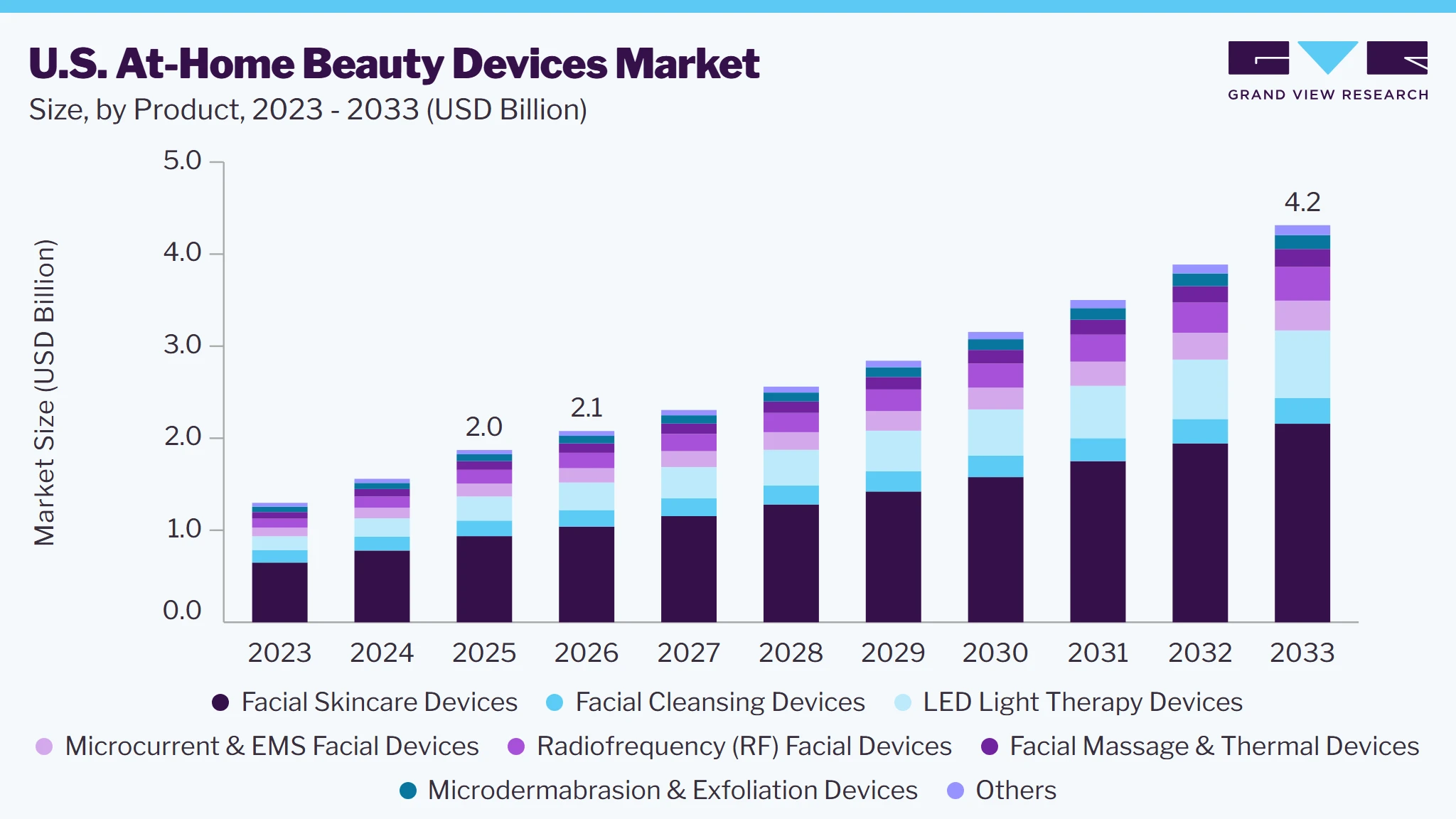 Source: Grand View Research, IR Documents, Primary Interviews, Paid DatabasesTo learn more about this report,
 Download Free Sample Report
 The shift toward data-driven personalization is also encouraging beauty companies to integrate advanced diagnostics directly into consumer-facing technologies. In January 2025, L’Oréal Groupe unveiled Cell BioPrint, a tabletop lab-on-a-chip device capable of delivering personalized skin analysis in approximately five minutes using advanced proteomics. Technology evaluates skin biological age, ingredient responsiveness, and potential skin concerns, while combining biomarker analysis with facial imaging and consumer-reported concerns. The development demonstrates how diagnostics, biomarker analysis, and digital technology can increasingly be integrated into the consumer beauty journey, creating opportunities for more personalized at-home beauty devices in the U.S. market.
At-home treatment technologies are also gaining visibility across multiple skincare concerns, particularly through LED and red-light devices. The American Academy of Dermatology notes that red-light devices are available in forms such as masks, panels, and wands for concerns including wrinkles, dark spots, rough-feeling skin, and discoloration. The AAD also notes that several at-home red-light devices have received FDA clearance for certain applications, although treatment outcomes can vary, and further research is needed. This combination of increasing consumer awareness and expanding technology applications is supporting opportunities for manufacturers to develop more targeted and evidence-based personal beauty devices.
Market Dynamics
Growing consumer preference for customized skincare and beauty routines is driving demand for personal beauty devices in the U.S. at-home beauty devices industry. Consumers are increasingly seeking targeted treatments and adjustable device settings that address individual skincare concerns, encouraging manufacturers to develop personalized beauty technologies. An Akeneo 2025 U.S. consumer survey found that 48% of consumers were willing to pay more for a personalized experience, with respondents indicating an average willingness to pay 28% more, highlighting the potential for personalization to support premium beauty-device adoption.
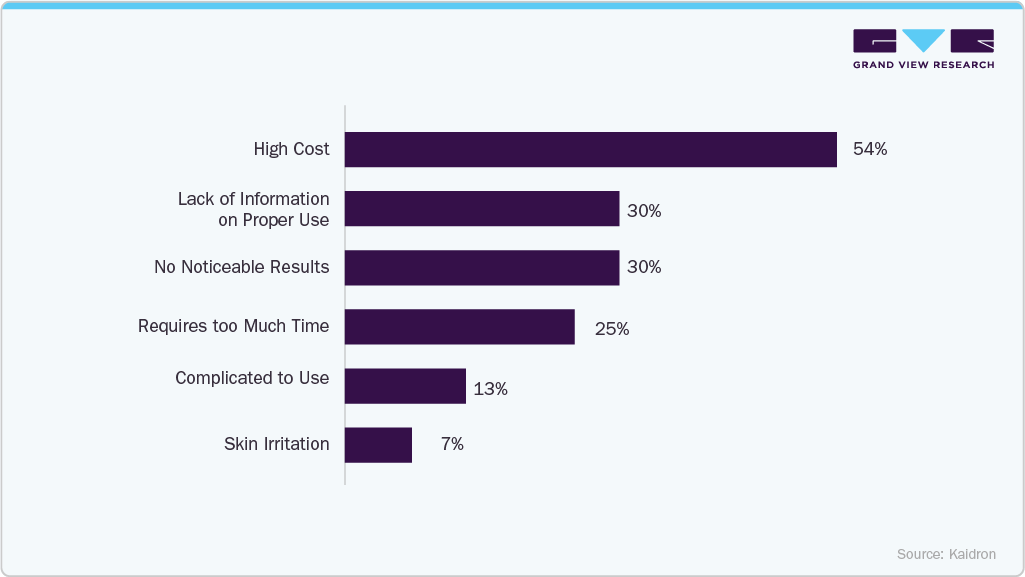
The adoption of at-home beauty devices is constrained by several consumer challenges related to cost, perceived results, usability, and time commitment. High cost is the most significant barrier, cited by 54% of consumers, followed by no noticeable results and lack of information on proper use, each reported by 30%. In addition, 25% of consumers consider these devices too time-consuming, while 13% find them complicated to use. Skin irritation, reported by 7%, further reflects concerns regarding device suitability and usage.
 To learn more about this report, Download Free Sample Report
 The integration of advanced technologies such as galvanic currents, smart sensors, AI, and connected functionality is creating opportunities for manufacturers to develop more sophisticated personal beauty devices. These technologies can improve treatment precision, enhance skincare-product absorption, and provide consumers with more targeted at-home treatments, supporting innovation in the U.S. at-home beauty devices market. In October 2025, LG Pra. L launched the SUPERFORM Galvanic Booster in the U.S. The device uses optimized galvanic technology to enhance skincare-product absorption by up to 182% and incorporates 8,500 vibrations per minute for facial massage, demonstrating the integration of advanced technology into compact, consumer-oriented beauty devices.
Consumer Insights
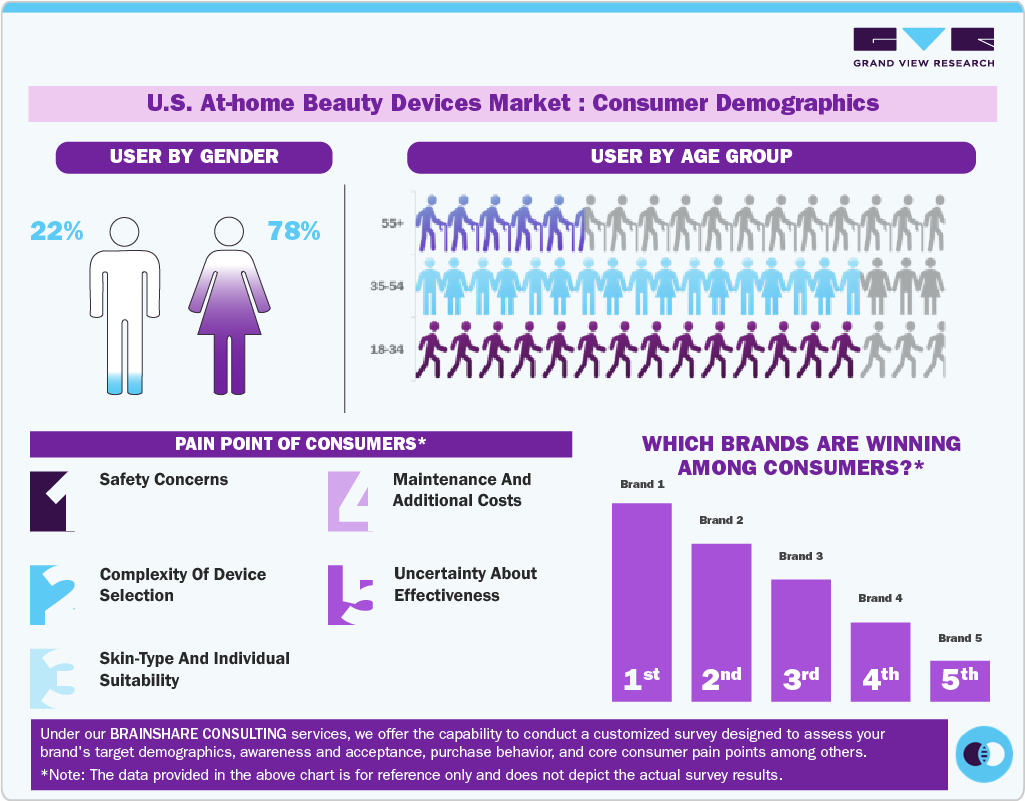
Consumer demand in the U.S. market is influenced by gender, age, skincare and beauty routines, product awareness, and willingness to invest in convenient personal-care technologies. Purchasing decisions are increasingly shaped by demand for personal beauty devices that offer convenience, personalized treatments, time savings, and salon- or professional-inspired results at home.
 To learn more about this report, Download Free Sample Report
 -
Female consumers accounted for the largest market revenue share of an estimated 78.0%, supported by higher engagement with skincare, facial care, hair removal, anti-aging, and other personal beauty routines. Empower reported that approximately 75% of American women use skincare products, indicating a broad consumer base for personal beauty devices focused on facial care, skin rejuvenation, and other at-home treatments. In addition, 76% of women consider positive online skincare reviews important when making purchase decisions, reflecting strong engagement with beauty product research.
-
Male consumers account for approximately 22.0%, with adoption supported by growing interest in skincare, grooming, hair care, and convenient personal-care solutions. The increasing integration of skincare into men's routines is fostering greater openness to personal beauty devices, particularly technologies that enable consumers to address skin appearance and other beauty concerns at home. Empower also highlights growing consumer interest in researching beauty products online, with positive reviews serving as an important consideration when evaluating skincare products. This increasing engagement with skincare and beauty technology provides a broader foundation for male adoption of at-home beauty devices.
Consumers aged 18-34 are primarily younger beauty consumers, working professionals, and digitally engaged users who adopt at-home beauty devices for skincare, grooming, hair removal, and personalized beauty routines, and who are more interested in technology-enabled solutions, convenience, and trend-driven products. Consumers aged 35-54 include established professionals and beauty-conscious consumers who increasingly use personal beauty devices for anti-aging, skin maintenance, hair removal, and professional-inspired treatments at home, with greater emphasis on product reliability and targeted results. Consumers aged 55 and above primarily use at-home beauty devices for anti-aging, skin rejuvenation, hair removal, and long-term personal care routines, with greater interest in ease of use, comfort, safety, and devices tailored to individual skincare needs.
Consumers in the U.S. at-home beauty devices industry commonly encounter several challenges related to product selection, safety, usability, and ongoing ownership.
-
Safety Concerns: Consumers may have concerns about potential skin irritation, discomfort, burns, or other adverse effects when using at-home beauty devices, particularly when devices involve technologies such as light therapy, heat, microcurrent, or electrical stimulation.
-
Complexity of Device Selection: The wide range of personal beauty devices available across different technologies, functions, price points, and treatment purposes can make it difficult for consumers to identify the most suitable device for their specific beauty needs.
-
Skin-Type and Individual Suitability: Differences in skin type, sensitivity, tone, age, and individual beauty concerns can affect device suitability, creating uncertainty about whether a particular at-home beauty device is appropriate for a consumer's specific requirements.
-
Maintenance and Additional Costs: Regular cleaning, charging, replacement components, consumables, and compatible skincare products can increase the ongoing cost and maintenance requirements associated with at-home beauty devices.
-
Uncertainty About Effectiveness: Consumers may remain uncertain about the consistency and visibility of results, particularly when comparing at-home beauty devices with professional beauty treatments or when products require repeated and long-term use to achieve desired outcomes.
Analyst Perspective
The U.S. at-home beauty devices market is evolving toward convenient, technology-enabled, and personalized beauty routines, with consumers increasingly adopting at-home beauty device treatments without visiting professional facilities. Demand is supported by growing interest in personalized beauty solutions, time-saving treatment options, and long-term value compared with recurring professional services. Manufacturers are expanding their personal beauty device portfolios with advanced LED, microcurrent, radiofrequency, and intense pulsed light technologies while strengthening online channels, app-enabled features, and user-focused designs to broaden adoption across U.S. consumers.
Product Insights
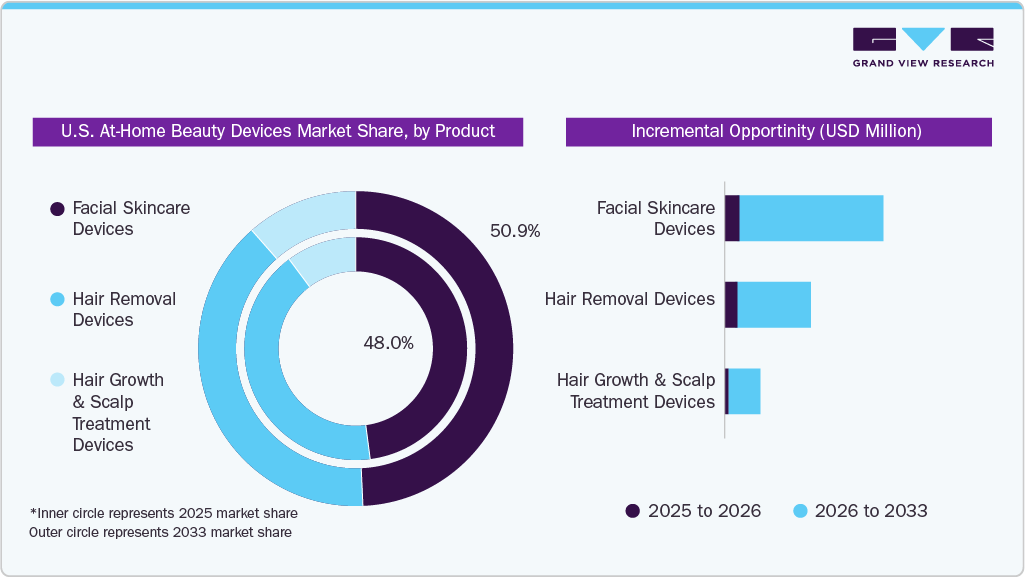
The facial skincare devices segment led the market with the largest revenue share of 48.0% in 2025, supported by increasing consumer adoption of convenient, technology-enabled solutions for facial skin concerns, including fine lines, wrinkles, collagen stimulation, and breakouts. According to CivicScience, 18% of U.S. adults owned a microcurrent or LED device for at-home use, while 9% of non-owners planned to purchase one. In addition, half of existing device owners planned to purchase another device, indicating potential for repeat purchases and continued category expansion. CivicScience also found that 26% of U.S. adults performed facials or other skin treatments at home at least monthly, compared with 12% who did so at spas, highlighting the strong consumer engagement with at-home facial treatments. These adoption patterns support continued demand for personal beauty devices across LED, microcurrent, and other facial treatment technologies in the U.S. market.
 To learn more about this report, Download Free Sample Report
 The hair growth & scalp treatment devices segment is expected to grow at the fastest CAGR of 12.0% from 2026 to 2033. The demand for at-home hair growth and scalp treatment technologies is expanding as manufacturers integrate hair-care functionality into multifunctional LED and light-therapy devices. In April 2026, BioPhotas introduced the Celluma MYSTIQUE, an FDA-cleared LED mask designed to address acne, facial wrinkles, and scalp hair loss within a single device. The product combines facial skincare and hair-loss treatment on a single platform, demonstrating how manufacturers are extending light-based personal beauty devices beyond standalone facial applications. This convergence of skincare and hair-care functionality creates opportunities for manufacturers to offer more versatile at-home beauty devices and expand the addressable applications of the U.S. market.
Technology Insights
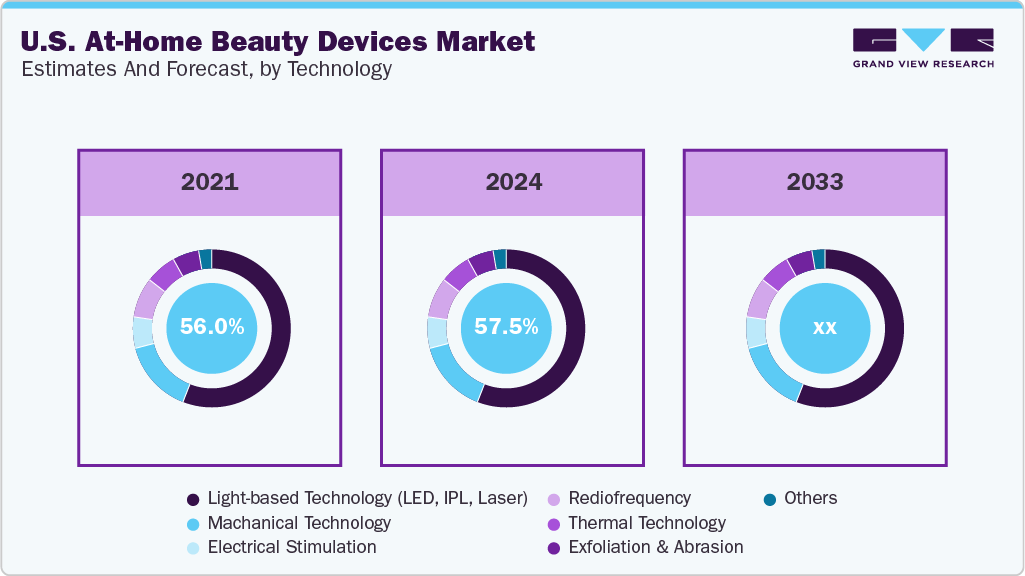
The light-based technology segment led the market with the largest revenue share of 58.0% in 2025, gaining traction in the market as manufacturers combine multiple wavelengths and treatment technologies to address a broader range of skincare and hair-care needs. In January 2026, L’Oréal Groupe introduced its LED Face Mask at CES 2026, featuring red light at 630 nm and near-infrared light at 830 nm. The flexible silicone device is designed to deliver 10-minute light treatments and target visible signs of skin aging, including fine lines, sagging, and uneven skin tone. The product was recognized as a CES 2026 Innovation Award honoree, demonstrating continued investment in advanced LED-based personal beauty devices.
In August 2026, JOVS launched the 6D Laser and EMS Anti-Aging Therapy Mask, combining laser technology with electrical muscle stimulation for at-home facial treatments. The launch reflects the industry's shift from conventional LED-only devices toward more advanced light-based systems and multifunctional treatment platforms. Such innovations are expanding the applications of at-home beauty devices across anti-aging and skin-rejuvenation routines in the U.S. market.
 To learn more about this report, Download Free Sample Report
 The electrical stimulation segment is expected to grow at the fastest CAGR of 11.8% from 2026 to 2033. The manufacturers are expanding electrical stimulation beyond conventional two-electrode microcurrent devices by incorporating multiple current patterns and app-guided personalization. In 2025, FOREO's FAQ 401 introduced a four-sphere system using three types of microcurrent: Tapping, Lifting, and Advanced Microcurrent with adjustable intensity and app-based treatment guidance. The device is designed for facial lifting, tightening, and contouring, illustrating the development of more customizable electrical-stimulation personal beauty devices.
End Use Insights
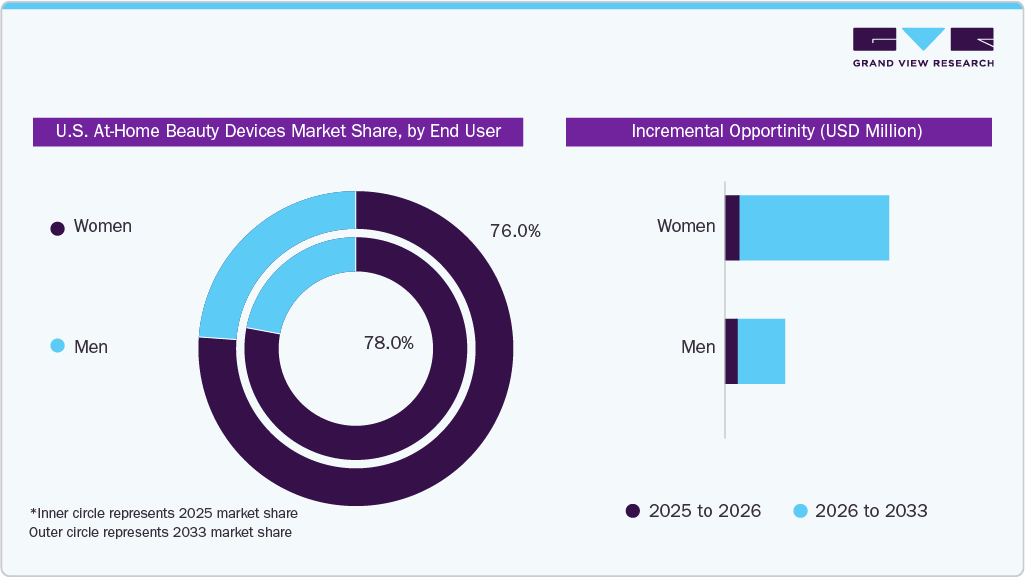
The women segment led the market with the largest revenue share of 78.0% in 2025, supported by frequent skincare use, a preference for convenience, and interest in multifunctional beauty solutions. In January 2025, The Benchmarking Company surveyed 3,900 U.S. female beauty buyers and found that 96% used facial skincare products, with 49% using them daily and 46% multiple times per day. In addition, 94% considered convenience important, while 93% sought ways to simplify their beauty routines without compromising results. These behaviors create favorable conditions for personal beauty devices that allow women to integrate targeted skincare treatments into regular home routines.
 To learn more about this report, Download Free Sample Report
 The men’s segment is projected to grow at the fastest CAGR of 11.1% from 2026 to 2033, supported by increasing engagement with personal care and skincare routines. According to YouGov’s 2025 U.S. Personal Care Brand Rankings, 46% of U.S. men spend at least 5 minutes per day on skincare or personal-care routines, including 30% spending 5-10 minutes and 9% spending 11-20 minutes. In addition, 7% of men spend more than 20 minutes on these routines. The ongoing time investment in personal care creates opportunities for manufacturers to position personal beauty devices as convenient tools that can be incorporated into men's regular grooming and skincare routines, including facial cleansing, skin rejuvenation, hair growth, and other targeted treatments.
Price Tier Insights
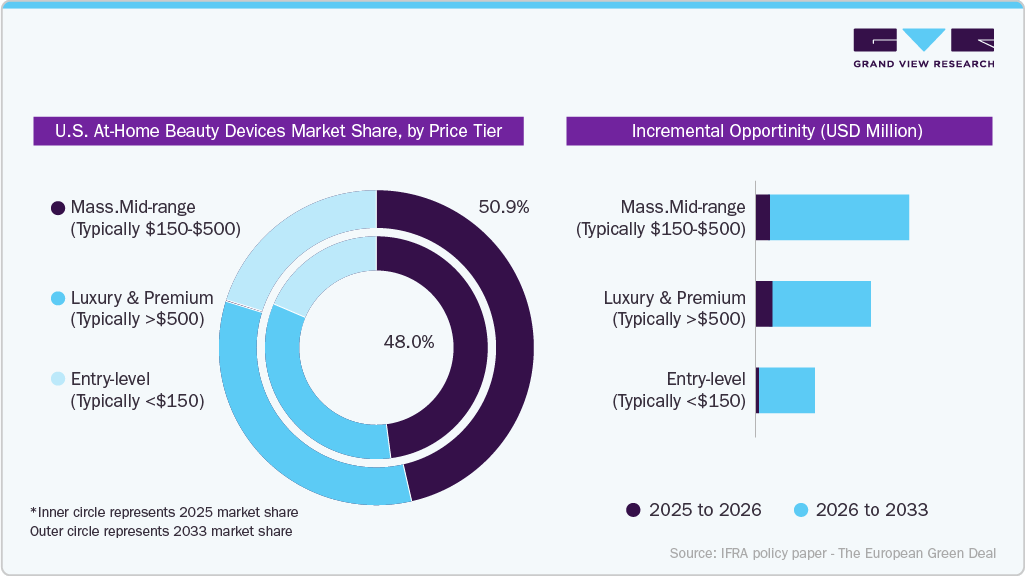
The mass/mid-range (typically $150-$500) price tier segment led the market with the largest revenue share of 48.0% in 2025, as consumers gained access to LED, microcurrent, and other technology-enabled treatments at prices below those of premium and luxury devices. In 2025, products within this range included the NuFACE Trinity+ at approximately US$395, the Omnilux Contour Face at US$395, the Nood Flasher Pro at US$399, and the Therabody Depuffing Wand at US$180, illustrating the availability of multiple device technologies within the US$150-US$500 price band.
In 2026, the US$150-US$500 range continued to include products across multiple technologies. For example, Dreame Beauty lists its Chrona LED Light Therapy Mask at US$209.99, while its Nova Expert IPL Hair Removal Device is priced at US$249.99 and the Astra IPL Hair Removal Device at US$314.99. The availability of multiple technologies within this price band supports consumer choice and broadens access to at-home beauty devices in the U.S. market.
 To learn more about this report, Download Free Sample Report
 The luxury & premium (typically > $500) price tier segment is anticipated to grow at the fastest CAGR of 11.2% from 2026 to 2033, driven by consumer preference for advanced, multifunctional, and clinically evaluated personal beauty devices. Premium products increasingly integrate multiple treatment technologies, enhanced treatment protocols, and clinical validation to differentiate from lower-priced alternatives.
In 2025, Therabody’s TheraFace Mask Glo was supported by a 12-week clinical study involving 104 participants that evaluated its LED-based treatment for fine lines, wrinkles, skin firmness, radiance, dark spots, tone, and texture. The device uses 504 LEDs across red, infrared, and blue light therapies and provides a 12-minute treatment. These features reflect the premium segment’s emphasis on clinically evaluated, multi-wavelength, and technology-rich at-home beauty devices, supporting continued demand within the U.S. market.
Distribution Channel Insights
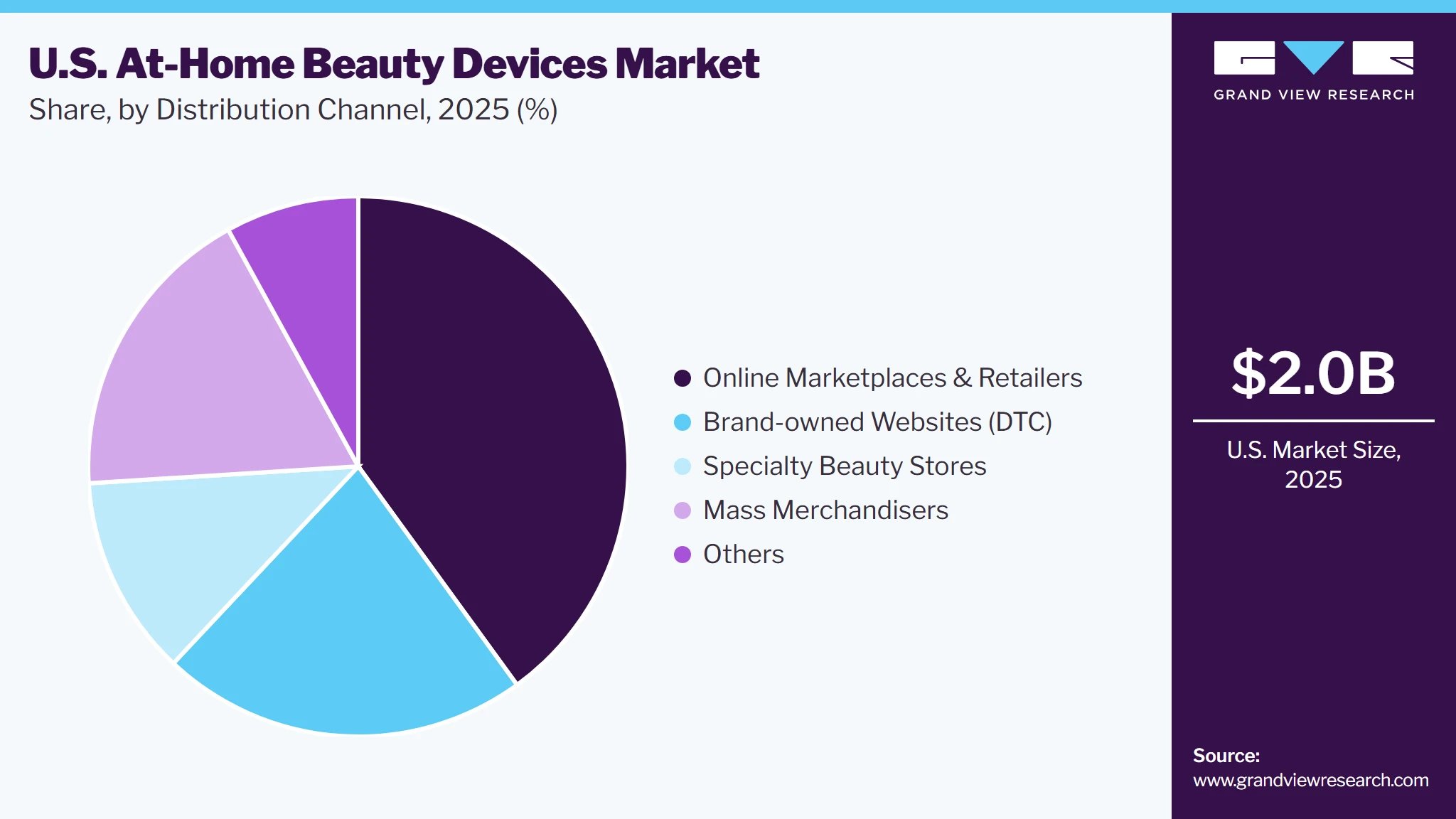
The online marketplaces & retailers segment led the market with the largest revenue share of 40.0% in 2025, as consumers increasingly use digital platforms to compare device features, prices, customer reviews, and treatment technologies before making a purchase. Major platforms such as Amazon, Sephora, and Ulta Beauty offer a broad assortment of at-home beauty devices, including LED masks, microcurrent devices, facial cleansing tools, dermaplaning tools, and other skincare technologies.
 To learn more about this report, Download Free Sample Report
 In 2025, Amazon was identified as the leading online beauty destination in the U.S., with 78% of surveyed consumers regularly shopping for beauty products on the platform, followed by Walmart at 46%, Sephora at 33%, and Ulta Beauty at 30%. Sephora also maintains a dedicated beauty-device assortment, featuring brands such as NuFACE, Dr. Dennis Gross, Shark Beauty, HigherDOSE, and DERMAFLASH across different price points. The channel, therefore, provides manufacturers with broader consumer reach, greater product discoverability, and convenient purchasing options, while enabling personal beauty devices to reach consumers beyond traditional physical retail locations.
The mass merchandiser segment is expected to grow at a CAGR of 10.7% from 2026 to 2033, driven by broader physical availability, competitive pricing, and an expanding assortment of at-home beauty devices across major retailers. In December 2025, GLO24K partnered with Walmart to expand its at-home LED beauty device portfolio in more than 200 U.S. stores, including its 7 Color LED Mask and Triple Action Eye Care Therapy Wand, demonstrating the role of mass retailers in expanding access to personal beauty devices. In 2026, Target offered 466 facial-device listings, spanning LED masks, microcurrent tools, thermal devices, facial cleansing technologies, and other skincare devices, highlighting the expanding assortment available through mass retail.
Key U.S. At-Home Beauty Devices Company Insights
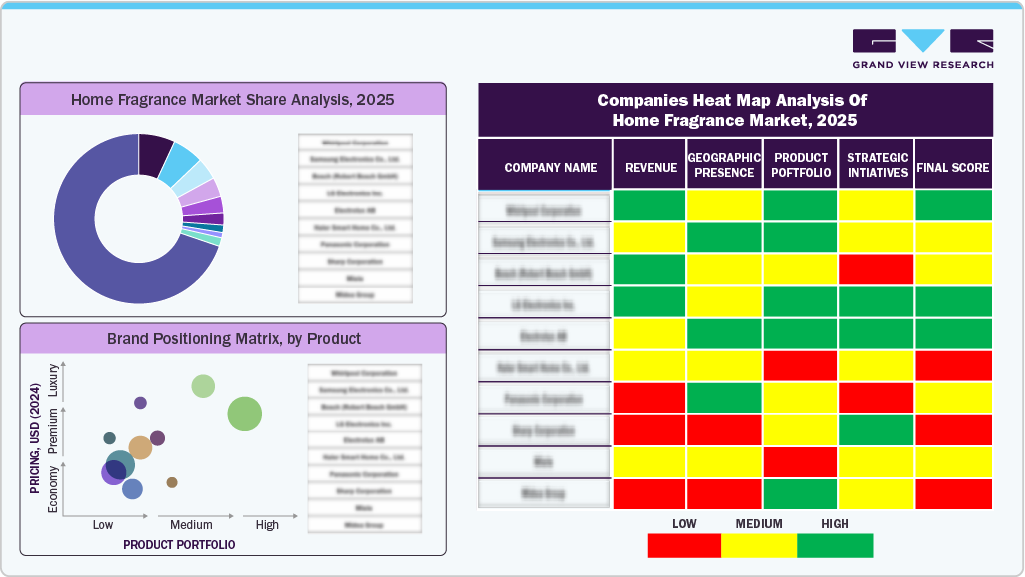
The U.S. at-home beauty devices industry is characterized by a diverse competitive structure comprising global beauty companies, consumer electronics manufacturers, specialized beauty-tech brands, and emerging direct-to-consumer players. Competition is primarily shaped by product innovation, device efficacy, brand recognition, technology integration, pricing, product design, distribution reach, and the ability to address specific consumer needs through personal beauty devices. Companies are expanding their portfolios across LED light therapy, microcurrent, radiofrequency, and facial cleansing, while strengthening direct-to-consumer and online retail channels.
-
Global Beauty & Consumer Technology Leaders: Companies such as L’Oréal S.A., Koninklijke Philips N.V., Panasonic Corporation, and Conair Corporation compete through broad consumer reach, established brand recognition, technology capabilities, and extensive distribution networks. L’Oréal is expanding its Beauty Tech portfolio through technology-enabled skincare and haircare solutions, including its LED Face Mask and other light-based innovations. Philips competes strongly in at-home hair removal through its Lumea range, which uses Intense Pulsed Light technology and personalized treatment features. Panasonic and Conair strengthen competition through consumer-focused personal-care and beauty-device portfolios.
-
Specialized Beauty-Tech & Skincare Device Brands: FOREO AB, NuFACE, The Beauty Tech Group, and Solawave focus more specifically on technology-enabled skincare and facial-care applications. FOREO offers facial cleansing and microcurrent devices, including its LUNA and BEAR product lines, positioning its personal beauty devices around cleansing, firming, and at-home facial treatments. CurrentBody has developed a portfolio spanning LED face masks, LED hair-growth devices, radiofrequency devices, and other beauty-tech solutions. These companies compete through specialized technology, product design, targeted skincare applications, and direct consumer engagement.
-
Premium & Technology-Driven Asian Beauty Device Companies: YA-MAN Ltd. and Panasonic Corporation compete through technology-focused beauty equipment, emphasizing advanced skincare functionality, compact designs, and home-use convenience. Their positioning supports the shift toward salon-inspired treatments that consumers can incorporate into regular home beauty routines. This segment of the U.S. at-home beauty devices market is supported by consumer interest in sophisticated devices that combine multiple functions and treatment technologies.
-
Microcurrent, LED & Personalized Beauty Specialists: NuFACE (Carol Cole Company, Inc.), FOREO AB, Solawave, and The Beauty Tech Group (CurrentBody) compete in targeted facial skincare applications, including facial toning, LED light therapy, skin rejuvenation, and anti-aging routines. Their strategies emphasize consumer education, treatment-specific product positioning, ease of use, and integration into daily skincare routines. FOREO, for example, markets its LUNA facial-cleansing devices and BEAR microcurrent devices for at-home use.
-
Direct-to-Consumer & Consumer-Centric Brands: Solawave, NuFACE, and CurrentBody strengthen competition through direct online engagement, product demonstrations, educational content, and targeted beauty concerns. Their relatively focused product portfolios allow them to position at-home beauty devices around specific use cases such as LED light therapy, facial toning, skin rejuvenation, and anti-aging. CurrentBody's portfolio, for example, includes LED masks, radiofrequency devices, and hair-health devices.
 To learn more about this report, Download Free Sample Report
 Key U.S. At-Home Beauty Devices Companies
-
L’Oréal S.A.
-
Koninklijke Philips N.V.
-
FOREO AB
-
NuFACE (Carol Cole Company, Inc.)
-
Nu Skin Enterprises, Inc.
-
Panasonic Corporation
-
YA-MAN Ltd.
-
The Beauty Tech Group (CurrentBody)
-
Solawave
-
Conair Corporation
Competitive Benchmarking
Category
Operating Strategies
Competitive Edge
Weakness
Established Players / Major Players : (L’Oréal S.A.; Koninklijke Philips N.V.; FOREO AB; NuFACE; Nu Skin Enterprises, Inc.; Panasonic Corporation; YA-MAN Ltd.; Conair Corporation)
- Focus on expanding and strengthening at-home beauty device portfolios through advanced technologies such as LED, microcurrent, RF, IPL, EMS, cleansing, and multifunctional skincare systems. These players leverage established beauty and consumer electronics brands, extensive distribution networks, product innovation, and complementary skincare offerings to address the growing demand for convenient, salon-inspired treatments at home. Several companies also emphasize connected devices, personalized treatment routines, and technology-enabled beauty experiences.
- Benefit from strong brand recognition, established distribution networks, extensive R&D capabilities, and broad consumer reach across the U.S. market. Their technological expertise enables the development of multifunctional personal beauty devices combining treatments such as microcurrent and cleansing. Established customer ecosystems and complementary skincare portfolios further support repeat purchases and brand loyalty.
- Face intense competition from specialist beauty-tech brands and lower-priced alternatives, while consumers increasingly expect clinically supported results and easy-to-use devices. High development costs, rapid technological change, premium pricing, and the need to continuously demonstrate treatment effectiveness can put pressure on margins and hinder market adoption.
Emerging & Specialist Players: (The Beauty Tech Group)
- Focus on differentiated, technology-driven personal beauty devices, particularly LED and red-light therapy solutions designed for convenient home treatments. These companies emphasize direct-to-consumer sales, digital marketing, product-specific education, and premium positioning to build brand awareness. Their strategies also include expanding into targeted facial, neck, eye, and multifunctional treatment devices to capture specific consumer needs within the U.S. at-home beauty devices market.
- Gain a competitive advantage through focused beauty-tech expertise, distinctive product designs, specialized treatment technologies, and strong digital-first consumer engagement. Their narrower product focus enables rapid innovation and positioning around specific technologies such as LED and red-light therapy, while targeted product formats help differentiate their offerings from those of broader consumer electronics companies.
- Increasing competition from established beauty and electronics companies, a growing number of LED and multifunctional device brands, and consumer concerns about product effectiveness can limit differentiation. Premium pricing, the need for continued clinical validation, high customer acquisition costs, and the challenge of maintaining consumer engagement with regular treatment routines remain important challenges.
Recent Developments
-
In September 2026, The Beauty Tech Group introduced the CurrentBody Series 3 LED Face Mask, featuring six wavelengths: blue, green, yellow, red, near-infrared, and deep near-infrared, along with MyDose technology that enables users to customize individual LED wavelengths through a connected app. The launch enhances personalized at-home skincare by combining multi-wavelength LED therapy with app-based treatment customization, supporting the growing adoption of advanced at-home beauty devices in the U.S. market.
-
In August 2026, Solawave published clinical testing and regulatory information for its 4-in-1 Skincare Wand, an FDA-cleared Class II device combining red light therapy, galvanic current, therapeutic warmth, and vibrational massage. The development strengthens the multifunctional capabilities of at-home beauty devices by integrating multiple skincare technologies into a single handheld device, enabling convenient, professional-style beauty treatments.
-
In August 2026, THOME expanded its at-home beauty devices portfolio in the U.S. through Sephora, making its Glow Signature and Twenty Up ultrasound skincare devices available across more than 580 U.S. stores and Sephora.com. The devices utilize dual-frequency ultrasound technology, strengthening the adoption of advanced facial treatment technologies in the U.S. at-home beauty devices market by improving access to professional-style skincare treatments through mainstream beauty retail channels.
U.S. At-Home Beauty Devices Market Report Scope
Report Attribute
Details
Market size in 2025
USD 2.0 billion
Estimated market size in 2026
USD 2.1 billion
Projected market size by 2033
USD 4.2 billion
Growth rate
CAGR of 9.9% from 2026 to 2033
Base year for estimation
2025
Historical data
2021 - 2024
Forecast period
2026 - 2033
Quantitative units
Revenue in USD billion and CAGR from 2026 to 2033
Report coverage
Revenue forecast, company ranking, competitive landscape, growth factors, and trends
Segments covered
Product, technology, end use, price tier, distribution channel
Country scope
U.S.
Key companies profiled
L’Oréal S.A.; Koninklijke Philips N.V.; FOREO AB; NuFACE (Carol Cole Company, Inc.); Nu Skin Enterprises, Inc.; Panasonic Corporation; YA-MAN Ltd.; The Beauty Tech Group (CurrentBody); Solawave; Conair Corporation.
Customization scope
Free report customization (equivalent up to 8 analysts’ working days) with purchase. Addition or alteration to country, regional & segment scope.
Pricing and purchase options
Avail customized purchase options to meet your exact research needs. Explore purchase options
U.S. At-Home Beauty Devices Market Report Segmentation
This report forecasts revenue growth at the country level and provides an analysis of the latest trends and opportunities in each of the sub-segments from 2026 to 2033. For this study, Grand View Research has segmented the U.S. at-home beauty devices market report based on the product, technology, end use, price tier, and distribution channel
-
Product Outlook (Revenue, USD Billion, 2021 - 2033)
-
Facial Skincare Devices
-
Facial Cleansing Devices
-
LED Light Therapy Devices
-
Microcurrent & EMS Facial Devices
-
Radiofrequency (RF) Facial Devices
-
Facial Massage & Thermal Devices
-
Microdermabrasion & Exfoliation Devices
-
Others
-
-
Hair Removal Devices
-
Diode Laser
-
Intense Pulsed Light (IPL) Devices
-
Others
-
-
Hair Growth & Scalp Treatment Devices
-
LED Hair Growth Caps and Helmets
-
Scalp Massage Devices
-
Hair Combs (incl. laser combs)
-
Others
-
-
-
Technology Outlook (Revenue, USD Billion, 2021 - 2033)
-
Light-based Technology (LED, IPL, laser)
-
Electrical Stimulation
-
Radiofrequency
-
Thermal Technology
-
Mechanical Technology
-
Exfoliation and Abrasion
-
Others
-
-
End Use Outlook (Revenue, USD Billion, 2021 - 2033)
-
Women
-
Men
-
-
Price Tier Outlook (Revenue, USD Billion, 2021 - 2033)
-
Entry-level (typically < $150)
-
Mass / Mid-range (typically $150-$500)
-
Luxury & Premium (typically > $500)
-
-
Distribution Channel Outlook (Revenue, USD Billion, 2021 - 2033)
-
Brand-owned Websites (DTC)
-
Online Marketplaces & Retailers
-
Specialty Beauty Stores
-
Mass Merchandisers
-
Others
-
Research Methodology
The U.S. at-home beauty devices market figures in this report are based on a proven research process that combines executive interviews with secondary research from proprietary databases, company filings, and recognized regulatory and institutional sources. Market size is built through value-chain sizing - reconciling supply-side and demand-side estimates - and triangulated with bottom-up and top-down approaches. Every estimate passes multiple levels of expert validation before publication, with each U.S. at-home beauty devices segment quantified using the revenue-capture definitions in the table below.
Segment Definition
Segment - End Use
Revenue capture definition
Women
Revenue from at-home beauty devices purchased and used by women for personal beauty, skincare, hair removal, facial care, skin rejuvenation, and other beauty and grooming applications in the home.
Men
Revenue generated from beauty and personal-care devices designed for male consumers and utilized in residential settings for facial treatments, skincare, hair management, skin rejuvenation, grooming, and related aesthetic applications.
Estimation Model
01
02
03
04
At-home Beauty Devices Base Layer
Consumer Demand Layer
Purchase & Usage Layer
Monetization Layer
Who purchases At-home Beauty Devices?
Who has a demand for Personal Beauty Devices?
Who actively purchases and uses At-home Beauty Devices?
How much revenue is generated?
Identifies the U.S. consumer population with access to and interest in at-home beauty devices. Includes adults seeking convenient skincare, hair removal, facial cleansing, anti-aging, and other personal beauty treatments at home.
Captures consumers seeking convenient, personalized, and cost-effective beauty treatments. Focuses on individuals interested in personal beauty devices for skincare, hair removal, skin rejuvenation, and routine beauty maintenance.
Segments demand by device type, including LED light therapy, microcurrent, radiofrequency, intense pulsed light (IPL), facial cleansing, and hair-removal devices. Considers direct purchases through brand websites, online marketplaces, specialty beauty stores, and other retail channels.
Converts device purchases into market revenue based on average selling prices, purchase frequency, replacement cycles, and sales across online and offline channels. Includes revenue generated from at-home beauty devices sold to U.S. consumers.
Delivered Customizations
This report has been delivered with the following In-depth customizations
Client Request
Customization Delivered
Value Adds
Market Consumer Demand, Usage Patterns & Purchase Behavior Analysis
Conducted a detailed assessment of consumer demand for at-home beauty devices, covering device usage frequency, treatment preferences, skincare and beauty concerns, product adoption, price sensitivity, brand preferences, online purchase behavior, and factors influencing personal beauty device purchases.
Help stakeholders identify high-value consumer segments, understand evolving at-home beauty routines, and align product portfolios, pricing, and marketing strategies with consumers seeking convenient, personalized, and cost-effective beauty treatments.
Product Innovation, Technology & Treatment Trends
Evaluated innovation across at-home beauty devices, including LED light therapy devices, microcurrent and facial toning devices, cleansing devices, facial massagers, radiofrequency devices, laser and IPL devices, smart connectivity, app-enabled treatments, and multifunctional beauty technologies.
Provides insights into emerging technology and treatment preferences, supporting differentiation through multifunctional devices, personalized treatment programs, connected features, user-friendly designs, and technology-driven beauty experiences.
U.S. At-home Beauty Devices Market Distribution, Channel & Market Opportunity Assessment
Assessed opportunities across brand-owned websites, online marketplaces, specialty beauty retailers, department stores, mass retailers, and other distribution channels, while analyzing consumer access, digital purchasing behavior, retail presence, and regional demand for personal beauty devices.
Supports investment and expansion decisions by identifying high-potential distribution channels, consumer demand centers, retail opportunities, and digital commerce platforms serving the growing U.S. market.
About the Author(s)
Beauty & Personal Care Research Team
Consumer Goods · Beauty & Personal CareThis report was authored by the beauty & personal care research team at Grand View Research - comprising two research analysts, one senior research analyst, and one industry expert - with specialized expertise in the beauty & personal care segment of the consumer goods industry. All findings are based on proprietary consumer goods databases, executive interviews, and regulatory analysis, subject to internal peer review prior to publication.
Last Updated:
Speak to Analyst

Customize this report to your needs - add regions, segments, or data points, with 20% free customization.
Or view our licence options:


ISO 9001:2015 & 27001:2022 Certified
We are GDPR and CCPA compliant! Your transaction & personal information is safe and secure. For more details, please read our privacy policy.


