- Home
- »
- Market Trend Reports
- »
-
Competitive Landscape Of The Animal Health Industry
![Competitive Landscape Of The Animal Health IndustryReport]()
Competitive Landscape Of The Animal Health Industry
- Published: Oct, 2025
- Report ID: GVR-MT-100480
- Format: PDF/Excel databook
- No. of Pages/Datapoints: 30
- Report Coverage: 2024 - 2030
Report Overview
The animal health industry is highly competitive, dominated by a few global players with broad product portfolios and strong R&D capabilities. Leading companies such as Zoetis, MSD Animal Health, Elanco, Boehringer Ingelheim, and Ceva Santé Animale collectively hold a majority of the market share, offering vaccines, therapeutics, diagnostics, and nutritional products for both livestock and companion animals. Competition is driven by innovation in biologics, precision medicines, digital health solutions, and vaccines, with firms continuously investing in research to address emerging diseases, improve animal welfare, and enhance productivity. For instance, MSD Animal Health’s NUMELVI, a second-generation JAK1 inhibitor for dogs, and Zoetis’ Lenivia (izenivetmab) for canine osteoarthritis exemplify the focus on differentiated, high-value products in companion animals.
Regional players and startups also contribute to competitive dynamics by introducing specialized or niche products, such as Bactana Corp.’s postbiotic solutions for livestock gut health, recently acquired by Kemin Industries to scale global reach. Mergers, acquisitions, and strategic partnerships are common strategies to expand geographic presence, accelerate innovation, and consolidate market position. Companies like Cargill acquiring Mig-Plus in Brazil demonstrate the trend of leveraging local expertise and infrastructure to strengthen supply chains and end-user access, further intensifying competition across both developed and emerging markets.
Competitive Landscape: Animal Health Industry Report Coverage
Competitive Landscape: Animal Health Industry Report Coverage
Market Overview
Market Share Analysis
Company Categorization
Company Position Analysis
Product Offering Analysis
List of Key Animal Health Companies, by Region
Key Service Offerings
Financial Reporting
Recent Strategic Developments
SWOT Analysis
The key industry participants operating in the animal health market are proactively focused on implementing several strategic initiatives, such as product launches, collaborations, mergers, partnerships, acquisitions, agreements, expansions, and others, to gain a competitive edge in the overall market. For instance, in September 2025, MSD Animal Health launched NUMELVI (atinvicitinib) tablets, a highly selective second-generation JAK1 inhibitor for dogs, approved by the European Commission for treating pruritus and atopic dermatitis in dogs as young as six months. The once-daily therapy offers rapid efficacy, a strong safety profile, and minimal immune interference, representing a next-generation solution in veterinary dermatology. Such product launches broadened the company's revenue growth opportunities in the market.
Market Characteristics:
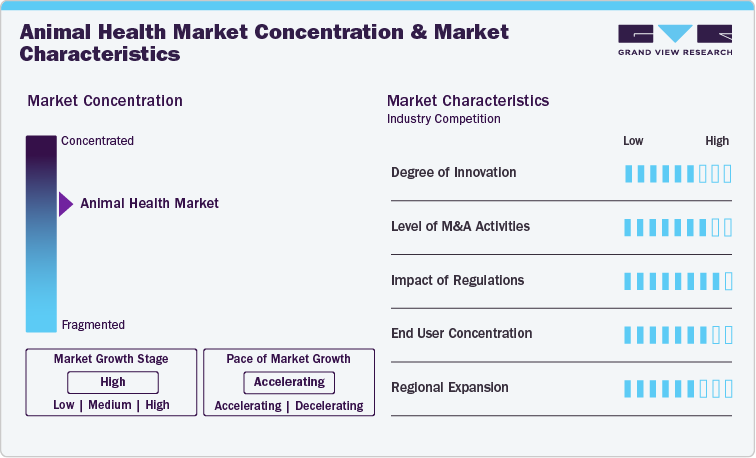
The animal health market's growth stage is high, and the pace of growth is accelerating. The market is characterized by a degree of innovation, the Level of M&A activities, the impact of regulations, product innovation, and regional expansions.
- Degree of Innovation: The animal health industry demonstrates a high degree of innovation, driven by advances in targeted therapies, biologics, and digital health solutions. Recent breakthroughs, such as MSD Animal Health’s NUMELVI (atinvicitinib), a second-generation, highly selective JAK1 inhibitor for dogs launched in September 2025, exemplify progress in precision medicine and improved safety profiles. Companies are increasingly focusing on next-generation vaccines, monoclonal antibodies, and gene therapies, addressing both companion and livestock health needs. These innovations reflect the industry’s shift toward safer, faster acting, and more personalized veterinary treatments, reinforcing its role as a key contributor to global health and sustainability.
-
Level of M&A Activities: The animal health industry is experiencing a high level of merger and acquisition (M&A) activity, driven by the need for innovation, market expansion, and integrated value chain capabilities. Recent deals, such as Kemin Industries’ acquisition of Bactana Corp. in August 2025 and Cargill’s acquisition of Mig-Plus in July 2025, highlight strategic efforts to strengthen biotechnology, microbiome-based solutions, and regional animal nutrition portfolios. Global and regional players are actively pursuing acquisitions to enhance R&D pipelines, scale production, and expand geographic presence, particularly in emerging markets. This consolidation trend reflects a focused strategy to accelerate innovation, sustainability, and competitive advantage across the animal health ecosystem.
-
Impact of Regulations: Regulatory frameworks have a profound effect on innovation, market access, and competitiveness in the animal health industry. Current U.S. regulations, described as slow, rigid, and costly, often delay product approvals and deter global companies from pursuing development domestically. The Reagan-Udall Foundation's 2025 report emphasizes the need to modernize FDA oversight to enable streamlined, risk-based review processes and greater regulatory flexibility. Modernized regulations would accelerate innovation, reduce economic barriers, and enhance the availability of advanced veterinary drugs, biologics, and feed additives across the market.
-
End User Concentration: In the animal health industry, end-user concentration varies by segment, with companion animal care dominated by veterinary clinics and hospitals in the market. In the livestock segment, large-scale commercial farms, integrated poultry and dairy producers, and government procurement programs serve as primary buyers, concentrating demand among a smaller number of high-volume customers. For example, companies like Zoetis and Merck Animal Health primarily supply vaccines and therapeutics to major poultry integrators in the U.S. and Europe, while in companion animals, products are distributed through vet chains such as Banfield Pet Hospitals and independent clinics. This concentration gives a few end users significant negotiating power and shapes product development and distribution strategies.
-
Regional Expansion: The animal health industry is experiencing significant regional expansion, driven by rising livestock production, pet ownership, and veterinary infrastructure in emerging markets. Asia-Pacific and Latin America are the fastest-growing regions, with markets like China, India, and Brazil seeing increasing demand for vaccines, feed additives, and companion animal care products. For instance, Zoetis has expanded its vaccine production facilities in Brazil, while Elanco has strengthened its distribution networks in India and Southeast Asia. Developed regions such as North America and Europe continue to grow steadily through product innovation and digital veterinary solutions, reflecting a mix of mature and high-growth markets shaping global strategies.
Market Position Analysis:
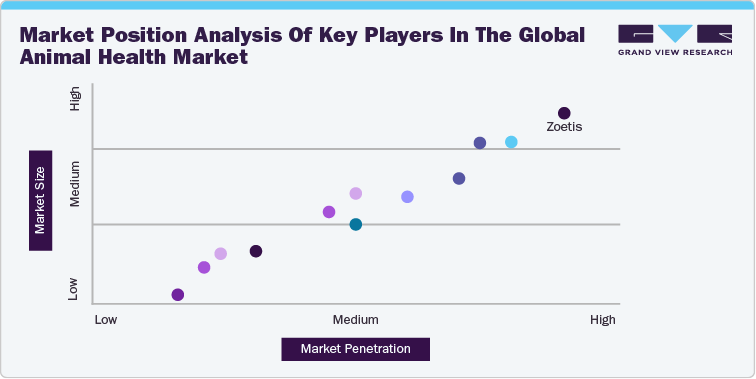
Market position analysis in the animal health industry assesses a company’s standing relative to competitors based on factors such as revenue share, product portfolio diversity, geographic presence, technological and manufacturing capabilities, client base, and specialization in niche segments. Global leaders like Zoetis, Merck Animal Health, Elanco, Boehringer Ingelheim, and Ceva Santé Animale dominate the market due to their extensive product ranges, robust R&D pipelines, and established global distribution networks. This analysis helps classify firms as market leaders, innovators, niche specialists, or emerging players, providing insights that guide strategic investments and competitive positioning. Ongoing advancements in biologics, diagnostics, and digital veterinary health solutions continue to reshape market dynamics, enhance operational efficiency, and drive overall industry profitability.
Market Share Analysis:
Market share analysis by region in the animal health market includes analyzing market share distribution across five regions including North America, Europe, Asia Pacific, Latin America and Middle East and Africa.
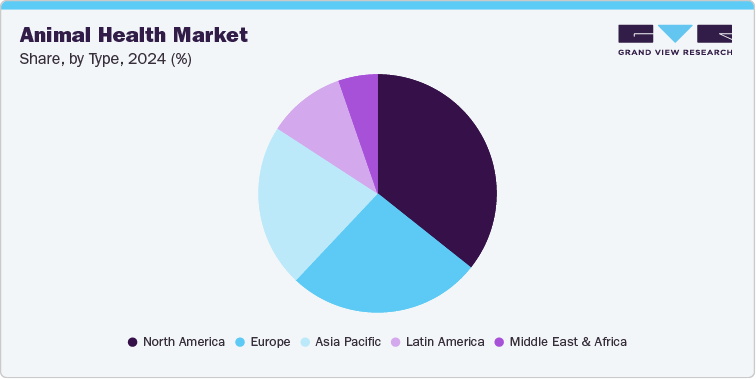
The animal health market shows regional variation in adoption, infrastructure, and focus areas. North America leads in advanced veterinary services, digital diagnostics, and companion animal care, while Europe emphasizes farm-specific vaccines, livestock health, and regulatory compliance. Asia-Pacific rapidly expands due to increasing pet ownership, livestock production, and government-driven veterinary programs. Latin America, particularly Brazil, relies heavily on large-scale poultry and livestock operations, making the market concentrated among major producers. These regional dynamics influence product strategy, distribution networks, and innovation priorities for global animal health companies.
Other aspects that will be analyzed will include PORTER's five forces analysis, key animal health market players by region, and major company profiles that cover company overview, financial reporting, product benchmarking, key strategic initiatives, and SWOT analysis to gain thorough insights regarding the competitive scenario in the animal health market. Key parameters are represented as below:
Key Product Offerings of Zoetis.
Company Name
Product category
Animal Type
Description
Zoetis
Pharmaceuticals
Dogs and cats
Zoetis small animal portfolio includes Parasiticides (Proheart 6, Revolution, Simparica, Cestex, Eradimite, Butoxide, Mitaban etc.), Anti-Infectives/Steroids (Convenia, Clavamox, Simplicef, Zeniquin, Antirobe), Sedatives (Antisedan And Dexdomitor), Anesthetic (Isoflo, Ketaset, Propoflo, Sevoflo, Telazol), etc.
Zoetis
Pharmaceuticals and Vaccine
Equine
The zoetis equine portfolio includes a variety of vaccines such as Quest/Equest/Equest Pramox, Amiglyde-V-Anti-Infective Injection, Arvac Equine Arteritis Vaccine, Carbocaine-V-Injection For Horse, Equiloid Innovator Encephalomyelitis-Tetanus Toxoid Vaccine, Equine Rotavirus Vaccine, Equivac Innovator EHV-1/4 For Equine Rhinopneumonitis Prevention, Excede Fluvac Innovator Vaccines, Fluvac Innovator Vaccines, Ketofen Injectable Solution, etc.
Zoetis
Pharmaceuticals and Vaccine
Cattle
Zoetis Cattles product line comprises of several product such as Calf-Guard, Entrolyte H.E, Scourguard 4k, Liquamycin LA-200, Naxcel, Excenel RTU EZ, Draxxin, Advocin, Lutalyse, Excede, Draxxin, Factrel among others
Zoetis
Pharmaceuticals and Vaccine
Swine
Zoetis' swine vaccine product line includes Aureomycin, Dectomax Injectable, Draxxin Injectable Solution, Excede, Excenel RTU EZ, Farrowsure Gold, Flusure XP, Fostera Prrs, Liquamycin, Improvest/Improvac/Vivax/ Innosure, Lincomix Feed Medication (lincomycin) and others.
Zoetis
Diagnostics
Dogs, cats, Equine
Zoetis diagnostic product line includes several Instruments and devices such as Blood Glucose Monitoring System, VETSCAN Analyzers, VETSCAN IMAGYST, Stablelab EQ-1 Handheld Reader, VETSCAN Hdmicroscope, etc. It also provides rapid tests like VETSCAN Lineup, WITNESS Lineup, ViraCHEK Test Kits, ProFLOK Range of Test Kits etc.
Financial Reporting for Zoetis.
Financial Reporting for Zoetis
Key Financials
Revenue (in USD Million)
As of dated 31st December
2022
2023
2024
Total Revenue
8,080
8,544
9,256
EBITA
2,656
2,936
3,133
Net Income
2,114
2,344
2,486
Research & Development Expense
539
614
686
Asset Turnover
7,506
6,343
5,986
Note: Latest financials as per the company's annual reports will be provided in the final deliverable
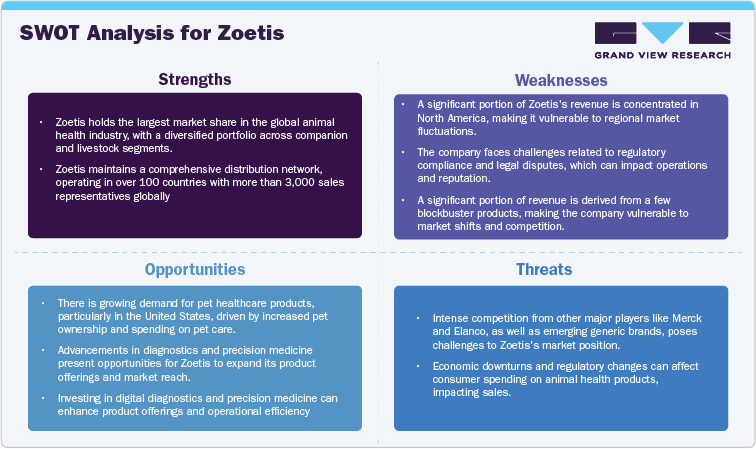
SWOT Analysis for Zoetis.
An in-depth analysis shall be provided for the below listed animal health key players:
-
Zoetis
-
Merck & Co., Inc.
-
Boehringer Ingelheim
-
Elanco
-
Idexx Laboratories
-
Ceva
-
Virbac
-
Dechra Pharmaceuticals PLC
-
Vetoquinol
-
Vimian AB Group
-
Phibro Animal Health
-
Neogen Corporation
-
Heska Corporation
-
Ourofino Saúde Animal
-
Bimeda
-
Norbrook Laboratories
-
Eco Animal Health
-
SeQuent Scientific
-
Animalcare Group
-
ImmuCell Corporation
-
Hester Biosciences
-
Biogenesis Bago
-
Biovac Institute
-
Bioniche Animal Health
-
Calier
-
Animal Care Group Plc
-
Zomedica
-
Tianjin Ringpu Bio-Technology
-
Ashish Life Science
-
Orion Corporation
![gvr icn]()
GET A FREE SAMPLE
![gvr icn]()
This FREE sample includes market data points, ranging from trend analyses to market estimates & forecasts. See for yourself.
![gvr icn]()
NEED A CUSTOM REPORT?
We can customize every report - free of charge - including purchasing stand-alone sections or country-level reports, as well as offer affordable discounts for start-ups & universities.
Contact us now to get our best pricing.
![esomar icon]()
ESOMAR certified & member
![ISO]()
ISO Certified
We are GDPR and CCPA compliant! Your transaction & personal information is safe and secure. For more details, please read our privacy policy.






We are committed towards customer satisfaction, and quality service.
Client Testimonials

"The quality of research they have done for us has been excellent..."
ISO Certified