- Home
- »
- Market Trend Reports
- »
-
Edoxaban (Savaysa And Lixiana) Market: Patent Expiry Impact, Regulatory Landscape, & Global Anticoagulant Market Outlook
![Edoxaban (Savaysa And Lixiana) Market: Patent Expiry Impact, Regulatory Landscape, And Global Anticoagulant Market OutlookReport]()
Edoxaban (Savaysa And Lixiana) Market: Patent Expiry Impact, Regulatory Landscape, And Global Anticoagulant Market Outlook
- Published: Oct, 2025
- Report ID: GVR-MT-100481
- Format: PDF/Excel databook
- No. of Pages/Datapoints: 120
- Report Coverage: 2024 - 2030
Report Overview
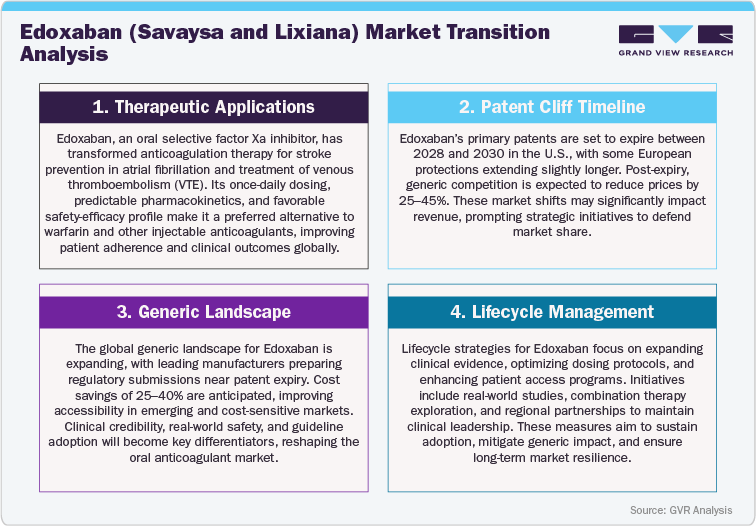
Edoxaban, marketed as Savaysa and Lixiana, is an oral, selective factor Xa inhibitor developed by Daiichi Sankyo that has transformed anticoagulation therapy for stroke prevention in atrial fibrillation and treatment of venous thromboembolism. Approved in more than 40 countries, it offers convenient once-daily dosing and a favorable safety-efficacy profile compared to traditional anticoagulants. The primary patents for Edoxaban are set to expire after 2028 , with secondary patents extending exclusivity in select markets. Patent expiration is expected to trigger the entry of generics, intensifying competition and influencing pricing dynamics. Despite this, Edoxaban remains clinically relevant due to its established efficacy, real-world evidence, and incorporation into global anticoagulation guidelines. Market growth will be shaped by pricing pressures, access programs, lifecycle management strategies, and expansion in high-burden regions including North America, Europe, and Asia Pacific.
Key Report Deliverables
-
A comprehensive analysis of the Edoxaban (Savaysa and Lixiana) market landscape, covering global revenue performance, key growth drivers in anticoagulation therapy, evolving treatment paradigms for atrial fibrillation and venous thromboembolism, and shifting competitive dynamics due to emerging generic and biosimilar entrants.
-
Forecasts evaluating post-patent market dynamics, including timelines for generic entry across major regions, and the projected impact on revenue growth, pricing pressures, and patient access following patent expirations in the U.S. (2028) and Europe (2030).
-
Identification of regulatory and market access barriers influencing generic adoption, including approval complexities, pricing and reimbursement frameworks, tendering systems, and payer-driven formulary decisions in key geographies such as the U.S., Europe, Asia Pacific, and Latin America.
-
An in-depth competitive landscape overview, profiling direct competitors including generic manufacturers, emerging oral anticoagulants, pipeline innovations, and strategies shaping the future of anticoagulation management and treatment accessibility.
-
Strategic implications for Daiichi Sankyo, including lifecycle management initiatives, pricing optimization, partnerships for combination therapies, expansion into high-burden and emerging markets, and strategies to maintain clinical and market leadership amid intensifying competition from generics and alternative anticoagulants.
Patent Cliff Analysis
The market for Edoxaban (Savaysa and Lixiana), a leading oral factor Xa inhibitor for atrial fibrillation and venous thromboembolism, is expected to undergo notable shifts over the next decade as key patents expire, resulting in significant market share changes in major regions. U.S. patents are set to expire after 2028, while European patents extend until 2030, paving the way for competition from generic Edoxaban and alternative oral anticoagulants. In the short term, until patent expiry, Edoxaban is expected to maintain a strong market presence, supported by established clinical preference, proven efficacy, and a favorable safety-efficacy profile, with only modest declines in adoption.
Post-patent, Edoxaban will face growing competition from generics and alternative anticoagulants, including rivaroxaban (Xarelto), apixaban (Eliquis), and dabigatran (Pradaxa). Between 2029 and 2035, generics are projected to capture significant market share of Edoxaban’s market share in emerging and mature markets. Payers will increasingly negotiate pricing, while treatment guidelines gradually incorporate cost-effective alternatives. This period will also see the adoption of combination therapies and next-generation oral anticoagulants, further fragmenting the market.
The most substantial phase of the patent cliff is anticipated between 2032 and 2038, as generics gain widespread adoption and competition from next-generation anticoagulants intensifies. Market share get decline, with cost-effective generics becoming the preferred choice for healthcare providers and payers globally. Uptake of alternative factor Xa inhibitors and novel oral anticoagulants will erode Edoxaban’s dominance, particularly in regions with high atrial fibrillation prevalence.
By 2039, Edoxaban is expected to retain some part its current global market share, with generics firmly established as the mainstay of anticoagulation therapy. While Edoxaban may continue to be prescribed in specific patient populations or regions with limited generic availability, its market influence will be significantly reduced. This phase marks the final stage of Edoxaban’s patent cliff, where competition stabilizes, pricing pressures normalize, and generics dominate, effectively reshaping the global oral anticoagulant landscape.
Current Market Scenarios
Edoxaban (Savaysa and Lixiana), developed by Daiichi Sankyo, currently holds a strong position in the global oral anticoagulant market, supported by its proven efficacy, favorable safety-efficacy profile, and convenient once-daily dosing for atrial fibrillation and venous thromboembolism management. key European patents until 2030, the market is approaching a patent cliff phase, opening the door for increased generic competition. These shifts are expected to reshape pricing, market access, and revenue streams across major regions.
In Europe, aggressive pricing policies, tender systems, and payer-driven formulary decisions are likely to accelerate generic adoption post-patent expiry, driving significant cost reductions. In Asia Pacific, particularly in China, India, and Japan, local manufacturing initiatives, government reimbursement programs, and healthcare expansion efforts are expected to improve affordability and patient access, fueling early market penetration. Conversely, in markets like the U.S., where regulatory complexities and brand loyalty persist, generic uptake may be gradual, allowing Daiichi Sankyo to retain premium positioning in the near term.
Despite increasing competition, demand for Edoxaban remains strong due to its established role in standard-of-care anticoagulation regimens, real-world evidence supporting safety and efficacy, and clinical guideline endorsements. Ongoing developments in combination therapies, novel factor Xa inhibitors, and next-generation oral anticoagulants reinforce its clinical relevance. Daiichi Sankyo’s strategic focus on lifecycle management, market expansion, and access initiatives positions Edoxaban to sustain market share, even amid intensifying generic competition. Moving forward, the oral anticoagulant landscape will be shaped by pricing pressures, regional access programs, and innovation-driven differentiation, with Daiichi Sankyo expected to prioritize targeted strategies and evidence-based clinical leadership to maintain global market prominence.
Market Dynamics
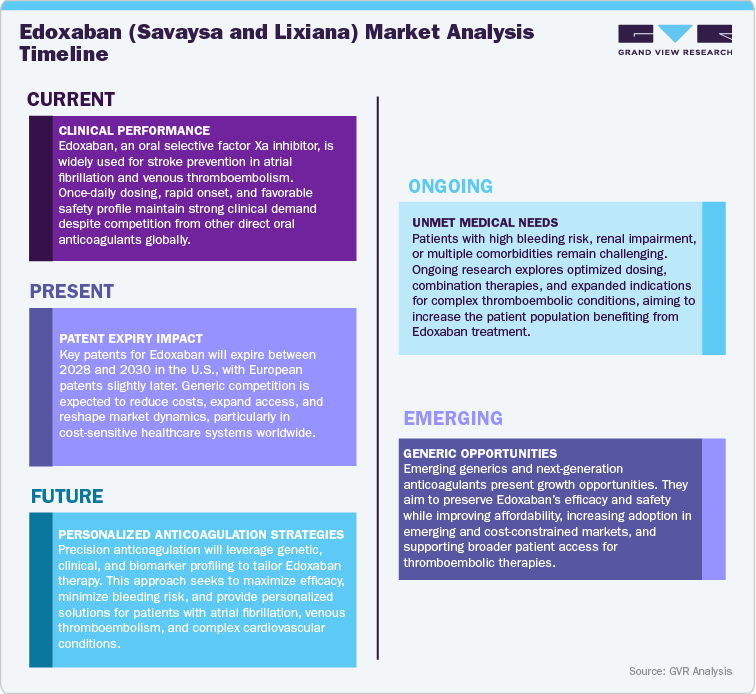
Growing Demand for Oral Factor Xa Inhibitors
The rising global prevalence of atrial fibrillation and venous thromboembolism, coupled with expanded healthcare access and growing preference for oral anticoagulants, has fueled strong demand for Edoxaban (Savaysa and Lixiana). With a convenient once-daily dosing schedule, proven efficacy, and a favorable safety-efficacy profile, Edoxaban remains a preferred option for treatment-naïve and previously treated patients. Its clinical utility is reinforced by integration into guideline-recommended anticoagulation regimens, real-world evidence, and broad adoption across developed and emerging markets, solidifying its pivotal role in oral anticoagulation therapy.
Pricing and Market Erosion Post-Patent
With patent expirations in the U.S. (2028) and Europe (2030), the Edoxaban market is poised for increased generic competition and pricing pressures. As generics and alternative oral anticoagulants, including rivaroxaban (Xarelto) and apixaban (Eliquis), enter key markets, payers in Europe, Asia Pacific, and Latin America are likely to favor cost-effective alternatives, accelerating uptake. While physician familiarity with Edoxaban and clinical conservatism may initially slow generic penetration, affordability-driven healthcare systems will drive rapid adoption of lower-cost options. Consequently, Daiichi Sankyo’s market share could face gradual erosion as regional pricing policies, reimbursement frameworks, and generic approvals reshape competitive dynamics. Early generic entrants will need to demonstrate comparable efficacy, safety, and real-world outcomes to compete with the established Edoxaban brand.
Opportunities in Lifecycle Management and Regional Divergence
Daiichi Sankyo is proactively addressing the patent cliff through lifecycle management strategies, including expanded indications, optimized dosing programs, and patient access initiatives aimed at improving adherence and clinical outcomes. The impact of generic competition is expected to vary regionally: in the U.S., Japan, and Western Europe, regulatory requirements and physician preference may delay generic adoption, sustaining Edoxaban’s premium market presence; conversely, emerging markets such as India, China, and Brazil are likely to witness faster generic uptake driven by affordability initiatives and government-backed programs. To maintain market leadership, Daiichi Sankyo is expected to focus on innovation, strategic partnerships, and regional pricing optimization, ensuring Edoxaban continues to drive global anticoagulation therapy adoption.
The Pressure of Pricing and Market Erosion Post-Patent
As Edoxaban (Savaysa and Lixiana) approaches patent expirations in the U.S. (2028-2030) and Europe (2030), the market is expected to face significant generic competition, driving pricing pressures and potential market share erosion for Daiichi Sankyo. Generics are likely to gain faster traction in cost-sensitive regions such as India, China, Brazil, and Latin America due to local manufacturing initiatives, government incentives, and affordability programs. Adoption in mature markets like the U.S., Europe, and Japan may progress more gradually due to regulatory complexities, brand loyalty, and clinical conservatism. Over time, payer-driven pricing strategies, tender systems, and reimbursement adjustments are expected to accelerate generic uptake globally, reshaping market access and competitive dynamics within the oral anticoagulant segment. Despite these challenges, Edoxaban’s proven efficacy, once-daily convenience, and established real-world evidence will help Daiichi Sankyo mitigate the impact of generic entry. To sustain market leadership, the company is focusing on lifecycle management, market expansion, and patient-centric strategies to maintain its competitive edge in an evolving anticoagulation landscape.
Innovating Beyond the Patent - Unlocking Future Growth Paths
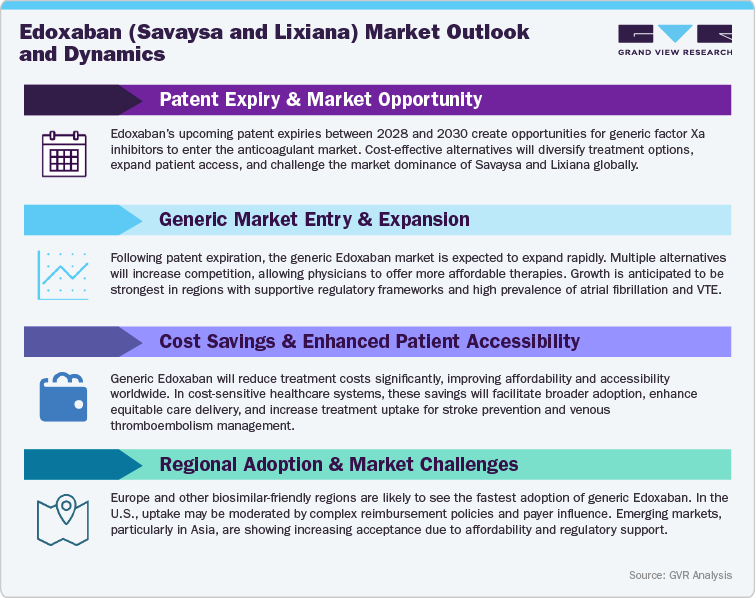
Even as generic competition intensifies post-patent expiry, significant opportunities exist to drive future growth in the oral anticoagulant market. Next-generation innovations, including optimized dosing programs, combination therapies with antiplatelet agents, and simplified anticoagulation protocols, can enhance patient adherence, outcomes, and therapy adoption. Ongoing research into real-world effectiveness, expanded indications, and clinical guideline integration reinforces Edoxaban’s differentiation, maintaining its role in standard-of-care anticoagulation regimens. Daiichi Sankyo’s innovation strategy, centered on combination therapy optimization, lifecycle management, and targeted regional expansion, will be critical in sustaining clinical relevance amid intensifying generic pressures. Moreover, the expansion of affordable generic options in emerging markets opens avenues for enhanced patient access, particularly in Asia Pacific, Latin America, and Africa, where cost-effective therapies are increasingly prioritized. Strengthening healthcare infrastructure, improving screening and risk stratification programs, and growing awareness of effective stroke and VTE prevention therapies are expected to drive demand for both branded Edoxaban and lower-cost alternatives, enabling broader patient access and reinforcing Daiichi Sankyo’s strategic leadership in the global oral anticoagulant market.
Shaping the Future - Generics, Patient-Centric Models, and Regional Shifts
The shift toward patient-centric treatment models is accelerating in the oral anticoagulant market, emphasizing simplified dosing, improved adherence, and tailored therapy for diverse patient populations. Innovations such as optimized dosing programs, combination therapies with antiplatelet agents, and fixed-dose regimens will enable more personalized anticoagulation approaches, reinforcing the clinical relevance of Edoxaban (Savaysa and Lixiana) even as generics enter the market. The growing adoption of value-based healthcare and cost-containment initiatives is expected to drive faster generic uptake in price-sensitive regions, reshaping competitive dynamics between branded Edoxaban and lower-cost alternatives.
Regional variations will continue to play a pivotal role: in mature markets such as the U.S., Europe, and Japan, regulatory complexities, brand loyalty, and clinical conservatism may slow generic penetration, allowing Daiichi Sankyo to maintain premium market positioning. In contrast, emerging markets like India, China, Brazil, and Latin America are likely to witness rapid generic adoption fueled by affordability pressures, government incentives, and streamlined regulatory pathways. These regional differences will create distinct competitive landscapes, requiring Daiichi Sankyo to tailor market strategies, optimize pricing, and expand access, ensuring Edoxaban maintains global leadership while delivering broader patient access and supporting improved cardiovascular and thromboembolic outcomes.
Overview of Alternative Therapeutics
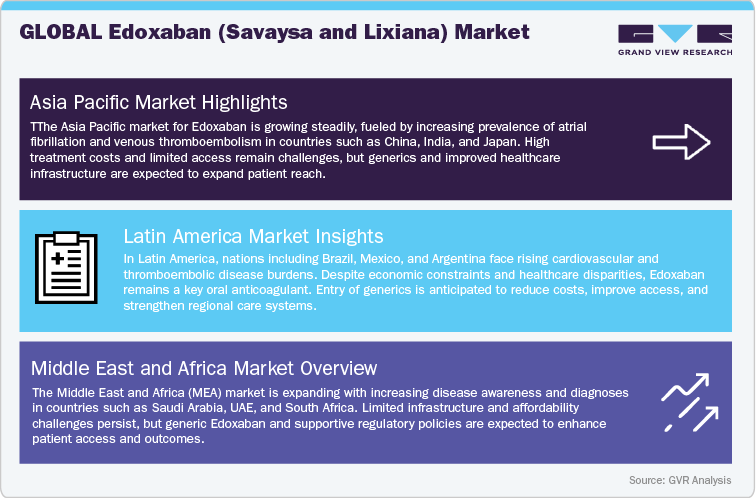
Edoxaban (Savaysa and Lixiana) is facing increasing competition from other oral anticoagulants and emerging treatment regimens, including rivaroxaban (Xarelto), apixaban (Eliquis), dabigatran (Pradaxa), and next-generation factor Xa inhibitors. These competitors are expanding indications, dosing strategies, and geographic reach to capture larger shares of the global oral anticoagulant market. In parallel, innovations such as optimized dosing programs, combination therapies with antiplatelet agents, and simplified regimens are reshaping the therapeutic landscape, intensifying competitive pressures in atrial fibrillation and venous thromboembolism management.
A growing wave of generic Edoxaban formulations is entering global markets following patent expirations in the U.S. (2028-2030) and Europe (2030). The success of these generics will depend on demonstrating clinical comparability, securing regulatory approvals, offering cost advantages, and implementing strategic pricing to gain traction in price-sensitive regions, where government programs and healthcare payers strongly influence treatment decisions.
The evolving competitive landscape emphasizes the need for Daiichi Sankyo to leverage innovation, lifecycle management, and strategic collaborations to maintain leadership in the oral anticoagulant segment. As generics and alternative factor Xa inhibitors reshape global anticoagulation markets, Daiichi Sankyo must focus on differentiating Edoxaban through combination therapy optimization, expanded indications, and patient-centric strategies to sustain market position and ensure continued relevance in a rapidly changing therapeutic environment.
Competitive Landscape
The competitive landscape for Edoxaban (Savaysa and Lixiana) is rapidly evolving as generic formulations and next-generation oral anticoagulants intensify competition in atrial fibrillation and venous thromboembolism management. Daiichi Sankyo, the primary developer of Edoxaban, continues to leverage its strong market position through extensive real-world evidence, guideline-supported dosing, and proactive lifecycle management strategies, including optimized dosing programs, combination therapies, and patient-centric adherence initiatives. Competitors such as rivaroxaban (Xarelto), apixaban (Eliquis), dabigatran (Pradaxa), and emerging factor Xa inhibitors are broadening indications and geographic reach, creating a more competitive environment in the global oral anticoagulant market.
On the generic front, Edoxaban generics are entering markets following patent expirations in the U.S. (2028-2030) and Europe (2030). In emerging markets such as India, China, Brazil, and Latin America, local manufacturers and government-backed access programs are facilitating faster market entry, increasing competitive pressures and accelerating generic adoption. Additionally, next-generation oral anticoagulants and combination regimens represent longer-term competition due to their potential for improved convenience, simplified dosing, and broader therapeutic applications.
To maintain market leadership, Daiichi Sankyo is focusing on lifecycle management, strategic partnerships, and patient-centric initiatives, while competitors emphasize pipeline expansion, regulatory approvals, and regional market penetration. The rise of generics and newer oral anticoagulants is expected to drive pricing pressures, enhance patient access, and redefine global anticoagulation dynamics. Ultimately, the ability to innovate, differentiate, and deliver clinically effective, patient-focused solutions will be critical for Daiichi Sankyo and other market players to maintain resilience and leadership in the rapidly evolving oral anticoagulant segment.
North America Edoxaban Market
North America remains a key market for Edoxaban (Savaysa and Lixiana), with the U.S. driving the majority of sales due to advanced healthcare infrastructure, high screening rates for atrial fibrillation and venous thromboembolism, and strong demand for effective oral anticoagulants. Patent protection in the U.S. is set to expire between 2028, enabling generic entry. Post-patent, pricing pressures are anticipated as payers prioritize cost-effective alternatives, while physician familiarity and guideline endorsements may sustain branded Edoxaban usage in the short term. Canada, with patent expirations around 2030, is expected to experience similar dynamics, with generics entering earlier and reshaping competitive and pricing landscapes.
Europe Edoxaban Market
Europe represents a significant market for Edoxaban, with Germany, France, and the U.K. as major contributors. Patent expirations in key markets are set for 2030, after which generics and alternative oral anticoagulants are expected to gain approval. Europe’s cost-conscious healthcare systems, tender-based procurement policies, and national cardiovascular risk management programs will accelerate adoption of lower-cost options, impacting branded Edoxaban pricing and market share. Regulatory processes may slow initial uptake, but once generics are approved, significant shifts in competitive dynamics and treatment access are anticipated.
Asia Pacific Edoxaban Market
The Asia Pacific region offers substantial growth potential, particularly in India, China, and Japan, where the prevalence of atrial fibrillation and thromboembolic disorders is rising and awareness of effective oral anticoagulants is increasing. Local manufacturing initiatives and government-led affordability programs will drive early generic adoption, intensifying competition. India is likely to see rapid generic penetration due to cost-sensitive healthcare systems, while China may witness controlled uptake guided by regulatory and government incentives. Japan, despite high demand for effective anticoagulants, may experience slower generic adoption due to stringent regulatory frameworks. Overall, the region provides strong growth opportunities, requiring strategic navigation of regulatory and pricing dynamics.
Latin America Edoxaban Market
In Latin America, the rising prevalence of cardiovascular disorders is driving demand for Edoxaban, with Brazil, Mexico, and Argentina as key markets. Post-patent generic entry is expected to reduce treatment costs and broaden patient access. Regulatory authorities in Brazil and Mexico are likely to facilitate faster approvals, accelerating generic adoption. However, infrastructure challenges and distribution limitations in some areas may require innovative pricing and access strategies to ensure comprehensive market coverage.
Middle East and Africa Edoxaban Market
The Middle East and Africa (MEA) market is emerging, with Saudi Arabia, UAE, and South Africa as primary contributors. Awareness of atrial fibrillation and venous thromboembolism, along with access to oral anticoagulants, is improving, but high treatment costs remain a barrier. Generic entry is expected to play a pivotal role in increasing accessibility. Regulatory pathways vary, with more efficient approvals in the UAE and Saudi Arabia, while other nations may experience delays. As healthcare infrastructure strengthens and patient access expands, the MEA region is poised for long-term growth, driven by generics and government-backed cardiovascular disease management initiatives.
Analyst Perspective
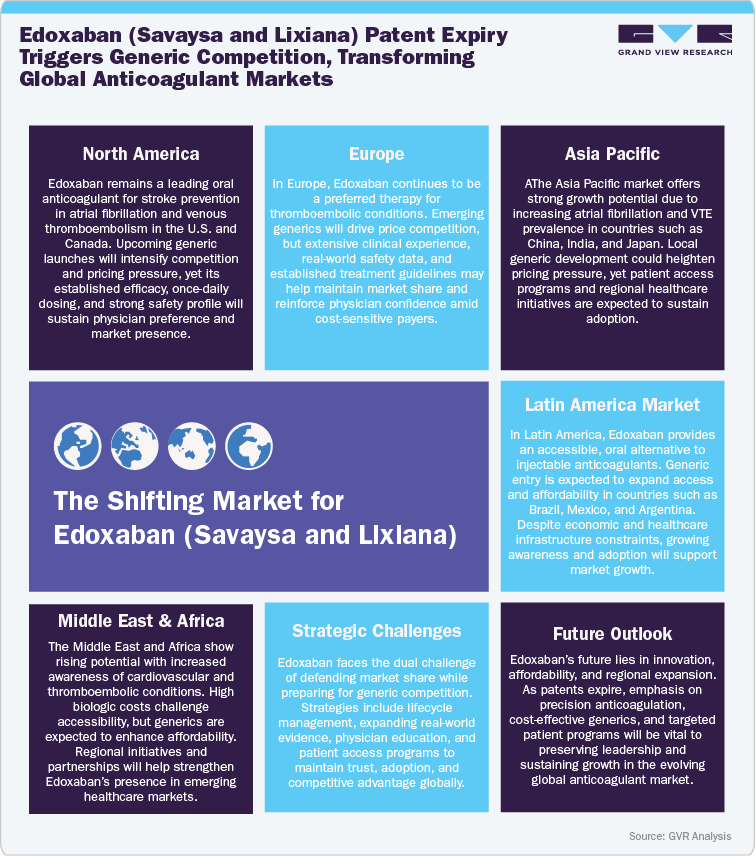
The Edoxaban (Savaysa and Lixiana) market is approaching a pivotal juncture as key patents near expiration. Dominated by Daiichi Sankyo, the market is expected to face intensified competition from generic Edoxaban formulations and next-generation oral anticoagulants, which are likely to drive pricing pressures and shifts in market share. Emerging competitors such as rivaroxaban (Xarelto), apixaban (Eliquis), dabigatran (Pradaxa), and novel factor Xa inhibitors are expected to heighten competitive pressures, particularly in price-sensitive regions including Europe, Asia Pacific, and Latin America.
Despite these challenges, demand for Edoxaban remains strong, supported by its proven efficacy, favorable safety-efficacy profile, once-daily convenience, and broad adoption across diverse patient populations. Its relevance is further reinforced by integration into clinical guidelines, real-world evidence, and ongoing developments in combination therapies and optimized dosing regimens, ensuring it continues to play a central role in atrial fibrillation and venous thromboembolism management.
To sustain competitiveness, Daiichi Sankyo is focusing on lifecycle management, combination therapy optimization, and strategic partnerships to maintain a clinical edge. Patient-centric strategies, including access programs, adherence support, and integration into national cardiovascular risk management initiatives, will be critical to retaining market leadership. Strategic initiatives such as regional expansion, generic management, and collaborations with healthcare providers and governments will help navigate the evolving post-patent landscape, ensuring Edoxaban maintains its position as a leading therapy in the global oral anticoagulant market.
Case Study (Recent Engagement): Keytruda Patent-Cliff & Price- Erosion Impact Model
PROJECT OBJECTIVE
To evaluate the potential revenue, price, and patient access implications of Keytruda’s 2028 patent cliff, incorporating biosimilar entry dynamics, country-specific adoption curves, and Merck’s lifecycle defense strategies (remarkably the subcutaneous formulation). The goal was to provide the client with a transparent, scenario-based model to anticipate outcomes and inform strategy
GVR SOLUTION
-
Built a bottom-up commodity-flow and analogue-based model, anchored on Merck’s $29.5B Keytruda sales in 2024.
-
Integrated jurisdictional LOE timelines (EU mid-2028, U.S. 2028-2029 pending litigation outcomes).
-
Modeled biosimilar adoption S-curves calibrated to oncology antibody analogues (EU faster via tenders, U.S. slower via contracting).
-
Applied price-erosion benchmarks (EU -15-30% Yr-1, deepening to -45-60% by Yr-3; U.S. -10-25% net decline over same horizon).
-
Layered lifecycle defenses (SC uptake assumptions of 25-40% of innovator units, combo refresh, contracting) to quantify buffers.
-
Delivered outputs as a dynamic Excel scenario tool and a management-ready PPT deck with revenue bridges, sensitivity tornadoes, and SC migration visuals.
IMPACT FOR CLIENT
-
Enabled the client to quantify downside vs. defense-optimized revenue trajectories:
-
Base case: 30-40% global revenue decline by Year-3 post-LOE.
-
Downside: 45-55% decline in tender-heavy markets.
-
Defense-optimized: Contained erosion to ~-20-25% with strong SC adoption.
-
-
Gave the client a clear view of which markets drive early erosion (EU) and where strategic contracting or SC migration can preserve share (U.S.).
-
Equipped decision-makers with a playbook of watch-points (tender concentration, litigation outcomes, SC IP coverage, combo pipeline) to guide commercial strategy.
-
Provided a transparent methodology that could be presented to boards/investors with evidence-backed assumptions
WHY THIS MATTERS
-
Keytruda is the world’s best-selling cancer drug, representing nearly one-third of Merck’s revenue.
-
Patent expiry will reshape both Merck’s earnings profile and global oncology access dynamics.
-
Payers and governments stand to benefit from biosimilar entry through lower costs, but manufacturers need to manage cliff risk while capturing upside from lifecycle innovations.
-
Understanding how quickly revenues erode and how patient access expands post-biosimilar is critical for:
-
Biopharma companies (strategic planning, pipeline prioritization).
-
Investors (valuing Merck’s cash flows beyond 2028).
-
Payers and policymakers (budgeting for oncology drug spend).
-
A robust patent cliff model helps clients navigate the dual challenge of price erosion and patient expansion, ensuring strategies are grounded in real-world benchmarks.
![gvr icn]()
GET A FREE SAMPLE
![gvr icn]()
This FREE sample includes market data points, ranging from trend analyses to market estimates & forecasts. See for yourself.
![gvr icn]()
NEED A CUSTOM REPORT?
We can customize every report - free of charge - including purchasing stand-alone sections or country-level reports, as well as offer affordable discounts for start-ups & universities.
Contact us now to get our best pricing.
![esomar icon]()
ESOMAR certified & member
![ISO]()
ISO Certified
We are GDPR and CCPA compliant! Your transaction & personal information is safe and secure. For more details, please read our privacy policy.




We are committed towards customer satisfaction, and quality service.
Client Testimonials

"The quality of research they have done for us has been excellent..."
ISO Certified