- Home
- »
- Market Trend Reports
- »
-
Europe Cannabidiol Market Consumption Trends, Market Size & Volume Analysis, 2033
![Europe Cannabidiol Market: Consumption Trends, Market Size, Volume Report]()
Europe Cannabidiol Market: Consumption Trends, Market Size, Volume Analysis & Forecast, 2026-2033
- Published: Apr, 2026
- Report ID: GVR-MT-100539
- Format: PDF/Excel databook
- No. of Pages/Datapoints: 50
- Report Coverage: 2024 - 2030
Report Overview
The market is undergoing a transition from a niche alternative therapy segment to a mainstream, wellness-driven category, supported by growing adoption across lifestyle, healthcare, and personal care applications.
This report provides a comprehensive analysis of the Europe cannabidiol (CBD) market, with a strong focus on:
-
Consumption patterns
-
Pricing dynamics
-
Volume growth trends
-
Regulatory landscape
-
Country-level demand outlook
It is designed as a decision-support tool, offering actionable insights across product categories, consumer behavior, and regional dynamics.
Market Size & Growth
The Europe CBD market was valued at USD 1.82 billion in 2025 and is projected to grow at a CAGR of 12.57%, reaching approximately USD 4.80 billion by 2033. This growth is primarily driven by increasing consumer awareness, expanding product availability, and evolving regulatory support across key European countries.
Market Size by Product
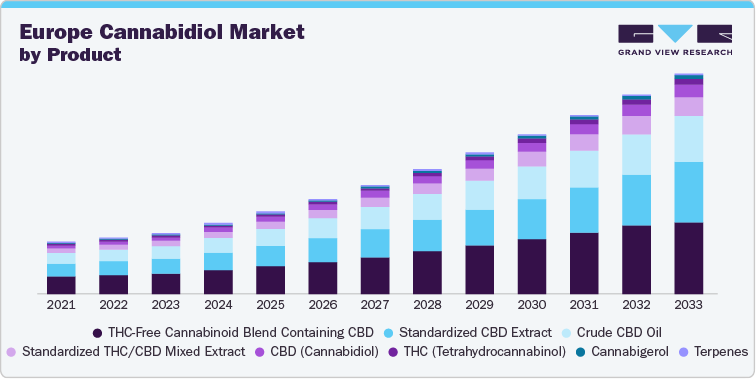
Crude CBD oil holds the highest revenue share in the European market primarily due to its role as a versatile intermediate product used across multiple downstream applications, including oils, edibles, topicals, and pharmaceutical formulations. Moreover, the expansion of EU-GMP certified production facilities and rising exports from countries such as Portugal and the UK are strengthening supply availability, further driving revenue growth.
Volume Trend Analysis (2021-2033)
The Europe CBD market exhibited strong growth in consumption volume, increasing from approximately 80K kg in 2025 to 215K kg by 2033.
This growth is driven by:
-
Expansion of low-dose, high-frequency consumption formats (edibles, beverages)
-
Increasing consumer penetration
-
Rising repeat usage, particularly for stress and sleep-related applications
A key structural shift is observed from:
- High-concentration, low-volume products → Mass-consumption formats
Country-Level Volume Insights
-
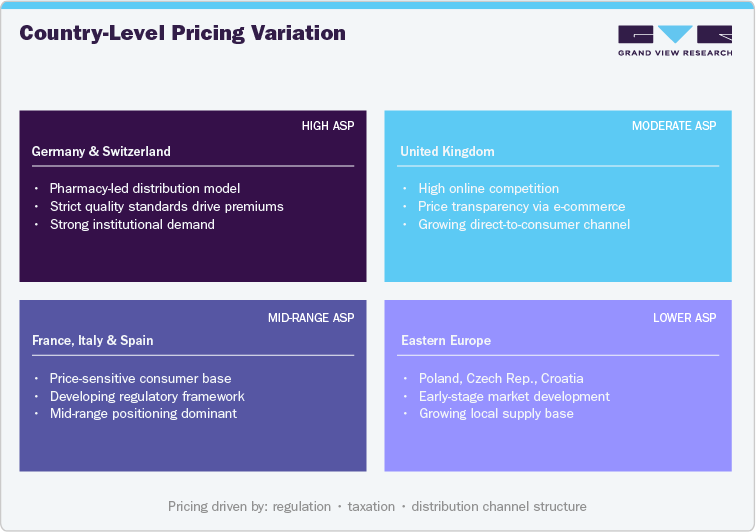
Germany remains the largest market, with volume of 35K kg by 2025, supported by pharmacy-led distribution and strong medical acceptance
-
UK is second dominant market, driven by wellness demand and online channel dominance with a CAGR of ~11 % from 2026 to 2033
-
France, Italy, and Spain are emerging high-growth markets driven by regulatory evolution and retail expansion
Consumer Trend and Behavior Analysis.
The market’s growth is closely linked to evolving consumer preferences, particularly the shift toward convenience, lifestyle integration, and low-risk consumption formats.
Segment Category
Sub-Segment
Consumption Trend
Key Drivers
Pricing Trend
Volume Impact
Key Insight
Product Type
Oils & Tinctures
Historically dominant; moderating growth
Dosing complexity, taste limitations
Declining
High base, declining share
Transitioning to alternative formats
Edibles (Gummies, Beverages)
Fastest growing
Convenience, discreet use, taste
Premium vs oils
Strong volume growth
Core driver of mass adoption
Topicals (Skincare)
Stable demand
Premium skincare integration
Premium
Moderate volume
High-value niche
Capsules & Pharma-grade
Steady growth
Clinical positioning
High premium
Low volume
Institutional demand
Emerging Formats
Rapid growth
Innovation, urban demand
Premium
Low base, high growth
Future expansion segment
Application
Stress / Sleep / Anxiety
Leading segment
Daily wellness needs
Moderate
High repeat usage
Drives recurring consumption
Pain Management
Stable demand
Aging population
Low sensitivity
Consistent base
Therapeutic usage
Wellness & Lifestyle
Fastest growing
Preventive health trend
High sensitivity
High incremental volume
Expands user base
Skincare
Niche
Beauty & personal care
Premium
Low volume
Value-driven segment
Distribution Channel
Online (D2C & Marketplaces)
Dominant & fastest growing
Accessibility, variety
Price pressure
Largest contributor
Drives volume scale
Retail (Pharmacies & Stores)
Credibility-focused
Regulation, trust
Higher ASP
Moderate
Supports premium pricing
Medical Channels
Limited but relevant
Prescription usage
Highest
Low
High-value niche
Country
Germany
Mature
Medical & pharmacy-led
High
Largest volume
Stable, structured demand
United Kingdom
Mature
Wellness, online driven
Moderate
High
Price-transparent market
France
Emerging
Regulation-driven
Mid
Growing
Price-sensitive demand
Italy & Spain
Developing
Retail expansion
Mid
Strong growth
Lifestyle-driven adoption
Netherlands
Mature
Innovation-led
High
Stable
Premium positioning
Rest of Europe
Early-stage
Awareness expansion
Low-Mid
Fastest growth
Future volume driver
Product Mix & Market Share
Crude CBD oil accounts for the largest share of the European market due to its role as a core intermediate across multiple downstream applications, including oils, edibles, topicals, and pharmaceutical formulations. Its scalability, combined with increasing EU-GMP certified production and export growth from countries such as Portugal and the UK, continues to strengthen supply availability.
Non-ingestible CBD products, particularly cosmetics and topicals, are emerging as a stable and compliant revenue stream due to fewer regulatory hurdles compared to ingestible formats. While oils and edibles remain key categories, stricter Novel Food regulations have increased compliance costs and slowed approvals. In contrast, cosmetics benefit from established EU regulatory frameworks, enabling faster commercialization.
This has led brands to increasingly prioritize topicals and skincare segments, supported by higher margins, stronger branding potential, and repeat purchase behavior.
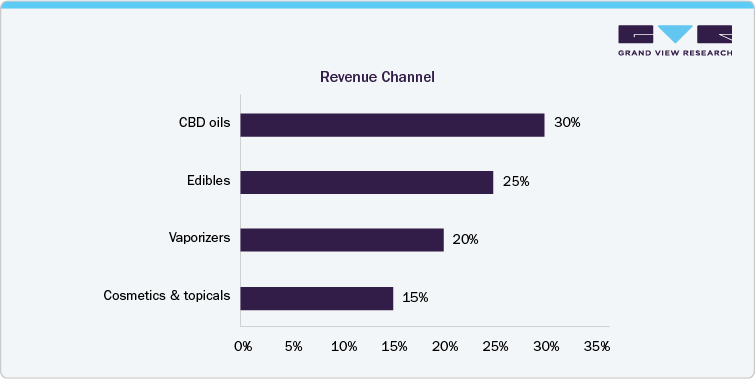
Product Type
Market Share
Growth Drivers
CBD Oils/Tinctures
30%
Core product category, still dominant for wellness
CBD Gummies/Edibles
25%
Discreet, flavored, and convenient
CBD Skincare & Cosmetics
15%
Anti-aging, acne care, luxury appeal
CBD Topicals/Balms
12%
Sports recovery, pain relief
CBD Beverages
10%
Functional drinks, coffee & wellness shots
Pricing (ASP) Analysis
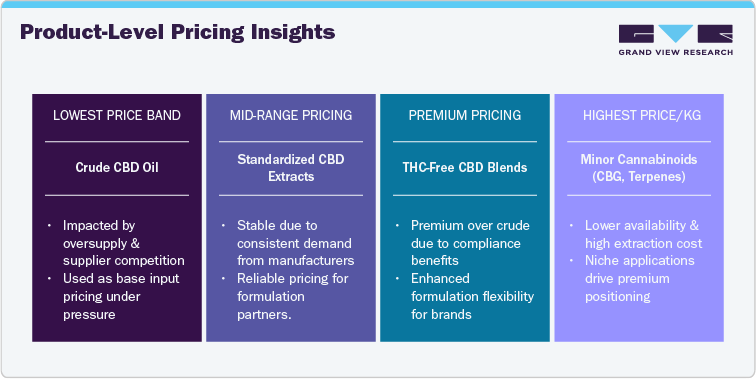
Average selling prices (ASPs) across Europe are witnessing a moderate decline in commoditized segments, such as crude CBD oil and bulk extracts, due to increasing supplier competition and market fragmentation.
However, value-added and branded products continue to maintain pricing stability, supported by:
-
Product differentiation
-
Premium positioning
-
Innovation in formulations
Key Pricing Insight
-
Volume growth is outpacing revenue growth in bulk segments
-
Premiumization is offsetting price erosion in finished products
Regulatory Landscape & Market Tolerance (2024/2025)
The European CBD market in 2025 is highly fragmented, with tolerance levels varying based on regulatory openness toward CBD, particularly ingestible. Countries such as Switzerland and the Czech Republic show high tolerance due to liberal policies, while markets such as the UK and Austria are commercially mature but still regulated. Most countries fall into a medium category with restricted ingestible use, whereas low-tolerance markets maintain stricter controls, limiting growth and product availability.
Tolerance Level
Markets
Very High
Switzerland, Czech Republic
High
United Kingdom, Austria, Luxembourg
Medium
Spain, France, Belgium, Netherlands, Germany, Denmark, Malta, Poland, Hungary, Croatia, Romania, Bulgaria, Greece, North Macedonia, Latvia, Estonia
Low
Ireland, Portugal, Italy, Slovenia, Slovakia, Cyprus, Lithuania, Finland, Sweden, Norway
Key Regulatory Insights
-
Novel Food approval remains critical for ingestible
-
EFSA dosage benchmark (~2 mg/day) influencing enforcement
-
Increasing scrutiny across retail, online, and cross-border trade
-
Need for strong compliance documentation and localized strategies
![gvr icn]()
GET A FREE SAMPLE
![gvr icn]()
This FREE sample includes market data points, ranging from trend analyses to market estimates & forecasts. See for yourself.
![gvr icn]()
NEED A CUSTOM REPORT?
We can customize every report - free of charge - including purchasing stand-alone sections or country-level reports, as well as offer affordable discounts for start-ups & universities.
Contact us now to get our best pricing.
![esomar icon]()
ESOMAR certified & member
![ISO]()
ISO Certified
We are GDPR and CCPA compliant! Your transaction & personal information is safe and secure. For more details, please read our privacy policy.






We are committed towards customer satisfaction, and quality service.
Client Testimonials

"The quality of research they have done for us has been excellent..."
ISO Certified