- Home
- »
- Market Trend Reports
- »
-
Sofosbuvir, Velpatasvir, And Voxilaprevir (Vosevi) Market: Patent Expiry Impact, Regulatory Landscape, And Competitive Outlook
![Sofosbuvir, Velpatasvir, And Voxilaprevir (Vosevi) Market: Patent Expiry Impact, Regulatory Landscape, And Competitive OutlookReport]()
Sofosbuvir, Velpatasvir, And Voxilaprevir (Vosevi) Market: Patent Expiry Impact, Regulatory Landscape, And Competitive Outlook
- Published: Oct, 2025
- Report ID: GVR-MT-100477
- Format: PDF/Excel databook
- No. of Pages/Datapoints: 120
- Report Coverage: 2024 - 2030
Overview
Vosevi, a combination therapy of Sofosbuvir, Velpatasvir, and Voxilaprevir, developed by Gilead Sciences, has played a pivotal role in the treatment of chronic hepatitis C. Its high efficacy across all six genotypes of the virus has contributed to its success in the antiviral market. As the patent expiration for its components approaches, the Vosevi market is on the brink of significant transformation. The upcoming patent cliffs, particularly the expiration of Sofosbuvir’s patent in 2024, will introduce competitive pressures and open the door to generic versions. This market shift will bring both challenges and opportunities, as generic versions and alternative treatments vie for market share, potentially reshaping the landscape of hepatitis C therapy.
Key Report Deliverables
-
Vosevi Market Landscape: Analyze the current Vosevi market size, growth drivers, and trends, focusing on the impact of patent expirations (Sofosbuvir in 2024) and the entry of generics.
-
Market Growth Forecast: Project future trends, highlighting opportunities in the generic space and assessing risks from increased competition as patents expire.
-
Regulatory and Market Barriers: Identify regulatory hurdles and market access issues that may impact the expansion of Vosevi, especially regarding generic entry in various regions.
-
Competitive Landscape: Examine key players in the Vosevi market, including Gilead Sciences and generics. Assess strategic moves, market share distribution, and competition from alternative treatments.
-
Regulatory Barriers: Detail challenges related to the approval and market access of Vosevi generics, focusing on pricing, reimbursement, and approval processes.
-
Strategic Implications: Evaluate strategies for Gilead Sciences to maintain market leadership, including differentiation, geographic expansion, and patient support programs.
Pipeline and Patent Cliff Analysis
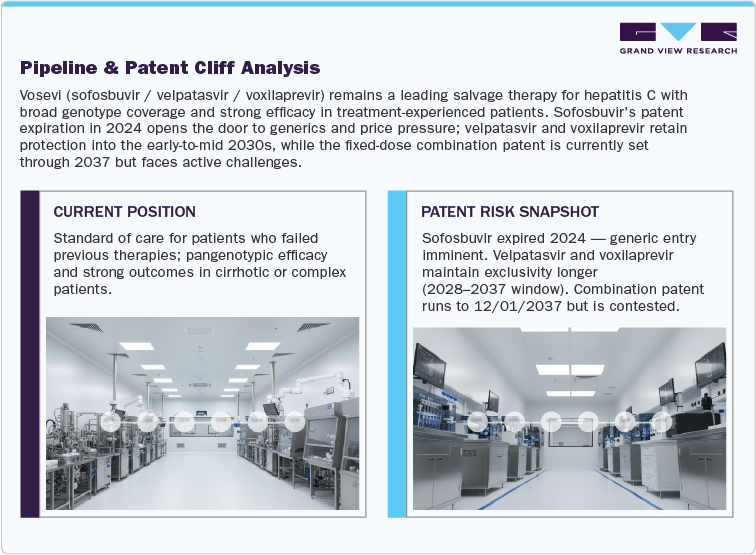
Vosevi, a combination of sofosbuvir, velpatasvir, and voxilaprevir, has solidified its position as a key treatment for hepatitis C, particularly in patients who have not responded to previous therapies. Approved by the FDA in 2017, Vosevi is used to treat all six major genotypes of the hepatitis C virus (HCV), offering a high cure rate for a wide range of patients, including those with cirrhosis or prior treatment failures.
Currently, no new therapies in late-stage development present a direct challenge to Vosevi's strong efficacy and broad genotype coverage. Alternatives like Mavyret (glecaprevir/pibrentasvir) from AbbVie and Zepatier (elbasvir/grazoprevir) from Merck have been on the market for a while but do not significantly outperform Vosevi, especially in the harder-to-treat populations.
Key Strengths of Vosevi
-
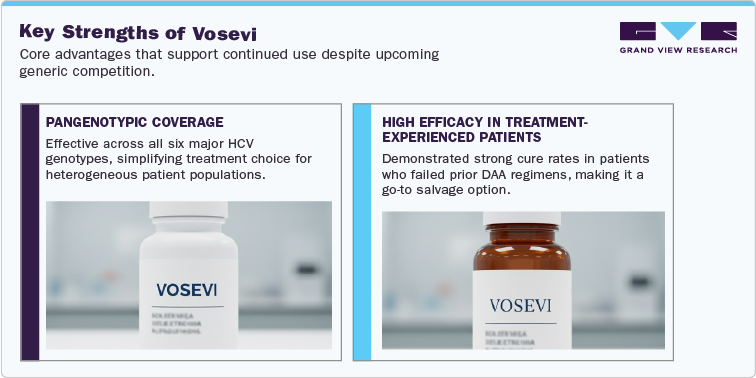
Pangenotypic treatment, covering all major HCV genotypes.
-
High efficacy in treatment-experienced patients.
-
Relatively simple treatment regimen (12-week course).
Even with these strengths, Vosevi faces competition not just from other existing therapies, but from emerging generic options once its patents begin to expire. Given that there are currently no new treatments positioned to replace Vosevi's comprehensive effectiveness, it remains a go-to treatment for a broad patient base, especially in complex cases.
Vosevi is protected by patents for each of its three components, but those protections will start to phase out in the coming years, creating a shift in the competitive landscape.
-
Sofosbuvir: The primary patent for sofosbuvir, one of the key components of Vosevi, expired in 2024. This opens the door for generic versions of sofosbuvir, which will directly affect the pricing and market share of Vosevi. Generic competition for sofosbuvir could lead to a reduction in Vosevi's market price, especially in regions where pricing is more sensitive to generic availability.
-
Velpatasvir and Voxilaprevir: Patents for these two components will last longer. Velpatasvir’s patent expires between 2028 and 2034, while voxilaprevir is protected until 2037. This means that while the combination therapy remains protected for longer in terms of these two agents, the loss of sofosbuvir’s exclusivity creates the potential for generic combinations that could erode Vosevi’s market share.
-
Combination Therapy Patent: The patent for the fixed-dose combination therapy (U.S. Patent No. 11,338,007) is set to expire on December 1, 2037. However, there are ongoing patent challenges, and the possibility of earlier generic entry could reduce this timeline. While the patent for the combination is still in effect for the next decade or so, generic versions of Vosevi could emerge sooner if any patent challenges succeed.
The timing of generic competition for Vosevi may be accelerated, depending on the outcome of ongoing litigations or regulatory decisions. This could impact Gilead’s market share and revenues as the market shifts towards more affordable generic alternatives.
Vosevi faces a mix of opportunities and challenges over the next decade. While the drug remains a strong player in the hepatitis C market, especially for difficult-to-treat cases, the impending expiration of key patents and the potential for generic competition will be significant factors shaping its market dynamics in the coming years. Stakeholders in the hepatitis C space will need to keep a close eye on patent expirations, regulatory developments, and market shifts as they plan for the future.
Current Market Scenarios
The Vosevi market is undergoing a significant transformation as the expiration of key patents approaches. Sofosbuvir’s patent, which expired in 2024, is expected to lead to the entry of generic versions, which will disrupt the current pricing model. Generic competition is anticipated to create downward pressure on prices, particularly in regions with cost-sensitive healthcare environments. As generic Sofosbuvir becomes available, it will affect the price of Vosevi, also impact Gilead Sciences’ revenue from the drug, especially in emerging markets where access to high-cost therapies has been limited.
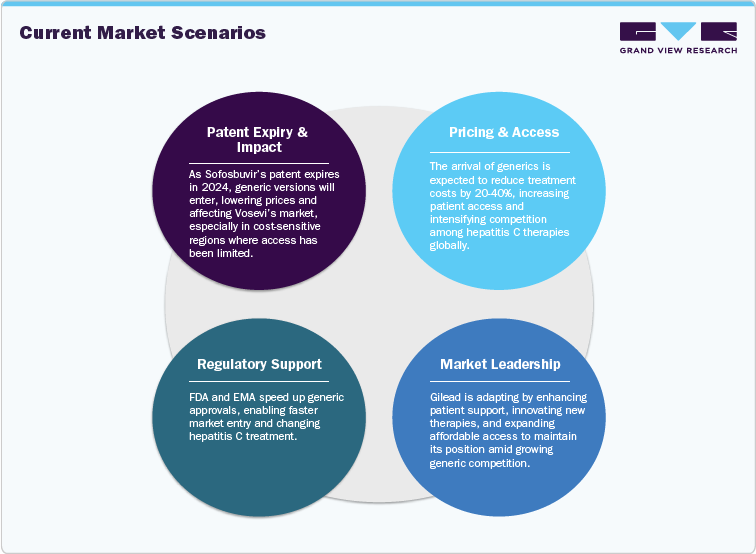
While Velpatasvir and Voxilaprevir's patents remain protected until 2028 and 2037, respectively, the market shift caused by the availability of generic Sofosbuvir will drive significant changes. The competition from generics is expected to lead to more affordable treatment options, increasing patient access to hepatitis C therapy in regions where cost has been a barrier. The introduction of generic Sofosbuvir will likely accelerate the erosion of Vosevi's market share, even as other treatments like Mavyret and Zepatier continue to compete in the market.
The regulatory landscape is also evolving in favor of generics, with agencies like the FDA and EMA facilitating quicker approvals for generic versions. This will likely speed up the entry of low-cost alternatives, further reshaping market dynamics. With generics priced 20-40% lower than branded versions, the adoption rate of these treatments will likely surge, especially in regions where cost containment is a priority. This will force Gilead to adjust its pricing and market strategies to retain its leadership position in the HCV treatment space.
For Gilead, the challenge will be in adapting to these changes while maintaining its leadership in the market. Strategies could include reinforcing brand loyalty through patient support programs, innovating with next-generation HCV therapies, and expanding access in regions with high demand for affordable treatment options. The competitive dynamics in the coming years will be shaped by generic market entry and the push for lower-cost treatments, which will ultimately lead to an expanded patient base but a more fragmented market share.
Market Dynamics
“Rising Hepatitis C Prevalence Drives Vosevi Market Growth”
The Vosevi market is driven by the increasing prevalence of hepatitis C, particularly in regions with high infection rates. The combination of Sofosbuvir, Velpatasvir, and Voxilaprevir continues to be a preferred treatment option for chronic HCV due to its high efficacy across all six major genotypes. This broad genotype coverage positions Vosevi as a key product in the HCV treatment market, especially for treatment-experienced patients who have failed prior therapies. The demand for such therapies is expected to remain strong in developed regions like North America and Europe, where healthcare infrastructure supports access to advanced antiviral treatments. Furthermore, emerging markets in Asia, Latin America, and Africa, with their increasing healthcare investments and rising patient awareness, present growth opportunities for Vosevi as access to HCV treatment improves.
“Patent Expiration and Generic Competition Limit Vosevi Growth”
Vosevi is facing significant challenges due to the expiration of Sofosbuvir’s patent in 2024, which will allow generic alternatives to enter the market. Generic Sofosbuvir is expected to be priced 20-40% lower than the branded product, directly affecting Vosevi’s price competitiveness, particularly in cost-sensitive regions. Although Velpatasvir and Voxilaprevir's patents are protected until between 2028 and 2037, the availability of generic Sofosbuvir will significantly impact the overall cost of the combination therapy, with the potential for generic versions of Vosevi entering the market shortly after. This will drive price competition, particularly in emerging markets, where price is a crucial factor for healthcare providers when choosing antiviral treatments.
The entry of generics will likely reduce Vosevi’s market share in regions with strong cost containment measures and more affordable alternatives. In developed markets such as the U.S. and Europe, pricing pressure from generics could limit Gilead’s flexibility to command premium prices, further complicating its position in the market. Additionally, the regulatory environment is becoming more favorable to generics, which could expedite the approval and availability of these alternatives, accelerating the decline of Vosevi’s market share.
“Opportunities in Indications, Formulations, and Emerging Markets for Vosevi Growth”
Despite the challenges posed by patent expiration and generic competition, Vosevi has specific growth opportunities. One key opportunity lies in expanding the drug’s indications. Vosevi is currently approved for chronic HCV infection, but there may be potential to explore its use in additional viral infections or co-infections. Clinical trials investigating new indications could provide a competitive edge for Vosevi, differentiating it from emerging generics.
Another opportunity is the development of next-generation formulations, such as extended-release versions or more convenient dosing regimens. These innovations could improve patient adherence and offer an advantage over generics that may not have the same convenient dosing schedule. Additionally, exploring combination therapies involving Vosevi could further enhance its therapeutic profile, especially in more complex cases of HCV infection or co-infections, making it more difficult for generics to match the drug’s comprehensive efficacy.
Expansion into emerging markets is another critical growth opportunity. Regions such as Asia, Latin America, and Africa are seeing improvements in healthcare infrastructure and access to treatment. As healthcare systems in these regions mature and government spending on health increases, biologics like Vosevi will become more accessible, potentially leading to higher adoption rates. However, Gilead will need to adapt its pricing and distribution strategies to fit the specific economic conditions of these markets to ensure market penetration and growth.
“Post-Patent Competition, Personalized Medicine, and Market Expansion Lift Vosevi Market”
-
Biosimilar Competition Post-Patent Expiry and Market Dynamics:
With the expiration of Sofosbuvir’s patent in 2024, generic alternatives will soon enter the market, increasing competition and driving prices down, particularly in price-sensitive regions. Gilead will need to adjust its pricing, marketing, and patient support strategies to maintain market share as generics gain traction. In addition to lower costs, the shift toward value-based pricing, where treatments are priced based on health outcomes, may also impact Vosevi’s position in the market.
-
Shift Towards Personalized Medicine and Vosevi’s Role:
Personalized medicine is becoming a key trend in HCV treatment, with advancements in genomics and biomarker identification enabling more tailored therapies. Vosevi could benefit from this trend by being incorporated into personalized treatment regimens based on patient-specific factors. This would help differentiate it from emerging biosimilars and maintain its position in the treatment algorithm, particularly for patients who require more specialized care.
-
Market Expansion in Emerging Markets:
Emerging markets present a significant growth opportunity for Vosevi as healthcare access improves. As government spending on healthcare increases and biologics become more accessible, Vosevi stands to benefit from the growing demand for effective antiviral treatments. However, to capture this opportunity, Gilead will need to adapt its pricing strategy and potentially partner with local healthcare providers to ensure the drug’s availability and affordability in these regions.
Overview of Alternative Therapeutics
Several alternative therapies are emerging in the Vosevi market, especially as generic versions of Sofosbuvir become available. One of the primary competitors is Mavyret (Glecaprevir/Pibrentasvir) from AbbVie. Mavyret is a pangenotypic treatment, effective across all major HCV genotypes, similar to Vosevi, but with a shorter treatment duration of 8 weeks compared to Vosevi’s 12-week regimen. This shorter treatment course, along with AbbVie’s competitive pricing strategy, makes Mavyret a strong alternative, particularly in price-sensitive regions where cost is a significant factor. Additionally, Zepatier (Elbasvir/Grazoprevir) from Merck, while more limited in its genotype coverage, remains an option for specific patient populations. Zepatier’s efficacy and shorter treatment duration of 12 weeks provide an attractive alternative in certain cases, especially when priced lower than Vosevi, though its limited flexibility in genotype coverage may limit its overall market share compared to Vosevi.
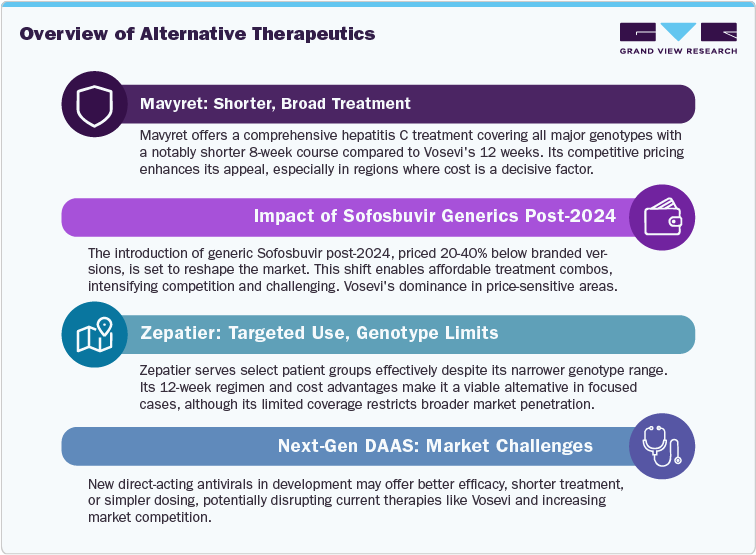
In addition to these treatments, the entry of biosimilars for Sofosbuvir following its patent expiration in 2024 will significantly impact the Vosevi market. These biosimilars are expected to offer similar efficacy to the branded drug but at a substantially lower price, making them a cost-effective alternative in markets with strict budget constraints. Furthermore, ongoing development of next-generation DAAs could introduce new treatment options that challenge Vosevi’s market share. These new therapies may offer similar or improved efficacy, shorter treatment regimens, or more convenient dosing, all of which could position them as attractive alternatives to Vosevi. As the market increasingly prioritizes cost-effectiveness and convenience, the entry of these competitive therapies will intensify pressure on Vosevi, particularly in price-sensitive and emerging markets where affordability is crucial.
Competitive Landscape
The competitive landscape for Vosevi is evolving as alternative therapies and generic entrants impact the hepatitis C (HCV) treatment market. While Mavyret (Glecaprevir/Pibrentasvir) from AbbVie offers a pangenotypic treatment with a shorter 8-week regimen, it is protected by patents that are open to challenges from 2027, with generic entry estimated around 2036. Zepatier (Elbasvir/Grazoprevir) from Merck, though limited in genotype coverage, remains an option for specific patient populations, with generic entry expected around 2031 DrugPatentWatch.
The expiration of Sofosbuvir’s patent in 2024 is a significant event, allowing generic versions of Sofosbuvir to enter the market. These generics are expected to be priced 20-40% lower than the branded product, increasing competition in cost-sensitive regions. While Velpatasvir and Voxilaprevir have patent protections extending into the early to mid-2030s, the availability of generic Sofosbuvir will enable the production of cost-effective combinations that could challenge Vosevi's market share.
Additionally, the development of next-generation direct-acting antivirals (DAAs) targeting novel viral proteins may provide more attractive options for patients, further intensifying competition for Vosevi. These new therapies could offer similar or improved efficacy with potentially shorter treatment durations or simpler dosing regimens, appealing to healthcare providers seeking alternatives to the current standard of care.
North America Sofosbuvir + Velpatasvir + Voxilaprevir (Vosevi) Market
The North America Vosevi Market remains significant, driven by the increasing demand for effective hepatitis C treatments. The U.S. healthcare system, with its favorable coverage through Medicare and private insurers, continues to support the use of Vosevi as a first-line treatment for chronic hepatitis C. The drug’s established clinical efficacy, particularly in treating patients who have failed previous therapies, solidifies its place in the treatment guidelines. However, the expiration of Sofosbuvir’s patent in 2024 will likely lead to the introduction of generic Sofosbuvir, driving price competition. This is especially impactful in the U.S., where the high cost of biologics is under scrutiny in ongoing healthcare reforms. While Vosevi’s strong clinical foundation will help maintain its relevance, insurers are increasingly looking for cost-effective alternatives, which will put pressure on pricing and market share in the region.
Europe Sofosbuvir + Velpatasvir + Voxilaprevir (Vosevi) Market
In the Europe Vosevi Market, the demand for hepatitis C treatments remains high, especially in countries with strong healthcare systems like Germany, France, and the UK. The adoption of direct-acting antivirals (DAAs) for HCV treatment continues to grow. However, with the expiration of Sofosbuvir’s patent in 2024, generic versions of Sofosbuvir are expected to enter the market, significantly impacting Vosevi’s pricing and market share, particularly in Southern and Eastern Europe, where cost containment is a priority. While Velpatasvir and Voxilaprevir patents will remain in effect for several years, the availability of generic Sofosbuvir will lead to a reduction in the overall cost of treatment regimens, challenging Vosevi’s position in these cost-sensitive regions. Despite this, Vosevi’s broad genotype coverage and strong clinical outcomes will help maintain its relevance, although price competition from generics will intensify.
Asia Pacific Sofosbuvir + Velpatasvir + Voxilaprevir (Vosevi) Market
The Asia Pacific Vosevi Market is seeing growth due to rising healthcare access in countries like China, Japan, and India. As healthcare infrastructure improves, demand for advanced treatments like Vosevi is increasing, particularly in developed markets like Japan, where access to HCV treatment is strong. Vosevi remains a preferred treatment due to its broad genotype coverage, which is critical in regions with diverse HCV genotypes. However, the introduction of generic Sofosbuvir post-patent expiration will significantly impact the market, particularly in emerging markets such as India and China, where cost is a key factor. As healthcare systems in these regions evolve, generics will likely gain traction, and Vosevi’s market share could decrease, especially as affordable alternatives enter the market. Despite these challenges, Vosevi’s proven clinical efficacy will continue to support its presence in developed markets, though pricing pressures will increase in emerging regions.
Latin America Sofosbuvir + Velpatasvir + Voxilaprevir (Vosevi) Market
The Latin America Vosevi Market is expanding as healthcare access improves and awareness of hepatitis C rises. Countries such as Brazil, Mexico, and Argentina are witnessing increased demand for hepatitis C treatments due to better healthcare infrastructure and rising patient awareness. However, cost sensitivity remains a major issue, and the entry of generic Sofosbuvir in 2024 will provide more affordable alternatives to Vosevi, potentially leading to a decline in its market share in the region. In cost-sensitive markets, healthcare systems are increasingly focused on finding more affordable treatments, and generic Sofosbuvir could be seen as a more viable option, putting pressure on Vosevi’s pricing and adoption. Despite these challenges, Vosevi’s proven clinical outcomes and ability to treat complex cases of hepatitis C will help it maintain a strong presence, especially as biologic access improves in the region.
Middle East and Africa Sofosbuvir + Velpatasvir + Voxilaprevir (Vosevi) Market
The Middle East and Africa Vosevi Market is growing due to improvements in healthcare infrastructure and rising awareness of hepatitis C. In developed markets like the UAE and Saudi Arabia, there is increasing demand for Vosevi as a preferred treatment due to its efficacy in treating chronic hepatitis C. However, in other parts of the region, particularly in Sub-Saharan Africa and parts of North Africa, cost-sensitive healthcare systems may limit access to expensive treatments like Vosevi. The introduction of generic Sofosbuvir will increase competition in these markets, driving price competition and potentially limiting Vosevi’s market share in regions where affordability is a primary concern. Despite these challenges, the growing healthcare investments in the region and Vosevi’s established clinical outcomes will continue to support its market presence, although generics will likely impact pricing flexibility and adoption, particularly in cost-sensitive countries across Africa and the Middle East.
Analyst Perspective
The Sofosbuvir + Velpatasvir + Voxilaprevir (Vosevi) Market is at a critical juncture, with impending generic competition expected to reshape the landscape. While Vosevi’s proven efficacy across all HCV genotypes continues to support its strong market presence, the expiration of Sofosbuvir's patent in 2024 will pave the way for lower-cost generics, particularly in price-sensitive regions like Asia Pacific, Latin America, and the Middle East. The competition from established alternatives like Mavyret and Zepatier, combined with the entry of generics, will likely pressure Vosevi’s pricing and market share, especially in emerging markets where cost containment is a priority. However, its broad genotype coverage, established clinical outcomes, and position in treatment guidelines will help maintain its relevance in developed markets like North America and Europe, though pricing flexibility will be constrained. As generic Sofosbuvir and alternative DAAs gain traction, Vosevi’s success will depend on Gilead’s ability to adapt its pricing strategy, expand in underserved regions, and potentially innovate with next-generation formulations or combination therapies to retain its competitive edge.
Case Study (Recent Engagement): Keytruda Patent-Cliff & Price- Erosion Impact Model
PROJECT OBJECTIVE
To evaluate the potential revenue, price, and patient access implications of Keytruda’s 2028 patent cliff, incorporating biosimilar entry dynamics, country-specific adoption curves, and Merck’s lifecycle defense strategies (remarkably the subcutaneous formulation). The goal was to provide the client with a transparent, scenario-based model to anticipate outcomes and inform strategy
GVR SOLUTION
-
Built a bottom-up commodity-flow and analogue-based model, anchored on Merck’s $29.5B Keytruda sales in 2024.
-
Integrated jurisdictional LOE timelines (EU mid-2028, U.S. 2028-2029 pending litigation outcomes).
-
Modeled biosimilar adoption S-curves calibrated to oncology antibody analogues (EU faster via tenders, U.S. slower via contracting).
-
Applied price-erosion benchmarks (EU -15-30% Yr-1, deepening to -45-60% by Yr-3; U.S. -10-25% net decline over same horizon).
-
Layered lifecycle defenses (SC uptake assumptions of 25-40% of innovator units, combo refresh, contracting) to quantify buffers.
-
Delivered outputs as a dynamic Excel scenario tool and a management-ready PPT deck with revenue bridges, sensitivity tornadoes, and SC migration visuals.
IMPACT FOR CLIENT
-
Enabled the client to quantify downside vs. defense-optimized revenue trajectories:
-
Base case: 30-40% global revenue decline by Year-3 post-LOE.
-
Downside: 45-55% decline in tender-heavy markets.
-
Defense-optimized: Contained erosion to ~-20-25% with strong SC adoption.
-
-
Gave the client a clear view of which markets drive early erosion (EU) and where strategic contracting or SC migration can preserve share (U.S.).
-
Equipped decision-makers with a playbook of watch-points (tender concentration, litigation outcomes, SC IP coverage, combo pipeline) to guide commercial strategy.
-
Provided a transparent methodology that could be presented to boards/investors with evidence-backed assumptions
WHY THIS MATTERS
-
Keytruda is the world’s best-selling cancer drug, representing nearly one-third of Merck’s revenue.
-
Patent expiry will reshape both Merck’s earnings profile and global oncology access dynamics.
-
Payers and governments stand to benefit from biosimilar entry through lower costs, but manufacturers need to manage cliff risk while capturing upside from lifecycle innovations.
-
Understanding how quickly revenues erode and how patient access expands post-biosimilar is critical for:
-
Biopharma companies (strategic planning, pipeline prioritization).
-
Investors (valuing Merck’s cash flows beyond 2028).
-
Payers and policymakers (budgeting for oncology drug spend).
-
A robust patent cliff model helps clients navigate the dual challenge of price erosion and patient expansion, ensuring strategies are grounded in real-world benchmarks.
![gvr icn]()
GET A FREE SAMPLE
![gvr icn]()
This FREE sample includes market data points, ranging from trend analyses to market estimates & forecasts. See for yourself.
![gvr icn]()
NEED A CUSTOM REPORT?
We can customize every report - free of charge - including purchasing stand-alone sections or country-level reports, as well as offer affordable discounts for start-ups & universities.
Contact us now to get our best pricing.
![esomar icon]()
ESOMAR certified & member
![ISO]()
ISO Certified
We are GDPR and CCPA compliant! Your transaction & personal information is safe and secure. For more details, please read our privacy policy.






We are committed towards customer satisfaction, and quality service.
Client Testimonials

"The quality of research they have done for us has been excellent..."
ISO Certified