
- Home
- »
- Electronic & Electrical
- »
-
U.S. Television Market - Brand Share LandscapeGVR Report cover
![U.S. Television Market - Brand Share LandscapeReport]()
U.S. Television Market - Brand Share Landscape
Report Overview
The U.S. television market is increasingly shaped by the convergence of traditional viewing and streaming-driven consumption. Despite the prevalence of mobile devices, Americans continue to invest in large-screen TVs for living rooms and home theaters, with LED and LCD models remaining dominant due to their affordability and reliability. Mid-range brands like TCL, Vizio, and Hisense have multiplied, offering value-for-money options that appeal to the budget-conscious segment, especially in suburban and first-time homebuyer households.
Consumers are upgrading to OLED, QLED, and Mini-LED models at the premium end to access sharper contrast, deeper blacks, and higher resolutions for 4K and 8K content. Samsung’s Neo QLED, LG’s OLED Gallery series, and Sony’s Bravia XR have seen strong adoption among home theater enthusiasts and tech-savvy buyers. Interestingly, sales are increasingly driven by bundles with streaming subscriptions or smart-home integrations, signaling a shift from mere display performance to connected entertainment experiences.
Current trends also reflect a growing interest in energy-efficient and smart TVs. Voice control, AI-based picture optimization, and built-in streaming apps are becoming standard expectations. At the same time, the resale and upgrade cycle has shortened slightly, as younger buyers replace older models every 3–4 years to stay current with streaming and gaming technology, creating a dynamic mix of budget and premium demand across the U.S. market.

U.S. Brand Share Analysis: market share, 2021 To 2025 (in %)
Rank
Brand Name
Market Share,
2021 (in %)Market Share,
2025 (in %)#1
Samsung
27.05%
36.14%
#2
LG
%
%
#3
Hisense
%
%
#4
TCL
%
%
#5
Sony
%
%
#6
Vizio
%
%
#7
ONN
%
%
#8
Insignia
%
%
#9
Element
%
%
#10
Philips
%
%
Note: This trend report features an extensive brand share analysis covering 28 leading and emerging TV brands in U.S., tracked annually from 2021 through 2025.
Note: This trend report features an extensive brand share analysis covering 28 leading and emerging TV brands worldwide, tracked annually from 2021 through 2025.
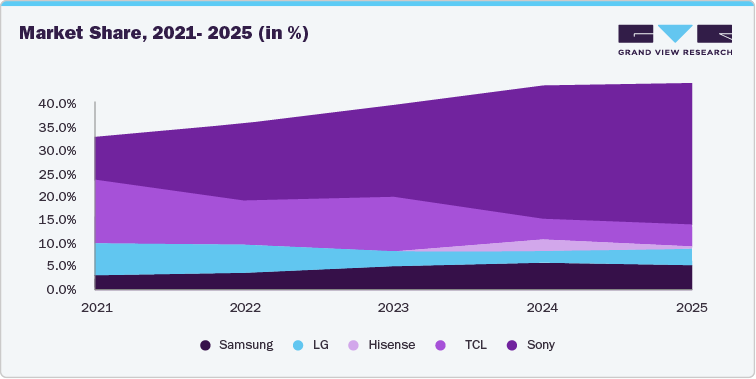
Samsung’s dominance in the U.S. TV market has grown consistently, while LG’s position has gradually diminished over recent years.
Over this period, Hisense and TCL have shown slow but steady improvement, with TCL especially advancing in the most recent years, owing to more competitive offerings.
Sony’s role remains stable and comparatively smaller. These shifts reflect the expanding presence of certain brands, increased competition, and evolving consumer preferences for advanced features and larger screen sizes.
Chinese brands, particularly TCL, have achieved noticeable gains recently due to their competitive pricing and evolving product lineup. Hisense has also grown, though more modestly, and Sony’s position has stayed relatively unchanged.
This dynamic reflects how shifting consumer interests, especially for advanced technology and larger screens, have influenced brand momentum.
Strategies And Recent Development
In the U.S. television market, brands are shifting strategies to respond to a streaming-first audience, price-sensitive households, and rising demand for connected home entertainment. Competition is increasingly shaped by software ecosystems, retail power, and affordability rather than hardware alone.
Samsung continues to lead with its expansion of Neo QLED and OLED lines powered by advanced AI technology. It focuses on delivering premium picture quality, larger displays, and immersive viewing experiences enhanced by partnerships with sports networks like ESPN.
LG is focused on deepening its presence in the premium segment by promoting OLED for home cinema users and expanding features for gamers, including low-latency modes and NVIDIA G-Sync. A major part of its U.S. strategy includes integrating ThinQ AI with major smart home platforms like Google Home and Amazon Alexa to stay relevant in connected households.
TCL and Hisense are rapidly gaining U.S. market share by combining aggressive pricing with premium features such as Mini-LED backlighting and high refresh rate displays. Their growth is strongly tied to deep retail partnerships especially with Walmart, Best Buy, and Costco-which dominate TV distribution in the country. According to a December 2022 article by OpenBrand, Walmart alone accounts for just over 37% of total U.S. TV sales, while Walmart and Best Buy together represent nearly two-thirds of all units sold. By bundling Google TV and Roku OS for seamless streaming integration, TCL and Hisense have positioned themselves as the top value choices for American households seeking big-screen smart TVs without premium brand pricing.
Vizio and Walmart’s ONN brand are competing through value-driven strategies. Vizio is doubling down on SmartCast and advertising-based streaming revenue, while ONN is rapidly scaling share in the sub-USD 400 price segment by offering ultra-low-cost smart TVs. Both brands are capitalizing on economic conditions where U.S. buyers prioritize price over brand prestige.
Across the U.S. market, brands are also rethinking energy efficiency, durability, and software longevity as purchase decision factors. Software updates, OS stability, and app support are now as important as display quality, reflecting how television brands transition from hardware sellers to long-term digital platforms. The American Customer Satisfaction Index (ACSI) also highlights “energy efficiency” and “reliability (durability)” among key drivers of consumer satisfaction in televisions-factors that brands can leverage to win loyalty.

TV Ownership, By Brand in the U.S., in 2023
The 2023 TV ownership data highlights the dominance of leading brands in the U.S.
-
Samsung is the clear market leader, present in roughly one-third of households, followed by LG and Vizio with strong but smaller penetration.
-
Sony, Hisense, and TCL maintain solid shares but remain secondary choices, reflecting both long-standing brand loyalty and the influence of newer, value-focused entrants.
-
Samsung’s growing lead is fueled by product innovation, aggressive marketing, and extensive retail partnerships.
-
LG’s strength lies in its premium OLED and smart TV offerings, while Vizio appeals to price-conscious consumers through value-oriented models.
-
TCL and Hisense continue to expand by providing feature-rich yet affordable TVs, leveraging both online distribution and promotional strategies.
Overall, the U.S. TV market remains competitive, driven by evolving technology preferences, differentiated product strategies, and changing consumer segments. Leading brands retain their dominance through wide product portfolios and the ability to meet American households’ expectations for quality, innovation, and value, while tier-two and budget brands push for greater share through affordability and targeted features.
Impact of Tariffs on the U.S. Television Market Share
Tariffs on electronics imported from China have significantly reshaped brand competition in the U.S. TV market. Since over 80% of TVs sold in the U.S. are manufactured in China or rely on Chinese components, tariff policies directly influence pricing strategies and brand positioning. The 2018–2020 U.S.–China tariff waves raised import costs on TV components from 7.5% to as high as 25%, forcing brands to adapt in different ways:
-
Premium brands like Samsung and LG shifted production out of China to avoid tariffs, relocating TV assembly to Vietnam, Mexico, and India. This move helped them protect margins and maintain price stability in the premium segment.
-
Budget brands like TCL and Hisense were hit harder, as they depend heavily on Chinese manufacturing. However, they responded by increasing local assembly in Mexico to continue offering low-cost TVs and protect U.S. market share.
-
Retailer brands like Walmart’s ONN gained share during tariff periods by offering low-cost imported or rebranded models, absorbing some tariff costs to remain under the $300–$400 price threshold favored by U.S. consumers.
-
The tariffs also accelerated competition on U.S.-Mexico supply chains, making Mexico a major TV assembly hub serving the U.S. market under USMCA trade rules.
Market Share Impact from Tariffs
U.S. Brand Share Impacts by Tariffs
Brand Name
Impact
Samsung & LG
Maintained share due to the rapid shift of production out of China
Hisense & TCL
Short-term tariff disruption, but rebounded and gained share after moving production to Mexico.
Vizio
Benefited from Mexico sourcing-kept a strong hold in the mid-range U.S. market.
Walmart ONN
Gained U.S. unit share due to price-first strategy
Sony
Minor impact-already produced many TVs outside China
-


Customize this report to your needs - add regions, segments, or data points, with 20% free customization.
Or view our licence options:


ISO 9001:2015 & 27001:2022 Certified
We are GDPR and CCPA compliant! Your transaction & personal information is safe and secure. For more details, please read our privacy policy.


