Active Wound Care Market Size Worth $2.2 Billion By 2030
Active Wound Care Market Growth & Trends
The global active wound care market size is anticipated to reach USD 2.2 billion by 2030, according to a new report by Grand View Research, Inc. The market is expected to expand at a CAGR of 4.9% from 2025 to 2030. The increasing prevalence of chronic and acute wounds, rapidly aging population, rising number of diabetic patients,, and surge in research and development activities are the major factors driving the market.
The rising demand for skin grafts is a primary driver of market expansion. Burn care and treatment have recently changed to a more holistic strategy that focuses not only on healing from burn injury but also on enhancement in long-term function and shape of the healed lesion, as well as the quality of life. As a result of this trend, the need for grafting and other substitutes in the treatment and management of acute burns has increased and continues to rise.
Skin grafts are commonly utilized on partial and full-thickness burns and play a significant role in burn injury treatment. Furthermore, these grafts give a more intact extracellular matrix, which benefits wound healing. Because of the existence of a foundation membrane, skin grafts allow for efficient re-epithelization and provide greater control over scaffold composition. In terms of absorbency and frequency of dressing change, it also outperforms other dressing materials. The aforementioned benefits are expected to fuel the market's overall expansion.
Furthermore, there are several growth factors known to impose significant effects on surgical use, including PDGF, VEGF, FGF, epidermal growth factor (EGF), keratinocyte growth factor (KGF), transforming growth factor-beta (TGF-), granulocyte-macrophage colony-stimulating factor (GM-CSF), and others, due to advancements in genetic engineering and biological technology. Growth factors attract cells into wounds, boost their proliferation, and have a great impact on extracellular matrix deposition. It has led to statistically significant improvements in tissue repair. Such factors are contributing to market growth.
 Request a free sample copy or view report summary: Active Wound Care Market Report
Active Wound Care Market Report Highlights
-
Based on product, the biomaterials segment dominated the market and accounted for a revenue share of 44.4% in 2021, owing to an increase in research and development and the launch of novel products
-
Based on application, the chronic wound segment is likely to witness the fastest growth over the forecast period, owing to an increase in the number of diabetic foot ulcers and pressure ulcers
-
Based on end-use, the hospital segment dominated the market, owing to the increasing number of admissions for wound injuries and the developing healthcare infrastructure
-
North America dominated the market with the highest revenue share of more than 59.0% in 2021 owing to the large presence of key players and rising adoption of advanced active wound care products
Active Wound Care Market Segmentation
Grand View Research has segmented the global active wound care market based on product, application, end-use, and region:
Active Wound Care Product Outlook (Revenue, USD Million, 2018 - 2030)
-
Biomaterials
-
Skin-substitutes
-
Biological Skin-substitute
-
Allograft
-
Xenograft
-
Others
-
-
Synthetic Skin-substitute
-
-
Growth Factors
Active Wound Care Application Outlook (Revenue, USD Million, 2018 - 2030)
-
Chronic Wounds
-
Diabetic foot ulcers
-
Pressure ulcers
-
Venous leg ulcers
-
Other chronic wounds
-
-
Acute Wounds
-
Surgical & traumatic wounds
-
Burns
-
Active Wound Care End-use Outlook (Revenue, USD Million, 2018 - 2030)
-
Hospitals
-
Specialty Clinics
-
Home Healthcare
-
Others
Active Wound Care Regional Outlook (Revenue, USD Million, 2018 - 2030)
-
North America
-
U.S.
-
Canada
-
-
Europe
-
Germany
-
U.K.
-
France
-
Italy
-
Spain
-
-
Asia Pacific
-
Japan
-
China
-
India
-
Australia
-
South Korea
-
-
Latin America
-
Brazil
-
Argentina
-
Mexico
-
Colombia
-
-
Middle East & Africa
-
South Africa
-
Saudi Arabia
-
UAE
-
List of Key Players of the Active Wound Care Market
-
Smith & Nephew
-
MiMedx
-
Tissue Regenix
-
Organogenesis Inc.
-
Acell Inc.
-
Integra Life Sciences
-
Solsys Medical
-
Osiris Therapeutics Inc.
-
Cytori Therapeutics Inc.
-
Human BioSciences
-
Wright Medical Group N.V

GET A FREE SAMPLE

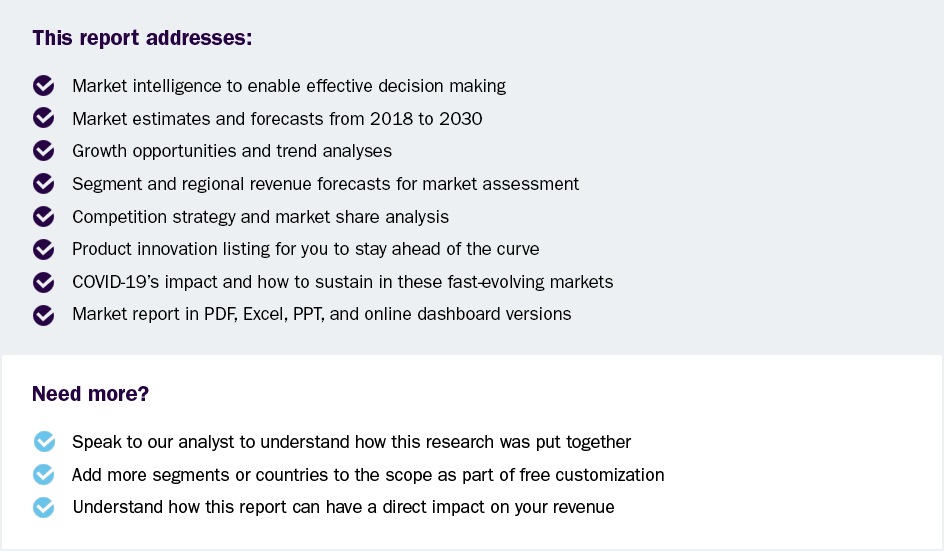
This FREE sample includes market data points, ranging from trend analyses to market estimates & forecasts. See for yourself.

NEED A CUSTOM REPORT?
We offer custom report options, including stand-alone sections and country-level data. Special pricing is available for start-ups and universities.
Request Customization