Americas Dietary Supplements Market: Unlocking Country-Wise Opportunities in a Preventive Health–Driven Decade
The Americas dietary supplements market represents one of the most structurally resilient and opportunity-rich segments within the global health and wellness industry. The market has transitioned from short-term pandemic-driven demand spikes to a sustained, long-term growth trajectory, supported by rising preventive healthcare adoption, aging populations, lifestyle-related health challenges, and expanding access through omnichannel distribution.
Between 2026 and 2033, the region is expected to record steady growth across vitamins & minerals, sports nutrition, probiotics, herbal supplements, and condition-specific formulations. While the United States continues to dominate in terms of market value and innovation, Latin American markets, particularly Brazil, Mexico, Argentina, and Peru, are emerging as high-growth opportunity centers due to improving consumer awareness and expanding middle-income populations.
Market Evolution and Structural Shifts
From Supplement Consumption to Preventive Health Management
The report on the Global dietary supplements market highlights a clear structural evolution in the American market:
-
Supplements are increasingly viewed as preventive health tools, not discretionary wellness products.
-
Demand is shifting toward science-backed, condition-specific, and personalized formulations.
-
Consumers are demonstrating higher willingness to pay for quality, safety, and clinical credibility, especially in North America.
Across the region, supplements addressing immunity, bone and joint health, digestive health, metabolic health, and mental well-being have shown strong and consistent uptake.
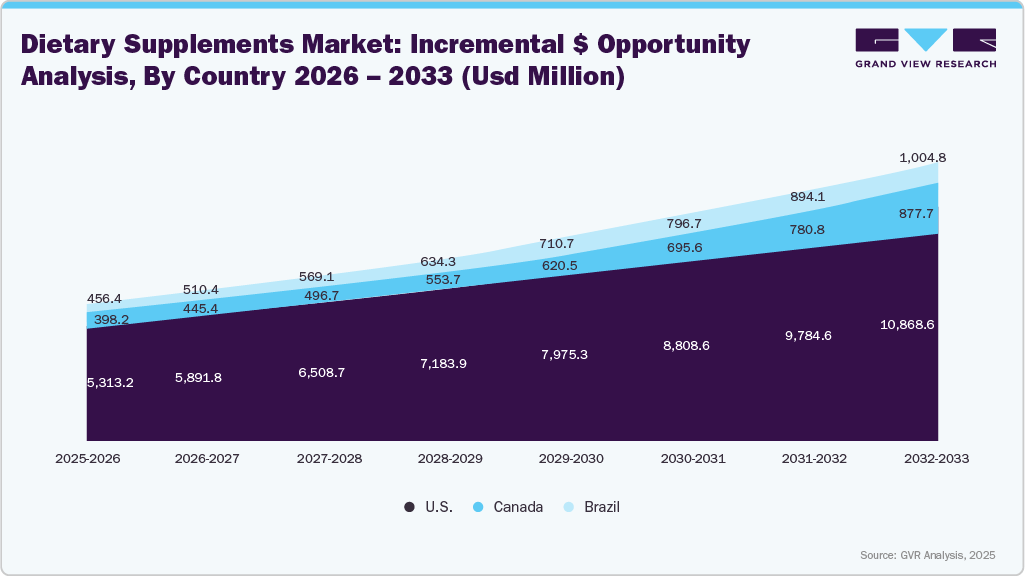
United States: Value Expansion Through Premiumization
The U.S. dietary supplements market was valued at USD 68.74 billion in 2025 and is estimated to grow at a CAGR of 8.5% from 2025 to 2033. The U.S. dietary supplements industry reflects a strong and growing interest in health and wellness across generations. With an increasing number of Americans adopting active lifestyles, there has been a surge in demand for protein powders, amino acids, and performance-boosting supplements.
Consumption Patterns:
-
A significant share of U.S. adults are regular supplement users, with multivitamins, vitamin D, vitamin C, omega-3s, and probiotics among the most frequently consumed products.
-
According to GVR analysis, daily or near-daily usage is common, particularly among consumers aged 35+.
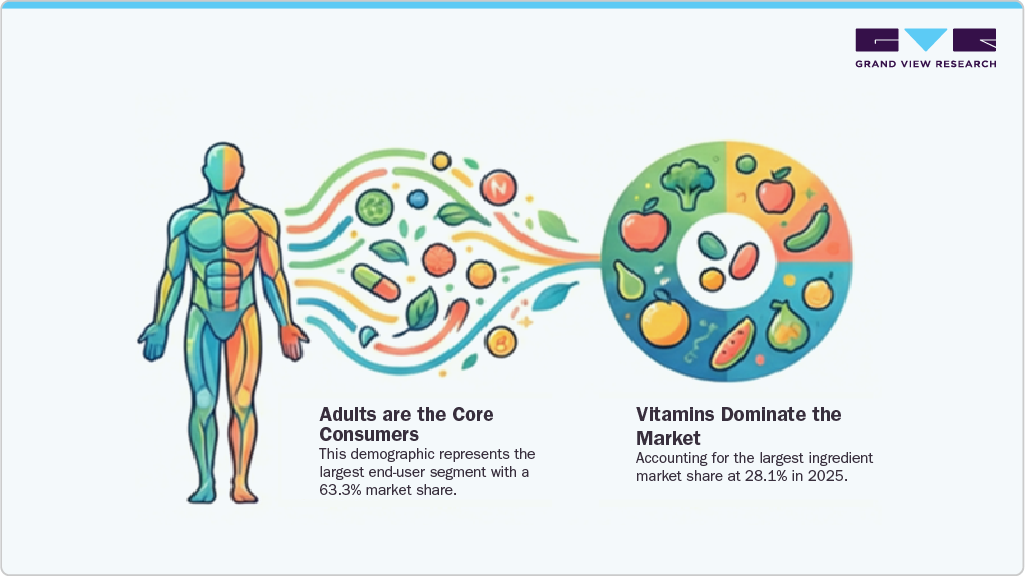
Purchase Drivers:
-
Clinical backing and scientifically supported claims
-
Clean-label attributes (non-GMO, organic, allergen-free)
-
Convenience formats such as gummies, softgels, and powders
Channel Behavior:
-
E-commerce and subscription models are increasingly preferred for repeat purchases
-
Pharmacies and mass retailers remain key trust anchors
Opportunity Implication (2026–2033):
Growth will be driven by premiumization, personalization, and adherence-focused solutions, rather than first-time adoption.
Canada: Trust-Led and Regulation-Driven Growth
The Canada dietary supplements market is expected to grow at a CAGR of 9.4% from 2026 to 2033. Canadians are becoming more health-conscious, and there is a growing trend towards preventive healthcare. People are increasingly seeking ways to maintain and improve their health, and dietary supplements are viewed as a convenient and accessible means to support overall well-being. This heightened health consciousness has led to a greater demand for vitamins, minerals, herbal extracts, and other dietary supplements.
Consumption Patterns:
-
Canadian consumers show high consistency in supplement intake, particularly for vitamins, minerals, and herbal products.
-
Supplements addressing bone health, immunity, and digestion show strong repeat purchase behavior.
Trust & Regulation:
-
Health Canada approval and product licensing significantly influence buying decisions.
-
Consumers demonstrate lower tolerance for exaggerated claims, favoring credibility and safety.
Opportunity Implication (2026-2033):
Brands that emphasize regulatory compliance, clinical validation, and sustainability are better positioned for long-term loyalty.
Brazil: Education-Driven Adoption and Value Sensitivity
Rising consumer concerns related to gut health, coupled with the increasing demand for dietary fibers to prevent constipation, cramps, bloating, and irritable bowel syndrome, are anticipated to drive the demand for probiotics in Brazil in the coming years.
Consumption Patterns:
-
Brazil has one of the highest adoption rates of sports nutrition in the region.
-
Protein powders, amino acids, and energy-related supplements show high repeat usage.
-
Vitamins are widely consumed as part of daily routines.
Comparative Opportunity Outlook:
|
Country |
Market Maturity |
Growth Potential |
Primary Opportunity Driver |
|
United States |
Very High |
Moderate |
Premiumization & personalization |
|
Canada |
High |
Moderate |
Regulatory trust & preventive health |
|
Mexico |
Medium |
High |
Volume expansion & affordability |
|
Brazil |
Medium–High |
Very High |
Sports nutrition & lifestyle adoption |
|
Argentina |
Medium |
High |
Digital commerce & localized offerings |
|
Peru |
Low |
Very High |
Early-stage category development |
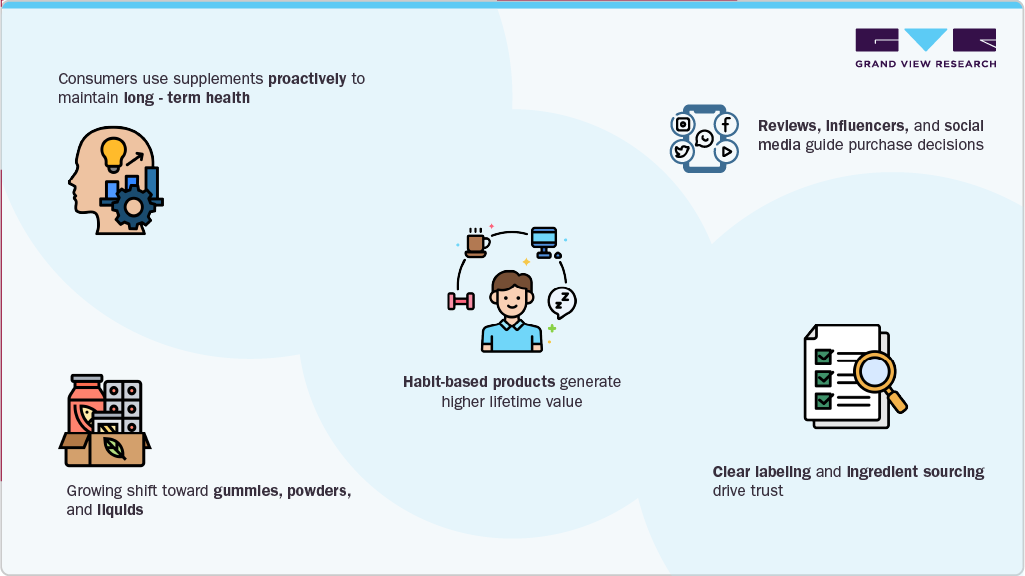
Behavioral Drivers Shaping Demand:
The following behavioral drivers will shape demand across the Americas:
Two major trends are defining "trust" in 2025:
-
GMP Certification: In January 2025, a new GMP-certification program was launched in the U.S. to help brands establish manufacturing quality and navigate complex regulatory requirements.
-
Sustainability: Consumers are increasingly avoiding brands that use harmful packaging. A significant majority of older consumers are now willing to pay more for eco-friendly packaging. Brands like NOW Foods are leading the way by partnering with TerraCycle to provide recycling services for their supplement packaging, turning environmental responsibility into a competitive advantage.
The Multi-Channel Sales Funnel: Where to Find Your Customers
If you want to generate leads, you must be where the consumers are. While the majority of sales still occur through offline stores, where consumers trust the expert guidance of staff in specialty shops, the online channel is growing at the fastest rate.
Amazon remains the giant in the room, with reports indicating that the majority of all supplement online sales now occur on the platform. However, lead generation is also thriving on specialized e-commerce sites like iHerb or brand-owned portals, which offer deeper product education and subscription models that build long-term loyalty.
Lessons from the Industry Titans
The market leaders are currently focusing on diversification and consumer education to stay ahead:
-
Bayer AG (May 2024): Launched a social media campaign featuring NFL star Julian Edelman to combat wellness misinformation, providing honest narratives to counter unrealistic claims found online.
-
Vitanergy Health (August 2025): Released three new clean-label, vegan supplements specifically for women’s wellness, focusing on the "clean-label" trend that has become non-negotiable for modern buyers.
-
Kerry Group (February 2025): Released "Supplement Taste Charts" to help manufacturers align with evolving flavor preferences, proving that in 2025, if a product doesn't taste good, it won't sell.
The Verdict for 2025
The Americas' dietary supplements market is no longer a "luxury" for the few; it is a necessity for the many. To successfully generate leads and grow a brand in this space, you must move beyond the bottle.
The future belongs to brands that:
1. Embrace new formats: Move into gummies, liquids, and on-the-go powders.
2. Target specific needs: Focus on "companion" categories like GLP-1 support or specialized life stages like prenatal and geriatric care.
3. Lead with transparency: Use GMP certifications and sustainable packaging to build a bridge of trust with the skeptical consumer.
Conclusion
The Americas' dietary supplements market has evolved into a preventive health-driven and structurally resilient industry, moving beyond pandemic-led demand toward sustained long-term growth. Between 2026 and 2033, expansion across vitamins and minerals, sports nutrition, probiotics, and condition-specific supplements will be fueled by aging populations, rising health awareness, and lifestyle-related health challenges. While the United States continues to lead in market value through premiumization and personalization, Latin American markets, particularly Brazil, Mexico, Argentina, and Peru, are emerging as high-growth opportunity centers supported by expanding middle-income populations and improving access to supplements.
Looking ahead, consumer trust and behavior will define competitive success. Demand is increasingly shaped by clean label formulations, clinical credibility, sustainable packaging, and convenient formats such as gummies, liquids, and powders. At the same time, omnichannel engagement spanning pharmacies, specialty stores, and rapidly growing ecommerce platforms will be critical for scale and loyalty. Brands that align product innovation with preventive health needs, transparency, and education will be best positioned to capture long-term value in a market where dietary supplements have become a daily necessity rather than a discretionary purchase.