Artificial Intelligence in GCC Healthcare Transformation from Smart Hospitals to Intelligent Health Systems
Introduction
Over the past decade, healthcare systems across the Gulf Cooperation Council (GCC) have undergone a significant transformation. Smart hospitals, paperless clinics, and virtual care platforms have progressed from pilot initiatives to core components of national healthcare infrastructure. As governments in the United Arab Emirates (UAE), Saudi Arabia, Bahrain, Qatar, Kuwait, and Oman advance Vision 2030 and other national transformation agendas, there is growing recognition that healthcare systems must evolve into intelligent, connected, and data-driven ecosystems.
Artificial intelligence (AI) and automation are central to this evolution, offering the potential to improve operational efficiency, improve clinical workforce shortages, and address the rising burden of chronic diseases. Market growth is further supported by the rapid expansion of digital health infrastructure, increasing adoption of telemedicine and remote care models, sustained government investments, and the rollout of national AI strategies across the region.
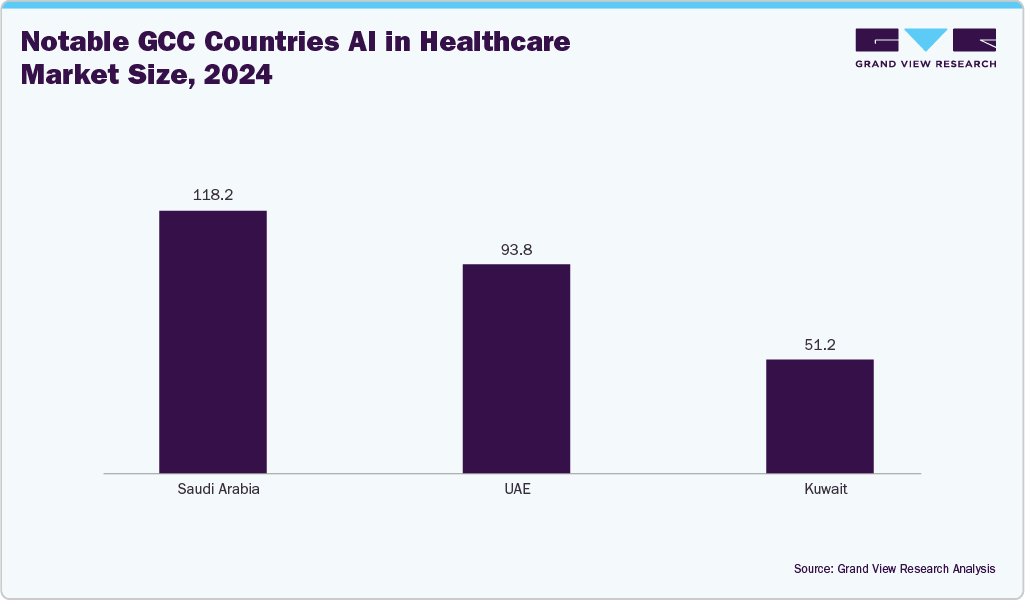
Building the Digital Backbone: Unified Health Records and Data Infrastructure
The Gulf Cooperation Council (GCC) has made substantial investments in national health information exchanges to standardize data and facilitate advanced analytics. Abu Dhabi’s Malaffi platform, for example, connects 59 public and private hospitals, 1,100 clinics, and 380 pharmacies. It enables 39,600 clinicians across 1,539 facilities to access unified patient records. By 2025, Malaffi contained 3.5 billion clinical records representing 12.7 million unique patient profiles, with 53,476 authorized users across 3,072 facilities. Recent enhancements include radiology image exchange and artificial intelligence-powered risk scoring. Integration of Malaffi with Dubai’s Nabidh and the federal Riayati platform has resulted in a unified system. This integrated network encompasses 1.9 billion records for 9.5 million patients, accessible by 90,000 providers across 3,057 facilities. Such nationwide interoperability establishes a foundation for AI-assisted analytics, care coordination, and public health surveillance.
However, Security and privacy are critical. Abu Dhabi’s Healthcare Information and Cyber Security Standard (ADHICS) mandates robust access controls, encryption, and audit logging across 11 security domains, while the UAE has created the world’s first Minister of State for AI and appointed chief AI officers in every ministry to oversee governance and ethics. Saudi Arabia established the Saudi Data & AI Authority (SDAIA) to establish data governance policy and oversee the use of AI in the healthcare sector. These governance structures are expected to gain significance due to the increasing penetration of AI in the years to come.
Artificial Intelligence in Action: From Smart Hospitals to Intelligent Health Systems
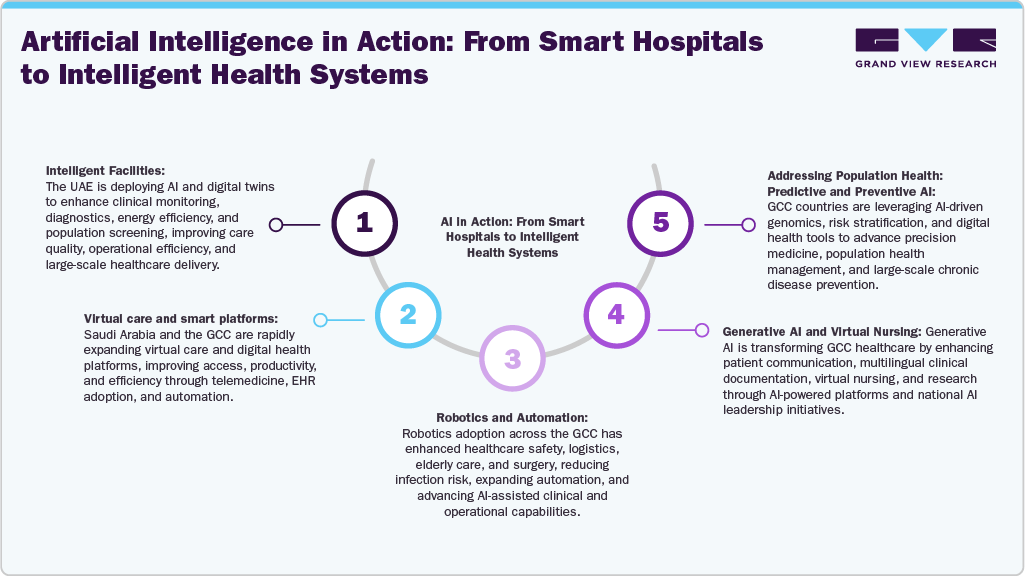
1) Intelligent facilities
Emirates Health Services (EHS) in the United Arab Emirates has implemented Care AI, a computer vision system that continuously monitors patient rooms and updates clinical records in real-time. This system tracks patient movement, assists clinicians during diagnosis, and automatically analyzes compliance with safety protocols. EHS has also developed a digital twin of Al Qassimi Hospital in collaboration with Schneider Electric and Microsoft. The virtual model reduced energy consumption by 30% and decreased equipment breakdowns and maintenance by 20%. In addition, digital twins are likely to simulate patient physiology, thereby supporting clinician training and optimizing surgical procedures. According to the World Economic Forum, the UAE is exploring the application of digital twins in precision medicine, cancer care, and clinical training.
Cleveland Clinic Abu Dhabi exemplifies AI‑assisted clinical care. In November 2022, the hospital adopted the ARTIS Icono system, which integrates 2D/3D imaging with AI, enabling stroke patients to receive immediate treatment without the need for a separate CT scan. The technology provides real-time images and utilizes AI to reduce radiation and enhance accuracy. In addition, M42, the G42 healthcare arm, launched AIRIS-TB, an AI model for tuberculosis screening that achieved a 98.5% area under the ROC curve with a 0% false-negative rate and can automate up to 80% of routine chest X-ray readings. Such models free radiologists from complex cases and illustrate how AI can scale population‑screening programs.
2) Virtual care and smart platforms
Saudi Arabia’s Seha Virtual Hospital ranks among the largest virtual care networks globally. The platform connects 224 facilities, encompasses more than 71 specialties, and has an annual capacity of 480,000 patients. By 2024, the Sehhaty application reported 31 million active users, representing approximately 88% of the population, and had facilitated 51 million virtual consultations. The system reduced radiology report turnaround time by 87% and recorded over 40 million vital sign readings, highlighting the potential of virtual care to enhance productivity and extend healthcare access to remote populations.
The digital health market is undergoing substantial expansion. In Saudi Arabia, the market reached USD 2.80 billion in 2025 and is projected to surpass USD 11 billion by 2033. Over 80% of hospitals have implemented electronic health records. Telemedicine adoption is extensive, with mobile applications such as Sehhaty, BeAware, and Sehati offering integrated digital wallets and remote care services. The Altibbi platform in the United Arab Emirates, the largest in the region, has facilitated over 4.5 million telehealth consultations, attracted more than 20 million unique monthly visitors, and employs over 1,500 certified physicians. Bahrain’s Doctory platform serves 30,000 users through 400 providers, and a recently introduced teleradiology platform enables remote diagnosis. These platforms are further supported by robotic process automation (RPA) bots that manage appointment scheduling, claims processing, and other administrative functions.
3) Robotics and automation
Robotics introduces an additional dimension of intelligence. For example, according to the World Economic Forum (WEF), Bahrain deployed robots during the COVID‑19 pandemic to disinfect hazardous areas, transport medicine, and move heavy medical devices. These robots utilized thermal cameras and facial recognition technology to monitor body temperature, reducing the risk of infection to medical personnel by 80%. Meanwhile, Saudi Arabia is piloting robots for elderly care and anxiety reduction, and has registered 2,344 robotics companies as of Q2 2023, an increase from 1,537 the previous year. Similarly, Kuwait’s Jaber Hospital implemented 3D robotic devices for surgical planning and performed the Gulf region’s first AI‑assisted endoscopic operation to detect colon and stomach tumours. These cases demonstrate that automation extends beyond clinical artificial intelligence to encompass logistics and surgical procedures.
4) Generative AI and Virtual Nursing
Generative AI is increasingly influencing patient communications and clinical documentation. The United Arab Emirates (UAE) was the first nation to appoint an AI minister. Building on this initiative, in 2023, Emirates Health Services partnered with the U.S.-based company Care AI to implement a virtual care nursing platform. This collaboration aims to provide generative AI-powered discharge instructions, multilingual documentation, and virtual nursing services across emergency departments, operating rooms, and neonatal units. In addition, initial pilot studies indicate that AI can draft clinical letters, personalize discharge notes, and generate synthetic datasets for research purposes.
Key Challenges and Enablers
-
Data Governance and Interoperability: Data governance and interoperability remain significant challenges. Despite recent progress, data fragmentation persists across multiple systems. Interoperability between public and private providers is inconsistent, and harmonization of privacy laws across GCC states is required.
-
Workforce Readiness: Workforce readiness is critical for advancement. AI acts as an enabler by generating new roles, including data scientists, AI ethicists, and clinical informaticists, and necessitates the retraining of existing staff. The UAE National Strategy for AI reports that approximately 43% of work activities in the country are expected to be automated, emphasizing the need for upskilling and effective change management.
-
Trust, Ethics and Bias: Trust, ethics, and bias demand continuous attention. In a multi-ethnic population with high digital literacy, ensuring algorithmic fairness and providing transparent explanations for AI recommendations are essential. Regional regulatory bodies must regularly update ethical guidelines to remain aligned with global best practices.
-
Economic sustainability: Economic sustainability is a critical consideration. Although AI offers potential cost savings, initial investments are substantial. Demonstrating a clear return on investment, such as through reduced readmissions, faster diagnostics, and improved throughput, is essential for securing long-term funding.
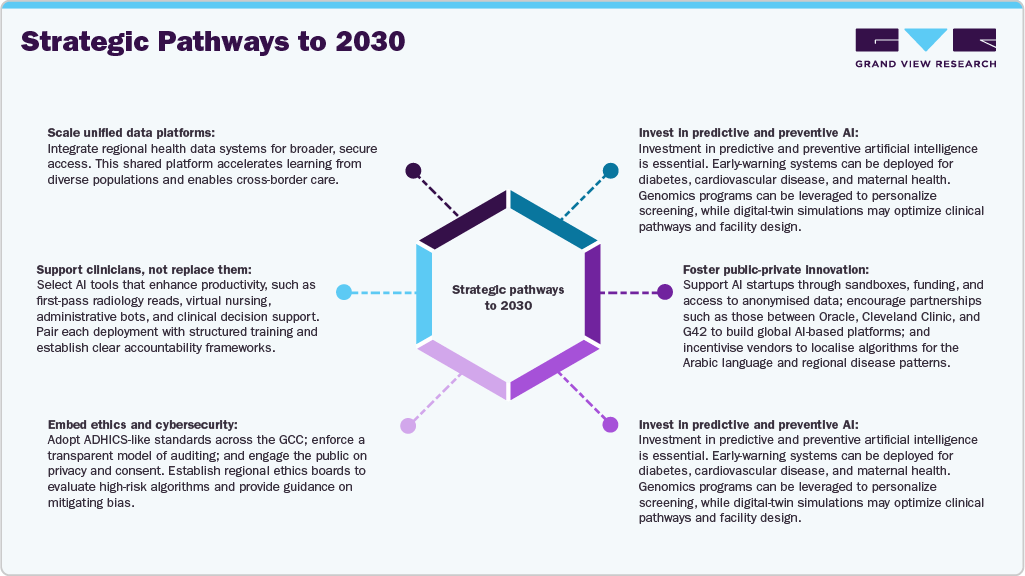
Conclusion:
The transition of the Gulf Cooperation Council (GCC) from smart hospitals to intelligent health systems is progressing. The implementation of unified health records, AI-enabled diagnostics, virtual hospitals, robotics, and genomic initiatives reflects the region’s commitment to surpassing traditional healthcare models. However, the successful scaling of these innovations depends on sustained investment in data infrastructure, workforce development, and ethical governance. By adopting artificial intelligence as a means to prevent disease, personalize care, and optimize resources, GCC countries can enhance population health and establish a globally competitive hub for health innovation. Through coordinated efforts, the realization of intelligent, patient-centric health systems by 2030 is within reach.
Talk to an analyst
Tell us what you need. We reply within one working day.
Service Guarantee
-
Insured Buying
This report has a service guarantee. We stand by our report quality.
-
Confidentiality
Your transaction & personal information is safe and secure.
-
Custom research service
Design an exclusive study to serve your research needs.
-
24/5 Research support
Get your queries resolved from an industry expert.