Global Coffee Market Outlook 2030: Navigating Demand Momentum Amid Supply Volatility
Demand Analysis: Premiumisation, Convenience, And Packaging Innovation Drive Growth
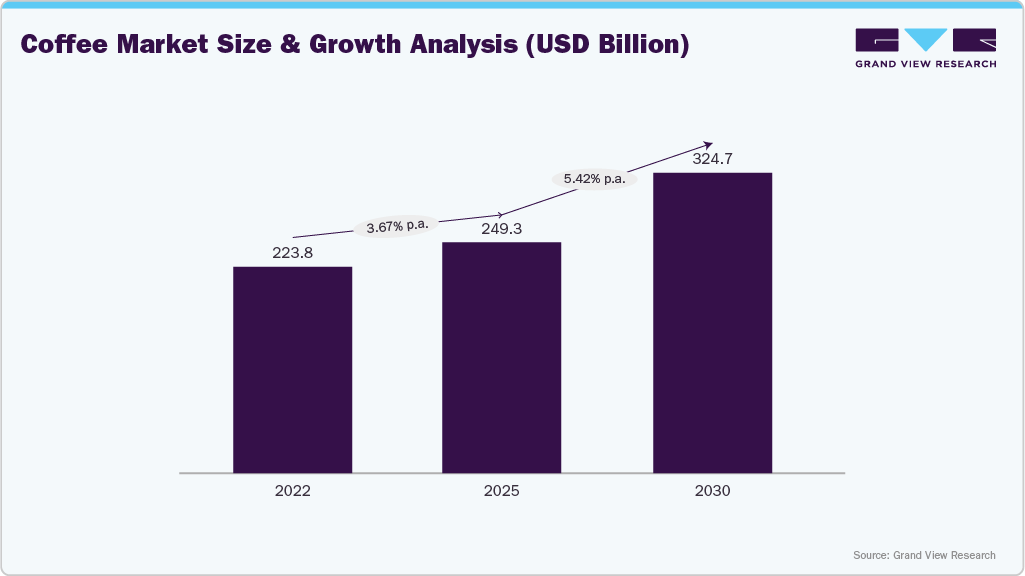
As per Grand View Research, the global coffee market is valued at $249.34 billion in 2025 and is projected to reach $324.69 billion by 2030, growing at a CAGR of 5.4% from 2025 to 2030. The demand is driven by strengthening global consumption, premium product adoption, and sustained investments in packaging formats that enhance convenience, freshness, and consumer engagement.
The interplay of convenience, experience, and value-added packaging is redefining the consumer engagement model, reinforcing demand resilience across global markets.
-
Premiumisation across markets: Emerging and developed markets are witnessing a sustained pivot toward higher-quality beans, artisanal roasting, and origin-specific offerings. This shift is reshaping pricing power and reinforcing the role of specialty and premium categories as margin engines.
-
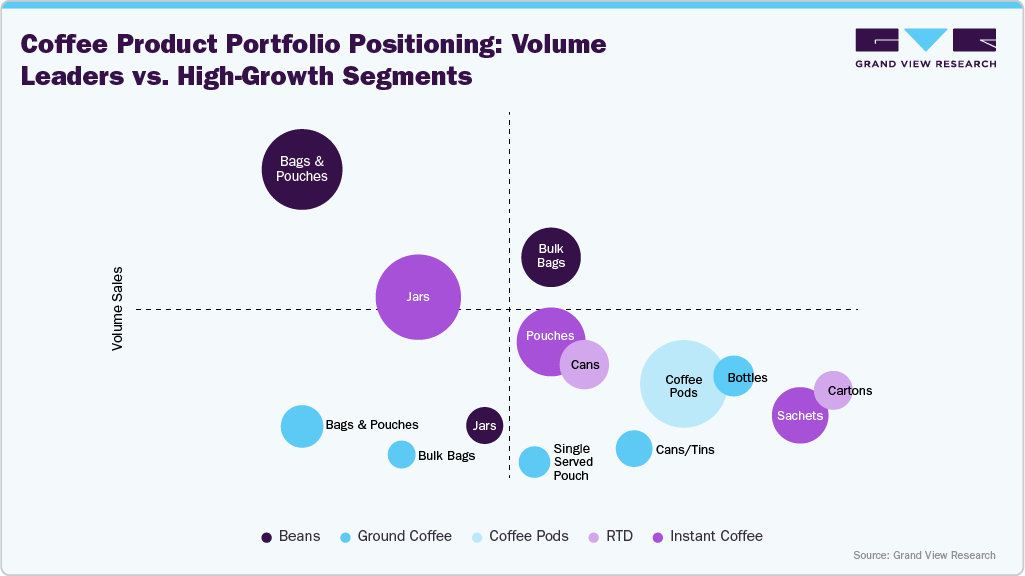
Rapid growth of convenience-led formats: Ready-to-drink beverages, single-serve pods, and portion-controlled formats continue to outpace traditional offerings. While coffee pods remain a moderate-volume category, they demonstrate strong forward CAGR, underpinned by machine penetration and consumer preference for consistent, high-quality brewing.
-
Packaging innovation enabling value creation: Formats such as pouches, cartons, and cans are gaining traction—especially in price-sensitive and emerging markets—owing to their portability, lower cost, and longer shelf life. Conversely, mature formats like jars and bulk bags show stagnation, reflecting a category-wide pivot toward mobility, freshness, and user experience.
The New Reality: Supply Concentration Meets Price Volatility
World coffee production for 2025/26 is projected to reach 178.7 million 60-KG bags, representing a 4.3 million bag increase from the previous year and establishing a new production record. This growth is driven primarily by continued recovery in Vietnam and Indonesia following drought-related production declines, along with record output in Ethiopia.
|
Production (Mn 60-KG Bags) |
2020-21 |
2021-22 |
2022-23 |
2023-24 |
2024-25 |
2025-26 (June) |
|
Arabica |
102.11 |
87.09 |
87.78 |
97.24 |
98.69 |
97.02 |
|
Robusta |
74.44 |
77.96 |
76.61 |
72.11 |
75.70 |
81.66 |
|
Total |
176.55 |
165.04 |
164.39 |
169.35 |
174.40 |
178.68 |
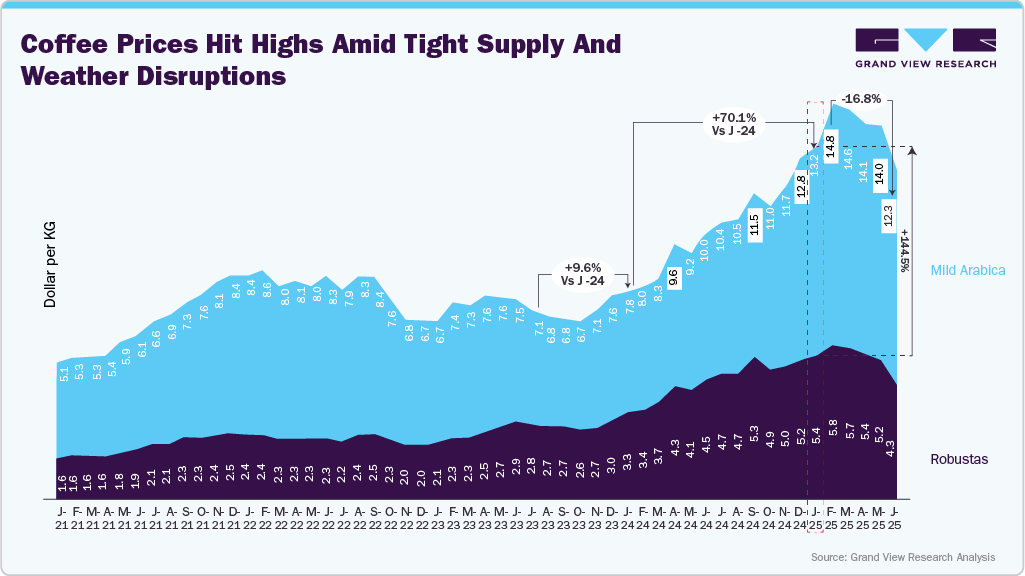
Coffee prices have reached all-time high levels, reflecting fundamental supply-demand imbalances that have persisted for over two years. Mild Arabica prices reached $13.2 per KG in late 2025, representing a 70.1% increase from January 2024 levels. Robusta prices stood at approximately $5.4 per KG, up 9% year-over-year, though Robusta's more modest price increase reflects the differential supply situation between the two market segments.
Five-Year Production Dynamics (2020/21 – 2025/26): A Deep Dive
Arabica Production Dynamics
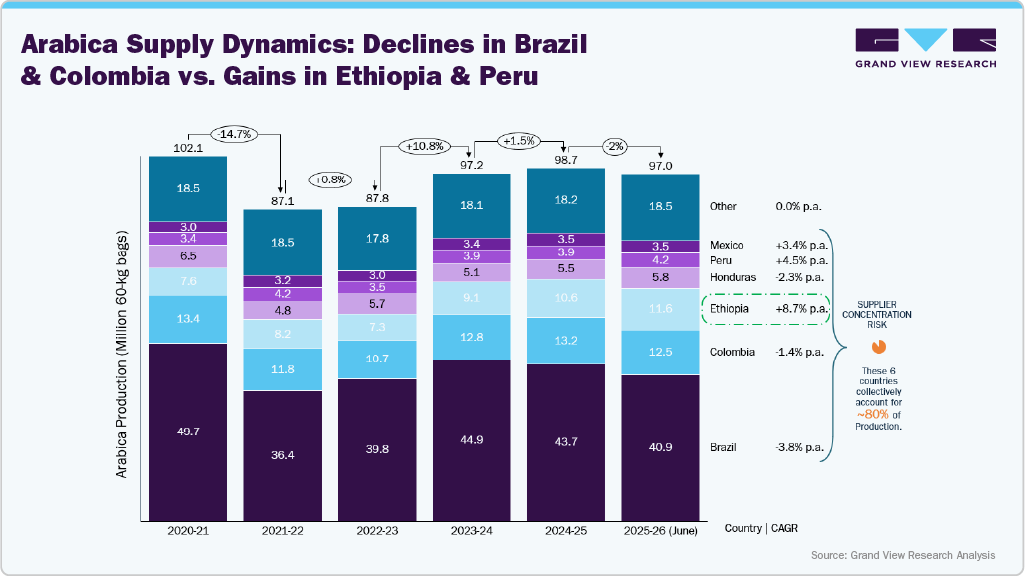
Global Arabica production has declined from 102.1 million bags in 2020/21 to an estimated 97.0 million bags in 2025/26, representing a reduction of 5.1 million bags or approximately 5% over the five years. This contraction is concentrated in traditional major producing countries.
-
Brazil remains the dominant Arabica producer but has experienced significant production volatility and decline. Output drops from 49.7 million bags in 2020/21 to an estimated 40.9 million bags in 2025/26, representing a 17.7% decrease. The 2021/22 crop year saw production collapse to 36.4 million bags following severe frost events in July 2021 that damaged coffee trees in the major producing states of Paraná, São Paulo, and southern Minas Gerais. Subsequent years have been affected by drought and high temperatures during critical flowering and fruit development periods, particularly in Minas Gerais and São Paulo. Brazil's biennial production cycle has amplified this volatility, with off-years showing particularly depressed output.
-
Colombia has experienced a production decline from 13.4 million bags in 2020/21 to an estimated 12.5 million bags in 2025/26. The 2022/23 crop year saw output drop to 10.7 million bags, the lowest level in the recent period. Production challenges include excessive rainfall and cloud cover disrupting flowering periods, ongoing management of coffee leaf rust despite widespread adoption of disease-resistant varieties, and rural labor shortages as younger populations migrate to urban areas. While the National Federation of Coffee Growers has implemented extensive productivity programs, these have not reversed the production decline.
-
Honduras has experienced one of the sharpest contractions among major producers. Production fell from 6.5 million bags in 2020/21 to 4.8 million bags in 2021/22 following hurricanes Eta and Iota in late 2020, which caused extensive damage to coffee infrastructure and trees. While production has partially recovered to an estimated 5.8 million bags in 2025/26, it remains below the 2020/21 level. Contributing factors include persistent coffee leaf rust pressure and irregular rainfall patterns affecting yield.
-
Ethiopia stands as the primary growth market for Arabica, with production increasing from 7.6 million bags in 2020/21 to an estimated 11.6 million bags in 2025/26, representing an 8.7% CAGR. This expansion has been driven by a national program to replace older coffee trees with higher-yielding varieties, with over half the cultivated area replanted in the last three years. Additionally, extension programs encouraging post-harvest pruning have improved yields. Ethiopia's diverse coffee genetics, adapted to highland growing conditions, have provided natural resilience to some disease pressures affecting other origins.
-
Peru showed initial growth from 3.4 million bags in 2020/21 to 4.2 million bags in 2021/22, but production has fluctuated in subsequent years, with an estimated 4.2 million bags for 2025/26. Challenges include coffee leaf rust affecting yields, aging tree stock requiring renovation investment, and continued competition from coca cultivation in remote growing regions, though organic and specialty coffee premiums have helped maintain producer interest.
-
Mexico has demonstrated modest but consistent growth from 3.0 million bags in 2020/21 to an estimated 3.9 million bags in 2025/26. Government support programs, improved disease management protocols, and premium pricing for organic and shade-grown coffee production have supported this expansion.
Robusta Production Dynamics
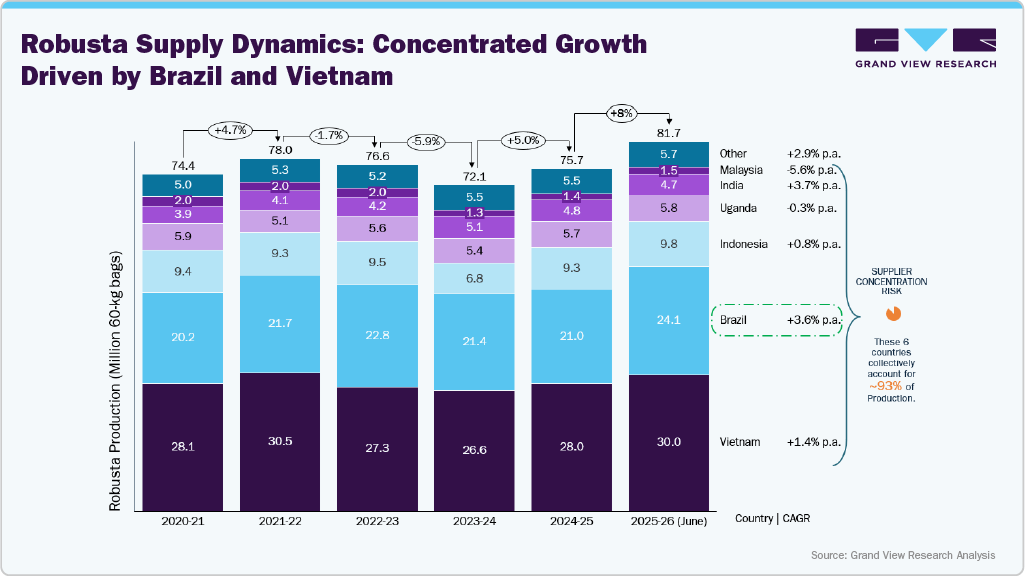
Global Robusta production increased from 74.4 million bags in 2020/21 to an estimated 81.7 million bags in 2025/26, representing a growth of 9.8% over the period. However, this overall growth masks significant year-to-year volatility, particularly in the dominant producing country.
-
Vietnam remains the world's largest Robusta producer, with output ranging from a low of 26.6 million bags in 2023/24 to an estimated high of 30.0 million bags in 2025/26. The 2023/24 production decline resulted from severe drought conditions in the Central Highlands, which account for approximately 75% of Vietnam's coffee production. Irregular rainfall during critical flowering periods reduced blossom set, and water stress during fruit development reduced yields and bean size. The estimated recovery to 30.0 million bags in 2025/26 reflects the return of more normal rainfall patterns and increased fertilizer application enabled by elevated coffee prices. Despite these fluctuations, Vietnam's production has grown only 1.4% annually on average from the 2020/21 base of 28.1 million bags, constrained by limited land expansion opportunities and an aging tree population requiring renovation.
-
Brazil has emerged as a significant growth market for Robusta, with production increasing from 20.2 million bags in 2020/21 to an estimated record 24.1 million bags in 2025/26, representing 19.3% growth. This expansion has been concentrated in the states of Espírito Santo and Bahia, where Conilon (Brazilian Robusta) cultivation has expanded significantly. Brazilian farmers have increasingly shifted to Robusta production in response to Arabica's greater climate vulnerability and Robusta's superior economics at current price ratios.
-
Indonesia is the world's third-largest Robusta producer, with production ranging from 6.8 million bags in 2023/24 to an estimated 9.8 million bags in 2025/26. The 2023/24 production decline resulted from erratic weather patterns affecting the main growing regions of southern Sumatra and Java. Production is estimated to recover to 9.8 million bags in 2025/26 on improved weather conditions. However, Indonesia's long-term production growth has been constrained by competition from palm oil cultivation, which offers more attractive returns to farmers, and limited investment in coffee farm renovation.
-
Uganda has maintained relatively stable production in the range of 5.4-5.9 million bags over the period, with an estimated 5.8 million bags for 2025/26. Uganda's government implemented several initiatives through the Uganda Coffee Development Authority to expand production, including programs to develop underutilized land, distribute improved seed varieties, and improve access to fertilizers and other inputs. While Uganda set an aggressive target to reach 20 million bags by 2030, production has grown more modestly than planned. The National Coffee Bill dissolved the Uganda Coffee Development Authority in November 2024, transferring its functions to the Ministry of Agriculture with the objective of increasing efficiency.
-
India demonstrated growth from 3.9 million bags in 2020/21 to a peak of 5.1 million bags in 2023/24, before moderating to an estimated 4.7 million bags in 2025/26. Production growth in Karnataka and Kerala states has been supported by government programs and improved processing infrastructure.
-
Rising procurement risk for roasters and FMCG players
The Strategic Implications for the Coffee Value Chain
-
Rising procurement risk for roasters and FMCG players
- Supply concentration and climate unpredictability are pushing global buyers to diversify origin portfolios, hedge more aggressively, and invest in multi-origin blends.
-
Shift toward flexible packaging and value-engineered formats
- As demand pivots toward convenience-driven products, packaging suppliers must innovate around sustainability, cost-efficiency, and extended shelf life.
-
Opportunities in premium and differentiated segments
- Specialty, origin-specific, and RTD (Ready-to-Drink) categories offer significant value pools as consumer willingness to pay increases.
-
Need for upstream investment and origin-level partnership
-
Resilience will increasingly depend on replanting programs, climate-smart agriculture, irrigation, and farmer training—areas where downstream players are becoming active investors.
-
Conclusion
The structural shift toward Robusta in the global coffee market presents both opportunities and challenges for producing regions. While rising demand for Robusta, driven by climate pressures on Arabica and greater adoption by roasters, creates a clear pathway for higher export revenues and expanded market share, increasing climate variability, rising input costs, and productivity constraints may offset these potential gains. To maintain competitiveness, producing countries must accelerate the adoption of climate-resilient agronomy, invest in modern processing infrastructure, and strengthen farmer support systems to ensure consistent quality and supply.
At the same time, diversifying export markets and moving further up the value chain through improved post-harvest processing and value-added Robusta products will be essential for long-term resilience. Supportive policy frameworks, better access to finance, and strategic public-private collaboration will further enable producers to capture emerging opportunities. Ultimately, the ability of Robusta-origin countries to navigate these climate, cost, and capability challenges will determine their future strength and sustainability within a rapidly evolving global coffee industry.
Talk to an analyst
Tell us what you need. We reply within one working day.
Service Guarantee
-
Insured Buying
This report has a service guarantee. We stand by our report quality.
-
Confidentiality
Your transaction & personal information is safe and secure.
-
Custom research service
Design an exclusive study to serve your research needs.
-
24/5 Research support
Get your queries resolved from an industry expert.