FMCG Category Implications in the Middle East: 2026
A Category-Led View of Growth, Consumers, and Competitive Advantage
Executive Overview: A Region at a Turning Point
By 2026, the FMCG landscape across the Middle East and North Africa (MENA) will look fundamentally different from what global playbooks assume. The region has reached a clear inflection point-one defined not just by scale, but by structural divergence across categories.
FMCG sales in MENA surpassed USD 450 billion in 2025 and are on track to approach USD 650 billion by 2030, growing at roughly 5% CAGR. This makes the Middle East one of the fastest-growing consumer markets globally-especially when contrasted with mature markets, where CPG volume growth in 2025 remained below 2% and was largely driven by pricing rather than true demand expansion.
Yet headline growth masks an important reality: the FMCG market in the Middle East is no longer governed by a single consumer logic or operating model. Instead, four distinct category realities now coexist:
-
Food has moved beyond discretionary consumption and is increasingly treated as nutrition-critical national infrastructure
-
Beverages are transforming into functional hydration and wellness platforms, driven by regulation, climate, and health awareness
-
Personal care is shifting from beauty-led aspiration to health-adjacent, trust-based decision-making
-
Home care remains firmly value-driven, with limited room for emotional branding or premiumization
Success in this environment requires category-specific strategies rooted in local policy, consumer economics, and execution realities-not imported global playbooks.
Regional Market Context: Growth with Uneven Foundations
Uneven Volume Growth Across Core Markets
Growth across Middle Eastern markets remains highly uneven, creating both opportunity and risk.
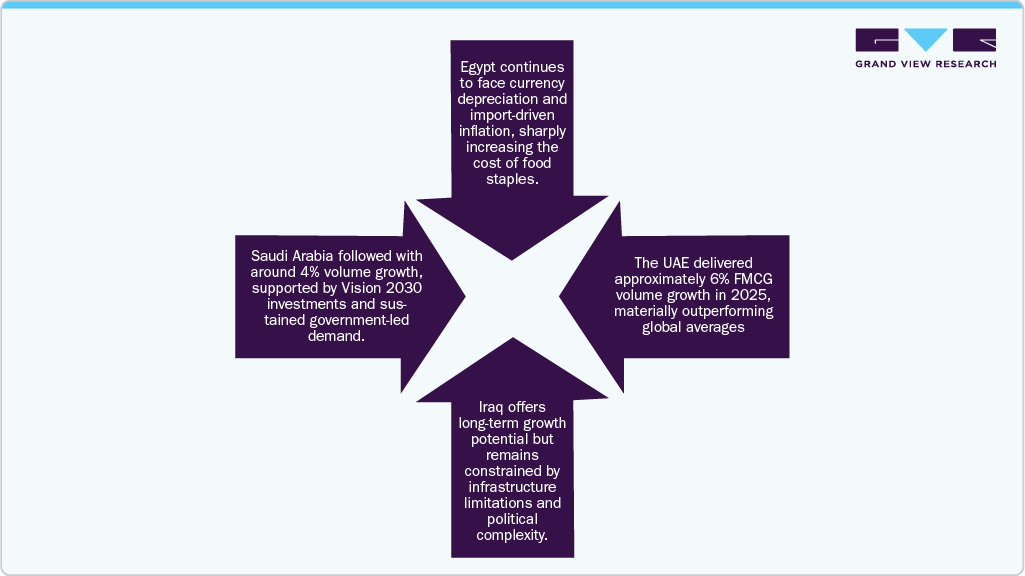
Together, Saudi Arabia, the UAE, Egypt, and Iraq form the strategic core of Middle East FMCG-representing the majority of both growth potential and execution risk.
Inflation, Trade Disruption, and the New Margin Reality
-
Global inflation, energy volatility, and logistics disruption have materially reshaped FMCG cost structures. The Red Sea shipping disruptions of 2024-2025 extended lead times and increased freight costs across food, beverage, and personal care supply chains.
-
These pressures were further amplified by new trade measures, including US reciprocal tariffs introduced in 2025 and higher Section 232 tariffs on steel and aluminum, which directly affect packaging-intensive categories.
-
Importantly, tariff impacts are structurally lagged. It typically takes 12-18 months for cost increases to fully flow through to shelf prices-making 2026 a margin inflection year. Leading global CPG companies have already disclosed tariff-related cost impacts running into hundreds of millions of dollars.
-
In response, most multinational players have prioritized margin protection over volume expansion. Pricing discipline, mix optimization, and brand equity preservation have taken precedence over chasing unit growth-reflecting constrained consumer affordability and limited tolerance for further price increases.
Consumers in 2026: Confident, but Selective
Consumer confidence across the region remains relatively resilient, averaging around 6 out of 10. However, this resilience increasingly hides a more selective and intentional consumer mindset.
Three behavioral shifts define FMCG consumption in 2026:
|
Essentials-first budgeting |
Spending on food, housing, and personal care remains protected, while discretionary categories fragment sharply by income level. |
|
Time poverty as a structural constraint |
More than one-third of consumers report lacking sufficient time for daily tasks. This is accelerating demand for convenience formats, ready-to-drink (RTD) products, and quick commerce-especially among millennials and urban professionals |
|
Values-driven brand relationships |
Over half of consumers report boycotting brands due to value misalignment. Trust, cultural sensitivity, transparency, and ethical positioning now sit alongside price and quality in purchase decisions |
Brand relationships are no longer purely transactional. They are increasingly reputational, emotional, and identity-linked.
Digital Acceleration and Route-to-Market Disruption
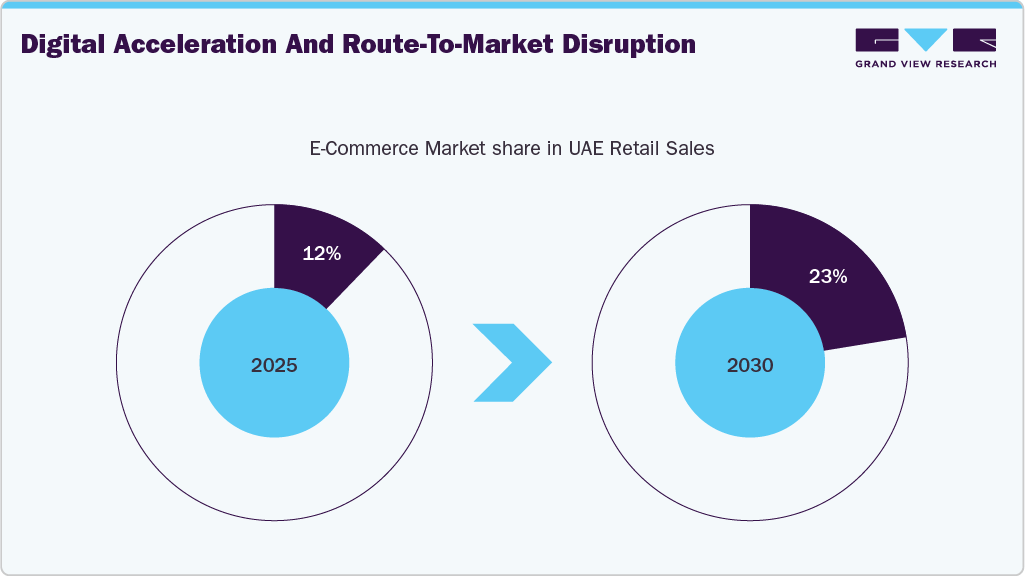
E-Commerce Market share in UAE Retail Sales
In the UAE, e-commerce accounted for 12-14% of retail sales in 2025 and is expected to reach 20-25% by 2030, capturing the majority of incremental retail growth. Quick commerce has emerged as a structurally advantaged channel-particularly for beverages and convenience-led categories-due to high purchase frequency, immediacy, and dense urban populations.
Despite widespread executive awareness of digital and AI’s importance, execution remains uneven. While over 90% of CPG leaders acknowledge AI’s strategic relevance, fewer than 10% have clear deployment roadmaps. Capability gaps, unclear use cases, and integration costs continue to limit impact.
Category Deep Dives
1. Food: From Import Dependence to Nutrition-Critical Infrastructure
Food has undergone a fundamental repositioning. Across the Middle East, it is now treated as strategic national infrastructure, closely tied to food security, inflation control, and public health outcomes.
High import dependence and rising diet-related diseases have prompted governments to actively shape category economics. Policy now determines:
-
Which food categories are localized through incentives and industrial policy
-
Which products receive subsidies or fast-track approvals
-
Which SKUs face penalties through sugar taxes, labeling mandates, or import restrictions
Growth is increasingly concentrated in staples, fortified foods, protein-rich products, and shelf-stable formats designed for hot climates. Functional everyday foods consistently outperform niche superfoods by combining habitual consumption with clear health benefits.
Local manufacturing delivers three decisive advantages: price stability, regulatory access, and eligibility for institutional procurement, which can represent up to 25% of volume in staple categories.
Winners: Nutrition-led, affordable, locally manufactured portfolios
Losers: Import-heavy, indulgence-only brands without health alignment
2. Beverages: From Refreshment to Functional Hydration
The beverage category is undergoing a structural reset. Sugar regulation, extreme climate conditions, and rising wellness awareness are reshaping consumption patterns.
Traditional carbonated soft drinks face declining per-capita consumption and margin pressure. Growth is shifting toward:
-
Low- and no-sugar beverages
-
Functional hydration
-
RTD teas and coffees
-
Protein- and energy-enhanced drinks
Premiumization is still possible-but only when clearly tied to functional benefits, clean ingredients, and lifestyle relevance. Quick commerce is disproportionately benefiting beverages, forcing a rethink of pricing, pack sizes, and channel economics.
Winners: Hydration-, energy-, and health-led portfolios
Losers: Sugar-heavy, undifferentiated brands
3. Personal Care: From Beauty to Trust and Health
Personal care is increasingly health-adjacent and credibility-driven. Consumers are scrutinizing ingredients, demanding halal compliance, and gravitating toward dermatology-inspired positioning.
Pharmacies and health retailers are gaining share, while influencer-led DTC models increasingly shape discovery and trial. At the same time, mass beauty brands without clear differentiation are being squeezed between premium science-backed players and improving private labels.
Winners: Clinically credible, culturally aligned brands
Losers: Generic mass brands lacking trust signals
4. Home Care: Efficiency Over Emotion
Home care remains the most price-sensitive FMCG category in the region. Purchase decisions are driven primarily by efficacy, performance, and cost per use, rather than emotional brand narratives.
Private label penetration continues to rise as quality gaps narrow. Success increasingly depends on concentrated formats, local water-condition optimization, and demonstrable performance benefits.
Winners: High-performance, value-optimized, locally adapted brands
Losers: Over-branded products without functional superiority
Cross-Category Strategic Imperatives
Despite divergent category dynamics, three strategic imperatives apply across the board:
-
Redesign growth models around health, functionality, and evolving routes to market
-
Simplify portfolios and cost structures to fund reinvestment and resilience
- Move digital and AI from pilots to operational scale
Conclusion: Strategy by Category, Not by Template
There is no single winning FMCG strategy in the Middle East. Food, beverages, personal care, and home care each require distinct operating models, value propositions, and investment priorities.
Companies that align their category strategies with local policy, consumer economics, and cultural context-and execute with discipline-will capture disproportionate value. Those relying on generic global playbooks will increasingly struggle in a market defined by divergence, selectivity, and execution excellence.