From Payer to Partner: How GCC Health Insurers Can Lead a Customer-Centric, Data-Intelligent Transformation
The insurance sector in the GCC is at a defining inflection point. While the region continues to record above-average premium growth, structural challenges including rising medical inflation, an expanding chronic disease burden, limited product differentiation, and evolving customer expectations are redefining what it means to compete and grow. As the market matures, insurers, reinsurers, brokers, TPAs, healthcare providers, InsurTechs, and regulators face a common imperative: shifting from a transactional, payer-driven model to an integrated, customer-centric, data-intelligent ecosystem that delivers measurable outcomes.
This article outlines the forces contributing to the change in the sector, the gaps that hinder sustainable growth, and the actions required across the entire value chain to move the GCC insurance industry from “payer” to “partner.”
Market at a Turning Point
Growth has Outpaced Profitability
GCC markets have maintained strong top-line momentum. Saudi Arabia recorded ~27% growth in Gross Written Premiums (GWP) in 2023, while total GCC insurance premiums reached approximately USD 17–19 billion. Yet profitability remains under pressure:
-
Excluding the top three insurers in Saudi Arabia, the remaining 24 insurers reported a combined loss of ~USD 80 million in 2025, compared to a profit of ~USD 140 million in 2024.
-
Health insurance remains the dominant line, representing 40–45% of total premiums in both Saudi Arabia and the UAE.
Such concentration exposes insurers to margin compression and cyclical volatility.
Medical Inflation Continues to Exceed Premium Growth
Across the GCC, medical inflation ranges from 7–14% annually, driven by:
-
High prevalence of chronic disease (e.g., 17–20% diabetes prevalence in Saudi Arabia)
-
Rising utilization intensity
-
Fragmented payer–provider relationships
-
Limited cost-control mechanisms
The result is upward pressure on loss ratios and increasing claims leakage.
Regulatory Environment is Accelerating Modernization
Regulators across the region (SAMA, CBUAE, Qatar Central Bank), are driving structural reform:
-
Price transparency mandates
-
Digitalization requirements
-
Solvency and governance enhancements
-
Insurance sandboxes enabling InsurTech partnerships
-
Open finance frameworks fostering data exchange
These reforms create pressure but also clear pathways for industry-wide advancement.
Takaful: Growth Momentum Amid Profitability Pressures
Takaful insurance is a foundational pillar of the GCC insurance landscape, supported by demographic alignment, regulatory backing, and growing demand for Sharia-compliant financial products. However, recent industry data reveals a bifurcation between strong top-line growth and weakening bottom-line performance, challenging earlier assumptions of unidirectional growth.
Strong Revenue Growth but Earnings Under Significant Pressure
According to S&P Global Ratings, the Islamic/Takaful segment is expected to grow around 10% annually in 2025–2026, supported by mandatory coverage requirements, domestic population growth, and continued infrastructure expansion.
However, the same reports highlight that:
-
Net earnings for Islamic/Takaful insurers in the GCC are projected to decline noticeably in 2025, with early indicators showing a ~35% year-on-year earnings decline due to underwriting and investment pressures.
-
Margin compression in motor and medical—two core Takaful lines—continues to weigh on profitability.
Structural Challenges Exposed
The earnings decline reflects deeper systemic constraints:
-
High competition in low-margin mandatory lines
-
Slower investment returns amid market volatility
-
Limited scale for smaller operators, driving higher expense ratios
-
Traditional surplus distribution mechanisms that restrict capital agility
Implications for the Future of Takaful
For Takaful operators to remain competitive and sustainable, they must invest in:
-
Advanced analytics for cooperative risk pooling
-
Pricing sophistication aligned with loss experience
-
Diversification into higher-margin protection and SME lines
-
Digital-first customer engagement models
-
Stronger capital and investment strategies
Takaful remains a strategically important market, but growth alone is no longer sufficient—profitability, discipline, and data-intelligent operating models will define the segment’s long-term trajectory.
Why the Current Model Is Reaching Its Limits
Despite progress, several systemic constraints limit the region’s ability to transition to next-stage growth:
Fragmented Data and Limited Analytics Maturity
Although insurers hold large volumes of claims and provide data, most operate with siloed systems and limited predictive analytics capabilities. This results in:
-
20–25% average annual claims rejection in Saudi Arabia
-
Inefficient underwriting for high-risk cohorts
-
Inability to personalize pricing or proactively manage risk
Transactional, Payer-Centric Relationships Dominate
The current model is characterized by:
-
Fee-for-service payments that incentivize volume
-
Limited visibility into provider performance
-
Reactive rather than preventive health management
This dynamic reinforces inflationary behavior.
Limited Product Innovation Beyond Mandatory Lines
A heavy dependency on motor and health reduces portfolio resilience. Life, protection, SME, cyber, and specialty lines remain underpenetrated despite strong potential.
Ecosystem Players are not yet Fully Integrated
Brokers, TPAs, InsurTechs, providers, reinsurers, and regulators often operate with misaligned incentives and incomplete data sharing. This creates friction across the value chain.
The New Imperative: Becoming a Customer-Centric, Data-Intelligent Partner
To move from payer to partner, the GCC insurance ecosystem must shift in three interconnected directions:
customer-centric design, data-driven decision intelligence, and outcome-led operating models.
Redesigning insurance around customer journeys
Leading global insurers are redesigning their offerings around life events and behavioral needs—not insurance products. For the GCC, this translates into:
-
Integrated wellness and preventive care benefits
-
Personalized protection plans for families, SMEs, and expats
-
Hybrid advisory models combining digital tools with human interaction
-
Clear communication and simplified product structures
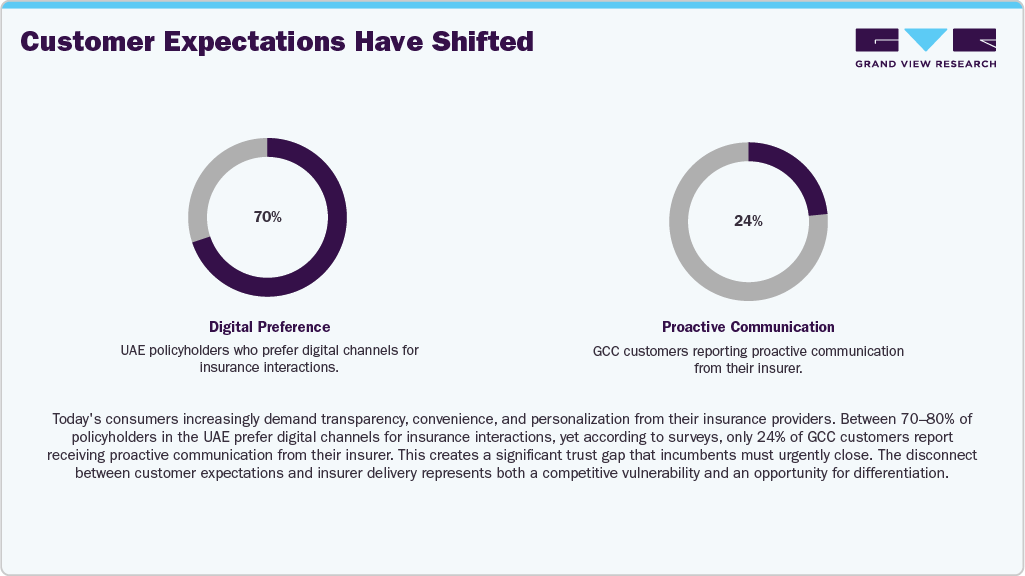
Early adopters in the UAE and Saudi Arabia have demonstrated that enhanced engagement can increase retention by 15–20%.
Building the region’s next-generation data and analytics backbone
A data-intelligent insurer will:
-
Establish unified Customer 360 and Claims 360 platforms
-
Use predictive models for underwriting and fraud detection
-
Deploy real-time utilization management
-
Integrate claims adjudication with AI-based decision support
-
Leverage provider benchmarking to guide network strategy
This shift is foundational. Insurers that deploy end-to-end analytics have demonstrated 30–50% improvements in claims processing speed and significant reductions in leakage.
Transitioning to outcome-led payer–provider partnerships
To contain costs and improve quality, the sector must shift from activity-based payments to value-based and shared-savings models. Key elements include:
-
Provider quality scorecards
-
Bundled payments for chronic diseases and elective procedures
-
Performance-linked contracting
-
Joint analytics dashboards
International experience suggests 8–12% savings are achievable through coordinated care model’s similar early evidence is emerging from pilot programs in GCC markets.
Scaling embedded insurance and ecosystem partnerships
Embedded insurance offered seamlessly through travel platforms, mobility apps, banks, and e-commerce will be a major growth driver. Opportunities include:
-
Usage-based motor insurance
-
Micro-health and personal accident coverage via digital health apps
-
Integrated SME protection bundled with fintech services
-
Gadget and warranty insurance through retailers
-------------
A Vision for the Future of GCC Insurance
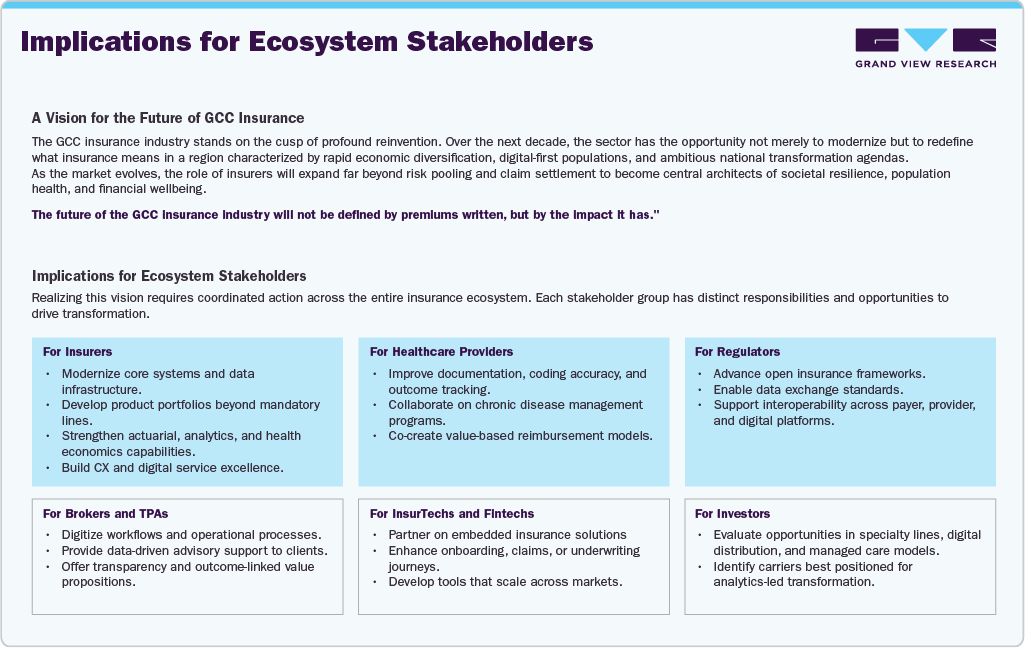
The GCC insurance sector is on the verge of significant transformation. Over the coming decade, insurers have the opportunity to evolve from transactional payers into strategic partners that contribute to the change in population health, financial resilience, and broader economic outcomes. In this future model, insurance becomes an integrated, data-driven service that anticipates risks, personalizes protection, and enables coordinated care across healthcare, financial, and digital ecosystems.
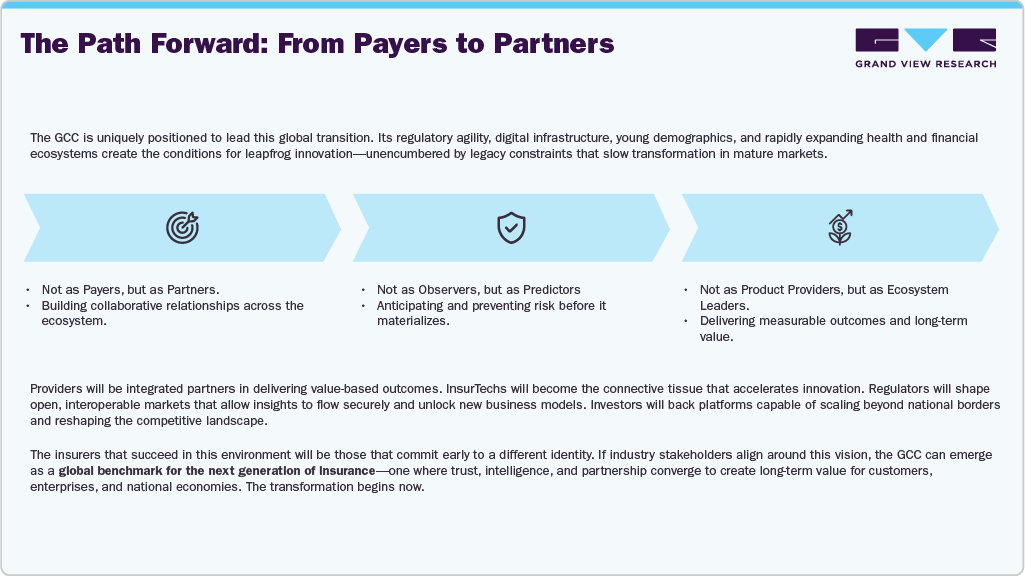
The region’s regulatory agility, strong digital infrastructure, and young, rapidly growing population create a unique foundation for leapfrog innovation. Insurers that embrace customer-centric models, invest in advanced analytics, and build collaborative partnerships will define the next era of growth. Ultimately, the future of GCC insurance will be measured not by premiums written, but by the value and impact delivered across the ecosystem.