Healthcare in the Middle East: Strategic Market Trends Shaping 2026
1. Healthcare as a Strategic Economic Sector, Not Just Social Infrastructure
Healthcare across the Middle East is undergoing a structural repositioning, evolving from a predominantly publicly funded social service toward an increasingly investment-oriented and economically significant sector. This shift is reflected in national investment strategies and sector development frameworks across leading regional markets.
For example, the Dubai Health Investment Guide, published in collaboration with the Dubai Health Authority and Dubai FDI, highlights the scale of foreign direct investment (FDI) projects and employment generation across priority sectors, including healthcare. The guide positions healthcare within Dubai’s broader investor-friendly ecosystem, emphasizing opportunities for private sector participation across medical services, medical devices, and pharmaceuticals, rather than framing the sector solely through a public welfare lens.
Similarly, the Saudi Vision 2030 Annual Report identifies healthcare transformation as a core component of the Kingdom’s economic diversification agenda. The report emphasizes innovation, digitization, private sector engagement, and financial sustainability as key enablers to improve healthcare access and quality, while supporting long-term system efficiency under continued government oversight. It further highlights the role of private investment and structured transformation programs in reshaping healthcare delivery over the coming decade.
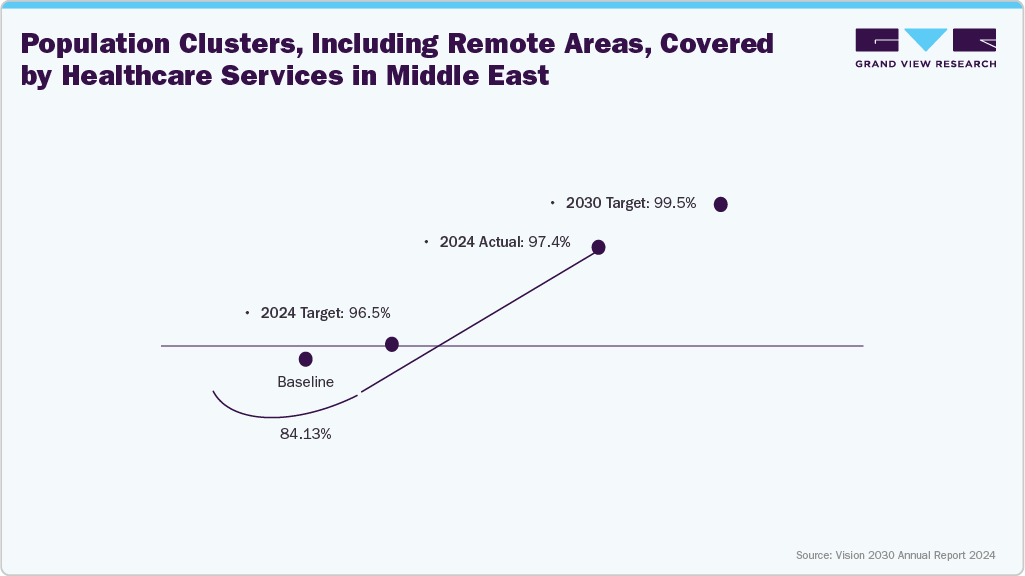
Healthcare coverage across population clusters, including remote areas, has improved significantly, rising from a baseline of 84.1% to 97.4% in 2024 already surpassing the 2024 target of 96.5%. The trajectory indicates strong execution momentum, positioning the system well to achieve near-universal coverage (99.5%) by 2030.
Based on the strategic direction outlined in these policy frameworks, by 2026 healthcare investment policies across leading Middle Eastern markets are expected to increasingly:
-
Encourage foreign direct investment (FDI) in healthcare services, MedTech, and life sciences
-
Expand private sector participation in diagnostics, specialty care, and hospital operations
-
Align healthcare sector growth with economic output, job creation, and innovation capacity, alongside clinical performance objectives
(Takeaway for stakeholders
Healthcare strategies in the Middle East are increasingly assessed not only on clinical outcomes, but also on economic scalability, capital efficiency, and alignment with national development priorities. For investors, operators, and solution providers, demonstrating commercial sustainability and readiness for private sector participation is becoming as critical as clinical excellence.)
2. Shift Toward Integrated Healthcare Ecosystems and Medical Clusters
Healthcare infrastructure development across the Middle East is increasingly being guided by system-level planning frameworks that emphasize integration, coordination, and cluster-based delivery models, rather than isolated expansion of standalone healthcare assets.
In the United Arab Emirates, this ecosystem-based approach is explicitly articulated in regulatory and planning publications issued by the Dubai Healthcare City Authority, which define Dubai Healthcare City (DHCC) as a healthcare free zone integrating hospitals, outpatient clinics, diagnostic providers, medical education institutions, and research organizations within a single geographic and regulatory framework. Official DHCC documents position the model as an integrated ecosystem designed to support clinical service delivery, professional training, and life sciences activity through co-location and centralized governance.
In Saudi Arabia, a comparable structural direction is outlined in healthcare reform documents issued under the National Transformation Program and the Health Sector Transformation Program by the Saudi Ministry of Health. These documents describe the establishment of regional health clusters as a core mechanism to improve care coordination across primary, secondary, and tertiary settings, optimize resource utilization, and support population-based healthcare delivery within defined geographic catchments. The cluster model is positioned as a foundational element of the Kingdom’s broader Vision 2030 healthcare system redesign.
Based on the explicit objectives articulated in these frameworks, by 2026 leading Middle Eastern markets are expected too increasingly:
-
Prioritize medical cities and integrated healthcare clusters encompassing hospitals, outpatient care, diagnostics, rehabilitation, education, and research
-
Encourage co-location of healthcare providers, academic institutions, and research organizations
-
Promote shared infrastructure, centralized services, and coordinated governance models
(Takeaway for stakeholders
Opportunities are increasingly evaluated within the context of coordinated ecosystems rather than standalone assets. Participation in integrated healthcare platforms supports operational resilience, diversified revenue exposure, and closer alignment with government-led healthcare planning priorities.)
3. Digital Health Enters a Procurement-Led Growth Phase
Digital health adoption across the Middle East is transitioning from pilot-driven experimentation toward policy-backed, procurement-led scale, as outlined in national digital health strategies and centralized implementation programs.
-
In the UAE, this transition is documented in the National Digital Health Strategy issued by the UAE Ministry of Health and Prevention, which establishes Riayati as the national unified health record platform. The strategy defines Riayati as a foundational digital infrastructure enabling interoperable health data exchange across public and private providers, embedding digital health directly into national care delivery.
-
In Saudi Arabia, official publications issued by the Saudi Ministry of Health describe Seha Virtual Hospital as a centralized virtual care platform integrating telemedicine, digital diagnostics, and specialist consultations across the Kingdom. The program is positioned as a national service delivery model rather than a decentralized provider-level initiative.
Based on priorities stated in these strategies, by 2026 digital transformation efforts are expected to focus on:
-
Interoperable electronic health records and national health data platforms
-
AI-supported diagnostics in regulated clinical domains
-
Virtual care models integrated into public healthcare workflows
-
Automation of clinical and administrative processes aligned with government digitization agendas
Takeaway for stakeholders
Vendors offering enterprise-grade, interoperable, and regulator-aligned platforms are best positioned for large-scale public-sector digital health procurements.
4. Localization of Pharmaceutical and Medical Device Manufacturing
Supply chain resilience and healthcare security have been explicitly elevated as strategic priorities across Middle Eastern industrial and healthcare policy frameworks, particularly following COVID-19-related disruptions.
In the UAE, the Ministry of Industry and Advanced Technology identifies pharmaceuticals and medical devices as priority sectors under Operation 300bn, the national industrial development strategy. Official policy documents outline incentives for pharmaceutical formulation, fill-finish operations, and medical device manufacturing to reduce import dependency and strengthen domestic production capacity.
Saudi Arabia has articulated a comparable direction through strategies issued by the Saudi Industrial Development Fund and the Saudi Authority for Industrial Cities, which emphasize localization of pharmaceutical production, medical device assembly, and contract manufacturing to improve supply continuity and healthcare security.
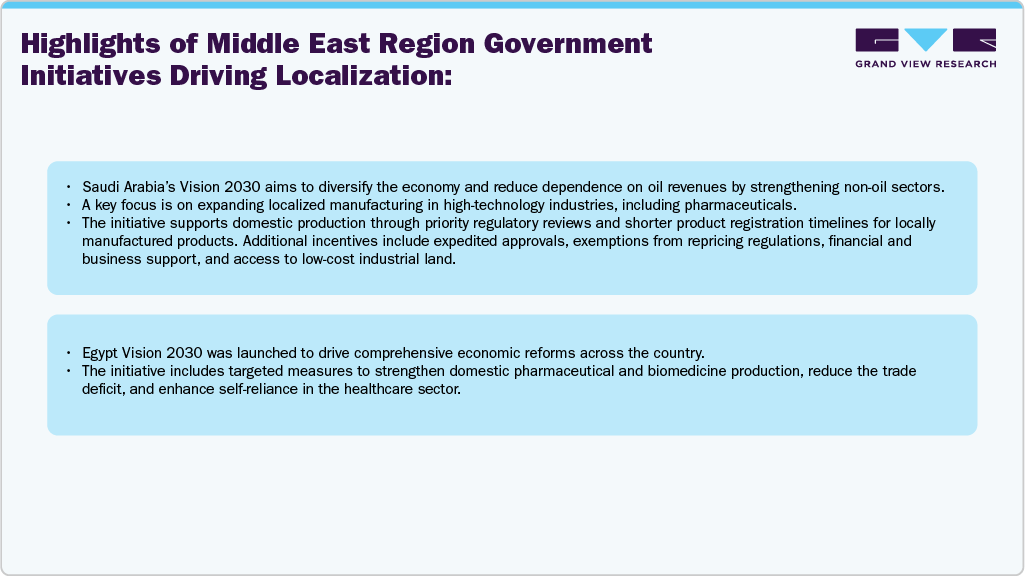
Highlights of Middle East region government initiatives driving localization:
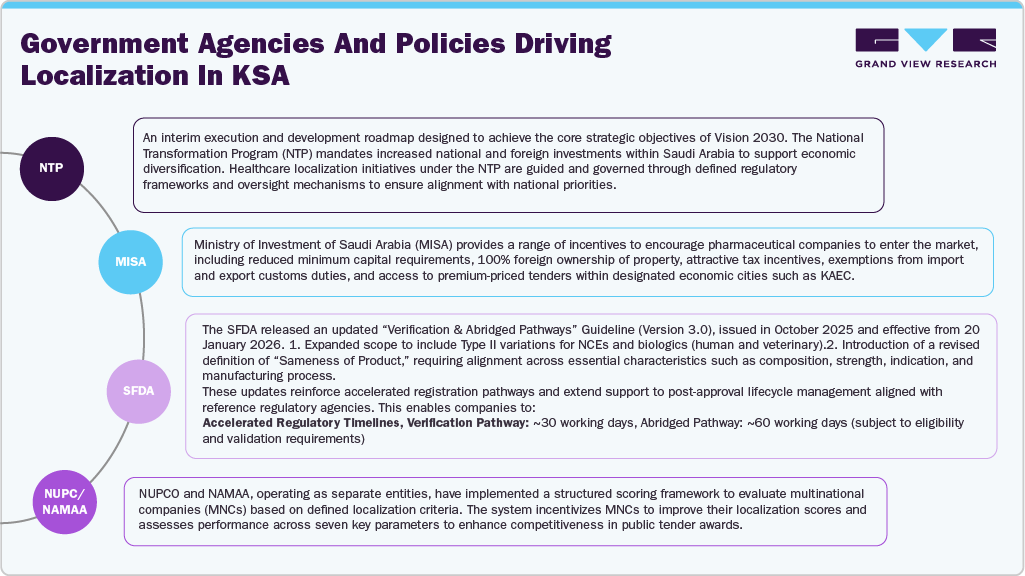
Government agencies and policies driving localization in KSA
By 2026, regional priorities outlined in these strategies include:
-
Expansion of pharmaceutical formulation and fill-finish capacity
-
Growth in regional assembly, calibration, and servicing of medical devices
-
Increased emphasis on contract manufacturing and private-label production
(Takeaway for stakeholders
Regional manufacturing strategies create opportunities for global pharma and MedTech players through local partnerships, optimized cost structures, and improved regulatory access.)
5. Specialty Care Becomes the Primary Revenue Growth Engine
Healthcare growth across the Middle East is increasingly being driven by high-acuity, specialty-led services, as reflected in government healthcare strategies and investment prioritization frameworks.
In the UAE, the Dubai Health Authority identifies oncology, cardiology, orthopedics, and fertility care as priority areas within its healthcare sector strategy, linking these specialties to domestic demand growth and advanced care positioning. For instance, in June 2025, The Dubai Health Authority (DHA), in collaboration with the Emirates Oncology Society, has introduced a new set of standards to regulate the delivery of oncology services across healthcare facilities in Dubai.
This initiative aligns with the objectives of Dubai’s Healthcare Strategy 2026, which seeks to build a world-class healthcare system that enhances patient and family confidence, improves clinical outcomes, and strengthens Dubai’s position as a leading global healthcare destination. Furthermore, comparable priorities are reflected in Saudi Arabia’s healthcare planning documents, which emphasize centers of excellence and advanced specialty services.
High-priority specialty areas include:
-
Oncology and advanced diagnostics
-
Cardiovascular and interventional care
-
Orthopedics and sports medicine
-
Fertility and women’s health
(Takeaway for stakeholders
Healthcare investment and medical tourism strategies are increasingly specialty-centric, with providers focusing on centers of excellence rather than broad, undifferentiated service portfolios.)
6. Preventive Care, Wellness, and the Longevity Economy Gain Institutional Momentum
Preventive care in the Middle East is increasingly being institutionalized through national health and quality-of-life programs.
In Saudi Arabia, Vision 2030 initiatives, including the Quality of Life Program, explicitly target non-communicable diseases such as obesity, diabetes, and cardiovascular conditions. Similarly, population health initiatives issued by the UAE Ministry of Health and Prevention emphasize early detection, lifestyle disease prevention, and population health management.
By 2026, policy frameworks indicate increasing emphasis on:
-
Integration of preventive services into care pathways and reimbursement models
-
Expansion of population health and chronic disease management programs
-
Investment in data-driven wellness, screening, and longevity-focused solutions
(Takeaway for stakeholders
These initiatives create sustained institutional demand for preventive diagnostics, digital therapeutics, nutrition platforms, and employer-supported health solutions.)
7. Healthcare Workforce and Capability Development as a Growth Constraint
As healthcare infrastructure and digital adoption accelerate, workforce availability, skills depth, and clinical capability are increasingly identified as structural constraints in official health system assessments.
In Dubai, workforce development priorities outlined by the Dubai Health Authority emphasize expanded clinical training capacity, continuous professional development, and readiness for digitally enabled and specialty-driven care models. Regional workforce challenges are also documented in assessments published by the World Health Organization for the Eastern Mediterranean region.
By 2026, healthcare systems are expected to be invested in:
-
Medical education and clinical training partnerships
-
Simulation-based and technology-enabled training centers
-
Workforce upskilled with digital health, AI, and advanced clinical care delivery
(Takeaway for stakeholders
Workforce development is no longer a support function; it is a core enabler of healthcare system scalability and sustainability.)
8. Pharmacies as decentralized care hubs
Healthcare systems across the Middle East are increasingly repositioning pharmacies from retail dispensing points into integrated access hubs for preventive and chronic care, aligned with national goals to reduce hospital burden and expand primary care reach.
-
In Saudi Arabia, the Wasfaty national e-prescription platform has digitally integrated community pharmacies into the care continuum, enabling services such as medication reconciliation, vaccinations, patient education, and monitoring programs for diabetes and hypertension.
-
In the UAE, digitally enabled pharmacies are supporting tele-pharmacy consultations, remote renewal of chronic medications, point-of-care testing, and temperature-controlled home delivery for specialty drugs, reinforcing their role in virtual and hybrid care pathways.
(Takeaway for stakeholders
Pharmacies are emerging as scalable, cost-efficient “front doors” to healthcare, making them strategic assets for preventive care delivery, chronic disease management, and continuity of care in hospital-constrained systems.)
9. Distributed and home-based care replacing hospital-centric infrastructure
Healthcare infrastructure across the Middle East is shifting from large, centralized hospitals toward distributed care networks that integrate outpatient centers, rehabilitation facilities, and home-based services to better manage chronic diseases and control long-term costs.
-
In Saudi Arabia, Vision 2030 is driving investment away from incremental bed expansion toward outpatient clinics, rehabilitation centers, and home-health ecosystems, supported by digital platforms and PPP-led infrastructure development.
-
In the UAE, strong digital regulation and telehealth frameworks are enabling outpatient, virtual, and home-care models, reducing per-episode costs by 30–50% while maintaining clinical outcomes for procedures traditionally delivered in inpatient settings.
(Takeaway for stakeholders
The region’s next phase of healthcare infrastructure growth will be defined by connected, distributed care models that prioritize continuity, cost efficiency, and chronic disease management over traditional hospital expansion.)
10. MedTech and digital health accelerating the shift to intelligent health systems
The Middle East’s healthcare transformation is increasingly centered in MedTech adoption and digital health infrastructure, as governments and providers invest in AI, robotics, unified health records, and virtual care to address chronic disease burden, capacity constraints, and clinician shortages.
-
In Saudi Arabia, national platforms such as NPHIES and Wasfaty are digitizing insurance, prescriptions, and care coordination at scale, while investments in robotics, Tele-ICU networks, and AI-enabled diagnostics are improving efficiency and outcomes across public hospitals.
-
In the UAE, unified health record systems such as Malaffi, combined with advanced imaging, robotic surgery programs, and AI-driven diagnostics at institutions like Cleveland Clinic Abu Dhabi, are enabling data-driven, high-acuity care and supporting medical tourism growth.
(Takeaway for stakeholders
MedTech and digital health are moving from pilot initiatives to core system infrastructure, positioning the GCC to transition from smart hospitals toward fully integrated, intelligent health ecosystems capable of delivering scalable, predictive, and high-quality care.)
11. Chinese capital and operators entering healthcare
Chinese enterprises see the Middle East as a “strategic engine of growth”, with 80-82% firms planning to enter or deepen their presence across sectors, including digital and green economy areas that intersect healthcare (e.g., medtech manufacturing, health IT, green hospitals).
-
For instance, in November 2025, Saudi Arabia strengthened its healthcare investment ties with China-linked partners through a major agreement with Ewpartners aimed at expanding dialysis, rehabilitation, fertility, and diagnostic services, as the Kingdom accelerates private-sector participation to address ongoing capacity shortfalls.
-
In October 2025, at the Saudi International Medical and Health Expo, the Ministry of Investment and the Ministry of Health and signed a strategic cooperation agreement with Ewpartners and four industry partners. Valued at approximately around USD 214 Mn (1.5 bn yuan), the initiative focuses on four high-demand segments: hemodialysis, rehabilitation medicine, assisted reproductive services, and healthcare diagnostics.
Chinese investors are shifting from representative offices to operational entities and regional HQs, with independent investments and JVs as preferred modes.
(Takeaway for stakeholders
In the Middle East healthcare sector, Chinese companies are emerging as key contributors in digital health infrastructure, MedTech manufacturing, and public–private partnership (PPP) hospital projects.)
12. National EHR platforms becoming the backbone of connected healthcare systems
The Middle East is rapidly shifting from hospital-level digitalization to national, interoperable electronic health record (EHR) ecosystems, recognizing that unified patient records are essential for continuity of care, population health management, and scalable digital health delivery.
-
In the UAE, in January 2023, national integration of Riayati with Malaffi and Nabidh created a real-time medical record spanning more than 1.9 billion records across over 3,000 facilities, enabling clinicians to access longitudinal patient histories across public and private providers.
-
In Saudi Arabia, platforms such as NPHIES and Wasfaty are connecting hospitals, specialty centers, insurers, and pharmacies into a single digital care fabric, while Jordan’s Hakeem and Oman’s Al Shifa demonstrate early nationwide EHR deployment linked to patient-facing services.
(Takeaway for stakeholders
EHR adoption in the Middle East has moved beyond software deployment to system-level patient memory, making interoperability, data sovereignty, and clinician readiness the critical determinants of resilient, scalable, and value-based healthcare delivery.)
13. Smart Hospitals & IoT Integration
The Middle East is rapidly embracing smart hospitals and connected healthcare, driven by government investment, population growth, rising chronic disease burden, and a strategic shift toward digital-first health ecosystems. Integration of Internet of Things (IoT), AI, robotics, and real-time analytics is transforming patient care, improving operational efficiency, and supporting long-term digital health strategies.
-
In September 2025, Saudi Arabia launched the SEHA Virtual Hospital (SVH), connecting 130 hospitals nationwide and eight specialty clinics. IoT-enabled devices provide remote monitoring, allowing the hospital to manage more than 400,000 patients annually without requiring travel to central facilities.
-
In May 2025, Saudi Arabia opened the world’s first fully AI-driven hospital, in partnership with the country’s Almoosa Health Group. The clinic is equipped with “Dr. Hua,” an AI-driven system that independently diagnoses conditions and recommends treatment plans, which are subsequently reviewed and validated by human physicians for accuracy and safety.
-
In December 2024, UAE-based Mulk International and India’s Ajeenkya DY Patil Group launched the region’s first large-scale global virtual hospital with a USD 27.2 million investment. The platform connects over 20,000 physicians, provides 24/7 telehealth consultations, AI-enabled ICU pods, smart ambulances, mobile clinics, and discounted medicines, demonstrating how virtual infrastructure can expand healthcare access and accelerate digital integration.
(Takeaway for stakeholders
Smart hospitals and IoT integration are enabling data-driven, patient-centric healthcare in the Middle East. By connecting physical facilities, virtual platforms, and home-based monitoring, these initiatives are redefining care delivery, improving clinical outcomes, and expanding access across the region.)
14. Expanding Medical Tourism in the Region
Medical tourism is rapidly evolving into a major strategic pillar of the Middle East’s healthcare economy, supported by world‑class infrastructure, internationally accredited facilities, integrated health‑travel platforms, and targeted government initiatives that elevate the region’s global appeal. GCC hubs such as the UAE and Saudi Arabia are investing in coordinated ecosystems that blend advanced clinical services with hospitality, regulatory support, and digital patient engagement tools to attract and retain international patients.
-
UAE Leadership in Global Medical Travel: Dubai and Abu Dhabi emerged as leading global destinations for medical tourism, with Dubai ranking 6th worldwide on the Medical Tourism Index and the UAE treating patients from over 153 countries. According to an article published by WAM, as of 2023, Dubai hosted over 691,000 medical tourists who spent more than AED 1.03 billion (≈ USD 280 million) on healthcare services, generating significant indirect revenue across tourism and hospitality sectors.
-
Saudi Arabia’s Growth Trajectory: Saudi Arabia is leveraging healthcare modernization under Vision 2030 to expand specialty care offerings in cardiology, orthopedics, oncology, and other high‑demand fields, positioning Riyadh and Jeddah as competitive medical tourism destinations within the Gulf.
-
Broader GCC Momentum: Other GCC and neighboring markets including Qatar, Bahrain, Kuwait, and Oman are enhancing infrastructure and services to compete in niche medical tourism segments such as rehabilitation, dental care, and preventive wellness.
(Takeaway for stakeholders
Medical tourism in the Middle East is transitioning from asset‑level competitiveness to integrated destination strategy, combining clinical excellence, hospitality, streamlined visas, and digital platforms to capture growing cross‑border demand and diversify healthcare revenue streams.)
15. Robotics in Healthcare: Middle East Emerging as a Global Leader
The Middle East is rapidly transitioning from selective technology adoption to establishing a region-wide ecosystem for advanced robotic-assisted surgery. Governments, healthcare providers, and technology partners are aligning national strategies with operational deployment, embedding robotics across multiple specialties, and enhancing clinical outcomes, efficiency, and scalability.
-
UAE Scaling Robotic Surgery: Cleveland Clinic Abu Dhabi and American Hospital Dubai have integrated robotic platforms across cardiology, urology, gynecology, and complex abdominal procedures. National initiatives such as the Dubai Robotics & Automation Program (launched 2024) and UAE AI Strategy 2031 support infrastructure, workforce readiness, and operational standardization for robotics across hospitals.
-
Saudi Arabia Advanced Surgical Robotics: King Faisal Specialist Hospital & Research Centre (KFSHRC) has performed world-first fully robotic procedures, including liver and heart transplants, and robotic-assisted artificial heart pump implantation. Under Vision 2030, robotics is a strategic pillar for complex surgical care, emphasizing precision, outcomes, and national capability building.
-
Leading Hospitals in Practice: American Hospital Dubai completed over 1,800 robotic procedures across multiple specialties by December 2024. Dubai Hospital performed 145 robotic surgeries since mid-2022, while Sheikh Shakhbout Medical City (SSMC) completed 500 robotic-assisted surgeries by November 2024. These deployments illustrate robotics moving from pilot programs to operational backbones of care delivery.
(Takeaway for stakeholders
Robotics is evolving from a prestige technology to a core pillar of advanced surgical care in the Middle East. By integrating AI, multi-specialty platforms, and national digital infrastructure, the region is improving precision, scaling surgical capacity, optimizing workforce efficiency, and positioning itself as a global leader in robotic healthcare innovation.)
Conclusion: What Will Define Winners in the 2026 Healthcare Landscape
Based on explicit policy direction and published national strategies, the Middle East healthcare market in 2026 will favor organizations that:
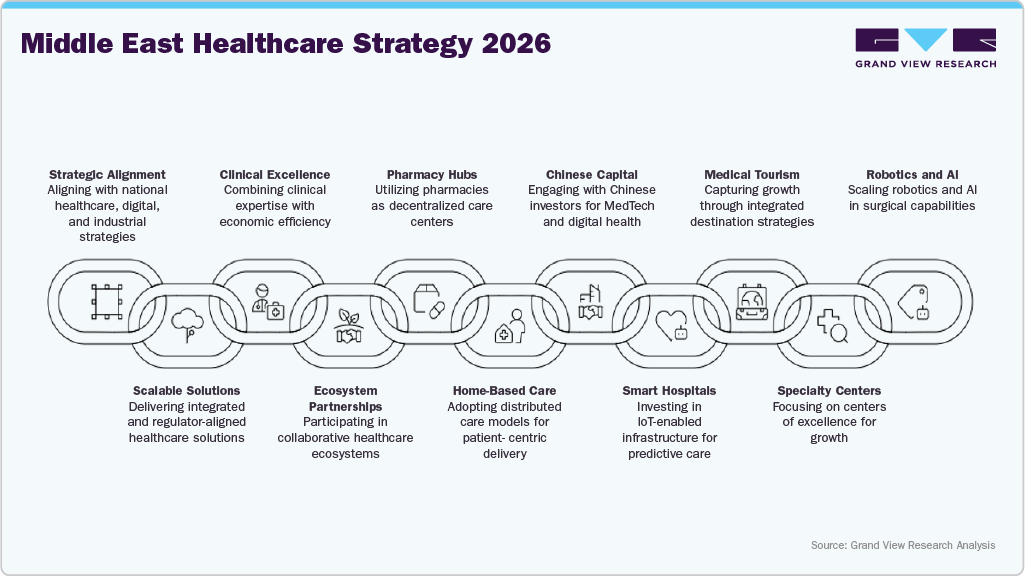
Healthcare in the Middle East is no longer positioned as a purely social sector. As articulated in national policy frameworks, it is increasingly treated as a growth-oriented, innovation-driven pillar of economic and human capital development.