Middle East Household Appliances Industry: From Convenience To Critical Infrastructure
A Climate-Driven, Infrastructure-Led Household Appliances Market
The Middle East household appliances market operates at the intersection of climate necessity, rapid urbanization, energy-system transformation, and evolving household lifestyles. Unlike many mature Western markets where appliance demand is largely replacement-driven, the Middle East reflects a hybrid demand structure—combining first-time household formation, infrastructure-led demand (cooling and water-related appliances), and value-driven upgrades shaped by policy and resource constraints.
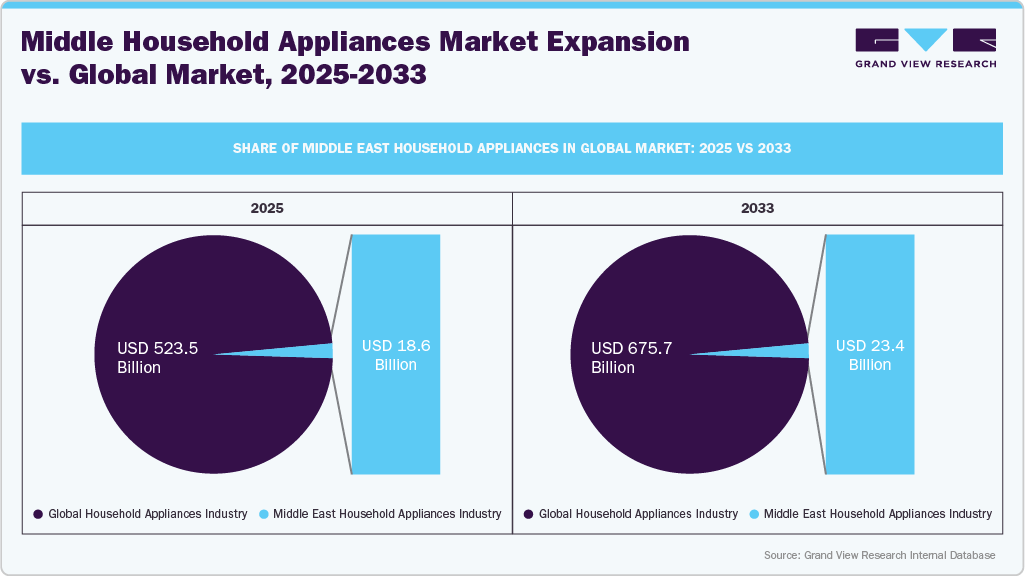
According to Grand View Research, the Middle East household appliances market is expected to reach USD 18.62 billion by 2025. The Middle East has experienced sustained population growth, high urban concentration, and rising household formation, particularly in Gulf Cooperation Council (GCC) countries and major urban centers across Saudi Arabia, the UAE, Egypt, and Qatar. According to the World Bank, urban population shares in GCC countries exceed 85%, reinforcing apartment-based living and centralized utility dependence. Urban density directly increases reliance on electrical household appliances for climate control, food storage, cooking, and laundry.
Structural Role Shift
Cooling appliances are now “life-support” for the modern Middle East home:
The International Energy Agency (IEA) notes that electricity demand in the Middle East and North Africa tripled between 2000 and 2024, driven materially by rising cooling needs (air conditioning) and water desalination in a heat- and water-stressed region.
This shift changes the appliance stack:
-
Air conditioners and ventilation move from discretionary to essential (comfort + health + indoor air quality).
-
Voltage protection, stable compressors, and service access become as important as features.
-
Energy efficiency becomes a “bill shock” mitigator, not just a sustainability badge..
Energy-price reform turns efficiency into a household budget strategy :
Multiple Gulf countries began reducing energy price gaps and reforming domestic energy pricing starting around 2015 (with variation by country), increasing the economic value of efficient appliances.
As pricing becomes more cost-reflective, consumers respond by prioritizing:
-
higher-efficiency cooling (e.g., inverter/variable-speed AC)
-
better insulation performance (appliance + building envelope interaction)
-
appliance replacement driven by operating-cost savings, not just failures
-
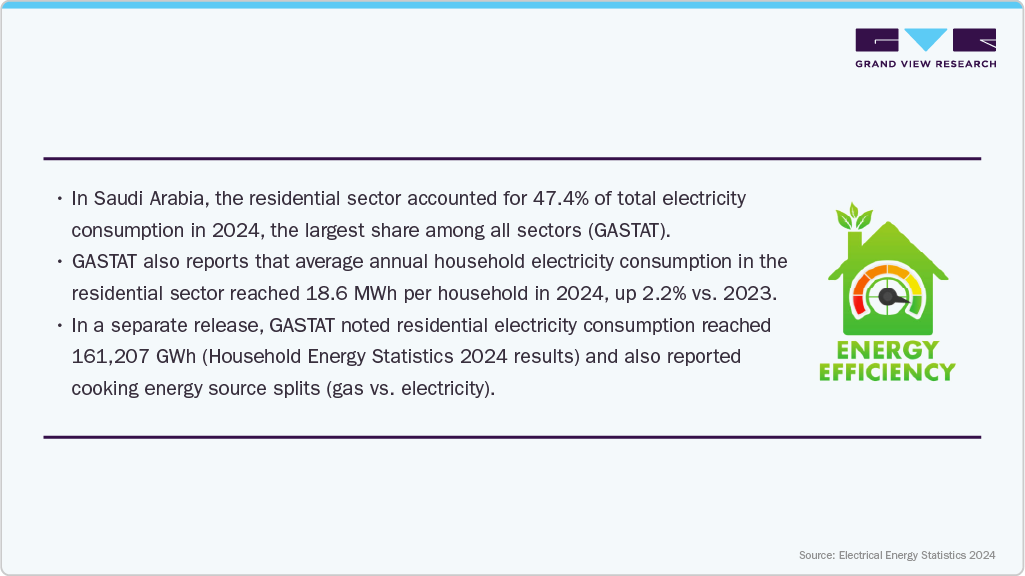
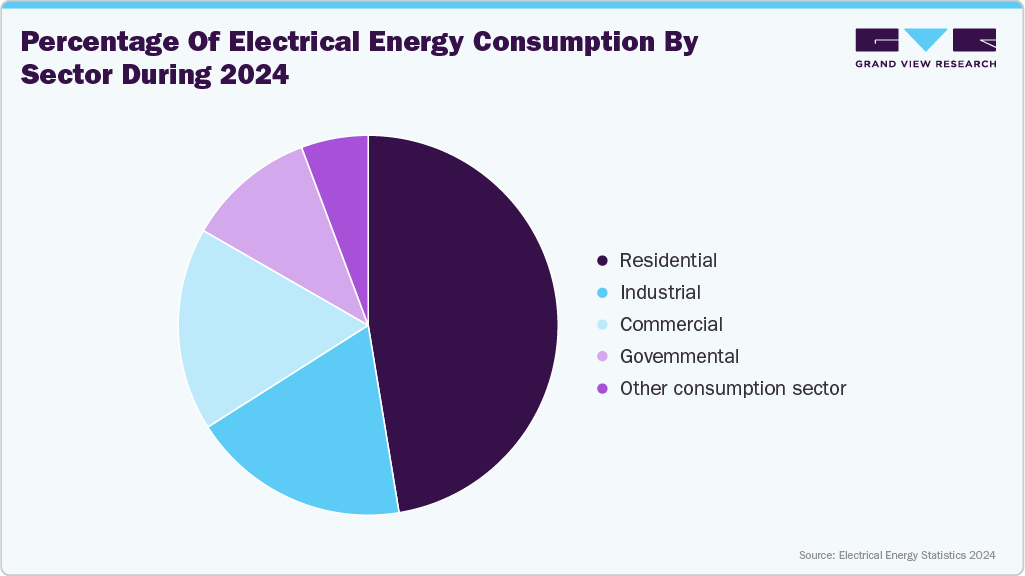
In Saudi Arabia, the residential sector accounted for 47.4% of total electricity consumption in 2024, the largest share among all sectors (GASTAT).
-
GASTAT also reports that average annual household electricity consumption in the residential sector reached 18.6 MWh per household in 2024, up 2.2% vs. 2023.
-
In a separate release, GASTAT noted residential electricity consumption reached 161,207 GWh (Household Energy Statistics 2024 results) and also reported cooking energy source splits (gas vs. electricity).
Implication for the appliances industry: as grids tighten and peak demand grows, policies increasingly push consumers and importers toward higher-efficiency ACs and major appliances, accelerating replacement of older models.
Water stress elevates “water-smart” appliances
Saudi Arabia’s World Bank profile highlights extreme water pressure, including very high annual freshwater withdrawals relative to internal resources.
In practice, this favors:
-
high-efficiency washing machines
-
dishwashers positioned as water-saving vs handwashing
-
smarter leak detection, load sensing, and low-water cycles
The market is import-heavy, but with pockets of local production and re-export logistics
Trade data illustrates how demand expresses itself through imports. For example, Saudi Arabia imported electric instantaneous or storage water heaters (HS 851610) worth about US$34.1 million and ~410,269 units in 2023 (World Bank WITS / UN Comtrade).
The region’s appliance market therefore behaves like a supply-chain and standards market: logistics, compliance, and after-sales capability often matter as much as branding.
Strategic Implications
Regulation Is Increasingly The “Hidden Hand” That Shapes Winners
Governments and standards bodies are tightening energy performance requirements and labeling systems, which steadily removes low-efficiency models from shelves and procurement lists. For the UAE, the energy efficiency labeling framework for electrical appliances has formal standards coverage including household air conditioners and laundry appliances.
Across the Middle East, the appliances market is increasingly governed by (1) conformity/safety rules and (2) energy and water efficiency labeling + minimum performance requirements.
UAE: Energy Efficiency Labels (EESL) and digital label issuance
The UAE’s Ministry of Industry and Advanced Technology (MoIAT) provides services to issue product efficiency cards/labels indicating energy efficiency for electrical appliances (and environmental performance for certain product classes).
MoIAT also published an Energy Efficiency Labels user manual describing the move to a new digital system and related process flows.
GCC-level standards: the “regional harmonization” direction
The Gulf Standardization Organization (GSO) plays a central role in harmonizing requirements across GCC markets (with varying degrees of national customization).
A concrete example: GSO 2738:2024 defines performance and energy requirements for electric clothes washing machines (capacity up to 25 kg) tied to valid energy efficiency labeling.
Power systems planning is now directly connected to appliance strategy
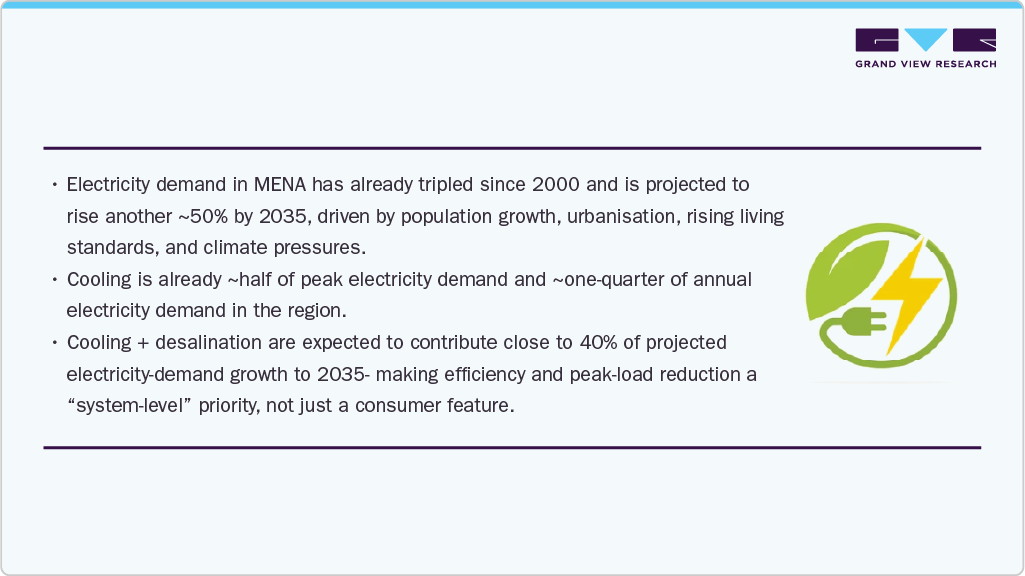
The IEA projects substantial power-sector investment and grid modernization needs to meet rising demand, explicitly linked to cooling loads.
Implication for appliance players: grid constraints and peak demand create a commercial advantage for:
-
efficient cooling that reduces peak draw
-
smart controls / demand response readiness
-
“heat and dust resilience” design (performance stability in harsh conditions)
Portfolio Strategy
Power-system planning is increasingly shaped by what happens inside homes—especially cooling and other electricity-intensive end uses.
The IEA links regional demand growth directly to cooling and projects large, sustained power-sector and grid investment needs, which makes high-efficiency, peak-friendly cooling (and smart controls that can reduce peak draw) the most critical “must-win” category.
In Saudi Arabia, the residential sector is the largest electricity-consuming sector (47.4% in 2024), reinforcing why cooling and other high-consumption appliances sit at the center of policy and replacement demand. Alongside cooling, laundry and refrigeration remain core because they are high-penetration essentials where differentiation comes from energy/water efficiency, reliability in high ambient heat, and protection against power-quality variation; the regulatory push is visible through GCC and national standards/labeling systems such as GSO-aligned efficiency requirements and the UAE’s structured efficiency labeling framework.
Selective growth should target “premium pull” categories where demand is strongest and service ecosystems are mature—particularly dishwashers and small kitchen appliances in premium GCC markets—backed by import demand signals like the UAE’s sizeable dishwasher imports in 2023. The main portfolio risks are low-efficiency legacy models (increasingly exposed as MEPS/labeling tighten) and price-only SKUs without strong after-sales, because harsh climates make uptime, spare parts availability, and repair turnaround a decisive factor in repeat purchase and brand trust.
Retail Dynamics
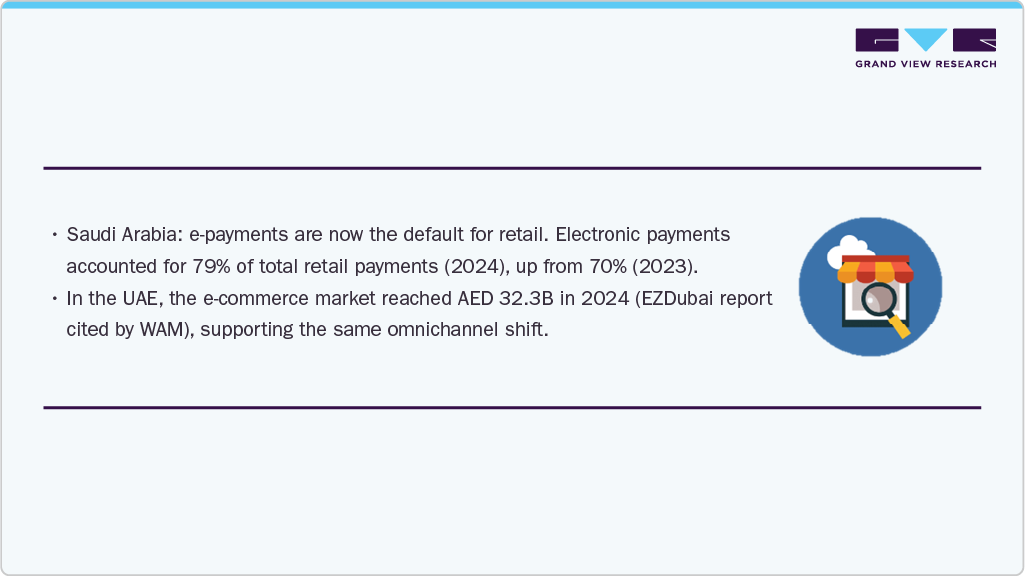
Retail dynamics in the Middle East household appliances market are increasingly omnichannel and service-led: consumers often start with online discovery and price comparison, but conversion still depends on offline experience, installation planning, and warranty confidence. This is reinforced by the region’s rapid shift to digital payments and e-commerce, which makes the “digital front-end” (search, reviews, marketplaces) inseparable from the “physical back-end” (delivery, installation, parts, repairs). In Saudi Arabia, electronic payments reached 79% of total retail payments in 2024, and total non-cash transactions hit 12.6 billion—a clear indicator that appliance shopping journeys (even when finalized offline) are increasingly digital-first.
Competitive Landscape Analysis: Product Innovation And Strategic Moves Shaping The Middle East Market
Competition in the Middle East household appliances market is increasingly defined by who can align fastest with climate stress, efficiency regulation, and infrastructure realities, rather than by feature-led differentiation alone. This is most visible in the cooling and large white goods segments, where manufacturers are repositioning appliances from discretionary consumer durables to mission-critical household infrastructure. Recent product launches and partnerships indicate that leading players are converging around three themes: efficiency-led upgrades, smart/AI-enabled ecosystems, and localization of supply chains.
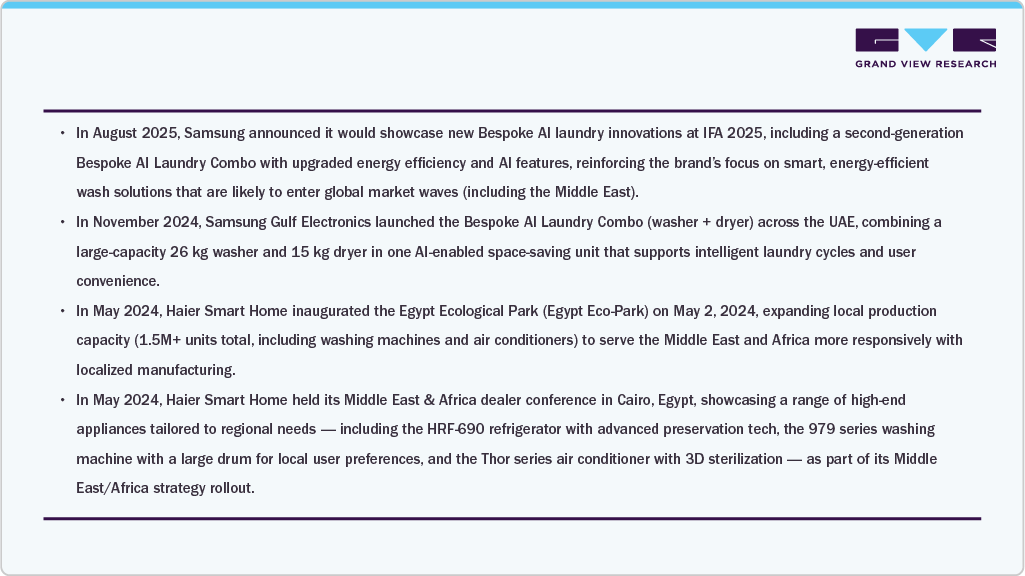
On the product front, premium multinational brands are using AI and connectivity as upgrade accelerators, particularly in GCC markets where replacement demand is increasingly efficiency- and comfort-driven. For instance, Samsung’s Bespoke AI and AI Home appliance launches—covering laundry, refrigeration, and kitchen appliances—are designed to push consumers toward ecosystem-based upgrades rather than single-product replacements. These launches emphasize energy optimization, usage intelligence, and integration with smart-home platforms, aligning well with rising electricity cost awareness and peak-load sensitivity in markets such as Saudi Arabia and the UAE. The strategic impact is that premium brands are defending margins while shortening replacement cycles, even as headline appliance penetration remains high.
Country Lens: How The Opportunity Differs
|
Country / Sub-region |
Opportunity driver |
Latest government / association stat or proof-point |
What it means for appliances demand |
|
Saudi Arabia |
Large population + high residential electricity load |
Population 35.3M (2024) (World Bank). Residential sector is 47.4% of total electricity consumption (2024); avg household consumption 18.6 MWh (2024) (GASTAT). |
High structural demand for cooling + major appliances; upgrades/replacement cycles rise as efficiency norms tighten and energy costs/peak load awareness increases. |
|
United Arab Emirates (UAE) |
Premiumization + compliance-led SKU strategy |
UAE macro strength (GDP & GDP per capita, 2024) (World Bank). MoIAT provides energy efficiency label / product efficiency card services and related processes (MoIAT). |
Higher willingness to pay supports premium, smart, built-in categories; compliance/labeling influences importable SKUs, assortment, and channel access. |
|
Qatar |
Conservation programs shaping consumer behavior |
KAHRAMAA Tarsheed program focuses on reducing consumption and improving efficiency (KAHRAMAA). |
Supports demand for high-efficiency AC/white goods, replacement of older models, and increased attention to labeled/efficient products in procurement. |
|
Oman / Bahrain / Kuwait (GCC) |
Standard harmonization + efficiency labeling direction |
GCC standardization is driven by GSO (Gulf Standardization Organization). Example: GSO 2738:2024 for washing machines ties performance/energy requirements to labeling. |
Increasing alignment enables regional SKU platforms and raises compliance as a competitive advantage; retail modernization improves category penetration and upgrade cycles. |
|
Wider Middle East (non-GCC) |
Climate-driven cooling demand + urbanization, but higher price sensitivity |
IEA notes MENA electricity demand growth is strongly influenced by cooling needs. Regional urbanization trend (World Bank). |
Demand remains structurally strong for AC and core white goods, but sales are more exposed to currency/import constraints and affordability, favoring value tiers and flexible financing/promotions. |
Outlook For 2026–2030: What To Expect
-
Efficiency-driven replacement will keep rising
As electricity demand pressures persist and standards tighten, manufacturers that lead in high-efficiency SKUs are structurally advantaged. (IEA + national energy efficiency direction in GCC.)
-
Compliance + speed-to-market will decide winners
Where label issuance and conformity processes are digitized and enforced (e.g., UAE services), importers and brands with strong regulatory operations can scale faster and avoid port/channel bottlenecks.
-
Omnichannel and after-sales will remain “share multipliers”
In many Middle East markets, product parity is high—so service quality, installation capability, warranty handling, and spare-part availability become key drivers of repeat purchase and retailer preference.
Conclusion: The Middle East Appliance Market Is Becoming An Infrastructure Market
The Middle East household appliances industry is evolving from a discretionary consumer category into critical household infrastructure, led by climate intensity, power-system constraints, and water stress. Cooling has become the anchor category, and the market’s center of gravity is shifting toward efficiency, resilience, compliance, and serviceability rather than feature-only differentiation.
Over 2026–2030, the most structurally advantaged players will be those that treat the region not just as a sales market, but as a standards-driven operating environment: building portfolios aligned with MEPS and labeling, engineering products for harsh conditions, and investing in omnichannel execution plus after-sales ecosystems. As electricity demand and peak-load pressures grow, appliance strategy and power-system planning will become increasingly linked—making high-efficiency, peak-friendly cooling and reliable core white goods the “must-win” battleground, while compliant, service-led go-to-market capabilities will determine who scales sustainably across the region.