U.S. Television Consumer Insights - Usage, Attitudes, And Brand Performance Report
Introduction:
The television market in the U.S. has seen a significant transformation driven by AI, lifestyle changes due to the availability of similar features in smaller and compact devices, such as smartphones and laptops. Nowadays, consumers demand more control over the personalization of what they want to consume, and the industry is continuously evolving and shaping the future of the television industry. As consumers are shifting to online streaming services like Netflix, Hulu, and other OTT platforms, the brands are promoting smart televisions that can run these OTT platforms on a bigger screen. Televisions are becoming multifunctional and interconnected so that the viewers can enjoy platforms like Instagram and TikTok in addition to these OTT platforms. The preferences and the market trends that are driving the television industry are:
-
Dominance of streaming services: There has been a significant shift away from traditional cable services toward streaming services (OTT platforms), driven by on-demand content at lower prices. The decline was mainly among the young users who prefer flexibility in usage and affordability instead of one-dimensional content.
-
Smart TVs and connected devices: Multifunctional devices with built-in AI and internet connectivity are becoming standard in U.S. households. With the help of the internet, people can play video games and cast their device screens to the television, making it a multifunctional device.
-
Ad-supported streaming models: These models are rapidly growing not only in the U.S. but also globally. Platforms like Hulu and Peacock offer both paid and subscription-free models where the consumer has to watch the ads in intervals to consume the content for free. These ads are quite similar to traditional television ads; they are usually short and appear before, during, or even after a program.
Future aspects:
By looking at the current scenario in the U.S. television market, it will be dominated by streaming services like Netflix, Disney+, and Hulu. With the internet a basic household requirement in the U.S., these streaming services will expand their content offerings, making their prices more affordable, since the primary users are young people. This is a generation in which the ecosystem plays a vital role in everyone’s life, and television will be a major part of it. Additionally, live sports and events are available on streaming services, providing viewers with more options and the convenience of watching them live.
Methodology:
The insights covered in this report are drawn from GVR’s ‘Voice of Consumer Survey’ and its periodic updates. The latest survey represents 75,000+ consumer interviews conducted across 20 countries for 100+ product categories. These insights are specifically catered to the brands operating in the television industry in order to guide them in their strategic decision-making process. This report provides insights covering category usage & attitude, buying behavior, brand performance metrics, and brand health indicators of leading players in the U.S. television market.
Chapter 1: Usage and Attitude
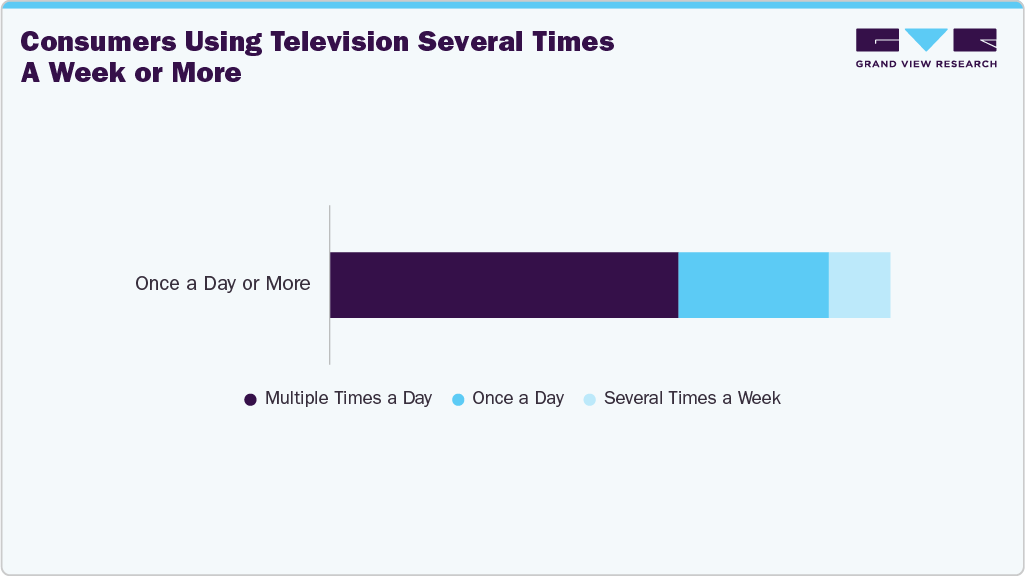
In the U.S., TV usage is not as much as it used to be, with more people turning to streaming services, especially on other devices that offer convenience and ease of accessibility. Having said that, 68% of consumers watch television multiple times a day, which is largely driven by older generations such as baby boomers.
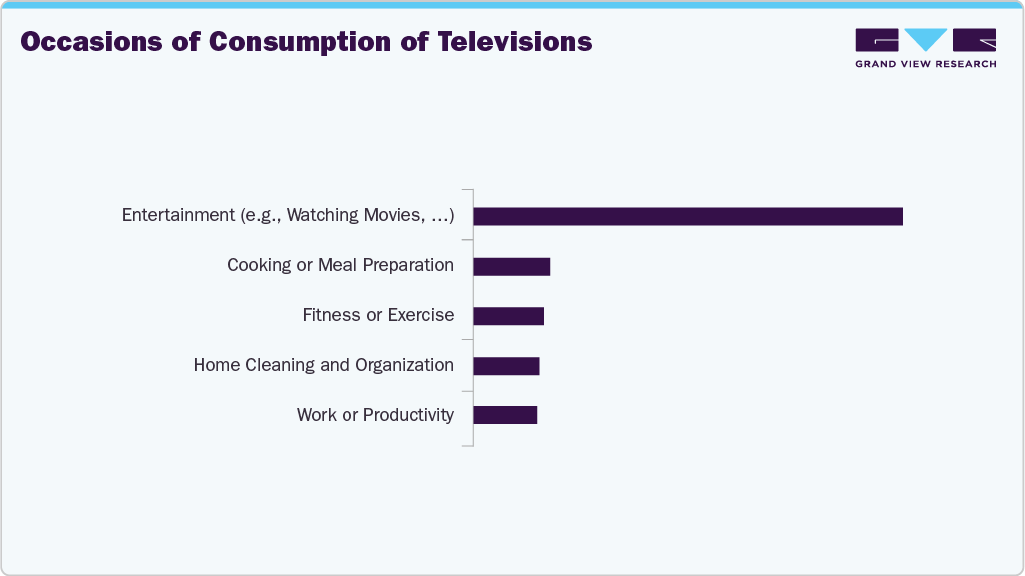
Televisions are mostly used for entertainment, according to about 9 out of 10 consumers. However, fewer people also like to tune in to television while cooking or meal preparation, which helps them relax. Consumers do not watch television for entertainment; they use it as a guide for cooking, too. About 9% of them also watch television while doing exercises following a fitness routine guided by a YouTube video or a fitness program. Consumers associate watching television not just with entertainment but also with accessing information and learning new things, as television today offers much more. However, with the ease of access to content, people also fear becoming overly dependent on digital devices and increasing screen time. Lastly, consumers also feel that with the advancement in technology, the cost of owning a television has also increased, creating a negative association in their minds.
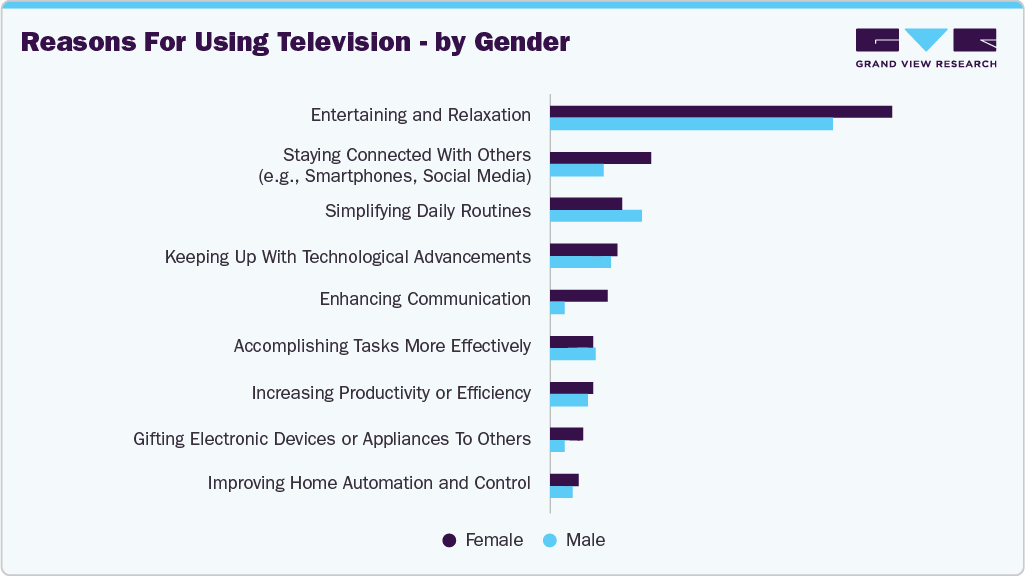
Consumers, i.e., both males and females, mainly use or watch television for relaxation and entertainment, for example, winding down after work on a weekday, watching content while eating, playing music on television while doing chores, and more. For males, simplifying daily routines is another significant reason to own a television, while for females, staying connected with others is the second-best reason for using television.
What delights consumers about the use of a television is the cutting-edge technology of the device or its performance, followed by experiencing a user-friendly interface, making it easier for them to navigate.
Buying Behavior
Before making a big purchase, consumers prefer information on certain aspects, since a television is a long-term investment. Some important information points are a television’s performance and reliability, given that televisions now cost more and are a big investment. The second is pricing, and knowing that a consumer is getting good value for money, especially with the rise in living expenses, a majority of the population is becoming budget savvy. The last important information point that is sought after is the technological features and innovations in the product. As mentioned previously, because televisions are a long-term investment, consumers typically purchase them every 5 years. The longevity of the product also plays a major role in the frequency of purchase.
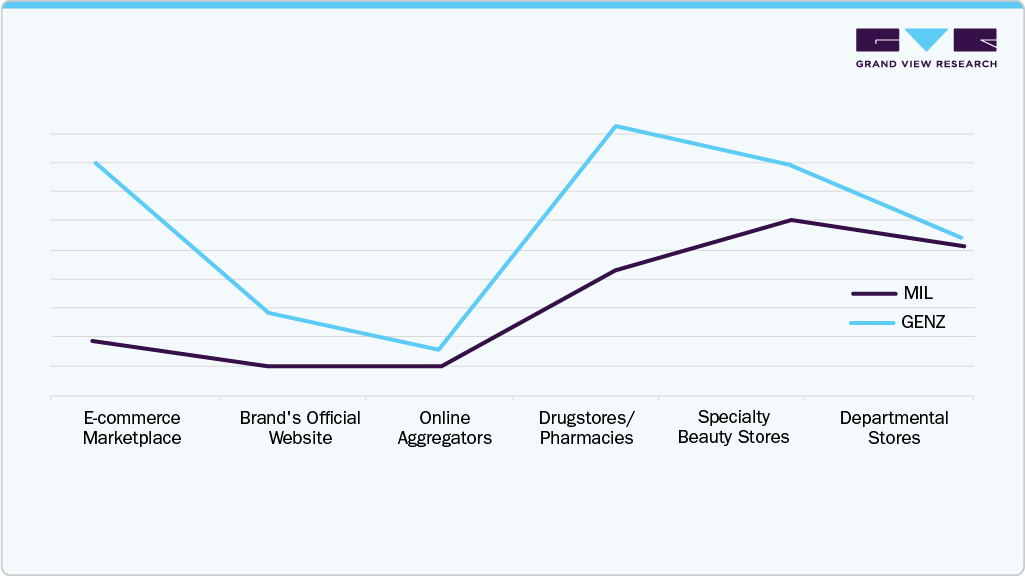
When it comes to the mode of purchase, electronic retail stores and department stores are the most common options; however, when analyzed in terms of different generations, electronic retail stores are a go-to place for Gen Z, and department stores are preferred by Millennials.
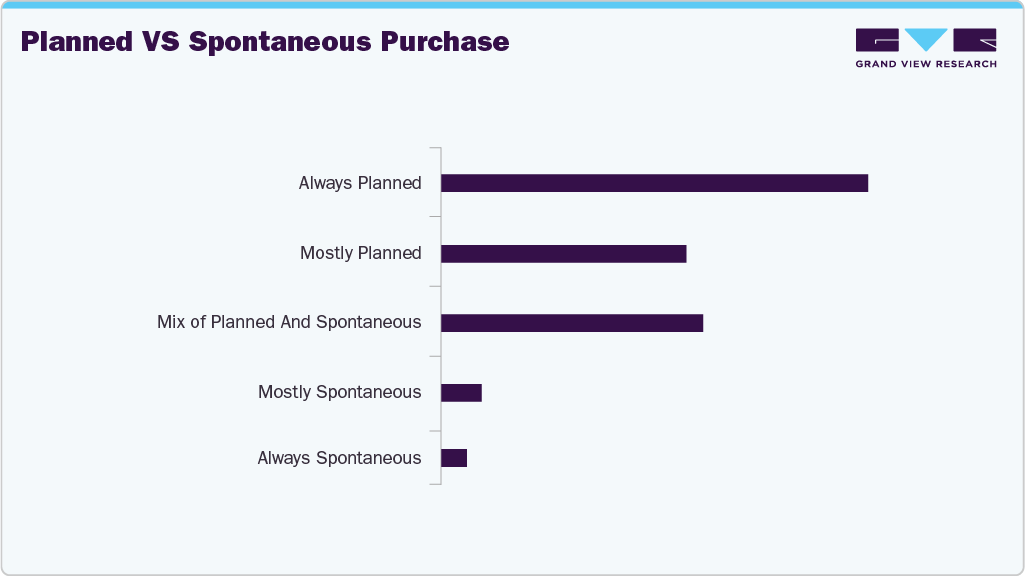
Televisions, as suspected, mainly fall under a planned purchase, as 47% of consumers say they always plan their purchases, while 22% mostly plan their purchases. This indicates that a significant portion of the consumer base prefers to make well-thought-out purchasing decisions rather than act on impulse. Although a very small portion of the population spontaneously purchases a television, it is largely driven by the need to upgrade or replace old devices, which are offered at very low prices during Black Friday sales, compelling consumers to make an impulse buy.
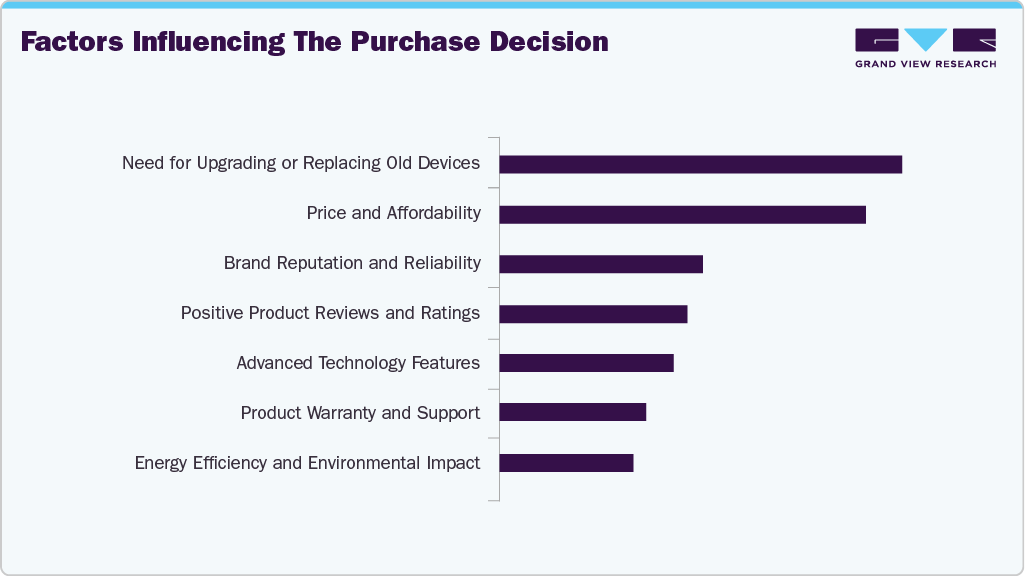
Now, coming to what drives consumers to make a purchase, the need to upgrade or replace an old television leads the way. Followed by the pricing and affordability factors, which is a strong signal that consumers are very sensitive to the hike in prices of new devices and wait for sales, offers, promotions, and discounts to exchange the old devices for new ones. Offering attractive deals could be a powerful tool in driving purchases.
Consumers are highly influenced by online reviews and promotions, so brands need to build a positive online brand image by offering advanced, reliable products at reasonable prices to drive better reviews and ratings.
Some of the challenges expressed by consumers are a lack of affordable options in the market with essential features, as the prices keep rising, followed by difficulty in understanding advanced features. Thus, they demand a product with a simple user interface. Brands can definitely gain the upper hand by addressing these issues and filling the gaps.
Brand Power Play (Brand Health and Performance)
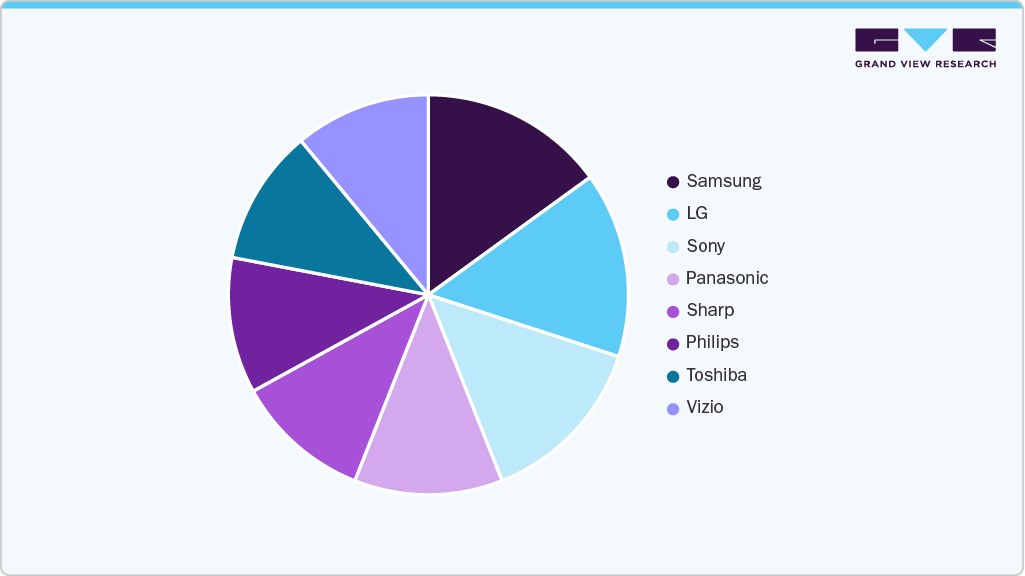
Some of the popular television brands in the U.S. include Samsung, LG, Sony, Panasonic, Sharp, Toshiba, and Philips. Although the television industry is saturated, Samsung dominates the market with a 90% share (by awareness), due to its cutting-edge technology and advanced features.
Purchase Funnel
The prominent brands enjoy a high level of awareness; however, when we look further down the brand or purchase funnel, not all of them deliver a promising performance. Phillips, which enjoys high awareness, sees significant declines in consideration and preference. While many brands do not enjoy strong preference and purchase intent, Samsung and LG are able to withstand the competition and emerge as star performers. Thus, exhibiting a strong purchase funnel despite significant drops from awareness to consideration, driven by higher satisfaction and brand loyalty. Top brands like Samsung and LG should focus on maintaining their market dominance by consistently delivering high quality, affordability, and strong marketing. Although Vizio has lower awareness than Samsung and LG, it converts well into actual usage, making it an emerging contender in the market.
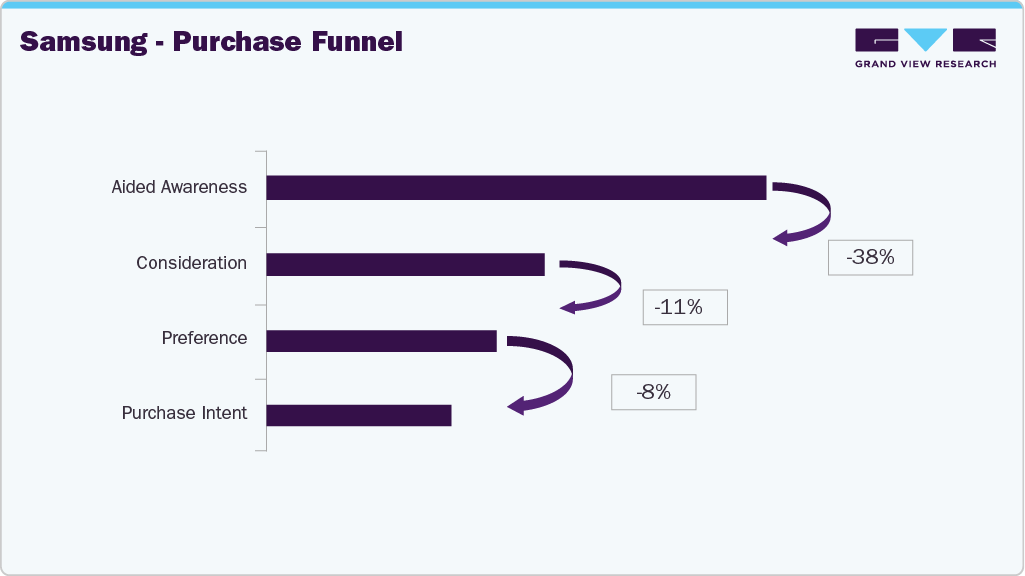
While the overall NPS score of the leading brands varies from -51 to 53, Samsung, as expected, leads the way with the highest NPS score (53) compared to other prominent television brands in the market.
