
- Home
- »
- Advanced Interior Materials
- »
-
Base Metal Mining Market Size & Share Report, 2026-2033GVR Report cover
![Base Metal Mining Market (2026 - 2033)Report]()
Base Metal Mining Market (2026 - 2033)
Size, Share & Trends Analysis Report By Product (Aluminum, Copper, Zinc, Lead, Nickel, Tin, Tungsten), By End-use (Construction, Automotive, Electrical & Electronics, Consumer Products), By Region, And Segment Forecasts
Market Size, 2025
$562.0BMarket Estimate, 2026
$567.9BMarket Forecast, 2033
$831.5BCAGR, 2026–2033
5.6%Base Metal Mining Market Summary
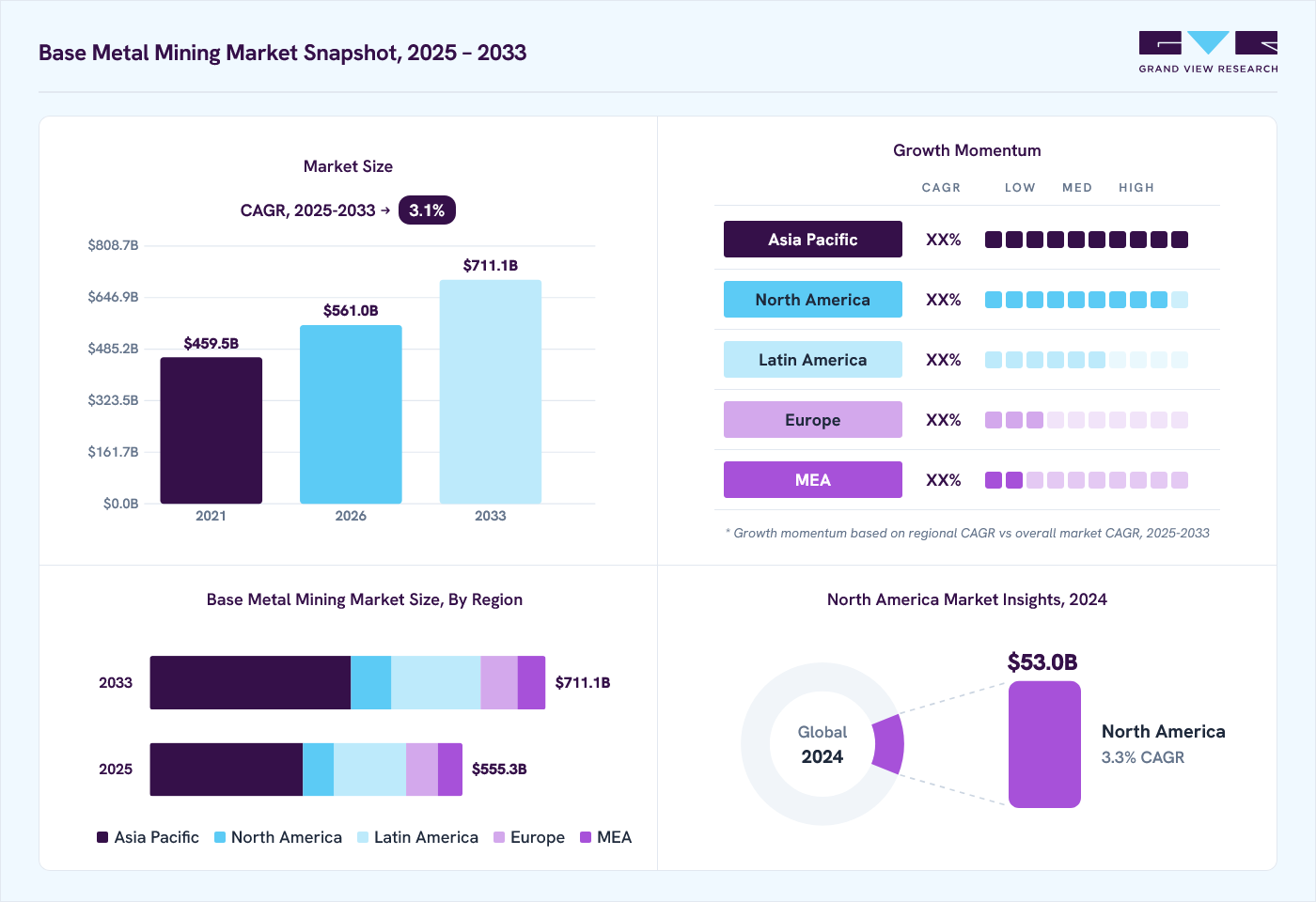
The base metal mining market size was valued at USD 562.0 billion in 2025 and is projected to grow from USD 567.9 billion in 2026 to USD 831.5 billion by 2033, at a CAGR of 5.6% from 2026 to 2033. Asia Pacific dominated the base metal mining market with the largest revenue share of 48.8% in 2025. Growth is driven by rising demand for copper, nickel, zinc, and aluminum in EVs, renewable infrastructure, and industrial manufacturing.
Key Market Trends & Insights
- By product: Aluminum segment held the largest market share of 35.1% in 2025.
- By end use: Construction segment held the largest market share of 39.6% in 2025.
Regional Highlights
- Largest regional market: Asia Pacific (48.8% revenue share, 2025)
- Fastest-growing regional market: North America (highest CAGR, 2026-2033)
- By country: China held the largest market share in 2025.
Market Size & Forecast
- Market size in 2025: USD 562.0 Billion
- Estimated market size in 2026: USD 567.9 Billion
- Projected market size by 2033: USD 831.5 Billion
- CAGR (2026-2033): 5.6%
Additionally, increasing investments in low-carbon mining technologies, digital operations, and expanded resource exploration are supporting the long-term expansion of the industry. The industry is increasingly transitioning toward low-carbon, socially responsible, and circular-economy operating models as regulatory pressure, investor expectations, and ESG reporting standards tighten across global mining regions. Companies are prioritizing renewable-powered extraction, water-efficient ore processing, dry-stack tailings, biodiversity restoration, and scope 1-3 emission reduction targets to align with climate-aligned pathways. Moreover, partnerships with recycling companies, e-waste processors, and smelters are gaining prominence as end users, particularly manufacturers of EV batteries, renewable infrastructure, and electronics, seek responsibly sourced metals with full traceability and ethical provenance documentation. This shift is gradually repositioning sustainability from a cost center to a value-creation driver through premium pricing, access to sustainability-linked financing, and long-term offtake agreements with low-emission, procurement-focused customers.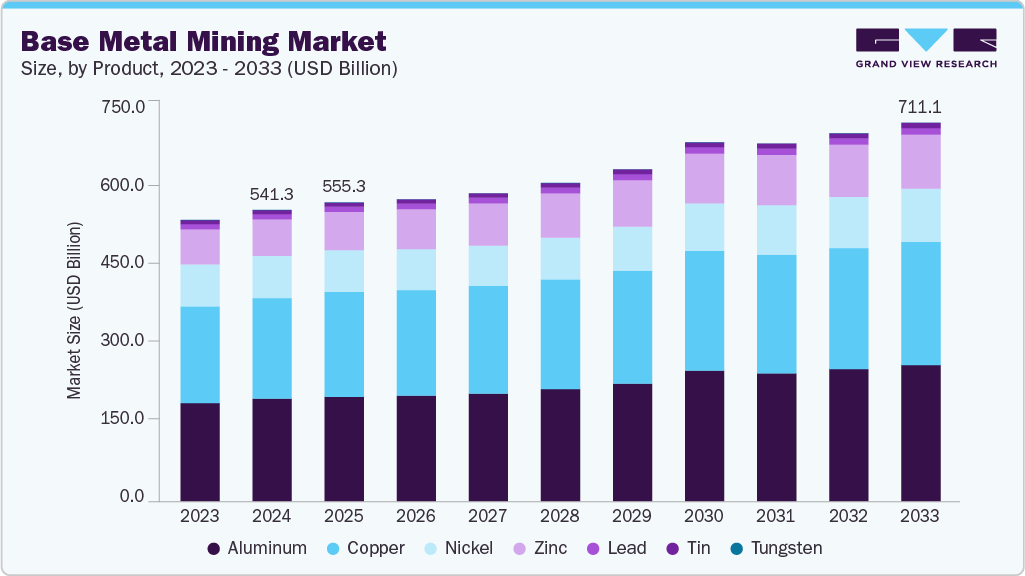
Technology adoption across the base metal mining sector is centered on improving ore discovery success, automation, safety, productivity, and metallurgical recovery efficiency. Advanced solutions, such as AI-assisted geological modeling, drone-based mine mapping, autonomous haulage fleets, IoT-enabled condition monitoring, digital twins, and real-time ore-sorting sensors, are driving operational optimization and reducing the cost per ton. Emerging process technologies, including hydrometallurgical leaching advancements, bio-mining, microwave ore treatment, and low-temperature refining, are enabling the extraction of resources from lower-grade and complex deposits that were previously considered uneconomical. Additionally, blockchain-based traceability, integrated command-and-control digital platforms, and predictive maintenance algorithms are strengthening supply chain transparency, reducing unplanned downtime, and enhancing ESG compliance visibility across mining value chains.
Market Dynamics
The base metal mining market is experiencing steady growth due to increasing demand for copper, nickel, zinc, lead, aluminum, and other industrial metals from the construction, automotive, electrical & electronics, renewable energy, and industrial manufacturing sectors. The global transition toward electrification, urbanization, and clean energy technologies is significantly increasing the consumption of base metals. Rising investments in power transmission infrastructure, electric vehicles (EVs), energy storage systems, and industrial development projects are further supporting market expansion worldwide.
The accelerating global shift toward electrification and decarbonization is a major factor driving the growth of the base metal mining market. Base metals such as copper, nickel, zinc, and aluminum are critical raw materials used in electric vehicles, battery systems, charging infrastructure, renewable energy installations, and power transmission networks. Copper demand is particularly increasing due to its extensive use in electrical wiring, motors, transformers, and grid infrastructure, while nickel plays a vital role in high-performance lithium-ion batteries.
Furthermore, governments across the world are investing heavily in renewable energy projects, smart grids, and transportation electrification to achieve climate and energy transition goals. Rapid industrialization and urban development in emerging economies are also increasing the consumption of base metals in construction, manufacturing, and infrastructure applications. As investments in clean energy and advanced manufacturing continue to rise, demand for base metals is expected to remain strong throughout the forecast period.
Environmental regulations governing mining activities represent a significant challenge for the base metal mining market. Mining companies must comply with increasingly stringent requirements related to emissions, waste management, water usage, tailings disposal, land rehabilitation, and biodiversity conservation. Compliance with these regulations often results in higher capital expenditure and operating costs. Additionally, prolonged permitting processes and stricter environmental approvals can delay project development timelines and limit the expansion of mining operations.
The increasing importance of base metals in the global energy transition presents substantial growth opportunities for market participants. The growing deployment of electric vehicles, renewable power generation, battery storage systems, data centers, and grid modernization projects is driving long-term demand for copper, nickel, zinc, and other strategically important metals. Furthermore, government initiatives aimed at strengthening domestic critical mineral supply chains and reducing import dependency are creating new investment opportunities across the mining value chain.
Analyst Perspective
The base metal mining market is experiencing robust growth, driven by rising demand for copper, aluminum, nickel, zinc, lead, tin, and tungsten across key industries such as construction, automotive, electrical & electronics, industrial manufacturing, and renewable energy. Increasing investments in electrification, power transmission infrastructure, electric vehicles, battery technologies, and clean energy projects are significantly strengthening demand for base metals worldwide. Additionally, ongoing urbanization, industrial development, and infrastructure modernization across both developed and emerging economies are supporting long-term consumption growth. Advances in mining technologies, resource development initiatives, and efforts to secure critical mineral supply chains are further enhancing market prospects, positioning the industry for sustained expansion over the forecast period.
Product Insights
By product, the aluminum segment led the market with the largest revenue share of 35.1% in 2025 due to its widespread application across construction, transportation, packaging, electrical systems, and consumer durables, supported by its lightweight, corrosion-resistant, and high-recyclability profile. Its demand is further reinforced by government-led sustainability and decarbonization initiatives, where aluminum is increasingly utilized for lightweight automotive manufacturing, EV body structures, and renewable energy infrastructure such as solar panel frames and transmission components. Additionally, investments in green aluminum, powered by renewable energy-based smelting, enable both cost efficiency and ESG-compliant supply chains, making aluminum a preferred base metal in multiple fast-growing industries globally.
Other base metals, including copper, nickel, zinc, and lead, continue to play significant roles across industrial and technological applications, each driven by distinct sectoral demand dynamics. Copper remains indispensable for power distribution, EV motors, and smart-grid development, while nickel is gaining strategic importance in battery-grade materials for next-generation energy storage solutions. Zinc maintains strong relevance in galvanization and corrosion-resistant steel manufacturing, particularly for construction and automotive safety components. Lead, on the other hand, sustains demand in battery applications, radiation shielding, and industrial chemicals. These metals collectively complement aluminum in supporting global infrastructure modernization, electrification, and digital manufacturing advancements.
End-use Insights
By end use, the construction segment led the market with the largest revenue share of 39.6% in 2025, driven by large-scale infrastructure development, urbanization, and government-funded modernization projects in both emerging and developed economies. Aluminum, copper, and zinc-based products are widely incorporated across building frameworks, roofing, cladding, HVAC systems, electrical wiring, and plumbing components due to their durability, corrosion resistance, and strength-to-weight advantages. Increasing investments in green buildings, smart cities, and energy-efficient structures continue to drive metal consumption in both residential and commercial projects, making construction the most influential demand-driving application for base metals globally.

Other key end use sectors, including automotive, electrical & electronics, and consumer products, collectively represent a growing demand base as industries adopt lightweight, high-conductivity, and longer-life metal components for advanced manufacturing. The automotive industry is transitioning toward EV production, which requires higher volumes of copper, aluminum, and nickel for batteries, motors, and lightweight chassis. Meanwhile, the electrical and electronics segment is expanding due to the rising penetration of smart devices, data centers, and renewable energy grids. At the same time, consumer products leverage these metals for appliances, furniture, hardware, and lifestyle goods. Combined, these segments form a diversified and technology-aligned market opportunity beyond traditional construction needs.
Regional Insights
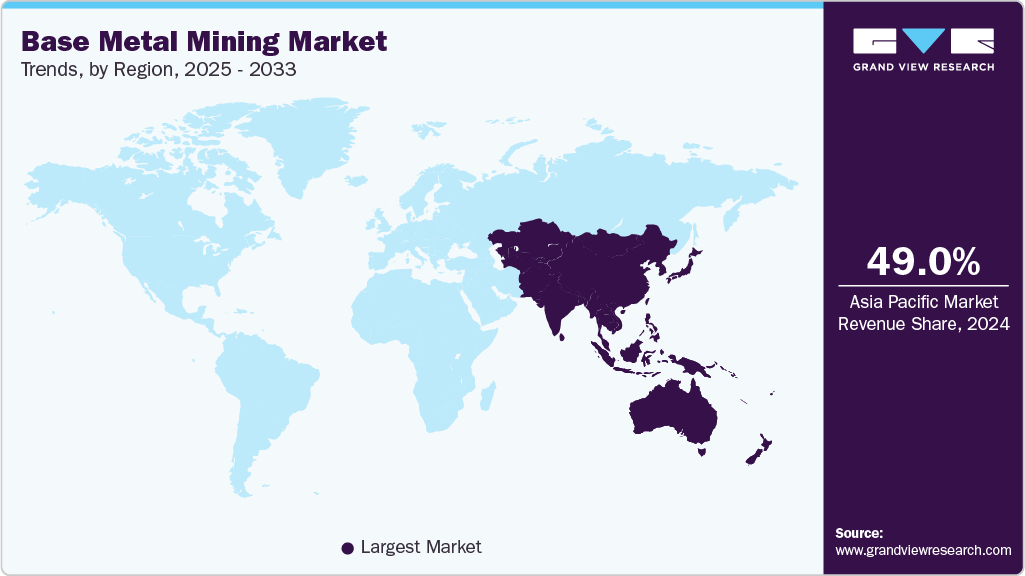
Asia Pacific dominated the base metal mining market with the largest revenue share of 48.8% in 2025, driven by vast mineral reserves, extensive smelting and refining capacities, and robust end use demand from the construction, manufacturing, electronics, and automotive industries. China remains a key producer and consumer, while countries such as India, Indonesia, and Australia are expanding capacity through new exploration, foreign investment inflows, and value-added downstream development. Rapid urbanization, industrial corridor projects, and the growth of EV and renewable supply chain ecosystems continue to drive long-term regional demand.
China Base Metal Mining Market Trends
The base metal mining market in China held the largest share in the Asia Pacific region in 2025. China is a pivotal market in global base metal mining, supported by its large-scale industrial activity, strong infrastructure spending, and world-leading refining capacity. The country is a major producer of aluminum, zinc, and lead, while remaining the largest consumer of copper and nickel for construction, power transmission, EV manufacturing, and renewable energy projects. Driven by state-backed investments and expanding metal-intensive industries, China continues to significantly influence global supply, pricing trends, and long-term demand for base metals.
North America Base Metal Mining Market Trends
The North American base metal mining market benefits from established mineral reserves, highly mechanized extraction operations, and strong demand from construction, automotive, defense, and electrical infrastructure sectors. The region is experiencing a surge in investment in copper, nickel, and zinc production, which supports the development of renewable energy infrastructure, the growth of electric vehicles, and grid modernization. Focus on digital mine management, worker safety, and emission reduction technologies such as autonomous haulage and electrified fleets continues to strengthen the region’s competitive position.
The base metal mining market in the U.S. remains strategically essential due to its large domestic consumption of copper, zinc, nickel, and lead for manufacturing, clean energy systems, and the production of defense-grade materials. Federal policies targeted at strengthening critical mineral independence and reducing reliance on imports are encouraging new exploration and brownfield expansions. Enhanced permitting reforms, ESG-driven operational transparency, and increasing private sector partnerships with technology developers are shaping the next phase of growth in U.S. base metal mining.
Europe Base Metal Mining Market Trends
The base metal mining market in Europe is heavily influenced by its clean energy transition, circular economy policies, and strategic interest in securing critical metals for batteries, wind turbines, and advanced manufacturing. Although mining activity is comparatively limited, the region focuses on efficient refinement, recycling, and processing technologies supported by strong regulatory frameworks and innovation funding. Increasing interest in domestic sourcing, reduced import risk, and partnerships across Africa, Latin America, and Canada are shaping Europe’s supply chain strategy for base metals.
Key Base Metal Mining Company Insights
Key players operating in the based metal mining market are undertaking various initiatives to strengthen their presence and increase the reach of their products and services. Strategies such as expansion activities and partnerships are key in propelling the market growth. Some of the key players operating in the market include BHP, Freeport-McMoRan Inc., Antofagasta PLC, and others.
-
BHP, established in 1851 and headquartered in Melbourne, Australia, is a leading global diversified resources company engaged in the production of iron ore, copper, metallurgical coal, nickel, and potash. The company operates across major mining regions, supplying essential raw materials for infrastructure, manufacturing, and clean-energy applications. BHP focuses on long-term portfolio resilience, operational efficiency, and sustainability-driven value creation aligned with global decarbonization trends.
-
Freeport-McMoRan, Inc., formally structured in 1988 and headquartered in Phoenix, Arizona, is a major global mining company specializing in copper, gold, and molybdenum production. Key operations span North America, South America, and the Grasberg minerals district in Indonesia. The company emphasizes large-scale, long-life assets, integrated value chain capabilities, and continuous improvement in safety, social responsibility, environmental stewardship, and operational productivity.
-
Antofagasta PLC, founded in 1888 and headquartered in London, United Kingdom, is a Chile-focused mining group primarily engaged in copper production with additional outputs of gold, silver, and molybdenum. The company operates significant mining assets in northern Chile, alongside an integrated transport division that supports mine logistics. Antofagasta prioritizes sustainable mining practices, water-efficient processes such as desalination, and strategic project expansion to maintain long-term production stability.
Key Base Metal Mining Companies
The following key companies have been profiled for this study on the base metal mining market.
-
Anglo American
-
Antofagasta PLC
-
Aurubis
-
BHP
-
CODELCO
-
Freeport-McMoRan, Inc.
-
Glencore
-
Norilsk Nickel
-
Vale
-
Zijin Mining Group Co., Ltd.
Competitive Benchmarking
Category
Operating Strategies
Competitive Edge
Weakness
Established Players (Anglo American, BHP, CODELCO, Freeport-McMoRan, Glencore, Vale, Zijin Mining Group Co., Ltd.)
- Focus on large-scale mining operations supported by diversified base metal portfolios across multiple geographies.
- Invest in resource expansion, mine-life extension projects, automation, and digital mining technologies to enhance productivity.
- Strengthen market position through strategic acquisitions, long-term supply agreements, and downstream integration initiatives.
- Extensive reserve base and strong production capabilities across multiple metals.
- Global operational footprint with established logistics, processing, and marketing networks.
- Strong financial resources enabling investment in large-scale projects and advanced mining technologies.
- Exposure to commodity price volatility and cyclical demand fluctuations.
- High capital intensity is associated with mine development, expansion, and environmental compliance.
- Increasing regulatory scrutiny related to sustainability, emissions, and community engagement.
Emerging & Regional Players (Antofagasta PLC, Aurubis, Norilsk Nickel)
- Emphasize value-added processing, refining, and production of high-purity metals for industrial and technology-driven applications.
- Focus on operational efficiency, metal recovery optimization, and product quality enhancement.
- Expand customer relationships in sectors such as electrification, renewable energy, batteries, and advanced manufacturing.
- Strong expertise in metal processing, refining, and specialty metal production.
- Ability to deliver high-quality products tailored to specific industrial requirements.
- Established relationships with downstream manufacturers and industrial consumers.
- Greater dependence on feedstock availability and raw material sourcing dynamics.
- Concentrated exposure to specific metals and end-use industries.
- Rising energy, processing, and environmental compliance costs can impact margins.
Recent Developments
-
BHP, in July 2025, announced record group copper production of over 2 million tons, reflecting an 8% year-on-year increase driven by improved operational efficiency and stable ore grades at Escondida, Spence, and its broader Copper SA portfolio. The company stated that this production momentum aligns with its strategy to expand exposure to future-critical minerals while maintaining disciplined cost and asset performance.
-
Freeport-McMoRan, in May 2025, confirmed accelerated repair progress at its Manyar smelter in Gresik following a fire incident, noting that copper anode output had successfully resumed ahead of initial timelines. The company emphasized that rapid restoration efforts were supported by strengthened project supervision, contingency planning, and revised safety standards to avoid future disruptions.
-
Freeport-McMoRan, in Q2 2025, initiated operational start-up of its new downstream processing facility in East Java, achieving first copper anode production by July and targeting full ramp-up before the end of 2025. This development supports the company’s long-term objective of increasing domestic value addition, expanding refining capabilities, and improving supply chain resilience.
Base Metal Mining Market Report Scope
Report Attribute
Details
Market definition
The base metal mining market represents the annual value of base metals produced through mining activities.
Market size in 2025
USD 562.0 billion
Estimated market size in 2026
USD 567.9 billion
Projected market size by 2033
USD 831.5 billion
Growth rate
CAGR of 5.6% from 2026 to 2033
Base year for estimation
2025
Historical data
2021 - 2024
Forecast period
2026 - 2033
Quantitative units
Revenue in USD million, Volume in Kilotons, and CAGR from 2026 to 2033
Report coverage
Revenue forecast, volume forecast, company ranking, competitive landscape, growth factors, and trends
Segments covered
Product, end use, region
Regional scope
North America; Europe; Asia Pacific; Latin America; Middle East & Africa
Country scope
U.S.; Canada; Mexico; Norway; Russia; India; China; Australia; Indonesia; Philippines; Brazil; Chile; Peru; Bahrain; UAE
Key companies profiled
Anglo American; Antofagasta PLC; Aurubis; BHP; CODELCO; Freeport-McMoRan, Inc.; Glencore; Norilsk Nickel; Vale; Zijin Mining Group Co., Ltd.
Customization scope
Free report customization (equivalent up to 8 analysts' working days) with purchase addition or alteration to country, regional & segment scope.
Pricing and purchase options
Avail customized purchase options to meet your exact research needs. Explore purchase options
Global Base Metal Mining Market Report Segmentation
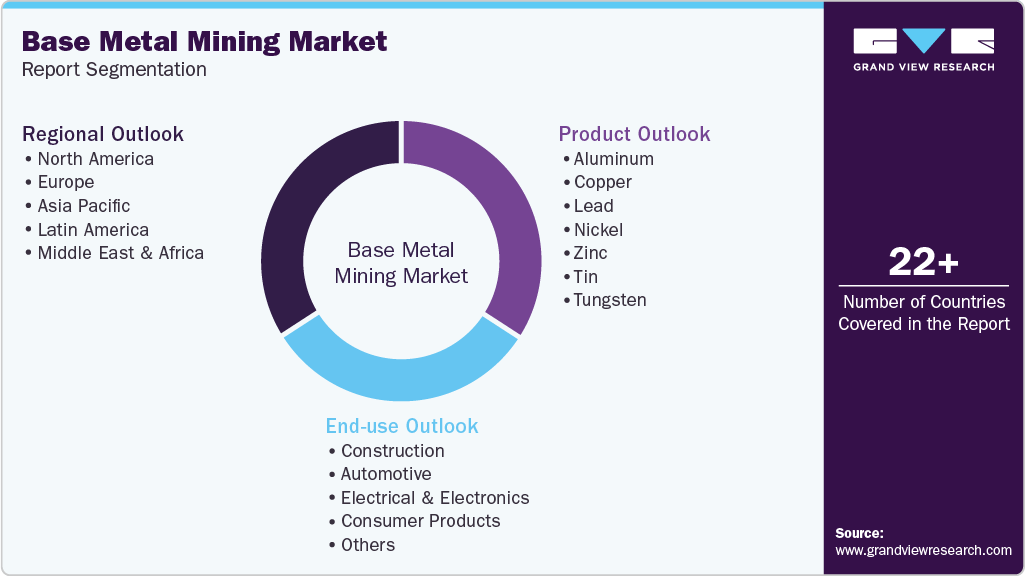
This report forecasts global, regional, and country-level volume & revenue growth and analyzes the latest trends in each sub-segment from 2021 to 2033. For this study, Grand View Research has segmented the global base metal mining market report by product, end-use, and region.
-
Product Outlook (Volume, Kilotons; Revenue, USD Million, 2021 - 2033)
-
Aluminum
-
Copper
-
Lead
-
Nickel
-
Zinc
-
Tin
-
Tungsten
-
-
End-use Outlook (Volume, Kilotons; Revenue, USD Million, 2021 - 2033)
-
Construction
-
Automotive
-
Electrical & Electronics
-
Consumer Products
-
Others
-
-
Regional Outlook (Volume, Kilotons; Revenue, USD Million, 2021 - 2033)
-
North America
-
U.S.
-
Canada
-
Mexico
-
-
Europe
-
Norway
-
Russia
-
-
Asia Pacific
-
China
-
India
-
Australia
-
Indonesia
-
Philippines
-
-
Latin America
-
Brazil
-
Chile
-
Peru
-
-
Middle East & Africa
-
Bahrain
-
UAE
-
-
Research Methodology
The base metal mining market figures in this report are based on a proven research process that combines executive interviews with secondary research from proprietary databases, company filings, and recognized regulatory and institutional sources. Market size is built through value-chain sizing - reconciling supply-side and demand-side estimates - and triangulated with bottom-up and top-down approaches. Every estimate passes multiple levels of expert validation before publication, with each base metal mining segment quantified using the revenue-capture definitions in the table below.
Segment Definition
Product
Revenue Capture Definition
Aluminum
This segment includes revenue generated from the production of primary aluminum derived from mined aluminum-bearing ores. Demand is driven by the construction, transportation, packaging, electrical, machinery, and consumer goods industries.
Copper
This segment comprises revenue generated from the extraction and sale of copper ores and concentrates. Copper is widely used in power transmission, electrical equipment, electronics, renewable energy systems, construction, and electric vehicle manufacturing.
Lead
This segment includes revenue generated from the mining and sale of lead ores and concentrates. Lead is primarily used in lead-acid batteries, energy storage systems, radiation shielding, industrial equipment, and specialty alloys.
Nickel
This segment covers revenue generated from the extraction and sale of nickel ores and concentrates. Nickel is a critical material for stainless steel production, battery manufacturing, aerospace components, and industrial applications.
Zinc
This segment includes revenue generated from mining and the sale of zinc ores and concentrates. Zinc is primarily used for galvanizing steel, die-casting, alloys, construction materials, and infrastructure applications.
Tin
This segment comprises revenue generated from the extraction and sale of tin ores and concentrates. Tin is widely used in soldering applications, electronics manufacturing, chemicals, packaging, and specialty alloys.
Tungsten
This segment includes revenue generated from the mining and sale of tungsten ores and concentrates. Tungsten is utilized in cutting tools, mining equipment, aerospace components, defense applications, and high-temperature industrial products due to its exceptional hardness and heat resistance.
End Use
Revenue Capture Definition
Construction
Revenue generated from base metals used in residential, commercial, industrial, and infrastructure construction applications, including structural components, roofing, wiring, piping, reinforcement systems, and building materials.
Automotive
Revenue generated from base metals utilized in vehicle manufacturing, including body structures, engines, batteries, electrical systems, lightweight components, and electric vehicle platforms.
Electrical & Electronics
Revenue generated from base metals used in power generation, transmission and distribution infrastructure, consumer electronics, semiconductors, telecommunications equipment, wiring, cables, and electrical components.
Consumer Goods
Revenue generated from base metals incorporated into household appliances, packaging materials, cookware, personal electronics, furniture, and various consumer products.
Others
Revenue generated from base metals used in industrial machinery, aerospace, defense, marine, renewable energy, energy storage systems, oil & gas, and other specialized applications not covered under the above categories.
Estimation Model
Layer Name
Key Question
Description
End-Use Demand Assessment Layer
What constitutes the demand base for base metals?
Assess demand for copper, aluminum, nickel, zinc, lead, tin, and tungsten across key end-use industries, including construction, automotive & transportation, electrical & electronics, industrial machinery, renewable energy, aerospace & defense, and consumer goods. Evaluate industry-specific adoption patterns, application penetration, infrastructure investments, manufacturing activity, and technological developments to establish the overall demand foundation of the market.
Production, Supply & Trade Assessment Layer
How is the market supplied?
Analyze the global supply landscape by evaluating mining operations, ore reserves, production capacities, processing infrastructure, refining capabilities, and recycling activities across major producing regions. Assess import-export dynamics, trade flows, supply chain structures, and the role of key mining companies and metal producers in meeting market demand.
Application & Consumption Analysis Layer
How are base metals utilized across applications?
Evaluate the consumption patterns of base metals across major applications, including electrical infrastructure, electric vehicles, batteries, construction materials, industrial equipment, packaging, electronics, and specialty industrial uses. Assess application-specific requirements, material intensity, industrial output trends, and technology adoption rates to understand demand distribution across products, applications, and regions.
Pricing & Market Value Assessment Layer
What is the revenue potential of the market?
Evaluate pricing trends for copper, aluminum, nickel, zinc, lead, tin, and tungsten across major producing and consuming regions. Assess the influence of commodity market dynamics, regional pricing differentials, product-grade specifications, trade patterns, contractual pricing structures, and supply-demand fundamentals on revenue generation. This layer establishes the market value across products, applications, and geographies while ensuring consistency with broader industry consumption and supply dynamics.
Delivered Customizations
This report has been delivered with the following In-depth customizations
Client Request
Customization Delivered
Value Adds
Pricing & Cost Structure Analysis
Comprehensive evaluation of base metal pricing trends across copper, aluminum, nickel, zinc, lead, tin, and tungsten. Assessed the impact of mining costs, ore grades, processing and refining expenses, energy prices, logistics costs, treatment and refining charges (TC/RCs), and regional supply-demand dynamics on market pricing and profitability.
Supported pricing strategy development, profitability assessment, cost competitiveness analysis, and informed decision-making related to production planning and supply chain optimization.
Resource Availability & Production Capacity Assessment
Mapped major mining regions, reserve availability, mine production capacities, smelting and refining infrastructure, and expansion projects across key producing countries: evaluated supply concentration, production outlook, and regional supply security for major base metals.
Supported long-term sourcing strategies, capacity planning, supply risk assessment, and identification of regions with strong resource potential and production growth opportunities.
Opportunity Assessment
Identified emerging growth opportunities driven by electrification, renewable energy deployment, electric vehicle adoption, grid modernization, infrastructure investments, and industrial manufacturing expansion. Assessed opportunities across high-growth end-use sectors, critical mineral supply chains, and rapidly developing regional markets.
Enabled prioritization of high-growth market segments, supported strategic investment decisions, and identified long-term growth opportunities across energy transition, transportation, infrastructure, and advanced manufacturing applications.
Frequently Asked Questions About This Report
The base metal mining market size was estimated at USD 562.0 billion in 2025 and is expected to reach USD 567.9 billion in 2026.
The base metal mining market is expected to grow at a compound annual growth rate of 5.6% from 2026 to 2033 to reach USD 831.5 billion by 2033.
Asia Pacific dominated the base metal mining market with the largest revenue share of 48.8% in 2025.
The base metal mining market in China held the largest share in the Asia Pacific region in 2025.
By end use, the construction segment led the market with the largest revenue share of 39.6% in 2025.
By product, the aluminum segment led the market with the largest revenue share of 35.1% in 2025.
The key players operating in the base metal mining market are Anglo American, Antofagasta PLC, Aurubis, BHP, CODELCO, Freeport-McMoRan, Inc., Glencore, Norilsk Nickel, Vale, Zijin Mining Group Co., Ltd., among others.
The key factor driving the growth of the global base metal mining market is the rising demand for copper, nickel, zinc, and aluminum from electrification, renewable energy, electric vehicles, and infrastructure development projects worldwide.
North America is anticipated to register the fastest CAGR over the forecast period.
About the Author(s)
Advanced Interior Materials Research Team
Advanced Materials · Advanced Interior MaterialsThis report was authored by the advanced interior materials research team at Grand View Research - comprising two research analysts, one senior research analyst, and one industry expert - with specialized expertise in the advanced interior materials segment of the advanced materials industry. All findings are based on proprietary advanced materials databases, executive interviews, and regulatory analysis, subject to internal peer review prior to publication.
Last Updated:
Speak to Analyst


Customize this report to your needs — add regions, segments, or data points, with 20% free customization.
Or view our licence options:


ISO 9001:2015 & 27001:2022 Certified
We are GDPR and CCPA compliant! Your transaction & personal information is safe and secure. For more details, please read our privacy policy.


