
- Home
- »
- Beauty & Personal Care
- »
-
Lip Care Products Market Size & Share Report, 2026-2033GVR Report cover

Lip Care Products Market (2026 - 2033)
Size, Share & Trends Analysis Report By Product (Lip Balm, Lip Scrub, Lip Masks, Lip Butter), By Type (Synthetic, Natural And Organic), By Price Tier, By End User, By Distribution Channel, By Region, And Segment Forecasts
Market Size, 2025
$4.1BMarket Estimate, 2026
$4.3BMarket Forecast, 2033
$6.1BCAGR, 2026–2033
5.1%Lip Care Products Market Summary
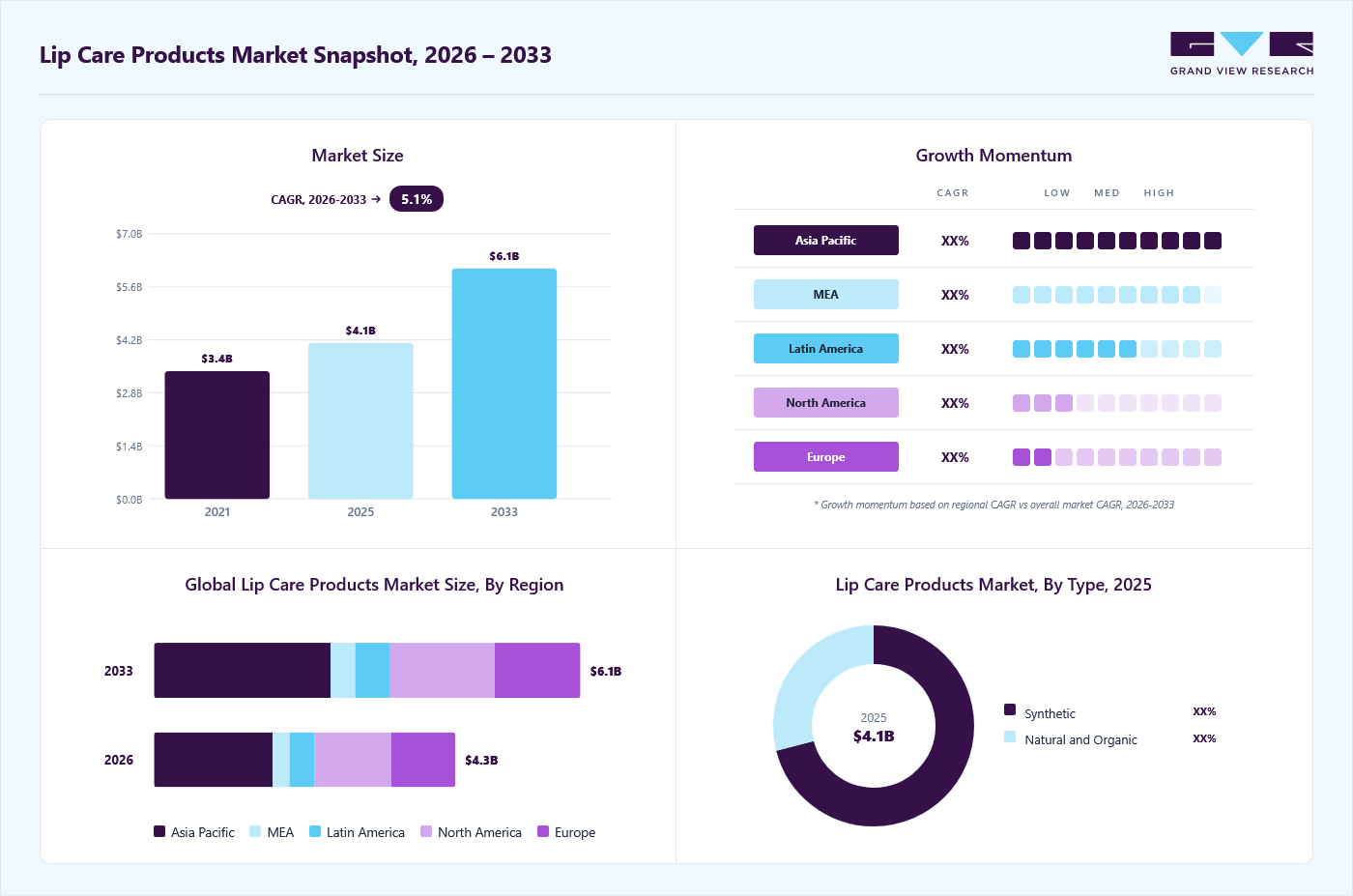
The global lip care products market size was valued at USD 4.1 billion in 2025 and is projected to grow from USD 4.3 billion in 2026 to USD 6.1 billion by 2033, at a CAGR of 5.1% from 2026 to 2033. The Asia Pacific held the largest share of 39.1% of the global market in 2025. Rising awareness of lip health and damage prevention is significantly influencing the global lip care products market, as consumers increasingly recognize the need for daily protection and treatment of lips exposed to environmental stressors such as UV radiation, pollution, and dryness.
 Source: Grand View Research, IR Documents, Primary Interviews, Paid DatabasesTo learn more about this report,
 Download Free Sample Report
 Key Market Trends & Insights
- By product: Lip balms segment held the largest market share of 64.5% in 2025.
- By type: Synthetic lip care segment held the largest market share of 71.0% in 2025.
- By price tier: Mass/economy segment held the largest market share of 56.9% in 2025.
- By end use: Women’s lip care segment held the largest market share of 80.1% in 2025.
- By distribution channel: Hypermarkets & supermarkets segment held the largest market share of 37.1% in 2025.
Regional Highlights
- Largest regional market: Asia Pacific (39.1% revenue share, 2025)
- By country: China held the largest share in 2025
Market Size & Forecast
- Market size in 2025: USD 4.1 Billion
- Estimated market size in 2026: USD 4.3 Billion
- Projected market size by 2033: USD 6.1 Billion
- CAGR (2026-2033): 5.1%
Three ways to get this report
Buy it, customize it, or ask a question.Ask an Analyst
Analyst response in 1 business day
- AccessReport author, directly
- Reply timeWithin 1 working day
- No sales callDirect answer only
- FormatEmail reply
- CostFree, no cost
Get the Full Report
What the study covers
- FormatsPDF · Excel · Dashboard
- Timeline2026–2033 annual, 2025 base
- Coverage20+ countries, 5 regions
- Companies10+ key players profiled
Customize the Report
20% free customization
- IncludeCountries, segments, points
- TailorTo your product definition
- ExtendDeeper competitor detail
- OrA fully bespoke study
- Turnaround5–10 working days
This trend is also positively impacting the lip care products packaging market, as brands focus on protective and convenient formats that support frequent, on-the-go application. Demand is shifting toward functional products such as SPF-infused balms, barrier-repair formulations, and intensive lip treatments designed for hydration and restoration. According to January 2026 insights published by BeautyMatter, consumer engagement with lip-focused products is expanding beyond basic hydration, with increased interest in treatment-oriented formats incorporating skincare-inspired ingredients such as peptides, ceramides, and nourishing oils. This reflects a broader shift toward positioning lip care as an extension of skincare routines, rather than a standalone cosmetic step. As a result, consumers are applying lip care products more frequently throughout the day and adopting preventative usage habits, directly supporting higher consumption volumes across both mass and premium segments while also encouraging innovation in the lip care products packaging market.Growing focus on personal grooming and self-care routines is further driving demand in the global lip care products market, as consumers integrate lip care into everyday wellness and appearance-focused habits. Lip products are increasingly used throughout the day for both comfort and subtle enhancement, aligning with low-effort, repeat-use routines. According to February 2026 coverage by Personal Care Insights, lip products such as glosses, balms, and hybrid color-care formats continue to benefit from high reapplication rates and impulse purchasing behavior, particularly in North America. This pattern is supporting steady volume growth, as consumers replace products more frequently and maintain multiple formats for different usage occasions.
 To learn more about this report, Download Free Sample Report
 A strong shift toward natural, organic, and clean-label products is reshaping the global lip care products market, as consumers prioritize ingredient transparency and safer formulations. Products featuring plant-based oils, natural butters, and vegan ingredients are gaining traction, while demand for formulations free from parabens, synthetic additives, and petroleum derivatives continues to rise. According to March 2026 insights published by Beauty Packaging, brands are increasingly combining clean formulations with enhanced sensorial attributes such as lightweight textures, glossy finishes, and nourishing benefits. This transition is encouraging premium product adoption and driving reformulation strategies, as manufacturers align with evolving consumer expectations around safety, sustainability, and performance.
Furthermore, growth in male grooming and gender-neutral beauty trends is expanding the consumer base within the global lip care products market, as lip care becomes increasingly positioned as an essential and universal aspect of personal hygiene and appearance. Male consumers are gradually incorporating basic lip care products such as hydrating balms and protective treatments into their daily routines, driven by greater awareness of grooming and skin health. At the same time, the industry is moving toward gender-neutral product positioning, with simplified formulations, functional benefits, and minimalist packaging designed to appeal across demographics. This shift is reducing traditional barriers to adoption and encouraging broader usage, prompting brands to create inclusive product lines that cater to diverse consumer needs and preferences, thereby supporting sustained market expansion.
In addition, the rapid expansion of e-commerce and digital retail channels is significantly enhancing accessibility and reshaping purchasing behavior in the global lip care products market. Consumers are increasingly shifting toward online platforms for both product discovery and purchase, driven by convenience, wider assortment availability, and seamless comparison across brands and price points. Digital ecosystems are enabling more informed decision-making through user reviews, ingredient transparency, and visual content such as tutorials and short-form demonstrations. This transition is accelerating the speed at which new products gain visibility and traction, while also shortening purchase cycles. In response, brands are strengthening their digital presence through direct-to-consumer platforms, optimized online merchandising, and personalized engagement strategies, making e-commerce a primary growth channel for lip care products.
Brand Market Share Insights
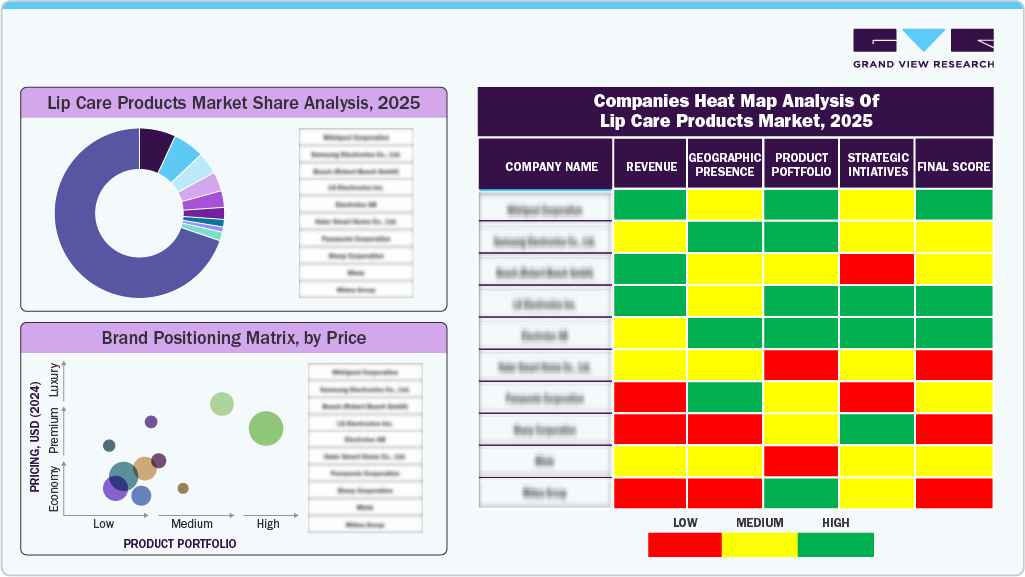
The global lip care products market is highly competitive, driven by continuous product innovation and strong demand for both functional and aesthetic lip solutions. Major companies such as L'Oréal, Estée Lauder Companies, Shiseido, Procter & Gamble, and Unilever compete through frequent launches of moisturizing lip balms, treatment-based lip care products, tinted lip balms, and lip oils. Competition is increasingly centered on multifunctional formulations that combine hydration, sun protection, and subtle color, along with clean-label and natural ingredient positioning. Trend-led demand, influenced by platforms such as TikTok and Instagram, is accelerating the popularity of glossy finishes, lip oils, and plumping products. The growth of e-commerce and direct-to-consumer channels is further intensifying competition by enabling faster product discovery, stronger consumer engagement, and rapid global expansion of both established and emerging brands.
 To learn more about this report, Download Free Sample Report
 Consumer Insights
Consumer behavior in the global lip care products market is increasingly centered on treatment-led performance, where buyers prioritize products that deliver visible hydration, repair, and long-term lip health benefits rather than basic, short-term relief. Consumers are actively seeking formulations that address dryness, chapping, and lip barrier damage, driving demand for advanced formats such as peptide-infused treatments and nutrient-rich lip butters. In February 2026, an article published by Happi highlighted that search interest in peptide lip treatments surged by over 300%, reflecting a sharp increase in consumer focus on high-performance, skincare-inspired lip solutions. The same trend environment is driving stronger demand for richer, conditioning formulations, particularly during seasonal periods associated with increased dryness, reinforcing lip care as a results-driven category where efficacy and ingredient functionality directly influence purchase decisions.
 To learn more about this report, Download Free Sample Report
 At the same time, purchasing behavior in the global lip care products market is strongly influenced by high-frequency usage patterns and multi-format consumption. Consumers are incorporating multiple lip care products into their daily routines, including daytime hydration balms, intensive repair treatments, and gloss-balm hybrids, leading to higher replacement cycles and increased product rotation. Lip butters and conditioning formats are witnessing accelerated uptake within seasonal demand cycles due to their thicker textures and longer-lasting hydration benefits, encouraging repeated application throughout the day. This behavior is driving consumers to maintain multiple products for different use occasions, supporting higher basket sizes and consistent repurchase rates. The combination of performance-driven expectations, seasonal usage intensity, and elevated reapplication frequency is reinforcing sustained volume growth and continuous product experimentation within the global lip care products market.
Product Insights
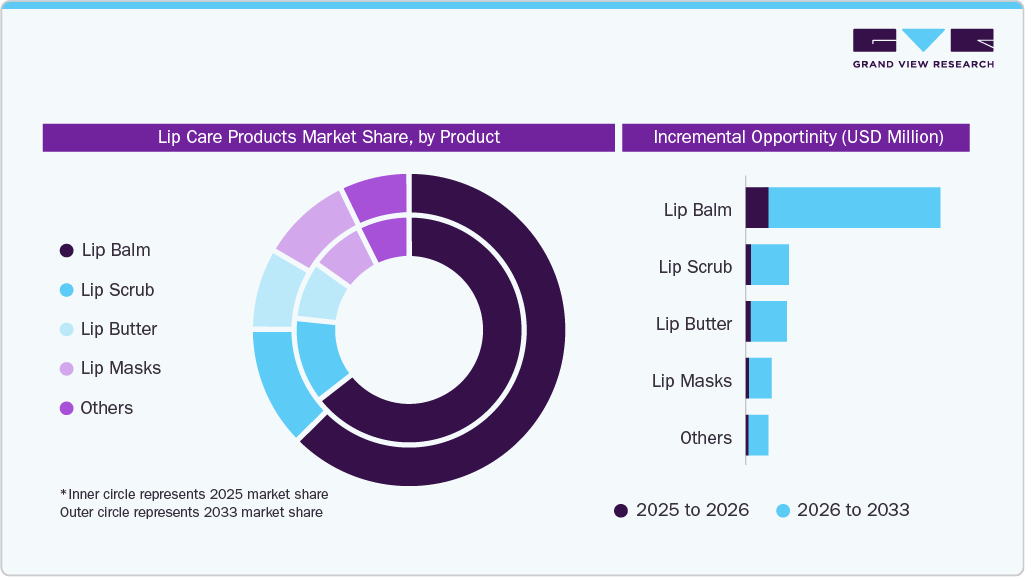
Lip balms segment accounted for the largest market revenue share of 64.5% in 2025, supported by consistent usage for hydration, protection, and relief from dryness across different climates and environmental conditions. Strong repeat purchase behavior is observed as consumers rely on lip balms as a necessity, particularly for on-the-go application. At the same time, continuous product innovation is strengthening the segment, with the introduction of SPF-infused variants, tinted balms, and ingredient-led formulations incorporating peptides, ceramides, and natural oils. The availability of convenient formats such as sticks and pocket-sized packaging further supports frequent use throughout the day.
 To learn more about this report, Download Free Sample Report
 Lip masks are anticipated to grow at a CAGR of 7.5% from 2026 to 2033, driven by increasing exposure to harsh environmental conditions such as pollution, air conditioning, and extreme weather, which intensify lip dryness and damage and create demand for deeper, longer-lasting treatment solutions. Consumers are shifting toward products that provide extended repair benefits beyond temporary relief, positioning lip masks as a preferred solution for intensive care. At the same time, rising participation in nighttime skincare routines is supporting adoption, as consumers seek specialized products that work over longer durations without reapplication. The growing influence of premium skincare trends is also encouraging uptake, with lip masks benefiting from elevated positioning, richer formulations, and sensorial textures that enhance the overall user experience.
Type Insights
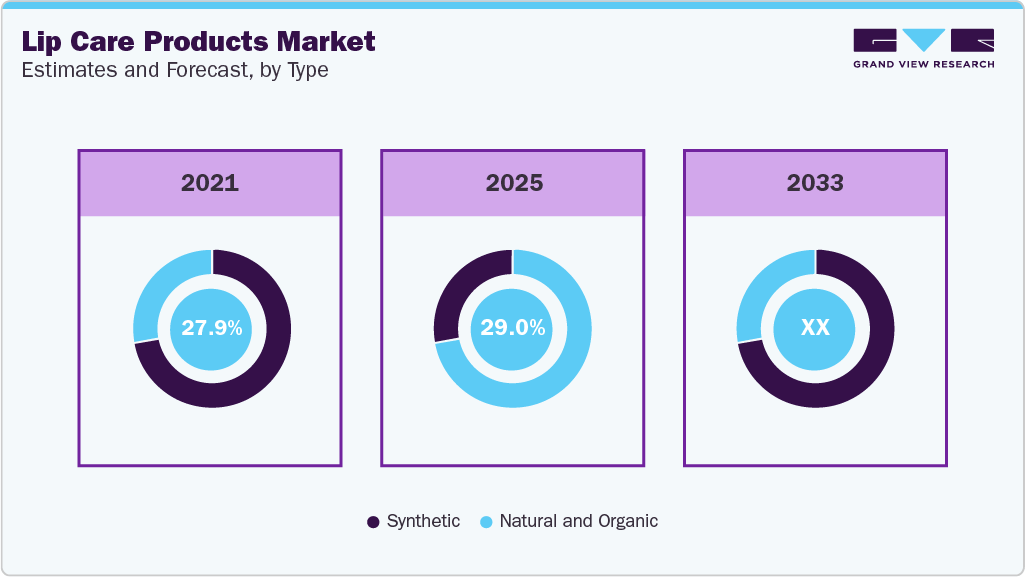
Synthetic lip care segment accounted for a revenue share of 71.0% in 2025, driven by their strong compatibility with medicated and dermatologically tested formulations that address specific concerns such as severe dryness, cracked lips, and sensitivity. These products are widely preferred in therapeutic and pharmacy-led segments, where controlled compositions and clinically backed ingredients support targeted treatment claims. In addition, synthetic formulations enable enhanced preservation and protection against microbial contamination, ensuring product safety over extended usage periods.
 To learn more about this report, Download Free Sample Report
 Natural and organic lip care segment is expected to grow at a CAGR of 6.1% from 2026 to 2033. Consumers are actively shifting toward plant-based formulations that incorporate ingredients such as shea butter, beeswax, coconut oil, and botanical extracts, which are perceived to be safer and more compatible with sensitive skin. This trend is further supported by rising awareness of long-term product usage, as lip care products are applied multiple times a day, prompting preference for cleaner alternatives. Meanwhile, brands are enhancing the efficacy and sensory appeal of natural formulations by improving texture, absorption, and hydration performance, while also introducing multifunctional products such as tinted balms and oil-based treatments that combine nourishment with subtle cosmetic benefits.
For instance, in January 2025, Lotus Herbals launched a premium lip balm range targeting younger consumers, strengthening its position in the lip care category. The new range features variants such as Peptide, Café Mocha, and Sugar Delight, formulated to provide hydration, nourishment, and sun protection with SPF 15. The products are developed with vegan, paraben-free, and alcohol-free ingredients, aligning with the growing demand for clean beauty.
Price Tier Insights
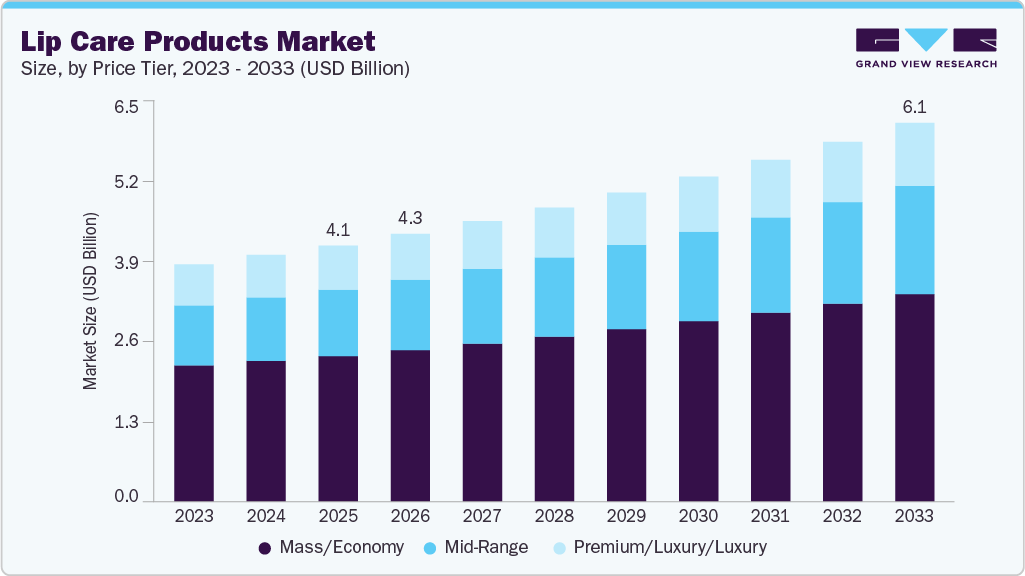
Mass/economy segment is accounted for a revenue share of 56.9% in 2025, supported by strong demand for affordable, everyday-use essentials that cater to high-frequency application habits. Consumers widely prefer budget-friendly lip balms and basic care products for routine hydration and protection, particularly in regions with large population bases and varied climatic conditions that require consistent usage. The segment benefits from high sales volumes driven by easy accessibility across supermarkets, convenience stores, pharmacies, and online platforms, enabling frequent and impulse purchases.
Mid-range lip care segment is expected to grow at a CAGR of 6.3% from 2026 to 2033, driven by rising demand for everyday premiumization, where consumers seek better aesthetics, improved sensorial experience, and enhanced product feel without moving into high-end price tiers. This segment benefits from strong appeal among urban consumers who prioritize packaging design, fragrance, and texture as part of their purchase decision, alongside functional benefits. In addition, increasing exposure to global beauty trends through digital platforms is encouraging consumers to upgrade from basic products to more refined options that offer a more elevated usage experience.
End Use Insights
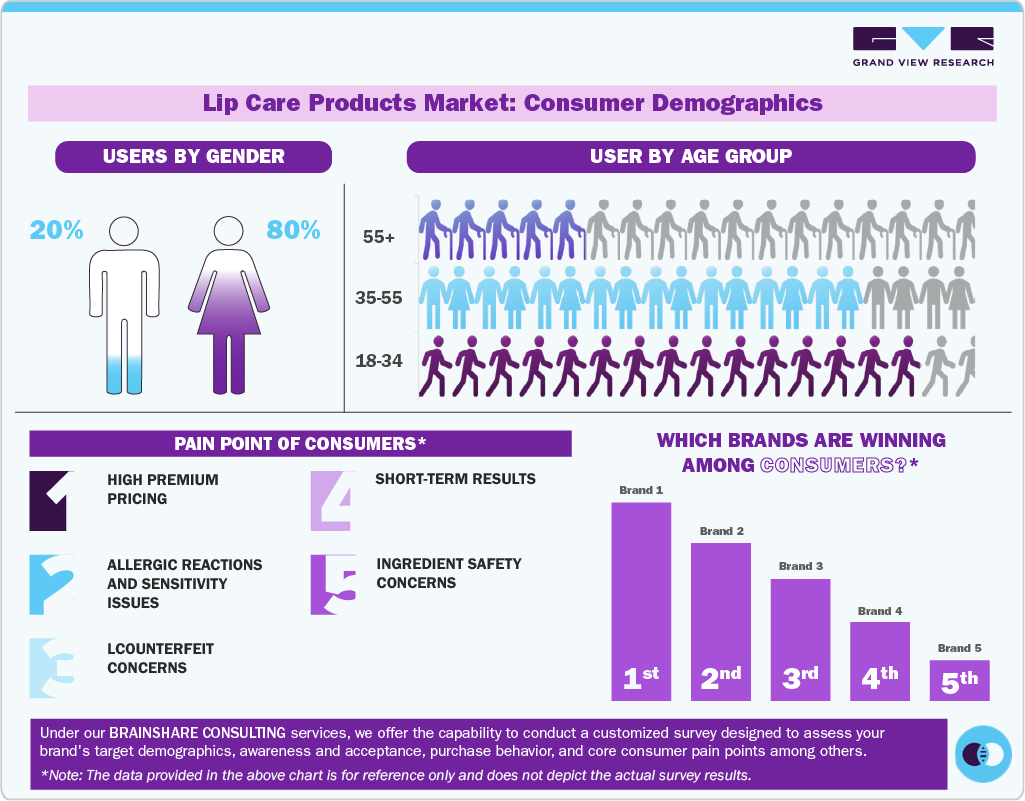
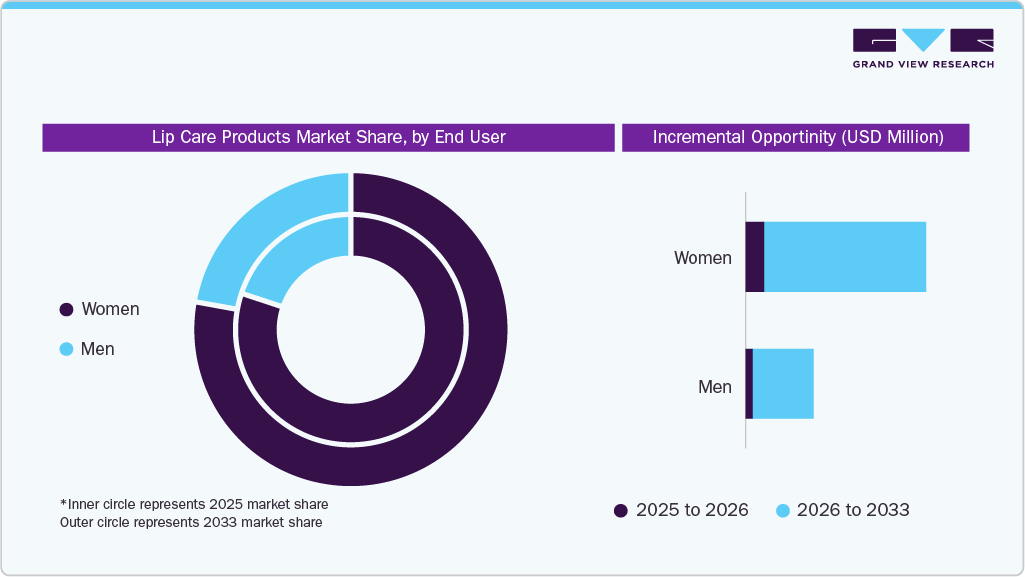
Women’s lip care segment dominated with a revenue share of 80.1% in 2025. Women consumers actively use multiple lip care formats, including basic balms, tinted variants, lip scrubs, and overnight treatments, leading to higher overall consumption and repeat purchase rates. The segment also benefits from greater product variety and continuous innovation in textures, finishes, and flavors, which encourages product experimentation and multi-product ownership. In addition, strong alignment with cosmetic preferences, such as tinted hydration and gloss-enhancing effects, further supports demand, as lip care products are often used for both functional and aesthetic purposes.
 To learn more about this report, Download Free Sample Report
 Lip care products for men segment is expected to grow at a CAGR of 6.5% from 2026 to 2033, driven by increasing adoption of basic grooming routines and rising awareness of lip health among male consumers. Men are increasingly incorporating simple, functional products such as hydrating balms and repair treatments into their daily routines, particularly in response to concerns about dryness, cracking, and environmental exposure. The segment is supported by preference for low-maintenance, easy-to-use formats that offer quick application and non-greasy finishes without added color or shine. In addition, expanding availability of gender-neutral and male-focused products with minimalistic packaging and subtle formulations is improving product acceptance.
Distribution Channel Insights
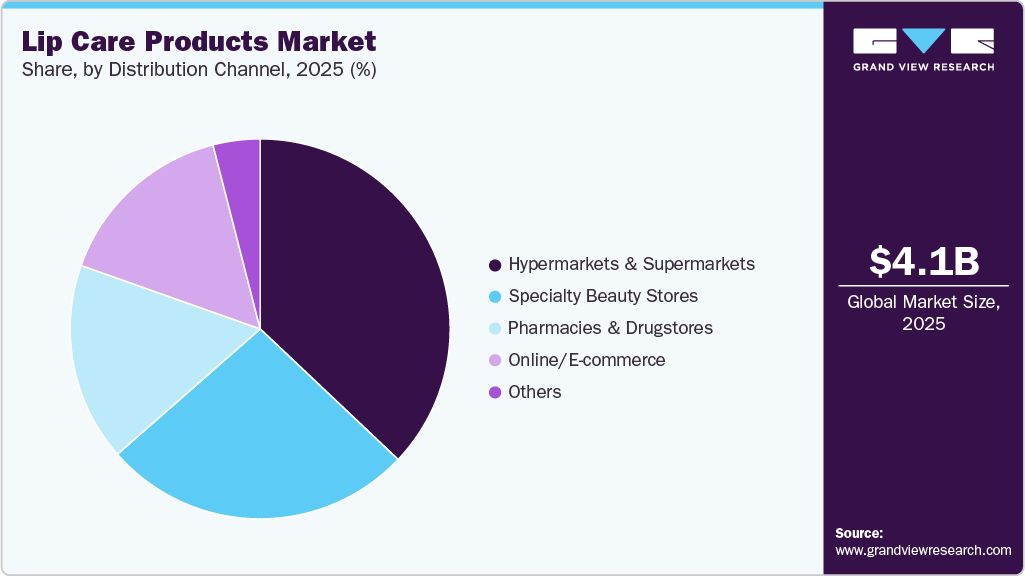
The sale of lip care products through hypermarkets & supermarkets accounted for a share of 37.1% in 2025, driven by strong consumer preference for easily accessible retail channels that support routine, need-based purchases. These outlets enable consumers to conveniently purchase everyday essentials such as lip balms and basic treatments alongside regular household shopping, contributing to consistent footfall and high-volume sales. The presence of a wide assortment of mass and mid-range brands, along with competitive pricing and frequent promotional offers, encourages impulse buying and multi-unit purchases. In addition, prominent shelf placement, bundled offers, and seasonal displays enhance product visibility and drive trial across different variants.
 To learn more about this report, Download Free Sample Report
 The sale of lip care products through online/e-commerce channels is expected to grow at a CAGR of 7.1% from 2026 to 2033. Online platforms allow consumers to browse a broad range of brands and product types, including niche and premium offerings that may not be available in physical stores, supporting greater product discovery and choice. The availability of detailed product information, user reviews, and ingredient transparency is enabling more informed decision-making, particularly for frequently used products such as lip balms and treatments. In addition, subscription models, auto-replenishment options, and targeted digital promotions are encouraging repeat purchases and improving customer retention.
Regional Insights
Asia Pacific Lip Care Products Market Trends
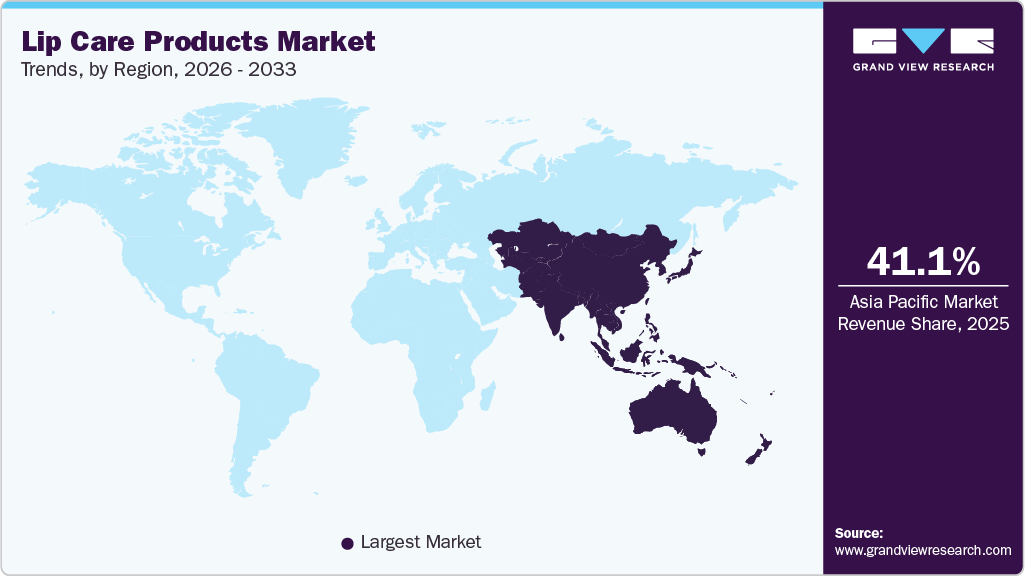
Lip care products industry in Asia Pacific held the largsest share of 39.1% in 2025 and is expected to grow at the fastest CAGR from 2026 to 2033. The market is driven by strong demand for lightweight, non-sticky formulations suited to humid and tropical climates prevalent across many countries in the region. Consumers actively prefer fast-absorbing lip care products that provide hydration without heaviness, particularly in markets where high temperatures and humidity influence product texture preferences. The market is also supported by growing demand for sun protection-focused lip care, as increased awareness of UV exposure is encouraging adoption of SPF-infused balms and protective treatments. In addition, the rising popularity of layering routines in countries such as South Korea and Japan is promoting the use of multiple lip care formats, including base balms, gloss treatments, and overnight masks.
 To learn more about this report, Download Free Sample Report
 The lip care products industry in the China accounted for a revenue share of around 43.1% on the Asia Pacific market in 2025. The China lip care products market is driven by strong integration of lip care products within daily skincare routines, where consumers treat lip care as an essential extension of facial care. Chinese consumers actively adopt step-based routines, increasing demand for multiple lip care formats such as daytime balms, lip essences, and overnight masks. The market is also supported by high responsiveness to localized product attributes, including preference for lightweight textures, subtle fragrances, and aesthetically appealing packaging. In addition, the rapid expansion of domestic brands offering competitively priced, trend-aligned products is intensifying market penetration across both premium and mass segments.
India Lip Care Products Market Trends
India lip care products industry is expected to grow at a CAGR of 8.5% from 2026 to 2033, driven by high exposure to climatic variations such as heat, dryness, and pollution, which increase the need for regular lip protection and hydration. Consumers across the country frequently use lip care products to manage dryness and prevent damage, supporting strong daily usage and repeat purchase behavior. The market is also benefiting from growing demand for affordable, small-pack formats that cater to price-sensitive consumers and enable easy trial and frequent replacement. In addition, increasing availability of lip care products across general trade stores, pharmacies, and emerging quick commerce platforms is improving accessibility in both urban and semi-urban areas.
North America Lip Care Products Market Trends
The North American lip care products market accounted for a significant share of 25.5% in 2025, driven by high consumer awareness of lip health and strong adoption of daily-use lip care routines across the U.S. and Canada. Consumers in the region frequently use lip care products for hydration, protection, and aesthetic enhancement, leading to high per capita consumption and repeat purchase behavior. Demand is particularly strong for functional products such as SPF-infused balms, medicated treatments, and ingredient-led formulations that address concerns such as dryness and environmental damage. The market also benefits from a well-established retail and digital ecosystem, enabling easy access to a wide range of products across mass and premium segments.
U.S. Lip Care Products Market Trends
The lip care products industry in the U.S. accounted for a revenue share of 84.8% of the North America market in 2025, driven by high consumer engagement with daily lip care routines and strong demand for both functional and premium formulations. The U.S. market benefits from high disposable income and a well-established culture of personal care spending, where consumers consistently invest in products that offer hydration, protection, and enhanced lip appearance. Frequent usage and reapplication of lip care products such as balms, treatments, and tinted variants contribute to strong replacement cycles and sustained sales volume. In addition, the market is characterized by rapid adoption of new product formats and ingredient-led innovations, with consumers actively exploring advanced formulations and trend-driven launches.
Canada lip care products industry is expected to grow at a CAGR of 7.0% from 2026 to 2033. The Canada lip care products market is driven by strong demand for protective and moisture-retaining lip care solutions suited to prolonged cold and dry weather conditions. Consumers in Canada actively use lip care products to prevent dryness, chapping, and environmental damage, leading to consistent daily application and high replacement frequency. The market is also supported by increasing preference for comfort-focused formulations that provide long-lasting hydration without heaviness, particularly in winter months.
Europe Lip Care Products Market Trends
Europe lip care products market accounted for the revenue share of 21.5% fo the global market in 2025, driven by strong consumer preference for high-quality, ingredient-focused formulations and well-established skincare-led beauty routines across the region. Consumers actively prioritize lip care as part of daily personal care, with consistent demand for products that offer hydration, protection, and repair, particularly in regions experiencing seasonal climate variations. The market is also supported by a growing inclination toward natural and sustainably sourced ingredients, encouraging adoption of plant-based and clean-label lip care products. In addition, widespread availability through pharmacies, specialty beauty retailers, and premium outlets is enhancing product accessibility and supporting both mass and premium segment growth.
The lip care products industry in the France accounted for a revenue share of around 24.9% on the Europe market in 2025, driven by strong consumer emphasis on product quality, formulation sophistication, and sensorial experience. French consumers actively prefer lip care products that deliver refined textures, smooth application, and subtle enhancement, aligning with a preference for understated, everyday grooming. The market is supported by high adoption of premium and pharmacy-based products, where efficacy, ingredient quality, and brand credibility play a key role in purchase decisions. In addition, frequent use of lip care as part of daily routines, combined with demand for aesthetically pleasing packaging and indulgent product feel, is encouraging higher-value purchases.
Lip care products industry in the UK is expected to grow at a CAGR of 6.1% from 2026 to 2033, driven by increasing consumer focus on preventative care and early intervention for lip damage, leading to higher adoption of products. Consumers are incorporating lip care into daily routines alongside skincare, supporting consistent usage across different age groups. The market is also benefiting from growing demand for fragrance-free and sensitive-skin formulations, particularly among consumers seeking gentle, non-irritating products for frequent application. In addition, the rise of compact, travel-friendly packaging is encouraging multiple product ownership, with consumers carrying lip care products across different settings such as work, travel, and home.
Central & South America Lip Care Products Market Trends
The Central & South America lip care products industry is expected to grow at a CAGR of 4.9% from 2026 to 2033, driven by strong demand for protective and moisturizing lip care solutions in regions experiencing high sun exposure and dry climatic conditions. Consumers actively use lip care products with hydration and sun protection benefits to prevent dryness and environmental damage, supporting consistent daily usage. The market is also characterized by preference for affordable products, where lip balms and basic treatments are widely purchased due to their accessibility and essential nature. In addition, widespread presence of direct selling channels and neighborhood retail stores is improving product reach across diverse consumer groups, particularly in semi-urban and rural areas.
Middle East & Africa Lip Care Products Market Trends
The Middle East & Africa lip care products industry is expected to grow at a CAGR of 5.6% from 2026 to 2033, driven by extreme climatic conditions such as high temperatures, dry air, and strong sun exposure, which increase the need for continuous lip hydration and protection. Consumers in the region frequently use lip care products to prevent dryness, cracking, and sun damage, supporting high daily usage and repeat purchases. The market is also influenced by preference for long-lasting and protective formulations, including products with SPF and intensive moisturizing properties suited to harsh environments. In addition, expanding retail infrastructure, including malls, pharmacies, and travel retail, is improving product availability across both urban and developing areas.
Key Lip Care Products Companies:
The following key companies have been profiled for this study on the lip care products market.
- L'Oréal S.A.
- Unilever PLC
- Beiersdorf AG
- Kao Corporation
- Procter & Gamble
- Revlon, Inc.
- Avon Products, Inc.
- Kiehl's LLC
- NUXE
- Laneige
- Clinique Laboratories, LLC
Recent Developments
-
In February 2026, e.l.f. Cosmetics launched a limited-edition pickle-flavored lip balm under its Glow Reviver line. The product combines the brand’s moisturizing formula with a novelty sensory experience, featuring a green tint and unconventional flavor profile. This launch reflects the growing trend of flavor-led and experiential lip care innovation, especially among Gen Z consumers.
-
In January 2026, Moroccanoil entered the lip care segment with the introduction of its first lip balm, building on its established use of argan oil. The formulation combines nourishing oils, butters, peptides, and hydrating agents to improve moisture retention and lip texture. This launch signals the brand’s move to extend its ingredient-led positioning into adjacent categories, targeting growing consumer interest in treatment-focused, skincare-inspired lip products.
-
In January 2026, Clinique expanded its Chubby Stick Moisturizing Lip Color Balm line with seven new shades, bringing the total assortment to 14. The launch focused on hydration + color payoff, reinforcing the growing consumer demand for balm-tint hybrids that offer both skincare and makeup benefits.
-
In October 2025, Space Camp Wellness expanded its retail presence by launching its organic lip balms in Target stores across the U.S., including an exclusive flavor developed specifically for the retailer. The products, known for their USDA-certified organic formulations and long-lasting hydration, had previously been sold primarily online but gained strong popularity through social media engagement and creator-led promotion. This move marks the brand’s transition into large-scale retail, aiming to reach a broader consumer base while capitalizing on demand for clean, flavor-driven lip care products.
Lip Care Products Market Report Scope
Report Attribute
Details
Market size in 2025
USD 4.1 billion
Estimated market size in 2026
USD 4.3 billion
Projected market size by 2033
USD 6.1 billion
Growth rate
CAGR of 5.1% from 2026 to 2033
Base year for estimation
2025
Historical data
2021 - 2024
Forecast period
2026 - 2033
Quantitative units
Revenue in USD million/billion and CAGR from 2026 to 2033
Report coverage
Revenue forecast, company ranking, competitive landscape, growth factors, and trends
Segments covered
Product; type; price tier, end user, distribution channel, and region
Regional scope
North America; Europe; Asia Pacific; Central & South America; Middle East & Africa
Country scope
U.S.; Canada; Mexico; UK; Germany; France; Italy; Spain; Poland; Sweden; Netherlands; China; India; Japan; South Korea; Australia & New Zealand; Malaysia; Singapore; Thailand; Brazil; Argentina; Peru; Colombia; South Africa; Saudi Arabia; UAE; Qatar; Oman
Key companies profiled
L'Oréal S.A.; Unilever PLC; Beiersdorf AG; Kao Corporation; Procter & Gamble; Revlon, Inc.; Avon Products, Inc.; Kiehl's LLC; NUXE; Laneige; Clinique Laboratories, LLC
Customization scope
Free report customization (equivalent up to 8 analysts working days) with purchase. Addition or alteration to country, regional & segment scope.
Pricing and purchase options
Avail customized purchase options to meet your exact research needs. Explore purchase options
Global Lip Care Products Market Report Segmentation
This report forecasts revenue growth at global, regional & country levels and provides an analysis on the latest trends and opportunities in each of the sub-segment from 2021 to 2033. For this study, Grand View Research has segmented the lip care products market based on product, concentration, end user, skin type, distribution channel, and region.
-
Product Outlook (Revenue, USD Million, 2021 - 2033)
-
Lip Balm
-
Lip Scrub
-
Lip Masks
-
Lip Butter
-
Others (Lip Oils, etc.)
-
-
Type Outlook (Revenue, USD Million, 2021 - 2033)
-
Synthetic
-
Natural and Organic
-
-
Price Tier Outlook (Revenue, USD Million, 2021 - 2033)
-
Mass/Economy
-
Mid-range
-
Premium/Luxury/Luxury
-
-
End User Outlook (Revenue, USD Million, 2021 - 2033)
-
Women
-
Men
-
-
Distribution Channel Outlook (Revenue, USD Million, 2021 - 2033)
-
Hypermarkets & Supermarkets
-
Specialty Beauty Stores
-
Pharmacies & Drugstores
-
Online/E-commerce
-
Others (Department Stores, etc.)
-
-
Regional Outlook (Revenue, USD Million, 2021 - 2033)
-
North America
-
U.S.
-
Canada
-
Mexico
-
-
Europe
-
UK
-
Germany
-
France
-
Italy
-
Spain
-
Poland
-
Sweden
-
Netherlands
-
-
Asia Pacific
-
China
-
India
-
Japan
-
South Korea
-
Australia & New Zealand
-
Malaysia
-
Singapore
-
Thailand
-
-
Central & South America
-
Brazil
-
Argentina
-
Peru
-
Colombia
-
-
Middle East & Africa
-
South Africa
-
Saudi Arabia
-
UAE
-
Qatar
-
Oman
-
-
Frequently Asked Questions About This Report
The global lip care products market size was estimated at USD 4.1 billion in 2025 and is expected to reach USD 4.3 billion in 2026.
Some key players operating in the lip care products market include L'Oréal S.A., Unilever, Beiersdorf AG, The Colgate-Palmolive Company, The Estée Lauder Companies, Inc., and Johnson and Johnson.
Growing concerns related to prolonged sun exposure, dryness, premature aging, and lip darkening have resulted in an increased demand for high-quality products among consumers.
Lip balms segment led with a 64.5% revenue share in 2025.
Synthetic lip care segment held the highest market share of 71.0% in 2025.
Women’s lip care segment accounted for the largest share of 80.1% in 2025.
Mass/economy segment held the highest market share of 56.9% in 2025.
Hypermarkets & supermarkets segment accounted for the largest share of 37.1% in 2025, while A is the fastest-growing segment.
The global lip care products market is expected to grow at a compound annual growth rate of 5.1% from 2026 to 2033 to reach USD 6.1 billion by 2033.
Asia Pacific dominated with a 39.1% revenue share in 2025.
About the Author(s)
Beauty & Personal Care Research Team
Consumer Goods · Beauty & Personal CareThis report was authored by the beauty & personal care research team at Grand View Research - comprising two research analysts, one senior research analyst, and one industry expert - with specialized expertise in the beauty & personal care segment of the consumer goods industry. All findings are based on proprietary consumer goods databases, executive interviews, and regulatory analysis, subject to internal peer review prior to publication.
Last Updated:
Speak to Analyst

Customize this report to your needs - add regions, segments, or data points, with 20% free customization.
Or view our licence options:


ISO 9001:2015 & 27001:2022 Certified
We are GDPR and CCPA compliant! Your transaction & personal information is safe and secure. For more details, please read our privacy policy.


