
- Home
- »
- Next Generation Technologies
- »
-
Mining Automation Market Size, Share Report, 2026-2033GVR Report cover

Mining Automation Market (2026 - 2033)
Size, Share & Trends Analysis Report By Solution (Software Automation, Services, Equipment Automation), By Application (Metal Mining, Mineral Mining, Coal Mining), By Region (North America, Europe, Asia Pacific, Latin America, MEA), And Segment Forecasts
Market Size, 2025
$6.2BMarket Estimate, 2026
$6.6BMarket Forecast, 2033
$11.1BCAGR, 2026–2033
7.8%Mining Automation Market Summary
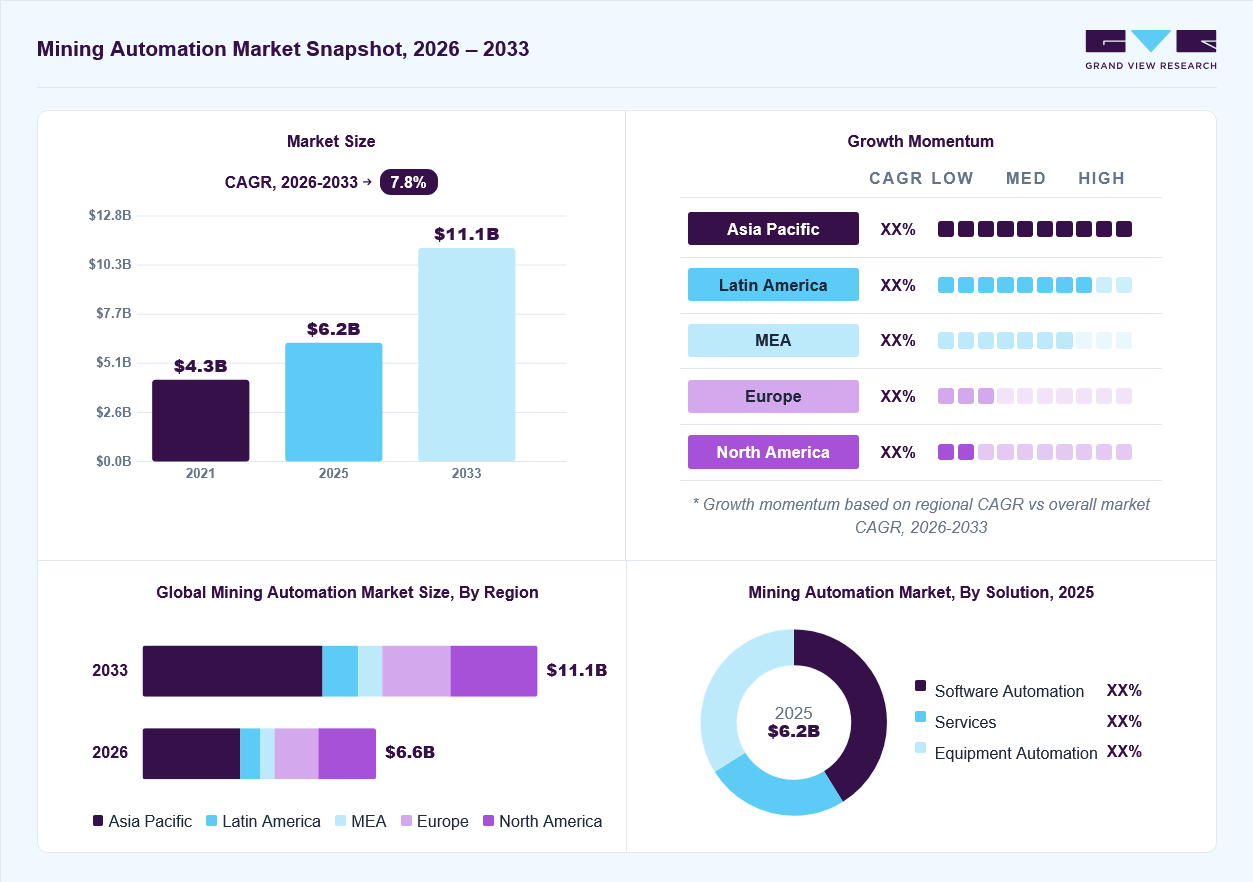
The global mining automation market size was valued at USD 6.2 billion in 2025 and is projected to grow from USD 6.6 billion in 2026 to USD 11.1 billion by 2033, at a CAGR of 7.8% from 2026 to 2033. Asia Pacific dominated the global market with the largest revenue share of 41.3% in 2025. The market is growing due to increasing adoption of autonomous equipment, AI-driven analytics, and digital mining solutions to improve operational efficiency, enhance worker safety, and reduce mining costs.
 Source: Grand View Research, IR Documents, Primary Interviews, Paid DatabasesTo learn more about this report,
 Download Free Sample Report
 Key Market Trends & Insights
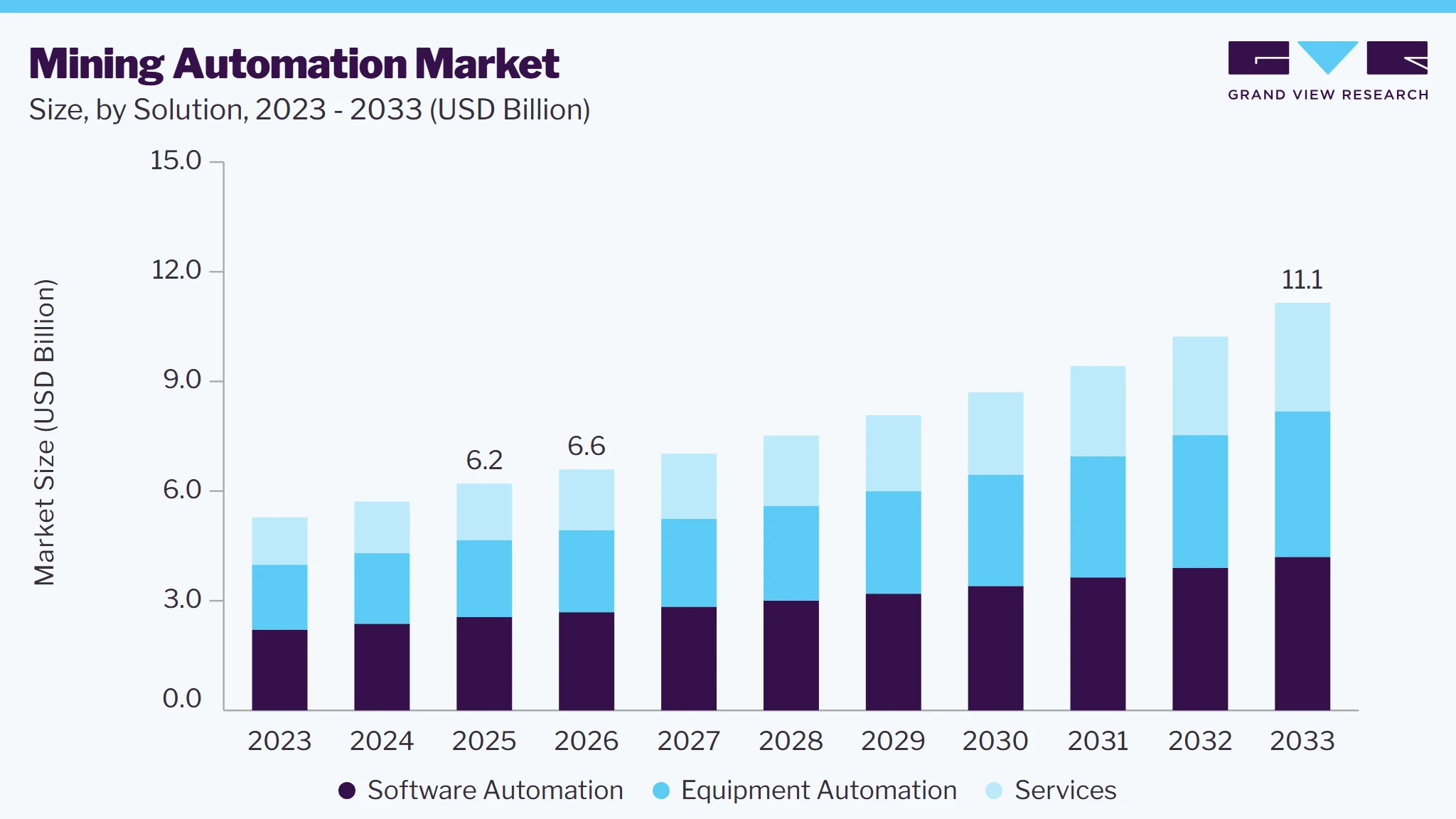
- By solution: Software automation segment led the market and held the largest revenue share of over 41.0% in 2025.
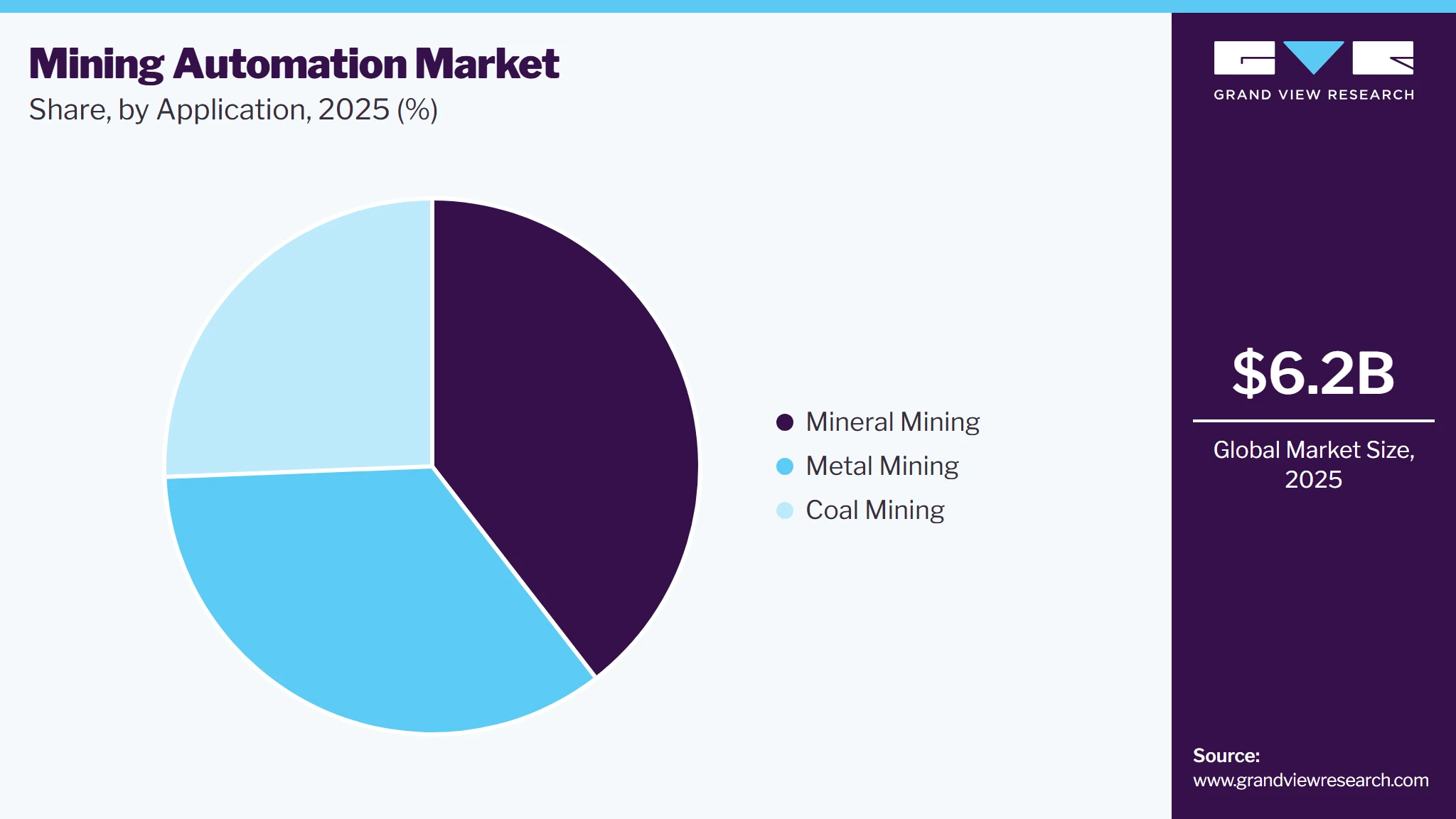
- By application: Mineral mining segment led the market and held the largest revenue share of over 39.5% in 2025.
Regional Highlights
- Largest regional market: Asia Pacific (41.3% revenue share, 2025)
- By country: The China held the largest market share in 2025
Market Size & Forecast
- Market size in 2025: USD 6.2 Billion
- Estimated market size in 2026: USD 6.6 Billion
- Projected market size by 2033: USD 11.1 Billion
- CAGR (2026-2033): 7.8%
Three ways to get this report
Buy it, customize it, or ask a question.Ask an Analyst
A direct answer, usually in 1 working day
- AccessReport author, directly
- Reply timeWithin 1 working day
- No sales callDirect answer only
- FormatEmail reply
- CostFree, no cost
Get the Full Report
What the study covers
- FormatsPDF · Excel · Dashboard
- Timeline2026–2033 annual, 2025 base
- Coverage20+ countries, 5 regions
- Companies10+ key players profiled
Customize the Report
20% free customization
- IncludeCountries, segments, points
- TailorTo your product definition
- ExtendDeeper competitor detail
- OrA fully bespoke study
- Turnaround5–10 working days
The rising adoption of innovative technologies is a key factor propelling the expansion of the mining automation sector. The integration of the Internet of Things (IoT) is further transforming the industry by providing operators with real-time data and analytics through advanced visualization tools. In addition, several companies are partnering with technology providers to implement wireless networks in underground mining operations, a development that is expected to accelerate market growth in the coming years.The increasing integration of AI and robotics is transforming the mining automation industry by enabling smarter, safer, and more efficient operations. Mining automation industries are applying AI to optimize drilling and blasting, implement predictive maintenance, and support data-driven decision-making. Robotics is being deployed to perform tasks in hazardous environments, enhancing safety and minimizing operational disruptions. These technologies are driving enhancements in productivity and cost-efficiency, contributing to a more advanced and competitive mining automation landscape.
 To learn more about this report, Download Free Sample Report
 Moreover, the push for greater productivity is encouraging mining automation industries to adopt automation technologies that streamline operations and minimize downtime. By integrating automated systems into their processes, these companies can enhance efficiency, maintain consistent output, and reduce reliance on manual labor. This drive toward operational excellence is significantly contributing to the growing adoption of mining automation industry solutions.
The integration of IoT in mining operations is transforming how data is gathered and utilized on-site. Enabling real-time monitoring and analytics, IoT empowers operators with timely insights that support smarter decision-making and improved operational oversight. This technological advancement is enhancing efficiency and reliability, further driving the adoption of the automated mining industry.
Furthermore, the collaboration between mining companies and technology providers is gaining traction as they work together to implement underground wireless networks. These partnerships are essential in building the digital infrastructure required for advanced automation systems. Enabling seamless connectivity and real-time data exchange, these efforts are playing a crucial role in driving the adoption of mining automation and enhancing operational efficiency, thereby driving industry expansion.
Market Dynamics
The mining automation market is experiencing significant growth as mining companies increasingly adopt advanced technologies to improve operational efficiency, worker safety, productivity, and resource utilization. Mining automation solutions encompass autonomous haulage systems, automated drilling equipment, robotic machinery, fleet management systems, remote operation centers, artificial intelligence, IoT-enabled monitoring systems, and predictive maintenance platforms. These technologies help mining operators reduce operational costs, enhance equipment performance, minimize human intervention in hazardous environments, and optimize overall mine productivity.
The Mining Automation Market is expanding rapidly due to the growing need to improve productivity while ensuring worker safety in mining operations. Rising mineral demand, declining ore grades, and increasing operational costs are encouraging mining companies to invest in automation technologies that can optimize extraction processes and maximize equipment utilization. Autonomous vehicles, automated drilling systems, and real-time monitoring solutions enable continuous operations with improved accuracy and reduced downtime.
Additionally, stricter workplace safety regulations and the need to reduce human exposure to hazardous mining environments are driving automation adoption. Mining companies are increasingly leveraging AI, machine learning, and IoT technologies to enhance decision-making, improve resource management, and achieve sustainable mining operations. As the industry continues its digital transformation journey, demand for mining automation solutions is expected to increase substantially.
Despite strong growth prospects, the mining automation market faces challenges related to high capital investment requirements and system integration complexities. Implementing autonomous equipment, advanced software platforms, communication infrastructure, and digital control systems requires significant upfront expenditure, which can be challenging for small and mid-sized mining operators.
Furthermore, integrating automation technologies with existing mining infrastructure often involves technical complexities, workforce training requirements, and operational disruptions. Limited digital expertise, cybersecurity concerns, and resistance to technological change may further hinder adoption. These factors can slow the pace of automation implementation, particularly in developing mining regions.
The growing adoption of smart mining technologies is creating substantial opportunities for the mining automation market. Mining companies are increasingly investing in autonomous haul trucks, automated drilling systems, digital twins, predictive maintenance solutions, AI-powered analytics, and remote operations centers to enhance operational efficiency and reduce costs.
Moreover, increasing demand for critical minerals used in electric vehicles, renewable energy systems, and advanced electronics is accelerating investments in technologically advanced mining operations. The integration of artificial intelligence, machine learning, cloud computing, 5G connectivity, and real-time data analytics is enabling more intelligent and connected mining environments. As the mining sector continues to prioritize productivity, safety, and sustainability, mining automation solutions are expected to play a pivotal role in shaping the future of mining operations.
Market Concentration & Characteristics
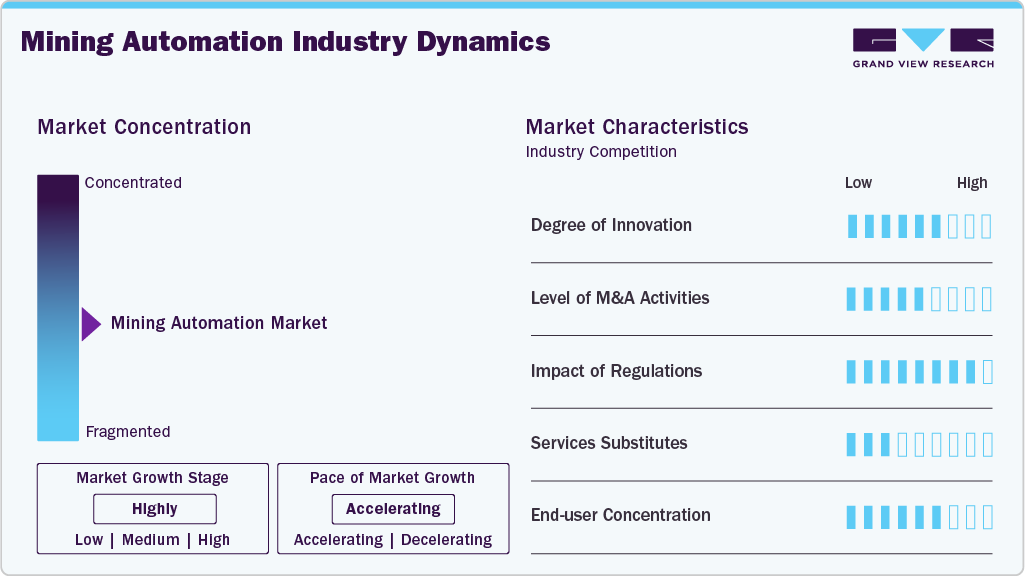
The mining automation market is highly fragmented, with a diverse mix of mining equipment manufacturers, automation technology providers, industrial software developers, engineering service companies, and digital mining solution vendors competing across surface and underground mining applications. The market includes established players such as Caterpillar Inc., Komatsu Ltd., Epiroc AB, Sandvik AB, Siemens AG, Rockwell Automation Inc., Hitachi Ltd., Liebherr Group, Trimble Inc., Autonomous Solutions Inc., and Rio Tinto Group. These companies are actively developing autonomous haulage systems, intelligent drilling solutions, teleoperated equipment, fleet management platforms, and AI-driven mining analytics to improve operational efficiency and safety.
 To learn more about this report, Download Free Sample Report
 Analyst Perspective
The mining automation market sits at the intersection of increasing demand for operational efficiency, enhanced worker safety, and digital transformation across the global mining industry. Demand is being driven by the growing adoption of autonomous haulage systems, automated drilling equipment, fleet management software, remote operation centers, artificial intelligence, and IoT-enabled mining solutions. As mining companies seek to reduce operating costs, address labor shortages, improve productivity, and meet sustainability objectives, automation technologies have evolved from supplementary operational tools into essential components of modern mining operations. The continued advancement of autonomous equipment, real-time data analytics, and intelligent mine management systems is expected to further accelerate market growth and reshape the future of mining.
Solution Insights
Based on solution, the software automation segment led the market with the largest revenue share of 41.1% in 2025, owing to the development of robust technology-based vehicles, such as autonomous trucks, remote control equipment, and teleoperated mining equipment. In addition, rapid advancements in hardware automation technology are expected to persistently streamline the way the large-scale mining industry is undertaken across the globe.
The services segment is expected to witness the highest CAGR of over 7% from 2025 to 2030, fueled by the growing demand for maintenance, consulting, and system integration services as mining companies increasingly adopt automated solutions. As automation technologies become more complex, the need for specialized expertise to install, manage, and maintain these systems is rising. In addition, the focus on minimizing downtime and ensuring seamless operation of automated equipment is driving the demand for end-to-end service offerings.
Application Insights
Based on application, the metal mining segment led the market with the largest revenue share of 34.8% in 2025, owing to the significant demand for efficiency, safety, and cost optimization in large-scale extraction operations. As mineral mining becomes more complex, companies are using automation to make work easier, rely less on manual labor, and improve accuracy. The adoption of autonomous drilling, haulage systems, and real-time monitoring tools is transforming mineral extraction, making operations more sustainable and productive. Moreover, growing investments in smart mining solutions and the integration of IoT and AI are further strengthening the segment's dominance in the mining automation industry.
 To learn more about this report, Download Free Sample Report
 The metal mining segment is expected to witness a significant CAGR from 2025 to 2030, driven by the increasing demand for metals such as copper, nickel, lithium, and rare earth elements, which are essential for electric vehicles, renewable energy systems, and advanced electronics. As the global push for decarbonization and clean energy accelerates, metal mining operations are under pressure to boost output while improving efficiency and safety. This has led to a growing adoption of automation technologies, including autonomous haulage systems, automated drilling, and real-time monitoring solutions, which enhance productivity and reduce operational risks.
Regional Insights
North America accounted for a significant share of over 25% in 2024, primarily driven by the region’s strong focus on technological innovation and early adoption of automation in mining operations. The presence of leading mining companies, robust investment in R&D, and widespread implementation of advanced technologies such as AI, IoT, and autonomous equipment have positioned North America at the forefront of mining automation.
U.S. Mining Automation Market Trends
The U.S. mining automation industry dominated the market with a share of over 80% from 2025 to 2030, driven by the country’s strong focus on innovation and technological advancement. In addition, the growth of startups and the increasing adoption of digital transformation strategies by established companies contribute to the rising demand for mining automation in the U.S. Government support for smart mining initiatives and the push for sustainable operations are further accelerating industry expansion.
Europe Mining Automation Market Trends
Europe mining automation market is expected to grow at a CAGR of over 5% from 2025 to 2030, driven by the region’s emphasis on innovation, safety, and environmental compliance. Stringent regulatory frameworks are compelling mining companies to adopt cleaner and more efficient technologies, and the need to enhance productivity and reduce human intervention in hazardous environments is accelerating automation adoption. In addition, the region’s strong industrial base and focus on sustainable resource extraction continue to propel the demand for sophisticated mining automation solutions.
The UK mining automation industry is expected to grow at a significant rate in the coming years, owing to the highly developed industrial base and a strong focus on technological innovation within the mining sector. In addition, the UK’s commitment to sustainability and stringent safety regulations is encouraging mining companies to implement automation to reduce environmental impact and enhance operational efficiency.
The Germany mining automation industry is fueled by the country’s strong engineering expertise, advanced manufacturing infrastructure, and commitment to industrial innovation. In addition, the presence of leading technology providers and strong environmental regulations is encouraging mining companies to invest in intelligent systems that reduce emissions and optimize resource usage. These factors collectively position Germany as a key player in the European mining automation landscape.
Asia Pacific Mining Automation Market Trends
Asia Pacific dominated the Mining Automation Market with the largest revenue share of 41.3% in 2025, driven by rapid industrialization, increasing investments in smart mining technologies, and a strong focus on operational safety and efficiency. Government initiatives promoting digital transformation and infrastructure development are further supporting this growth. In addition, the region’s abundant mineral resources and rising demand for metals across various industries are accelerating the deployment of advanced mining automation solutions in APAC.
 To learn more about this report, Download Free Sample Report
 The Mining Automation Market in the China held the largest share in the Asia Pacific region in 2025, fueled by the country’s rapid industrialization and strong push for technological advancement in the mining sector. In addition, China’s focus on enhancing safety standards and improving operational efficiency within its vast mining operations is driving the demand for automated systems.
The India mining automation market is expected to grow at a CAGR of over 11% from 2025 to 2030, due to the country’s expanding mining sector and the increasing adoption of advanced technologies. In addition, the government's focus on digital transformation, coupled with initiatives aimed at improving mining efficiency and sustainability, is driving the demand for automation solutions.
Key Mining Automation Company Insights
Some of the key players operating in the industry include Atlas Copco AB and Caterpillar Inc.
-
Atlas Copco AB is a global player in providing industrial solutions, specializing in compressors, vacuum solutions, generators, and mining equipment. The company offers cutting-edge technologies aimed at improving efficiency and reducing operational costs. The company integrates advanced automation, AI, and digitalization in its products to optimize mining operations and enhance productivity.
-
Caterpillar Inc. is a global manufacturer of heavy equipment and machinery, specializing in construction, mining, and energy solutions. The company is at the forefront of innovation in automation, offering a wide range of products and services designed to optimize operations in the mining sector. Strong commitment to sustainability and operational efficiency, Caterpillar integrates advanced technologies such as autonomous vehicles, IoT, and AI into its equipment.
Sandvik AB and Autonomous Solution Inc. are some of the emerging industry participants in the mining automation industry.
-
Sandvik AB is an engineering company specializing in mining automation and advanced technological solutions. The company offers a wide array of products and services, including automation systems, digital tools, and precision equipment, all powered by advanced technologies such as AI, robotics, and IoT. Sandvik AB’s commitment to enhancing operational efficiency, safety, and sustainability enables clients to optimize production processes and meet evolving industry demands.
-
Autonomous Solution Inc. is an emerging provider of advanced automation and technology solutions, specializing in the development and deployment of autonomous systems for various industries, including mining. With a commitment to innovation and operational efficiency, the company integrates cutting-edge technologies such as AI, robotics, IoT, and machine learning to deliver high-performance solutions.
Key Mining Automation Companies:
The following are the leading companies in the mining automation market. These companies collectively hold the largest market share and dictate industry trends.
- Atlas Copco AB
- Autonomous Solution Inc.
- Caterpillar, Inc.
- The Weir Group PLC
- Epiroc AB
- Hexagon AB
- Hitachi, Construction Machinery Co. Ltd.
- Komatsu Ltd.
- Liebherr Group
- MST (Mine Site Technologies)
- Rio Tinto
- Rockwell Automation, Inc.
- RPM Global Holdings Ltd.
- Sandvik AB
- Siemens AG
- Trimble Inc.
Competitive Benchmarking
Category
Operating Strategies
Competitive Edge
Weakness
Established Players (Caterpillar, Inc., Komatsu Ltd., Sandvik AB, Epiroc AB, Siemens AG, Rockwell Automation, Inc., Hexagon AB, Hitachi Construction Machinery Co., Ltd)
- Expand mining automation capabilities through autonomous haulage systems, automated drilling solutions, fleet management platforms, AI-powered analytics, remote operation centers, and strategic partnerships with mining companies.
- Strengthen their market presence through continuous innovation, digital transformation initiatives, and integration of advanced automation technologies across mining operations.
- Strong global presence, extensive mining equipment portfolios, advanced automation expertise, established customer relationships, robust R&D capabilities, comprehensive service networks, and proven experience in large-scale mining projects.
- High capital investment requirements, integration complexities with legacy mining infrastructure, cybersecurity concerns, fluctuating commodity prices affecting mining investments, and increasing competition from specialized technology providers
Emerging Players (Autonomous Solutions Inc., Mine Site Technologies (MST), RPM Global Holdings Ltd., and other specialized mining technology providers)
- Focus on niche mining automation applications such as autonomous vehicle technologies, mine communication systems, fleet optimization software, predictive maintenance solutions, digital mine planning, remote monitoring, and AI-driven operational analytics.
- Invest in cloud-based platforms, machine learning, industrial IoT, and advanced data analytics to enhance productivity, safety, and operational visibility.
- Strong technological innovation, specialized expertise in digital mining solutions, greater agility in product development, and the ability to rapidly address evolving automation requirements.
- Capable of delivering highly customized solutions, integrating emerging technologies, and scaling software-driven offerings across mining operations
- Challenges in building global market presence, competing with established mining equipment manufacturers and industrial automation companies, securing large-scale contracts, integrating solutions with existing mining infrastructure, and demonstrating long-term operational value and return on investment.
Recent Developments
-
In April 2025, The Weir Group PLC announced the acquisition of Australian software company Micromine. This strategic acquisition aims to enhance Weir's digital platform capabilities across the mining value chain, including exploration, operational management, and processing. The acquisition is expected to expand Weir’s industry opportunities, solidifying its position as a leader in mining automation and technology integration.
-
In March 2025, Caterpillar, Inc. announced a partnership with Luminar to integrate lidar technology into its Cat Command autonomy platform. This collaboration aims to enhance the safety and efficiency of autonomous construction and mining equipment by improving object detection capabilities in challenging environments.
-
In January 2025, Hexagon AB announced a significant investment in Saudi Arabia's mining sector by providing technology and training to King Saud University. This initiative is part of Hexagon's strategy to develop the next generation of mining professionals and promote the adoption of advanced mining technologies in the region.
Mining Automation Market Report Scope
Report Attribute
Details
Market size in 2025
USD 6.2 billion
Estimated market size in 2026
USD 6.6 billion
Projected market size by 2033
USD 11.1 billion
Growth rate
CAGR of 7.8% from 2026 to 2033
Base year for estimation
2025
Historical data
2021 - 2024
Forecast period
2026 - 2033
Quantitative units
Revenue in USD million/billion and CAGR from 2026 to 2033
Report coverage
Revenue forecast, company ranking, competitive landscape, growth factors, and trends
Segments covered
Service, application region
Regional scope
North America; Europe; Asia Pacific; Latin America; MEA
Country scope
U.S.; Canada; Mexico; Germany; U.K; France; Italy; China; Japan; India; Australia; Brazil; Saudi Arabia; South Africa; UAE;
Key companies profiled
Atlas Copco AB, Autonomous Solutions Inc., Caterpillar, Inc., The Weir Group PLC, Epiroc AB, Hexagon AB, Hitachi Construction Machinery Co., Ltd., Komatsu Ltd., Liebherr Group, Mine Site Technologies (MST), Rio Tinto Group, Rockwell Automation, Inc., RPM Global Holdings Limited, Sandvik AB, Siemens AG, Trimble Inc.
Customization scope
Free report customization (equivalent up to 8 analysts' working days) with purchase. Addition or alteration to country, regional & segment scope.
Pricing and purchase options
Avail customized purchase options to meet your exact research needs. Explore purchase options
Global Mining Automation Market Report Segmentation
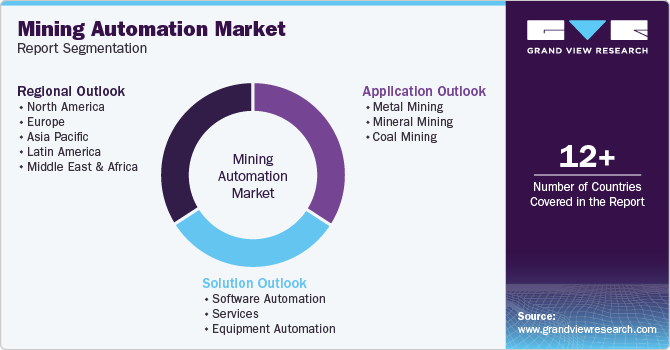
This report forecasts revenue growth at global, regional, and country levels and provides an analysis of the latest technological trends in each of the sub-segments from 2021 to 2033. For this study, Grand View Research has segmented the mining automation market report based on solution, application, and region:
 To learn more about this report, Download Free Sample Report
 -
Solution Outlook (Revenue, USD Million, 2021- 2033)
-
Software Automation
-
Services
-
Implementation & Maintenance
-
Training
-
Consulting
-
-
Equipment Automation
-
Autonomous Trucks
-
Remote Control Equipment
-
Teleoperated Mining Equipment
-
-
-
Application Outlook (Revenue, USD Million, 2021- 2033)
-
Metal Mining
-
Mineral Mining
-
Coal Mining
-
-
Regional Outlook (Revenue, USD Million, 2021- 2033)
-
North America
-
U.S.
-
Canada
-
-
Europe
-
UK
-
Germany
-
Sweden
-
Turkey
-
-
Asia Pacific
-
China
-
Japan
-
India
-
Australia
-
-
Latin America
-
Brazil
-
Mexico
-
-
Middle East & Africa
-
Saudi Arabia
-
UAE
-
South Africa
-
-
Research Methodology
Segment Definition
Segment - Solution
Revenue capture definition
Software Automation
Revenue is generated through the development, licensing, and deployment of software solutions that automate mining operations, including fleet management systems, mine planning software, asset performance management platforms, predictive maintenance tools, data analytics solutions, artificial intelligence applications, and remote monitoring systems designed to improve operational efficiency, productivity, and safety in mining environments.
Services
Revenue is generated through the provision of consulting, system integration, installation, maintenance, training, technical support, remote operation management, software implementation, and optimization services that enable mining companies to deploy, operate, and maximize the performance of automated mining equipment and digital mining solutions.
Equipment Automation
Revenue is generated through the manufacture, sale, and deployment of automated mining equipment, including autonomous haulage trucks, automated drilling rigs, robotic loaders, excavators, conveyor systems, and other machinery equipped with advanced sensors, navigation systems, and control technologies that enhance operational efficiency, safety, and productivity in mining operations.
Segment - Application
Revenue capture definition
Metal Mining
Revenue in this segment is generated through the deployment of automation solutions in the extraction and processing of metallic minerals such as iron ore, copper, gold, aluminum, nickel, zinc, and silver. Automated equipment, fleet management systems, drilling technologies, and digital monitoring platforms are utilized to improve operational efficiency, safety, and productivity across metal mining operations.
Mineral Mining
Revenue in this segment is generated through the adoption of automation technologies in the extraction and processing of industrial minerals and non-metallic resources such as phosphate, potash, limestone, gypsum, salt, and silica. Automated machinery, remote monitoring systems, process control solutions, and digital mine management platforms help enhance productivity, operational efficiency, and resource utilization in mineral mining operations
Coal Mining
Revenue in this segment is generated through the implementation of automation solutions in coal extraction and processing operations. Autonomous haulage systems, automated drilling equipment, remote-controlled machinery, mine monitoring platforms, and predictive maintenance technologies are utilized to improve safety, optimize production efficiency, reduce operational costs, and enhance productivity across surface and underground coal mining sites
Estimation Model
Layer Name
Key Question
Description
Addressable Mining Operations Layer
Which mining operations can adopt automation solutions?
Identify global surface and underground mining operations across metal mining, coal mining, and mineral mining segments that require productivity enhancement, safety improvements, cost reduction, and operational optimization.
Automation Readiness Layer
Which mining companies are willing to invest in automation?
Apply adoption readiness rates across large-scale mining enterprises, mid-sized mining operators, and technologically advanced mines investing in autonomous equipment, fleet management systems, digital mine platforms, remote operations, and industrial IoT solutions.
Deployment Layer
Which mining operations actively use automation technologies?
Estimate active deployments based on the implementation of autonomous haulage systems, automated drilling equipment, robotic mining machinery, fleet management software, remote monitoring systems, predictive maintenance platforms, and AI-driven operational analytics.
Monetization Layer
How much revenue is generated?
Multiply active automation deployments by average spending on mining automation equipment, software platforms, integration services, maintenance contracts, training programs, and digital optimization solutions to estimate total market revenue.
Delivered Customizations
This report has been delivered with the following In-depth customizations
CLIENT REQUEST
CUSTOMIZATION DELIVERED
VALUE ADDS
Competitive Landscape & Technology Benchmarking
Conducted a comprehensive analysis of global mining automation providers, autonomous equipment manufacturers, industrial automation companies, digital mining software vendors, and mine technology specialists. Evaluated competitive positioning, product portfolios, automation capabilities, and strategic developments across the mining automation ecosystem.
Helps stakeholders identify leading market participants, assess competitive differentiation, evaluate partnership and acquisition opportunities, and understand technology evolution within the mining automation value chain.
Mining Automation Adoption & Market Demand Analysis
Evaluated automation adoption trends across key mining segments including metal mining, coal mining, and mineral mining. Assessed demand for autonomous haulage systems, automated drilling equipment, fleet management solutions, remote operations centers, predictive maintenance platforms, and AI-enabled mining technologies.
Provides insights into high-growth application areas, automation investment trends, operational efficiency requirements, and revenue opportunities to support market expansion, product development, and strategic planning initiatives.
Digital Mining & Growth Opportunity Assessment
Assessed the impact of artificial intelligence, industrial IoT, robotics, machine learning, autonomous vehicles, cloud-based analytics, and remote monitoring technologies on mining automation market growth. Identified emerging opportunities across surface and underground mining opera
Supports investment and growth strategies by identifying emerging technology opportunities, evaluating market attractiveness, understanding future automation trends, and highlighting key factors driving long-term development of the mining automation market.
Frequently Asked Questions About This Report
The global mining automation market size was estimated at USD 6.2 billion in 2025 and is estimated to reach USD 6.6 million in 2026.
The global mining automation market is expected to grow at a compound annual growth rate of 7.8% from 2026 to 2033 to reach USD 11.1 billion by 2033.
Some of the key players in the global mining automation market include Caterpillar, Inc.; Rio Tinto Group; Komatsu Ltd.; and Rockwell Automation, Inc.
Key factors driving the mining automation market growth include growing concern for mine and labor safety and the introduction of technologically advanced equipment.
Software Automation led the market with a 41.1% share in 2025, while service segment is the fastest growing in the market.
Asia Pacific dominated the mining automation market with 41.3% market share in 2025.
The mineral mining application segment dominated the global mining automation market with a share of over 39.5% in 2025. This is attributable to the increasing adoption of autonomous solutions in metal exploration activities.
Mineral Mining led the market with a 39.5% share in 2025, driven by extensive automation adoption in large-scale mineral extraction operations to enhance productivity, safety, and cost efficiency
About the Author(s)
Next Generation Technologies Research Team
Technology · Next Generation TechnologiesThis report was authored by the next generation technologies research team at Grand View Research - comprising two research analysts, one senior research analyst, and one industry expert - with specialized expertise in the next generation technologies segment of the technology industry. All findings are based on proprietary technology databases, executive interviews, and regulatory analysis, subject to internal peer review prior to publication.
Last Updated:
Speak to Analyst

Customize this report to your needs - add regions, segments, or data points, with 20% free customization.
Or view our licence options:


ISO 9001:2015 & 27001:2022 Certified
We are GDPR and CCPA compliant! Your transaction & personal information is safe and secure. For more details, please read our privacy policy.


