
- Home
- »
- Next Generation Technologies
- »
-
Virtual Desktop Infrastructure Market Size Report, 2026-2033GVR Report cover

Virtual Desktop Infrastructure Market (2026 - 2033)
Size, Share & Trends Analysis Report By Component (Hardware, Software, Services), By VDI Type, By Deployment (On-Premises, Cloud), By Enterprise Size, By End-use (On-Premises, Cloud, Education), By Region, And Segment Forecasts
Market Size, 2025
$22.5BMarket Estimate, 2026
$26.3BMarket Forecast, 2033
$85.3BCAGR, 2026–2033
18.3%Virtual Desktop Infrastructure Market Summary
The global virtual desktop infrastructure market size was valued at USD 22.5 billion in 2025 and is projected to grow from USD 26.3 billion in 2026 to USD 85.3 billion by 2033, at a CAGR of 18.3% from 2026 to 2033. North America dominated the market, accounting for a revenue share of 32.5% in 2025. The continued adoption of hybrid and remote work across the globe is driving demand for VDI solutions. Organizations use VDI to centralize desktop environments, simplify IT management, support diverse devices, and maintain consistent user experiences across distributed workforces.
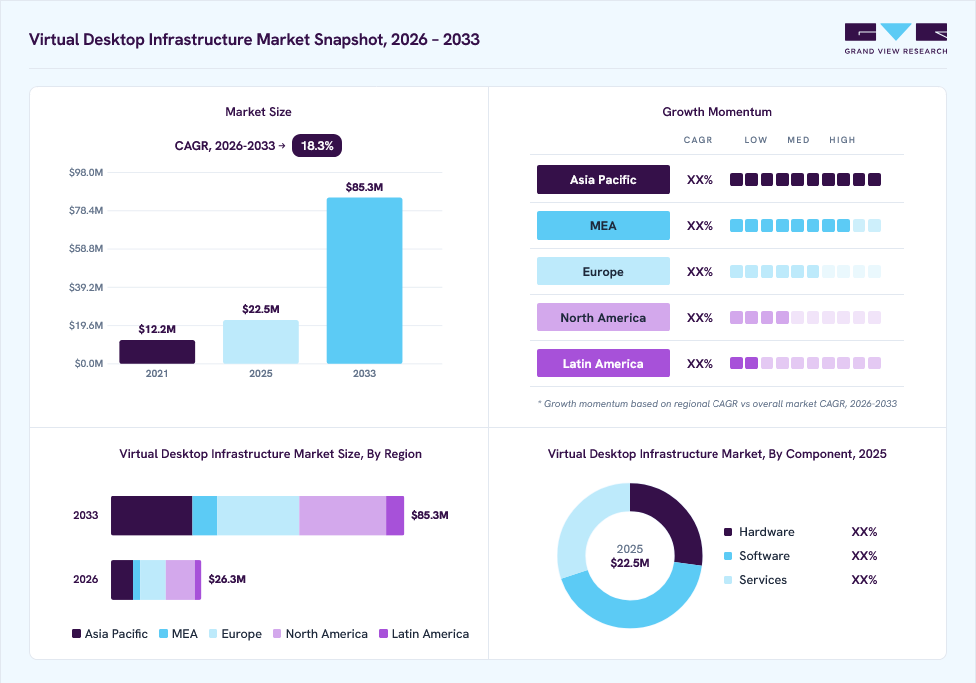 Source: Grand View Research, IR Documents, Primary Interviews, Paid DatabasesTo learn more about this report,
 Download Free Sample Report
Key Market Trends & Insights
- By component: Software segment dominated the market, with a revenue share of 42.6% in 2025.
- By VDI type: Persistent VDI segment held the largest market share of 55.2% in 2025.
- By deployment: Cloud segment held the largest revenue share of 52.3% in 2025.
- By enterprise size: Large enterprises segment held the largest revenue share in 2025.
- By end-use: IT & Telecom segment held the largest revenue share in 2025.
Regional Highlights
- Largest regional market: North America (32.5% revenue share, 2025)
- Fastest-growing regional market: Asia Pacific (highest CAGR, 2026-2033)
- By country: The U.S. held the largest market share in 2025.
Market Size & Forecast
- Market size in 2025: USD 22.5 Billion
- Estimated market size in 2026: USD 26.3 Billion
- Projected market size by 2033: USD 85.3 Billion
- CAGR (2026-2033): 18.3%
Three ways to get this report
Buy it, customize it, or ask a question.Ask an Analyst
Analyst response in 1 business day
- AccessReport author, directly
- Reply timeWithin 1 working day
- No sales callDirect answer only
- FormatEmail reply
- CostFree, no cost
Get the Full Report
What the study covers
- FormatsPDF · Excel · Dashboard
- Timeline2026–2033 annual, 2025 base
- Coverage20+ countries, 5 regions
- Companies10+ key players profiled
Customize the Report
20% free customization
- IncludeCountries, segments, points
- TailorTo your product definition
- ExtendDeeper competitor detail
- OrA fully bespoke study
- Turnaround5–10 working days
 To learn more about this report, Download Free Sample Report
The increasing adoption of Bring Your Own Device (BYOD) policies is driving demand for Virtual Desktop Infrastructure (VDI) solutions. Organizations allow employees to use personal laptops, tablets, and smartphones for work, creating challenges related to data security, device management, and application access. VDI addresses these concerns by hosting desktops and applications centrally while allowing users to access them remotely through authorized devices. Sensitive business data can remain within the organization’s controlled infrastructure rather than being stored directly on personal devices. This approach enables IT teams to enforce security policies, manage user access, and monitor desktop environments centrally. As flexible work practices expand, VDI provides enterprises with a scalable and secure way to support BYOD while maintaining productivity and operational control.Market Dynamics
The virtual desktop infrastructure industry is experiencing strong growth as organizations accelerate digital workplace transformation, hybrid work adoption, cloud migration, and investments in secure endpoint infrastructure. The increasing prevalence of remote and distributed workforces is driving demand for centrally hosted virtual desktops that provide secure, consistent access to enterprise applications and data across locations and devices. Growing adoption of Desktop-as-a-Service (DaaS) and cloud-based VDI is enabling organizations to reduce upfront infrastructure investments, improve scalability, and simplify desktop management. Rising cybersecurity threats, ransomware incidents, data-protection requirements, and Zero Trust security strategies are further encouraging enterprises to centralize desktop environments and strengthen access controls. The growing need to centrally provision, configure, monitor, patch, and secure large numbers of desktops is encouraging adoption among enterprises with geographically distributed workforces. In addition, increasing investments by cloud service providers, virtualization technology companies, managed service providers, and enterprises in cloud-native digital workplace infrastructure are strengthening the VDI ecosystem and accelerating innovation.
The continued adoption of hybrid, remote, and distributed work models is a key driver of the market. Organizations are seeking secure and centrally managed desktop environments that enable employees to access corporate applications and data from different locations and devices. virtual desktop infrastructure (VDI) allows enterprises to deliver standardized virtual desktops while maintaining centralized control over applications, security policies, and user access. The growing use of contractors, temporary workers, and geographically dispersed teams is further increasing demand for flexible desktop provisioning. As organizations prioritize workforce mobility, business continuity, and secure remote access, VDI adoption is expected to expand across enterprises globally.
High implementation costs and the technical complexity associated with deploying and managing VDI environments remain significant restraints to market growth. Traditional on-premises VDI deployments require investments in servers, storage, networking, virtualization software, security infrastructure, and specialized IT expertise. Designing appropriate desktop architectures, ensuring sufficient computing capacity, integrating existing applications, and maintaining performance across large user populations can further increase deployment complexity. Organizations may also face challenges related to application compatibility, user experience, infrastructure scalability, and ongoing maintenance. These factors can discourage smaller enterprises with limited IT budgets and resources from adopting VDI solutions.
The increasing adoption of cloud-based VDI and Desktop-as-a-Service (DaaS) presents significant opportunities for the virtual desktop infrastructure industry. Cloud delivery enables organizations to access virtual desktops through subscription or usage-based models, reducing upfront investments in servers, storage, and networking infrastructure. DaaS providers also manage infrastructure provisioning, updates, security, monitoring, and maintenance, lowering the technical expertise required for deployment. At the same time, advancements in cloud-native VDI, GPU-enabled virtual desktops, AI-assisted management, Zero Trust security, and hybrid-cloud integration are improving scalability, performance, and user experience.
Analyst Perspective
Growing demand for centralized desktop management, secure endpoint environments, flexible workforce models, and reduced IT infrastructure costs is driving the adoption of VDI across various sectors. Organizations are shifting from traditional on-premises desktop environments toward cloud-hosted, hybrid, and Desktop-as-a-Service (DaaS) models to improve scalability, simplify IT administration, and enable access to virtual desktops from diverse devices and locations. The increasing use of AI-enabled applications, graphics-intensive workloads, and remote collaboration is also creating demand for high-performance virtual desktop environments supported by GPU virtualization and accelerated computing. The primary competitive advantage belongs to vendors who combine scalable virtualization platforms, cloud-native architectures, robust cybersecurity, endpoint management, GPU acceleration, automation, and seamless integration with enterprise applications and cloud ecosystems.
Component Insights
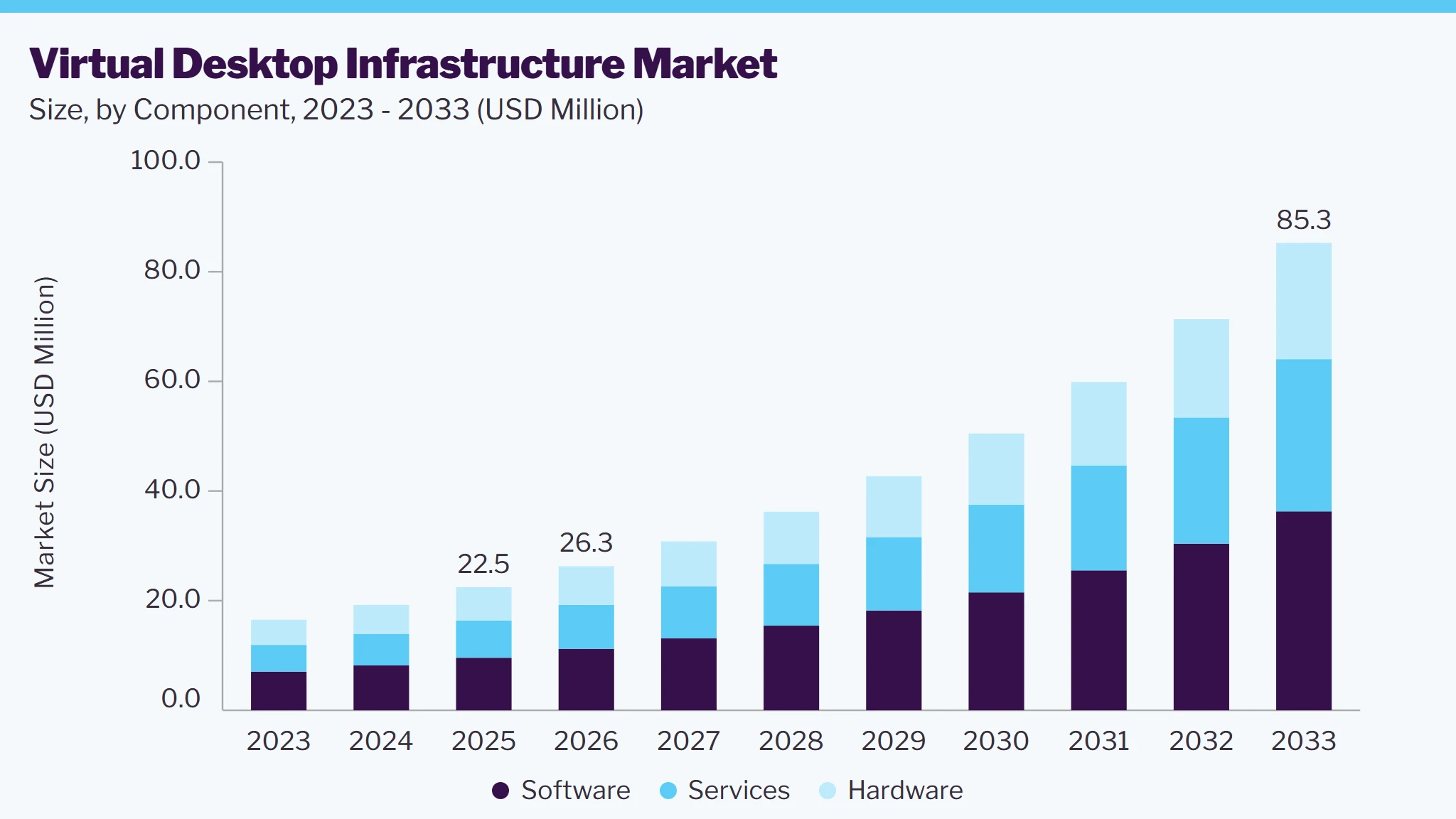
The software segment dominated the market and accounted for a revenue share of 42.6% in 2025. Enterprises are adopting VDI software to simplify and centralize desktop administration across large and geographically distributed workforces. Virtual desktop infrastructure enables IT teams to provision virtual desktops, deploy applications, apply security policies, manage updates, and monitor performance from a centralized platform. This reduces the need for manual configuration and maintenance of individual physical devices, lowering IT workload and operational complexity. Centralized management also enables faster onboarding, consistent desktop configurations, and streamlined troubleshooting. As organizations manage diverse endpoints and distributed employees, demand for scalable and centrally controlled desktop environments continues to support growth in VDI software adoption.
The services segment is anticipated to grow at the highest CAGR during the forecast period. As virtual desktop infrastructure environments become more complex, enterprises increasingly require specialized expertise for architecture design, deployment, configuration, integration, and optimization. Service providers help organizations assess workloads, select appropriate infrastructure, integrate VDI with existing IT systems, and ensure performance and scalability. This drives demand for consulting and implementation services.
VDI Type Insights
The persistent VDI segment dominated the market and accounted for the largest revenue share of 55.2% in 2025. Persistent VDI provides employees with dedicated virtual desktops that retain personal settings, applications, files, preferences, and configurations across sessions. Users can maintain a consistent workspace tailored to their specific roles and workflows. This creates a user experience similar to using a traditional physical computer while providing centralized management and security. Organizations adopt persistent VDI for employees who rely on specialized applications, customized configurations, or frequently accessed resources.
The non-persistent VDI segment is anticipated to grow at the highest CAGR during the forecast period. Call centers and shared-workstation environments require standardized applications and consistent desktop configurations across large user groups. Non-persistent VDI allows organizations to provide identical virtual desktops and automatically reset them after each session. This improves resource utilization, simplifies maintenance, strengthens security, and enables faster workstation availability for different users.
Deployment Insights
The cloud segment dominated the market and accounted for the largest revenue share of 52.3% in 2025. Cloud VDI reduces the capital investment required to deploy and operate virtual desktop environments by eliminating the need to purchase extensive servers, storage systems, networking equipment, and associated hardware. Instead, organizations can access virtual desktops through subscription-based or usage-based pricing models. This allows enterprises to align infrastructure spending with the number of users and actual resource consumption. Cloud providers also handle much of the infrastructure maintenance, upgrades, and capacity management. As organizations seek to control IT budgets, improve cost predictability, and avoid large upfront investments, cloud VDI becomes an increasingly attractive alternative to traditional on-premise deployments.
The on-premise segment is expected to grow at a significant CAGR during the forecast period. Organizations handling sensitive financial, healthcare, government, and business information increasingly prioritize direct control over data and IT infrastructure. On-premises VDI enables enterprises to host desktops within their own data centers, allowing greater control over data storage, access permissions, security policies, infrastructure configurations, and compliance requirements while reducing reliance on external providers.
Enterprise Size Insights
The large enterprise segment dominated the market and accounted for the largest revenue share in 2025. Large enterprises often operate across multiple locations, countries, and time zones, creating challenges in managing diverse desktop environments. VDI enables centralized delivery of standardized desktops and applications to employees regardless of their location. This simplifies IT administration, ensures consistent user experiences, strengthens security, and enables organizations to efficiently manage distributed workforces while reducing desktop maintenance complexity.
The small & medium enterprises segment is expected to grow at a significant CAGR during the forecast period. SMEs often operate with constrained IT budgets, making significant investments in servers, storage, networking, and desktop infrastructure challenging. VDI, particularly cloud-based solutions, reduces these capital requirements by providing virtual desktops through subscription or usage-based models. This enables SMEs to access enterprise-grade desktop capabilities while improving cost flexibility and financial predictability.
End-use Insights
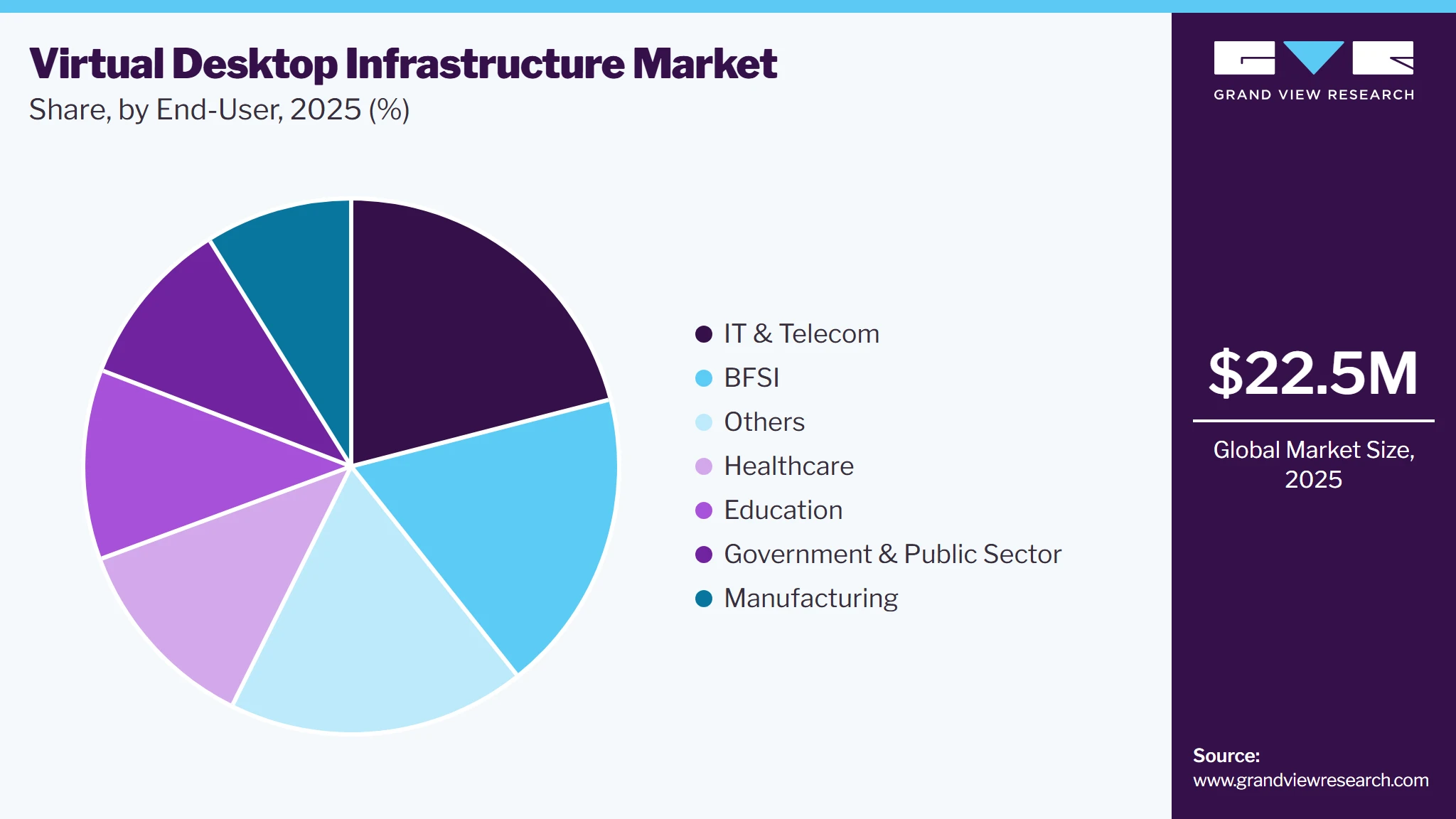
The IT & Telecom segment dominated the market and accounted for the largest revenue share in 2025. IT and telecom companies operate through geographically dispersed teams, remote employees, contractors, and multiple office locations. Managing desktop environments across these users can increase IT complexity and security risks. VDI enables organizations to centrally deliver standardized desktops and applications while providing secure access from different locations and devices. This improves workforce flexibility, simplifies desktop administration, ensures consistent user experiences, and supports efficient collaboration across distributed teams.
 To learn more about this report, Download Free Sample Report
The healthcare segment is expected to grow at a significant CAGR over the forecast period. Hospitals use diverse endpoints, including desktops, workstations, tablets, thin clients, and shared clinical devices, across departments and facilities. Managing these devices individually increases IT complexity and security risks. VDI enables centralized desktop and application management, allowing healthcare providers to efficiently deploy updates, enforce security policies, and maintain consistent configurations across endpoints.
Regional Insights
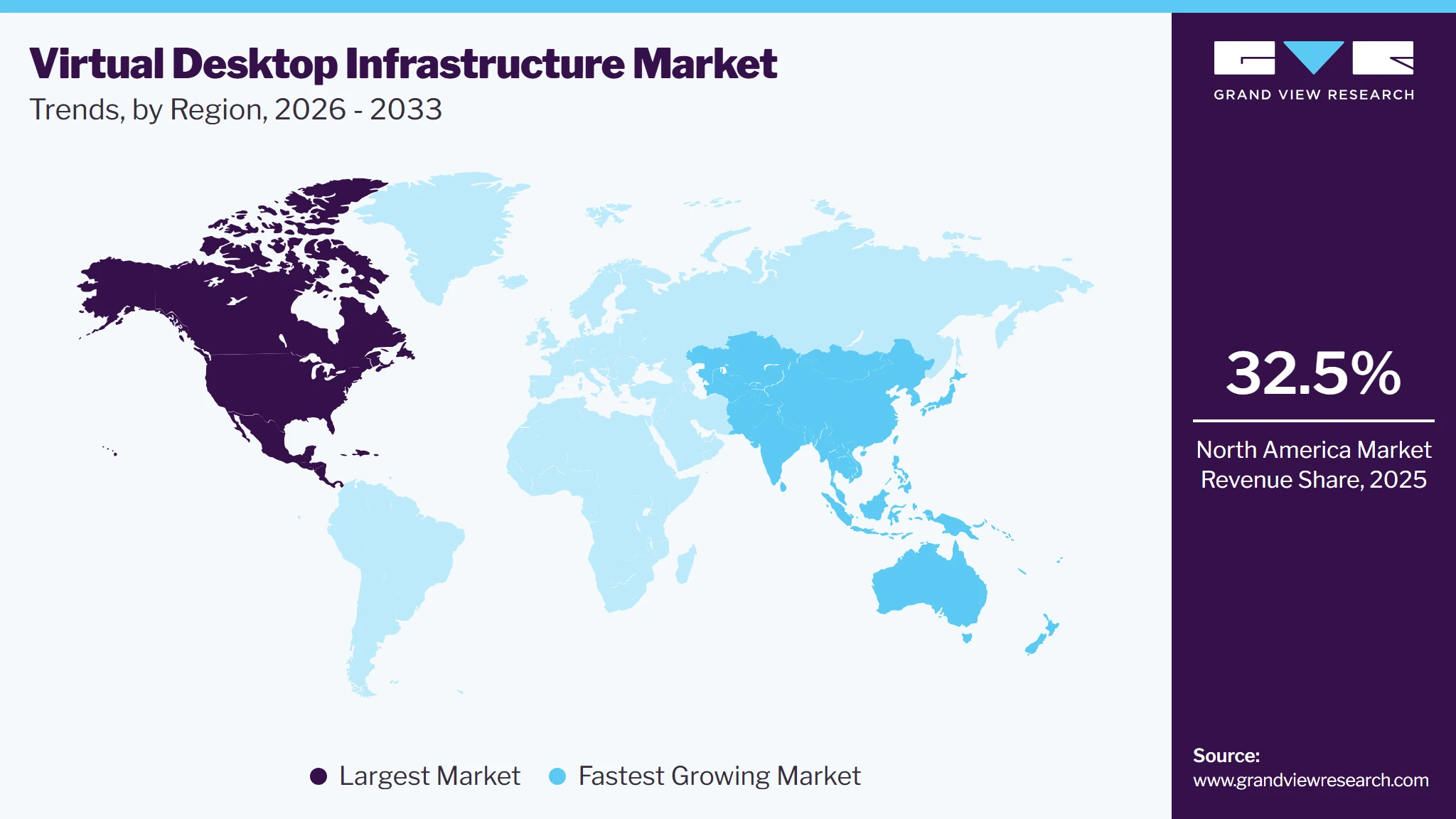
The North America virtual desktop infrastructure market led with the largest revenue share of 32.5% in 2025. North America hosts leading VDI and cloud technology providers, including Microsoft, Amazon Web Services, Citrix, Omnissa, and Nutanix. Their continuous investments in cloud-based desktops, virtualization, cybersecurity, AI, and automation are driving product innovation, improving solution capabilities, and increasing enterprise awareness and adoption of VDI technologies across the region.
 To learn more about this report, Download Free Sample Report
U.S. Virtual Desktop Infrastructure Market Trends
The virtual desktop infrastructure market in the U.S. is expected to grow significantly, at a CAGR of 16.4% from 2026 to 2033. The U.S. has a mature cloud ecosystem and high adoption of public, private, and hybrid cloud services. Enterprises are shifting from traditional on-premises VDI toward cloud VDI and Desktop-as-a-Service (DaaS) to improve scalability and reduce infrastructure management requirements.
Europe Virtual Desktop Infrastructure Market Trends
The virtual desktop infrastructure market in Europe is anticipated to register considerable growth from 2026 to 2033. European businesses are investing in modernization of IT infrastructure, applications, and digital workplaces. VDI supports these initiatives by providing centrally managed virtual desktops that can integrate with cloud platforms, enterprise applications, and digital workplace technologies.
The UK virtual desktop infrastructure market is expected to grow rapidly in the coming years. Increasing ransomware, phishing, endpoint attacks, and data breaches are encouraging organizations to strengthen desktop and access security. VDI centralizes applications and desktop environments, enabling organizations to implement consistent security controls, authentication, monitoring, and access policies.
The virtual desktop infrastructure market in Germany held a substantial share in 2025. Germany's large automotive, machinery, engineering, and industrial manufacturing sectors are digitalizing their operations. VDI can provide engineers, designers, and other professionals with centralized access to applications such as CAD, product lifecycle management, simulation, and engineering software.
Asia Pacific Virtual Desktop Infrastructure Market Trends
The virtual desktop infrastructure market in Asia Pacific held a significant share in the global market in 2025, and is expected to witness the fastest CAGR of 20.5% from 2026 to 2033. The adoption of flexible work models is increasing demand for secure remote access to corporate applications in this region. VDI allows employees to access standardized desktop environments from different locations and devices while IT teams maintain centralized management.
The Japan virtual desktop infrastructure market is expected to grow rapidly in the coming years. Japan's banking, insurance, healthcare, and public-sector organizations manage sensitive information and require secure, standardized IT environments. VDI supports centralized desktop administration, access controls, and security policies across large user groups.
The virtual desktop infrastructure market in China held a substantial share in 2025. Large Chinese enterprises often operate multiple offices, branches, factories, and facilities. VDI allows IT teams to centrally provision and manage standardized desktops across geographically distributed employees while reducing endpoint-management complexity.
Key Virtual Desktop Infrastructure Company Insights
Key players operating in the virtual desktop infrastructure industry are focusing on various strategic initiatives, including new product development, partnerships & collaborations, and agreements to gain a competitive advantage over their rivals. For instance, in May 2025, Rancher Government Solutions (RGS) and Kasm Technologies announced a strategic partnership to modernize virtual desktop infrastructure for U.S. government and defense organizations. The partnership combines RGS’s secure, open-source Kubernetes platform with Kasm’s web-native VDI technology. The solution supports secure virtual desktops and applications across on-premises, hybrid, cloud, and air-gapped environments without requiring endpoint agents or proprietary hardware. It emphasizes zero-trust security, multi-cloud flexibility, lower total cost of ownership, and reduced vendor lock-in. The platform also supports federal security requirements, including FIPS 140-2, NIST controls, and DISA STIG guidelines.
Key Virtual Desktop Infrastructure Companies:
The following key companies have been profiled for this study on the virtual desktop infrastructure industry market
-
Microsoft Corporation
-
Amazon Web Services (AWS)
-
Citrix Systems, Inc.
-
Omnissa, LLC
-
Nutanix, Inc.
-
Google LLC
-
Alibaba Cloud
-
Parallels International GmbH
-
IBM Corporation
-
Huawei Technologies Co., Ltd.
-
Dell Technologies Inc.
-
Cisco Systems, Inc.
-
Hewlett Packard Enterprise (HPE)
-
Oracle Corporation
-
NComputing Co., Ltd
Competitive Benchmarking
Category
Operating Strategies
Competitive Edge
Weakness
Established Players (Microsoft, Citrix, Omnissa, Amazon Web Services, Nutanix, Google, IBM, Dell Technologies)
- Established VDI providers focus on delivering comprehensive virtual desktop platforms, cloud-based desktops, virtualization software, DaaS, endpoint management, security, and supporting infrastructure. Their strategies emphasize continuous product development, cloud integration, hybrid deployment capabilities, AI-enabled management, strategic partnerships, and integration with enterprise applications, identity management, cybersecurity, and cloud ecosystems. These companies target large enterprises, government organizations, BFSI, healthcare, IT & telecom, education, and other sectors with complex desktop requirements.
- Established players benefit from strong brand recognition, extensive enterprise customer bases, mature technology portfolios, global sales and service networks, and established cloud and IT ecosystems. Their ability to offer integrated solutions spanning VDI software, cloud infrastructure, security, endpoint management, networking, and professional services provides strong value for large-scale deployments. Long-standing relationships with enterprises, system integrators, and channel partners further support customer retention and market penetration.
- Established vendors face challenges including high platform complexity, integration requirements, migration costs, and competition from cloud-native DaaS providers. Large enterprise solutions may require significant implementation and management expertise. In addition, dependence on broader cloud and virtualization ecosystems can create vendor lock-in concerns, while rapidly changing customer preferences toward simpler, subscription-based solutions can pressure traditional VDI business models.
Emerging Players (Nerdio, Kasm Technologies, Workspot, Leostream, Cameyo, Parallels)
- Emerging and specialized providers primarily focus on cloud VDI, DaaS management, browser-based virtual desktops, application virtualization, hybrid-cloud deployments, and simplified VDI administration. Their strategies emphasize ease of deployment, automation, lower total cost of ownership (TCO), cloud-native architectures, rapid provisioning, and integration with platforms such as Microsoft Azure, AWS, and other cloud environments. These companies target SMEs, enterprises modernizing legacy VDI, government organizations, distributed workforces, and organizations seeking alternatives to complex traditional VDI platforms.
- Emerging providers offer greater flexibility, simplified management, specialized functionality, and faster innovation compared with larger legacy platforms. Their cloud-native and automation-focused approaches can reduce deployment complexity and administrative requirements. Specialized solutions such as browser-based desktops, hybrid-cloud management, and automated Azure Virtual Desktop deployment enable these vendors to address specific customer requirements and underserved market niches.
- Emerging providers generally have smaller customer bases, lower brand recognition, and more limited financial and global service capabilities than established vendors. They may depend heavily on third-party cloud platforms and underlying infrastructure providers. Building large enterprise ecosystems, expanding international sales channels, ensuring long-term platform support, and competing with vendors offering integrated cloud, security, productivity, and endpoint-management portfolios remain key challenges.
Recent Developments
-
In April 2026, Nerdio and Nutanix announced a strategic technology alliance to modernize end-user computing for the AI era. The partnership combines Nerdio’s management platform, Nutanix’s hybrid-cloud infrastructure, and Microsoft Azure Virtual Desktop to deliver integrated virtual desktop environments. The solution aims to simplify VDI deployment and management, support hybrid-cloud architectures, improve scalability, and help enterprises modernize their desktop infrastructure while preparing for growing AI-related computing requirements.
-
In November 2025, Nerdio announced support for Microsoft Azure Virtual Desktop (AVD) for hybrid environments, helping organizations modernize existing on-premises VDI deployments. The solution enables enterprises to extend their current VDI infrastructure to Azure while maintaining hybrid environments. It aims to simplify migration, improve scalability and flexibility, reduce infrastructure management complexity, and provide a pathway for organizations to adopt cloud-based virtual desktops without requiring an immediate full transition to the cloud.
Virtual Desktop Infrastructure Market Report Scope
Report Attribute
Details
Market size in 2025
USD 22.5 billion
Estimated market size in 2026
USD 26.3 billion
Projected market size in 2033
USD 85.3 billion
Growth rate
CAGR of 18.3% from 2026 to 2033
Base year for estimation
2025
Historical data
2021 - 2024
Forecast period
2026 - 2033
Quantitative units
Revenue in USD billion and CAGR from 2026 to 2033
Report coverage
Revenue forecast, company ranking, competitive landscape, growth factors, and trends
Segments covered
Component, VDI type, deployment, enterprise size, end-use, region
Regional scope
North America; Europe; Asia Pacific; Latin America; MEA
Country scope
U.S.; Canada; Mexico; Germany; UK; France; China; Japan; India; South Korea; Australia; Brazil; Saudi Arabia; South Africa; UAE
Key companies profiled
Microsoft Corporation; Amazon Web Services (AWS); Citrix Systems, Inc.; Omnissa, LLC; Nutanix, Inc.; Google LLC; Alibaba Cloud; Parallels International GmbH; IBM Corporation; Huawei Technologies Co., Ltd.; Dell Technologies Inc.; Cisco Systems, Inc.; Hewlett Packard Enterprise (HPE); Oracle Corporation; NComputing Co., Ltd.
Customization scope
Free report customization (equivalent up to 8 analysts' working days) with purchase. Addition or alteration to country, regional & segment scope.
Pricing and purchase options
Avail customized purchase options to meet your exact research needs. Explore purchase options
Global Virtual Desktop Infrastructure Market Report Segmentation
This report forecasts revenue growth at the global, regional, and country levels and provides an analysis of the latest industry trends in each of the sub-segments from 2021 to 2033. For this study, Grand View Research has segmented the global virtual desktop infrastructure market report based on component, VDI type, deployment, enterprise size, end-use, and region.
-
Component Outlook (Revenue, USD Billion, 2021 - 2033)
-
Hardware
-
Software
-
Services
-
-
VDI Type Outlook (Revenue, USD Billion, 2021 - 2033)
-
Persistent VDI
-
Non-Persistent VDI
-
-
Deployment Outlook (Revenue, USD Billion, 2021 - 2033)
-
On-Premises
-
Cloud
-
-
Enterprise Size Outlook (Revenue, USD Billion, 2021 - 2033)
-
Small & Medium Enterprises
-
Large Enterprise
-
-
End-use Outlook (Revenue, USD Billion, 2021 - 2033)
-
BFSI
-
IT & Telecom
-
Manufacturing
-
Healthcare
-
Education
-
Government & Public Sector
-
Others
-
-
Regional Outlook (Revenue, USD Billion, 2021 - 2033)
-
North America
-
U.S.
-
Canada
-
Mexico
-
-
Europe
-
UK
-
Germany
-
France
-
-
Asia Pacific
-
China
-
India
-
Japan
-
South Korea
-
Australia
-
-
Latin America
-
Brazil
-
-
Middle East & Africa
-
UAE
-
Saudi Arabia
-
South Africa
-
-
Research Methodology
The virtual desktop infrastructure market figures in this report are based on a proven research process that combines executive interviews with secondary research from proprietary databases, company filings, and recognized regulatory and institutional sources. Market size is built through value-chain sizing-reconciling supply-side and demand-side estimates-and triangulated with bottom-up and top-down approaches. Every estimate passes multiple levels of expert validation before publication, with each virtual desktop infrastructure segment quantified using the revenue-capture definitions in the table below.
Segment Definition
Component
Revenue capture definition
Hardware
Includes physical computing, storage, networking, endpoint, and related infrastructure used to support and operate VDI environments.
Software
Includes VDI platforms and software solutions used to create, provision, manage, secure, monitor, and deliver virtual desktops and applications to end users.
Services
Includes professional and managed services such as consulting, implementation, integration, migration, maintenance, monitoring, support, and optimization of VDI environments.
VDI Type
Revenue capture definition
Persistent VDI
Provides each user with a dedicated virtual desktop that retains personal settings, applications, configurations, and files across sessions, offering a personalized desktop experience.
Non-Persistent VDI
Provides standardized virtual desktops that are reset to a predefined state after users log out or sessions end, enabling efficient resource utilization and centralized management.
Deployment Model
Revenue capture definition
On-Premise
VDI infrastructure is deployed and operated within an organization's own data center or IT environment, providing direct control over computing resources, data, security, and configurations.
Cloud
VDI infrastructure is hosted and delivered through cloud environments, enabling users to access virtual desktops remotely while allowing organizations to scale resources based on requirements.
Organization Size
Revenue capture definition
Large Enterprises
The Large enterprises segment, with respect to the number of employees, typically comprises organizations employing more than 1,000 employees for multinational corporations.
Small & Medium-sized Enterprises (SMEs)
The SMEs segment, with respect to the number of employees, generally includes organizations employing between 10 and 999 employees
End-User
Revenue capture definition
BFSI
Includes banks, financial institutions, insurance companies, investment firms, and fintech organizations using VDI to provide secure and centrally managed access to financial applications and sensitive data.
IT & Telecom
Includes software companies, IT service providers, data centers, telecommunications operators, and technology organizations using VDI for distributed workforces, development environments, technical applications, and secure remote access.
Healthcare
Includes hospitals, clinics, laboratories, healthcare networks, and other providers using VDI to securely deliver clinical, administrative, and healthcare applications across multiple locations and devices.
Government & Public Sector
Includes federal, national, state, and local government agencies and public-sector organizations using VDI for secure desktop delivery, centralized IT management, data protection, and workforce mobility.
Education
Includes schools, universities, colleges, training institutions, and research organizations using VDI to provide students, faculty, researchers, and administrators with centralized access to applications and computing resources.
Manufacturing
Includes automotive, electronics, machinery, industrial, and other manufacturing organizations using VDI for engineering, design, production, administration, and other applications across distributed facilities.
Others
Includes industries such as retail, professional services, media & entertainment, transportation & logistics, energy & utilities, hospitality, and other organizations adopting VDI for secure and centralized desktop management.
Estimation Model
Layer
Question
Analysis
Digital Workplace & Workforce Demand Layer
Who drives demand for VDI?
Identify organizations adopting hybrid and remote work, digital workplace transformation, BYOD policies, centralized endpoint management, and secure remote-access strategies. Assess demand across large enterprises and SMEs, including organizations with distributed employees, contractors, temporary workers, and geographically dispersed teams. Evaluate workforce size, remote/hybrid workforce penetration, endpoint proliferation, cybersecurity requirements, and digital workplace investments to estimate the Total Addressable Market (TAM) for VDI.
VDI Infrastructure & Deployment Expansion Layer
Where is demand for VDI infrastructure generated?
Evaluate enterprise investments in on-premises and cloud-based VDI environments, including compute servers, storage, networking, virtualization platforms, desktop-management software, security infrastructure, and cloud resources. Assess adoption of DaaS, hybrid-cloud VDI, hyperconverged infrastructure, and GPU-enabled virtual desktops. Analyze cloud migration, data-center modernization, cybersecurity investments, and enterprise IT infrastructure spending to determine the Operational VDI Infrastructure Market (OM).
VDI Adoption & Technology Deployment Layer
Who adopts VDI and what technologies are deployed?
Assess VDI adoption across BFSI, IT & Telecom, healthcare, government & public sector, education, manufacturing, and other industries. Analyze deployment by software, hardware, and services; persistent and non-persistent VDI; on-premises and cloud environments; and large enterprises versus SMEs. Evaluate deployment volumes based on number of virtual desktops/users, endpoint types, workload requirements, security needs, and application use cases.
Revenue Generation Layer
How is VDI revenue generated?
Estimate revenue generated from VDI software licenses/subscriptions, hardware infrastructure, cloud-based desktop consumption, DaaS subscriptions, implementation and integration services, consulting, managed services, maintenance, and support. Analyze Average Selling Prices (ASPs), per-user/per-desktop subscription pricing, infrastructure spending per virtual desktop, deployment models, renewal rates, and migration from traditional physical desktops to virtual environments. Assess vendor revenue across software platforms, cloud providers, hardware suppliers, and VDI service providers to estimate the overall VDI market revenue.
Delivered Customizations
This report has been delivered with the following In-depth customizations
Client Request
Customization Delivered
Value Adds
VDI Vendor Competitive Benchmarking
Assessed leading VDI vendors based on desktop virtualization platforms, DaaS capabilities, deployment models, endpoint support, security features, application delivery, scalability, management capabilities, cloud integration, GPU virtualization, pricing models, partnerships, geographic presence, and product roadmap.
Enables stakeholders to benchmark competitors, identify technology leaders, evaluate product differentiation, assess platform capabilities, and formulate competitive product development, partnership, and go-to-market strategies.
Deployment Model Assessment
Analyzed demand and adoption across on-premises VDI, public cloud VDI, private cloud, hybrid VDI, and Desktop-as-a-Service (DaaS), considering security requirements, scalability, IT control, infrastructure investment, workload characteristics, and organizational size.
Helps enterprises identify the most suitable deployment model, evaluate migration opportunities, reduce infrastructure complexity, and develop cost-effective digital workplace strategies.
Pricing & Cost per User Analysis
Assessed VDI pricing and cost structures across subscription-based DaaS, perpetual/on-premises licensing, and hybrid deployment models, including per-user/per-month pricing, infrastructure costs, software licensing, endpoint requirements, support costs, and total cost of ownership across user segments.
Helps stakeholders estimate deployment costs, compare vendor pricing, evaluate TCO, optimize licensing strategies, assess profitability, and improve financial planning for VDI and DaaS deployments.
Frequently Asked Questions About This Report
The global virtual desktop infrastructure market is expected to grow at a compound annual growth rate of 18.3% from 2026 to 2033 to reach USD 85.3 billion by 2033.
Key factors include organizations accelerating digital workplace transformation, hybrid work adoption, cloud migration, and investments in secure endpoint infrastructure
North America dominated with 32.5% revenue share in 2025.
Asia Pacific is the fastest-growing region over the forecast period.
The software segment led with a 42.6% revenue share in 2025, while the services segment is the fastest-growing segment.
The persistent VDI segment led with a 55.2% revenue share in 2025, while the non-persistent VDI segment is the fastest-growing segment.
The cloud segment held the largest share (over 52.0% ) in 2025, while the on-premise segment is the fastest-growing segment.
Key players operating in the virtual desktop infrastructure market include Microsoft Corporation, Amazon Web Services (AWS), Citrix Systems, Inc., Omnissa, LLC, Nutanix, Inc., Google LLC, Alibaba Cloud, Parallels International GmbH, IBM Corporation, Huawei Technologies Co., Ltd., Dell Technologies Inc., Cisco Systems, Inc., Hewlett Packard Enterprise (HPE), Oracle Corporation, NComputing Co., Ltd.
The global virtual desktop infrastructure market size was estimated at USD 22.5 billion in 2025 and is expected to reach USD 26.3 billion in 2026.
About the Author(s)
Next Generation Technologies Research Team
Technology · Next Generation TechnologiesThis report was authored by the next generation technologies research team at Grand View Research - comprising two research analysts, one senior research analyst, and one industry expert - with specialized expertise in the next generation technologies segment of the technology industry. All findings are based on proprietary technology databases, executive interviews, and regulatory analysis, subject to internal peer review prior to publication.
Last Updated:
Speak to Analyst

Customize this report to your needs - add regions, segments, or data points, with 20% free customization.
Or view our licence options:


ISO 9001:2015 & 27001:2022 Certified
We are GDPR and CCPA compliant! Your transaction & personal information is safe and secure. For more details, please read our privacy policy.


