
- Home
- »
- Food Safety & Processing
- »
-
Wrapping Machine Market Size & Share Report, 2026-2033GVR Report cover
![Wrapping Machine Market (2026 - 2033)Report]()
Wrapping Machine Market (2026 - 2033)
Size, Share & Trends Analysis Report By Machine Type (Stretch, Shrink), By Mode Of Operation (Automatic, Semi-automatic), By Application (Beverages, Food, Chemicals, Personal Care, Pharmaceuticals), By Region, And Segment Forecasts
Market Size, 2025
$2.8BMarket Estimate, 2026
$2.9BMarket Forecast, 2033
$3.9BCAGR, 2026–2033
4.7%Wrapping Machine Market Summary
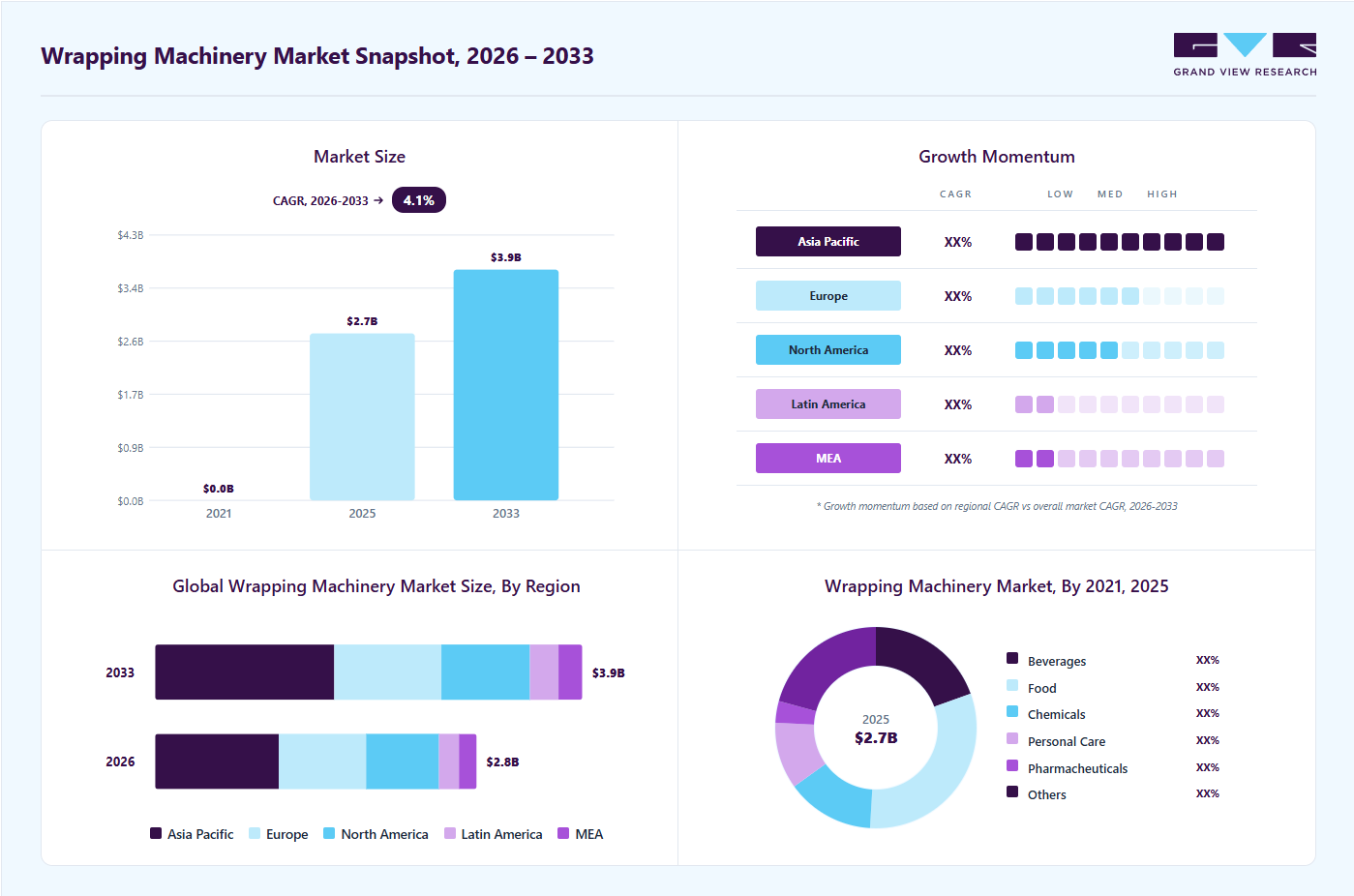
The global wrapping machine market size was valued at USD 2.8 billion in 2025 and is projected to grow from USD 2.9 billion in 2026 to USD 3.9 billion by 2033, at a CAGR of 4.7% from 2026 to 2033. The market in Asia Pacific dominated with a revenue share of 38.4% in 2025. The growing demand for packaged and processed products, driven by changing consumer purchasing patterns and the expansion of organized retail and e-commerce channels, is encouraging manufacturers to invest in automated and semi-automated wrapping systems to improve productivity and packaging consistency.
Key Market Trends & Insights
- By mode of operation: Semi-automatic segment held the largest market share of 50.5% in 2025.
- By machine type: Stretch segment held the largest market share of 40.6% in 2025.
- By application: Food segment held the largest market share of 31.5% in 2025.
Regional Highlights
- Largest regional market: Asia Pacific (38.4% revenue share, 2025)
- By country: China held the largest market share in 2025
Market Size & Forecast
- Market size in 2025: USD 2.8 Billion
- Estimated market size in 2026: USD 2.9 Billion
- Projected market size by 2033: USD 3.9 Billion
- CAGR (2026-2033): 4.7%
In addition, rising emphasis on product safety, tamper resistance, and extended shelf life is supporting the adoption of advanced stretch and shrink wrapping technologies across industrial and consumer goods applications.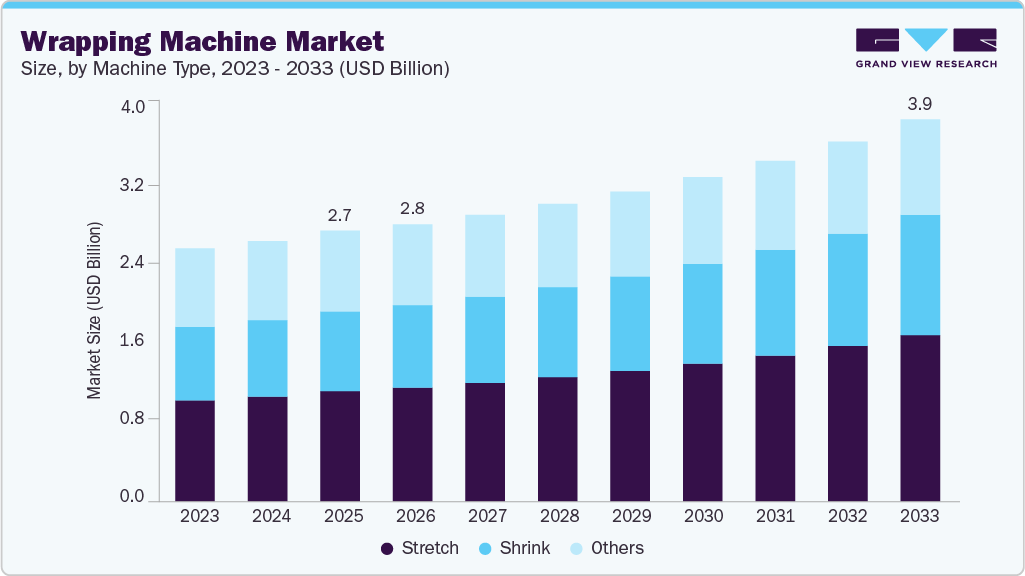
Technological advancements in automatic wrapping equipment, including integration with smart manufacturing systems, robotics, and sensor-based controls, are further contributing to market growth by improving operational efficiency and reducing labor dependency. Manufacturers are also focusing on energy-efficient, material-optimized machines to meet sustainability targets and reduce packaging waste. Moreover, increasing industrial production, the expansion of logistics and warehousing infrastructure, and growing investments in manufacturing facilities across emerging economies continue to strengthen global demand for wrapping machinery.
Market Dynamics
The global wrapping machine market is primarily driven by rising demand for automated packaging solutions across food, beverage, pharmaceutical, and other industrial sectors. Manufacturers are increasingly adopting automatic and semi-automatic wrapping machines to improve operational efficiency, ensure product safety, and reduce labor costs. In addition, rapid growth in e-commerce and logistics is increasing demand for secure, high-throughput packaging solutions, supporting the adoption of stretch and shrink wrap technologies. Stringent hygiene and product integrity regulations, along with the growing emphasis on sustainable, material-efficient packaging processes, are also contributing to market growth.
The substantial initial capital investment required for procurement and installation stands as a primary barrier to market expansion. Advanced wrapping machinery, particularly fully automated systems integrated with sophisticated sensors and control technologies, commands a high premium that frequently exceeds the budgetary constraints of small and medium-sized enterprises (SMEs). Beyond the purchase price of the equipment, integrating these machines into existing production lines entails additional expenditures for facility modifications, specialized software, and operator training. Consequently, this high financial threshold prolongs the return on investment (ROI) timeline, compelling many smaller manufacturers to defer automation and rely instead on manual or semi-automatic alternatives.
Market Concentration & Characteristics
The wrapping machine market is relatively fragmented, with the presence of numerous global, regional, and local manufacturers competing across automatic and semi-automatic machine segments. The market includes a broad range of suppliers offering customized solutions for various packaging formats, production scales, and end-use industries, creating a highly competitive environment. While large multinational companies maintain strong positions through extensive product portfolios, automation capabilities, and established distribution networks, regional players remain competitive by offering cost-effective and application-specific machinery solutions. Manufacturers are increasingly focusing on product innovation, integration of automation, and expansion of after-sales services to strengthen market presence and differentiate their offerings.
Technological advancement remains a major competitive factor within the wrapping machine industry. Manufacturers are integrating robotics, sensor-based monitoring systems, programmable controls, and smart automation features to improve packaging speed, accuracy, and operational efficiency. Demand for flexible machinery capable of handling multiple packaging formats and varying production volumes is also increasing, particularly across food, beverage, pharmaceutical, and e-commerce applications. In addition, growing focus on energy-efficient systems and material optimization is encouraging the development of sustainable wrapping technologies.
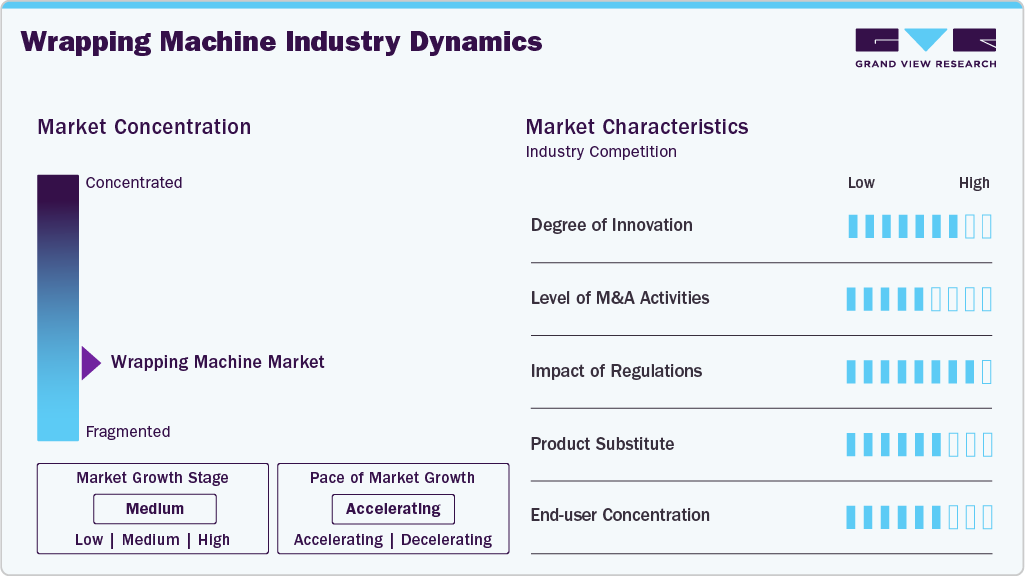
Regulatory standards related to packaging safety, hygiene, workplace safety, and environmental sustainability continue to influence market development. Packaging operations in the food, pharmaceutical, and personal care industries are subject to strict compliance requirements, encouraging the adoption of advanced and precision-controlled wrapping equipment. At the same time, increasing regulations on plastic waste and sustainable packaging materials are creating pressure on manufacturers to develop machines compatible with recyclable and eco-friendly films. However, the market faces competition from alternative packaging and sealing technologies, including carton-based packaging, reusable transport packaging systems, and adhesive-free containment solutions, which may limit adoption in certain applications.
Machine Type Insights
The stretch wrapping machine segment accounted for the largest revenue share of the 40.6% in 2025, driven by its widespread adoption across logistics, warehousing, food & beverage, consumer goods, and e-commerce industries for pallet stabilization and transportation safety. Stretch wrapping systems offer advantages such as lower consumption of packaging materials, high operational speed, reduced labor dependency, and compatibility with automated production lines, making them highly suitable for high-volume packaging environments.
The shrink segment is projected to grow at a CAGR of 5.5% over the forecast period, driven by increasing demand for secure, tamper-evident, and visually appealing packaging across food, beverages, pharmaceuticals, personal care, and retail applications. Shrink wrapping machines provide tight product sealing, enhanced shelf presentation, moisture resistance, and product bundling capabilities, making them suitable for both individual and multipack packaging formats. Growth in retail-ready packaging, expanding packaged food consumption, and rising demand for secondary packaging solutions in e-commerce and consumer goods sectors are supporting market expansion.
Mode of Operation Insights
The semi-automatic segment dominated the wrapping machine industry, accounting for 50.5% share in 2025. The segment’s growth is driven by a market need for cost-effective flexibility, lower initial capital investment, and adaptability to varied production environments. The machines typically require partial operator involvement for load handling, film attachment, or cycle initiation. Consequently, its primary application scenarios are found in small-to-medium enterprises (SMEs), decentralized warehouse bays, and facilities with highly diverse or low-volume product lines where the extreme speed of a fully automated system cannot justify the upfront capital expenditure.
The automatic segment’s growth is driven by the growing emphasis on maximizing throughput, reducing labor costs, and enabling seamless integration into fully automated production lines. These high-end systems require zero human intervention, utilizing sensors and mechanical arms to automatically attach, wrap, cut, and seal the film. They are deployed in high-volume, 24/7 manufacturing plants, massive fulfillment centers, and large-scale industrial hubs, where consistency, speed, and data tracking are critical to maintaining the flow of the supply chain.
Application Insights
The food segment dominated the wrapping machine market, accounting for the largest revenue share of 31.5% in 2025, driven by stringent regulatory hygiene standards and an expanding food industry. Packaging films in this space must protect against oxygen, moisture, and microbial contamination. In application scenarios, shrink and stretch films are tailored for both wholesale and retail environments, ranging from specialized barrier films wrapped tightly around fresh meats, poultry, and cheeses to lock in freshness, to macro-perforated stretch wraps used on bulk agricultural produce to allow ventilation and prevent moisture buildup during transport from farm to grocery shelf.
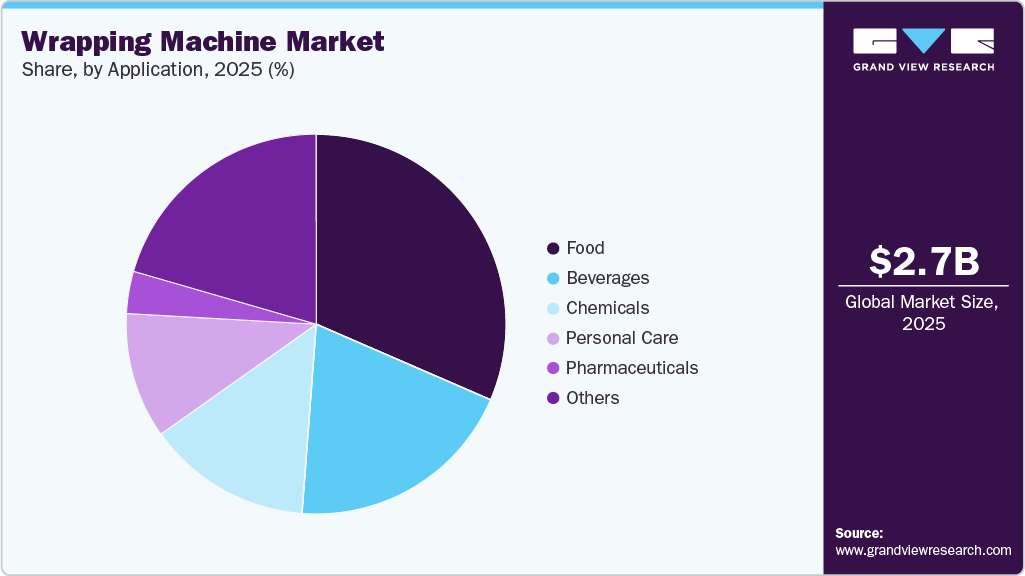
The pharmaceutical segment is projected to grow at the fastest CAGR over the forecast period. The expansion of global pharmaceutical production, rising demand for over-the-counter (OTC) drugs, biologics, and personalized medicines, and the growth of contract manufacturing activities are supporting segment demand. Additionally, stringent packaging and traceability regulations imposed by organizations such as the U.S. Food and Drug Administration (FDA) and the European Medicines Agency (EMA) are encouraging investment in automated and high-precision wrapping systems integrated with serialization, inspection, and quality control technologies.
Regional Insights
Asia Pacific accounts for the largest global market share revenue share of 38.4% in 2025 and is expected to witness strong growth, supported by expanding e-commerce logistics networks and a large food and beverage processing industry. The regional market is increasingly adopting automated stretch hood wrapping systems and down-gauged, high-clarity linear low-density polyethylene (LLDPE) films to support rising export volumes from manufacturing hubs such as China and India. Macro-economic growth drivers include rapid urbanization, ongoing investments in supply chain and warehousing infrastructure, and rising disposable incomes across developing economies. In addition, the region is gradually shifting from polyvinyl chloride (PVC)-based materials toward polyethylene-based alternatives, supported by local production capacity expansions and increasing demand for compact and single-serve retail packaging formats.

China Wrapping Machine Market Trends
The China wrapping machine market accounts for a substantial share of Asia Pacific, supported by large-scale manufacturing activities, rapid industrialization, and expanding e-commerce logistics networks. The country continues to witness strong demand for automatic and semi-automatic wrapping systems across food processing, consumer goods, electronics, and logistics applications. Rising exports and ongoing investments in warehouse automation are accelerating the adoption of high-speed stretch and shrink wrapping technologies.
The India wrapping machine market is projected to grow at a CAGR of 6.6% from 2026 to 2033. The wrapping machine market in India is expected to grow rapidly due to the expansion of the food processing, pharmaceutical, personal care, and retail sectors. The increasing penetration of organized retail and e-commerce platforms is driving demand for secure, cost-efficient packaging solutions across transportation and distribution activities. The market continues to demonstrate significant demand for semi-automatic machinery among small and medium-sized enterprises, while larger manufacturers are increasingly investing in automated systems to improve operational efficiency. Growth in domestic manufacturing activities, infrastructure development, and rising packaged goods consumption further support market expansion.
North America Wrapping Machine Market Trends
North America demonstrates stable market growth, supported by a well-established retail sector, advanced logistics infrastructure, and high levels of packaging automation. Demand for automation-compatible stretch wraps and advanced barrier packaging solutions is increasing across beverage multipacks and ready-to-eat food applications. From a macro-economic perspective, continued e-commerce expansion, fluctuations in petroleum-based resin prices, and relatively high labor costs are encouraging investments in fully automatic wrapping machinery. The region is also witnessing growing adoption of robotic palletization systems, smart sensors, and digital monitoring technologies to improve packaging efficiency and supply chain visibility.
The U.S. wrapping machine market is characterized by high levels of automation adoption, supported by strong demand from the food, beverage, pharmaceutical, and e-commerce sectors. Manufacturers and logistics operators are increasingly investing in fully automatic stretch and shrink wrapping systems to improve throughput, reduce labor dependency, and enhance packaging consistency. Growing warehouse automation, expansion of cold-chain logistics, and rising demand for secondary and tertiary packaging solutions continue to support market growth.
Europe Wrapping Machine Market Trends
The Europe segment represents a mature market characterized by strong emphasis on sustainable and high-performance packaging solutions, particularly across dairy, meat, and poultry applications. Market growth is increasingly influenced by research and development activities focused on circular economy initiatives, including recyclable and material-efficient multi-layer film technologies. Macro-economic conditions in the region are closely linked to stringent European Union regulations on plastics usage, recycling targets, and industrial energy efficiency standards. Manufacturers in the region are also among the early adopters of bio-based and compostable shrink films, as well as energy-efficient wrapping systems, to align with evolving environmental compliance requirements.
The Germany wrapping machine market is one of the most technologically advanced markets in Europe, and is supported by its strong manufacturing base and emphasis on industrial automation. Demand is driven by food processing, pharmaceuticals, automotive components, and industrial exports requiring high-performance and precision packaging systems. The market is increasingly focused on sustainable packaging technologies, including recyclable and bio-based films, in response to stringent European Union environmental regulations. German manufacturers are also investing in Industry 4.0-enabled machinery, integrating smart sensors, robotics, and digital monitoring systems to improve operational efficiency and production flexibility.
The wrapping machine market in Italy plays a significant role in the global market due to its established packaging equipment manufacturing sector and strong export orientation. The country is recognized for producing flexible, customized packaging machinery solutions for food, beverage, personal care, and industrial applications. Demand for compact, energy-efficient, and high-speed wrapping systems continues to increase as manufacturers focus on productivity optimization and sustainable packaging operations.
Latin America Wrapping Machine Market Trends
Latin America is a developing market, supported by agricultural exports, fresh produce transportation, and expanding regional beverage manufacturing activities. Demand for breathable and macro-perforated stretch wraps is increasing for palletized fruits, vegetables, and agricultural products intended for long-distance transportation. Macro-economic recovery trends, infrastructure modernization efforts, and manufacturing investments are contributing to market development. However, the region remains relatively cost-sensitive, resulting in continued demand for semi-automatic machinery and cost-efficient wrapping materials alongside gradual adoption of advanced packaging technologies.
The Brazil wrapping machine market is one of the most prominent in Latin America, supported by strong agricultural exports, beverage production, and the food processing industries. Demand for stretch wrapping systems is increasing for pallet stabilization and transportation of packaged agricultural products and consumer goods. Economic recovery efforts, modernization of logistics infrastructure, and expansion of regional manufacturing operations are contributing to market development. However, cost sensitivity remains an important market characteristic, supporting continued demand for affordable and semi-automatic wrapping machinery solutions alongside the gradual adoption of advanced automation technologies.
Middle East & Africa Wrapping Machine Market Trends
The Middle East & Africa wrapping machine market is steadily expanding, driven by growth in construction materials transport, petrochemical logistics, and organized retail expansion. Demand is increasing for durable tertiary packaging solutions and heavy-gauge stretch hood systems capable of protecting industrial shipments under challenging environmental conditions, including heat and dust exposure. Macro-economic conditions are influenced in part by the presence of major petrochemical producers in countries such as Saudi Arabia, which support regional resin availability and packaging material production. In addition, expanding cold-chain infrastructure and modern retail development are supporting the adoption of advanced food-safe stretch and shrink packaging applications across the region.
The wrapping machine market in Saudi Arabia is emerging in the Middle East, supported by growth in petrochemicals, construction materials, food processing, and organized retail activities. The country benefits from strong regional availability of resin-based raw materials, supporting packaging film production and industrial packaging applications. Demand for heavy-duty stretch hood and shrink wrapping systems is increasing across logistics, industrial transport, and export-oriented sectors. In addition, government-led industrial diversification initiatives and investments in warehousing, cold-chain logistics, and manufacturing infrastructure are contributing to the broader adoption of advanced packaging automation technologies.
Key Wrapping Machine Company Insights
Some of the key players operating in the market include Robopac and Promach, Inc.
-
Robopac is a prominent manufacturer of secondary packaging machinery specializing in stretch wrapping, shrink wrapping, palletizing, and automated end-of-line packaging systems. The company operates as part of the Aetna Group and has established a strong global presence across logistics, food & beverage, consumer goods, and industrial packaging. Its product portfolio includes semi-automatic and fully automatic stretch wrappers, robotic packaging systems, and integrated packaging lines equipped with smart monitoring and film optimization technologies.
-
ProMach, Inc. is a manufacturer of integrated packaging and processing solutions serving industries such as food & beverage, pharmaceuticals, personal care, and household products. The company offers a broad portfolio spanning filling, labeling, coding, conveying, wrapping, case packing, and end-of-line automation systems through its extensive network of specialized product brands. ProMach has strengthened its market position through continuous acquisitions, technology expansion, and geographic growth strategies aimed at enhancing its packaging automation capabilities and service reach.
Key Wrapping Machine Companies:
The following key companies have been profiled for this study on the wrapping machine market.
-
Robopac
-
Pro Mach, Inc.
-
Lantech
-
Pacteon
-
Durapak
-
Matco International
-
Coesia S.p.A
-
Syntegon Technology GmbH
-
Sealed Air
-
IPG
-
UFlex Limited
-
Signode Industrial Group LLC
-
Italdibipack SpA
-
Gruppo Fabbri
-
Chuen An Machinery Co., Ltd
Competitive Benchmarking
Operating Strategies
Competitive Edge
Weaknesses
Mature Players: Lantech, Signode Industrial Group LLC, Robopac
- Focuses on high-value automated packaging systems, continuous R&D investment, strategic acquisitions, and integration of Industry 4.0 technologies across packaging operations.
- Expands through integrated transit packaging solutions, automation-focused product development, and strong after-sales service networks.
- Strong global presence, diversified product portfolio, advanced engineering capabilities, and high R&D intensity.
- Extensive end-of-line packaging portfolio, strong global distribution network, and established industrial customer relationships.
- Premium pricing structure and high system complexity may restrict adoption among smaller manufacturers
- Mature players often face greater exposure to cyclical industrial investment trends and regulatory compliance costs
Emerging Players: Pacteon, Chuen An Machinery Co., Ltd
- Emerging companies primarily compete through cost-effective machinery offerings, customized packaging solutions, regional expansion strategies, and flexible system integration capabilities.
- Focus on serving SMEs and developing markets where demand for affordable semi-automatic and mid-level automation systems remains strong.
- Competitive pricing, faster operational adaptability, and stronger flexibility in addressing application-specific customer requirements support the market positioning of emerging players.
- Their growing presence in developing industrial markets and ability to offer lower-cost automation solutions provide opportunities for market share expansion.
- Emerging players generally possess more limited global distribution and service infrastructure, lower R&D spending capacity, and narrower product portfolios compared to established multinational competitors.
- Lower brand recognition and comparatively limited technological sophistication in advanced automation systems may also restrict penetration into premium industrial applications.
Recent Developments
-
In February 2026, Lantech announced the launch of its new SL400 and SL400LT semi-automatic stretch wrapping systems with autonomous mobile robot (AMR) integration capabilities for automated warehouse environments. The company stated that the solutions are designed to support facilities at different stages of automation adoption while reducing labor dependency, downtime, and shipping damage. The SL400 targets warehouses transitioning from manual operations, whereas the SL400LT is intended for highly automated manufacturing and logistics facilities with optional AMR compatibility. The systems incorporate technologies such as Load Guardian, TurboTak, and Load Seeking Clamp to improve load stability, eliminate loose film tails, and enhance operational efficiency in automation-intensive environments.
-
In September 2025, Signode introduced the Octopus Prestige stretch wrapper, a high-speed automatic wrapping system designed for high-volume industrial packaging operations. The launch focuses on improving throughput, operational reliability, and sustainability through features such as advanced motion control, simplified mechanics, floor-level maintenance access, and the Double-S film carriage system, aimed at reducing film consumption and improving load stability. The machine is positioned as an integrated end-of-line packaging solution for automation-intensive manufacturing and logistics environments, supported by Signode’s Mima stretch film portfolio and global service network.
Wrapping Machine Market Report Scope
Report Attribute
Details
Market size in 2025
USD 2.8 billion
Estimated market size in 2026
USD 2.9 billion
Projected market size by 2033
USD 3.9 billion
Growth Rate
CAGR of 4.7% from 2026 to 2033
Base year for estimation
2025
Historical data
2021 - 2024
Forecast period
2026 - 2033
Quantitative units
Revenue in USD million/billion and CAGR from 2026 to 2033
Report coverage
Revenue forecast, company market position analysis, competitive landscape, growth factors, and trends
Segments covered
Machine type, mode of operation, application, region
Regional scope
North America; Europe; Asia Pacific; Latin America; Middle East & Africa
Country Scope
U.S.; Canada; Mexico; Germany; UK; Italy; Spain; Russia; China; Japan; India; Australia; South Korea; Brazil; Saudi Arabia; UAE
Key companies profiled
Robopac; Pro Mach, Inc.; Lantech; Pacteon; Durapak; Matco International; Coesia S.p.A; Syntegon Technology GmbH; Sealed Air; IPG; UFlex Limited; Signode Industrial Group LLC; Italdibipack SpA; Gruppo Fabbri; Chuen An Machinery Co., Ltd
Customization scope
Free report customization (equivalent up to 8 analysts working days) with purchase. Addition or alteration to country, regional & segment scope.
Pricing and purchase options
Avail customized purchase options to meet your exact research needs. Explore purchase options
Global Wrapping Machine Market Report Segmentation
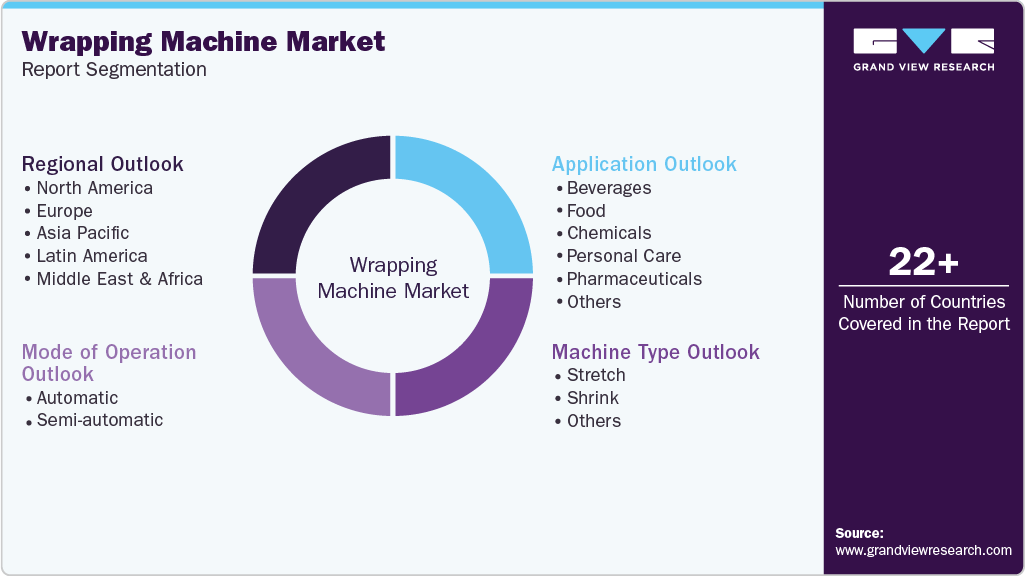
This report forecasts revenue growth at the global, regional & country levels and provides an analysis of the industry trends in each of the sub-segments from 2021 to 2033. For this study, Grand View Research has segmented the global wrapping machine market report based on machine type, mode of operation, application, and region:
-
Machine Type Outlook (Revenue, USD Million, 2021 - 2033)
-
Stretch
-
Shrink
-
Others
-
-
Mode of Operation Outlook (Revenue, USD Million, 2021 - 2033)
-
Automatic
-
Semi-automatic
-
-
Application Outlook (Revenue, USD Million, 2021 - 2033)
-
Beverages
-
Food
-
Chemicals
-
Personal Care
-
Pharmaceuticals
-
Others
-
-
Regional Outlook (Revenue, USD Million, 2021 - 2033)
-
North America
-
U.S.
-
Canada
-
Mexico
-
-
Europe
-
UK
-
Germany
-
Russia
-
Italy
-
Spain
-
-
Asia Pacific
-
Japan
-
China
-
India
-
Australia
-
South Korea
-
-
Latin America
-
Brazil
-
-
Middle East & Africa
-
Saudi Arabia
-
UAE
-
-
Delivered Customizations
This report has been delivered with the following In-depth customizations
Client Request
Customization Delivered
Value Adds
Regional Segmentation
Delivered detailed regional and country-level analysis covering Asia Pacific, Europe, North America, Latin America, and Middle East & Africa, along with key country assessments for the U.S., Germany, Italy, China, India, Brazil, and Saudi Arabia. The analysis incorporated packaging automation trends, logistics expansion, regulatory influence, industrial growth patterns, and adoption trends across wrapping technologies.
Enabled the client to identify high-growth regional markets, evaluate country-specific expansion opportunities, and prioritize investments based on industrial development, packaging demand, and automation adoption potential.
Vendor Landscape
Delivered a comprehensive vendor landscape analysis covering wrapping machinery manufacturers, packaging automation providers, film and resin suppliers, and broader packaging ecosystem participants.
Supported the client in understanding the competitive and value-chain structure of the market, identifying key industry participants, and evaluating potential collaboration, sourcing, and market positioning opportunities.
Opportunity Assessment
Delivered assessment of high-growth opportunities across automatic and semi-automatic machinery, stretch and shrink wrapping technologies, e-commerce logistics, food and beverage packaging, warehouse automation, and sustainable packaging solutions. The study also highlighted opportunities linked to SME automation adoption, emerging manufacturing hubs, and recyclable packaging materials.
Delivered an assessment of high-growth opportunities across automatic and semi-automatic machinery, stretch and shrink wrapping technologies, e-commerce logistics, food and beverage packaging, warehouse automation, and sustainable packaging solutions. The study also highlighted opportunities linked to SME automation adoption, emerging manufacturing hubs, and recyclable packaging materials.
Frequently Asked Questions About This Report
The semi-automatic segment led with a 50.5% revenue share in 2025.
The stretch segment accounted for the largest revenue share of 40.6% in 2025.
Food segment held the largest share (over 31.0%) in 2025, while pharmaceutical is the fastest-growing application.
The global wrapping machine market size was valued at USD 2.8 billion in 2025 and is estimated at USD 2.9 billion for 2026.
The global wrapping machine market is expected to grow at a CAGR of 4.7% from 2026 to 2033, reaching USD 3.9 billion by 2033.
The Asia Pacific wrapping machine market dominated the global revenue share in 2025 accounting for 38.4% of the share, driven by expansion of manufacturing, rapid e-commerce penetration, increasing food and beverage packaging demand, and rising adoption of automated packaging systems across developing economies such as China and India.
Key players include Robopac; Pro Mach, Inc.; Lantech; Pacteon; Durapak; Matco International; Coesia S.p.A; Syntegon Technology GmbH; Sealed Air; IPG; UFlex Limited; Signode Industrial Group LLC; Italdibipack SpA; Gruppo Fabbri; Chuen An Machinery Co., Ltd.
The wrapping machine market is driven by increasing demand for automated packaging solutions, expansion of e-commerce and logistics activities, rising packaged goods consumption, and growing adoption of efficient and sustainable packaging technologies across industrial sectors.
About the Author(s)
Food Safety & Processing Research Team
Consumer Goods · Food Safety & ProcessingThis report was authored by the food safety & processing research team at Grand View Research - comprising two research analysts, one senior research analyst, and one industry expert - with specialized expertise in the food safety & processing segment of the consumer goods industry. All findings are based on proprietary consumer goods databases, executive interviews, and regulatory analysis, subject to internal peer review prior to publication.
Last Updated:
Speak to Analyst

Need a Tailored Report?
Customize this report to your needs — add regions, segments, or data points, with 20% free customization.
Or view our licence options:


ISO 9001:2015 & 27001:2022 Certified
We are GDPR and CCPA compliant! Your transaction & personal information is safe and secure. For more details, please read our privacy policy.












