- Home
- »
- Market Trend Reports
- »
-
Brolucizumab (Beovu) Market Forecast, 2025-2033: Competitive Positioning & Post-Patent Strategies In Ophthalmology
![Global Brolucizumab (Beovu) Market Forecast, 2025-2033: Competitive Positioning And Post-Patent Strategies In OphthalmologyReport]()
Global Brolucizumab (Beovu) Market Forecast, 2025-2033: Competitive Positioning And Post-Patent Strategies In Ophthalmology
- Published: Nov, 2025
- Report ID: GVR-MT-100502
- Format: PDF/Excel databook
- No. of Pages/Datapoints: 120
- Report Coverage: 2024 - 2030
Report Overview
Brolucizumab (Beovu) Market represents a key segment within the retinal disease treatment landscape, primarily addressing neovascular (wet) age-related macular degeneration (nAMD) and diabetic macular edema (DME). Developed by Novartis, Beovu is a humanized single-chain antibody fragment (scFv) targeting vascular endothelial growth factor (VEGF), offering high molar concentration and durable efficacy with fewer injections compared to other anti-VEGF agents. The market is influenced by rising prevalence of retinal disorders, increasing geriatric population, and technological advancements in biologics. However, safety concerns related to intraocular inflammation and retinal vasculitis have impacted adoption in some regions. Patent protection extends until 2031, delaying biosimilar entry and maintaining Novartis’ exclusivity. Growing clinical evidence, real-world data supporting dosing flexibility, and expanding label indications are strengthening the product’s therapeutic positioning. Strategic focus on ophthalmology pipeline innovation and post-marketing surveillance continues to define the competitive landscape.
Key Report Deliverables
-
Analyze the Brolucizumab (Beovu) market landscape, detailing the current market size, growth drivers, and key industry trends, particularly in light of the upcoming patent expiration and the impact of biosimilars entering the market.
-
Forecast Market Growth, projecting future trends for the Brolucizumab (Beovu) market, highlighting emerging opportunities within the biosimilar space, and assessing potential risks to growth as competition increases following patent expiry.
-
Identify Regulatory and Market Barriers, providing insights into regulatory and market barriers that could impact future market expansion and product development, with a specific focus on the challenges biosimilars may face in gaining approval and market access.
-
Concurrent Competitive Landscape, identifying key players in the Brolucizumab (Beovu) market, including both originator and biosimilar manufacturers. Examine their strategic moves, partnerships, and distribution of market share to understand competitive positioning and potential shifts as biosimilars are introduced.
-
Regulatory Barriers, identifying key regulatory challenges related to the entry of Brolucizumab (Beovu) biosimilars, including approval processes and market access restrictions, and assessing their potential impact on the speed and scope of market expansion.
-
Strategic Implications, evaluating strategic moves for manufacturer and its competitors to maintain leadership in the market. This includes exploring innovation, differentiation, potential patient support programs, and geographic expansion strategies.
Current Market Scenarios and Sales Performance
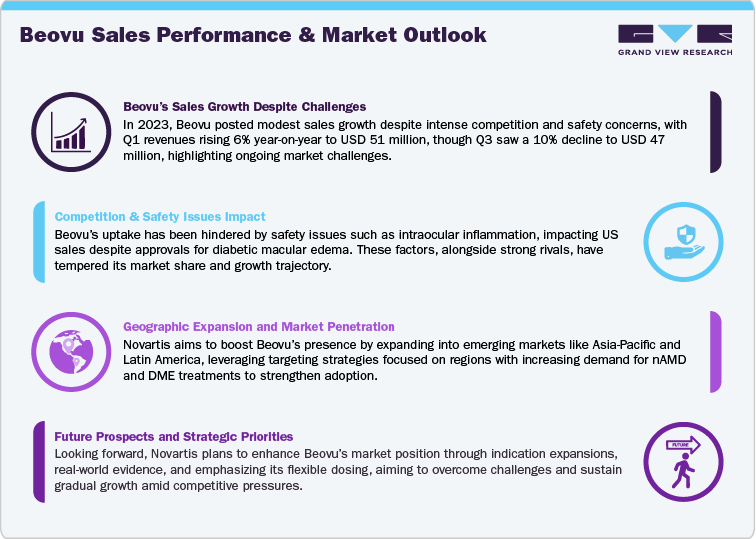
Beovu (brolucizumab) remains a key player in the treatment of neovascular age-related macular degeneration (nAMD) and diabetic macular edema (DME), with its extended dosing intervals and strong visual outcomes contributing to its ongoing relevance in the retinal biologics market. However, its growth has been tempered by safety concerns, particularly related to intraocular inflammation and retinal vasculitis, which have impacted adoption in some regions, notably the US. Despite these challenges, Beovu’s performance has been steady in certain markets like Europe, Japan, and Emerging Markets, where it continues to show growth following the approval for DME.
In 2023, Beovu's sales performance was modestly contributing to Novartis' overall growth, with USD 51 million in sales in Q1, reflecting a 6% year-on-year increase, while Q3 2023 saw a decline to USD 47 million, representing a 10% drop from the previous year. This decline underscores the product's struggles amid competitive pressure and safety-related issues. For the full year, global sales are estimated to range between USD 200 million and USD 300 million.
In 2022, Beovu generated USD 200 million, driven by 9% growth in markets outside the US, where sales were impacted by safety concerns. The launch of Beovu for DME in both the US and EU in 2022 provided a boost, though the product’s performance was still affected by the ongoing safety updates. Despite these challenges, Beovu’s extended dosing flexibility continues to differentiate it from competitors like Aflibercept and Ranibizumab.
Looking ahead to 2024, Beovu’s future remains uncertain, with competition intensifying, especially as biosimilars of Eylea (aflibercept) emerge. However, Novartis is focused on global expansion and indication diversification, including potential approvals for Diabetic Retinopathy (DR) and Retinal Vein Occlusion (RVO), which could provide significant growth opportunities. The Asia-Pacific region is expected to drive growth, supported by expanding healthcare infrastructure and increasing patient pools.
Beovu’s strategy will emphasize real-world evidence generation, patient adherence optimization, and digital integration to strengthen its market position and differentiate it from competitors. Although Beovu faces pressure from safety concerns and intense competition, its long-acting therapy and innovative dosing regimen offer significant potential for continued market relevance in 2024 and beyond.
Patent Landscape and Exclusivity Outlook
The patent landscape for Brolucizumab (Beovu) reflects a strategically layered protection framework, ensuring sustained market exclusivity for Novartis in the global ophthalmology segment. The core U.S. composition patent, US 8349322 B2, covering stable and soluble antibodies inhibiting VEGF, remains valid until June 2029, inclusive of patent-term extensions. Complementary filings across key regions such as the European Union, Japan, and Canada reinforce protection through secondary patents addressing formulation optimization, manufacturing processes, and dosing regimens, extending effective exclusivity into the early 2031s.
From an exclusivity standpoint, Brolucizumab benefits from a combination of biologic data exclusivity and patent protection, creating a strong entry barrier for potential biosimilar developers. As of 2025, no biosimilar or interchangeable product has been disclosed or approved globally, underscoring the molecule’s technological complexity and high development threshold. The earliest potential biosimilar entry is projected around 2031 or later, contingent upon successful patent challenges or accelerated regulatory pathways.
This extended exclusivity period allows Novartis to maintain pricing power, brand equity, and market leadership in the retinal biologics segment. The company’s focus on lifecycle management, including indication expansion and real-world data integration, further consolidates Beovu’s position against competitive anti-VEGF therapies. The patent and exclusivity outlook thus supports a stable mid-term revenue stream and a measured transition strategy toward next-generation ophthalmic innovations.
Market Dynamics
“Rising Prevalence of Retinal Disorders and Advancements in Biologic Therapies”
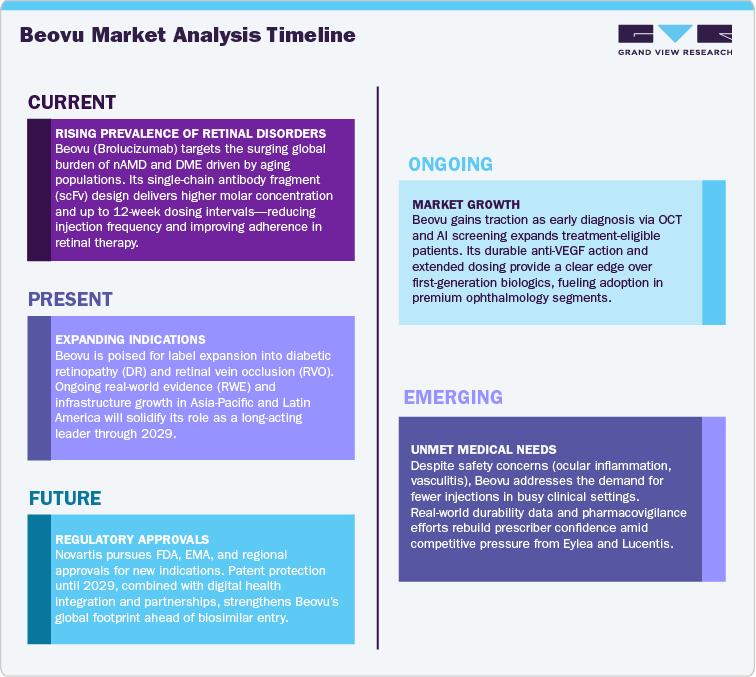
The primary growth driver for the Brolucizumab (Beovu) market is the increasing global incidence of retinal disorders, particularly neovascular age-related macular degeneration (nAMD) and diabetic macular edema (DME). As the aging population expands, the burden of these sight-threatening conditions continues to grow, creating a consistent demand for effective and durable anti-VEGF therapies. Beovu’s unique molecular design as a single-chain antibody fragment (scFv) enables higher drug concentration and extended dosing intervals, offering a significant clinical advantage over earlier-generation biologics. Physicians and patients increasingly favor longer-acting treatments that reduce injection frequency, improving treatment adherence and quality of life. Advancements in ophthalmic diagnostics, such as optical coherence tomography (OCT) and AI-assisted screening, are leading to earlier disease detection and expanded treatment initiation rates. Together, these factors are fueling sustained market momentum and enhancing Beovu’s positioning as a next-generation retinal therapy.
“Safety Concerns and Competitive Pressure from Established Anti-VEGF Agents”
A key restraint influencing the growth of the Beovu market is the impact of post-marketing safety concerns related to ocular inflammation and retinal vasculitis. Although regulatory authorities and Novartis have implemented extensive pharmacovigilance measures, early safety alerts temporarily reduced physician confidence and slowed adoption in certain regions. The presence of strong incumbents such as Aflibercept (Eylea) and Ranibizumab (Lucentis) has further intensified competition, as these agents have long-established safety profiles and well-integrated reimbursement frameworks.
In addition, pricing pressures, reimbursement variability, and budget limitations across healthcare systems restrict broader access to premium biologics in cost-sensitive markets. These factors collectively pose challenges to market expansion, requiring targeted education, ongoing clinical transparency, and value-based access strategies to reinforce prescriber trust and competitive positioning.
“Indication Expansion, Real-World Validation, and Geographic Growth Potential”
The Brolucizumab market presents substantial opportunities driven by pipeline diversification, real-world data generation, and regional expansion. Novartis is actively pursuing new indication approvals, including diabetic retinopathy (DR) and retinal vein occlusion (RVO), which are expected to significantly expand the therapy’s addressable patient base. Ongoing real-world evidence (RWE) studies continue to demonstrate Beovu’s durability and clinical effectiveness, supporting its differentiation within the competitive anti-VEGF segment.
In parallel, emerging markets in Asia-Pacific and Latin America are experiencing rapid growth in ophthalmic care infrastructure, opening avenues for deeper market penetration and early adoption. The drug’s patent protection until 2029 provides Novartis a strategic window to strengthen market leadership through lifecycle management initiatives, collaborative partnerships, and digital patient engagement programs. This combination of geographic diversification, clinical validation, and portfolio synergy positions Beovu for long-term value creation and resilience ahead of biosimilar competition.
“Shift Toward Extended-Dosing and Long-Acting Anti-VEGF Therapies, Increasing Emphasis on Real-World Evidence and Post-Marketing Surveillance, Expansion of Ophthalmology Infrastructure and Digital Health Integration are contributing to the market”
- Shift Toward Extended-Dosing and Long-Acting Anti-VEGF Therapies
A major trend shaping the Brolucizumab (Beovu) market is the industry-wide transition toward extended-dosing regimens and long-acting anti-VEGF formulations. Physicians and patients increasingly prefer therapies that reduce the frequency of intravitreal injections while maintaining consistent visual outcomes. Beovu’s high molar concentration and scFv molecular design allow dosing intervals of up to 12 weeks, aligning with this shift toward treatment convenience and improved patient compliance. This trend is further reinforced by advancements in drug delivery platforms, such as sustained-release implants and biopolymer-based systems, which aim to minimize treatment burden. As healthcare systems emphasize patient-centered care and resource efficiency, Beovu’s dosing flexibility continues to position it as a competitive solution within evolving treatment paradigms.
- Increasing Emphasis on Real-World Evidence and Post-Marketing Surveillance
The growing focus on real-world data (RWD) and post-marketing safety validation has become a critical determinant of long-term product success in the ophthalmology biologics market. Following initial safety concerns related to Beovu, Novartis has intensified pharmacovigilance programs and observational studies to monitor adverse event trends and reinforce clinical confidence. Regulators and payers are increasingly prioritizing evidence-based outcomes, requiring continuous real-world data to support reimbursement and formulary inclusion. These studies not only strengthen prescriber confidence but also help refine dosing protocols, optimize patient selection criteria, and guide label expansions. As real-world validation continues to demonstrate Beovu’s therapeutic durability and efficacy, it is emerging as an important differentiator for maintaining market relevance in a competitive landscape.
- Expansion of Ophthalmology Infrastructure and Digital Health Integration
Global investment in ophthalmic care infrastructure and the integration of digital health technologies are transforming treatment delivery models across major and emerging markets. Rapid growth in retinal screening programs, AI-driven diagnostics, and teleophthalmology platforms is improving early disease detection and expanding patient access to biologic treatments such as Beovu. In high-growth regions like Asia-Pacific and Latin America, increased government funding and private-sector participation are strengthening specialty care networks and accelerating biologic adoption. Concurrently, digital monitoring tools are enabling personalized treatment planning, allowing clinicians to track disease progression and therapeutic response more effectively. This convergence of infrastructure growth and digital integration is creating a conducive environment for Beovu’s market expansion and reinforcing Novartis’s ability to deliver data-driven, patient-centric ophthalmic care.
Overview of Alternative Therapeutics
The alternative therapeutics landscape for retinal diseases is evolving rapidly, characterized by a mix of established anti-VEGF agents, emerging biologics, and next-generation delivery platforms aimed at improving durability, safety, and patient convenience. Within this competitive framework, Brolucizumab (Beovu) faces sustained competition from Aflibercept (Eylea), Ranibizumab (Lucentis), and newer entrants such as Faricimab (Vabysmo) and Abicipar Pegol, each offering distinct clinical and pharmacological advantages.
Aflibercept (Eylea), developed by Regeneron and Bayer, continues to dominate the segment due to its established efficacy and safety profile in treating nAMD, DME, and retinal vein occlusion. Its extended-dosing formulation, Eylea HD (8 mg), approved in select markets, enables longer treatment intervals of up to 16 weeks, further strengthening its competitive positioning. Ranibizumab (Lucentis), developed by Genentech and Novartis, remains a key therapy due to its long-standing clinical validation and widespread reimbursement support, though its market share is gradually eroding in favor of newer biologics with improved durability profiles.
The introduction of Faricimab (Vabysmo) by Roche/Genentech marks a significant advancement in retinal therapy. As the first bispecific antibody targeting both VEGF-A and Angiopoietin-2 (Ang-2), it demonstrates enhanced vascular stability and reduced injection frequency, setting a new benchmark for dual-pathway inhibition. Faricimab’s successful adoption is reshaping physician preferences toward biologics that offer multi-mechanistic efficacy and extended treatment intervals.
In addition to biologics, gene therapy and sustained-release technologies are emerging as transformative alternatives. Programs under development by companies such as Adverum Biotechnologies and Regenxbio aim to deliver long-term intraocular VEGF suppression through single-dose gene therapy, potentially eliminating the need for repeated injections. Meanwhile, port delivery systems and biodegradable implants are being explored to further extend dosing intervals and enhance patient compliance.
Overall, the market for retinal therapeutics is shifting toward long-acting, multi-targeted, and less invasive solutions. Beovu maintains its relevance through high molar potency and flexible dosing, but continued innovation in dual-action biologics, gene-based therapies, and advanced delivery mechanisms will define the next phase of competition. Companies that effectively balance efficacy, safety, and dosing convenience are poised to capture the evolving demand in this rapidly transforming therapeutic area.
Competitive Landscape
The competitive landscape for Brolucizumab (Beovu) is shaped by intense innovation, clinical differentiation, and the dominance of a few global leaders in the retinal biologics market. Market positioning increasingly depends on dosing durability, safety outcomes, and treatment convenience, as physicians and healthcare systems prioritize long-acting anti-VEGF therapies that improve patient adherence and clinical efficiency.
Novartis continues to strengthen Beovu’s profile as a high-potency, long-duration treatment for neovascular age-related macular degeneration (nAMD) and diabetic macular edema (DME). The company’s strategy focuses on real-world evidence generation, safety surveillance, and lifecycle management initiatives to reinforce physician trust and sustain adoption. Key areas of investment include indication expansion, digital patient monitoring, and data-driven clinical support programs designed to enhance Beovu’s competitive resilience during its exclusivity period.
Regeneron and Bayer maintain a leading position through Aflibercept (Eylea), supported by a strong safety record, broad global reimbursement access, and growing uptake of Eylea HD (8 mg) for extended dosing intervals up to 16 weeks. Their strategic emphasis on formulation innovation, clinical consistency, and market penetration across both developed and emerging regions continues to secure category leadership.
Roche/Genentech has redefined the competitive environment with Faricimab (Vabysmo), a bispecific antibody targeting VEGF-A and Angiopoietin-2 (Ang-2). Its dual-pathway mechanism, proven durability, and favorable safety outcomes are rapidly shifting ophthalmology practice patterns toward multi-targeted biologics, capturing strong early adoption in key markets such as the United States and Japan.
Emerging companies including Kodiak Sciences, Regenxbio, and Outlook Therapeutics are advancing sustained-release technologies, gene therapy platforms, and non-injectable delivery systems that promise longer disease control and reduced treatment frequency. These innovations, along with upcoming biosimilar competition expected after 2029, are set to transform the market’s competitive structure.
Overall, the Beovu market operates in a highly innovation-driven environment, where success depends on durability, differentiation, and digital integration. Companies that effectively align clinical evidence, pricing strategy, and patient engagement will define the next phase of growth in the global ophthalmology therapeutics landscape.

Regional Analysis
North America Brolucizumab (Beovu) Market
North America remains the most established and commercially significant market for Brolucizumab (Beovu), driven by advanced healthcare infrastructure, high disease awareness, and early adoption of biologic therapies for neovascular age-related macular degeneration (nAMD) and diabetic macular edema (DME). The United States dominates regional revenues, supported by a large base of retina specialists, extensive use of optical coherence tomography (OCT) for disease monitoring, and a well-developed reimbursement framework under both public and private insurance. The presence of leading pharmaceutical companies, academic research centers, and active real-world evidence (RWE) programs has reinforced Beovu’s market credibility. However, competition remains intense from Eylea and Vabysmo, which benefit from established physician familiarity and broader payer acceptance. Future growth will be driven by long-acting formulations, AI-assisted patient management, and increased integration of digital ophthalmology solutions across major clinical networks.
Europe Brolucizumab (Beovu) Market
The European market for Beovu demonstrates a complex yet steadily expanding landscape characterized by diverse reimbursement systems, strict cost-effectiveness evaluations, and national healthcare prioritization policies. Western Europe, led by Germany, the U.K., and France, has shown consistent uptake due to established ophthalmic care infrastructure and structured patient management programs. Central and Eastern European countries are witnessing increasing adoption as healthcare investments rise and anti-VEGF access improves. However, variability in reimbursement decisions, reliance on health technology assessments (HTA), and sensitivity to drug pricing influence regional performance. Safety concerns that emerged early in Beovu’s lifecycle initially limited prescriber confidence but have been gradually mitigated through ongoing post-marketing surveillance and transparent communication with regulatory bodies. Long-term growth in Europe will depend on real-world outcome data, hospital procurement strategies, and integration into national treatment guidelines.
Asia Pacific Brolucizumab (Beovu) Market
The Asia-Pacific region represents the fastest-growing market for Beovu, fueled by rising prevalence of diabetic retinopathy, rapid urbanization, and improved access to ophthalmic diagnostics. Countries such as Japan, China, India, South Korea, and Australia are driving expansion through enhanced healthcare investments and increasing patient awareness of early retinal disease management. Japan remains a key market due to its advanced diagnostic ecosystem and favorable reimbursement conditions. In contrast, emerging economies such as India and Indonesia face challenges related to out-of-pocket healthcare spending, limited specialist density, and uneven biologic affordability. Market entry in Asia-Pacific is increasingly supported by public–private partnerships, tiered pricing strategies, and localized patient access programs. The region also presents strong opportunities for collaborative research and manufacturing localization, which can enhance market penetration and long-term sustainability.
Latin America Brolucizumab (Beovu) Market
Latin America is evolving into a promising secondary growth region for Beovu, supported by increasing recognition of retinal diseases as a key cause of visual impairment and gradual improvements in ophthalmic care infrastructure. Brazil, Mexico, Argentina, and Chile are among the largest markets, with growing networks of retina specialists and access to biologic therapies through private insurance and select public-sector initiatives. However, the region faces challenges such as uneven reimbursement coverage, economic volatility, and fragmented healthcare systems, which limit rapid adoption. High treatment costs often lead to preference for older, lower-cost anti-VEGF agents or off-label alternatives. To strengthen presence, Novartis and regional distributors are focusing on targeted physician education, clinical partnerships, and patient assistance programs that increase affordability and expand treatment availability beyond major urban centers.
Middle East and Africa Brolucizumab (Beovu) Market
The Middle East and Africa (MEA) region remains underpenetrated but strategically important for long-term expansion of Beovu. Market activity is concentrated in wealthier Gulf Cooperation Council (GCC) countries such as Saudi Arabia, the United Arab Emirates, and Qatar, where high investment in healthcare infrastructure and specialist training supports biologic adoption. North African nations, including Egypt and Morocco, present growing demand as ophthalmic awareness and screening initiatives expand. However, across much of Sub-Saharan Africa, access remains limited due to shortages of retina specialists, restricted public funding, and import dependency for advanced biologics. Companies operating in this region are focusing on capacity-building initiatives, training collaborations, and strategic partnerships with local distributors and government agencies to establish early market presence. Over the next decade, rising chronic disease burden and healthcare modernization are expected to gradually improve market viability, making MEA a potential frontier for future ophthalmology growth.
Analyst Perspective
The Brolucizumab (Beovu) market is positioned for sustained stabilization and strategic growth, driven by expanding real-world validation and geographic diversification. To strengthen competitive positioning, Novartis should continue reinforcing physician confidence through active post-marketing surveillance, transparent safety communication, and robust real-world data dissemination. The company must capitalize on its patent exclusivity until 2029 by accelerating indication expansion, executing a disciplined lifecycle management plan, and maximizing revenue potential ahead of biosimilar entry. Clinically, Beovu’s high molar potency and extended dosing profile should be leveraged as clear differentiators to sustain share retention against Eylea and Vabysmo, both of which dominate mature markets. Expansion in Asia-Pacific and Latin America remains a priority, supported by adaptive pricing models, strategic partnerships, and access programs to enhance affordability and patient reach. Continued investment in next-generation ophthalmic innovation, particularly sustained-release delivery systems and AI-driven disease management solutions, will be essential for maintaining long-term relevance and ensuring Novartis’s leadership in the evolving retinal biologics segment.
PROJECT OBJECTIVE
To evaluate the potential revenue, price, and patient access implications of Keytruda’s 2028 patent cliff, incorporating biosimilar entry dynamics, country-specific adoption curves, and Merck’s lifecycle defense strategies (remarkably the subcutaneous formulation). The goal was to provide the client with a transparent, scenario-based model to anticipate outcomes and inform strategy.
GVR SOLUTION
-
Built a bottom-up commodity-flow and analogue-based model, anchored on Merck’s $29.5B Keytruda sales in 2024.
-
Integrated jurisdictional LOE timelines (EU mid-2028, U.S. 2028–2029 pending litigation outcomes).
-
Modeled biosimilar adoption S-curves calibrated to oncology antibody analogues (EU faster via tenders, U.S. slower via contracting).
-
Applied price-erosion benchmarks (EU −15–30% Yr-1, deepening to −45–60% by Yr-3; U.S. −10–25% net decline over same horizon). •Layered lifecycle defenses (SC uptake assumptions of 25–40% of innovator units, combo refresh, contracting) to quantify buffers.
-
Delivered outputs as a dynamic Excel scenario tool and a management-ready PPT deck with revenue bridges, sensitivity tornadoes, and SC migration visuals.
IMPACT FOR CLIENT
-
Enabled the client to quantify downside vs. defense-optimized revenue trajectories:
-
Base case: 30–40% global revenue decline by Year-3 post-LOE.
-
Downside: 45–55% decline in tender-heavy markets.
-
Defense-optimized: Contained erosion to ~−20–25% with strong SC adoption.
-
-
Gave the client a clear view of which markets drive early erosion (EU) and where strategic contracting or SC migration can preserve share (U.S.).
-
Equipped decision-makers with a playbook of watch-points (tender concentration, litigation outcomes, SC IP coverage, combo pipeline) to guide commercial strategy. •Provided a transparent methodology that could be presented to boards/investors with evidence-backed assumptions
WHY THIS MATTERS
-
Keytruda is the world’s best-selling cancer drug, representing nearly one-third of Merck’s revenue.
-
Patent expiry will reshape both Merck’s earnings profile and global oncology access dynamics.
-
Payers and governments stand to benefit from biosimilar entry through lower costs, but manufacturers need to manage cliff risk while capturing upside from lifecycle innovations.
-
Understanding how quickly revenueserode and how patient access expands post-biosimilar is critical for:
-
Biopharma companies (strategic planning, pipeline prioritization).
-
Investors (valuing Merck’s cash flows beyond 2028).
-
Payers and policymakers (budgeting for oncology drug spend).
-
-
A robust patent cliff model helps clients navigate the dual challenge of price erosion and patient expansion, ensuring strategies are grounded in real-world benchmarks.
![gvr icn]()
GET A FREE SAMPLE
![gvr icn]()
This FREE sample includes market data points, ranging from trend analyses to market estimates & forecasts. See for yourself.
![gvr icn]()
NEED A CUSTOM REPORT?
We can customize every report - free of charge - including purchasing stand-alone sections or country-level reports, as well as offer affordable discounts for start-ups & universities.
Contact us now to get our best pricing.
![esomar icon]()
ESOMAR certified & member
![ISO]()
ISO Certified
We are GDPR and CCPA compliant! Your transaction & personal information is safe and secure. For more details, please read our privacy policy.





We are committed towards customer satisfaction, and quality service.
Client Testimonials

"The quality of research they have done for us has been excellent..."
ISO Certified