- Home
- »
- Market Trend Reports
- »
-
Darolutamide (Nubeqa) Market: Anticipating The Patent Cliff And Evolving Market Dynamics
![Darolutamide (Nubeqa) Market: Anticipating The Patent Cliff And Evolving Market DynamicsReport]()
Darolutamide (Nubeqa) Market: Anticipating The Patent Cliff And Evolving Market Dynamics
- Published: Oct, 2025
- Report ID: GVR-MT-100447
- Format: PDF/Excel databook
- No. of Pages/Datapoints: 120
- Report Coverage: 2024 - 2030
Report Overview
Darolutamide (Nubeqa) and Enzalutamide (Xtandi) are androgen receptor inhibitors in prostate cancer treatment. Darolutamide, developed by Bayer and Orion, is protected by U.S. patents with generic entry estimated in 2038. It is approved in over 80 markets globally and is under regulatory review for expanded indications, including combination with androgen deprivation therapy for metastatic hormone-sensitive prostate cancer. Enzalutamide, co-marketed by Pfizer and Astellas, faces patent expirations in 2026 (Europe) and 2027 (U.S.), presenting generic and biosimilar competition. Despite this, it remains a leading treatment, approved in over 70 countries, with ongoing clinical trials exploring use in earlier stages of prostate cancer. Both drugs’ market positions will be influenced by patent timelines, regulatory developments, and competitive dynamics in the prostate cancer therapeutic landscape.
Key Report Deliverables
-
A comprehensive analysis of the Darolutamide (Nubeqa) and Enzalutamide (Xtandi) market landscape, covering revenue size, prostate cancer growth drivers, global adoption trends, and the evolving competitive context shaping the androgen receptor inhibitor therapeutic segment.
-
Forecasts evaluating post-patent market trajectories, including expected generic and biosimilar entry timelines across key regions, and the projected impact on revenue streams, pricing dynamics, and market access in prostate cancer treatments.
-
Identification of regulatory and market barriers affecting generic and biosimilar penetration, including approval complexities, interchangeability requirements, pricing and reimbursement policies, and payer-driven access restrictions in major geographies worldwide.
-
Comprehensive competitive landscape overview, highlighting direct rivals in androgen receptor inhibition (e.g., other next-generation AR inhibitors), emerging pipeline candidates, combination therapies, and the innovation strategies shaping the prostate cancer treatment ecosystem.
-
Strategic implications for Bayer, Orion, Pfizer, Astellas, and other competitors, focusing on lifecycle management, novel formulations, expanded indications, clinical development pipelines, pricing strategies, and regional positioning to sustain leadership in the market amid patent expirations and increasing competition.
Current Market Scenarios
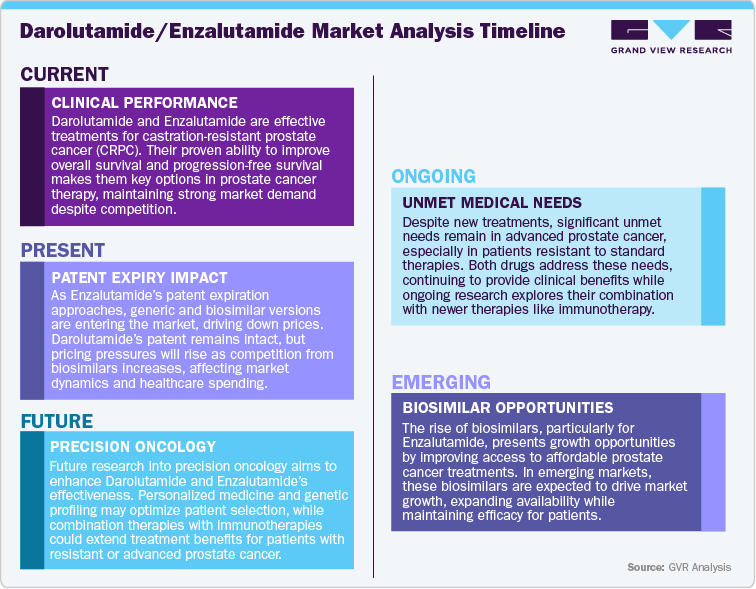
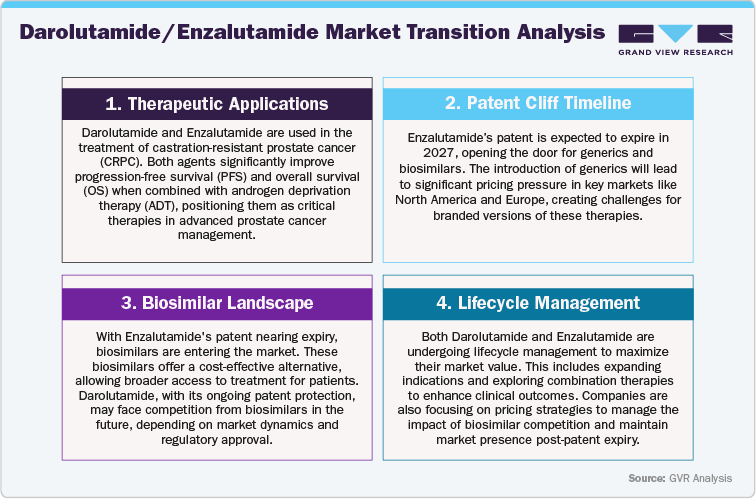
Darolutamide (Nubeqa) enjoys strong patent protection and regulatory exclusivities across major markets, with U.S. patents expected to provide exclusivity until 2032-2038, allowing a prolonged period of market dominance before generic entry. Enzalutamide (Xtandi), on the other hand, faces imminent patent expirations in 2027 (U.S.) and 2026 (Europe), opening the door for generic and biosimilar competition. Regional variations in patent timelines create uneven market exposure, influencing pricing dynamics and competitive positioning across key geographies.
In Europe, where cost-sensitive healthcare systems prevail, generic adoption is expected to be rapid, creating significant downward pricing pressure. China and India are preparing for earlier generic launches, aided by supportive government initiatives aimed at increasing treatment affordability, while Japan, despite a high-value market, may experience delayed generic penetration due to stringent regulatory scrutiny and slower clinical adoption. These regional differences set the stage for varied competitive landscapes and market-specific strategies.
Despite impending patent expirations, demand for both therapies remains robust, driven by expanded indications, combination regimens, and updated treatment guidelines in prostate cancer management. Ongoing clinical innovation, real-world evidence, and potential novel formulations continue to support growth. Overall, the global androgen receptor inhibitor market is projected to expand, with Darolutamide and Enzalutamide maintaining central roles, even amid generic competition, pricing pressures, and evolving market access challenges.
Market Dynamics
Growing Demand for Androgen Receptor Inhibitors:
The global rise in prostate cancer prevalence, combined with expanding approvals for androgen receptor inhibitors, drives strong demand for Darolutamide (Nubeqa) and Enzalutamide (Xtandi). Both therapies are established standards for non-metastatic and metastatic castration-resistant prostate cancer, as well as metastatic hormone-sensitive prostate cancer, reflecting their clinical value. Increasing adoption in earlier-stage disease management, along with combination therapy strategies, reinforces their central role and supports sustained market demand worldwide.
Pricing and Market Erosion Post-Patent:
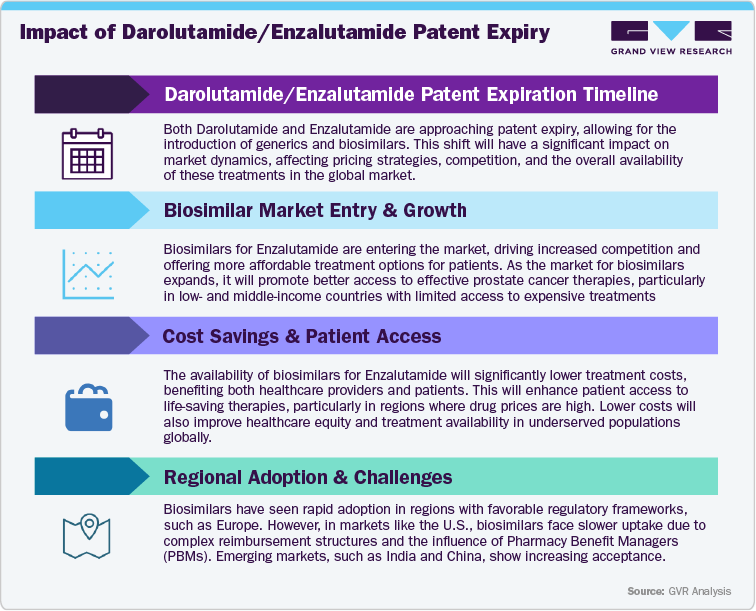
Upcoming patent expirations will expose the market to generic and biosimilar competition, introducing significant downward pricing pressure. While generics may initially face clinical adoption barriers, payers and governments will increasingly prioritize cost-effective alternatives. This trend is expected to accelerate in Europe, India, and China, reshaping competitive dynamics and eroding the exclusivity advantage of originator products like Darolutamide and Enzalutamide.
Opportunities in Lifecycle Management and Regional Divergence:
Manufacturers are actively defending market positions through expanded indications, novel formulations, and combination therapy regimens. Pipeline innovations, including next-generation androgen receptor inhibitors, provide additional avenues for growth. Post-patent impacts will vary regionally: mature markets like the U.S., Europe, and Japan may experience slower generic uptake due to regulatory scrutiny and cautious physician adoption, whereas emerging markets such as China, India, and Latin America are likely to see faster transitions driven by affordability initiatives, government incentives, and cost-conscious healthcare policies.
The Pressure of Pricing and Market Erosion Post-Patent
The expiration of Darolutamide and Enzalutamide patents will trigger intensified competition from generic and biosimilar androgen receptor inhibitors, significantly affecting pricing dynamics and market share in prostate cancer treatment. In the post-patent environment, downward pricing pressure is inevitable, especially in price-sensitive markets where payers prioritize cost-effective therapies. As lower-cost alternatives become available, the market share of originator products may decline, with patients and providers increasingly considering generics. However, initial adoption may be cautious due to concerns about clinical comparability, efficacy, and therapeutic outcomes.
The regulatory approval process will influence the pace of generic and biosimilar entry. In mature markets such as the U.S., Europe, and Japan, strict regulatory and clinical requirements may delay widespread uptake, although competition will intensify once approvals are granted. In contrast, China, India, and Latin America are likely to see earlier market entry driven by favorable regulatory pathways, domestic manufacturing activity, and government incentives, resulting in faster pricing erosion and shifts in market share.
The entry of generics will also raise clinical confidence concerns, as oncologists may be cautious about switching patients solely based on price, especially for critical therapies in advanced prostate cancer management. Nevertheless, payer policies, tender systems, and cost-containment measures will accelerate adoption. Over time, pricing normalization will compel originator companies to focus on innovation, lifecycle management, and patient-centric value propositions to sustain competitive advantage.
Innovating Beyond the Patent - Unlocking Future Growth Paths
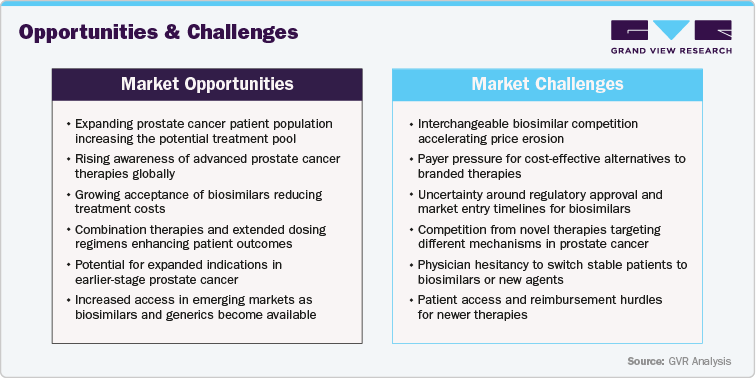
Despite the inevitable generic and biosimilar competition following Darolutamide and Enzalutamide patent expirations, the prostate cancer market continues to offer meaningful growth opportunities. A key avenue lies in the development of next-generation formulations and novel delivery approaches, which can improve patient convenience, adherence, and expand adoption. Ongoing research into combination regimens, pairing androgen receptor inhibitors with other hormonal therapies, chemotherapy, or novel targeted agents, provides differentiated market positioning and reinforces the role of these therapies in multi-modal prostate cancer management.
Innovation will be crucial in maintaining clinical relevance amid pricing pressures. Manufacturers are advancing new androgen receptor-targeted therapy assets and exploring enhanced formulations that extend leadership beyond current offerings. Additionally, the rise of generics and biosimilars may create market access opportunities in emerging economies, where affordability has historically limited uptake. Strategic partnerships or authorized biosimilars could help expand treatment access while maintaining brand presence.
Another important growth driver is the expansion into emerging markets with rising prostate cancer prevalence and improving healthcare infrastructure. Countries across Asia, Latin America, and Africa are experiencing growing demand for effective therapies. As healthcare systems strengthen, emphasis on cost-effective treatment options will increase. Ensuring the availability of both branded and affordable alternatives will support broader patient access and sustain the strategic relevance of Darolutamide and Enzalutamide in the global prostate cancer treatment landscape.
Shaping the Future - Generics, Patient-Centric Models, and Regional Shifts
-
Shift Towards Patient-Centric Prostate Cancer Treatments
There is a growing emphasis on patient-centric therapies in prostate cancer, focusing on convenience, adherence, quality of life, and long-term disease management. Innovations such as novel formulations, optimized dosing schedules, and combination regimens enhance therapy personalization. These approaches address diverse patient needs, reinforcing the clinical relevance of Darolutamide and Enzalutamide, even in the face of generic and biosimilar competition.
-
Adoption of Value-Based Healthcare Models
The global transition toward value-based healthcare is accelerating, with cost-effectiveness and measurable patient outcomes guiding treatment decisions. This model will encourage the adoption of generic and biosimilar androgen receptor inhibitors, particularly in price-sensitive markets where healthcare budgets are constrained. Payers and providers will increasingly prioritize therapies that maintain clinical efficacy while delivering cost savings, reshaping competitive dynamics for Darolutamide, Enzalutamide, and their emerging alternatives.
-
Regional Divergence in Competitive Dynamics
Following patent expirations, regional variations will strongly influence market adoption trends. In mature markets such as the U.S., Europe, and Japan, generic uptake may progress more slowly due to regulatory scrutiny and physician caution. In contrast, emerging markets like China, India, and Latin America are likely to transition faster, driven by affordability pressures, supportive government policies, and streamlined approval processes for generics and biosimilars, creating distinct regional competitive landscapes.
Overview of Alternative Therapeutics
Darolutamide and Enzalutamide face competition from other androgen receptor inhibitors and emerging therapies in prostate cancer, including apalutamide, bicalutamide, and novel next-generation AR-targeting agents. These competitors are expanding their indications, treatment regimens, and geographic presence to capture larger shares of the global prostate cancer market. Beyond AR inhibitors, innovations such as combination therapies, targeted therapies, and novel hormonal agents are shaping the future treatment landscape, intensifying competitive pressures.
A wave of generic and biosimilar androgen receptor inhibitors is advancing through global regulatory and clinical programs, with entry expected as primary patents for Enzalutamide and Darolutamide expire. The market success of these entrants will depend on demonstrating clinical comparability, achieving regulatory approvals, offering cost advantages, and implementing effective pricing strategies to gain adoption in price-sensitive markets where healthcare payers play a critical role.
Overall, the evolving competitive landscape highlights the need for originator companies to leverage innovation, lifecycle management, and strategic partnerships to maintain leadership while generics and alternative therapeutics reshape market dynamics in prostate cancer treatment.
Competitive Landscape
The competitive landscape for Darolutamide and Enzalutamide is evolving rapidly, with major players pursuing diverse strategies to sustain leadership amid impending patent expirations. Bayer and Orion, the primary developers of Darolutamide, continue to leverage its broad label portfolio, expanded indications, and lifecycle management initiatives, including exploration of novel formulations and optimized treatment regimens. Enzalutamide, co-marketed by Pfizer and Astellas, maintains dominance through extensive market penetration, clinical adoption, and ongoing research into combination therapies. Competitors such as Apalutamide, Bicalutamide, and other emerging androgen receptor inhibitors are broadening indications and geographic reach, intensifying competition across the prostate cancer treatment landscape.
On the indirect competition front, generic and biosimilar androgen receptor inhibitors are progressing through regulatory and clinical programs, with entry anticipated as patents expire. In emerging markets like China, India, and Latin America, local developers and supportive government policies are accelerating market access, increasing competitive pressures. Additionally, next-generation therapies, including novel AR-targeted agents, combination regimens, and targeted hormonal therapies, represent longer-term competition due to their potential efficacy and differentiated mechanisms of action.
To maintain market leadership, originator companies are implementing proactive strategies such as lifecycle extensions, strategic partnerships, and patient support programs, while competitors emphasize pipeline diversification and digital health engagement. The introduction of generics and next-generation therapies is expected to drive pricing pressure, expand treatment accessibility, and reshape therapeutic paradigms. Ultimately, companies’ ability to innovate, differentiate, and deliver patient-centric solutions will determine their resilience and success in the post-patent prostate cancer market.
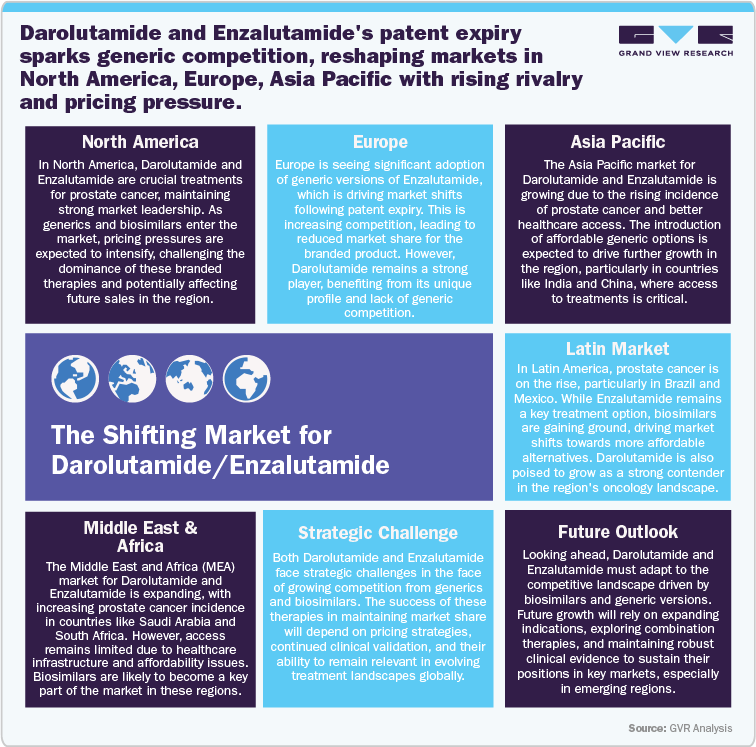
North America Darolutamide / Enzalutamide Market
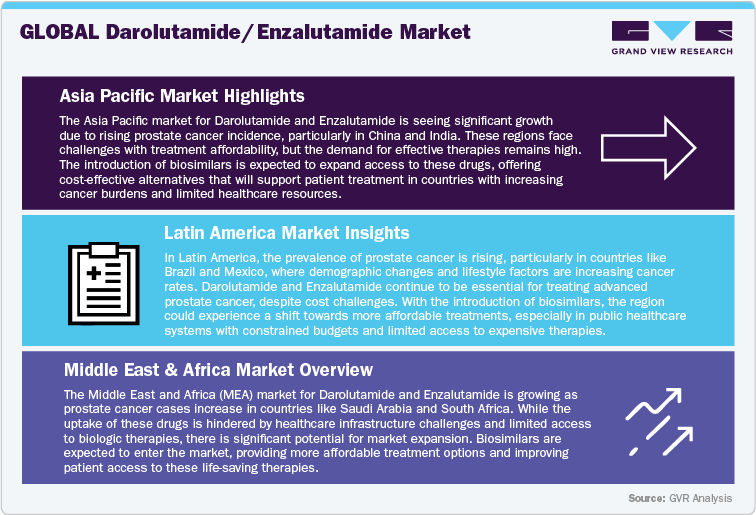
North America remains the largest market for Darolutamide and Enzalutamide, driven primarily by the U.S., which accounts for the majority of sales for both therapies. Patent exclusivity for Enzalutamide is expected to expire in 2027, while Darolutamide retains protection until 2032-2038, creating a window for generic and biosimilar entry. The U.S. market is likely to experience significant pricing pressure post-expiry, with payers favoring cost-effective alternatives. In Canada, where exclusivity also ends in the late 2020s to early 2030s, generics may enter sooner, intensifying competition. While regulatory and clinical adoption hurdles could delay immediate penetration, the region is expected to see substantial price erosion once generics establish market and payer confidence.
Europe Darolutamide / Enzalutamide Market
Europe represents a strong market for both therapies, with Germany, France, and the U.K. being the largest contributors. Patent protections, supported by regulatory exclusivities, provide a slightly longer market runway for Darolutamide compared to Enzalutamide. Once generics or biosimilars gain approval, Europe’s cost-conscious healthcare systems are expected to encourage switching to lower-cost options. The region’s regulatory requirements may delay immediate uptake, but upon approval, tender-based procurement and competitive pricing pressures are likely to rapidly reshape market share dynamics in favor of generics.
Asia Pacific Darolutamide / Enzalutamide Market
The Asia Pacific region presents substantial growth opportunities, particularly in China, India, and Japan, where prostate cancer awareness and treatment adoption are increasing. China is expected to see earlier generic launches due to local patent challenges and government support for domestic therapies, heightening competition. In India, affordability is a major driver, and generics are likely to gain rapid adoption once exclusivity lapses. Japan, with stringent regulatory standards, may experience slower generic penetration despite high demand for advanced therapies. Overall, the region offers significant growth potential but requires careful navigation of regulatory timelines and local competition.
Latin America Darolutamide / Enzalutamide Market
In Latin America, rising prostate cancer prevalence is driving demand for Darolutamide and Enzalutamide, with Brazil, Mexico, and Argentina as key markets. Affordability remains a central concern, and the introduction of generics post-patent expiry is expected to reduce prices and expand access. Regulatory agencies in Brazil and Mexico may facilitate faster approvals, accelerating competitive dynamics. However, logistical barriers and healthcare infrastructure limitations could restrict penetration in some areas, making pricing and distribution strategies critical for both originators and generics.
Middle East and Africa Darolutamide / Enzalutamide Market
The Middle East and Africa (MEA) market is emerging, with relatively lower penetration compared to developed regions. Key markets include Saudi Arabia, the UAE, and South Africa, where demand for prostate cancer therapies is growing. High treatment costs limit widespread access, making the introduction of generics post-patent expiry essential for expanding availability. Regulatory pathways vary across countries; the UAE and Saudi Arabia have more efficient approval processes, while other nations may experience delays. Nevertheless, improving healthcare infrastructure and patient access is expected to support long-term market growth.
Analyst Perspective
The Darolutamide and Enzalutamide market is approaching a pivotal transition as key patents near expiration, with Enzalutamide patents expiring in 2027 (U.S.) and 2026 (Europe), and Darolutamide retaining exclusivity until 2032-2038. Currently dominated by Bayer, Orion, Pfizer, and Astellas, the market will face increasing competition from generic and biosimilar androgen receptor inhibitors, which are expected to drive substantial price reductions and market share shifts. In addition, rival AR inhibitors such as Apalutamide, Bicalutamide, and emerging next-generation therapies, including novel AR-targeted agents and combination regimens, are set to intensify competitive pressures, particularly in price-sensitive regions.
Despite these challenges, demand for Darolutamide, Enzalutamide, and other AR-targeted therapies is expected to remain strong, supported by their proven efficacy, expanding indications in non-metastatic and metastatic prostate cancer, and continued integration into treatment guidelines.
To sustain competitiveness, originator companies must prioritize lifecycle innovation, clinical evidence generation, novel formulations, and patient-centric value strategies. Strategic initiatives such as market access partnerships, expanded indications, and combination therapy programs will be essential for maintaining leadership and resilience amid the evolving post-patent prostate cancer treatment landscape.
Case Study (Recent Engagement): Keytruda Patent-Cliff & Price- Erosion Impact Model
PROJECT OBJECTIVE
To evaluate the potential revenue, price, and patient access implications of Keytruda’s 2028 patent cliff, incorporating biosimilar entry dynamics, country-specific adoption curves, and Merck’s lifecycle defense strategies (remarkably the subcutaneous formulation). The goal was to provide the client with a transparent, scenario-based model to anticipate outcomes and inform strategy
GVR SOLUTION
-
Built a bottom-up commodity-flow and analogue-based model, anchored on Merck’s $29.5B Keytruda sales in 2024.
-
Integrated jurisdictional LOE timelines (EU mid-2028, U.S. 2028-2029 pending litigation outcomes).
-
Modeled biosimilar adoption S-curves calibrated to oncology antibody analogues (EU faster via tenders, U.S. slower via contracting).
-
Applied price-erosion benchmarks (EU −15-30% Yr-1, deepening to −45-60% by Yr-3; U.S. −10-25% net decline over same horizon).
-
Layered lifecycle defenses (SC uptake assumptions of 25-40% of innovator units, combo refresh, contracting) to quantify buffers.
-
Delivered outputs as a dynamic Excel scenario tool and a management-ready PPT deck with revenue bridges, sensitivity tornadoes, and SC migration visuals.
IMPACT FOR CLIENT
-
Enabled the client to quantify downside vs. defense-optimized revenue trajectories:
-
Base case: 30-40% global revenue decline by Year-3 post-LOE.
-
Downside: 45-55% decline in tender-heavy markets.
-
Defense-optimized: Contained erosion to ~−20-25% with strong SC adoption.
-
-
Gave the client a clear view of which markets drive early erosion (EU) and where strategic contracting or SC migration can preserve share (U.S.).
-
Equipped decision-makers with a playbook of watch-points (tender concentration, litigation outcomes, SC IP coverage, combo pipeline) to guide commercial strategy.
-
Provided a transparent methodology that could be presented to boards/investors with evidence-backed assumptions
WHY THIS MATTERS
-
Keytruda is the world’s best-selling cancer drug, representing nearly one-third of Merck’s revenue.
-
Patent expiry will reshape both Merck’s earnings profile and global oncology access dynamics.
-
Payers and governments stand to benefit from biosimilar entry through lower costs, but manufacturers need to manage cliff risk while capturing upside from lifecycle innovations.
-
Understanding how quickly revenues erode and how patient access expands post-biosimilar is critical for:
-
Biopharma companies (strategic planning, pipeline prioritization).
-
Investors (valuing Merck’s cash flows beyond 2028).
-
Payers and policymakers (budgeting for oncology drug spend).
-
A robust patent cliff model helps clients navigate the dual challenge of price erosion and patient expansion, ensuring strategies are grounded in real-world benchmarks.
![gvr icn]()
GET A FREE SAMPLE
![gvr icn]()
This FREE sample includes market data points, ranging from trend analyses to market estimates & forecasts. See for yourself.
![gvr icn]()
NEED A CUSTOM REPORT?
We can customize every report - free of charge - including purchasing stand-alone sections or country-level reports, as well as offer affordable discounts for start-ups & universities.
Contact us now to get our best pricing.
![esomar icon]()
ESOMAR certified & member
![ISO]()
ISO Certified
We are GDPR and CCPA compliant! Your transaction & personal information is safe and secure. For more details, please read our privacy policy.





We are committed towards customer satisfaction, and quality service.
Client Testimonials

"The quality of research they have done for us has been excellent..."
ISO Certified