- Home
- »
- Market Trend Reports
- »
-
Mapping The Value Chain: SKU-Level Pricing Analysis Of Dental Membranes & Bone Grafts Across Key Regions
![Mapping The Value Chain: SKU-Level Pricing Report]()
Mapping The Value Chain: SKU-Level Pricing Analysis Of Dental Membranes & Bone Grafts Across Key Regions
- Published: Nov, 2025
- Report ID: GVR-MT-100488
- Format: PDF/Excel databook
- No. of Pages/Datapoints: 60
- Report Coverage: 2024 - 2030
Objective
Analyzing the pricing of dental membranes and bone graft substitutes is crucial for assessing market competitiveness, profit margins, and value positioning. It allows for the identification of key cost drivers, optimization of pricing strategies, and effective adaptation to market fluctuations. SKU-level pricing offers detailed insights into each product’s performance, uncovering pricing disparities and margin opportunities across different regions and brands. This approach supports smarter purchasing decisions, enhances negotiation leverage, and informs strategic planning within the dental biomaterials market.
Introduction
The dental membrane and bone graft substitutes market encompasses various biomaterials and regenerative products designed to restore oral function and aesthetics following tooth loss or bone resorption. It includes dental implants, bone graft substitutes (BGS), and soft tissue regeneration products like dental membranes. Resorbable membranes, usually collagen-based, dissolve naturally after healing, while non-resorbable membranes like PTFE or titanium provide lasting structural support. Together, these innovations enhance bone regeneration, implant stability, and long-term treatment outcomes in restorative dentistry.
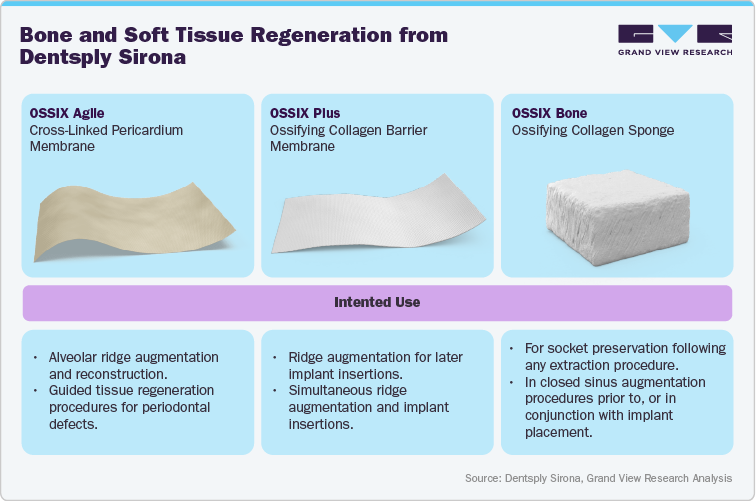

The chart below shows the pricing of Geistlich dental membranes varies between Geistlich Bio-Gide and Geistlich Bio-Gide Compressed due to differences in product structure and application. Bio-Gide, a standard collagen membrane, is typically priced around USD 234.00 for a 25×25 mm size, while the denser Bio-Gide Compressed variant commands a slightly higher price, reflecting its enhanced handling properties and reduced thickness.
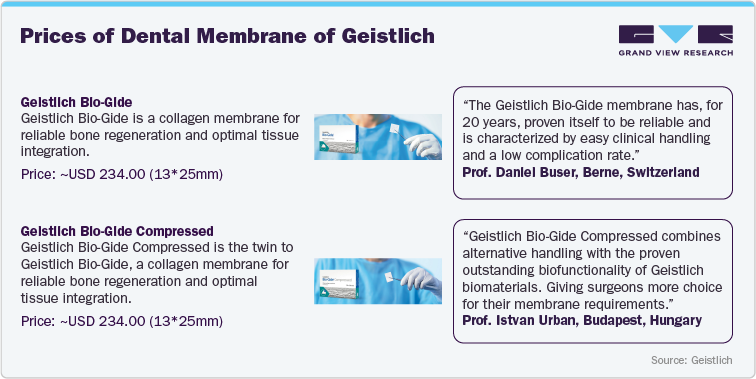
Prices of dental membranes and bone graft substitutes from REGEDENT AG vary significantly across product types, sizes, and regions.

Impact on the Market- Variations in Pricing
The pricing of dental membranes and bone graft substitutes varies across regions and SKUs due to differences in market conditions, import costs, and distribution networks. The table below illustrates this through Geistlich Bio-Gide, a collagen-based dental membrane by Geistlich Pharma AG. It presents the product size (25×25 mm), the market region (U.S.), and a retail price of ~USD 234.00. This SKU-level pricing highlights how regional factors influence product cost positioning within the global dental biomaterials market.
The product is priced in Middle East & Africa (USD 627.52 for 40×50 mm) and Asia Pacific (USD 197.85 for 25×25 mm), reflecting differences in purchasing power, import duties, regulatory costs, and healthcare market maturity. In North America (USD 234.00 for 25×25 mm), moderate pricing aligns with stable demand and established distribution networks. In contrast, the Europe (USD 466.46 for 30×40 mm) shows higher pricing due to higher European operational and compliance costs. Overall, these differences underscore how regional economies, healthcare infrastructure, and logistics impact the final market price of dental biomaterials.
Company
Product
Product Size
Region
Price (USD)
Geistlich
Geistlich Bio-Gide
25 x 25mm
North America
~USD 234.00
25 x 25 mm
Asia Pacific
~USD 197.85
30 x 40mm
Europe
~USD 466.46
40 x 50 mm
Middle East and Africa
~USD 627.52
Source: Geistlich
Average Cost per Graft in countries of various regions (in USD)
Country
Average Cost per Graft (USD)
Notes
USA
800 - 2,500
High cost due to labor and insurance costs
Australia
1,000 - 2,000
Expensive but quality care
UK
690 - 2,080
Medium range; Only private clinics
Thailand
300 - 600
The country is popular in dental tourism
Vietnam
200 - 500
International/Premium-level care at a cheaper affordable cost, This means that patients traveling to Vietnam can save between 70% and 80% on the same procedures, without sacrificing quality or safety.
Source: Saigon White Dental Clinic
Competitive Scenario
Some of the key players operating in the dental membrane and bone graft substitutes include:

![gvr icn]()
GET A FREE SAMPLE
![gvr icn]()
This FREE sample includes market data points, ranging from trend analyses to market estimates & forecasts. See for yourself.
![gvr icn]()
NEED A CUSTOM REPORT?
We can customize every report - free of charge - including purchasing stand-alone sections or country-level reports, as well as offer affordable discounts for start-ups & universities.
Contact us now to get our best pricing.
![esomar icon]()
ESOMAR certified & member
![ISO]()
ISO Certified
We are GDPR and CCPA compliant! Your transaction & personal information is safe and secure. For more details, please read our privacy policy.




We are committed towards customer satisfaction, and quality service.
Client Testimonials

"The quality of research they have done for us has been excellent..."
ISO Certified