- Home
- »
- Market Trend Reports
- »
-
Electric Impedance Tomography Market - Trends, Opportunities, And Competitive Landscape
![Electric Impedance Tomography Market - Trends, Opportunities, And Competitive LandscapeReport]()
Electric Impedance Tomography Market - Trends, Opportunities, And Competitive Landscape
- Published: Sep, 2025
- Report ID: GVR-MT-100428
- Format: PDF/Excel databook
- No. of Pages/Datapoints: 50
- Report Coverage: 2024 - 2030
Introduction:
Electrical Impedance Tomography (EIT) is a non-invasive, radiation-free medical imaging method that sends small electrical currents through surface electrodes, measures the resulting voltages, and creates images of tissue conductivity. Unlike traditional imaging techniques like CT or MRI, EIT provides the benefit of continuous, real-time monitoring directly at the bedside. It is highly portable, affordable, and safe for repeated use, making it especially useful for critical care and long-term monitoring.
Technology Overview
EIT systems can be implemented using different frequency approaches to suit various clinical and technical needs. For instance,
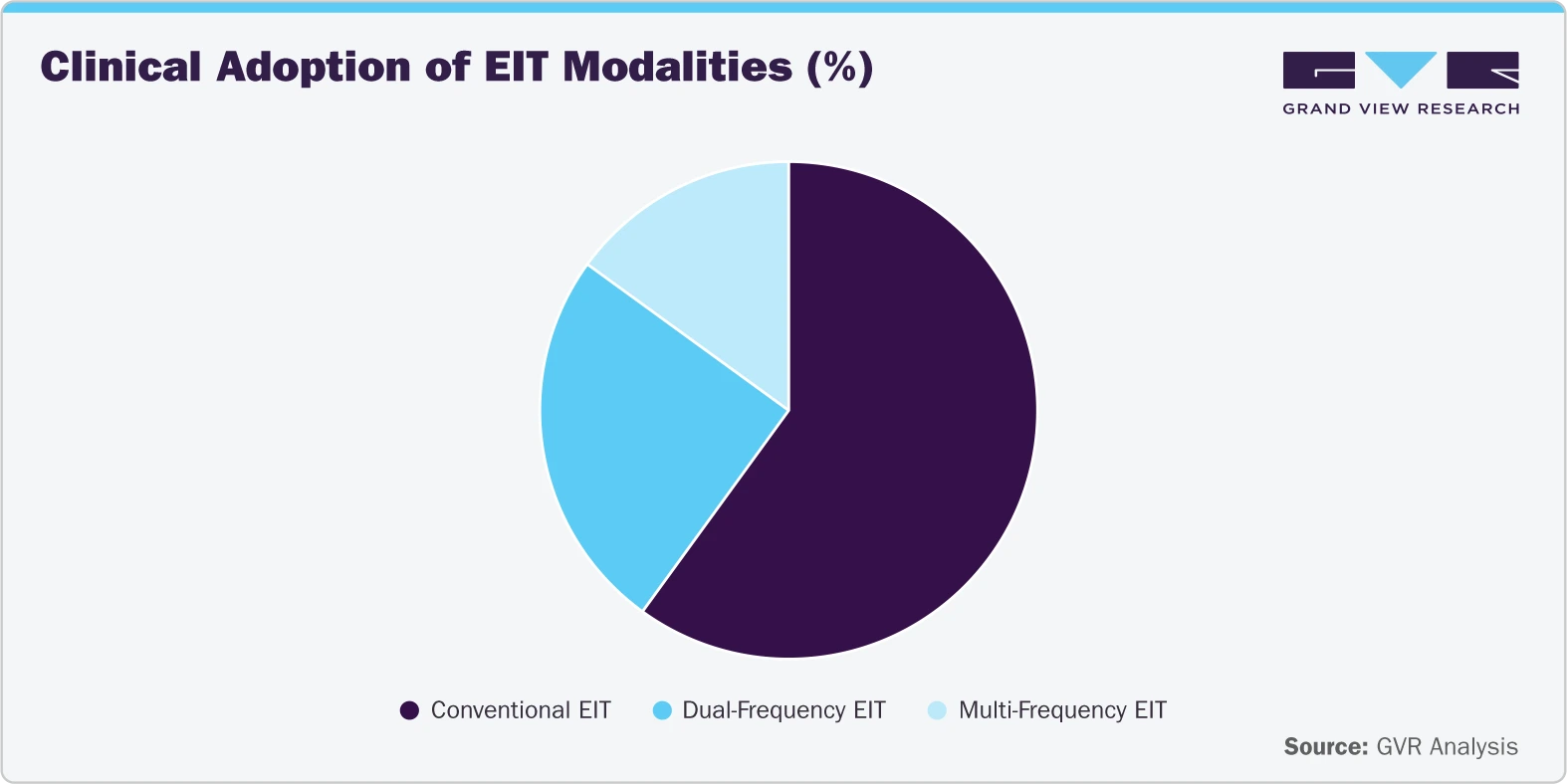
Conventional EIT: Operates at a single frequency and is the most established and widely used form, particularly in routine lung ventilation monitoring, ICU bedside care, and cardiac function assessment, driving the current clinical adoption of EIT devices.
Dual-Frequency EIT: This applies two distinct frequencies, offering improved contrast and tissue differentiation, making it useful in distinguishing healthy from diseased tissues, perfusion studies, and gastrointestinal monitoring. This approach is gaining traction as hospitals seek more precise functional imaging without relying on expensive modalities such as computed tomography (CT) or magnetic resonance imaging (MRI).
Multi-Frequency EIT: This is also known as Spectroscopic EIT, and it extends the technology further by applying a spectrum of frequencies to enable detailed tissue characterization, brain research, oncology detection, and blood flow analysis. This technology holds a strong potential for future clinical adoption in specialized diagnostics.
Limitations and Technical Challenges
Despite its benefits, EIT faces significant limitations that hinder its wider use in clinics. The technique provides low spatial resolution, making it less suitable for detailed anatomical imaging than CT or MRI methods. Instead, EIT works better for tracking functional changes such as ventilation, perfusion, or fluid shifts. Additionally, EIT is very sensitive to noise and measurement errors. Poor electrode contact, patient movement, or device variability can distort readings and reduce image quality, especially in busy clinical settings.
Another key challenge lies in modeling and reconstruction. Accurate EIT imaging depends on mathematical models that account for body geometry, electrode positioning, and the heterogeneous conductivity of tissues. However, human tissues vary significantly, and assumptions such as homogeneity or simplified geometry can introduce artifacts. Even minor deviations in electrode placement or neglecting tissue anisotropy may lead to unreliable images, especially for quantitative assessments. These issues highlight why EIT, while promising for real-time functional imaging, continues to face hurdles in achieving consistent accuracy and acceptance in routine clinical practice.
Recent Technological Advancements in EIT
Electrical Impedance Tomography (EIT) has seen notable progress recently, driven by the adoption of artificial intelligence (AI) and machine learning (ML). These advancements enhance the speed and accuracy of image reconstruction, facilitating automated detection of functional changes in organs. Modern reconstruction algorithms produce higher-resolution, clinically dependable images that improve lung ventilation and perfusion assessment diagnostics. Simultaneously, the advent of wireless and wearable EIT devices is making the technology more user-friendly, supporting continuous patient monitoring in ICUs, outpatient clinics, and at home. These breakthroughs are speeding up EIT’s integration, shifting it from mainly a research tool to a practical, real-time imaging method used in clinical settings.

The above figure illustrates the market opportunity for Electrical Impedance Tomography (EIT) in healthcare. The Total Addressable Market (TAM) encompasses the entire global medical imaging sector, including CT, MRI, X-ray, ultrasound, and emerging functional imaging technologies. The Serviceable Available Market (SAM) narrows this scope to the clinical areas where EIT is most applicable today, such as critical care, respiratory monitoring, perioperative management, and selected cardiology and neurology use cases. Finally, the Serviceable Obtainable Market (SOM) reflects the current adoption base, primarily concentrated in ICU lung monitoring, research laboratories, and early pilot deployments in perioperative and neurological applications. This layered framework highlights both the early-stage positioning of EIT and its long-term expansion potential within broader healthcare imaging.
Applications for Electric Impedance Tomography (EIT)
EIT is portable, cost-effective, and adaptable to different body regions; it is well-suited for ICU environments, emergency medicine, and continuous monitoring where repeated CT or MRI scans are impractical. The digitized signals are processed with advanced algorithms to produce functional maps. With the rise of wearable systems and AI-enhanced reconstruction, EIT is steadily expanding into oncology, neurology, and rehabilitation, broadening its clinical impact.
Clinical and Research & Functional Applications of EIT
Clinical
Research & Functional
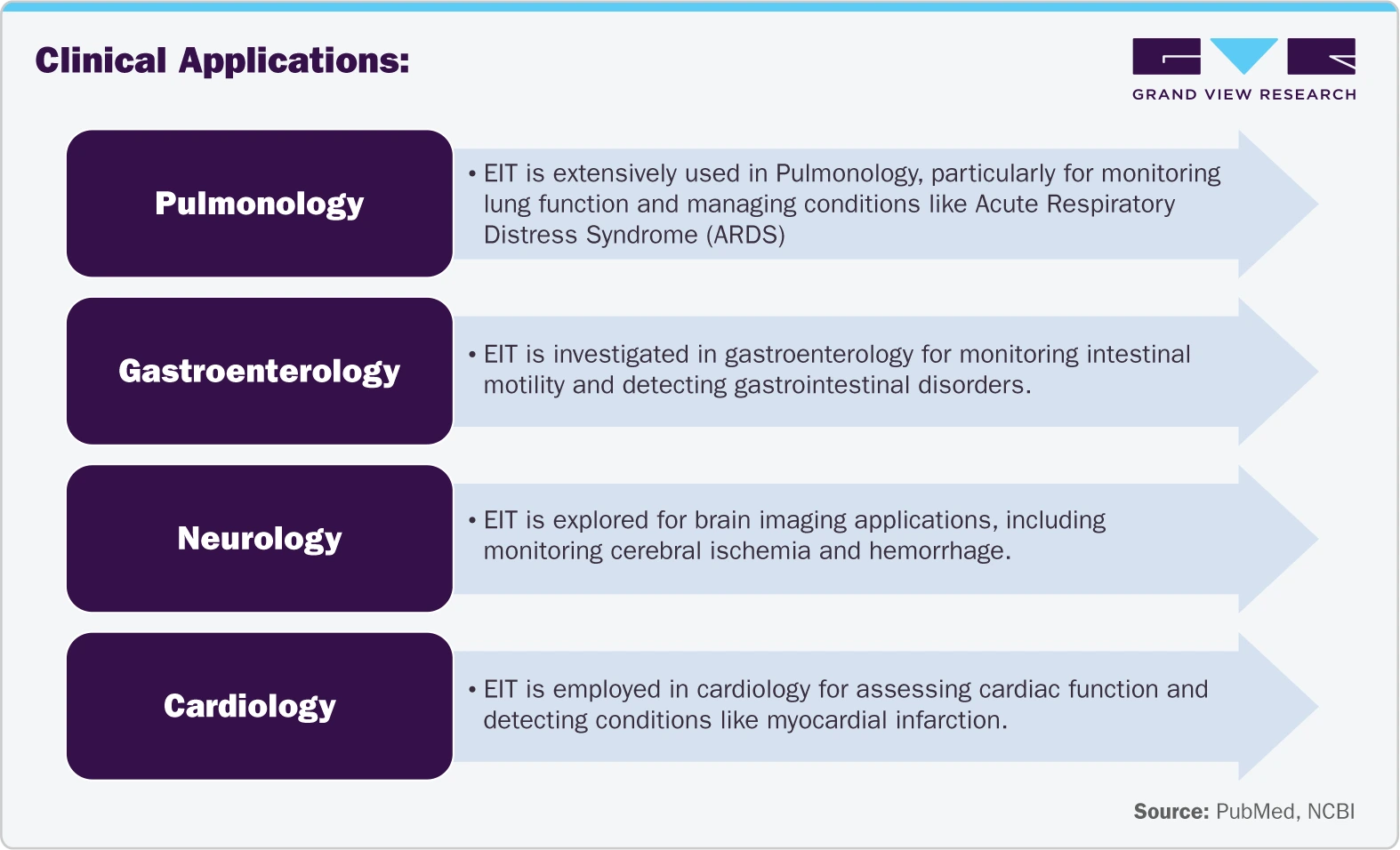
Neurology
Biomedical Research
Pulmonology
Clinical Trial Support
Cardiology
Advanced Functional Imaging
Gastroenterology
Algorithm & AI Development
Source: GVR Analysis
Clinical Applications:
Electrical Impedance Tomography (EIT) provides real-time, non-invasive organ function monitoring, making it a valuable tool in modern clinical practice. By capturing dynamic physiological changes at the bedside, EIT enables continuous assessment without radiation or complex imaging procedures. Its flexibility and portability allow it to be applied across various clinical settings, supporting decision-making, improving patient management, and enhancing the understanding of organ function in routine care and critical care environments.
Neurology:
EIT can non-invasively monitor brain activity by detecting impedance changes due to blood flow or cell swelling. Like fMRI, it captures slow changes (cerebral blood volume) and rapid neuronal activity. EIT enables continuous bedside imaging for epilepsy localization, stroke assessment, and pre-surgical planning, reducing the need for invasive electrodes. Its portability and low cost make it suitable for emergency neuroimaging, such as guiding thrombolytic therapy for stroke patients. Overall, EIT provides real-time, functional insights into brain activity safely and efficiently.

Comparison of EIT with Conventional Imaging Techniques
Electrical Impedance Tomography (EIT) is increasingly gaining popularity in healthcare because of its advantages over traditional imaging methods like X-rays and CT scans. While these conventional techniques offer high-resolution anatomical images, they are often static, expensive, and expose patients to ionizing radiation, which makes repeated or continuous monitoring difficult. In contrast, EIT is radiation-free, non-invasive, and capable of providing real-time, bedside monitoring, enabling clinicians to observe dynamic physiological changes continuously. This feature is especially useful in assessing lung function, where EIT can visualize ventilation distribution and detect rapid changes that static imaging might overlook. Its ability to deliver functional, time-resolved images, portability, and affordability make EIT a valuable complementary or alternative technology in critical care, promoting its increasing use in ICUs, respiratory monitoring, and other ongoing patient care scenarios.
Comparison Between Different Imaging Modalities
Medical Imaging Modality
Computed Tomography (CT)
Ultrasound (US)
Magnetic Resonance Imaging (MRI)
Electric Impedance Tomography (EIT)
Basic Principle
X-rays
High-frequency sound
Radio waves
Impedance
Types of Radiation
Ionizing radiation
Non-ionizing radiation
Non-ionizing radiation
Non-ionizing radiation
Contrast
High
Low
High
Low
Spatial Resolution
50-200 μm
50-500 μm
25-100 μm
Low
Scanning Time
<20 min
< 30 min
<40 min
<10 min
Cost
Moderate
Low
Very High
Low
Portability
Non-Portable
Portable
Non-Portable
Portable
Advantages
Bone and tumor imaging, anatomic imaging
Visualize muscles, tendons, and internal organs
Morphological and functional imaging
Rapid tomographic imaging, low cost, noninvasive
Disadvantages
High cost of ionizing radiation
Operator dependency
Noisy, cost, low sensitivity
Not mature yet
Source: National Library of Medicine
Trends and Opportunities in the Electric Impedance Tomography (EIT) market
AI-Enhanced EIT in Critical Care and Respiratory Monitoring
Integrating AI and EIT transforms critical care through real-time, non-invasive lung monitoring. EIT offers dynamic lung images, revealing ventilation and perfusion without ionizing radiation. Nonetheless, conventional EIT can face issues like low resolution and noise interference. AI, especially deep learning, helps overcome these limitations by refining image reconstruction, minimizing artifacts, and boosting diagnostic precision.
A notable example is the integration of AI with EIT in managing Acute Respiratory Distress Syndrome (ARDS). In a 2024 study, researchers combined EIT with variable ventilation strategies and AI to shift from reactive to predictive methods in critical care. This combination was designed to improve patient outcomes through personalized interventions and real-time monitoring.
Moreover, progress in deep learning has enhanced EIT image reconstruction methods. A 2022 study emphasized using deep learning in EIT, covering single network reconstruction, hybrid techniques that integrate traditional algorithms with deep learning, and multi-network approaches. These developments could significantly improve EIT's effectiveness in clinical practice.
Incorporating AI with EIT enhances clinical practice and promotes interdisciplinary teamwork. This partnership boosts the scope for innovative research and could revolutionize critical care by supporting a predictive, personalized approach to patient treatment.
Competitive Landscape of the Electric Impedance Tomography (EIT)
The electric impedance tomography (EIT) market is moderately competitive. It features several established leaders who continuously innovate and expand their market presence. Key players include Drägerwerk AG & Co. KGaA, Sentec AG, and Sciospec Scientific Instruments GmbH. These companies leverage advanced technologies and strategic partnerships to enhance their competitiveness.
Further countries such as Germany, China, the U.S., Italy, and the UK exhibit high publication output and citation frequency, indicating EIT technology's continued advancement and clinical applications. Furthermore, the concentration of research activity suggests high levels of academic, clinical, and technological expertise in these areas, making them predisposed markets for EIT systems to be adopted in the hospital and intensive care setting. These international research collaborations also validate the exchange of knowledge and inventive thinking that can support the more widespread rollout of EIT internationally.
Electric Impedance Tomography (EIT) Manufacturers
Competitive Landscape: Top 10 Electric Impedance Tomography (EIT) Manufacturers Overview
Market Outlook
Company Categorization
Company Share Analysis (Top 10 companies)
Company Position Analysis
List of Key Companies by Region
Company Overview
Product Benchmarking
Financial Performance
Recent Strategic Initiatives
SWOT Analysis
Emerging Players: Overview of 60+ Emerging Players and Startups in the Electric Impedance Tomography (EIT) Industry
Company Overview
Establishment Year
Headquarters
Business Verticals
Employee Count
Investor Information
Total Funding (USD)
Product Benchmarking
Strategic Initiatives
SWOT Analysis
Company Profiles
Drägerwerk AG & Co. KGaA
Company Overview:
Headquarters:Lübeck, Germany
Founded: 1889
Ownership: Public
Employees: 16,598
Revenue: Approx. USD 3.61 Billion
Specialization: Drägerwerk AG & Co. KGaA specializes in medical technology, focusing on acute care solutions, including Electrical Impedance Tomography (EIT) systems for continuous lung and respiratory monitoring. The company develops and manufactures advanced bedside imaging devices like the PulmoVista 500, which provide real-time, non-invasive monitoring for ICUs and critical care settings. Dräger’s healthcare solutions are deployed in over 190 countries, with dedicated sales and service subsidiaries in around 50 countries, ensuring global support and training for clinical teams. With 20 development and manufacturing sites worldwide, Dräger combines technological innovation with clinical expertise to advance patient monitoring and functional imaging in respiratory care.
Product Benchmarking:
Dräger PulmoVista 500
Purpose: The PulmoVista 500 is a non-invasive Electrical Impedance Tomography (EIT) system that provides real-time, regional visualization of lung ventilation at the patient's bedside. It aims to enhance lung-protective ventilation strategies by offering continuous monitoring without the need for ionizing radiation.
Features:
-
Real-Time Imaging: Delivers up to 50 images per second, presenting a dynamic view of lung ventilation.
-
Non-Invasive Monitoring: Utilizes a flexible silicone belt with 16 integrated electrodes, eliminating the need for invasive procedures.
-
Extended Monitoring Duration: Capable of monitoring pulmonary function continuously for up to 24 hours.
-
Advanced Data Analysis: Provides global and regional impedance waveforms, trend data on end-expiratory lung volumes, and comparative imaging to assess therapeutic interventions.
Clinical Use:
-
ICU and Critical Care: Supports clinicians in adjusting ventilation parameters to prevent ventilator-associated lung injuries.
-
Assessment of Ventilation Distribution: Identifies areas of atelectasis, over-inflation, and other ventilation abnormalities.
-
Evaluation of Therapeutic Maneuvers: Monitors the effects of interventions such as Positive End-Expiratory Pressure (PEEP) trials and recruitment maneuvers.
- Pediatric and Adult Care: This service is suitable for many patients, including pediatric and adult populations.
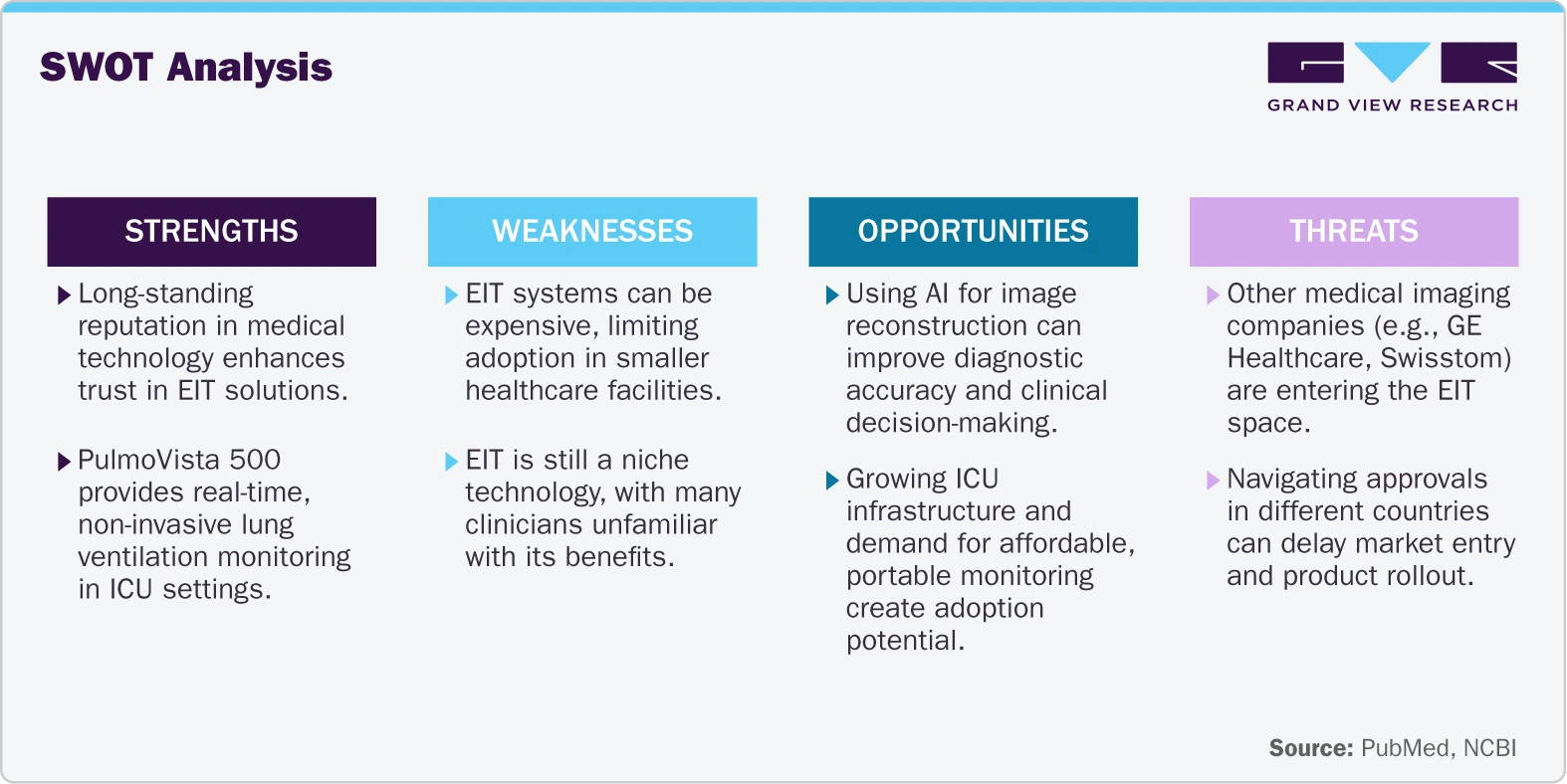
SWOT Analysis
![gvr icn]()
GET A FREE SAMPLE
![gvr icn]()
This FREE sample includes market data points, ranging from trend analyses to market estimates & forecasts. See for yourself.
![gvr icn]()
NEED A CUSTOM REPORT?
We can customize every report - free of charge - including purchasing stand-alone sections or country-level reports, as well as offer affordable discounts for start-ups & universities.
Contact us now to get our best pricing.
![esomar icon]()
ESOMAR certified & member
![ISO]()
ISO Certified
We are GDPR and CCPA compliant! Your transaction & personal information is safe and secure. For more details, please read our privacy policy.






We are committed towards customer satisfaction, and quality service.
Client Testimonials

"The quality of research they have done for us has been excellent..."
ISO Certified