- Home
- »
- Market Trend Reports
- »
-
Imaging Services In Non-Hospital And Remote Settings: Access, Technologies, And Business Models
![Imaging Services In Non-Hospital And Remote Settings: Access, Technologies, And Business ModelsReport]()
Imaging Services In Non-Hospital And Remote Settings: Access, Technologies, And Business Models
- Published: Oct, 2025
- Report ID: GVR-MT-100432
- Format: PDF/Excel databook
- No. of Pages/Datapoints: 50
- Report Coverage: 2024 - 2030
Overview Of Imaging Services In Non-Hospital And Remote Settings
Non-hospital imaging (mobile radiography, mobile mammography, point-of-care ultrasound, mobile CT/MRI trailers, and teleradiology) is expanding rapidly, driven by aging populations and long-term care needs, rural and underserved population demand, workforce shortages and hospital capacity constraints, and advances in portable imaging hardware, connectivity, and AI-assisted interpretation.
Such remote imaging technologies allow healthcare providers to deliver timely diagnostic services to rural and underserved communities. Pilot programs in Canada, for example, enable technologists to perform CT and MRI scans remotely, improving access where specialists are scarce. Remote radiology also connects local clinics with expert radiologists via secure cloud platforms, offering faster turnaround for urgent cases and expanding specialist availability.
Access To Imaging Services In Non-Hospital And Remote Settings
Challenges in Access
Geographical Barriers
The most significant obstacles to accessing imaging services in non-hospital and remote areas are geographical barriers. Many rural communities are located far from urban centers where hospitals and advanced diagnostic facilities are concentrated. Patients often need to travel long distances, sometimes several hours, to reach the nearest imaging center, which can delay diagnosis and treatment. These delays can be particularly detrimental for conditions that require timely intervention, such as strokes, cancers, or cardiac emergencies.
“Patients living in rural areas face unique barriers that prevent them from getting timely access to imaging services. If we as a community want to improve overall access to recommended imaging services, it is critical that we incorporate rural perspectives, particularly as many academic radiology departments are centered in urban or suburban areas."
- Associate Professor, Department of Radiology, University of Wisconsin-Madison
For example, rural populations often have limited local imaging facilities in countries like Australia, Canada, and the United States. A patient with a suspected fracture or tumor might have to schedule multiple appointments and arrange transportation, which can result in delayed care and increased healthcare costs. In addition, harsh weather, poor road conditions, or a lack of reliable transportation can further exacerbate the problem.
Key Challenges in Remote Imaging and Corresponding Solutions
Challenges
Strategies to Overcome Access
Geographical Barriers
Mobile Imaging Units
Workforce Shortages
Telemedicine
Infrastructure Limitations
Public-Private Partnerships
Source: GVR Analysis
Technological Innovations in Remote Imaging
Portable Imaging Devices
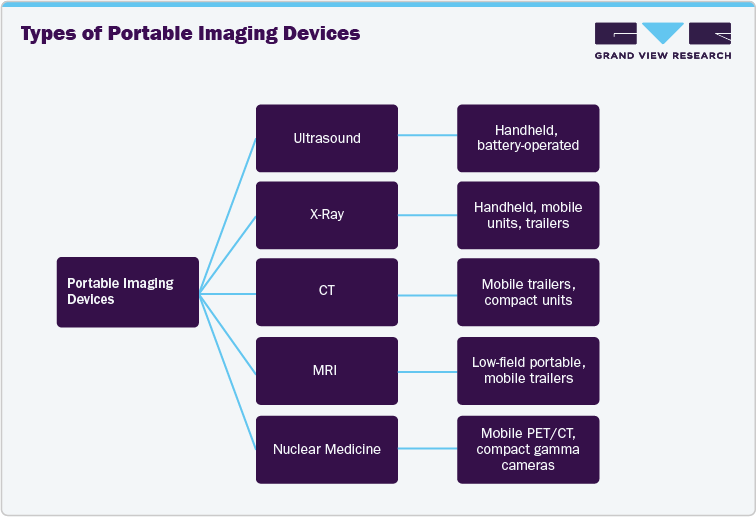
Ultrasound Devices
Portable ultrasound devices have emerged as critical technology to bridge the gap in remote imaging access. Unlike conventional ultrasound systems, which are bulky and confined to hospital settings, modern portable and handheld ultrasound machines are lightweight and battery-powered and can be transported easily to clinics, mobile units, and even patient homes.
These devices allow healthcare providers to perform point-of-care imaging in diverse scenarios, including rural health centers, disaster zones, and field clinics. For instance, obstetric care in remote villages often relies on portable ultrasound to monitor fetal development, enabling early detection of complications without hospital visits. Similarly, emergency response teams in conflict zones or natural disaster areas use portable ultrasound to assess internal injuries quickly.
Cloud-Based Imaging Solutions
Cloud-based imaging solutions are transforming the delivery of diagnostic services by enabling healthcare providers to store, manage, and share medical images securely over the internet. Platforms such as cloud-based Picture Archiving and Communication Systems (PACS) and Vendor Neutral Archives (VNA) allow imaging data to be accessed from multiple locations, breaking the constraints of on-site storage and physical film. These solutions are particularly beneficial in non-hospital and remote settings, where local infrastructure may be limited and radiologists are not always on-site. Clinicians can upload images from portable ultrasound, X-ray, CT, or MRI devices to the cloud, allowing specialists and teleradiologists to interpret scans remotely in real time. Integration with artificial intelligence (AI) further enhances these systems by assisting in automated image analysis, detecting anomalies, prioritizing urgent cases, and improving diagnostic accuracy and efficiency. Cloud-based imaging solutions not only facilitate timely consultations and second opinions but also reduce costs associated with physical storage, streamline workflow, and ensure secure, HIPAA-compliant data management across distributed healthcare networks.
Business Models Supporting Remote Imaging Services
Mobile Imaging Services
Mobile or On-demand imaging services are transforming how diagnostic imaging is delivered in non-hospital settings. In this model, companies deploy mobile units, such as vans, trucks, or trailers equipped with MRI, CT, X-ray, or ultrasound systems, to provide imaging at healthcare facilities, community centers, or directly at patient homes.
The on-demand approach is highly flexible, as healthcare providers can schedule imaging services according to patient needs without investing in permanent infrastructure. This model is particularly valuable for nursing homes, outpatient clinics, and remote hospitals that cannot afford high-cost imaging equipment or maintain full-time radiology staff.
Example: In the U.S., companies like Heritage Imaging provide mobile MRI and CT services to rural clinics and community hospitals per request, ensuring patients receive timely diagnostics without traveling long distances.
Key Advantages:
-
Lowers capital expenditure on healthcare facilities
-
Expands access to underserved populations
-
Allows rapid deployment in response to sudden spikes in demand (e.g., epidemics, disaster response)
Case Studies
I-MED Radiology Network, one of Australia’s largest diagnostic imaging providers, has implemented an innovative remote-controlled imaging system to enhance access to MRI services in regional and rural areas. In this model, MRI machines in remote centers are linked to a centralized control hub staffed by specialized radiologists. Local technologists at the imaging site perform patient preparation and positioning, while radiologists remotely control the scanning parameters, optimize imaging sequences, and supervise the acquisition in real time.
This system addresses the persistent challenge of workforce shortages in rural regions, where access to trained radiologists is limited. By leveraging remote expertise, I-MED ensures that even patients in smaller towns can receive high-quality MRI scans without traveling long distances to urban hospitals. Technologists are guided step-by-step during complex imaging procedures, which maintain the quality of diagnostic images while providing on-the-job training and support for local staff.
Patient and Operational Benefits:
-
Reduced Travel and Waiting Times: Patients can receive advanced imaging close to home, decreasing the physical, financial, and logistical burden of traveling to metropolitan centers.
-
Enhanced Diagnostic Accuracy: Remote supervision by expert radiologists ensures correct imaging protocols are followed, reducing the risk of repeat scans and diagnostic errors.
-
Increased Scan Volume and Efficiency: Remote-controlled workflows allow radiologists to oversee multiple regional sites simultaneously, improving throughput without compromising quality.
-
Empowerment of Local Staff: Technologists gain experience working under expert guidance, gradually increasing their skills and confidence in advanced imaging procedures.
Broader Impact on Rural Healthcare:
-
Equitable Access to High-End Technology: Previously limited to urban centers, MRI scans are now accessible to underserved populations.
-
Integration with Telehealth and Cloud Systems: Images can be stored in cloud-based PACS for remote consultation or second opinions, further improving patient outcomes.
-
Scalable Model: This approach can be expanded to other imaging modalities, such as CT and PET, and can serve as a blueprint for countries facing similar workforce and infrastructure challenges.
Combining mobile technology, remote expertise, and cloud-based imaging, I-MED’s system exemplifies how innovation can overcome geographical and workforce barriers, making high-quality diagnostic imaging more accessible and sustainable in remote healthcare settings.
Financial Performance of Outpatient Imaging Centers
Outpatient imaging centers, which provide diagnostic imaging services outside traditional hospital settings, generally demonstrate a robust financial profile due to their lower operating costs and targeted service delivery. EBITDA (Earnings Before Interest, Taxes, Depreciation, and Amortization) is often used as a key metric to evaluate operational efficiency, reflecting profitability while excluding non-operational factors. Outpatient centers typically report stronger EBITDA margins than hospital-based imaging units, largely due to lower overheads, streamlined workflows, and flexible staffing models. EBIT (Earnings Before Interest and Taxes) provides insight into the overall profitability after accounting for depreciation of expensive imaging equipment, such as MRI or CT scanners, which are significant capital investments.
While high equipment costs can reduce EBIT margins in the short term, centers that optimize utilization rates through mobile imaging services, subscription-based models, and teleradiology partnerships can achieve healthy operating profits. Additionally, outpatient centers benefit from predictable revenue streams from recurring outpatient visits and contracted imaging services for clinics, long-term care facilities, and corporate health programs. Overall, careful management of capital expenditures, staff productivity, and patient throughput is critical to maintaining strong financial performance and maximizing returns on investment in these centers.
Company Profiles
Catalyst MedTech
Company Overview:
Headquarters: Pennsylvania, U.S.
Founded: 2004
Overview: Catalyst MedTech is a specialized healthcare solutions provider known for its focused expertise in delivering advanced diagnostic and imaging services across various clinical environments. The company has built a reputation for integrating advanced technologies with customized service models, offering a combination of operational efficiency and clinical precision. Its strategic partnerships with equipment manufacturers and healthcare institutions enable it to maintain high service uptime, optimized workflows, and accelerated diagnostic turnaround times for its clients. Moreover, it focuses on compliance, remote monitoring capabilities, and maintenance programs that enhance client retention and operational continuity.
Service Benchmarking:
Imaging Center Solutions:
Description: Catalyst MedTech offers comprehensive solutions tailored for imaging centers, focusing on enhancing efficiency and operational capabilities in nuclear medicine and molecular imaging.
Their key offerings include:
High-Quality Imaging Equipment: Provision of top-tier molecular imaging and nuclear medicine equipment to meet diverse clinical needs.
Service & Maintenance: Access to a nationwide network of skilled technicians ensuring optimal equipment performance and longevity.
Interim & Rental Options: Flexible rental solutions for imaging equipment, accommodating temporary requirements or equipment transitions.
Laboratory Upgrades: Assistance in modernizing labs through software enhancements and workstation improvements.
Healthcare Systems Solutions:
Description: Catalyst MedTech offers tailored solutions for healthcare systems aiming to broaden their reach, enhance imaging capabilities, and improve operational efficiency. Their services are designed to support growth and ensure seamless patient care.
Their key offerings include:
Imaging Equipment: Provision of cost-effective, high-quality imaging systems to support expansion and improve diagnostic services.
Service & Maintenance: Comprehensive maintenance programs to ensure consistent performance and reliability of imaging equipment.
Interim & Rental Equipment: Flexible rental options to maintain service continuity during equipment downtime or facility renovations.
Satellite Imaging Solutions: Enablement of full cardiac imaging services at satellite locations without the need for equipment purchase.
Service Programs:
Description: Catalyst MedTech offers comprehensive service programs designed to maintain, repair, and support imaging equipment, ensuring optimal performance and patient care.
Their services include:
Annual Service Agreements: These full coverage plans guarantee 98% equipment uptime and encompass all service aspects, including parts, labor, clinical training, and application support. They cover both scheduled preventative maintenance and unexpected repairs.
Time & Materials Services: For facilities requiring flexible, on-demand support, Catalyst provides access to OEM-certified engineers for tasks such as equipment removal, installation, inspections, and troubleshooting, without the need for a long-term contract.
Preventative Maintenance: To proactively address potential issues, Catalyst offers scheduled maintenance services that can be arranged outside regular operating hours, minimizing disruption and maximizing equipment uptime.
Catalyst's service team comprises over 100 experienced professionals with expertise across various OEMs in SPECT, SPECT/CT, PET, PET/CT, and CT imaging. The company holds ISO 9001:2015 and ISO 13485:2016 certifications, ensuring quality and compliance in sales, repair, refurbishment, installation, and servicing of medical imaging devices.
![gvr icn]()
GET A FREE SAMPLE
![gvr icn]()
This FREE sample includes market data points, ranging from trend analyses to market estimates & forecasts. See for yourself.
![gvr icn]()
NEED A CUSTOM REPORT?
We can customize every report - free of charge - including purchasing stand-alone sections or country-level reports, as well as offer affordable discounts for start-ups & universities.
Contact us now to get our best pricing.
![esomar icon]()
ESOMAR certified & member
![ISO]()
ISO Certified
We are GDPR and CCPA compliant! Your transaction & personal information is safe and secure. For more details, please read our privacy policy.






We are committed towards customer satisfaction, and quality service.
Client Testimonials

"The quality of research they have done for us has been excellent..."
ISO Certified