Iron Ore Price vs. Steel Price: Why They Don't Always Move Together
If you track metal markets, you have likely seen this play out: iron ore prices surge, but steel prices barely budge, or worse, they head in the opposite direction. For procurement heads, financial analysts, and market observers, this dynamic often triggers a crucial question: If iron ore is the primary raw material for steel, shouldn't their prices move in lockstep?
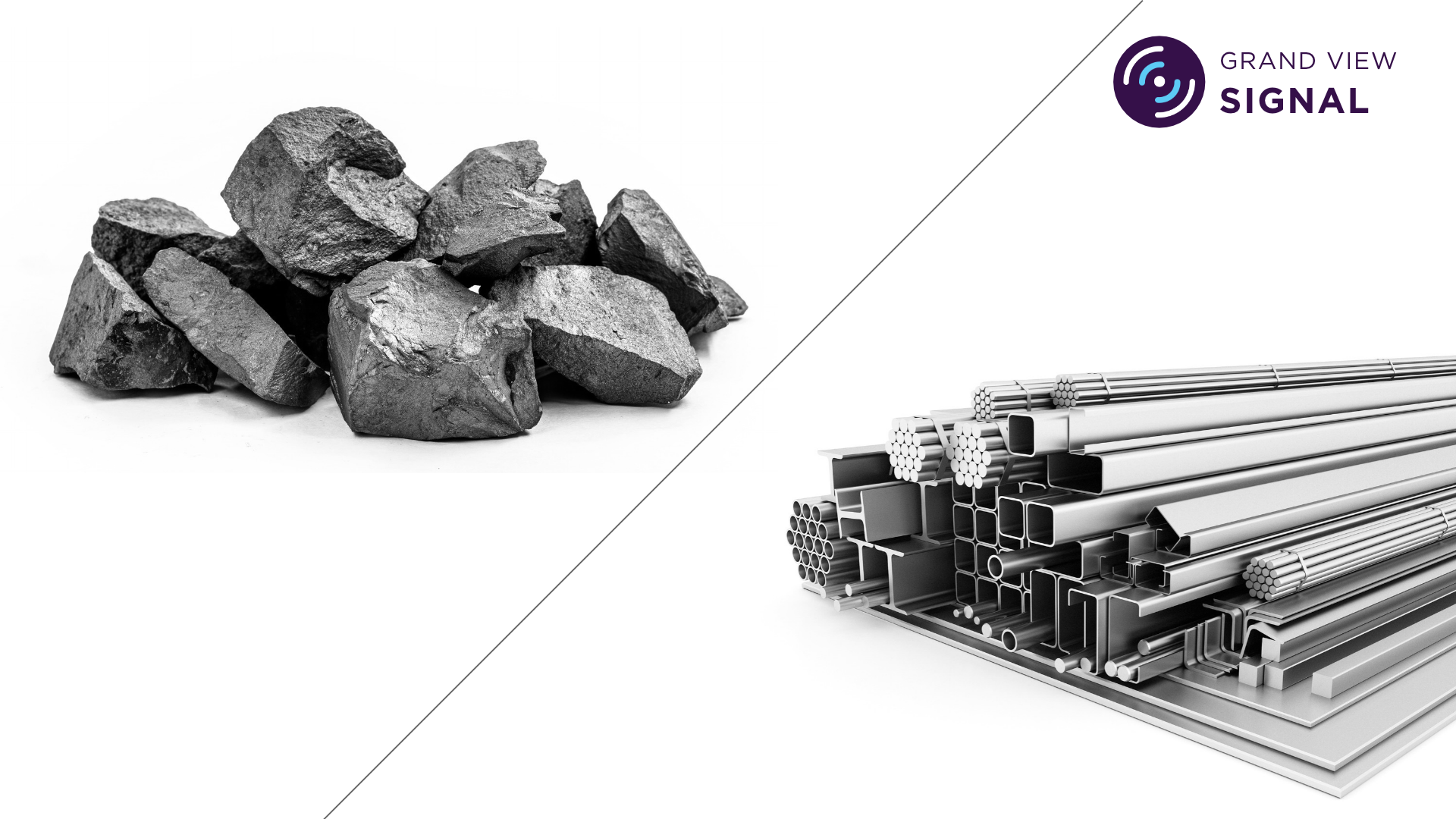
To understand why the iron ore price vs steel price dynamic breaks down, we have to look past simple supply-and-demand charts and evaluate market signals through a more structured framework. By applying ASP methodology from commodity price intelligence platforms like Grand View Signal, the underlying forces behind this divergence, specifically comparing real-time construction demand with overarching trade policy can be uncovered.
The Myth of the Fixed Correlation
On paper, the logic seems straightforward: iron ore makes up a major portion of the raw material input cost for blast furnace steelmaking (Basic Oxygen Furnace, or BF-BOF route). When raw material costs rise, finished steel prices should theoretically increase to protect steelmakers' margins, a concept known as raw material cost pass-through.
Historically, there is indeed a broad, long-term correlation between iron ore and steel prices. However, in short-to-medium-term windows, that correlation frequently breaks down.
When iron ore prices move up while finished steel prices lag or decline, the ferrous metals spread (the profit margin between raw input costs and finished steel output prices) compresses sharply. Data from McKinsey's SteelLens benchmark indicates that global steel industry EBITDA margins average 8% to 10%, well below the 15% to 17% required for long-term sustainability. When raw material pass-through fails, mill margins drop rapidly toward low single digits, leaving bottom-quartile mills operating at a loss.
Conversely, when steel prices rally while ore stays flat, mill margins expand.
To pinpoint why these pricing paths diverge, Signal’s ASP methodology breaks down the market into three core layers:
-
Supply & Demand Fundamentals (End-use demand vs. raw material availability)
-
Sentiment & Policy Interventions (Trade restrictions, tariffs, and government stimulus)
-
Price Dynamics & Financialization (Paper markets, inventory cycles, and margin pressures)
Access real-time impact analysis on commodity prices
Explore Grand View Signal
1. Analysis of Supply & Demand: Construction Realities vs. Mine Output
The first layer of divergence occurs when upstream supply dynamics disconnect from downstream end-use demand.
Upstream Raw Material Supply
Iron ore supply is heavily concentrated. A handful of major global miners across Australia and Brazil dominate seaborne supply. If operational disruptions occur, such as tropical cyclones in Western Australia, tailing dam issues in South America, or localized port congestions, seaborne iron ore prices can skyrocket rapidly due to tight upstream supply.
Downstream Finished Steel Demand
On the demand side, finished steel relies heavily on real-world consumption, particularly from the construction and real estate sectors, which historically account for a massive share of global steel usage.
When residential or commercial construction slows down due to high interest rates, credit tightening, or slowing infrastructure spend, real demand for finished products like rebar, wire rod, and structural steel drops. For instance, China witnessed a dip in its infrastructural development over the past year, which in turn, reflected on its steel production. Rebar prices in China registered a Y-o-Y drop of 10.3%.
The Divergence Mechanism
-
The Scenario: Global iron ore supplies face a sudden bottleneck, driving iron ore prices up.
-
The Downstream Reality: Construction site activity remains sluggish, and buyers refuse to accept higher finished steel prices.
-
The Outcome: Steel mills find themselves unable to execute a raw material cost pass-through. They cannot force higher prices onto end-buyers who simply do not need the volume. As a result, iron ore climbs while steel prices stay flat or decline, severely squeezing the ferrous metals spread.
2. Sentiment & Policy: Trade Barriers, Tariffs, and Government Interventions
While supply and demand set the baseline, trade policy and government market interventions act as powerful catalysts that force iron ore and steel prices onto completely different trajectories.
Trade Protectionism and Tariffs
Trade policies such as import tariffs, anti-dumping duties, and safeguard measures, are generally applied to finished steel products, not raw iron ore.
When a nation imposes heavy tariffs on foreign steel to protect domestic mills, domestic steel prices can artificially decouple from global benchmarks. A prime example is where India has imposed a three-year safeguard duty of 11–12% on select steel imports to protect domestic manufacturers from low-priced dumping, particularly from China, Vietnam, and Nepal. The levy drops from 12% in year one to 11% in year three, excluding specialized steel and select developing nations to safeguard downstream industries and support domestic manufacturing capacity.
Domestic mills enjoy pricing power at home, driving up local steel prices even if global raw material demand is soft.
Capacity Mandates and Production Controls
Governments often step in to regulate steel production directly for environmental or economic reasons. Mandatory steel production cuts aimed at curbing industrial emissions instantly depress iron ore consumption. For example, as steelmaking emissions in India rank amongst the highest across the world, about 32% more than the global average, the Indian Government announced a Rs. 5000-crore scheme to boost decarbonization in the steel sector.
In this scenario:
-
Iron Ore Market: A drop in steel mill operating rates reduces raw material demand, driving seaborne iron ore prices downward.
-
Steel Market: Reduced steel output restricts finished product supply in the domestic market, driving finished steel prices upward.
Here, policy directly drives a negative correlation: iron ore falls while steel rises.
3. Price Dynamics & Financialization: Paper Markets vs. Physical Off-Take
The third pillar of the ASP framework looks at how trading mechanics, speculative capital, and inventory buffers influence pricing speed.
-
Paper vs. Physical Speed: Iron ore is highly financialized, traded heavily via liquid futures contracts on exchanges like the Singapore Exchange (SGX) and the Dalian Commodity Exchange (DCE). Speculative sentiment around global macroeconomic announcements can push paper iron ore prices up or down in minutes.
-
Physical Steel Lag: Finished steel markets, while having futures contracts, remain far more anchored to physical spot trading, negotiated long-term procurement contracts, and physical distribution networks. Physical steel prices adjust with a multi-week lag compared to paper raw materials.
-
Inventory Buffers at Mills: Steel mills maintain raw material stockpiles. If a mill foresees rising iron ore costs, it may draw down existing port inventories rather than purchasing new seaborne cargoes, delaying the impact on finished steel pricing structures.
How Signal Empowers Industry Leaders
To help organizations make confident decisions in volatile physical and financial commodity markets, Grand View Signal provides comprehensive market intelligence and analytics solutions:
-
Cross-Commodity Pricing Intelligence: Real-time data and benchmark tracking across ferrous metals, non-ferrous metals, chemicals, and energy markets.
-
Predictive ASP Market Analytics: Advanced supply/demand, policy, and price-dynamics frameworks to anticipate spread compression and margin shifts before they happen.
-
Custom Procurement & Hedging Advisory: Tailored insights to help corporate procurement teams optimize raw material sourcing, manage margin risk, and benchmark supplier pricing.
-
Policy & Macro Impact Tracking: Continuous monitoring of global trade restrictions, tariffs, and environmental mandates to evaluate their direct impact on global supply chains.
Ultimately, navigating the decoupling of iron ore and steel prices requires supply chain executives, commodity buyers, and strategy teams to abandon oversimplified cost-plus assumptions in favor of a more nuanced market view. Rather than expecting finished steel prices to track raw material costs automatically, teams must actively monitor the ferrous metals spread to assess whether downstream demand can actually support price increases.
Equally important is separating true market supply-demand shifts from policy-driven distortions like import tariffs or export quotas, while keeping a close eye on leading construction indicators, such as housing starts, credit flow, and infrastructure funding, which consistently provide a far reliable signal for finished steel pricing than raw material trends alone.
Explore Grand View Signal
A SaaS based commodity pricing intelligence platform
Talk to an analyst
Tell us what you need. We reply within one working day.
Service Guarantee
-
Insured Buying
This report has a service guarantee. We stand by our report quality.
-
Confidentiality
Your transaction & personal information is safe and secure.
-
Custom research service
Design an exclusive study to serve your research needs.
-
24/5 Research support
Get your queries resolved from an industry expert.