Smart Hospitals & IoT Integration: The Future of Healthcare Infrastructure in Middle East
The Middle East healthcare landscape is going through one of the fastest digital transformation driven by large-scale government investments, rising chronic disease burden, an expanding population, and a strategic push toward digital-first health ecosystems. Among the most powerful developments reshaping the region’s healthcare landscape is the rise of smart hospitals supported by Internet of Things (IoT) integration.
Rapid adoption of virtual healthcare ecosystems that leverage advanced technologies, increasing internation partnerships shaping the future of the middle east. For instance, in December 2024, UAE's Mulk International and India’s Ajeenkya DY Patil Group launched the region’s first large-scale global virtual hospital with a USD 27.2 million (AED 100 million) investment. Featuring over 20,000 doctors, 24/7 telehealth consultations, discounted medicines, smart ambulances, mobile clinics, and AI-driven ICU pods, this initiative highlights how large-scale digital health investments are enhancing patient care models. Such projects not only address gaps in healthcare accessibility but also accelerate the integration of AI, IoT, and telemedicine into mainstream healthcare.
The Smart Hospital Landscape: Adoption Trends & Market Segments
The UAE and Saudi Arabia are making major investments in smart hospital infrastructure to build data-driven, patient-centered healthcare systems. Hospitals across Abu Dhabi, Dubai, Riyadh, and Jeddah are adopting IoT, AI, robotics, and real-time analytics to transform how care is delivered. These technologies boost operational efficiency, enhance patient safety, improve the overall care experience, and support both countries long-term digital health strategies.
For instance, in September 2025, Saudi Arabia launched the Middle East’s first-ever virtual hospital, allowing patients to receive specialized care without traveling long distances. Through the SEHA Virtual Hospital (SVH), patients simply go to their nearest local hospital, where they can join real-time video consultations with expert physicians based across the country.
SVH is connected to 130 hospitals nationwide, making it the largest virtual hospital in the world. It supports emergency and critical cases and runs eight specialty clinics, including cardiology, nephrology, hematology, diabetes care, psychiatry, genetic disorders, and medical rehabilitation.
The hospital also uses IoT-enabled devices to provide round-the-clock remote monitoring. With this digital infrastructure, SEHA Virtual Hospital can handle over 400,000 patients every year.
Similarly, in May 2025, UAE unveiled the world’s first fully AI-run hospital in Abu Dhabi, marking a major step forward in digital healthcare. Patients can now receive care in a facility where robots support surgical procedures, AI tools identify diseases at early stages, and smart monitoring systems track vital signs around the clock with minimal risk of human error.

Key initiatives supporting smart healthcare infrastructure growth in the Middle East are highlighted below:
-
In December 2025, PureHealth, the Middle East’s largest healthcare group launched an advanced AI-powered diagnostic center under its subsidiary, PureLab. This 70,000-square-foot facility is the UAE’s biggest and most sophisticated standalone lab, designed to enhabce diagnostic services by integrating advance AI automation, real-time quality checks, and connects seamlessly with a network of more than 140 accredited laboratories worldwide. The goal: faster, more accurate results and a new benchmark for healthcare innovation in the region.
-
In September 2025, Egypt’s Deputy Prime Minister and Minister of Health, Khaled Abdel Ghaffar, met with representatives from Huawei and Shanghai’s Renji Smart Hospital to explore collaboration in medical technology and AI. These discussions focused on strengthening Egypt’s digital health capabilities and expanding partnerships in advanced healthcare innovation.
-
In January 2023, Mindray, a global leader in medical devices and healthcare solutions, participated in Arab Health 2023 one of the world’s most prominent medical industry exhibitions. At the Dubai World Trade Centre, the company showcased its latest technologies and product innovations to more than 50,000 attendees.
-
American Hospital Dubai entered a partnership with Prepaire Labs to launch the region’s first GenetiQ Digital Twin platform, marking a significant step forward in personalized, predictive, and preventive healthcare. The collaboration unveiled at Arab Health 2025, held at the Dubai World Trade Centre from January 29 to February 1.
-
In 2023, KFSH&RC carried out 1,195 robotic procedures and introduced cutting-edge innovations such as the Harmony Transcatheter Pulmonary Valve (TPV). The hospital also achieved a historic milestone by performing the world’s first fully robotic liver transplant-an accomplishment that underscores its leadership in leveraging robotics to improve surgical accuracy, shorten recovery times, and enhance overall patient care.
UAE & Saudi Arabia leading the adoption of IoT Adoption
The internet of thing (IoT) is increasingly changing the landscape of Middle East by launching novel digital health solutions such as in October 2024 the UAE Dubai Health Authority (DHA) introduced the Dubai Health Experience (DHX), a digital platform designed to link patients with hospitals and clinics through a single mobile application. With this system, individuals can track their vital signs and seamlessly share real-time updates with their physicians, enabling earlier interventions and more personalized treatment plans.
Saudi Arabia is also accelerating its adoption of IoT-driven care. Hospitals and healthcare providers in the country are increasingly using remote monitoring technologies to keep an eye on patients’ health indicators outside the hospital setting. These tools allow clinicians to respond quickly to any concerning changes and manage chronic illnesses with far greater precision. Whether in Dubai or Riyadh, the growing use of IoT in healthcare reflects a broader shift toward patient-focused, data-driven care one that improves efficiency, strengthens clinical outcomes, and promotes more equitable access across the entire care journey. These initiatives mark a decisive shift toward patient-centric, data-driven healthcare in the Middle East-enhancing efficiency, improving clinical outcomes, and expanding equitable access to advanced care.
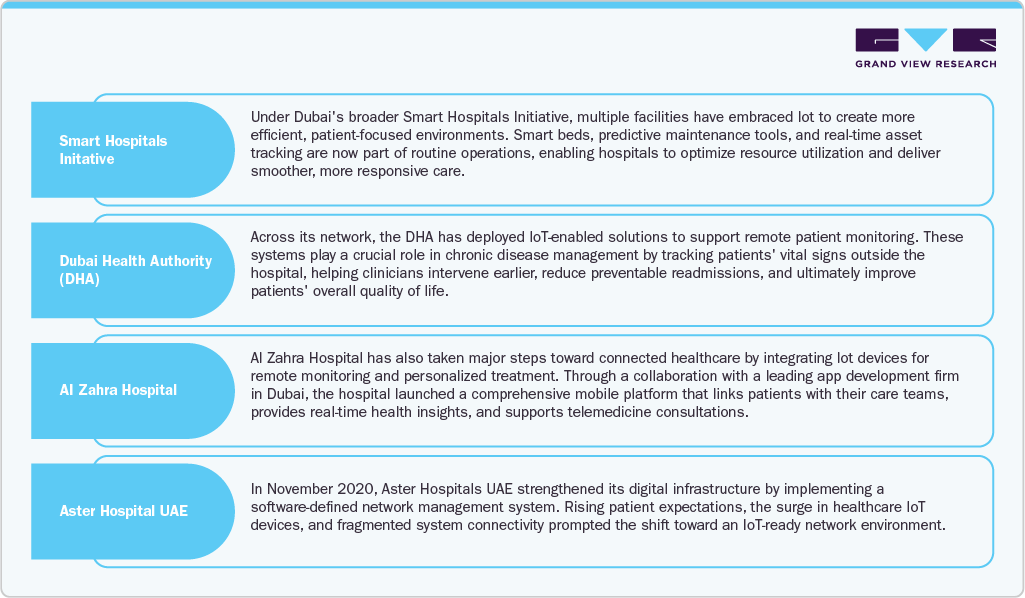
Middle East healthcare sector has witnessed strong progress in adopting IoT technologies, with several leading hospitals demonstrating how connected systems can elevate care delivery and operational efficiency.
Conclusion:
The rapid evolution of smart hospitals and IoT integration across the Middle East signals a transformative leap in healthcare delivery, where technology, connectivity, and patient-centric innovation merge seamlessly. As governments and private players continue to invest heavily in digital infrastructure, AI-powered diagnostics, and connected ecosystems, the region is not only reimagining how care is delivered but also setting new global benchmarks for healthcare excellence. Countries such as the UAE and Saudi Arabia are leading this movement-building fully digital, data-driven health systems that combine operational efficiency with personalized patient care.
Looking ahead, the convergence of IoT, AI, robotics, and remote care models will redefine how hospitals function-shifting the focus from reactive treatment to predictive and preventive health management. The growing momentum around virtual hospitals, AI-run facilities, and integrated health platforms underscores the Middle East’s vision of making healthcare smarter, faster, and more accessible for all. With continued innovation and cross-border collaboration, the region is poised to become a global hub for next-generation healthcare infrastructure.