
- Home
- »
- Medical Devices
- »
-
Surgical Equipment Market Size & Share Report, 2026-2033GVR Report cover
![Surgical Equipment Market (2026 - 2033)Report]()
Surgical Equipment Market (2026 - 2033)
Size, Share & Trends Analysis Report By Product (Surgical Sutures & Staplers, Handheld Surgical Devices), By Application (Neurosurgery, Plastic & Reconstructive Surgery), By Region, And Segment Forecasts
Market Size, 2025
$20.0BMarket Estimate, 2026
$21.8BMarket Forecast, 2033
$42.3BCAGR, 2026–2033
9.9%Surgical Equipment Market Summary
The global surgical equipment market size was valued at USD 20.0 billion in 2025 and is projected to grow from USD 21.8 billion in 2026 to USD 42.3 billion by 2033, at a CAGR of 9.9% from 2026 to 2033. North America dominated the market with the largest revenue share of 40.2% in 2025. Factors such as an increase in the incidence of lifestyle disorders that eventually require surgery, rising healthcare costs, and large unmet surgical needs are mainly driving the market growth.

Key Market Trends & Insights
- By product: Surgical sutures & staplers segment dominated the market, with a revenue share of 44.9% in 2025.
- By application: Orthopedic segment held the largest market share of 16.9% in 2025.
Regional Highlights
- Largest regional market: North America (40.2% revenue share, 2025)
- Fastest-growing regional market: Asia Pacific (highest CAGR, 2026-2033)
- By country: The U.S. held the largest market share in 2025.
Market Size & Forecast
- Market size in 2025: USD 20.0 Billion
- Estimated market size in 2026: USD 21.8 Billion
- Projected market size by 2033: USD 42.3 Billion
- CAGR (2026-2033): 9.9%
Lowered hospital stays post-surgery and increased ambulatory surgical centers are projected to fuel the market growth during the forecast period. In addition, the growing geriatric population can support market expansion as older people are at higher risk of acquiring chronic diseases and injuries. According to the India Ageing Report 2023, the number of older people across the globe is expected to double to 2.1 billion by 2050. Out of these, around 1.3 billion elderly people are expected to be from Asia.
Furthermore, the increase in the prevalence of diseases like cardiovascular and cancer that necessitate surgeries is anticipated to propel industry growth. According to the article published by WebMD LLC in January 2024, open-heart surgery in the U.S. is the most common, with nearly 400,000 procedures done every year. Thus, the large number of surgical procedures conducted across developed and developing countries is anticipated to propel the demand for surgical equipment.
Moreover, the manufacturers and industry participants are focusing on developing advanced products in the market. For instance, in August 2023, Healthium Medtech, a major medical technology firm, introduced a range of sutures, TRUMASTM, invented to address challenges encountered during suturing in minimal access surgeries. Such product launches are anticipated to support the industry’s growth over the forecast period.
The increasing geriatric population is a key factor contributing to market growth. Individuals that are aged 60 and above are at a higher risk of developing disorders that require surgery compared to the younger population. According to the Centers for Disease Control and Prevention, the number of hip replacements among people 45 and over was 310,800 in 2021.
Market Dynamics
The surgical equipment market is experiencing substantial growth as hospitals, ambulatory surgical centers (ASCs), specialty surgical clinics, and academic medical institutions increasingly invest in advanced surgical technologies to improve procedural efficiency, precision, and patient outcomes. Surgical equipment encompasses a broad range of products, including surgical instruments, electrosurgical devices, operating room equipment, surgical staplers and sutures, endoscopic systems, surgical visualization platforms, and robotic-assisted surgical systems. These technologies enable healthcare providers to perform complex procedures with enhanced accuracy, reduced invasiveness, shorter recovery times, and lower complication rates. Rising surgical procedure volumes, growing adoption of minimally invasive and robotic-assisted surgeries, increasing healthcare infrastructure investments, and the need for improved operating room efficiency are driving demand for technologically advanced surgical equipment worldwide. Furthermore, advancements in imaging integration, AI-assisted surgical guidance, smart operating rooms, and ergonomic surgical tools are transforming modern surgical practices and supporting market expansion across developed and emerging healthcare systems.
The surgical equipment market is expanding rapidly due to the increasing number of surgical procedures performed globally and the growing preference for minimally invasive surgical techniques. The rising prevalence of chronic diseases such as cardiovascular disorders, cancer, obesity, orthopedic conditions, and gastrointestinal diseases has significantly increased the demand for surgical interventions. Simultaneously, aging populations across developed and emerging economies are contributing to higher procedure volumes, as older individuals are more likely to require surgical treatment.
Minimally invasive surgery has become a key driver of equipment demand because it offers benefits such as reduced blood loss, shorter hospital stays, lower infection risks, and faster recovery. As a result, healthcare providers are increasingly investing in advanced laparoscopic instruments, energy-based devices, visualization systems, robotic-assisted platforms, and precision surgical tools. Continuous technological innovations and growing surgeon familiarity with these procedures are further accelerating the adoption of advanced surgical equipment across multiple specialties.
Despite strong growth prospects, the surgical equipment market faces challenges associated with high acquisition and maintenance costs, particularly for advanced technologies such as robotic-assisted surgical systems, integrated operating rooms, and sophisticated visualization platforms. Many healthcare facilities in developing countries and rural regions struggle to invest in these technologies due to budget limitations, inadequate infrastructure, and competing healthcare priorities.
Additionally, the effective use of advanced surgical equipment often requires specialized training, technical expertise, and ongoing maintenance support, which may not be readily available in low-resource settings. Financial constraints, reimbursement limitations, and shortages of skilled surgical personnel further restrict adoption. Consequently, many hospitals continue to rely on conventional surgical equipment, limiting access to advanced surgical technologies and slowing market penetration in certain regions.
Market Concentration & Characteristics
The rate of industry growth is high at an accelerating pace due to the rising development of advanced products and increased adoption of minimally invasive procedures.
Companies and manufacturers are innovating continuously to provide advanced products. In addition, the regulatory bodies are also supporting innovative products by providing approvals for clinical trials and marketing. For instance, in December 2023, Acclarent announced the FDA approval for its AERA Eustachian Tube Balloon Dilation System, used in the treatment of children affected with persistent obstructive Eustachian tube dysfunction.
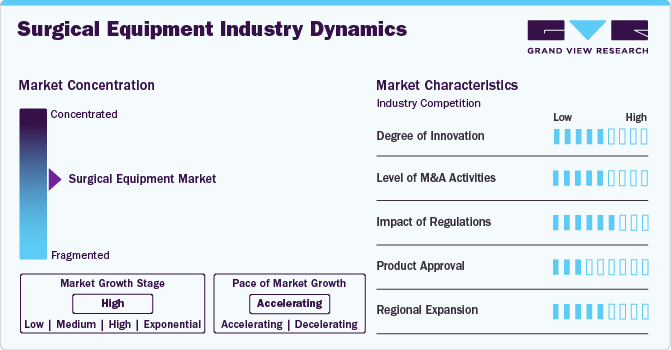
The market is also characterized by several merger and acquisition activities. Companies are undertaking acquisitions & mergers to gain a competitive advantage in the industry and the need to consolidate in a rapidly growing market. For instance, in January 2025, JUNE MEDICAL announced a strategic collaboration with Aspen Surgical Products, Inc. to distribute the Galaxy II retractor system across the U.S. market. This partnership will use Aspen Surgical’s sales network to increase JUNE MEDICAL’S Galaxy II Retractor System, which is a versatile surgical device used in multiple specialties such as orthopedics, gynecology, and others.
Regulations for medical devices, including surgical equipment, are overseen by regulatory bodies such as the Food and Drug Administration (FDA) in the U.S. and similar agencies globally. The authorities have published a regulatory framework and guidance documents to assure product effectiveness, safety, and quality standards. Furthermore, the authorities are updating their regulations for surgical instruments. For instance, in October 2022, the Central Drugs Standard Control Organization (CDSCO) published a notice about the classification of non-powered, non-sterile, hand-held, or hand-manipulated surgical instruments for general use planned to be utilized in diverse general surgical procedures.
In the surgical equipment industry, tissue adhesives and Hemostats serve as substitutes. This equipment can be used to control bleeding during surgery or wound closure.
Key market players such as Johnson & Johnson, BD, Zimmer Biomet Holdings Inc., and Medtronic hold substantial shares in the market. Their dominant presence is largely due to their well-established brands, financial position, product portfolio, and extensive distribution networks. For instance, Stryker offers diverse products like Non-Stick Bipolar Forceps, dual-directional expandable retractors, Biters, Graspers, and Scissors, among others.
The companies are significantly focusing on increasing the reach of their products in several countries. They are forming distribution partnerships to distribute their products across numerous markets. For instance, in April 2022, KitoTech Medical partnered with Corza Medical to sell and market microMend's wound closure products, including an array of miniature staples.
Analyst Perspective
The surgical equipment market is positioned at the center of several long-term healthcare and surgical care trends, including the rising global volume of surgical procedures, growing prevalence of chronic diseases, expanding aging populations, and continuous advancements in minimally invasive and robotic-assisted surgery. Increasing demand for effective treatment of cardiovascular diseases, cancer, orthopedic disorders, neurological conditions, gastrointestinal diseases, and trauma-related injuries is creating substantial opportunities for surgical equipment manufacturers, healthcare providers, and ambulatory surgical centers as healthcare systems seek greater procedural efficiency, improved patient outcomes, and reduced healthcare costs.
Furthermore, the ongoing shift toward minimally invasive and precision-based surgical interventions is fundamentally transforming the market landscape. Advanced surgical technologies such as robotic-assisted surgery platforms, high-definition visualization systems, energy-based tissue sealing devices, electrosurgical equipment, and AI-enabled surgical guidance tools are enabling enhanced surgical accuracy, superior intraoperative visualization, reduced tissue trauma, shorter hospital stays, and faster patient recovery compared with conventional surgical approaches.
Product Insights
Based on product, the surgical sutures & staplers segment led the market with the largest revenue share of 44.9% in 2025. The dominance of this segment can be due to the high adoption rate of staplers and sutures owing to their growing usage in wound closure processes. In addition, the adoption of staplers is expected to increase due to the advantages offered by staplers are superior to those offered by sutures. These advantages include rapid wound healing and a low risk of infection. Moreover, the companies are launching novel products in this segment. For instance, in June 2022, a major industry player, Johnson & Johnson’s Ethicon, launched a next-gen Echelon 3000 stapler.
The electrosurgical devices segment is anticipated to register the fastest CAGR of 10.77% over the forecast period. The growth of the segment can be attributed to the increasing demand for these devices in minimally invasive surgeries. Moreover, major market players such as Medtronic and Stryker offer electrosurgical devices. Thus, the availability of products from top companies is anticipated to support the segment growth.
Application Insights
Based on application, the orthopedic segment led the market with the largest revenue share of 16.9% in 2025. The other segments include radiosurgery, urological, and general surgeries. The increasing prevalence of cancer across the globe is anticipated to propel the demand for radiosurgery, which is expected to drive the need for surgical equipment. According to the article published by the American Cancer Society in January 2023, an estimated 609,820 individuals in the U.S. are expected to die from cancer in 2023.

The wound closure segment is expected to witness the fastest CAGR over the forecast period. This is due to the growing incidences of chronic wounds, the rising number of surgeries worldwide, and technological advancements in wound closure, and also the significantly improved patient outcomes and recovery times. For instance, in May 2023, the engineers at the Massachusetts Institute of Technology (MIT) designed smart sutures or sutures with smart applications, which are made of purified collagen from cows and are coated with a layer of hydrogel, which is embedded with types of cargo - microparticles that can sense inflammation, drug molecules, or living cells. These sutures can be adopted to heal wounds or surgical incisions in the body.
Regional Insights
North America dominated the surgical equipment market with the largest revenue share of 40.2% in 2025. This is due to the high prevalence of chronic diseases such as orthopedic diseases, cancer, and cardiovascular disorders, which drive the demand for advanced medical equipment. In addition, the presence of major product providers in the region, such as STERIS and KLS Martin Group is projected to improve the accessibility of products.

U.S. Surgical Equipment Market Trends
The surgical equipment market in the U.S. held the largest share in the North America region in 2025 due to the presence of key players, increased ambulatory surgical centers, and significant investments in novel developments of equipment. The major market participants like Stryker, Aspen Surgical, Zimmer Biomet, and Medtronic are present in the U.S.
Europe Surgical Equipment Market Trends
The Europe surgical equipment industry was identified as a lucrative region in this industry due to the growing elderly population coupled with the rising surgical procedures across the region. Moreover, the increasing launches of medical devices and instruments by industry players are expected to drive regional growth.
The surgical equipment industry in the UK is expected to grow over the forecast period, majorly due to the increasing availability of equipment used in surgeries like forceps, spatulas, sutures, dilators, and retractors, among others, across the country.
France surgical equipment industry is expected to grow over the forecast period due to the growing geriatric population in the country, as older people are at higher risk of undergoing surgeries. The increase in the number of surgeries in France due to rising sports activities along with rising injuries is also anticipated to boost the demand for surgical equipment in the country.
The Germany surgical equipment industry is expected to grow over the forecast period due to increased surgeries and the rising prevalence of chronic diseases. Moreover, the Germany-based industry product provider like KLS Martin Group is anticipated to support the market expansion.
Asia Pacific Surgical Equipment Market Trends
The Asia Pacific surgical equipment industry is expected to witness the fastest CAGR during the forecast period. This progress is driven by advancements in healthcare infrastructure, the rising prevalence of chronic diseases, and an increasing geriatric population. In addition, developing countries such as India and China and the rising focus of industry participants in these countries are projected to propel the regional industry.
Japan surgical equipment industry is expected to witness significant growth in the coming years. The rising older population across Japan is projected to boost market growth. According to the article published by the World Economic Forum in September 2023, over 1 in 10 individuals in Japan are aged 80 or older. In addition, around 33.33% of the country’s population is aged 65 or more. Thus, the presence of a large potential patient pool is expected to propel the demand for surgical equipment.
The surgical equipment industry in China is expected to grow over the forecast period due to the rising healthcare expenditure in China. In addition, the increasing approvals from the regulatory body and rising product launches are anticipated to support the market in China. For instance, in September 2023, China’s National Medical Products Administration (NMPA) approved the antibacterial sutures from Genesis MedTech.
The surgical equipment industry in India is expected to grow over the forecast period due to the rising focus of industry participants in the Indian market, growing investments in medical instruments, and increasing expansion activities for medical devices in India. For instance, in January 2024, the UK-based Surgical Instruments Group Holdings (SIGH) revealed that the company would establish a medical device manufacturing facility in Hyderabad. Thus, the increasing manufacturing of medical devices is anticipated to create opportunities for equipment providers in the country market.
MEA Surgical Equipment Market Trends
The surgical equipment industry in MEA is expected to grow over the forecast period.
The surgical equipment industry in Saudi Arabia is expected to grow over the forecast period due to the rising number of individuals undergoing surgeries. According to the article published by the Saudi Gazette report in March 2023, over 290,000 non-critical surgeries were conducted within various regions of Saudi Arabia in 2022.
The surgical equipment industry in Kuwait is expected to grow over the forecast period due to the significant increase in the number of surgeries being performed in the country. For instance, according to the article released by the Emirates Health Services (EHS) in August 2022, Kuwait Hospital in Sharjah conducted 939 surgeries and received 15,040 patients in the initial half of 2022, which shows an increase from the 573 surgeries and 10,992 patients recorded during the same period in the previous year.
Key Surgical Equipment Company Insights
The competitive scenario in the surgical equipment industry is driven by both new entrants and established players, with partnerships, market expansion, and innovative product launches being key strategies. Companies are developing advanced products that can increase the patient’s comfort. In addition, the rising investments are influencing the development of industry products.
Key Surgical Equipment Companies:
The following key companies have been profiled for this study on the surgical equipment market.
-
Johnson & Johnson (Ethicon Inc.)
-
Zimmer Biomet
-
B. Braun SE
-
GPC Medical
-
IndoSurgicals Private Limited
-
Smith + Nephew
-
Stryker
-
Aspen Surgical
-
Medtronic
-
BD
Competitive Benchmarking
Category
Operating Strategies
Competitive Edge
Weakness
Established Players (Medtronic; Johnson & Johnson (Ethicon); B. Braun; Stryker; Zimmer Biomet)
- Established companies focus on offering comprehensive surgical equipment portfolios that include surgical instruments, electrosurgical devices, surgical staplers and sutures, operating room equipment, visualization systems, robotic-assisted surgery platforms, and advanced energy devices. They invest heavily in R&D, surgeon education programs, hospital partnerships, and digital surgery ecosystems to strengthen market presence and support procedural efficiency.
- Extensive global distribution networks, strong brand recognition, large installed bases in hospitals and ambulatory surgical centers, and broad product portfolios spanning multiple surgical specialties. Strong clinical evidence, regulatory expertise, and long-standing customer relationships support sustained market leadership.
- Large organizational structures may slow response to rapidly evolving surgical technologies and emerging market needs. High regulatory compliance costs, complex product portfolios, and lengthy product development cycles can delay innovation and commercialization.
Emerging Players (GPC Medical; IndoSurgicals Private Limited; Purple Surgical; BOSS Instruments; Aspen Surgical)
- Emerging companies focus on cost-effective surgical instruments, specialized handheld devices, innovative wound closure solutions, compact electrosurgical technologies, and niche surgical applications. Many emphasize product customization, regional expansion, and targeted solutions for hospitals, ambulatory surgical centers, and emerging healthcare markets.
- Agile business models enable faster product development and adaptation to customer requirements. Competitive pricing strategies, specialization in niche surgical segments, and the ability to address unmet needs in developing markets provide differentiation from larger competitors.
- Limited financial resources, narrower product portfolios, and smaller distribution networks compared with multinational manufacturers. Challenges related to regulatory approvals, clinical validation, global expansion, and brand recognition may restrict large-scale market penetration.
Recent Developments
-
In January 2025, JUNE MEDICAL announced a strategic collaboration with Aspen Surgical Products, Inc. to distribute the Galaxy II retractor system across the U.S. market. This partnership will use Aspen Surgical’s sales network to increase JUNE MEDICAL’S Galaxy II Retractor System, which is a versatile surgical device used in multiple specialties such as orthopedics, gynecology, and others.
-
In September 2023, PainTEQ, the U.S.-based firm, introduced a new Surgery-Ready Instrument set and provided a cost-effective and safe option for interventional pain physicians.
-
In June 2023, SURE Retractors Inc., a medical device firm, launched single-use, sterile retractors for trauma, orthopedic, and spinal surgery.
-
In April 2023, Orthofix Medical (Orthofix), a spine and orthopedics company, introduced the Fathom pedicle-based retractor system and the Lattus lateral access system for spine procedures.
Global Surgical Equipment Market Report Scope
Report Attribute
Details
Market size in 2025
USD 20.0 billion
Estimated market size in 2026
USD 21.8 billion
Projected market size by 2033
USD 42.3 billion
Growth rate
CAGR of 9.9% from 2026 to 2033
Historical data
2021 - 2024
Forecast period
2026 - 2033
Quantitative units
Revenue in USD million/billion and CAGR from 2026 to 2033
Report coverage
Revenue forecast, company ranking, competitive landscape, growth factors, and trends
Segments covered
Product, application, region
Regional scope
North America; Europe; Asia Pacific; Latin America; MEA
Country scope
U.S.; Canada; Mexico; Germany; UK; France; Italy; Spain; Norway; Denmark; Sweden; China; Japan; India; South Korea; Australia; Thailand; Brazil; Argentina; Saudi Arabia; South Africa; UAE; Kuwait
Key companies profiled
Johnson & Johnson (Ethicon Inc.); Zimmer Biomet; B. Braun SE; GPC Medical; IndoSurgicals Private Limited; Smith + Nephew; Stryker; Aspen Surgical; Medtronic; BD
Customization scope
Free report customization (equivalent up to 8 analysts' working days) with purchase. Addition or alteration to country, regional & segment scope.
Pricing and purchase options
Avail customized purchase options to meet your exact research needs. Explore purchase options
Global Surgical Equipment Market Report Segmentation
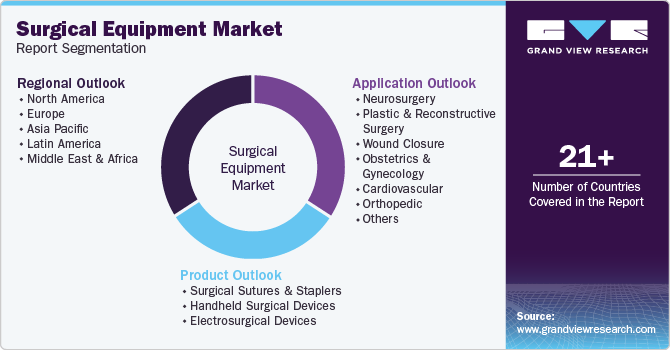
This report forecasts revenue growth at global, regional, and country levels and provides an analysis of the latest industry trends in each of the sub-segments from 2021 to 2033. For this study, Grand View Research has segmented the global surgical equipment market report based on product, application, and region:
-
Product Outlook (Revenue, USD Million, 2021 - 2033)
-
Surgical Sutures & Staplers
-
Handheld Surgical Devices
-
Forceps & Spatulas
-
Retractors
-
Dilators
-
Graspers
-
Auxiliary Instruments
-
Cutter Instruments
-
Others
-
-
Electrosurgical Devices
-
-
Application Outlook (Revenue, USD Million, 2021 - 2033)
-
Neurosurgery
-
Plastic & Reconstructive Surgery
-
Wound Closure
-
Obstetrics & Gynecology
-
Cardiovascular
-
Orthopedic
-
Others
-
-
Regional Outlook (Revenue, USD Million, 2021 - 2033)
-
North America
-
U.S.
-
Canada
-
-
Europe
-
Germany
-
UK
-
France
-
Italy
-
Spain
-
Norway
-
Sweden
-
Denmark
-
-
Asia Pacific
-
China
-
Japan
-
India
-
Australia
-
South Korea
-
Thailand
-
-
Latin America
-
Mexico
-
Brazil
-
Argentina
-
-
MEA
-
South Africa
-
Saudi Arabia
-
UAE
-
Kuwait
-
-
Research Methodology
The surgical equipment market figures in this report are based on a proven research process that combines executive interviews with secondary research from proprietary databases, company filings, and recognized regulatory and institutional sources. Market size is built through value-chain sizing - reconciling supply-side and demand-side estimates - and triangulated with bottom-up and top-down approaches. Every estimate passes multiple levels of expert validation before publication, with each surgical equipment segment quantified using the revenue-capture definitions in the table below.
Segment Definition
Segment - Product
Revenue capture definition
Surgical Sutures & Staplers
Revenue is captured through the sale of absorbable and non-absorbable sutures, surgical staplers, stapling reloads, and related wound closure consumables used across general, cardiovascular, gastrointestinal, gynecological, and orthopedic surgeries. Recurring demand is driven by procedure volumes.
Handheld Surgical Devices
Revenue is generated from the sale of reusable and disposable surgical instruments, including forceps, scalpels, retractors, scissors, graspers, needle holders, and specialty instruments. Revenue depends on hospital procurement cycles, replacement demand, and surgical procedure growth.
Electrosurgical Devices
Revenue is derived from electrosurgical generators, handpieces, electrodes, bipolar and monopolar instruments, vessel sealing systems, and disposable accessories. Revenue streams include both capital equipment purchases and recurring consumable sales.
Segment - Application
Revenue capture definition
Neurosurgery
Revenue is captured through the utilization of specialized surgical equipment and instruments used in cranial, spinal, and peripheral nerve procedures, including neurosurgical navigation systems, microsurgical instruments, electrosurgical tools, and associated disposables.
Plastic & Reconstructive Surgery
Revenue is generated from surgical instruments, tissue handling devices, electrosurgical systems, wound closure products, and specialty tools used in cosmetic and reconstructive procedures performed in hospitals and specialty clinics.
Wound Closure
Revenue is captured from the sale of sutures, staplers, clips, tissue adhesives, sealants, and wound closure strips used to close surgical incisions and traumatic wounds. Revenue is closely linked to surgical volumes and emergency care procedures.
Obstetrics & Gynecology
Revenue is generated from surgical equipment utilized in cesarean sections, hysterectomies, myomectomies, pelvic floor repair procedures, and minimally invasive gynecologic surgeries, including instruments, energy devices, and closure products.
Cardiovascular
Revenue is captured through sales of specialized surgical instruments, vessel sealing devices, cardiac stabilization tools, surgical staplers, and electrosurgical equipment used in cardiac and vascular procedures. Revenue growth is influenced by increasing cardiovascular disease prevalence and surgical intervention rates.
Orthopedic
Revenue is generated from surgical instruments, power tools, electrosurgical devices, and wound closure products used in fracture repair, joint replacement, sports medicine, and spinal surgeries. Procedure volume and aging populations are key revenue drivers.
Others
Revenue is captured from surgical equipment used across additional specialties such as urology, ENT, ophthalmology, thoracic surgery, pediatric surgery, and general surgery. Revenue is derived from both capital equipment and procedure-related consumables.
Estimation Model
Phase Title
Key Question
Process Steps
Data Sources
Scope Definition
What is being studied?
1. Define Surgical Equipment Categories 2. Scope applications by surgical specialty (neurosurgery, orthopedics, cardiovascular, urology, gynecology, etc.) 3. Set geographic boundaries (global/regional) 4. Align scope with key forecast horizon (2020-2030)
AGSYS, ISAPS, WHO, CDC, AHA, AAOS
Build the Product Base
How large is the total addressable market?
1. Gather installed base of surgical equipment and operating rooms 2. Apply product-specific pricing and replacement assumptions 3. Project Surgical Volume Trajectories
Hospital databases, surgical procedure databases, hospital procurement databases, hematology surgery registries
Estimate Penetration
What proportion of the market is active and utilizing offered features?
1. Survey Surgical Modality Adoption Rates 2. Map procedure volumes to equipment utilization rates 3. Identify technology mix (conventional, minimally invasive, robotic-assisted, and AI-enabled) 4. Triangulate with Vendor Shipment and Replacement Data
Primary interviews, company filings, data surveys
Revenue Conversion
How does volume become revenue?
1. Collect Surgical Cost Metrics 2. Segment by End-User/Room 3. Apply end-use channel share 4. Cross-check with Import/Export Data
Hospital pricing sheets, procurement data, surgical cost databases, export/import databases
Delivered Customizations
This report has been delivered with the following In-depth customizations
Client Request
Customization Delivered
Value Adds
Competitive Landscape Analysis
Conducted a comprehensive competitive landscape assessment for the global surgical equipment market, covering manufacturers of surgical instruments, electrosurgical devices, energy-based systems, operating room equipment, surgical robotics, visualization systems, and minimally invasive surgery platforms. The study evaluated company positioning, product portfolio differentiation, innovation pipelines, regulatory approvals, manufacturing capabilities, strategic partnerships, mergers and acquisitions, geographic expansion strategies, and commercialization activities. It also benchmarked leading multinational corporations and specialized surgical equipment providers to identify market share dynamics, technology adoption trends, pricing strategies, and competitive gaps across hospital and ambulatory care settings.
Enables stakeholders to understand the competitive dynamics of the surgical equipment market, assess technology leadership, benchmark innovation capabilities, identify partnership and acquisition opportunities, and develop strategic initiatives to strengthen market positioning across diverse surgical specialties and healthcare facilities.
Segment by Product Analysis
Conducted a detailed segment-level analysis of the surgical equipment market across key product categories, including surgical instruments, electrosurgical equipment, surgical sutures and staplers, operating room equipment, surgical visualization systems, and robotic-assisted surgery platforms. The study assessed demand patterns, technological advancements, procedure volume trends, adoption rates, and pricing preferences for leading brands and private labels across product segments. It further evaluated growth traction trends such as AI-enabled surgical systems, smart operating rooms, advanced anesthesia systems, and robotic-assisted procedures influencing market growth.
Enables stakeholders to gain granular insights into high-growth segments, identify emerging opportunities, evaluate competitive intensity within individual segments, and align product portfolio and investment strategies with changing surgical practices and healthcare provider requirements.
Macroeconomic Analysis
Conducted an in-depth assessment of macroeconomic and healthcare infrastructure trends shaping the surgical equipment market. The analysis covered healthcare growth, hospital expansion, reimbursement mechanisms, demographic shifts, and government incentives influencing modernization. The study analyzed economic indicators such as GDP growth, healthcare procurement, reimbursement dynamics, supply chain disruptions, inflationary pressures, raw material costs, and international trade patterns impacting equipment distribution. Additionally, it evaluated the shift toward outpatient surgical care and ambulatory surgery centers (ASCs), which is reshaping equipment purchasing patterns globally.
Enables stakeholders to understand key economic, demographic, regulatory, and healthcare infrastructure factors driving or restraining market growth. The analysis supports long-term strategic planning, investment prioritization, pricing optimization, market entry decisions, and risk assessment across regional and global surgical equipment markets.
Frequently Asked Questions About This Report
The global surgical equipment market size was estimated at USD 20.0 billion in 2025 and is expected to reach USD 21.8 billion in 2026.
The global surgical equipment market is expected to grow at a compound annual growth rate of 9.9% from 2026 to 2033 to reach USD 42.3 billion by 2033.
The surgical sutures & staplers product segment held the maximum market share of almost 44.9% in 2025 in the surgical equipment market, due to large usage in wound closure procedures.
Some key players operating in the surgical equipment market include Johnson & Johnson (Ethicon Inc.); Zimmer Biomet; B. Braun SE; GPC Medical; IndoSurgicals Private Limited; Smith + Nephew; Stryker; Aspen Surgical; Medtronic; BD
Key factors that are driving the surgical equipment market growth include the Increasing prevalence of chronic diseases, growing geriatric population base, rise in the number of surgical procedures, and introduction of technologically advanced products.
North America dominated the surgical equipment market with a share of 40.2% in 2025.
Asia Pacific is the fastest-growing region over the forecast period.
The surgical sutures & staplers segment led the market with the largest revenue share of 44.9% in 2025. The dominance of this segment can be due to the high adoption rate of staplers and sutures owing to their growing usage in wound closure processes.
Orthopedic segment held the largest revenue share of 16.9% in 2025, while wound closure is the fastest-growing area.
About the Author(s)
Medical Devices Research Team
Healthcare · Medical DevicesThis report was authored by the medical devices research team at Grand View Research - comprising two research analysts, one senior research analyst, and one industry expert - with specialized expertise in the medical devices segment of the healthcare industry. All findings are based on proprietary healthcare databases, executive interviews, and regulatory analysis, subject to internal peer review prior to publication.
Last Updated:
Speak to Analyst


Customize this report to your needs — add regions, segments, or data points, with 20% free customization.
Or view our licence options:


ISO 9001:2015 & 27001:2022 Certified
We are GDPR and CCPA compliant! Your transaction & personal information is safe and secure. For more details, please read our privacy policy.


