The Hormuz Crisis: A Structural Reset for Global Oil & Gas Markets
Executive Summary
The 2026 Strait of Hormuz crisis marks a critical inflection point for the global oil and gas industry, exposing the structural vulnerabilities of an energy system heavily dependent on key maritime chokepoints. As a corridor handling a significant share of global oil and LNG trade, its disruption has triggered widespread impacts across supply chains, pricing, and geopolitical dynamics.
In the near term, the crisis has tightened global supply, driving sharp increases in oil prices, heightened volatility, and disruptions in trade flows. Rerouting of cargoes, along with rising freight and insurance costs, has further constrained effective supply, placing import-dependent regions such as Asia and Europe under increased energy security pressure.
More importantly, the crisis signals a structural shift in market priorities, from cost efficiency toward resilience and supply security. As governments and industry players respond, the global energy landscape is expected to evolve through diversification of supply sources, investment in alternative infrastructure, and a stronger focus on energy independence.
Key Strategic Findings
|
~20 Mbd Oil through Hormuz daily, as of 2025 (equivalent of about 20% of global petroleum liquids consumption) |
25% Global seaborne oil trade transits the Strait (of which ~80% destined for Asia) |
19% Global LNG Trade transits through the Strait (i.e., 93% of Qatar and 96% of the UAE’s LNG exports) |
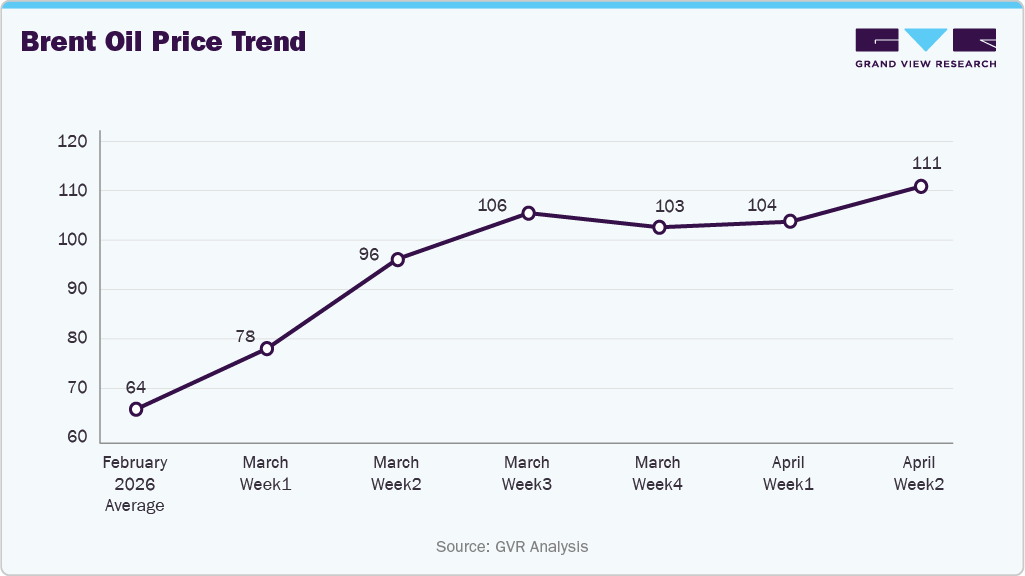
$115/bbl Brent crude oil price reached in March 2026 (from an average of $64 in February 2026) |
~142 transits through the Strait between 1-25 March 2026 (compared to > 2,600 last year, same period) |
-
Global LNG supply security has been materially disrupted, as attacks on QatarEnergy infrastructure on March 18-19, 2026, have reduced Qatar’s export capacity by ~17% (12.8 MTPA). The disruption is estimated to result in ~$20 billion in annual revenue losses and could take up to five years to fully restore, significantly affecting LNG supply to Europe and Asia.
-
The Strait of Hormuz disruption has triggered a historic collapse in global oil trade flows, with Middle Eastern exports falling by over 60% (as of Mid-March 2026), from ~25 Mbd to below 10 Mbd, alongside regional production cuts of 7–10 Mbd (up to ~10% of global demand). Major producers have been forced to curtail output significantly, including the UAE (>50% cuts), Iraq (~70%), and Saudi Arabia (~20%), highlighting the scale of upstream disruption.
-
OPEC crude output fell to ~21.6 Mbd in March 2026, down by nearly 7 Mbd from pre-crisis levels (Feb 2026), marking one of the steepest supply contractions since the 2020 pandemic shock and underscoring the severity of the Hormuz disruption.
1. Why the Strait of Hormuz Matters?
The Strait of Hormuz is one of the most critical energy transit chokepoints in the global oil and gas system, serving as a primary corridor for exports from major Middle Eastern producers including Saudi Arabia, Iraq, the United Arab Emirates, and Qatar. Approximately 20% of global petroleum liquids consumption and around 25% of seaborne oil trade pass through this narrow waterway, underscoring its central role in global energy flows.
In addition to crude oil, the Strait also facilitates nearly 19% of global LNG trade, with Qatar, one of the world’s largest LNG exporters, highly dependent on this route. A significant portion of these energy flows is directed toward Asia, particularly China, India, Japan, and South Korea, making the region structurally reliant on uninterrupted transit through Hormuz.
Despite its importance, viable large-scale alternatives to the Strait remain limited. While some bypass infrastructure exists, such as pipelines and alternative export routes, these lack sufficient capacity to fully offset disruptions. As a result, any instability in the Strait has immediate and far-reaching implications for global energy supply, pricing, and security.
2. Global Supply Shock
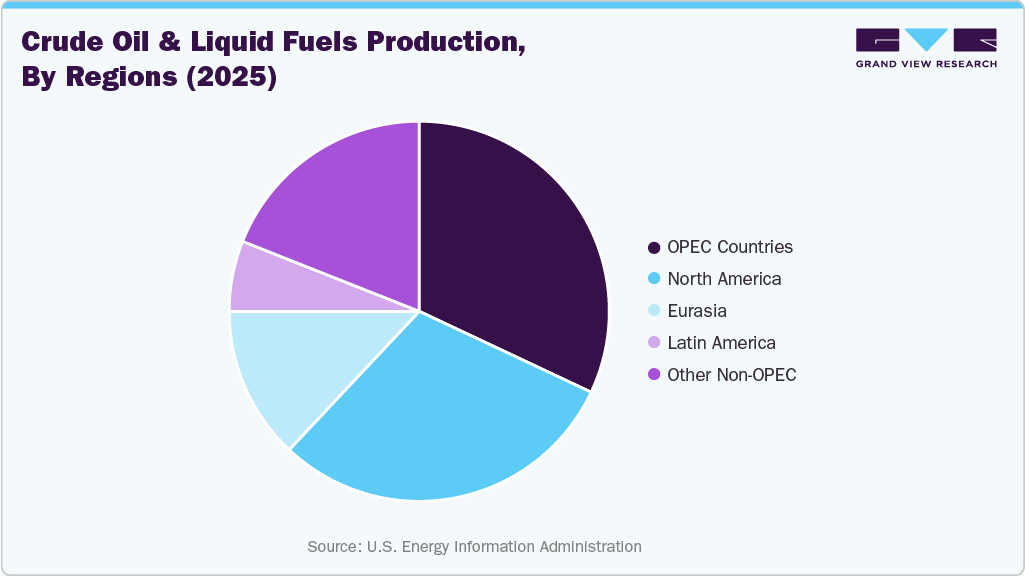
Global crude oil and liquid fuels production increased from 102.66 Mbd in 2023 to 106.31 Mbd in 2025, reflecting a steady expansion in supply driven primarily by non-OPEC regions. OPEC production remained relatively stable, rising marginally from 32.88 Mbd in 2023 to 33.79 Mbd in 2025. In contrast, North America emerged as the key growth engine, with production increasing from 29.86 Mbd to 31.76 Mbd over the same period. This growth is largely attributable to the United States, where output rose significantly from 21.98 Mbd in 2023 to 23.61 Mbd in 2025, reinforcing its position as the world’s leading oil producer.
Eurasian production remained relatively flat, hovering around 13.5 Mbd, with Russia maintaining stable output despite geopolitical pressures. Meanwhile, Latin America showed notable growth, increasing from 6.24 Mbd to 6.74 Mbd, supported by rising production in Brazil and Argentina. Overall, the global supply landscape of 2025 reflects a gradual shift toward non-OPEC production dominance, particularly led by North America, while OPEC continues to play a stabilizing role in balancing global markets.
Global oil production trends in early 2026 reflect a sharp transition from pre-emptive supply expansion to crisis-driven contraction. In February 2026, OPEC production increased by approximately 530,000 barrels per day, led by Saudi Arabia, which raised output to over 10.8 Mbd as part of a contingency strategy anticipating potential supply disruptions in the Middle East. This increase occurred despite OPEC+ maintaining formal output targets, highlighting proactive market intervention to stabilize supply.
However, this upward trend reversed abruptly following the escalation of conflict at the end of February. By March 2026, OPEC output had declined sharply to approximately 21.6 Mbd, reflecting a contraction of nearly 7 Mbd from recent levels. The collapse was driven by widespread export disruptions, logistical constraints, and forced production shut-ins across key Gulf producers, marking one of the most severe supply shocks since the 2020 pandemic.
3. Global Trade Routes
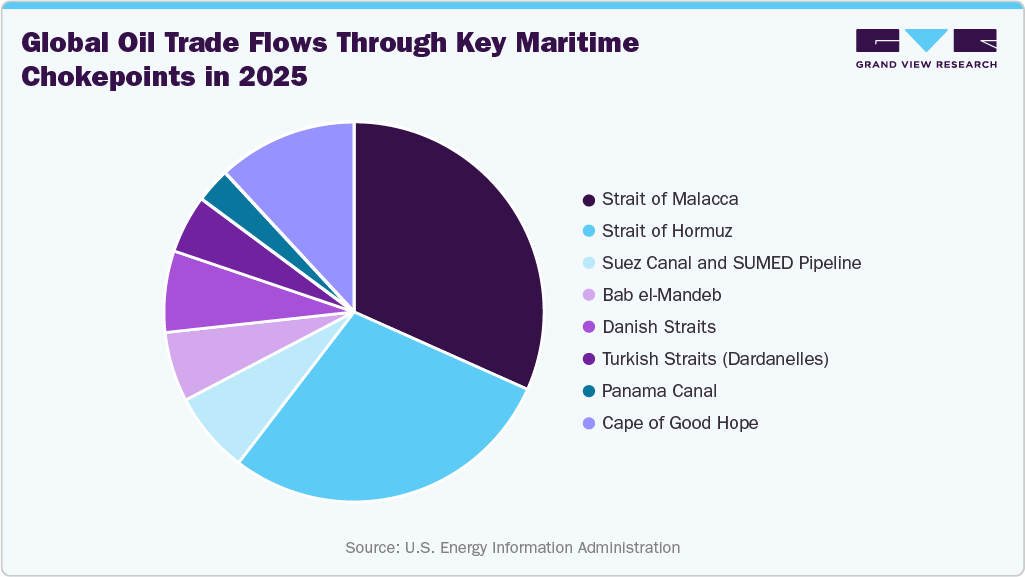
The global maritime oil trade is concentrated across a few critical chokepoints, with the Strait of Malacca (31.7%) and the Strait of Hormuz (28.6%) collectively accounting for over 60% of total seaborne oil flows. This highlights the central role of Asia-bound trade routes and Middle Eastern export corridors in global energy movement. Secondary routes such as the Cape of Good Hope (12.4%) have gained prominence, reflecting ongoing rerouting of vessels due to disruptions in the Red Sea region. Meanwhile, traditional corridors including the Suez Canal & SUMED pipeline (6.7%) and Bab el-Mandeb (5.7%) have seen relatively lower shares, indicating shifting trade patterns.
Overall, the distribution underscores a high structural dependence on a limited number of maritime passages, increasing the vulnerability of global oil trade to geopolitical and logistical disruptions.
Emerging alternative corridors such as the Russia–Iran Caspian route (INSTC) highlight efforts to bypass traditional maritime chokepoints; however, these routes remain constrained by limited capacity, infrastructure gaps, and geopolitical risks. As a result, they are not yet scalable substitutes for primary routes like the Strait of Hormuz, which continues to account for a significant share of global oil flows.
3. Trade & Chokepoint Dependency by Region
The disruption of flows through the Strait of Hormuz resulted in a decline of over 60% in Middle Eastern oil exports, while concurrent production cuts across key Gulf producers further reduced available supply. Given that nearly 20% of global oil supply typically transits through the Strait, markets incorporated a substantial risk premium associated with potential prolonged disruption.
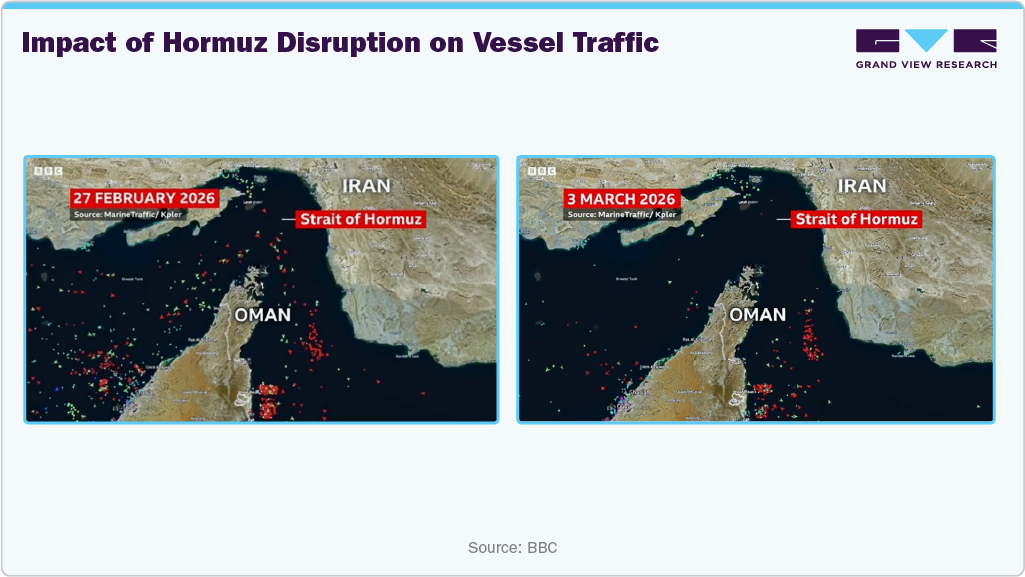
Additionally, the rerouting of cargoes via longer alternative pathways increased freight costs, transit times, and insurance premiums, further constraining effective supply in the short term. These factors, combined with heightened geopolitical uncertainty, drove sustained volatility and kept Brent prices elevated despite short-term corrections.
|
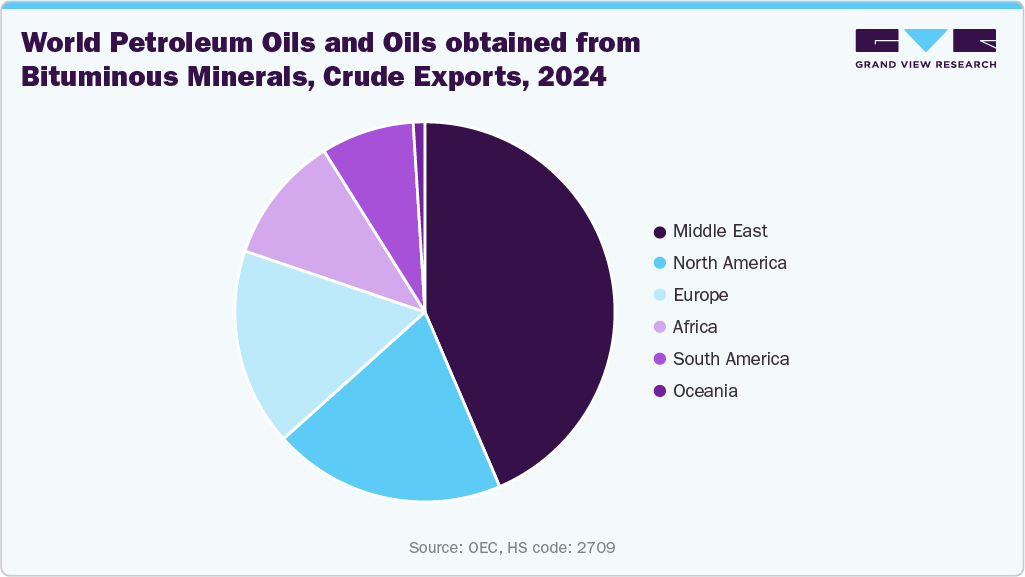
Region |
Share of Global Exports |
Key Characteristics |
Exposure to Disruption |
|
Middle East |
~43.8% |
Largest export hub; exports from Saudi Arabia, Iraq, UAE, Kuwait heavily oriented toward global markets |
Very high (strong reliance on Strait of Hormuz transit) |
|
North America |
~19.9% |
Diversified export routes (Atlantic & Pacific); led by U.S. and Canada |
Low–moderate (flexible routing, limited chokepoint dependence) |
|
Europe |
~16.7% |
Moderate exporter; largely driven by Norway and intra-regional trade |
Low (less dependent on single chokepoint) |
|
Africa |
~10.9% |
Export-oriented; key suppliers include Nigeria and Angola |
Moderate (dependent on external demand and trade routes) |
|
South America |
~8.2% |
Growing exporter; led by Brazil and Venezuela |
Moderate (export-driven, reliant on global demand flows) |
4. Global Oil Price Dynamics
The ongoing geopolitical conflict (U.S.-Iran War) has significantly escalated global oil prices due to severe supply-side disruptions and heightened market uncertainty. The sharp contraction in global crude oil supply translated into a rapid escalation in oil prices, with benchmarks rising by nearly 50–60% within a month as markets reacted to tightening supply and escalating geopolitical risk. The disruption of flows through the Strait of Hormuz, responsible for a significant share of global oil trade, led to a sharp reduction in available barrels, prompting a strong supply-driven repricing across global markets.
Brent crude oil prices mirrored this trend, rising from an average of $64/bbl in February 2026 to above $100/bbl by mid-March, and peaking at approximately $116/bbl on March 30, 2026, as the conflict intensified and concerns over supply disruption reached their peak. Initial price increases in early March reflected geopolitical risk anticipation, but as the conflict escalated and oil flows were materially disrupted, markets rapidly transitioned to full supply shock pricing. Although prices briefly corrected to around $103/bbl in the fourth week of March, this reflected short-term market repositioning rather than any structural easing of supply constraints.
Prices are expected to further elevate in April 2026, reflecting continued supply tightness and persistent geopolitical risk premiums. In the event of a prolonged conflict or sustained closure of key transit routes, prices could escalate further, with extreme scenarios projecting levels as high as $150–200 per barrel, highlighting the significant uncertainty and structural stress in global oil markets.
5. Current War Scenario Impact
Impact of Geopolitical Disruptions on Major Oil & Gas Consuming Regions
|
Region |
Key Countries |
Dependency Type |
Exposure to Disruption |
Key Impact |
|
Asia Pacific |
China, India, Japan, South Korea |
High import dependence on Middle East crude |
High (Hormuz + Malacca dependent) |
Supply risk, higher import costs, refining margin pressure |
|
Europe |
Germany, France, Italy |
Diversified imports (ME, U.S., Africa) |
Moderate (Suez/Bab el-Mandeb disruption) |
Increased freight costs, longer routes, and pricing pressure |
|
North America |
United States |
Largely self-sufficient |
Low |
Limited supply disruption, but exposed to global price increases |
|
Middle East |
Saudi Arabia, United Arab Emirates |
Export-driven |
High (Hormuz dependent) |
Export disruptions, revenue volatility |
|
Emerging Markets |
Brazil, South Africa |
Mixed dependency |
Moderate |
Higher import bills, currency and inflation pressure |
Asia Pacific — Most Exposed Demand Center
Asia Pacific is the largest energy-consuming region globally, accounting for approximately 35–40 million barrels per day (mb/d) of oil demand, representing ~35–40% of global consumption. This demand is driven by major economies such as China, India, Japan, and South Korea, with the region contributing the majority of global demand growth. In addition, Asia Pacific consumes approximately 850–950 billion cubic meters (bcm) of natural gas annually, accounting for ~20–25% of global demand, with consumption growth led by China and other emerging Asian economies.
China
China consumes ~15–16 mb/d of oil, with ~70–75% import dependence and remains structurally exposed to Middle Eastern supply routes via the Strait of Hormuz. As a result, escalation in the Iran conflict (March–April 2026) has led to tightening of Middle Eastern crude flows and price spikes, directly impacting China’s refining system—particularly independent refiners.
Key Impacts
-
In early March, China directed refiners to halt new fuel export contracts and cancel some shipments due to crude supply disruptions from the Iran war, with export cuts expected from April, while key refiners such as Zhejiang Petrochemical Corp and Sinopec (Fujian refinery) reduced throughput—tightening Asian supply and pushing diesel margins to ~$49/bbl and jet fuel cracks above $55/bbl.
-
Independent refiners in Shandong province reduced utilization to ~50–55% (from ~60–70% earlier), (Mar 31–Apr 2, 2026), due to Brent crude moving above ~$100/bbl and reduced availability of discounted Iranian crude cargoes
-
PetroChina supplied ~1.8 million barrels of Murban crude (loaded mid-March from Dalian, delivered late March to Jurong Island, Singapore) to its 50%-owned Singapore Refining Co. (with Chevron), marking a rare crude export from China to offset supply disruptions from the Iran war, which has cut Middle East flows and forced the 285 kbpd refinery to operate at ~60% capacity since early March.
Overall, the impact on China has been operational and cost-driven rather than supply-driven, with disruptions reflected in refinery throughput cuts, margin compression, and logistical adjustments. However, diversified sourcing, strategic reserves, and access to discounted crude have enabled China to avoid severe physical supply shortages.
India
India consumes ~5–6 mb/d of oil, with ~85–90% import dependence, making it one of the most import-reliant major economies. A significant share of crude imports originates from the Middle East, with key volumes transiting through the Strait of Hormuz, leaving India highly exposed to geopolitical disruptions in the region.
Key Impacts
-
LPG supply disruption and commercial shortage (March 2026) -
India consumed ~31.3 MMT of LPG in FY2025, with ~67% import dependence and ~90% of imports routed via Hormuz. Disruptions in this corridor delayed cargoes and tightened supply, leading to acute shortages of commercial LPG cylinders as authorities prioritized household consumption. This forced restaurants and hotels to reduce operations, switch fuels, and cut service levels.
-
Price distortion and black-market activity:
The supply-demand imbalance in LPG led to double-digit price increases and localized black-market activity, reflecting downstream stress in distribution and availability.
-
Panic buying and distribution stress in transport fuels:
Fears of supply disruption triggered panic buying across major cities (Ahmedabad, Lucknow, Bengaluru), with fuel sales rising 4–5x normal levels in some areas. This led to temporary stockouts and rationing at petrol pumps, with cities like Nashik reporting ~60% of outlets facing shortages, highlighting stress in last-mile distribution despite adequate national inventory.
-
Manufacturing slowdown and industrial disruption:
India’s factory activity slowed to a near 4-year low (PMI ~53.9 vs ~56.9 in February) as rising crude prices increased energy, transport, and feedstock costs, compressing industrial margins. Energy-intensive sectors were directly impacted, with gas supply cuts of >20% leading to ~40% output decline in segments such as glass manufacturing.
India has experienced a direct, multi-layered impact from the conflict, spanning physical supply disruptions, demand distortions, and macroeconomic effects. High import dependence and heavy reliance on Hormuz-linked flows make India significantly more vulnerable to geopolitical shocks compared to other major economies.
United States
The United States is a major consumer of oil and is largely insulated from direct supply disruptions due to strong domestic production and its position as a net exporter. Unlike import-dependent economies, the U.S. has minimal reliance on crude flows through the Strait of Hormuz. However, its integration with global oil markets exposes it to price-driven and macroeconomic impacts arising from geopolitical disruptions.
Key Impacts
-
Escalating military cost of war (March 2026):
The conflict with Iran has imposed a rapidly rising fiscal burden on the United States, with military operations costing ~$1 billion per day, and total expenditure already reaching tens of billions of dollars within weeks of escalation.
-
Rising public dissatisfaction and sentiment shift (March–April 2026):
The ongoing conflict has led to increasing public concern and dissatisfaction in the United States. For instance, a survey from Quinnipiac University indicated that over 50% of respondents oppose the war and ~55% do not view Iran as an immediate threat. This reflects growing unease around the economic and geopolitical implications of the conflict, adding pressure on policymakers to limit escalation.
-
Gasoline price spike due to global supply disruption (March 2026):
The Iran war-driven disruption in global oil supply pushed U.S. gasoline prices above ~$4 per gallon on March 31, 2026, marking the first time since 2022 that this threshold was breached. Prices increased by ~35–36% within a month, reflecting the sharp rise in crude prices above $100/bbl. Higher fuel costs increased transportation, logistics, and household expenses, amplifying inflationary pressure across the economy. The $4/gallon level acts as a psychological threshold, intensifying consumer sensitivity and economic impact.
-
Strained alliances and reduced military backing:
The Iran conflict is creating a significant rift between the U.S. and key European allies, with countries like France, Italy, and Spain distancing themselves, restricting use of bases/airspace, and signaling “not our war,” ultimately weakening transatlantic unity and limiting U.S. operational flexibility and diplomatic leverage.
Overall, the impact on the United States is indirect and price-driven rather than supply-driven, with the conflict translating into higher fuel prices, inflationary pressure, and fiscal costs, alongside emerging geopolitical constraints. Strong domestic production limits physical supply risk, but global price linkages ensure that the U.S. economy remains significantly affected by external shocks.
6. Scenario Analysis
The evolution of the Hormuz crisis remains highly uncertain, with outcomes dependent on the duration and intensity of geopolitical escalation. Three potential scenarios illustrate the range of market impacts:
- Base Case (Short-Term Disruption – 1–3 months):
Under a contained conflict scenario, partial disruption to flows through the Strait of Hormuz continues, with limited restoration of transit volumes. Oil prices are expected to remain elevated in the range of $100–120/bbl, supported by risk premiums and supply tightness. Strategic reserves and rerouted cargoes partially offset supply losses, preventing severe physical shortages. - Escalation Case (Prolonged Disruption – 3–9 months):
In the event of sustained geopolitical tensions and continued infrastructure disruptions, Middle Eastern exports remain significantly constrained. Oil prices could rise to $120–150/bbl, with increased volatility and tighter global balances. LNG markets face pronounced shortages, particularly in Europe and Asia, leading to fuel switching and industrial demand curtailment. - Extreme Case (Full Disruption / Strait Closure):
A severe escalation resulting in near-complete closure of the Strait would trigger a systemic supply shock. Global oil markets could experience supply losses exceeding 15–20 mb/d, pushing prices toward $150–200/bbl or higher. Strategic reserves would provide only temporary relief, while prolonged disruption could lead to demand destruction, economic slowdown, and accelerated policy intervention.
7. Strategic Implications for the Oil & Gas Industry
One of the most significant implications is the growing need to diversify supply sources and reduce dependence on concentrated export regions. Import-dependent economies, particularly in Asia, are expected to expand sourcing from North America, Africa, and Latin America, while increasing investments in strategic petroleum reserves and long-term LNG contracts.
At the same time, global trade flows are likely to undergo structural realignment. Increased reliance on alternative routes, including longer maritime pathways and pipeline infrastructure, will reshape logistics economics and introduce structurally higher transportation and insurance costs. This is expected to embed a persistent geopolitical risk premium within oil and gas pricing.
For producers, the crisis highlights the importance of export flexibility and infrastructure resilience. Investments in bypass pipelines, storage facilities, and diversified export terminals will become critical to mitigating future disruptions. Overall, the crisis is expected to redefine global energy trade architecture and strengthen the strategic importance of energy security in national policy frameworks.
8. Strategic Recommendations
In response to the evolving risk landscape, governments and industry stakeholders must adopt proactive strategies to enhance resilience and mitigate future disruptions.
For Governments and Policymakers:
-
Strengthen strategic petroleum reserves and emergency response mechanisms
-
Diversify import portfolios to reduce reliance on single regions or transit routes
-
Invest in alternative infrastructure, including pipelines and LNG regasification capacity
-
Enhance regional energy cooperation and crisis coordination frameworks
For Oil & Gas Companies:
-
Increase supply chain flexibility through diversified sourcing and trading strategies
-
Invest in infrastructure resilience, including storage, logistics, and alternative export routes
-
Expand LNG portfolio flexibility through destination-free contracts and spot exposure
-
Strengthen risk management frameworks to address geopolitical volatility
For Import-Dependent Economies:
-
Accelerate energy diversification, including renewables and alternative fuels
-
Improve demand-side efficiency to reduce exposure to price shocks
-
Develop contingency plans for industrial and critical sector energy allocation
-
Overall, the current crisis underscores the need for a transition toward a more resilient and adaptive global energy system, where security of supply becomes a central pillar of long-term strategy.
Talk to an analyst
Tell us what you need. We reply within one working day.
Service Guarantee
-
Insured Buying
This report has a service guarantee. We stand by our report quality.
-
Confidentiality
Your transaction & personal information is safe and secure.
-
Custom research service
Design an exclusive study to serve your research needs.
-
24/5 Research support
Get your queries resolved from an industry expert.