
- Home
- »
- Next Generation Technologies
- »
-
5G Optical Transceiver Market Size Report, 2026-2033GVR Report cover

5G Optical Transceiver Market (2026 - 2033)
Size, Share & Trends Analysis Report By Type (25G Transceivers, 50G Transceivers), By Form Factor, By Wavelength, By Distance, By 5G Infrastructure, By Region, And Segment Forecasts
Market Size, 2025
$3.1BMarket Estimate, 2026
$3.9BMarket Forecast, 2033
$18.6BCAGR, 2026–2033
24.8%5G Optical Transceiver Market Summary
The global 5G optical transceiver market size was valued at USD 3.1 billion in 2025 and is projected to grow from USD 3.9 billion in 2026 to USD 18.6 billion by 2033, at a CAGR of 24.8% from 2026 to 2033. North America dominated the global market, accounting for the largest revenue share of 35.0% in 2025.The optical transceiver, also known as a fiber-optic transceiver, is an interconnect component used to transmit and receive data.
Key Market Trends & Insights
- By 5G infrastructure: The 5G front haul segment held the largest market share of more than 73.0% in 2025.
- By wavelength: The 1310nm band segment held the largest market share of more than 43.0% in 2025.
- By distance: The more than 100 Km segment held the largest market share of more than 42.0% in 2025.
- By type: The 25G transceivers segment held the largest market share of more than 31.0% in 2025.
- By form factor: The SFP56 form factor segment held the largest market share of more than 28.0% in 2025.
Regional Highlights
- Largest regional market: North America (35.0% revenue share, 2025)
- Fastest-growing regional market: Asia Pacific (highest CAGR, 2026-2033)
Market Size & Forecast
- Market size in 2025: USD 3.1 Billion
- Estimated market size in 2026: USD 3.9 Billion
- Projected market size by 2033: USD 18.6 Billion
- CAGR (2026-2033): 24.8%
Three ways to get this report
Buy it, customize it, or ask a question.Ask an Analyst
A direct answer, usually in 1 working day
- AccessReport author, directly
- Reply timeWithin 1 working day
- No sales callDirect answer only
- FormatEmail reply
- CostFree, no cost
Get the Full Report
What the study covers
- FormatsPDF · Excel · Dashboard
- Timeline2026–2033 annual, 2025 base
- Coverage20+ countries, 5 regions
- Companies10+ key players profiled
Customize the Report
20% free customization
- IncludeCountries, segments, points
- TailorTo your product definition
- ExtendDeeper competitor detail
- OrA fully bespoke study
- Turnaround5–10 working days
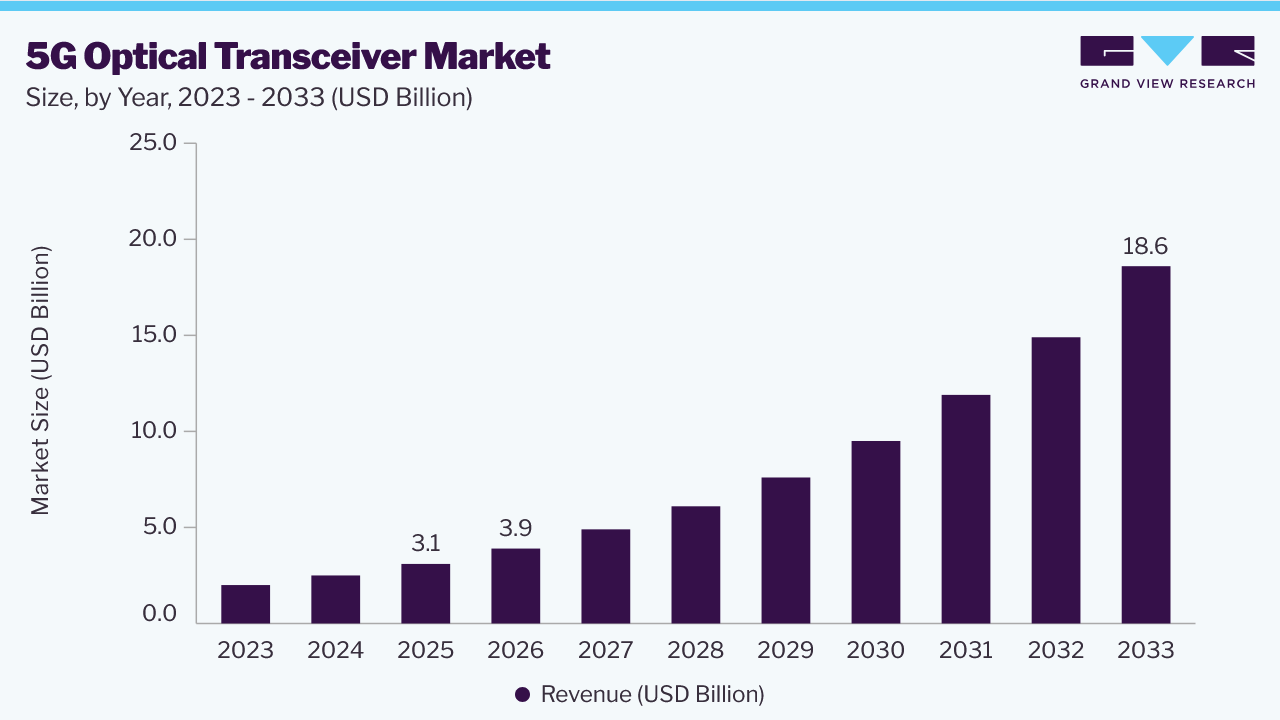 Source: Grand View Research, IR Documents, Primary Interviews, Paid DatabasesTo learn more about this report,
 Download Free Sample Report
 Analyst Perspective
The 5G optical transceiver industry is poised for significant growth driven by expanding 5G rollouts, the growing reliance on complex computing and vast networks, and the demand for efficient network solutions. However, it is likely to face significant challenges due to high infrastructure deployment costs and critical thermal management issues. Geopolitical dependencies, supply chain vulnerabilities, and differing priorities in resource deployments across countries are expected to heavily influence this industry. Innovation and new product launches, supported by effective partnerships and collaborations among industry participants, are anticipated to drive growth.
Type Insights
The 25G transceivers segment led the market with the largest revenue share of more than 31.0% in 2025. 25G transceivers are suitable for the 5G front-haul connection, which uses a direct fiber connection, due to their network construction efficiency. 25G transceivers combine multiple wavelengths into a single fiber using wavelength-division multiplexing (WDM) technology. Due to this technology, 25G transceivers can support transmission distances of 300m and 10 km. On the other hand, 5G macro base stations demand higher-speed optical transceivers, and 25G transceivers suit the requirements of the 5G macro base station. As the number of 5G macro base stations increases, the demand for 25G optical transceivers will be simulated, driving the segment’s growth over the forecast period.
The 400G transceivers segment is anticipated to grow at a significant CAGR over the forecast period. The adoption of 400G transceivers is expected to increase significantly over the forecast period. With the demand for data-intensive services growing, the investment in developing 400G has grown significantly. 400G transceivers offer a massive speed upgrade over 100G and 200G, but another significant advantage is that they are 800G-ready for potential future jumps. Even though the current investment required for 400G is significant, it is worth it given the ability to upgrade to 800G, which is expected to drive the segment's growth over the forecast period.
Form Factor Insights
The SFP56 form factor segment led the market with the largest revenue share of more than 28.0% in 2025. Optical transceivers with the SFP56 form factor are widely adopted in 5G infrastructure due to their compatibility with 50G and 25 G interfaces. Moreover, they are adopted for their high-speed connectivity, superior performance, higher quality, and reliability.
The QSFP28 segment is anticipated to register at a significant CAGR over the forecast period. QSFP28 optical transceivers support data rates up to 100 Gbps, making them an ideal fit for 5G networks. They also provide low latency, which is necessary for 5G network features such as video streaming and gaming. Moreover, QSFP28 optical transceivers have small form factors, which reduce the cost of cabling and space requirements, reducing the overall costs. High data rate compatibility, low latency, and cost-effectiveness are driving the segment's growth.
Wavelength Insights
The 1310nm band segment led the market with the largest revenue share of more than 43.0% in 2025. The 1310nm band wavelength optical transceivers are predominantly used in 5G infrastructure for high-speed backhaul connections. Backhaul connections connect the core network to the cell site and are necessary for transporting large amounts of data. The 1310nm band is suitable, as it exhibits low attenuation and can transport the signal over long distances without significant signal loss. In addition, 1310nm transceivers are relatively inexpensive and are widely available, making them an attractive choice for network infrastructure builders. The above-mentioned characteristic properties of the 1310nm band are driving the segment’s growth.
The 850nm band segment is anticipated to grow at a significant CAGR over the forecast period. The 850nm band optical transceivers are usually used in 5G infrastructure for short-distance connectivity, such as between small cells or in-building distributed antenna systems. 850nm transceivers are compatible with multimode fiber-optic cables, making them suitable for short-distance connectivity where higher bandwidth at lower cost is required. In addition, 850nm transceivers are readily available and inexpensive, making them a suitable option for 5G infrastructure, propelling the segment’s growth.
Distance Insights
The more than 100 km segment led the market with the largest revenue share of more than 42.0% in 2025. Technological advancements have increased the need for reliable, stable data networks, making transceivers an essential part of any network’s hardware. The more than 100 Km optical transceivers can transfer data over vast distances.
One of the challenges faced by 5G network providers is the range of the network. More than 100 km optical transceivers can help providers overcome this challenge and provide a secure, stable network over an extensive range, making them a suitable candidate for 5G infrastructure and contributing to the segment’s growth.
The 10-100 km segment is anticipated to register at a significant CAGR over the forecast period. 5G networks require long-distance transmission to connect remote locations and provide seamless coverage across large areas. The 10-100 km optical transceivers can transmit data over large areas and provide seamless coverage. In addition, the 5G optical transceiver industry is seeing various initiatives aimed at cost reduction and innovation. One such cost-reduction innovation includes a coherent 100G transceiver, which reduces the cost on premise and meets transmission distance requirements within 200 Km. The aforementioned innovations are further propelling the segment’s growth.
5G Infrastructure Insights
The 5G fronthaul segment led the market with the largest revenue share of more than 73.0% in 2025. After the launch of 5G in 2019, 5G networks were quickly commercialized and adopted globally. Billions of 5G base stations were already deployed across the globe. To cope with the construction and demand for base stations, network operators opted for optical transceivers, which provide high data rates, low latencies, and are readily available and cost-effective. In addition, 5G network fronthaul has higher demands for data rate and optical interference for transceivers, driving the demand for optical transceivers in 5G fronthaul, thereby driving the market’s growth.
The 5G midhaul/backhaul segment is expected to grow at a significant CAGR over the forecast period. 5G midhaul and backhaul are carried through the metro access layer, core layer, and convergence layer. The 50G/100G transceivers are commonly used for these layers. The compatibility of optical transceivers for 5G network infrastructure is driving its adoption among the 5G midhaul/backhaul segment. In addition, 5G optical transceivers can transmit high-speed data for applications such as video streaming, virtual reality, and augmented reality, among others. High-speed & long-distance transmission, low latency, and reliability are some crucial factors driving the adoption of 5G optical transceivers in midhaul/backhaul infrastructure, thus propelling the segment’s growth.
Regional Insights
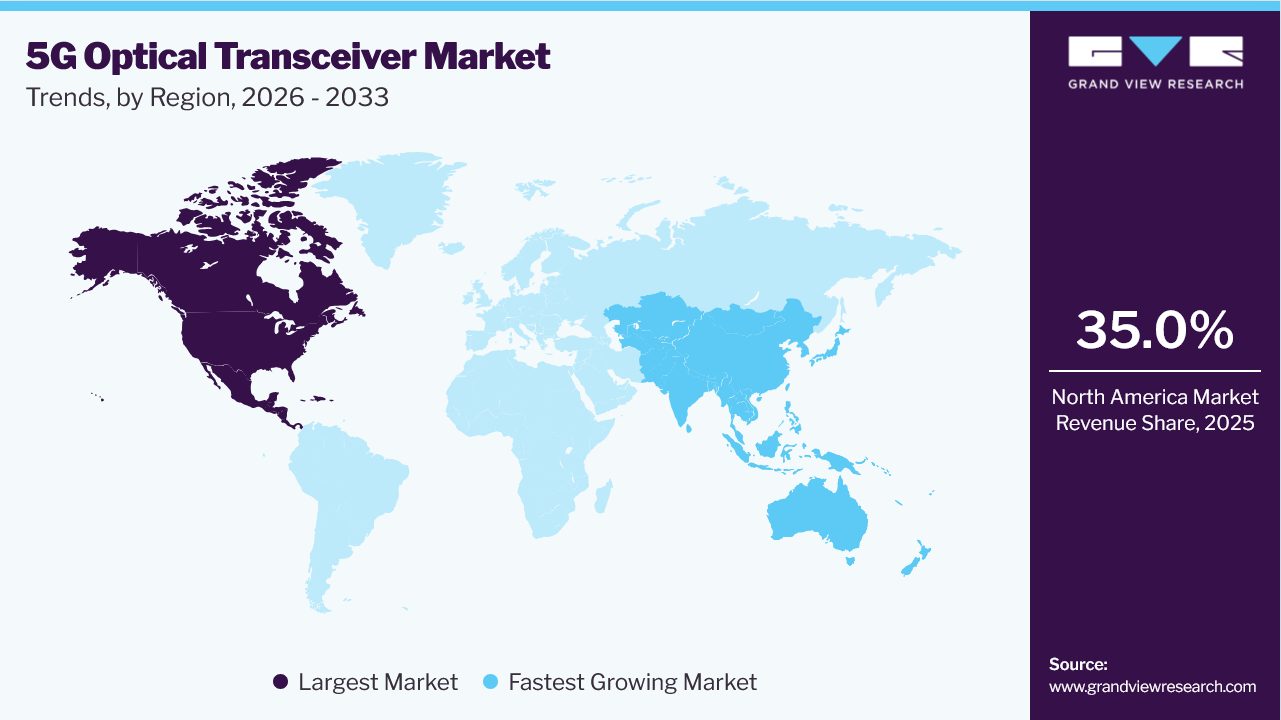
North America dominated the global 5G optical transceiver market with the largest revenue share of more than 35.0% in 2025. The regional market’s growth can be attributed to the growing demand for deploying 5G infrastructure from the U.S. and Canada. Key market players in the region are launching new optical transceiver product portfolios suitable for 5G technology, which is harnessing the region’s growth.
 To learn more about this report, Download Free Sample Report
 Asia Pacific 5G Optical Transceiver Market Trends
The 5G optical transceiver market in the Asia Pacific is anticipated to register at the fastest CAGR over the forecast period. The Asia Pacific region is considered a leader in 5G deployments. China and South Korea were some of the first countries to deploy 5G networks. The 5G deployment is on the rise in the Asia Pacific, fueling innovation, development, and an influx of 5G infrastructure. The growing adoption of 5G and deployment of 5G infrastructure bode well for regional industry growth.
Key 5G Optical Transceiver Company Insights
The 5G optical transceiver industry is fragmented, with several small players. It is a comparative niche market as the 5G technology is still newly commercialized. Following the commercialization of 5G networks, optical transceiver providers are entering into partnerships and launching products to capture market share in the 5G optical transceiver industry. The growing demand for 5G optical transceivers is fueled by the growing demand for 5G and the increasing deployment of 5G infrastructure.
Key 5G Optical Transceiver Companies
The following key companies have been profiled for this study on the global 5G optical transceiver market.
-
Coherent Corp.
-
INNOLIGHT
-
HiSilicon (Shanghai) Technologies CO., LTD
-
Cisco Systems, Inc.
-
HISENSE BROADBAND, INC.
-
Broadcom
-
Source Photonics.
-
Juniper Networks, Inc.
-
Eoptolink Technology Inc.
-
Molex, LLC
-
Accelink Technology Co. Ltd
-
Fujitsu Optical Components Limited
Recent Developments
-
In September 2025, NEC Corporation announced the expansion of its lineup of optical transceivers for 25Gb/s transmission, with initiating sales of the "25G SFP28 80km BiDi" equipped with 80km transmission capabilities.
-
In May 2025, GIGALIGHT announced the launch of its low-latency optical transceiver series. Designed to address ultra-low latency and high reliability requirements associated with high-performance computing scenarios and data centers.
5G Optical Transceiver Market Report Scope
Report Attribute
Details
Market size in 2025
USD 3.1 billion
Estimated market size in 2026
USD 3.9 billion
Projected market size by 2033
USD 18.6 billion
Growth rate
CAGR of 24.8% from 2026 to 2033
Base year for estimation
2025
Historical data
2021 – 2024
Forecast period
2026 – 2033
Quantitative units
Revenue in USD million/billion, and CAGR from 2026 to 2033
Report coverage
Revenue forecast, company ranking, competitive landscape, growth factors, and trends
Segments covered
Type, form factor, wavelength, distance, 5G infrastructure, region
Regional scope
North America; Europe; Asia Pacific; Latin America; Middle East & Africa
Country scope
U.S.; Canada; Mexico; UK; Germany; France; China; India; Japan; South Korea; Australia; Brazil; Kingdom of Saudi Arabia (KSA); UAE; South Africa
Key companies profiled
Coherent Corp.; INNOLIGHT; HiSilicon (Shanghai) Technologies CO., LTD; Cisco Systems, Inc.; HISENSE BROADBAND, INC.; Broadcom; Source Photonics.; Juniper Networks, Inc.; Eoptolink Technology Inc.; Molex, LLC; Accelink Technology Co. Ltd; Fujitsu Optical Components Limited
Customization scope
Free report customization (equivalent up to 8 analysts working days) with purchase. Addition or alteration to country, regional & segment scope.
Pricing and purchase options
Avail of customized purchase options to meet your exact research needs. Explore purchase options
Global 5G Optical Transceiver Market Report Segmentation
This report forecasts revenue growth at the regional and country levels and provides an analysis on the latest industry trends and opportunities in each of the sub-segments from 2021 to 2033. For this study, Grand View Research has segmented the global 5G optical transceiver market report based on the type, form factor, wavelength, distance, 5G infrastructure, and region:
-
Type Outlook (Revenue, USD Billion, 2021 - 2033)
-
25G Transceivers
-
50G Transceivers
-
100G Transceivers
-
200G Transceivers
-
400G Transceivers
-
-
Form Factor Outlook (Revenue, USD Billion, 2021 - 2033)
-
SFP28
-
SFP56
-
QSFP28
-
Others (QSFP56, CFP2, CFP8)
-
-
Wavelength Outlook (Revenue, USD Billion, 2021 - 2033)
-
850 nm band
-
1310 nm band
-
Others (CWDM, DWDM, LWDM, 1270nm, 1330 nm)
-
-
Distance Outlook (Revenue, USD Billion, 2021 - 2033)
-
1 to 10 Km
-
10 to 100 Km
-
More than 100 Km
-
-
5G Infrastructure Outlook (Revenue, USD Billion, 2021 - 2033)
-
5G FrontHaul
-
5G MidHaul/BackHaul
-
-
Regional Outlook (Revenue, USD Billion, 2021 - 2033)
-
North America
-
U.S.
-
Canada
-
-
Europe
-
U.K.
-
Germany
-
France
-
-
Asia Pacific
-
China
-
India
-
Japan
-
South Korea
-
Australia
-
-
Latin America
-
Brazil
-
Mexico
-
-
Middle East & Africa
-
Kingdom of Saudi Arabia (KSA)
-
UAE
-
South Africa
-
-
Frequently Asked Questions About This Report
The global 5G optical transceiver market size was valued at USD 3.1 billion in 2025 and is estimated at USD 3.9 billion in 2026.
The global 5G optical transceiver market is expected to grow at a CAGR of 24.8% from 2026 to 2033, reaching USD 18.6 billion by 2033.
North America dominated the global market with the largest revenue share of 35.0% in 2025.
Asia Pacific is the fastest-growing region over the forecast period.
QSFP56 form factor segment held the largest market share of more than 28.0% in 2025.
25G Transceivers segment dominated the market, with a revenue share of 31.0% in 2025.
Some key players operating in the 5G Optical Transceiver market include II-VI Coherent Corp., INNOLIGHT, HiSilicon Optoelectronics Co., Ltd., Cisco Acacia Communications, Inc., Hisense Broadband, Inc., Broadcom, Source Photonics, Juniper Networks, Inc., Eoptolink Technology Inc., Molex, LLC, Accelink Technology Co. Ltd, and Fujitsu Optical Components Limited.
The growing demand for high-speed, low-latency data transmission is driving the growth of the 5G optical transceiver market.
1310 nm band segment accounted for the largest revenue share of 43.0% in 2025, and it is the fastest-growing segment over the forecast period.
About the Author(s)
Next Generation Technologies Research Team
Technology · Next Generation TechnologiesThis report was authored by the next generation technologies research team at Grand View Research - comprising two research analysts, one senior research analyst, and one industry expert - with specialized expertise in the next generation technologies segment of the technology industry. All findings are based on proprietary technology databases, executive interviews, and regulatory analysis, subject to internal peer review prior to publication.
Last Updated:
Speak to Analyst

Customize this report to your needs - add regions, segments, or data points, with 20% free customization.
Or view our licence options:


ISO 9001:2015 & 27001:2022 Certified
We are GDPR and CCPA compliant! Your transaction & personal information is safe and secure. For more details, please read our privacy policy.


