
- Home
- »
- Clothing, Footwear & Accessories
- »
-
Active Backpack Market Size, Share & Growth Report, 2026-2033GVR Report cover

Active Backpack Market (2026 - 2033)
Size, Share & Trends Analysis Report By Type (Hiking/Trekking, Camping and Travelling, Sports), By Size (Less Than 10L, 10L-20L, 20L-40L), By Price Point, By Distribution Channel (Specialty Stores, Online), By Region, And Segment Forecasts
Market Size, 2025
$6.7BMarket Estimate, 2026
$7.2BMarket Forecast, 2033
$12.6BCAGR, 2026–2033
8.3%Active Backpack Market Summary
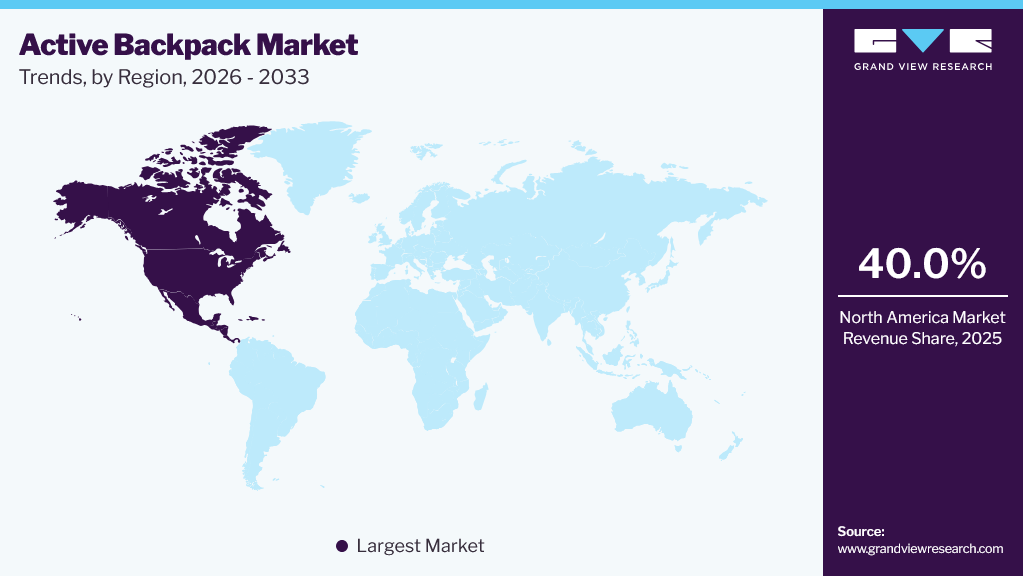
The global active backpack market size was valued at USD 6.7 billion in 2025 and is projected to grow from USD 7.2 billion in 2026 to USD 12.6 billion in 2033, at a CAGR of 8.3% from 2026 to 2033. North America dominated the market, accounting for 40.0% of revenue in 2025. An increasing number of people participating in recreational activities such as hiking, camping, fishing, biking, running, and other sports activities has significantly boosted the demand for sporting goods, accessories, and related products, including active backpacks.
Key Market Trends & Insights
- By size: 20L-40L segment accounted for the largest revenue share of over 50.0% in 2025.
- By price point: USD 51-100 segment accounted for the largest revenue share, exceeding 25.0% in 2025.
- By distribution channel: Specialty stores accounted for the largest market in 2025.
Regional Highlights
- Largest regional market: North America (40.0% revenue share, 2025)
- Fastest-growing regional market: Asia Pacific (highest CAGR, 2026-2033)
Market Size & Forecast
- Market size in 2025: USD 6.7 Billion
- Estimated market size in 2026: USD 7.2 Billion
- Projected market size by 2033: USD 12.6 Billion
- CAGR (2026-2033): 8.3%
Three ways to get this report
Buy it, customize it, or ask a question.Ask an Analyst
Analyst response in 1 business day
- AccessReport author, directly
- Reply timeWithin 1 working day
- No sales callDirect answer only
- FormatEmail reply
- CostFree, no cost
Get the Full Report
What the study covers
- FormatsPDF · Excel · Dashboard
- Timeline2026–2033 annual, 2025 base
- Coverage20+ countries, 5 regions
- Companies10+ key players profiled
Customize the Report
20% free customization
- IncludeCountries, segments, points
- TailorTo your product definition
- ExtendDeeper competitor detail
- OrA fully bespoke study
- Turnaround5–10 working days
According to the 2025 Outdoor Participation Trends Report by the Outdoor Foundation, which highlights top participation data and insights on various associated topics, some of the most popular outdoor recreation activities include hiking, walking for fitness, camping, fishing, and bicycling. The report also stated that in 2024, nearly 63 million individuals participated in hiking, while 48.2 million participated in running activities in the U.S. These statistics highlight the volume of participants in outdoor recreational activities and the market's growth potential.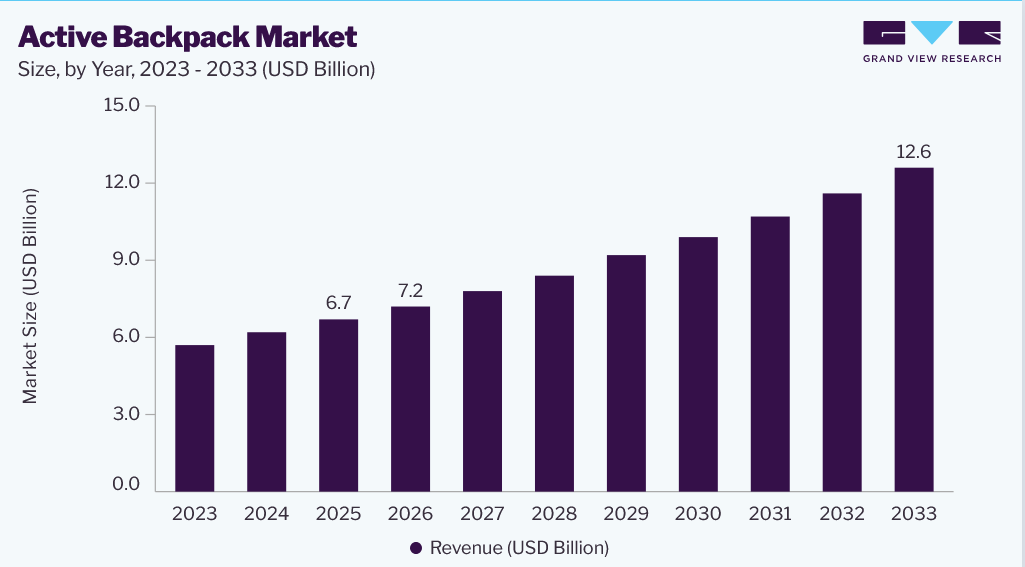 Source: Grand View Research, IR Documents, Primary Interviews, Paid DatabasesTo learn more about this report,
 Download Free Sample Report
 Furthermore, active backpacks have become the preferred choice among users for a range of purposes and occasions, from outdoor adventures to daily commutes, and even as a substitute for traditional handbags. This has led to the development of numerous types of backpacks and numerous new product launches in the market. For instance, in August 2025, Osprey, a manufacturer of specially engineered backpacks, luggage, and travel gear, announced its Spring 2026 hiking collection, featuring Kestrel | Kyte LT, Osprey Sportlite, and Hikelite LT, each with different designs and pack capacities. Comprehensive portfolios featuring a wide range of alternatives across style, design, color, and sizes are key to generating greater engagement for major brands in this market.
The most popular activities were hiking, followed by jogging, cycling, trekking, and mountaineering. The research additionally found that, among all respondents, hiking and jogging were the two most popular outdoor activities, at 39% and 33%, respectively. Cycling tours also saw a considerable increase in popularity in Europe in 2020.
In addition, active backpacks have become a popular fashion statement in recent years due to their versatility and functionality. Many backpacks now come in stylish designs, colors, and patterns, making them fashionable accessories that complement a person's style and personality. For instance, Nike’s fashionable backpacks included utility-based features via brands such as Brasilia. These training backpacks are designed for athletes and feature a durable, water-resistant exterior, a large main compartment for gear, and a separate ventilated shoe compartment. In addition to their appearance, the features of an active backpack can also contribute to its fashion status. For example, backpacks with smart technology such as wireless chargers, built-in speakers, or LED lights are not only practical but also innovative and eye-catching.
Furthermore, active backpacks have become popular for a range of occasions, from outdoor adventures to daily commutes, and even as a substitute for traditional handbags. This versatility allows people to express their sense of style and individuality while meeting their practical needs. For instance, Under Armor offers the Hustle 4.0 Backpack, designed for sports and gym-goers, featuring a water-repellent finish, a padded laptop compartment, a front pocket for organization, and two side water bottle pockets. Overall, active backpacks have become a fashion statement due to their combination of style, functionality, and versatility. As a result, they are increasingly seen as essential accessories that reflect a person's fashion sense and lifestyle. The multifunctionality of backpacks is a key driver of the market, as consumers seek versatile, adaptable products to meet their diverse needs and preferences.
However, the rise of counterfeit goods is impeding market expansion. Over the anticipated timeframe, the ease with which counterfeit goods are available is projected to provide challenges to market expansion. The price difference between counterfeit and branded products is a significant barrier to the market. Competition from other types of bags and baggage, such as messenger bags, duffel bags, and rolling suitcases, is one of the main obstacles. Depending on their unique requirements, preferences, or travel plans, consumers may choose various substitutes, which could impact the market for active backpacks.
Changing consumer preferences can pose market challenges in several ways. As consumer preferences shift towards more sustainable and eco-friendly products, active backpack manufacturers must adapt to meet these changing demands. This may involve investing in new materials or manufacturing processes, which can be costly and time-consuming. In addition, changing consumer preferences can shift the features and functions consumers seek in active backpacks. For instance, as more consumers prioritize sustainability, they may also look for backpacks incorporating eco-friendly features, such as recycled materials or renewable energy sources. If manufacturers are slow to adapt to these changing demands, they may lose market share to competitors who respond quickly.
Furthermore, the online portal, both e-commerce and company websites, offers various growth opportunities for the market. Consumers prefer e-commerce websites on account of increasing access to the internet, convenience, greater variety, and cost benefits. Consumers can compare a wide range of products on websites and make an informed decision. In addition, products purchased through e-commerce websites are delivered to the doorstep, thus offering convenience to customers. Additionally, many websites offer huge discounts throughout the year, making expensive products such as active backpacks affordable to an extent. Such offers attract a large consumer base and create opportunities to increase sales of active backpacks.
Market Dynamics
Driver: Significant Investment and International Expansion Strategies Embraced by Multiple Companies
In recent years, many brands have launched purpose-built backpacks with novel features, sustainable, durable materials, and attractive designs. However, the fragmented nature of this market has led to intense competition among participants. Various companies engaged in the manufacturing of premium collections of active backpacks have been adopting strategies such as expansion, partnerships with distributors to improve brand visibility, innovative product development, and more. For instance, in June 2025, Db Equipment, a Scandinavian outdoor and travel brand, announced that it would continue its international expansion with two new investors, including football professional Erling Braut Haaland and Gustav Magnar Witzøe.
The rise of counterfeit goods is impeding market expansion. Over the anticipated timeframe, the ease with which counterfeit goods are available is projected to provide challenges to market expansion. The price difference between counterfeit and branded products is a significant barrier to the market. Competition from other bag types, such as messenger bags, duffel bags, and rolling suitcases, is a major obstacle. Depending on their unique requirements, preferences, or travel plans, consumers may choose various substitutes, which could impact the market for active backpacks.
The online portal, as well as the e-commerce and company websites, offers various growth opportunities for the market. Consumers prefer e-commerce websites due to increased internet access, convenience, greater variety, and cost benefits. Consumers can compare a wide range of products on websites and make an informed decision. In addition, products purchased through e-commerce websites are delivered to customers' doorsteps, offering convenience. In addition, many websites offer significant discounts year-round, making expensive products such as active backpacks more affordable. Such offers attract a large consumer base and create opportunities to increase sales of active backpacks.
Analyst Perspective
The market is characterized by multiple brands focused on developing niche areas of expertise and product lines dedicated to outdoor travel experiences. This has led to strong competition among global market participants and small- to medium-scale operators that prioritize regional or country-level markets. This market growth is primarily driven by increasing participation in outdoor recreation, while modern distribution strategies adopted by key companies appear to improve penetration and brand visibility. Counterfeit products act as a restraining force on the growth of popular global brands, while trends such as the use of sustainable materials, reduced carbon footprints, textile recycling, and others influence consumer preferences and operational capabilities.
Type Insights
The sports segment accounted for over 50.0% in 2025. The participation rate in sports has been steadily increasing over the past few years, with more individuals adopting an active lifestyle. Several factors, including increasing awareness of the health benefits of regular exercise, rising disposable incomes, and the availability of more diverse and accessible sports and fitness options, have driven this trend. The growing participation rate in sports has created strong demand for sports accessories, such as sports backpacks, as athletes/people need these items to support their active lifestyles. In addition, the growing popularity of sports among youth and the rise of athleisure have driven the growth of the stylish sports backpack industry.
The hiking/trekking segment is anticipated to grow at a significant CAGR from 2026 to 2033. Sales of hiking backpacks are expected to be driven by comfort-focused models, ongoing product launches for hikers, and increased participation in outdoor activities, particularly among young people. Manufacturers focus on lightweight materials and designs to introduce new hiking backpacks. Consumers seek lightweight backpacks that are simple to carry on lengthy hikes. As a result, active backpack manufacturers use novel materials such as carbon fiber, Dyneema fiber, and lightweight nylon, along with streamlined designs that reduce bulk.
Size Insights
The 20L-40L active backpack size accounted for 50.0% of the market share in 2025. Hikers mostly use active backpacks with a 20-40-liter capacity, as they need to carry a large amount of supplies and hiking gear. These backpacks are highly durable and adjustable, making them ideal for rigorous hiking or other sports. They come with numerous features and compartments that allow users to customize and organize gear, making it easier to find and access items quickly. Many players offer active backpacks in this size. For instance, Black Diamond’s backpacks in the 20-40-liter range come with customizable features such as adjustable harnesses and hip belts, multiple compartments for organization, and trekking-pole and ice-axe attachments. Similarly, Gregory Packs offers backpacks with adjustable harnesses, interchangeable hip belts, and numerous pockets and compartments for organization.
The backpack segment with a size less than 10L is expected to grow at a significant CAGR over the forecast period. Active backpacks with a capacity of less than 10 liters are typically used for activities that require minimal gear, such as running, cycling, or short hikes. For example, runners may use a small backpack to carry essentials such as water, energy gels, and a phone, while cyclists might use it to hold a repair kit, snacks, and a water bottle. These backpacks are often designed to be lightweight and compact, allowing the wearer to move freely and quickly.
Price Point Insights
Backpacks priced between USD 51 and 100 accounted for over 25.0% of the market in 2025. Backpacks in this price segment appeal to consumers willing to spend a little more on additional features and higher quality. Customers who may not be willing to spend more than USD 100 on a backpack can still find a high-quality and functional option within this price range. The North Face is a well-known brand offering active backpacks priced at USD 51 to USD 100, including the Borealis and Recon series. These backpacks feature padded straps, multiple pockets and compartments, and a comfortable, breathable back panel. More people are taking up outdoor hobbies such as hiking, camping, and cycling. These consumers are looking for backpacks that offer improved functionality and durability within a specific price range.
The backpack segment under USD 50 is anticipated to grow at the fastest CAGR over the forecast period. As more people engage in outdoor activities such as exercise and travel, demand for affordable backpacks that withstand the rigors of outdoor use is growing. Active backpacks under USD 50 are well-positioned to meet this demand by providing a cost-effective option for consumers just starting to explore outdoor activities or who may not have much disposable income for the necessary gear. Moreover, advances in materials science and manufacturing processes have enabled the production of comparatively durable active backpacks at a lower cost. Players that offer active backpacks in this price range include AmazonBasics, High Sierra, TETON Sports, and Outlander.
Distribution Channel Insights
The specialty stores segment accounted for the largest revenue share of the global market in 2025. Specialty stores often carry a wide selection of active backpacks from various brands and at different price points. This allows customers to compare and choose from a variety of options, ensuring that they find a backpack that meets their needs and preferences. As sports enthusiasts or hikers need a backpack that fits well and is comfortable to wear during their activities, specialty stores often allow customers to try on backpacks to ensure a good fit. Specialty stores continue to remain popular, as many customers prefer in-store shopping. Retailers can offer advice and recommendations on individualized items that can be further customized to meet the customer's needs.
The sales through the online channel are projected to grow at a noteworthy CAGR over the forecast period. E-commerce has grown in popularity over the past few years due to the convenience of online shopping. Online shopping is becoming increasingly popular as it allows consumers to compare several options on a single platform. Several niche players offer high-quality active backpacks for various sports and travel activities. These players pose new challenges to other renowned market players, such as Osprey Packs and CamelBak. E-commerce has significantly changed consumers’ shopping choices and trends by offering benefits such as doorstep delivery, deep discounts, and access the a wide range of products on a single platform. Key players in the market are increasingly launching e-commerce websites to capitalize on the rising popularity of online shopping among millennials and Gen Z.
Regional Insights
North America held over 40.0% of the global market share in 2025. The primary driver propelling the market is the availability of several adventure sports destinations in the U.S. and Canada. According to the Outdoor Industry Association, hiking is the fourth most popular sport in the U.S., behind biking, jogging, and fishing.
 To learn more about this report, Download Free Sample Report
 Asia Pacific Active Backpack Market Trends
The active backpack market in the Asia Pacific is anticipated to grow at a significant CAGR during the forecast period. The growing popularity of active backpacks among sports enthusiasts and trekkers, along with the well-established sports industry in the region, drives sales. The rising popularity of outdoor recreational activities is a key market driver. Consumers are increasingly participating in outdoor activities owing to changing lifestyles and attitudes, rising leisure spending, and the mental and physical health advantages of outdoor activities. Due to rising urbanization and hectic work schedules, people are finding it more challenging to spend time outdoors with their family and friends. Therefore, an increasing number of people have started camping with their friends and families over the weekend. These factors are expected to drive growth in the active backpack industry in the Asia Pacific.
Consumers are increasingly participating in outdoor activities owing to changing lifestyles and attitudes, rising leisure spending, and the mental and physical health advantages of outdoor activities. Due to rising urbanization and hectic work schedules, people are finding it more challenging to spend time outdoors with their family and friends. Therefore, an increasing number of people have started camping with their friends and families over the weekend. These factors are expected to drive the growth of the active backpack industry in the Asia Pacific.
Key Active Backpack Company Insights
The market is highly fragmented, with multiple companies. Key players are adopting various steps to increase their presence. These steps include strategies such as partnerships, mergers & acquisitions, and global expansion.
Key Active Backpack Companies
The following key companies have been profiled for this study on the active backpack market.
-
Arc'teryx
-
CamelBak
-
Deuter Sport GmbH
-
Samsonite IP Holdings S.a.r.l.
-
JanSport, a VF Company
-
Kelty
-
Osprey.
-
The North Face
-
Patagonia, Inc.
-
Columbia Sportswear
Recent Developments
-
In June 2025, Deuter unveiled its Spring 2026 backpack collection, featuring an updated Futura Pro, a redesigned Traick running vest, and a reengineered Guide series. The Futura Pro incorporates an adjustable five-stage back-length system, while the updated collection emphasizes improved fit, carrying comfort, and load distribution for hiking and multi-day trekking.
-
In May 2025, Arc'teryx, one of the key brands engaged in manufacturing high-performance outdoor apparel, climbing gear, and equipment, announced the launch of Alpha SL. This durable, lightweight, and recyclable climbing pack is expected to strengthen its portfolio.
Active Backpack Market Report Scope
Report Attribute
Details
Market size in 2025
USD 6.7 billion
Estimated market size in 2026
USD 7.2 billion
Projected market size by 2033
USD 12.6 billion
Growth rate
CAGR of 8.3% from 2026 to 2033
Historical data
2021 - 2025
Forecast period
2026 - 2033
Quantitative units
Revenue in USD billion, and CAGR from 2026 to 2033
Report coverage
Revenue forecast, company ranking, competitive landscape, growth factors, and trends
Segments covered
Type, size, price point, distribution channel, region
Regional scope
North America; Europe; Asia Pacific; CSA; MEA
Country scope
U.S.; UK; Germany; France; China; Japan; India; Australia; Brazil; South Africa
Key companies profiled
Arc'teryx; CamelBak; Deuter Sport GmbH; Samsonite IP Holdings S.a.r.l.; JanSport, a VF Company; Kelty; Osprey Packs; The North Face; Patagonia, Inc.; Columbia Sportswear
Customization scope
Free report customization (equivalent to 8 analyst working days) with purchase. Addition or alteration to country, regional & segment scope.
Pricing and purchase options
Avail of customized purchase options to meet your exact research needs. Explore purchase options
Global Active Backpack Market Report Segmentation
This report forecasts revenue growth at the regional and country levels and provides an analysis of the latest industry trends and opportunities in each of the sub-segments from 2021 to 2033. For this study, Grand View Research has segmented the global active backpack market report based on type, size, price point, distribution channel, and region:
-
Type Outlook (Revenue, USD Million, 2021 - 2033)
-
Hiking/Trekking
-
Camping and Traveling
-
Sports
-
-
Size Outlook (Revenue, USD Million, 2021 - 2033)
-
Less than 10L
-
10L-20L
-
20L-40L
-
-
Price Point Outlook (Revenue, USD Million, 2021 - 2033)
-
Under $50
-
$51 - $100
-
$101 - $150
-
$151 - $200
-
$201 - $250
-
Above $250
-
-
Distribution Channel Outlook (Revenue, USD Million, 2021 - 2033)
-
Specialty Stores
-
Retail Stores
-
Online
-
-
Regional Outlook (Revenue, USD Million, 2021 - 2033)
-
North America
-
U.S.
-
-
Europe
-
UK
-
Germany
-
France
-
-
Asia Pacific
-
China
-
Japan
-
India
-
Australia
-
-
Central & South America
-
Brazil
-
-
Middle East & Africa
-
South Africa
-
-
Frequently Asked Questions About This Report
North America dominated with a revenue share of 40.0% in 2025.
The global active backpack market size was valued at USD 6.7 billion in 2025 and is estimated at USD 7.2 billion for 2026.
The global active backpack market is expected to grow at a CAGR of 8.3% from 2026 to 2033, reaching USD 12.6 billion by 2033.
20L-40L dominated the active backpack market with a share of 50.0% in 2025, while under USD 50 is the fastest-growing segment.
Key players include Arc'teryx, CamelBak, Deuter Sport GmbH, Samsonite IP Holdings S.a.r.l., JanSport, a VF Company, Kelty, Osprey Packs, The North Face, Patagonia, Inc., and Columbia Sportswear.
About the Author(s)
Clothing, Footwear & Accessories Research Team
Consumer Goods · Clothing, Footwear & AccessoriesThis report was authored by the clothing, footwear & accessories research team at Grand View Research - comprising two research analysts, one senior research analyst, and one industry expert - with specialized expertise in the clothing, footwear & accessories segment of the consumer goods industry. All findings are based on proprietary consumer goods databases, executive interviews, and regulatory analysis, subject to internal peer review prior to publication.
Last Updated:
Speak to Analyst

Customize this report to your needs - add regions, segments, or data points, with 20% free customization.
Or view our licence options:


ISO 9001:2015 & 27001:2022 Certified
We are GDPR and CCPA compliant! Your transaction & personal information is safe and secure. For more details, please read our privacy policy.


