
- Home
- »
- Plastics, Polymers & Resins
- »
-
Adiponitrile Market Size, Share & Trends Report, 2026-2033GVR Report cover

Adiponitrile Market (2026 - 2033)
Size, Share & Trends Analysis Report By Application (Nylon Synthesis, HDI, Electrolyte Solution), By End Use (Automobile, Chemical Intermediate, Electrical & Electronics), By Region, And Segment Forecasts
Market Size, 2025
$12.0BMarket Estimate, 2026
$12.9BMarket Forecast, 2033
$21.6BCAGR, 2026–2033
7.6%Adiponitrile Market Summary
The global adiponitrile market size was valued at USD 12.0 billion in 2025 and is projected to grow from USD 12.9 billion in 2026 to USD 21.6 billion by 2033, at a CAGR of 7.6% from 2026 to 2033. Asia Pacific accounted for dominating revenue share of 40.6% in the adiponitrile market revenue in 2025. This growth can be attributed to its increasing application as feedstock in manufacturing HDI & nylon 6,6, used in different end-use industries, including automobiles, chemicals, and electronics.
 Source: Grand View Research, IR Documents, Primary Interviews, Paid DatabasesTo learn more about this report,
 Download Free Sample Report
 Key Market Trends & Insights
- By application: Nylon synthesis segment held the largest market share of 85.9% in 2025.
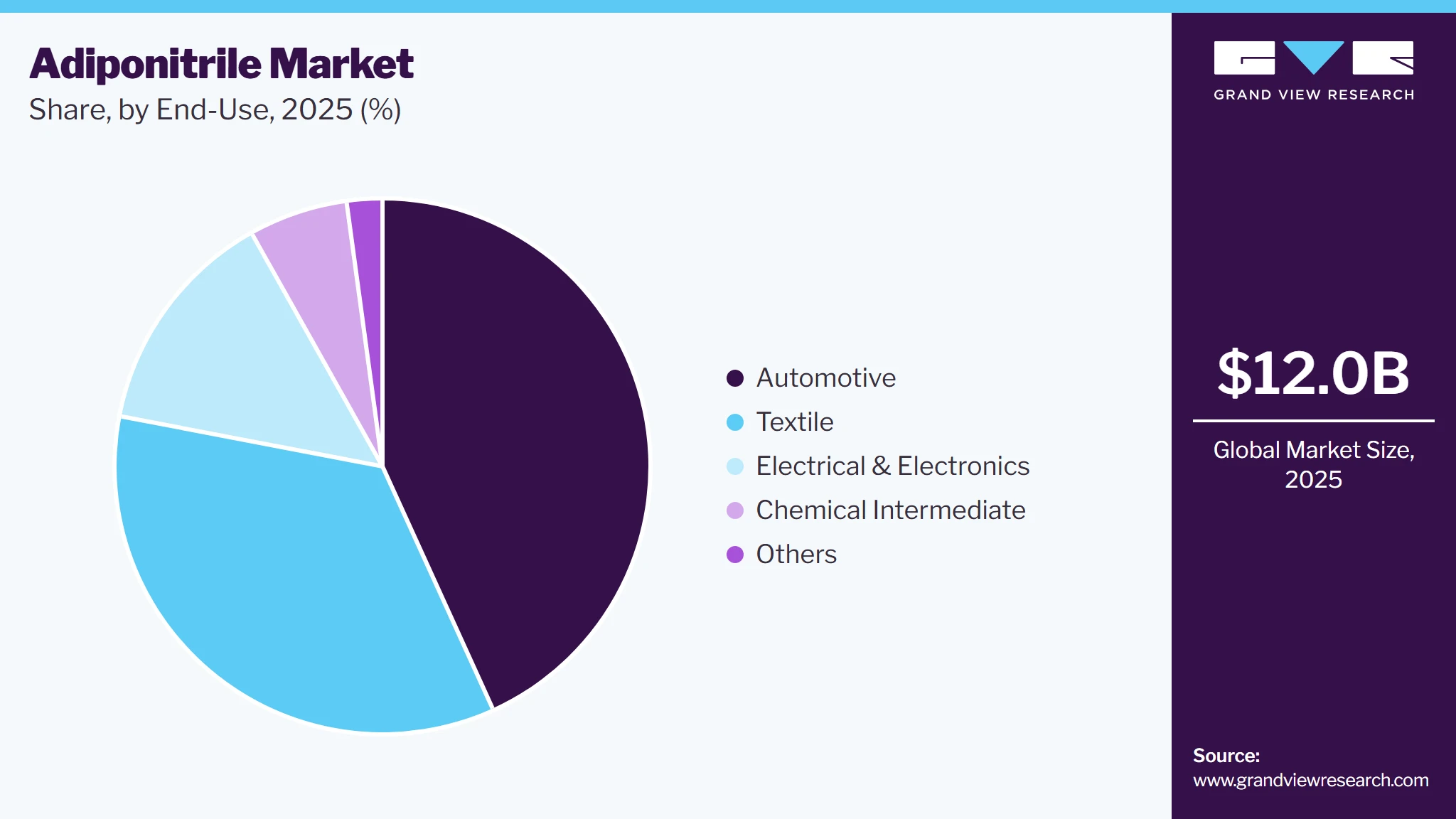
- By end use: Automotive segment held the largest market share of 43.2% in 2025.
Regional Highlights
- Largest regional market: Asia Pacific (40.6% revenue share, 2025)
- By country: China held the largest market share in 2025
Market Size & Forecast
- Market size in 2025: USD 12.0 Billion
- Estimated market size in 2026: USD 12.9 Billion
- Projected market size by 2033: USD 21.6 Billion
- CAGR (2026-2033): 7.6%
Three ways to get this report
Buy it, customize it, or ask a question.Ask an Analyst
A direct answer, usually in 1 working day
- AccessReport author, directly
- Reply timeWithin 1 working day
- No sales callDirect answer only
- FormatEmail reply
- CostFree, no cost
Get the Full Report
What the study covers
- FormatsPDF · Excel · Dashboard
- Timeline2026–2033 annual, 2025 base
- Coverage20+ countries, 5 regions
- Companies10+ key players profiled
Customize the Report
20% free customization
- IncludeCountries, segments, points
- TailorTo your product definition
- ExtendDeeper competitor detail
- OrA fully bespoke study
- Turnaround5–10 working days
Furthermore, adiponitrile is a specific organic chemical that serves as an essential component in the production of nylon 6,6, a prominent synthetic polymer used in various applications such as textiles, automotive components, and engineering plastics. The global increase in airbag production in the automobile industry, driven by regulations mandating airbag inclusion in different countries, is expected to boost the demand for nylon-66 further. This, in turn, will contribute to the growing need for adiponitrile, as it remains a fundamental precursor in producing this vital automotive material. To learn more about this report, Download Free Sample Report
 Adiponitrile is used in certain electrolyte solutions, primarily in electrochemical applications and batteries. It serves as a solvent or cosolvent in specific electrolyte formulations. For instance, adiponitrile can be incorporated into the electrolyte formulations of lithium-ion batteries as a cosolvent. It is often mixed with other solvents, such as ethylene carbonate (EC) and dimethyl carbonate (DMC), to improve the overall performance of batteries. Adiponitrile can enhance the thermal stability of electrolytes, reduce the risk of dendrite formation on lithium electrodes, and extend the lifecycle of batteries.
Producing adiponitrile often involves using hazardous chemicals that can generate harmful byproducts. Increasing environmental regulations and growing awareness about sustainability worldwide have led to stringent environmental compliance requirements. For instance, the adiponitrile manufacturing process often relies on the hydrocyanation of butadiene, which involves toxic hydrogen cyanide (HCN). Managing HCN safely can be environmentally challenging for manufacturers.
Furthermore, the advent of nylon substitutes such as polypropylene, bioresorbable polymers, para-aramid synthetic fibers, and polyvinylidene fluoride (PVDF) is anticipated to hamper the growth of the global nylon market owing to their low prices. This is expected to further affect the development of the product market.
Market Dynamics
The adiponitrile market is primarily driven by its indispensable role as a key intermediate in the production of hexamethylenediamine (HMDA), which is extensively used in nylon 6,6 manufacturing. Growing demand for lightweight, durable, and high-performance engineering plastics across automotive, electrical & electronics, and industrial applications continues to strengthen market growth. The increasing adoption of nylon 6,6 components in vehicle manufacturing to improve fuel efficiency and support electrification trends is further contributing to the expansion of adiponitrile consumption. The rising investments in advanced materials and specialty chemical production are creating new opportunities for market participants. On the supply side, manufacturers are focusing on capacity expansions, process optimization, and technological advancements to improve production efficiency and secure long-term supply reliability.
The primary driver of the adiponitrile market is the growing demand for nylon 6,6, for which adiponitrile serves as a critical precursor through the production of hexamethylenediamine (HMDA). Nylon 6,6 is widely utilized in automotive, electrical & electronics, industrial machinery, and textile applications due to its superior mechanical strength, thermal stability, and chemical resistance. Increasing vehicle lightweighting initiatives, expansion of electric vehicle production, and growing use of engineering plastics in advanced manufacturing are driving sustained demand for adiponitrile. The industrialization in emerging economies and investments in high-performance materials continue to support market growth.
Fluctuations in the prices of petrochemical feedstocks and energy resources represent a significant challenge for adiponitrile manufacturers. Since adiponitrile production is highly dependent on energy-intensive chemical processes, variations in raw material costs can directly impact manufacturing expenses and profit margins. Stringent environmental and safety regulations governing chemical production require substantial investments in compliance, emission control systems, and sustainable manufacturing technologies. These factors can increase operational costs and limit market expansion, particularly for smaller producers.
The growing focus on energy storage systems and next-generation lithium-ion batteries presents a promising opportunity for the adiponitrile market. Adiponitrile is gaining attention as a potential component in advanced electrolyte formulations due to its favorable electrochemical stability and safety characteristics. Increasing investments in electric vehicles, renewable energy integration, and battery research are expected to create new demand avenues beyond traditional nylon applications. As battery manufacturers seek higher-performance and safer electrolyte materials, adiponitrile could become an increasingly valuable specialty chemical in the evolving energy storage landscape.
Analyst Perspective
The adiponitrile market remains one of the most vertically integrated specialty chemical markets, with its growth trajectory closely tied to the performance of the nylon 6,6 value chain. Unlike many chemical intermediates that serve diverse end-use markets, adiponitrile derives the overwhelming majority of its demand from nylon synthesis, making automotive lightweighting, electrical & electronics miniaturization, and high-performance textile applications the primary determinants of long-term market expansion. This concentration creates a market where competitive advantage is less dependent on commercial distribution and more dependent on process technology, production efficiency, and integration with downstream HMDA and nylon 6,6 manufacturing assets. While conventional demand from engineering plastics will continue to anchor market growth, the emergence of adiponitrile as a potential component in advanced battery electrolyte formulations introduces a new, higher-value growth avenue that could gradually diversify demand beyond its traditional nylon-centric foundation. Consequently, producers that combine scale, proprietary production technologies, and strong positioning within both the engineering materials and emerging energy storage ecosystems are expected to be best positioned to capture future value creation within the adiponitrile market.
Application Insights
The nylon synthesis segment accounted for the largest share of the adiponitrile market, representing 85.9% of total revenue in 2025. This can be attributable to its exceptional tensile strength and resistance to abrasion, making it suitable for a wide range of applications, from clothing and carpets to mechanical parts and industrial components. The synthesis of Nylon-6,6 commences with the hydrogenation of adiponitrile, yielding hexamethylenediamine, another essential component in the process. Hexamethylenediamine, derived from adiponitrile, combines with adipic acid to initiate a polycondensation reaction. This reaction leads to the formation of nylon-6,6, which is distinguished by its long-chain polymer structure and characterized by alternating amide linkages. This chain structure imparts the polymer with exceptional mechanical properties, such as high tensile strength and excellent resistance to wear and tear.
The electrolyte solution is expected to grow at a CAGR of 10.1% over the forecast period, owing to the increasing demand for lithium-ion batteries, particularly in electric vehicles, which enhances the need for high-performance electrolytes, where adiponitrile plays a crucial role. In addition, advancements in battery technology and the push for more efficient energy storage solutions further fuel this demand. Furthermore, the automotive industry's shift towards sustainability and reduced emissions also significantly contributes to the rising utilization of adiponitrile in electrolyte formulations.
End Use Insights
In 2025, the automotive segment held the dominating revenue share of 43.2% in the global adiponitrile market. This can be attributed to the increasing use of the product in the automotive industry for various applications. Its applications span from producing lightweight and fuel-efficient components to improving vehicle safety and comfort. Adiponitrile serves as a precursor in the creation of polyurethane foams used in automotive seating and insulation, providing comfort and reducing vehicle weight to enhance fuel efficiency. In addition, adiponitrile plays a significant role in producing fuel system components such as fuel tanks and lines. Moreover, adiponitrile is utilized in the production of airbag fabrics. Airbags are crucial safety components in vehicles, and their fabrics must possess high tensile strength, tear resistance, and flame retardancy.
 To learn more about this report, Download Free Sample Report
 The electrical and electronics segment is expected to grow at the fastest CAGR of 6.3% from 2025 to 2030, owing to the growing demand for high-performance electrical insulation materials and cables is a primary factor, as adiponitrile provides excellent insulation properties. Furthermore, advancements in electronic devices and infrastructure create a need for reliable materials, further boosting demand. Moreover, the ongoing trend towards miniaturization in electronics also necessitates efficient insulation solutions, contributing to the rapid growth of adiponitrile in this sector.
Regional Insights
Asia Pacific accounted for dominating revenue share of 40.6% in the adiponitrile market revenue in 2025. This can be attributed to ongoing industrialization, growing population, and expanding manufacturing base in Asia Pacific. The region is home to some of the largest manufacturing economies in the world, including China, Japan, South Korea, and India. The region's countries, including China, India, Japan, South Korea, Singapore, and Malaysia, are the largest manufacturers of electrical and electronic products in the world. Thus, the market for adiponitrile is expected to rise in the upcoming years owing to the growth of the electronics industry in this region.
 To learn more about this report, Download Free Sample Report
 China Adiponitrile Market Trends
China maintained a leading position in the Asia Pacific adiponitrile market, with a highest revenue share of 47.9% in 2025, driven by rapid industrial expansion and increasing demand for high-performance materials. In addition, the automotive sector is a major contributor, as the rising production of electric vehicles boosts the need for adiponitrile in manufacturing components such as tire cords and insulation materials. Furthermore, the establishment of local production facilities by international manufacturers is reducing costs and enhancing supply chain efficiency, further propelling market growth in the region.
North America Adiponitrile Market Trends
North America adiponitrile market is expected to grow at a CAGR of 9.1% over the forecast period, owing to the construction industry's expansion, particularly in non-residential projects such as hospitals and commercial buildings. In addition, legislative initiatives such as the Affordable Healthcare Act have stimulated the construction of healthcare facilities, increasing the need for architectural adiponitrile. Furthermore, the automotive industry's shift towards lightweight materials for enhanced fuel efficiency is driving demand for adiponitrile to produce durable components.
The adiponitrile market in the U.S. led the North American market with the highest revenue share in 2024, primarily driven by the construction sector, which remains a key driver for adiponitrile demand. The focus on developing healthcare infrastructure and educational institutions underpins significant growth opportunities. Furthermore, advancements in battery technology and electric vehicle production contribute to increased utilization of adiponitrile in various applications, reinforcing its importance in the automotive and construction sectors.
Europe Adiponitrile Market Trends
Europe adiponitrile market is expected to grow significantly over the forecast period, owing to the increasing applications across multiple sectors, including automotive, textiles, and electrical industries. In addition, the region's stringent regulations on vehicle safety and emissions are driving demand for advanced materials such as nylon 66, which relies on adiponitrile as a precursor. Furthermore, the shift towards electric vehicles and sustainable manufacturing practices fosters innovation and expands the market.
Key Adiponitrile Company Insights
The adiponitrile market is consolidated, with international & domestic players operating globally. Key players operating in this market include Ascend Performance Materials, BASF SE, Butachimie, and others. These companies have adopted the strategy of expansion to increase their production capacities and meet the surging demand for their products. In addition, companies also emphasize sustainability by developing eco-friendly production methods and exploring bio-based alternatives. Furthermore, strategic partnerships, mergers, and acquisitions are frequently employed to strengthen market presence and expand product portfolios.
Asahi Kasei Corp manufactures adiponitrile as a key intermediate for nylon 66, widely used in automotive and industrial applications. Operating within the chemical and materials segment, the company focuses on developing innovative solutions that cater to diverse customer needs, leveraging its in-house production capabilities to ensure quality and supply stability across various sectors.
BASF SE produces adiponitrile through various advanced methods, including catalytic processes, which serve as essential precursors for nylon 66 and other specialty chemicals. Operating in the chemicals segment, the company focuses on sustainable practices and technological innovations to enhance product efficiency and reduce environmental impact. Its extensive portfolio supports multiple industries, including automotive, textiles, and electronics, reflecting its commitment to meeting diverse market demands.
Key Adiponitrile Companies
The following key companies have been profiled for this study on the adiponitrile market.
-
Asahi Kasei Corp
-
Ascend Performance Materials
-
BASF SE
-
Butachimie
-
Invista
-
Kishida Chemical Co., Ltd
-
Spectrum Chemical
-
Tokyo Chemical Industry
-
Vizag Chemical
Competitive Benchmarking
Category
Operating Strategies
Competitive Edge
Weakness
Established Players (Asahi Kasei Corporation, Ascend Performance Materials, BASF SE, Butachimie, Invista.)
- Maintain backward and forward integration across the adiponitrile-HMDA-nylon 6,6 value chain to ensure supply security and cost efficiency.
- Invest in capacity expansions, process optimization, and technological upgrades to improve production yields and operational reliability.
- Establish long-term supply agreements with automotive, electronics, and industrial customers to secure recurring demand.
- Focus on sustainability initiatives, energy efficiency, and emissions reduction to comply with evolving environmental regulations.
- Strong global manufacturing footprint and established distribution networks.
- Advanced proprietary technologies and production expertise in adiponitrile and downstream intermediates.
- Economies of scale that enable competitive pricing and stable supply capabilities.
- Deep customer relationships and integrated product portfolios serving multiple end-use industries.
- High dependence on cyclical end-use industries such as automotive and industrial manufacturing.
- Significant capital requirements for plant maintenance, expansion, and regulatory compliance.
- Exposure to fluctuations in feedstock and energy prices, which can affect profitability.
- Large-scale operations may limit flexibility in responding quickly to niche market opportunities.
Emerging/Regional Players (Kishida Chemical Co., Ltd., Spectrum Chemical, Tokyo Chemical Industry, Vizag Chemical.)
- Focus on specialty chemicals, laboratory-grade products, and niche applications rather than bulk commodity production.
- Expand regional distribution networks and strengthen partnerships with research institutions and industrial customers.
- Differentiate through customized product offerings, technical support, and flexible order volumes.
- Target high-growth specialty segments where large integrated producers have limited focus.
- Greater operational flexibility to address specialized customer requirements and niche applications.
- Strong expertise in research chemicals, specialty compounds, and customized formulations.
- Ability to serve small-volume, high-value markets is often overlooked by large producers.
- Faster response times and personalized customer service that help build strong relationships with regional and specialty customers.
- Limited production scale compared to major integrated adiponitrile manufacturers.
- Lower bargaining power in raw material procurement and supply chain negotiations.
- Restricted geographic presence and smaller customer base in global markets.
- Limited financial resources for large-scale capacity expansion and technology investments.
Recent Developments
-
In December 2024, Ascend Performance Materials announced the successful production of bio-circular performance chemicals, including adiponitrile, acrylonitrile, hexamethylene diamine, and nylon 6,6 from used cooking oil. This innovative process reduces the carbon footprint of nylon 6,6 by 25% compared to traditional methods. Utilizing an ISCC Plus-certified mass-balance approach, the company ensures sustainable production without compromising quality.
-
In October 2024, INVISTA announced that it would continue producing hexamethylene diamine (HMD) at its facility in Orange, Texas. This strategic move supports the ongoing demand for HMD, a key intermediate in the production of nylon 6,6 derived from adiponitrile. The Orange facility plays a crucial role in INVISTA's supply chain for high-performance materials, ensuring a reliable source of HMD to meet the needs of various industries while enhancing the company's commitment to sustainability and innovation.
Adiponitrile Market Report Scope
Report Attribute
Details
Market size in 2025
USD 12.0billion
Estimated Market size in 2026
USD 12.9billion
Projected Market size by 2033
USD 21.6 billion
Growth rate
CAGR of 7.6% from 2026 to 2033
Base year for estimation
2025
Historical data
2021 - 2024
Forecast period
2026 - 2033
Quantitative units
Revenue in USD million/billion and CAGR from 2026 to 2033
Report coverage
Revenue forecast, company ranking, competitive landscape, growth factors, and trends
Segments covered
Application, end use & Region
Regional scope
North America; Europe; Asia Pacific; Latin America; MEA
Country scope
U.S.; Canada; Mexico; Germany; UK; France; Italy; Spain; China; India; Japan; South Korea; Brazil; Argentina; Saudi Arabia; South Africa.
Key companies profiled
Asahi Kasei Corp; Ascend Performance Materials; BASF SE; Butachimie; Invista; Kishida Chemical Co., Ltd; Spectrum Chemical; Tokyo Chemical Industry; Vizag Chemical.
Customization scope
Free report customization (equivalent up to 8 analysts' working days) with purchase. Addition or alteration to country, regional & segment scope.
Pricing and purchase options
Avail customized purchase options to meet your exact research needs. Explore purchase options
Global Adiponitrile Market Report Segmentation
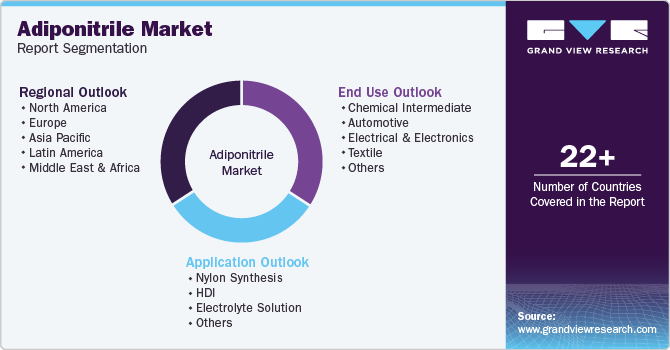
This report forecasts revenue growth at global, regional, and country levels and analyzes the latest industry trends in each sub-segment from 2021 to 2033. For this study, Grand View Research has segmented the global adiponitrile market report based on application, end use, and region.
 To learn more about this report, Download Free Sample Report
 -
Application Outlook (Volume, Kilotons; Revenue, USD Million, 2021 - 2033)
-
Nylon Synthesis
-
HDI
-
Electrolyte Solution
-
Others
-
-
End Use Outlook (Volume, Kilotons; Revenue, USD Million, 2021 - 2033)
-
Chemical Intermediate
-
Automotive
-
Electrical & Electronics
-
Textile
-
Others
-
-
Regional Outlook (Volume, Kilotons; Revenue, USD Million, 2021 - 2033)
-
North America
-
U.S.
-
Canada
-
Mexico
-
-
Europe
-
Germany
-
UK
-
France
-
Italy
-
Spain
-
-
Asia Pacific
-
China
-
Japan
-
South Korea
-
India
-
-
Latin America
-
Brazil
-
Argentina
-
-
Middle East and Africa
-
South Africa
-
Saudi Arabia
-
-
Research Methodology
The adiponitrile market figures in this report are based on a proven research process that combines executive interviews with secondary research from proprietary databases, company filings, and recognized regulatory and institutional sources. Market size is built through value-chain sizing - reconciling supply-side and demand-side estimates - and triangulated with bottom-up and top-down approaches. Every estimate passes multiple levels of expert validation before publication, with each adiponitrile segment quantified using the revenue-capture definitions in the table below.
Segment Definition
Segment - Application
Revenue capture definition
Nylon Synthesis
Revenue generated from the production and sale of adiponitrile used as a key intermediate in the manufacture of hexamethylenediamine (HMDA) and nylon 6,6 resins, fibers, and engineering plastics for automotive, textile, industrial, and consumer applications.
HDI
Market revenue attributed to adiponitrile consumption in the production of hexamethylene diisocyanate (HDI), which serves as a key component in high-performance polyurethane coatings, adhesives, sealants, elastomers, and specialty chemical formulations.
Electrolyte Solution
Revenue generated from the use of adiponitrile in battery electrolyte formulations and advanced energy storage applications, including lithium-ion batteries, where it serves as a solvent or functional additive to enhance electrochemical performance and safety.
Other Applications
Sales of adiponitrile for specialty chemicals, laboratory reagents, pharmaceutical intermediates, research purposes, and other niche industrial applications generate market revenue, excluding consumption associated with nylon synthesis, HDI production, and electrolyte solutions.
Segment - End Use
Revenue capture definition
Chemical Intermediate
The market encompasses revenue generated through the production, supply, and use of adiponitrile in the synthesis of hexamethylenediamine, hexamethylene diisocyanate, and various downstream chemical products utilized across multiple industries.
Automotive
Demand for adiponitrile-based materials, especially nylon 6,6 engineering plastics, contributes to revenue generation across automotive applications such as engine components, fuel systems, electrical connectors, under-the-hood parts, and lightweight structural components.
Electrical & Electronics
Revenue generated from adiponitrile-based products used in the manufacture of electrical and electronic components, including connectors, cable ties, circuit protection devices, switches, housings, and other high-performance engineering plastic applications.
Textiles
Demand for adiponitrile-based nylon 6,6 fibers contributes to revenue generation across apparel, industrial fabrics, carpets, tire cords, technical textiles, and various textile applications that require superior durability and performance.
Other End-uses
Revenue generated by the adiponitrile consumption across industries such as aerospace, construction, industrial equipment, consumer goods, healthcare, and other specialized applications that utilize adiponitrile-derived materials and chemical intermediates.
Estimation Model
Layer Name
Key Question
Description
Downstream Demand Base Layer
What forms the demand base?
Identify global demand for adiponitrile-derived products, primarily nylon 6,6, hexamethylenediamine (HMDA), and hexamethylene diisocyanate (HDI). Demand is driven by growth in automotive production, electrical and electronics manufacturing, industrial applications, textile consumption, and increasing adoption of high-performance engineering plastics and specialty chemicals.
Adiponitrile Adoption Layer
Where is adiponitrile utilized?
Assess the penetration of adiponitrile across key application areas including nylon synthesis, HDI production, electrolyte solutions, and specialty chemical applications. Evaluate adoption across end-use industries such as chemical intermediates, automotive, electrical & electronics, textiles, and other industrial sectors that rely on high-performance materials and chemical compounds.
Production & Supply Layer
How much adiponitrile is produced and supplied?
Analyze global adiponitrile production capacity, operating rates, and supply dynamics across major manufacturing regions. Production levels are influenced by feedstock availability, technological advancements, plant utilization rates, energy costs, environmental regulations, and investments in capacity expansion. Supply intensity varies based on integration with downstream nylon 6,6 value chains and regional industrial demand patterns.
Revenue Layer
How is market revenue generated?
Market revenue is generated through the production and sale of adiponitrile for nylon synthesis, HDI manufacturing, electrolyte solutions, and specialty chemical applications. Revenue growth is supported by rising demand for engineering plastics, lightweight automotive components, advanced coatings, electrical and electronic products, and emerging battery technologies. Increasing industrialization, infrastructure development, and investments in high-performance materials further contribute to market expansion.
Delivered Customizations
This report has been delivered with the following In-depth customizations
Client Request
Customization Delivered
Value Adds
Cross-Segmentation Analysis
Integrated mapping of adiponitrile demand across applications (nylon synthesis, HDI, electrolyte solutions, and other applications) against end-use industries including chemical intermediates, automotive, electrical & electronics, textiles, and other end-uses. The analysis evaluates consumption patterns, downstream value-chain integration, material performance requirements, and growth potential across key industry verticals.
Enables identification of high-value demand pockets where specific adiponitrile applications align with rapidly growing end-use sectors, supporting targeted investment decisions, product portfolio optimization, and strategic market expansion initiatives.
Competitive Benchmarking
Comparative evaluation of leading adiponitrile market participants based on production capacity, technological capabilities, value-chain integration, geographic footprint, product portfolio breadth, supply chain strength, sustainability initiatives, and customer reach. The assessment differentiates integrated adiponitrile producers from specialty chemical suppliers and regional distributors.
Supports strategic positioning by highlighting competitive strengths, operational efficiencies, technological advantages, and market leadership across major participants, enabling stakeholders to identify partnership opportunities, benchmark performance, and strengthen competitive strategies.
Opportunity Assessment
Analysis of growth opportunities across high-potential adiponitrile segments, including nylon 6,6 production, advanced coatings and polyurethane applications, battery electrolyte solutions, and specialty chemicals. The assessment focuses on increasing demand for lightweight automotive materials, electrical and electronic components, industrial engineering plastics, and next-generation energy storage technologies across major regional markets.
Helps identify emerging application areas, high-growth end-use industries, and underserved regional markets where manufacturers can expand capacity, diversify revenue streams, enhance profitability, and establish sustainable long-term competitive advantages.
Frequently Asked Questions About This Report
The global adiponitrile market size was estimated at USD 12.0 billion in 2025 and is expected to reach USD 12.9 billion in 2026.
Some key players operating in the adiponitrile market include Asahi Kasei Corp, Ascend Performance Materials, BASF SE, Butachimie, Invista, Kishida Chemical Co., Ltd, Spectrum Chemical, Tokyo Chemical Industry and Vizag Chemical.
Key factors that are driving the market growth include its increasing application as feedstock in the manufacturing of HDI & nylon 6,6, which are further used in different end-use industries including automobile, chemicals, and electric and electronics.
The nylon synthesis segment led the adiponitrile market with share of 85.9% in 2025, owing to its extensive use in the production of nylon 6,6 resins and fibers for automotive, textile, and industrial applications.
The electrolyte solution segment is projected to witness the fastest growth during the forecast period, registering a CAGR of 9.0% from 2026 to 2033, driven by rising demand for lithium-ion batteries used in electric vehicles and energy storage systems.
The automotive segment dominated the adiponitrile market in 2025, capturing 43.2% of market revenue, due to strong demand for nylon 6,6-based components that offer high strength, durability, and heat resistance in vehicle manufacturing.
The electrical & electronics segment is anticipated to grow at the fastest rate during the forecast period, registering a CAGR of 8.3% from 2026 to 2033,
The global adiponitrile market is expected to grow at a compound annual growth rate of 7.6% from 2026 to 2033 to reach USD 21.6 billion by 2033.
Asia Pacific accounted for dominating revenue share of 40.6% in the adiponitrile market revenue in 2025. This is attributable to ongoing industrialization, growing population, and expanding manufacturing base in Asia Pacific. The region is home to some of the largest manufacturing economies in the world, including China, Japan, South Korea, and India.
About the Author(s)
Plastics, Polymers & Resins Research Team
Bulk Chemicals · Plastics, Polymers & ResinsThis report was authored by the plastics, polymers & resins research team at Grand View Research - comprising two research analysts, one senior research analyst, and one industry expert - with specialized expertise in the plastics, polymers & resins segment of the bulk chemicals industry. All findings are based on proprietary bulk chemicals databases, executive interviews, and regulatory analysis, subject to internal peer review prior to publication.
Last Updated:
Speak to Analyst

Customize this report to your needs - add regions, segments, or data points, with 20% free customization.
Or view our licence options:


ISO 9001:2015 & 27001:2022 Certified
We are GDPR and CCPA compliant! Your transaction & personal information is safe and secure. For more details, please read our privacy policy.


