
- Home
- »
- Agrochemicals & Fertilizers
- »
-
Agricultural Micronutrients Market Size Report, 2026- 2033GVR Report cover

Agricultural Micronutrients Market (2026 - 2033) Size, Share & Trends Analysis Report By Mode Of Application (Soil, Foliar, Fertigation), By Product (Zinc, Boron, Iron), By Crop Type (Cereals, Pulses & Oilseeds, Fruits & Vegetables), By Form, By Region, And Segment Forecasts
Market Size, 2025
$5.7BMarket Estimate, 2026
$6.0BMarket Forecast, 2033
$10.1BCAGR, 2026–2033
7.6%Agricultural Micronutrients Market Summary
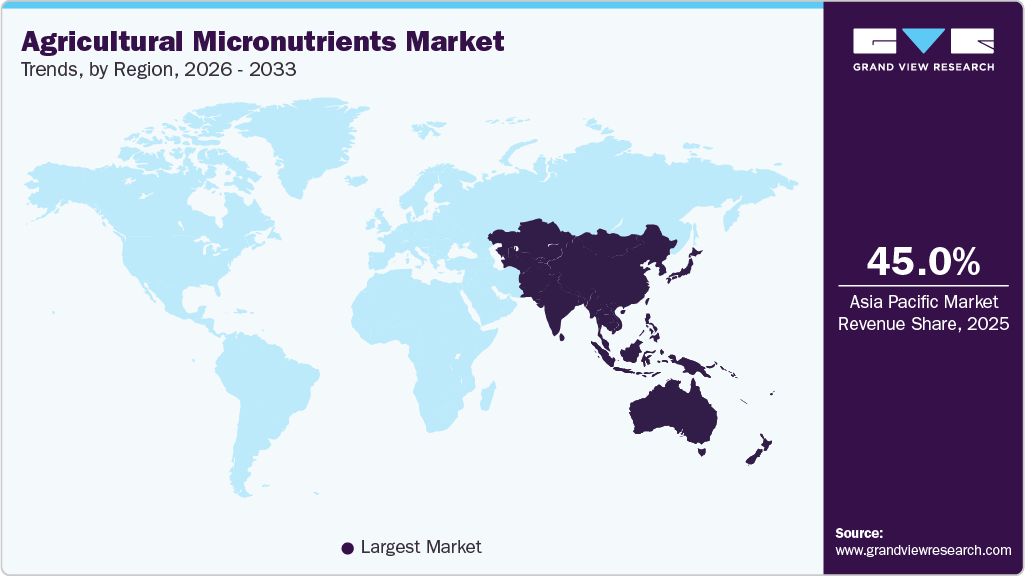
The global agricultural micronutrients market size was valued at USD 5.7 billion in 2025 and is projected to grow from USD 6.0 billion in 2026 to USD 10.1 billion by 2033, at a CAGR of 7.6% from 2026 to 2033. The market in Asia Pacific dominated with a revenue share of 45.0% in 2025, driven by the increasing need to enhance crop productivity and ensure food security amid a growing global population. Farmers are adopting micronutrient fertilizers to optimize nutrient balance, improve plant health, and boost yields, particularly in staple crops such as cereals and oilseeds.
 Source: Grand View Research, IR Documents, Primary Interviews, Paid DatabasesTo learn more about this report,
 Download Free Sample Report
Key Market Trends & Insights
- By product: Zinc segment dominated the industry with the largest revenue share of 42.6% in 2025.
- By form: Chelated micronutrients segment held the largest revenue share of 56.7% in 2025.
- By mode of application: Soil application dominated with largest revenue share of 43.3% in 2025.
- By crop type: Cereals segment held the largest revenue share of 47.1% in 2025.
Regional Highlights
- Largest regional market: Asia Pacific (45.0% revenue share, 2025)
- By country: The China held the largest market share in 2025.
Market Size & Forecast
- Market size in 2025: USD 5.7 billion
- Estimated market size in 2026: USD 6.0 billion
- Projected market size by 2033: USD 10.1 billion
- CAGR (2026-2033): 7.6%
Prism AI by Grand View Research Free to tryAsk a question about the agricultural micronutrients marketTry asking✓Every figure cited from GVR research Prefer the report? Download free sample →
The integration of precision agriculture technologies, including soil testing, GPS-guided nutrient applications, and crop monitoring systems, is a key market driver. These technologies enable farmers to apply micronutrients more efficiently and accurately, minimizing wastage while enhancing nutrient absorption and crop performance. The use of precision tools also allows targeted application for high-value crops like fruits and vegetables, driving demand for specialized micronutrient formulations designed for optimal efficacy.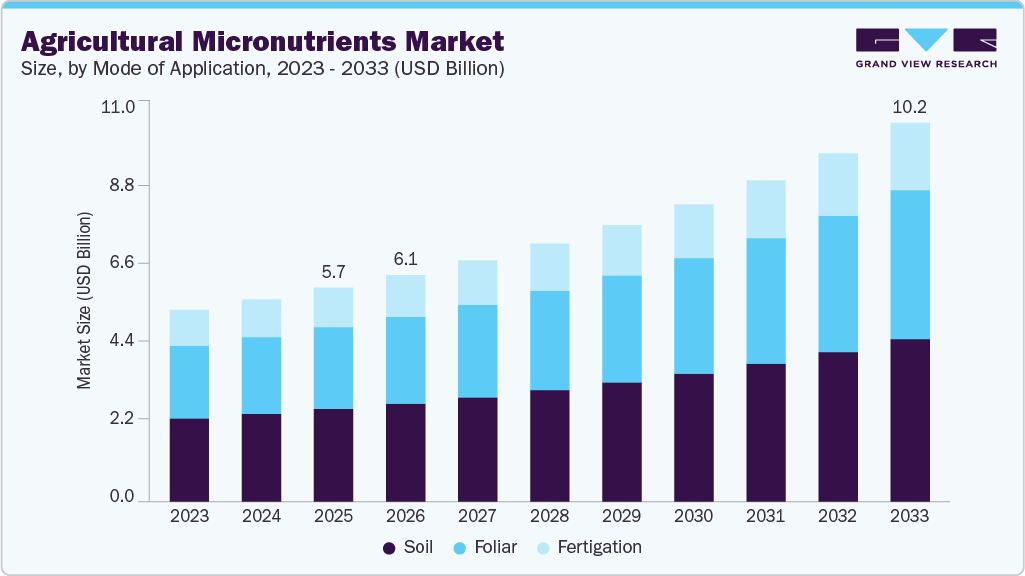 To learn more about this report, Download Free Sample Report
Emerging economies in Asia, Africa, and Latin America offer significant growth opportunities for the market. Increasing mechanization, modernization of farming practices, and rising awareness about soil nutrient deficiencies are driving the adoption of micronutrients. Manufacturers can capitalize on these markets by introducing cost-effective, region-specific formulations and establishing strong distribution networks to reach smallholders and commercial farms alike.
Market Dynamics
Declining soil fertility and increasing micronutrient deficiencies across agricultural land are strengthening the demand for agricultural micronutrients worldwide. Intensive farming practices, repeated crop cultivation, and excessive use of macronutrient fertilizers have reduced the availability of essential trace elements such as zinc, boron, iron, and manganese in soil. Farmers are increasingly adopting micronutrient fertilizers to improve crop health, nutrient absorption, and yield quality. Balanced nutrient management has become important for maintaining agricultural productivity and supporting sustainable farming practices across major crop-producing regions.
Commercial cultivation of fruits, vegetables, cereals, and oilseeds is also increasing the use of micronutrient products in precision agriculture systems. High-value crops require targeted nutrient applications to maintain product quality, appearance, and productivity under changing climatic conditions. Expanding awareness regarding crop nutrition management and growing adoption of fertigation and foliar application methods continue to support agricultural micronutrient consumption across both developed and developing agricultural economies.
Limited awareness regarding micronutrient deficiencies and balanced crop nutrition continues to restrict agricultural micronutrient adoption across rural farming regions. Many small-scale farmers remain dependent on conventional macronutrient fertilizers and lack technical understanding of micronutrient application methods, dosage requirements, and long-term soil health benefits. Inadequate agricultural extension services and limited access to soil testing facilities further reduce product utilization in developing agricultural economies. Higher product prices compared to traditional fertilizers also discourage adoption among cost-sensitive farming communities. Irregular distribution networks and lower availability of specialized micronutrient formulations in remote agricultural areas continue to affect market penetration and commercial growth opportunities for manufacturers.
Market Concentration & Characteristics
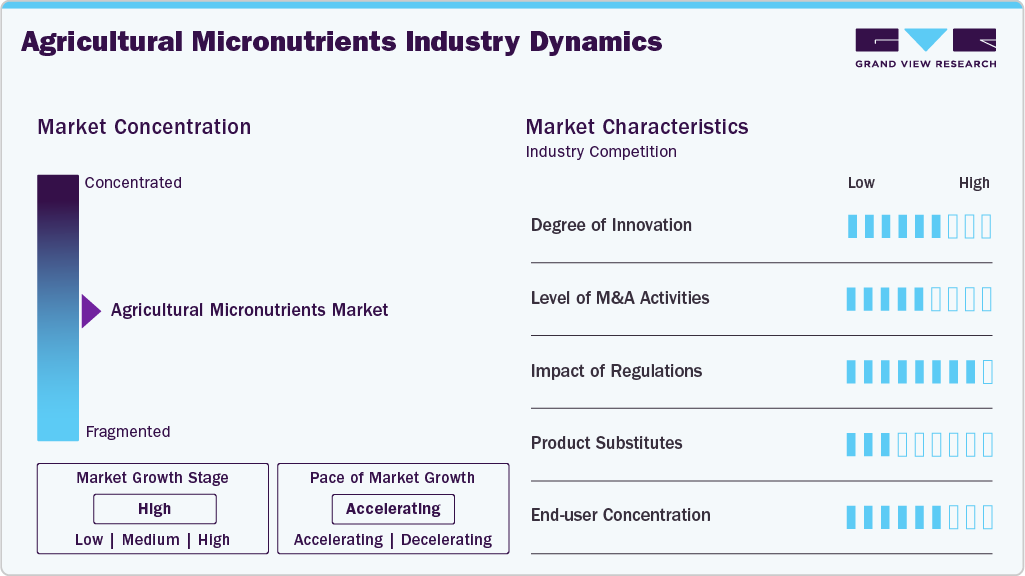
The agricultural micronutrients industry exhibits a moderately concentrated structure, dominated by global leaders such as BASF, Yara International ASA, and a few specialized regional players. These companies maintain strong competitive positions through extensive R&D investments, proprietary micronutrient formulations, and broad distribution networks that enable them to serve both large-scale commercial farms and precision agriculture operations. Market concentration is reinforced by high entry barriers, including the need for technical expertise, regulatory compliance, and investment in production technologies, which limit the presence of new entrants.
 To learn more about this report, Download Free Sample Report
The market is characterized by a diverse product portfolio, including zinc, manganese, and other essential micronutrients, offered in multiple forms such as chelated and non-chelated, for soil and foliar applications. Demand patterns are highly influenced by crop type, regional agricultural practices, and government regulations promoting balanced fertilization and sustainable farming. In addition, market dynamics are shaped by ongoing technological innovation in micronutrient delivery systems, precision farming integration, and increasing awareness of soil nutrient deficiencies, which drive the adoption of advanced, crop-specific solutions.
Mode of Application Insights
Soil application dominated the global agricultural micronutrients industry with the largest revenue share of 43.3% in 2025, because it allows uniform nutrient distribution and long-term availability in the root zone. Farmers rely on soil-applied products to enhance root development and overall crop growth.
Foliar application is the fastest-growing segment with a revenue CAGR of 8.0%, due to its ability to quickly correct nutrient deficiencies during critical growth stages. Farmers increasingly use foliar sprays in fruits, vegetables, and horticultural crops where quality and appearance are key for market value.
Product Insights
The zinc segment dominated the global agricultural micronutrients industry with the largest revenue share of 42.6% in 2025, due to its critical role in enhancing enzyme activity, protein synthesis, and overall crop growth. Zinc fertilizers are widely used in cereals and staple crops to prevent stunted growth and improve grain quality.
The manganese segment is the fastest-growing segment with a revenue CAGR of 8.2%, as it plays a vital role in photosynthesis, chlorophyll formation, and disease resistance in crops. Increasing cultivation of high-value fruits, vegetables, and horticultural crops is driving demand for manganese-enriched fertilizers.
Form Insights
Chelated micronutrients dominated the global agricultural micronutrients industry with the largest revenue share of 56.7% in 2025, due to their superior solubility, stability, and enhanced bioavailability, which ensures consistent nutrient uptake even in challenging soil conditions. Farmers widely prefer chelated formulations to improve crop resilience and productivity.
Non-chelated micronutrients are experiencing fast growth with a revenue CAGR of 7.9%, due to their cost-effectiveness and suitability for bulk fertilizer blends. Farmers adopt non-chelated products for cereals, pulses, and oilseeds to supplement standard fertilization programs efficiently.
Crop Type Insights
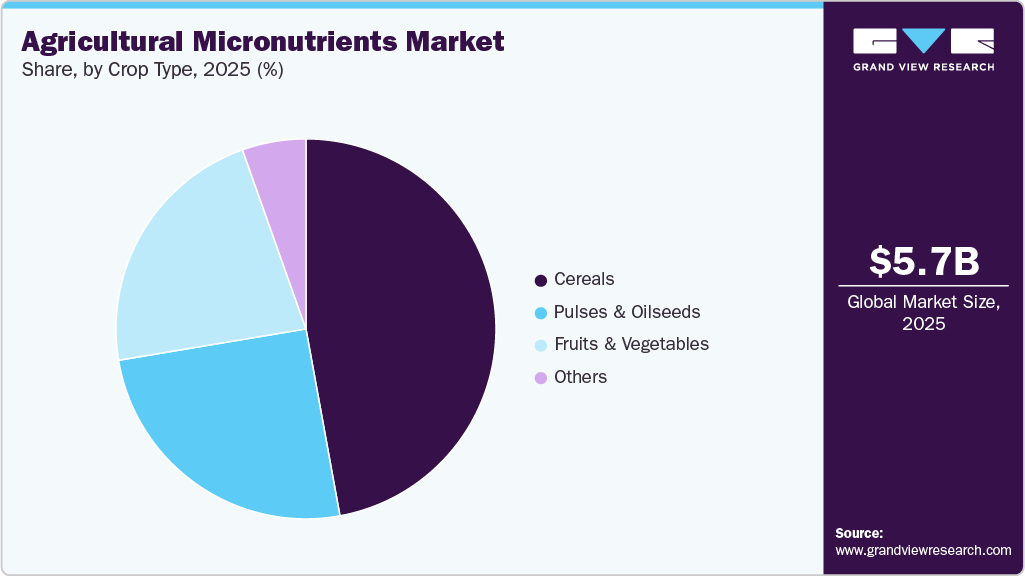
Cereals dominated the global agricultural micronutrients industry with the largest revenue share of 47.1% in 2025, due to the sheer scale of cereal cultivation globally, including major crops like wheat, rice, and maize. These staple crops require consistent and precise micronutrient supplementation to ensure optimal growth, high yields, and improved grain quality. Farmers prioritize zinc, manganese, and other key micronutrients for cereals to prevent deficiencies that can cause stunted growth, poor kernel development, and reduced resilience to environmental stresses such as drought or high temperatures.
 To learn more about this report, Download Free Sample Report
The fruit and vegetables segment is the fastest growing in the market with a revenue CAGR of 8.1%, driven by increasing consumer demand for high-quality, nutrient-rich produce. Micronutrients play a critical role in enhancing fruit size, color, flavor, and shelf life, which directly influences marketability and profitability, especially in export-oriented horticulture. Farmers increasingly invest in micronutrient applications to meet stringent quality standards and consumer expectations for appearance and nutritional content.
Regional Insights
Asia Pacific dominated the global agricultural micronutrients market with a 45.0% revenue share in 2025, driven by rapid population growth and rising food demand in countries such as China and India. Asia Pacific farmers adopt scientifically formulated products to address soil nutrient deficiencies and achieve consistent, high-quality harvests.
 To learn more about this report, Download Free Sample Report
China Agricultural Micronutrients Market Trends
The agricultural micronutrients market in China accounted for a 50.2% revenue share in 2025. China’s market growth is fueled by government initiatives promoting food security and high-yield crop production. Chinese farmers adopt micronutrient fertilizers to improve soil fertility, crop yield, and produce quality in alignment with national agricultural objectives.
North America Agricultural Micronutrients Market Trends
The agricultural micronutrients market in North America is propelled by the adoption of precision agriculture technologies, including soil testing, GPS-guided application, and crop monitoring systems. These innovations enable North American farmers to apply micronutrients more efficiently, increasing crop yields and reducing input wastage.
The U.S. agricultural micronutrients marketis driven by precision agriculture and data-driven nutrient management. U.S. farmers rely on advanced soil testing, satellite imagery, and crop monitoring systems to optimize micronutrient application, increasing yields and resource efficiency.
Europe Agricultural Micronutrients Market Trends
The agricultural micronutrients market in Europe is strongly influenced by strict environmental and sustainability regulations that promote the adoption of eco-friendly, high-efficiency fertilizers. European farmers increasingly require products that enhance nutrient uptake while minimizing environmental impact, driving continuous innovation by manufacturers.
Germany agricultural micronutrients marketis propelled by strict environmental policies and regulations that promote sustainable fertilization practices. German farmers seek high-efficiency micronutrients that maintain soil health while complying with environmental standards.
Middle East & Africa Agricultural Micronutrients Market Trends
The agricultural micronutrients market in the MEA is driven by widespread soil nutrient deficiencies, which reduce crop yield and quality. Farmers in the Middle East & Africa increasingly rely on fortified fertilizers and micronutrient blends to improve soil fertility and crop performance.
Latin America Agricultural Micronutrients Market Trends
The agricultural micronutrients market in Latin America is fueled by the expansion of large-scale commercial farming operations in countries like Brazil and Argentina. Agribusinesses in Latin America increasingly seek crop-specific micronutrient solutions to improve productivity and quality of export-oriented crops.
Key Agricultural Micronutrients Company Insights
BASF and Yara International ASA dominate the market through global operations, advanced R&D, and agronomic expertise, delivering high-quality, crop-specific solutions at scale.
-
BASF holds a strong position in the market supported by its advanced formulation technologies, extensive R&D infrastructure, and integrated crop protection portfolio. The company focuses on high-efficiency chelated micronutrients and sustainable solutions, enabling improved nutrient uptake and consistent yields across diverse agricultural systems.
-
Yara International ASA maintains a leading presence in the market through its vertically integrated production, strong agronomic advisory services, and global distribution network. Its emphasis on precision nutrition and farmer-centric solutions supports optimized micronutrient application and long-term soil productivity.
Recent Developments
-
On October 9, 2025, Yara South Asia announced plans to launch innovative crop nutrition solutions, including advanced micronutrient and integrated nutrient products, in 2026. This expansion aims to strengthen its product portfolio and support sustainable farming practices.
Key Agricultural Micronutrients Companies:
The following key companies have been profiled for this study on the agricultural micronutrients market.
- BASF
- Yara International ASA
- The Mosaic Company
- Haifa Group
- Nutrien Ltd.
- Coromandel International Ltd.
- ICL Group Ltd.
- Nufarm Limited
- Compass Minerals International, Inc.
Competitive Benchmarking
Operating Strategies
Competitive Edge
Weaknesses
Mature Players: Olin Corporation; Aditya Birla Chemicals; Sigura; Sinopec; Westlake Chemical Corporation; Tosoh Corporation; Hawkins Chemical, Inc.
- Major agricultural micronutrient manufacturers focus on expanding chelated and water-soluble nutrient portfolios for precision farming and high-value crop cultivation. Global distribution partnerships strengthen access across commercial agricultural markets.
- These companies invest in agronomic research and crop-specific nutrient formulations. Strategic collaborations with fertilizer distributors improve product penetration across intensive farming regions.
- Leading companies possess extensive micronutrient product portfolios supported by advanced formulation and nutrient delivery technologies. Strong global distribution networks ensure product availability across major agricultural economies.
- Established agronomic expertise helps manufacturers provide customized crop nutrition solutions. Integrated production capabilities also support consistent supply and operational efficiency advantages.
- Large manufacturers face fluctuating raw material prices affecting micronutrient production costs and profitability margins. Regulatory approvals for specialty agricultural inputs may also delay product commercialization timelines.
- Dependence on seasonal agricultural demand can create inventory management challenges. Broad geographic operations also increase distribution and operational complexity across regional markets.
Emerging Players: Tianjin Kaifeng Chemical Co., Ltd.; RXChemicals; Nikunj Chemicals; American Elements; Tianjin Ruifuxin Chemical Co., Ltd.; Vizag Chemicals; Kakadiya Chemicals; Sage Oil LLC
- Emerging agricultural micronutrient companies concentrate on regional crop nutrition requirements and localized distribution partnerships. Customized micronutrient blends support targeted applications across specific farming communities effectively.
- These manufacturers expand through competitive pricing and flexible product offerings. Focus on secondary agricultural markets improves regional customer acquisition and commercial presence.
- Emerging players provide quicker adaptation to local soil nutrient deficiencies and regional cropping patterns. Flexible manufacturing operations support customized micronutrient formulations for specialized agricultural applications.
- Regional market understanding strengthens relationships with local distributors and growers. Competitive pricing strategies also improve accessibility among medium-scale farming operations.
- Limited financial resources restrict investment in advanced micronutrient formulation technologies and large-scale distribution infrastructure development. Smaller production capacities may also affect supply consistency during peak agricultural seasons.
- Lower international brand recognition can reduce competitiveness against multinational fertilizer manufacturers. Dependence on regional agricultural markets also limits broader business expansion opportunities.
Agricultural Micronutrients Market Report Scope
Report Attribute
Details
Market size in 2025
USD 5.7 billion
Market size value in 2026
USD 6.0 billion
Revenue forecast in 2033
USD 10.1 billion
Growth rate
CAGR of 7.6% from 2026 to 2033
Base year for estimation
2025
Historical data
2018 - 2024
Forecast period
2026 - 2033
Quantitative units
Revenue in USD million/billion, volume in kilotons, and CAGR from 2026 to 2033
Report coverage
Revenue forecast, volume forecast, company ranking, competitive landscape, growth factors, and trends
Segments covered
Mode of application, product, form, crop type, region
Regional scope
North America; Europe; Asia Pacific; MEA; Latin America
Country scope
U.S.; Canada; Mexico; Germany; UK; France; Italy; Spain; China; India; Japan; South Korea; Brazil; Argentina; South Africa; Saudi Arabia
Key companies profiled
BASF; Yara International ASA; The Mosaic Company; Haifa Group; Nutrien Ltd.; Coromandel International Ltd.; ICL Group Ltd.; Nufarm Limited; Compass Minerals International, Inc.
Customization scope
Free report customization (equivalent up to 8 analysts’ working days) with purchase. Addition or alteration to country, regional & segment scope.
Pricing and purchase options
Avail customized purchase options to meet your exact research needs. Explore purchase options
Global Agricultural Micronutrients Market Report Segmentation
This report forecasts volume & revenue growth at global, regional, and country levels and provides an analysis of the latest industry trends in each of the sub-segments from 2018 to 2033. For this study, Grand View Research has segmented the global agricultural micronutrients market report based on form, crop type, product, mode of application, and region:
-
Mode of Application Outlook (Volume, Kilotons; Revenue, USD Million, 2018 - 2033)
-
Soil
-
Foliar
-
Fertigation
-
-
Product Outlook (Volume, Kilotons; Revenue, USD Million, 2018 - 2033)
-
Zinc
-
Boron
-
Manganese
-
Molybdenum
-
Iron
-
Other Application
-
-
Form Outlook (Volume, Kilotons; Revenue, USD Million, 2018 - 2033)
-
Chelated
-
Non-Chelated
-
-
Crop Type Outlook (Volume, Kilotons; Revenue, USD Million, 2018 - 2033)
-
Cereals
-
Pulses & Oilseeds
-
Fruits & Vegetables
-
Others
-
-
Regional Outlook (Volume, Kilotons; Revenue, USD Million, 2018 - 2033)
-
North America
-
U.S.
-
Canada
-
Mexico
-
-
Europe
-
Germany
-
UK
-
France
-
Italy
-
Spain
-
-
Asia Pacific
-
China
-
India
-
Japan
-
South Korea
-
-
Latin America
-
Brazil
-
Argentina
-
-
Middle East & Africa
-
Saudi Arabia
-
South Africa
-
-
Delivered Customizations
This report has been delivered with the following In-depth customizations
Client Request
Customization Delivered
Value Adds
Cross-segmentation
Detailed cross-segmentation analysis of the agricultural micronutrients market by product, form, application, and crop type, including market size comparison, consumption trends, revenue contribution, and growth analysis across interconnected segment combinations.
Support strategic planning and product positioning through enhanced understanding of high-growth segment combinations, application-specific demand trends, and evolving crop nutrition requirements across regional agricultural markets.
Competitive Benchmarking
Comparative analysis of agricultural micronutrient manufacturers based on production capacity, micronutrient product portfolio strength, formulation capabilities, distribution networks, agronomic support services, regional presence, and strategic developments across commercial agriculture sectors.
Assist supplier assessment and competitive intelligence activities through improved understanding of manufacturer positioning, operational capabilities, regional competitiveness, and product differentiation strategies within the agricultural micronutrients industry.
Opportunity Assessment
Assessment of emerging opportunities associated with precision farming expansion, rising micronutrient deficiency management, protected cultivation growth, sustainable agriculture practices, and increasing demand for high-efficiency crop nutrition solutions globally.
Help identify future growth areas and high-potential agricultural applications through deeper visibility into evolving farming practices, crop productivity requirements, nutrient management trends, and sustainability-focused agricultural investments worldwide.
Frequently Asked Questions About This Report
The global agricultural micronutrients market size was estimated at USD 5.7 billion in 2025 and is expected to reach USD 6.0 billion in 2026.
The global agricultural micronutrients market is expected to grow at a compound annual growth rate of 7.6% from 2026 to 2033 to reach USD 10.1 billion by 2033.
Asia Pacific dominated with a 45.0% revenue share in 2025.
Some of the key players operating in the agricultural micronutrients market include BASF, Yara International ASA, The Mosaic Company, Haifa Group, Nutrien Ltd.., Coromandel International Ltd., Haicheng Guangling Refractory, Yingkou Magnesite Chemical Boron Group, and Ube Material Industries.
Key factors include rising demand from refractory, steel, and construction industries, coupled with its growing use in environmental, agricultural, and healthcare applications. Increasing focus on high-performance materials, process efficiency, and sustainable manufacturing further accelerates MgO adoption across industrial value chains. Additionally, technological advancements in high-purity and reactive grades are expanding its role in next-generation industrial and green solutions.
The zinc segment held the highest market share of42.6% in 2025. while manganese is the fastest-growing segment.
The chelated micronutrients segment led with a 56.7% revenue share in 2025, while non-chelated micronutrients is the fastest-growing segment.
The soil application segment accounted for the largest share of 43.3% in 2025, while foliar application is the fastest-growing segment.
The cereals segment accounted for the largest share of 47.1% in 2025, while fruit and vegetables is the fastest-growing segment.
About the Author(s)
Agrochemicals & Fertilizers Research Team
Bulk Chemicals · Agrochemicals & FertilizersThis report was authored by the agrochemicals & fertilizers research team at Grand View Research - comprising two research analysts, one senior research analyst, and one industry expert - with specialized expertise in the agrochemicals & fertilizers segment of the bulk chemicals industry. All findings are based on proprietary bulk chemicals databases, executive interviews, and regulatory analysis, subject to internal peer review prior to publication.
Last Updated:
Speak to Analyst

Customize this report to your needs - add regions, segments, or data points, with 20% free customization.
Or view our licence options:


ISO 9001:2015 & 27001:2022 Certified
We are GDPR and CCPA compliant! Your transaction & personal information is safe and secure. For more details, please read our privacy policy.


