
- Home
- »
- Healthcare IT
- »
-
AI-assisted Radiation Therapy Planning Software Market Report, 2033GVR Report cover

AI-assisted Radiation Therapy Planning Software Market (2026 - 2033)
Size, Share & Trends Analysis Report By Deployment Mode (On-premise, Cloud-based), By Component (Software, Services), By End Use, By Region, And Segment Forecasts
Market Size, 2025
$659.6MMarket Estimate, 2026
$743.5MMarket Forecast, 2033
$1,815.3MCAGR, 2026–2033
13.6%AI-assisted Radiation Therapy Planning Software Market Summary
The global AI-assisted radiation therapy planning software market size was valued at USD 659.6 million in 2025 and is projected to grow from USD 743.5 million in 2026 to USD 1,815.3 million by 2033, at a CAGR of 13.6% from 2026 to 2033. North America dominated the market, accounting for the largest revenue share of 40.4% in 2025. Growth is driven by the rising prevalence of cancer, the increased demand for precise, personalized radiation therapy, and the broader adoption of artificial intelligence in radiation oncology. AI-assisted software automates treatment planning, contouring, dose optimization, and quality assurance, which improves workflow efficiency and treatment consistency. The expanded use of adaptive radiotherapy, combined with the need to reduce planning time and address anatomical changes during treatment, is also expected to accelerate market growth.
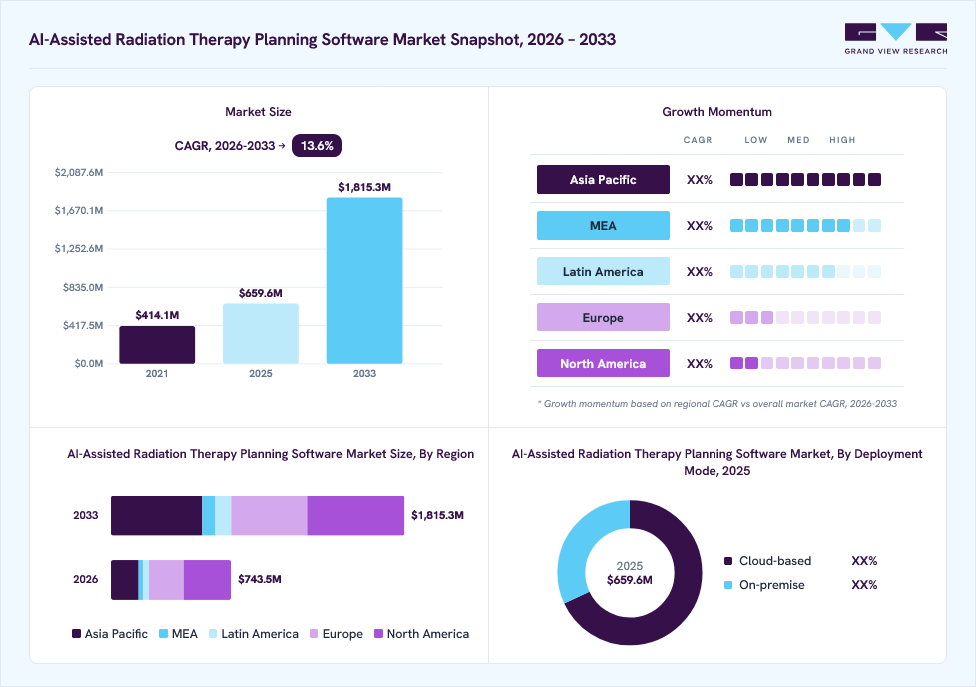 Source: Grand View Research, IR Documents, Primary Interviews, Paid DatabasesTo learn more about this report,
 Download Free Sample Report
Key Market Trends & Insights
- By deployment mode: The cloud-based segment held the largest market share of 68.0% in 2025.
- By component: The software segment held the largest market share of 73.8% in 2025.
- By end use: The hospitals segment held a dominant market share in 2025.
Regional Highlights
- Largest regional market: North America (40.4% revenue share, 2025)
- Fastest-growing regional market: Asia Pacific (highest CAGR, 2026-2033)
- By country: The U.S. held the largest market share in 2025.
Market Size & Forecast
- Market size in 2025: USD 659.6 Million
- Estimated market size in 2026: USD 743.5 Million
- Projected market size by 2033: USD 1,815.3 Million
- CAGR (2026-2033): 13.6%
Prism AI by Grand View Research Free to tryAsk a question about the AI-assisted radiation therapy planning software marketTry asking✓Every figure cited from GVR research Prefer the report? Download free sample →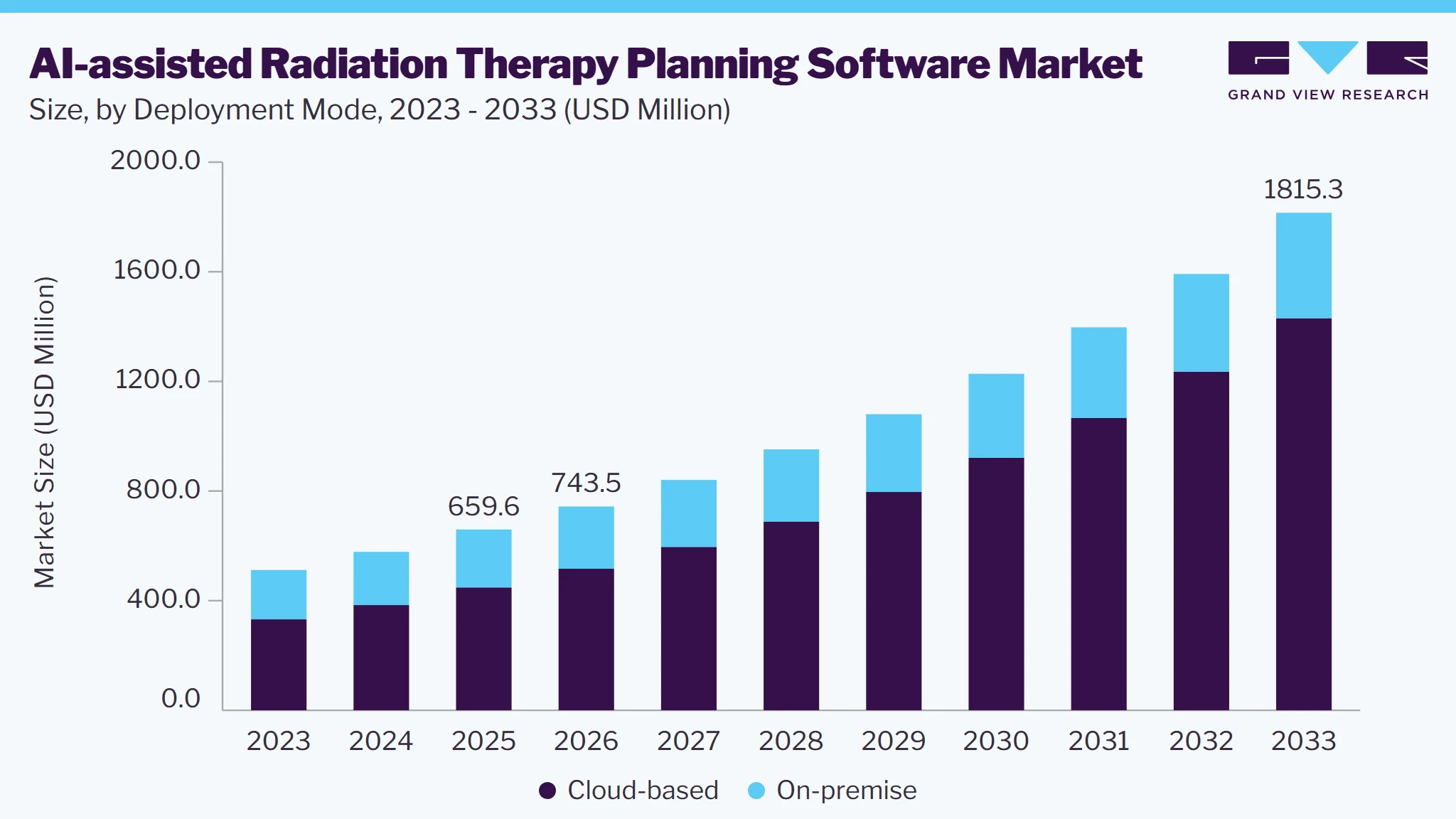 To learn more about this report, Download Free Sample Report
Market Dynamics
The AI-assisted radiation therapy planning software market is projected to grow as increased cancer screening and early detection drive demand for timely, precise radiotherapy. Artificial intelligence is enhancing treatment planning, automated contouring, dose optimization, and adaptive workflows, resulting in greater efficiency and accuracy. However, high implementation costs, infrastructure needs, system integration, and staff training may limit adoption, especially for smaller or resource-constrained healthcare facilities. The development of AI-ready planning systems and integrated oncology workflows presents opportunities to improve personalized care, streamline clinical processes, and expand the use of adaptive radiotherapy. These factors are expected to support continued innovation and market growth during the forecast period.
The growing emphasis on cancer awareness and early screening is supporting the adoption of AI-assisted radiation therapy planning software. Governments, healthcare providers, and oncology organizations are expanding awareness campaigns and screening programs to promote earlier cancer detection and timely treatment. Earlier diagnosis increases the need for accurate treatment planning and radiotherapy, creating opportunities for advanced software solutions that can improve treatment precision, optimize radiation doses, and streamline clinical workflows.
For instance, in January 2025, the Union for International Cancer Control (UICC) launched its World Cancer Day 2025 campaign to promote cancer prevention, early detection, and equitable access to cancer care. In addition, the Government of India has expanded cancer screening initiatives to improve early detection across the population. As screening and early diagnosis initiatives expand, healthcare providers are increasingly focusing on efficient and precise radiotherapy delivery, supporting the adoption of AI-assisted planning and adaptive therapy solutions. “We will come together once again to mark World Cancer Day - a day of unity, action, and hope. The World Cancer Day theme 'United by Unique' places people at the center of care and their stories at the heart of the conversation. Every individual facing cancer has a unique story, a unique experience - and yet, we’re all united by our shared commitment to create a world where we look beyond the disease and see the person before the patient.” - Cary Adams, CEO of UICC
Although AI-based planning tools have demonstrated promising results, prospective clinical evidence remains limited. For instance, a 2026 prospective evaluation of 22 patients undergoing prostate radiotherapy found that fully automated workflows achieved clinically acceptable results in 86% of cases, compared with 95% for conventional workflows, indicating that further clinical validation is required before such systems can be consistently relied upon in routine practice.
In addition, the joint ESTRO-AAPM guideline published in 2024 reported that AI models had not been widely adopted in clinical radiation therapy, highlighting clinical validation as an important gap. The guideline specifically recommends rigorous testing and validation before deployment and notes that many AI models have been developed using retrospective datasets from a single or a limited number of centers. This limited clinical evidence can delay the integration of AI-assisted planning and adaptive therapy solutions into routine radiation oncology workflows.
Opportunity: Growing Adoption of Cloud-Based AI Planning Platforms and Integrated Oncology Workflows
The increasing use of AI-ready treatment planning systems and integrated oncology workflows is expected to drive growth in the AI-assisted radiation therapy planning software market. Advanced platforms enhance planning accuracy, enable robust dose optimization, and unify multiple planning and review functions. The development of systems that incorporate AI and adaptive workflows will further support the shift toward more personalized and efficient radiation therapy.
For instance, in June 2026, Cosylab launched PlanOne, an FDA 510(k)-cleared treatment planning system for particle therapy. PlanOne features a GPU-accelerated Monte Carlo dose engine, supports robust optimization, and integrates contouring, planning, and review in a single environment. Cosylab noted that PlanOne is designed to evolve with AI and adaptive workflows and can integrate with existing oncology information systems. This development demonstrates the growing integration of advanced computing, AI-ready features, and adaptive workflows in radiation treatment planning, supporting broader adoption of AI-assisted radiation oncology software.
"PlanOne began with listening. Over the years, our work on control systems in radiation oncology has put us in direct, ongoing contact with medical physicists and clinical teams at some of the leading facilities in the world. Our partners have been clear on what matters most for particle therapy: physics accuracy they can defend, clinical confidence at the point of plan approval, and a platform built to grow with AI and adaptive workflows. We designed PlanOne™ around those three priorities, and we'll keep developing it together with the clinical community that helped shape it." -Mark Pleško, CEO of Cosylab
Some of the key AI-assisted radiation therapy planning software
Companies
Software’s
Features
Varian Medical Systems
Eclipse TPS with AI auto-contouring
AI-assisted auto-contouring of organs at risk and target volumes, automated treatment planning, and adaptive planning support
Elekta AB
Elekta ONE Planning
AI-enabled treatment planning, automated plan optimization, workflow automation, and personalized dose planning
RaySearch Laboratories
Raystation
AI-assisted segmentation, automated treatment planning and optimization, adaptive radiotherapy, and dose calculation
Accuray Incorporated
Accuray Precision Treatment Planning
Automated treatment planning, image-guided treatment support, plan optimization, and dose calculation for complex treatment plans
GE HealthCare Technologies Inc.
Intelligent Radiation Therapy (iRT)
AI-enabled image analysis, treatment planning support, workflow automation, and adaptive radiotherapy capabilities
DOSIsoft SA
PLANET Onco
AI-assisted dose assessment, treatment plan evaluation, radiotherapy workflow management, and personalized dosimetric analysis
TheraPanacea
ART-Plan
AI-driven auto-segmentation, automated treatment planning, adaptive radiotherapy, and real-time treatment plan optimization
Market Concentration & Characteristics
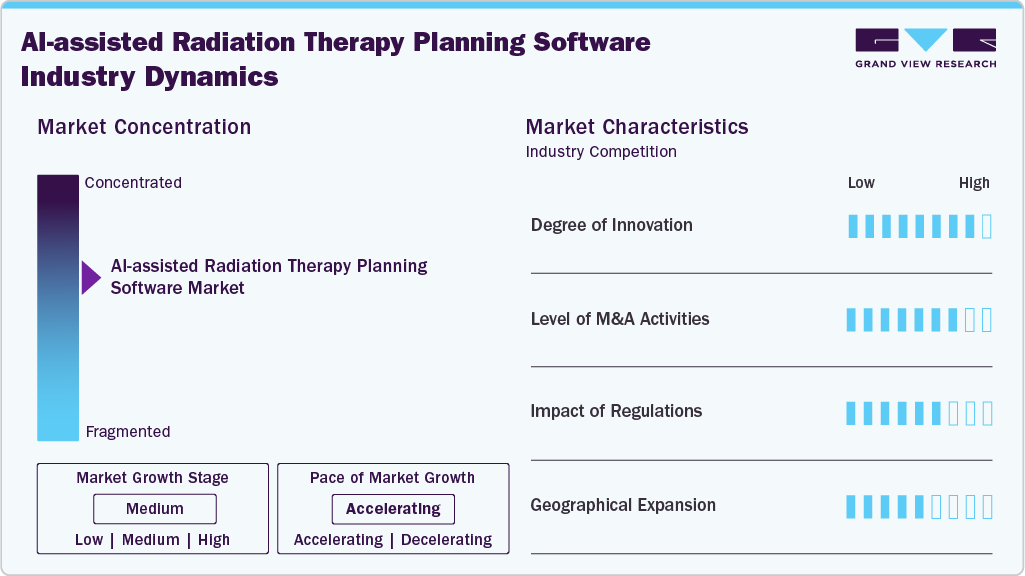
The AI-assisted radiation therapy planning software market is highly innovative, driven by advances in AI-based auto-contouring, treatment planning, image processing, workflow automation, and adaptive radiotherapy. Companies are integrating AI with imaging and planning platforms to improve precision, simplify workflows, and enable personalized treatment. For instance, in May 2024, GE HealthCare launched its AI-enhanced Intelligent Radiation Therapy (iRT) platform and Revolution RT at the ESTRO 2024 Congress. The updated iRT platform offers multi-vendor interoperability, automated workflows, and AI-enabled applications, and integrates with third-party solutions to support advanced therapy planning and imaging workflows.
The market is experiencing moderate M&A activity as companies expand their oncology software, imaging analytics, and AI capabilities. Strategic acquisitions focus on complementary technologies that enhance treatment planning, imaging, and digital oncology workflows. For instance, in April 2024, GE HealthCare acquired MIM Software, adding radiation oncology, imaging analytics, and digital workflow capabilities to its portfolio. This acquisition also strengthened GE HealthCare's collaboration with Elekta in precision radiation oncology and treatment planning.
 To learn more about this report, Download Free Sample Report
Regulatory impact is high in the industry, as developers must demonstrate software safety, clinical performance, and reliability before deployment. Regulatory clearance is especially important for AI-enabled tools used in treatment planning and adaptive therapy. For instance, in September 2025, MVision AI received U.S. FDA 510(k) clearance for Dose+, an AI-powered software for dose prediction and personalized radiotherapy planning. The FDA identifies Dose+ as a medical software device for use by radiation oncologists, dosimetrists, and physicists in external beam radiotherapy planning. This clearance highlights the regulatory requirements for commercializing AI-based radiation oncology software and supports broader clinical adoption of validated AI planning solutions.
The market is expanding as healthcare providers across emerging economies increasingly adopt AI-enabled treatment planning and adaptive radiotherapy solutions. Growing investments in advanced oncology infrastructure, rising cancer treatment volumes, and the need for more precise, personalized radiation therapy are supporting adoption across the Asia-Pacific and other developing regions. This regional expansion is creating opportunities for software providers to broaden their presence in hospitals and cancer treatment centers seeking to modernize radiation oncology workflows.
Analyst Perspective
The AI-assisted radiation therapy planning software market is growing steadily, driven by the rising cancer burden, use of precision radiotherapy, and advances in artificial intelligence and medical imaging. As healthcare providers seek to improve treatment accuracy and personalize care, adoption of AI-enabled planning, auto-contouring, dose optimization, and adaptive radiotherapy is increasing. In response, software providers are incorporating AI, automated image analysis, and real-time treatment adaptation to streamline workflows and support clinical decisions. Ongoing investment in oncology infrastructure and demand for precise, efficient radiation treatment are expected to sustain market growth throughout the forecast period.
By Deployment Mode
The cloud-based segment held the largest market share of 68.0% in 2025. Growth is driven by scalability, remote access, centralized data management, and AI-enabled planning without the need for extensive local infrastructure. Cloud-based platforms also enhance collaboration among radiation oncologists, medical physicists, and dosimetrists across locations, improving oncology workflows. For instance, in June 2025, MVision AI secured USD 3.25 million in Business Finland R&D funding to advance its cloud-based AI solutions for radiotherapy planning. The company stated that this investment would support product development to reduce the time from simulation to treatment and expand automated radiotherapy workflows. This development underscores ongoing investment in cloud-based AI technologies for radiation treatment planning.
The on-premise segment is expected to grow steadily as the solution offers greater control over software, patient data, and IT systems, which is essential for managing sensitive clinical information. These solutions integrate with existing treatment planning systems, imaging equipment, and hospital information systems, supporting continuity in established workflows. Facilities with dedicated IT teams and infrastructure may continue to prefer on-premise deployment to maintain operational control and limit reliance on external cloud environments.
By Component
The software segment held the largest market share of 73.8% in 2025. The rising demand is driven by AI-based treatment planning, adaptive radiotherapy, automated contouring, dose optimization, image registration and fusion, and quality assurance solutions. Healthcare providers are adopting advanced software to automate complex planning, improve consistency, and enhance workflow efficiency. For instance, in July 2026, RaySearch introduced new capabilities across RayStation, RayCare, and RayIntelligence at the 2026 AAPM meeting, including deep-learning segmentation, automated replanning, treatment-planning automation, and AI performance monitoring through its cloud-based RayIntelligence platform. These advancements reflect the ongoing integration of AI and automation in radiation oncology software.
The services segment is expected to grow at the fastest CAGR during the forecast period. Growth is driven by the increasing complexity of deploying AI-assisted radiation oncology solutions and the need for implementation, integration, training, maintenance, technical support, and consulting. As healthcare providers integrate advanced software with existing imaging, treatment planning, and oncology information systems, demand for specialized implementation and integration services will rise. Ongoing software upgrades, cybersecurity needs, technical support, and staff training will further drive demand for services and support rapid growth in the segment.
By End Use
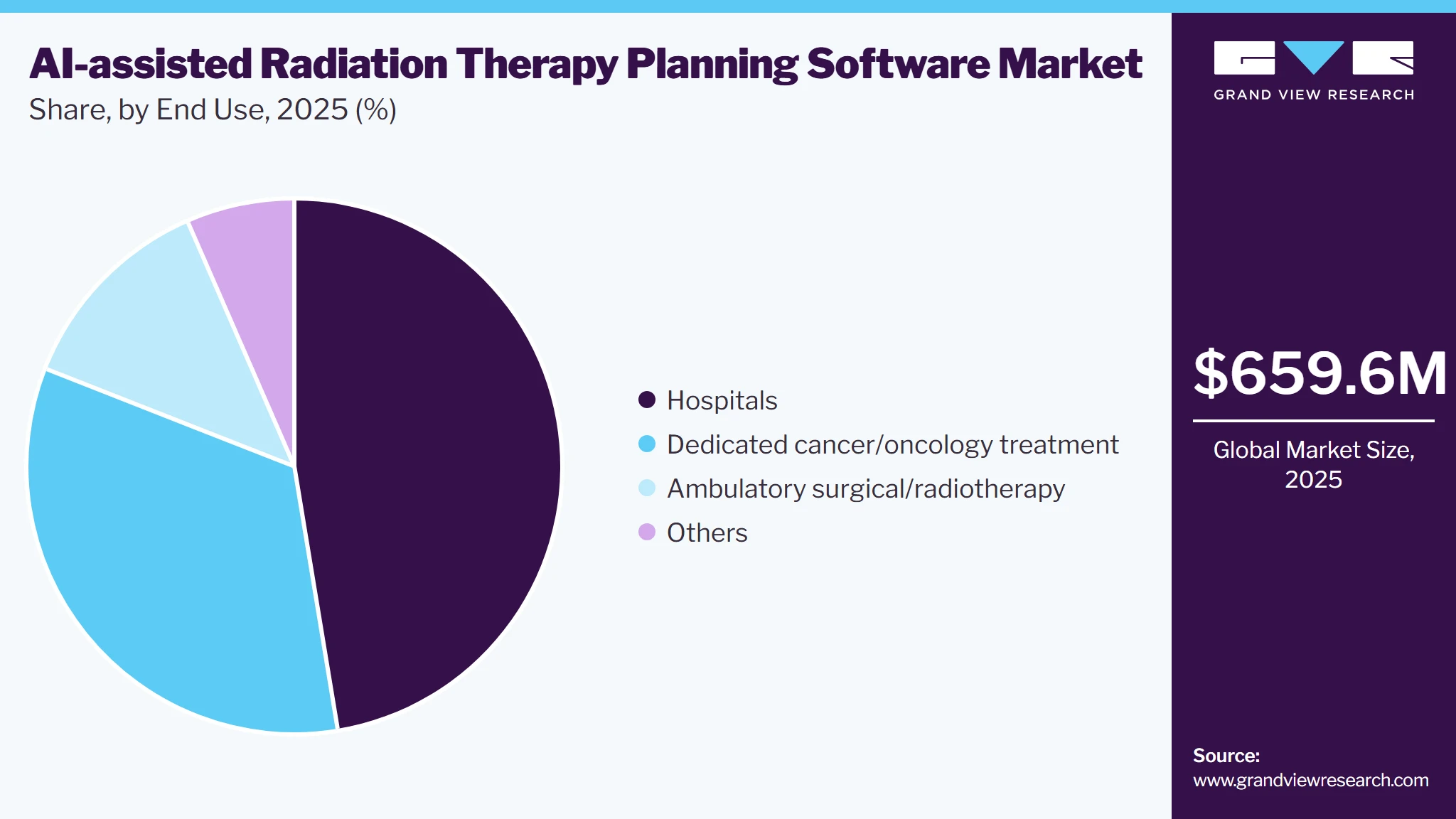
The hospital segment held the largest market share of 47.4% in 2025. It is supported by high patient volumes, established radiation oncology departments, advanced imaging and treatment infrastructure, and greater capacity to invest in AI-enabled technologies. Hospitals are increasingly integrating AI-assisted treatment planning and adaptive radiotherapy into clinical workflows to improve treatment precision, efficiency, and personalized cancer care. For instance, in July 2025, Siemens Healthineers and Prisma Health announced a USD 50 million investment in radiation therapy, including the acquisition of Varian’s Ethos adaptive radiotherapy system. This AI-driven system enables treatment plans to adapt to changes in tumor and patient anatomy, highlighting the growing adoption of AI-enabled adaptive radiotherapy in hospital-based cancer care.
 To learn more about this report, Download Free Sample Report
The dedicated cancer/oncology treatment centers segment is expected to grow at the fastest CAGR during the forecast period. Growth is driven by rising demand for specialized cancer treatment, increased adoption of precision radiotherapy, and investments in advanced radiation therapy infrastructure. These centers often have dedicated oncology teams and specialized equipment, enabling faster integration of AI-assisted planning, automated contouring, and adaptive radiotherapy solutions. The growing focus on personalized cancer treatment and the expansion of specialized oncology facilities will further increase demand for advanced radiation oncology software.
Regional Insights
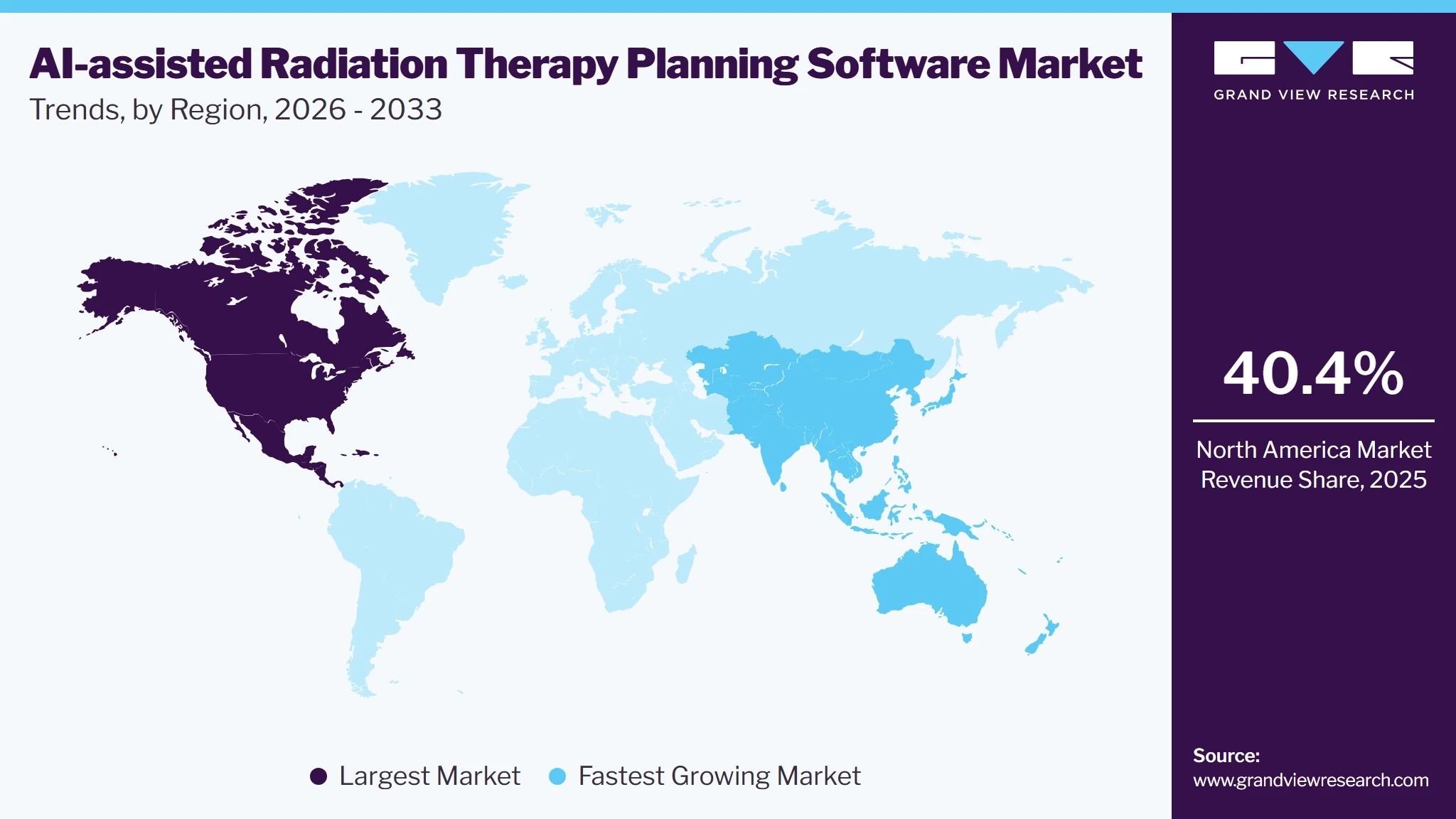
The North America AI-assisted radiation therapy planning software market held the largest market share of 40.4% in 2025. The growth is driven by a high burden of cancer, advanced oncology infrastructure, and widespread adoption of precision radiation therapy. According to data published by NCBI in 2025, 2,041,910 new cancer cases and 618,120 cancer deaths occurred in the U.S. The strong presence of healthcare technology companies and well-established cancer care systems further supports market expansion. Increasing integration of artificial intelligence into clinical workflows, along with advanced imaging and treatment equipment, is creating favorable conditions for growth. Hospitals and cancer centers are adopting image-guided radiation therapy, adaptive treatment planning, automated contouring, and AI-enabled treatment optimization to enhance precision and efficiency.
 To learn more about this report, Download Free Sample Report
U.S. AI-assisted Radiation Therapy Planning Software Market Trends
The AI-assisted radiation therapy planning software market in the U.S. is fueled by a significant cancer burden, advanced oncology infrastructure, and growing adoption of AI-enabled radiation treatment technologies. The country’s extensive network of hospitals, academic medical centers, and specialized cancer facilities, supported by advanced radiation therapy systems, provides a strong foundation for adopting these solutions. Greater integration of AI in radiation oncology is enabling improved cancer risk assessment, personalized treatment, and clinical decision making. For instance, in May 2025, University Hospitals reported increased use of AI-based biomarkers to enhance cancer risk stratification and support more precise, personalized care. In addition, AI-driven adaptive radiotherapy solutions such as Varian’s Ethos combine artificial intelligence with advanced imaging to enable personalized treatment planning and real-time adaptation. These advancements are strengthening AI integration across U.S. radiation oncology workflows and are expected to increase demand for automated contouring, treatment-plan optimization, image analysis, and adaptive therapy software.
Asia Pacific AI-assisted Radiation Therapy Planning Software Market Trends
The AI-assisted radiation therapy planning software market in the Asia Pacific is expected to grow at the fastest CAGR of 18.6% during the forecast period, driven by a rising cancer burden, higher healthcare spending, improved oncology infrastructure, and greater adoption of artificial intelligence in radiation therapy. Governments and healthcare providers are investing in advanced imaging systems, linear accelerators, and digital oncology platforms to enhance access to precision cancer treatment. The adoption of image-guided radiation therapy, automated treatment planning, AI-based contouring, and online adaptive radiotherapy is further accelerating market growth as hospitals aim to improve treatment accuracy, workflow efficiency, and personalized care. These trends are especially prominent in China and India, where investments in advanced radiotherapy infrastructure and AI-enabled technologies are expanding access to precision cancer care.
The China AI-assisted radiation therapy planning software market expects a promising opportunity on the back of rising cancer burden, expanded radiation oncology infrastructure, and increased integration of AI in treatment planning and adaptive radiotherapy. For instance, in April 2026, researchers at Sun Yat-sen University Cancer Center introduced an AI-based technology that automatically delineates tumors and healthy tissue, reducing physician outlining differences by 50% and cutting treatment time to about 30 minutes. This advancement underscores the growing adoption of AI to enhance radiation treatment planning and adaptive therapy in China.
The AI-assisted radiation therapy planning software market in India is supported by the rising cancer burden, expansion of specialized oncology facilities, and increasing need for advanced radiation treatment technologies. According to the WHO Global Status Report on Cancer 2026, based on IARC's Cancer Today 2024 estimates, India recorded approximately 1.56 million new cancer cases and 901,828 cancer-related deaths in 2024, while around 3.32 million people were living within five years of a cancer diagnosis. The growing patient burden is expected to increase demand for advanced radiation oncology planning, adaptive therapy, and AI-assisted software solutions that can support precise and personalized cancer treatment.
Europe AI-assisted Radiation Therapy Planning Software Market Trends
The AI-assisted radiation therapy planning software market in Europe is driven by a rising cancer burden, advanced oncology infrastructure, increased adoption of precision radiotherapy, and greater integration of AI in treatment planning. Hospitals are adopting AI-based contouring, automated planning, image-guided radiation therapy, and adaptive radiotherapy to enhance treatment accuracy and workflow efficiency. For instance, in May 2025, The Royal Marsden NHS Foundation Trust became the first hospital globally to treat a patient using RaySearch Laboratories' advanced online adaptive radiotherapy (oART) technology. The system enables clinicians to modify treatment plans on the same day based on changes in patient anatomy, using the RayStation treatment planning system alongside an Accuray Radixact linear accelerator. This adoption highlights the increasing integration of adaptive radiotherapy and advanced treatment planning software across European oncology centers.
The UK AI-assisted radiation therapy planning software market benefits from the NHS’s growing adoption of AI and digital technologies to enhance cancer treatment workflows. For instance, in October 2025, Royal Free London implemented an AI contouring system that automatically generates treatment contours from medical imaging data, reducing manual workload and accelerating radiotherapy planning. This development is expected to drive further integration of AI-assisted planning and contouring technologies across UK radiotherapy centers.
The AI-assisted radiation therapy planning software market in Germany is supported by advanced oncology infrastructure, strong clinical research capabilities, and increasing adoption of AI-enabled treatment technologies. Hospitals are increasingly integrating automated treatment planning, AI-assisted contouring, image-guided radiotherapy, and adaptive treatment approaches to improve treatment precision and personalize radiation delivery. The growing integration of these technologies into German cancer-care workflows is expected to increase demand for AI-assisted radiation therapy planning software.
Latin America AI-assisted Radiation Therapy Planning Software Market Trends
The AI-assisted radiation therapy planning software market in Latin America has gained prominence as providers are adopting image-guided and adaptive radiotherapy to enhance treatment accuracy and patient outcomes. For instance, in March 2026, the International Atomic Energy Agency (IAEA) reported on a study in Bolivia and Brazil that assessed the feasibility of advanced image-guided brachytherapy in resource-constrained settings. The study demonstrated that 3D image-guided adaptive brachytherapy, which adjusts treatment plans based on tumor and tissue changes, supports the adoption of advanced adaptive radiation technologies in Latin America.
Middle East & Africa AI-assisted Radiation Therapy Planning Software Market Trends
The AI-assisted radiation therapy planning software market in the Middle East & Africa expects growing regional capabilities in radiation treatment and digital cancer care. For instance, in November 2025, the Middle East Society of Therapeutic Radiation Oncology (MESTRO) Congress in Riyadh highlighted AI and advanced technologies in cancer treatment. Regional experts discussed developments in radiation oncology and emphasized the use and regulation of AI in radiotherapy diagnosis and treatment. This focus on AI-enabled cancer care is expected to accelerate the adoption of AI-assisted radiation therapy planning software in the region.
Key AI-assisted Radiation Therapy Planning Software Company Insights
Some of the key companies in the AI-assisted radiation therapy planning software market include Varian Medical Systems, Inc. (Siemens Healthineers), Elekta AB, RaySearch Laboratories, Accuray Incorporated, Brainlab SE, GE HealthCare Technologies Inc., Koninklijke Philips N.V., MVision AI, Mirada Medical Ltd., DOSIsoft SA, Radformation, Inc., and TheraPanacea.
Key market players are increasingly focusing on technological advancements and innovation to strengthen their competitive position in the market. These companies are undertaking several strategic initiatives, including product launches, partnerships, collaborations, and the integration of artificial intelligence and automation capabilities into radiation therapy planning workflows.
Key AI-assisted Radiation Therapy Planning Software Companies
The following key companies have been profiled for this study on the AI-assisted radiation therapy planning software market:
-
Varian Medical Systems, Inc. (Siemens Healthineers)
-
Elekta AB
-
RaySearch Laboratories
-
Accuray Incorporated.
-
Brainlab SE
-
GE HealthCare Technologies Inc.
-
Koninklijke Philips N.V.
-
MVision AI
-
Mirada Medical Ltd.
-
DOSIsoft SA
-
Radformation, Inc.
-
TheraPanacea
Competitive Benchmarking
Category
Operating Strategies
Competitive Edge
Weakness
Established Players (e.g., Varian Medical Systems, Inc. (Siemens Healthineers), Elekta AB, GE HealthCare Technologies Inc., Koninklijke Philips N.V., Brainlab SE)
- • Expand comprehensive portfolios across treatment planning systems (TPS), AI auto-contouring, adaptive radiotherapy (ART), and integrated QA platforms.
- • Invest in AI-enabled planning algorithms, cloud-based planning suites, strategic partnerships, and acquisitions to strengthen oncology AI presence.- Integrate AI planning software with existing linacs, MR-Linacs, and hospital IT (PACS/RIS/EHR).
- • Strong brand recognition, extensive global distribution networks, and integrated hardware and software solutions across hospitals and cancer centers.
- • Robust regulatory expertise (FDA, CE, etc.), advanced interoperability with imaging and oncology workflows, and strong commercialization and service capabilities.
- • Premium pricing may limit adoption in cost-sensitive markets and smaller radiotherapy centers.
- • Large organizational structures and reliance on capital-equipment procurement cycles slow innovation rollout and market expansion.
Emerging / Specialized Players
(e.g., RaySearch Laboratories, Accuray Incorporated, MVision AI, Mirada Medical Ltd., DOSIsoft SA, Radformation, Inc., TheraPanacea)
- • Develop specialized AI auto-contouring, plan optimization, adaptive replanning, and QA analytics modules, often as add-ons to existing TPS.
- • Focus on digital health, SaaS/cloud-based AI planning, subscription models, and expansion into high-growth regional markets (Asia-Pacific, Latin America, Middle East).
- • Strong innovation in AI algorithms, deep-learning contouring, automated planning, and adaptive therapy workflows.
- • Faster product development cycles, agile customization, and competitive pricing support adoption in outpatient and resource-constrained settings.
- • Limited global distribution networks and lower brand recognition compared to established radiotherapy manufacturers.
- • Smaller product portfolios and dependence on integration with third-party TPS/linacs may restrict large-scale market penetration.
Recent Developments:
-
In May 2026, GE HealthCare showcases AI-enabled radiation therapy solutions at the ESTRO 2026 Congress, featuring intelligent workflows and AI-based auto contouring for CT and MR images. These technologies automate treatment planning, enhance contouring efficiency, and enable more personalized radiation therapy.
“The complexity of all systems involved in radiation therapy has historically made it challenging to see the full picture of the patient care pathway as they moved through our department. iRT has fundamentally changed this. We now have more complete and clear visibility as well as increased control over every aspect of our workflow, from initial consultation through treatment delivery.”
- Dr. Árpád Kovácsiii, Head of the Radiotherapy Department at Debrecen University.
-
In April 2025, Sun Nuclear, a Mirion Medical company, acquired Oncospace, an AI-focused radiation oncology software provider offering cloud-based solutions for treatment planning and optimization. This acquisition expanded Sun Nuclear’s software portfolio and enhanced its AI-assisted treatment planning capabilities.
“By incorporating the Oncospace solutions dependent on AI and machine-learning capabilities, Sun Nuclear is affirming our commitment to drive innovation in radiation therapy. We look forward to the positive impact this will have on our software roadmap.”
-Luis Rivera, Sun Nuclear president and Mirion Medical executive vice president.
AI-assisted Radiation Therapy Planning Software Market Report Scope
Report Attribute
Details
Market size in 2025
USD 659.6 million
Estimated market size in 2026
USD 743.5 million
Revenue forecast in 2033
USD 1,815.3 million
Growth rate
CAGR of 13.6% from 2026 to 2033
Actual data
2021 - 2025
Forecast period
2026 - 2033
Quantitative units
Revenue in USD million and CAGR from 2026 to 2033
Report coverage
Revenue forecast, company ranking, competitive landscape, growth factors, and trends
Segments covered
Deployment mode, component, end use, region
Regional scope
North America; Europe; Asia Pacific; Latin America; MEA
Country scope
U.S.; Canada; UK; Germany; France; Italy; Spain; Denmark; Sweden; Norway; China; Japan; India; Australia; South Korea; Thailand; Brazil; Argentina; Mexico; South Africa; Saudi Arabia; UAE; Kuwait
Key companies profiled
Varian Medical Systems, Inc. (Siemens Healthineers); Elekta AB; RaySearch Laboratories; Accuray Incorporated.; Brainlab SE; GE HealthCare Technologies Inc.; Koninklijke Philips N.V.; MVision AI; Mirada Medical Ltd.; DOSIsoft SA; Radformation, Inc.; TheraPanacea
Customization scope
Free report customization (equivalent to 8 analysts working days) with purchase. Addition or alteration to country, regional & segment scope.
Pricing and purchase options
Avail customized purchase options to meet your exact research needs. Explore purchase options
Global AI-assisted Radiation Therapy Planning Software Market Report Segmentation
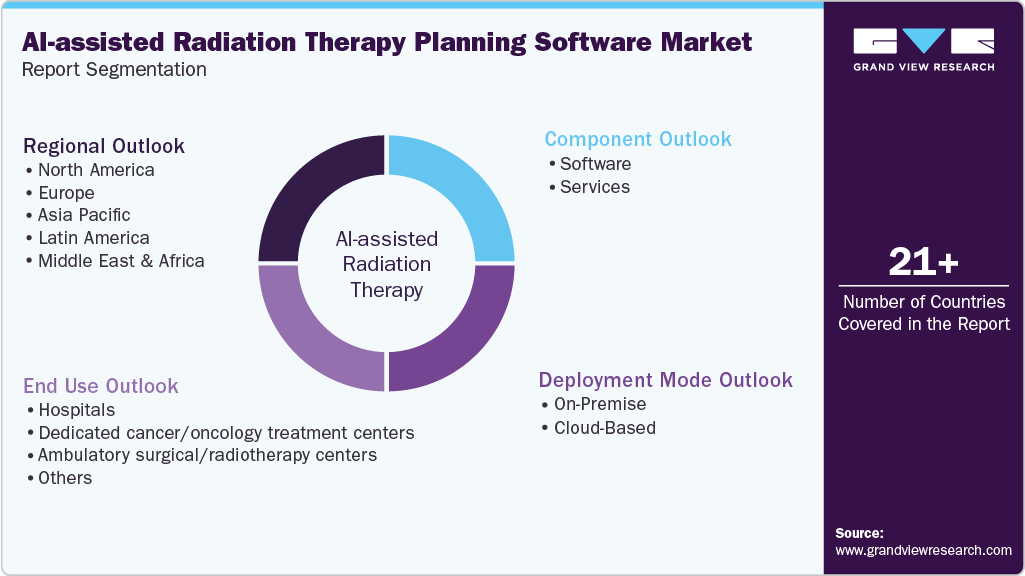
This report forecasts revenue growth at the global, regional, & country levels and provides an analysis of industry trends in each sub segment from 2021 to 2033. For this study, Grand View Research has segmented the global AI-assisted radiation therapy planning software market report on the basis of deployment mode, component, end use, and region:
 To learn more about this report, Download Free Sample Report
-
Deployment Mode Outlook (Revenue, USD Million, 2021 - 2033)
-
On-Premise
-
Cloud-Based
-
-
Component Outlook (Revenue, USD Million, 2021 - 2033)
-
Software
-
AI-based treatment planning software
-
Adaptive radiotherapy (ART) software
-
Auto-contouring/auto-segmentation software
-
Dose optimization software
-
Image registration & fusion software
-
Quality assurance (QA) software
-
-
Services
-
-
End Use Outlook (Revenue, USD Million, 2021 - 2033)
-
Hospitals
-
Dedicated cancer/oncology treatment centers
-
Ambulatory surgical/radiotherapy centers
-
Others (diagnostic imaging centers, academic & research institutes)
-
-
Regional Outlook (Revenue, USD Million, 2021 - 2033)
-
North America
-
U.S.
-
Canada
-
Mexico
-
-
Europe
-
UK
-
Germany
-
France
-
Italy
-
Spain
-
Denmark
-
Sweden
-
Norway
-
-
Asia Pacific
-
Japan
-
China
-
Australia
-
India
-
South Korea
-
Thailand
-
-
Latin America
-
Brazil
-
Argentina
-
-
Middle East & Africa
-
South Africa
-
Saudi Arabia
-
UAE
-
Kuwait
-
-
Research Methodology
The AI-assisted radiation therapy planning software marketfigures in this report are based on a proven research process that combines executive interviews with secondary research from proprietary databases, company filings, and recognized regulatory and institutional sources. Market size is built through value-chain sizing—reconciling supply-side and demand-side estimates—and triangulated with bottom-up and top-down approaches. Every estimate passes multiple levels of expert validation before publication, with eachAI-assisted radiation therapy planning softwaresegment quantified using the revenue-capture definitions in the table below.
Segment Definition
Segment
Segment Definition
By Deployment Mode:
On-premise
The on premise segment includes AI-assisted radiation therapy planning software installed and operated on healthcare providers’ local servers and IT infrastructure. Revenue is generated through software licenses, implementation, upgrades, and associated maintenance services, with healthcare facilities retaining direct control over data storage and system management.
Cloud-based
The cloud-based segment includes AI-assisted radiation therapy planning software hosted on remote cloud infrastructure and accessed through secure internet or network connections. Revenue is generated through subscription-based software, cloud usage fees, and related data management, integration, and support services.
By Component:
Software
The software segment includes AI-enabled applications used for radiation treatment planning, adaptive radiotherapy, image processing, contouring, dose optimization, image registration, and quality assurance. Revenue is generated through software licenses, subscriptions, upgrades, and platform-based access.
By Software:
AI-based Treatment Planning Software
The AI-based treatment planning software segment includes solutions that use artificial intelligence to automate or optimize radiation treatment plans based on patient anatomy, tumor characteristics, prescribed dose, and clinical treatment objectives. Revenue is generated through licenses, subscriptions, and associated software services.
Adaptive Radiotherapy (ART) Software
The adaptive radiotherapy software segment includes AI-enabled solutions that modify radiation treatment plans based on changes in patient anatomy, tumor position, or treatment conditions during the course of therapy. Revenue is generated through adaptive planning platforms, licenses, subscriptions, and related support services.
Auto-contouring/Auto-segmentation Software
The auto-contouring and auto-segmentation software segment includes AI-based solutions that automatically identify and delineate tumors, organs at risk, and other anatomical structures from medical images. Revenue is generated through software licenses, subscriptions, and integration with radiation treatment planning systems.
Dose Optimization Software
The dose optimization software segment includes AI-assisted solutions that optimize radiation dose distribution to improve target coverage while minimizing radiation exposure to surrounding healthy tissues. Revenue is generated through software licenses, subscriptions, and related optimization modules.
Image Registration & Fusion Software
The image registration and fusion software segment includes solutions that align and combine images from different imaging modalities or treatment sessions, such as CT, MRI, and PET, to support accurate radiation treatment planning and image-guided therapy. Revenue is generated through software licenses, subscriptions, and integration services.
Quality Assurance (QA) Software
The quality assurance software segment includes solutions used to verify radiation treatment plans, treatment delivery parameters, equipment performance, and dose accuracy before or during treatment. Revenue is generated through software licenses, subscriptions, and related QA support services.
Services
The services segment includes professional and technical services associated with implementing, integrating, operating, and maintaining AI-assisted radiation oncology software. Revenue is generated through implementation, training, maintenance, support, and consulting contracts.
By End Use
Hospitals
The hospitals segment includes general, tertiary-care, and multispecialty hospitals that use AI-assisted radiation oncology software for treatment planning, adaptive radiotherapy, image analysis, dose optimization, and quality assurance. Revenue is generated through software procurement, subscriptions, implementation, and related services.
Dedicated Cancer/Oncology Treatment Centers
The dedicated cancer and oncology treatment centers segment includes specialized facilities focused on cancer diagnosis and treatment, including radiation oncology services. Revenue is generated through the adoption of AI-assisted planning, adaptive radiotherapy, contouring, dose optimization, and imaging software.
Ambulatory Surgical/Radiotherapy Centers
The ambulatory surgical and radiotherapy centers segment include outpatient facilities that provide radiation therapy and related cancer treatments without requiring extended hospital stays. Revenue is generated through the adoption of AI-assisted treatment planning, adaptive radiotherapy, imaging, and quality assurance software.
Others (Diagnostic Imaging Centers, academic & research institutes)
The diagnostic imaging centers segment includes facilities providing CT, MRI, PET, and other medical imaging services that support radiation oncology workflows. The academic and research institutes segment includes universities, teaching hospitals, and research organizations that use AI-assisted radiation oncology software for clinical research, technology development, treatment optimization, and validation of advanced radiotherapy techniques. Revenue is generated through software procurement, research collaborations, and associated services.
Estimation Model
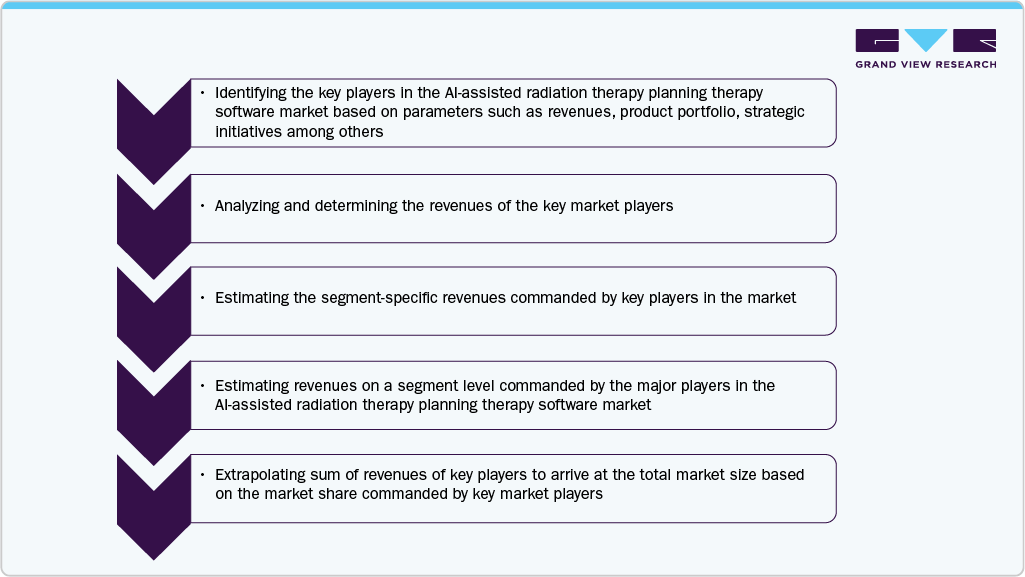
The market size was estimated using a CSA approach, wherein the revenues attributable to AI-assisted radiation therapy planning software were assessed across key market participants. The approach considers the revenue contribution of major software providers, their relevant product portfolios, AI-enabled capabilities, and estimated market shares. The identified company-level revenue pools were aggregated to derive the global market size, then validated through secondary research and industry-level cross-checks.
 To learn more about this report, Download Free Sample Report
Key companies identified in the broader treatment planning and adaptive radiotherapy software landscape include Varian, Elekta, RaySearch Laboratories, Accuray, GE HealthCare, DOSIsoft, and other specialized software providers.
Delivered Customizations
This report has been delivered with the following In-depth customizations
CLIENT REQUEST
CUSTOMIZATION DELIVERED
VALUE ADDS
Pricing and revenue model analysis
Detailed assessment of the pricing structures adopted across AI-assisted radiation therapy planning software, including subscription-based, perpetual licensing, usage-based, modular, and service-based models. The analysis can further evaluate pricing by software functionality, number of treatment machines, number of users, patient/treatment volumes, deployment model, implementation fees, maintenance charges, upgrades, technical support, and integration costs.
Supports clients in developing competitive pricing strategies, revenue models, and packaging structures. Helps identify recurring-revenue opportunities, appropriate pricing metrics, and potential areas for premium pricing based on advanced AI and adaptive therapy capabilities.
Hospital adoption analysis
Detailed evaluation of hospital-level adoption potential based on hospital size, number of radiation therapy units, oncology patient volume, cancer treatment capacity, availability of radiation oncologists and medical physicists, existing treatment planning systems, adaptive radiotherapy infrastructure, AI readiness, IT capabilities, and level of digital maturity.
Helps identify high-potential healthcare facilities and customer segments most likely to adopt AI-assisted radiation oncology software. Supports targeted sales strategies, customer prioritization, market-entry planning, and identification of hospitals suitable for pilot implementations or early technology adoption.
Cybersecurity assessment
Comprehensive assessment of cybersecurity requirements and risks associated with AI-assisted radiation oncology software, covering patient-data protection, cloud and on-premise security, encryption, identity and access management, authentication, data storage, network security, software updates, third-party integrations, audit trails, and incident-response mechanisms.
Helps clients identify technology, data-security, and compliance risks that may affect software adoption. Supports development of secure product architectures, strengthens customer confidence, and helps vendors address cybersecurity requirements during hospital procurement and implementation processes.
Frequently Asked Questions About This Report
The AI-assisted radiation therapy planning software market size was valued at USD 659.6 million in 2025 and is estimated at USD 743.5 million for 2026.
North America dominated with a 40.4% revenue share in 2025.
Growth is driven by the rising prevalence of cancer, the increased demand for precise, personalized radiation therapy, and the broader adoption of artificial intelligence in radiation oncology. AI-assisted software automates treatment planning, contouring, dose optimization, and quality assurance, which improves workflow efficiency and treatment consistency. The expanded use of adaptive radiotherapy, combined with the need to reduce planning time and address anatomical changes during treatment, is also expected to accelerate market growth.
Some of the key players operating in the AI-assisted radiation therapy planning software market include Varian Medical Systems, Inc. (Siemens Healthineers); Elekta AB; RaySearch Laboratories; Accuray Incorporated.; Brainlab SE; GE HealthCare Technologies Inc.; Koninklijke Philips N.V.; MVision AI; Mirada Medical Ltd.; DOSIsoft SA; Radformation, Inc.; TheraPanacea
Asia Pacific is the fastest-growing region over the forecast period.
The hospitals segment held the largest market share in 2025, while the dedicated cancer/oncology treatment centers segment is the fastest-growing end use segment.
The software segment held the largest market share of 73.8% in 2025.
The AI-assisted radiation therapy planning software market is expected to grow at a CAGR of 13.6% from 2026 to 2033, reaching USD 1,815.3 million by 2033.
The cloud-based segment held the largest market share of 68.0% in 2025.
About the Author(s)
Healthcare IT Research Team
Healthcare · Healthcare ITThis report was authored by the healthcare it research team at Grand View Research - comprising two research analysts, one senior research analyst, and one industry expert - with specialized expertise in the healthcare it segment of the healthcare industry. All findings are based on proprietary healthcare databases, executive interviews, and regulatory analysis, subject to internal peer review prior to publication.
Last Updated:
Speak to Analyst

Customize this report to your needs - add regions, segments, or data points, with 20% free customization.
Or view our licence options:


ISO 9001:2015 & 27001:2022 Certified
We are GDPR and CCPA compliant! Your transaction & personal information is safe and secure. For more details, please read our privacy policy.


