
- Home
- »
- Next Generation Technologies
- »
-
AI In Social Media Market Size, Share Report, 2026-2033GVR Report cover

AI In Social Media Market (2026 - 2033)
Size, Share & Trends Analysis Report By End Use (PR Agencies, Influencers), By Type (Content Creation & Management), By Application, By Deployment (On-premises, Cloud), By Vertical, By Region, And Segment Forecasts
Market Size, 2025
$4.0BMarket Estimate, 2026
$5.5BMarket Forecast, 2033
$48.2BCAGR, 2026–2033
36.4%AI In Social Media Market Summary
The global AI In social media market size was valued at USD 4.0 billion in 2025 and is projected to grow from USD 5.5 billion in 2026 to USD 48.2 billion by 2033, at a CAGR of 36.4% from 2026 to 2033. North America dominated the market, accounting for a revenue share of 33.0% in 2025. This growth is driven by the increasing demand for real-time content optimization, audience targeting, and predictive analytics, as social media platforms integrate AI to enhance user engagement and advertiser ROI.
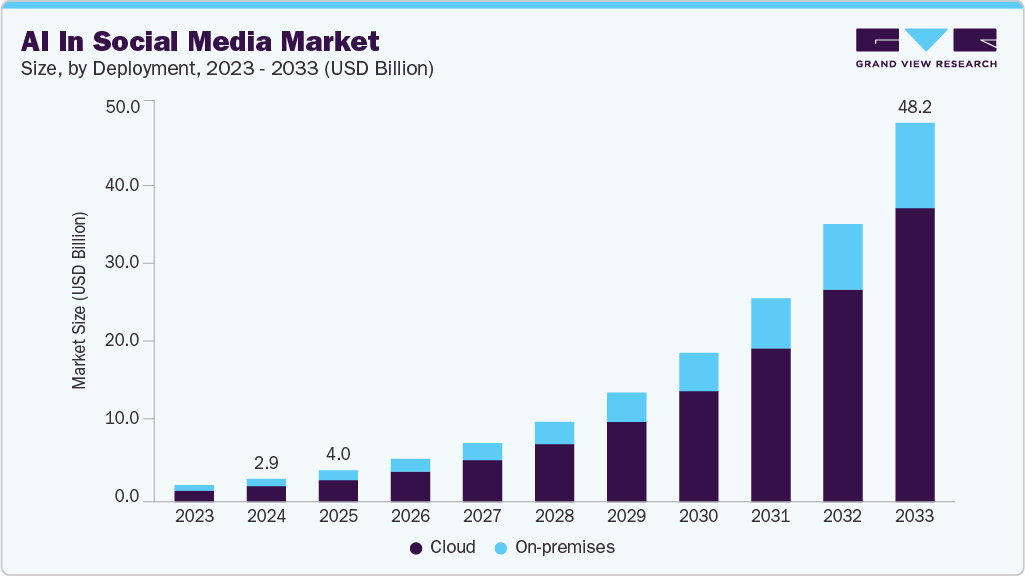 Source: Grand View Research, IR Documents, Primary Interviews, Paid DatabasesTo learn more about this report,
 Download Free Sample Report
Key Market Trends & Insights
- By type: Content creation & management held the largest market share of around 34.0% in 2025.
- By application: Marketing held the largest market share of around 36.0% in 2025.
- By deployment: Cloud held the largest market share of around 70.0% in 2025.
- By vertical: Retail and e-commerce held the largest market share of around 20.0% in 2025.
- By end use: The influencers segment led the market with a share of around 39.0% in 2025.
Regional Highlights
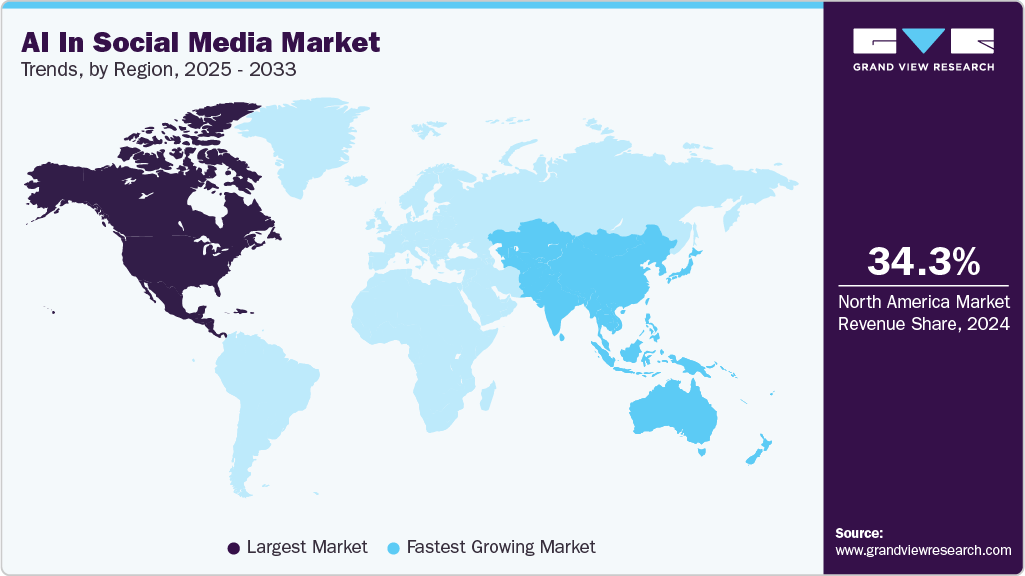
- Largest regional market: North America (33.0% revenue share, 2025)
- Fastest-growing regional market: Asia Pacific (highest CAGR, 2026-2033)
Market Size & Forecast
- Market size in 2025: USD 4.0 Billion
- Estimated market size in 2026: USD 5.5 Billion
- Projected market size by 2033: USD 48.2 Billion
- CAGR (2026-2033): 36.4%
Three ways to get this report
Buy it, customize it, or ask a question.Ask an Analyst
Analyst response in 1 business day
- AccessReport author, directly
- Reply timeWithin 1 working day
- No sales callDirect answer only
- FormatEmail reply
- CostFree, no cost
Get the Full Report
What the study covers
- FormatsPDF · Excel · Dashboard
- Timeline2026–2033 annual, 2025 base
- Coverage20+ countries, 5 regions
- Companies10+ key players profiled
Customize the Report
20% free customization
- IncludeCountries, segments, points
- TailorTo your product definition
- ExtendDeeper competitor detail
- OrA fully bespoke study
- Turnaround5–10 working days
The current state of the AI in social media industry reflects rapid adoption fueled by the exponential growth of user-generated content and the rising demand for personalized digital experiences. AI technologies, including machine learning and natural language processing, enable platforms to analyze vast volumes of data and user behavior to deliver tailored content recommendations, improve ad targeting, and automate content moderation. Social media companies continuously invest in AI infrastructure to enhance user engagement, maintain platform integrity, and support influencers, marketers, and brands in optimizing their digital strategies. In addition, the integration of AI-powered chatbots and social listening tools enhances customer interaction and brand monitoring, which increases operational efficiency and user satisfaction across social platforms.Moreover, the market growth is driven by advancements in AI algorithms that enhance content creation, curation, and campaign management capabilities, fostering more dynamic and efficient social media ecosystems. The rise of social commerce provides new monetization avenues whereby AI facilitates personalized product recommendations, seamless shopping experiences, and fraud detection, expanding the utility of social platforms beyond communication to direct sales. Demand for AI-based analytics tools is increasing as businesses seek deeper consumer insights to develop targeted, proactive marketing strategies. Additionally, growing regulatory scrutiny of data privacy is driving demand for transparent and compliant AI solutions that help maintain user trust.
Furthermore, expanding internet penetration and mobile-first digital behavior in developing regions contribute to increased social media usage, enlarging the addressable market for AI-driven social media tools. Mature markets continue refining AI capabilities for enhanced personalization and automation, while newer markets benefit from leapfrogging traditional technologies and adopting AI at scale. Investments in cloud-based AI services enhance scalability and accessibility for enterprises of all sizes, making social media AI tools more affordable and widespread. The continuous evolution of AI technology and growing commercial adoption across industries support market expansion.
Market Dynamics
The rising adoption of AI-powered personalized content recommendations is transforming how social media platforms engage users and improve content discovery. AI algorithms analyze user behavior, preferences, watch history, interactions, and browsing patterns to deliver highly relevant posts, videos, advertisements, and recommendations in real time. This personalized experience increases user engagement, session duration, and content consumption across platforms. Social media companies are increasingly investing in recommendation engines to enhance user retention and improve platform competitiveness in a highly saturated digital environment. The growing volume of user-generated data further supports the development of advanced AI models capable of delivering accurate and dynamic content suggestions.
Businesses, advertisers, and influencers are also leveraging AI-driven recommendation systems to improve audience targeting and campaign performance on social media platforms. Personalized recommendations help brands reach specific consumer segments with greater precision, improving conversion rates and customer engagement. The integration of generative AI and predictive analytics is further enhancing the ability of platforms to identify emerging user interests and content trends. In addition, the growing popularity of short-form video content and live-streaming applications is accelerating the need for intelligent recommendation systems that can continuously adapt to evolving user preferences.
AI-generated text, images, audio, and videos can closely replicate real individuals and events, making it difficult for users to distinguish authentic content from false information. The rapid spread of misleading content affects public trust in social media platforms and poses challenges to maintaining platform credibility. In addition, false information shared during political events, public emergencies, or brand campaigns can influence public opinion and damage reputations within a short period. These risks are encouraging governments and regulatory authorities to impose stricter monitoring and compliance requirements on digital platforms.
Content moderation has also become increasingly complex as the volume of user-generated content continues to grow across social media networks. AI systems often struggle to accurately identify harmful, offensive, or misleading posts across different languages, cultural contexts, and communication styles. Inaccurate moderation can result in the removal of legitimate content or in the failure to detect policy violations, leading to user dissatisfaction and legal action. The growing pressure to ensure ethical AI usage and platform safety is limiting the smooth adoption and scalability of AI solutions in the social media market.
AI-powered recommendation engines, visual search tools, and predictive analytics are helping brands deliver personalized shopping experiences directly through social media platforms. Businesses are increasingly using AI to analyze consumer preferences, browsing behavior, and engagement patterns to improve product discovery and conversion rates. The growing popularity of live commerce, shoppable posts, and AI-enabled chat assistants is further accelerating the adoption of AI-driven social commerce solutions. As consumers increasingly prefer seamless in-app purchasing experiences, companies are investing in advanced AI technologies to strengthen digital retail performance.
Meanwhile, AI-based influencer analytics is transforming how brands identify, evaluate, and collaborate with content creators across social platforms. AI tools enable companies to measure influencer authenticity, audience demographics, engagement quality, and campaign effectiveness with greater accuracy. These capabilities enable brands to optimize marketing spending and improve return on investment from influencer campaigns. AI is also supporting fraud detection by identifying fake followers, bot-generated engagement, and misleading performance metrics in influencer ecosystems.
Market Concentration & Characteristics
The market demonstrates a high degree of innovation with continuous advancements in generative AI, predictive analytics, sentiment analysis, and content personalization technologies. Companies are actively integrating AI into advertising optimization, social commerce, and creator monetization platforms to enhance user engagement. The rapid evolution of AI models and automation capabilities is accelerating feature development across social media ecosystems. Innovation remains a core factor supporting market expansion and competitive positioning.
The threat of service substitutes is relatively moderate as social media platforms increasingly rely on AI-driven personalization and engagement tools that are difficult to replicate through traditional digital marketing solutions. However, alternative digital advertising channels, streaming platforms, and independent creator platforms provide partial substitution for user engagement and advertising spending. Companies continue investing in AI-enhanced platform experiences to maintain competitive differentiation and user retention.
Analyst Perspective
The global AI in social media market is expected to grow steadily due to the increasing demand for personalized user experiences and data-driven marketing. Social media platforms and businesses are using AI technologies such as machine learning, natural language processing, computer vision, and generative AI to improve content recommendations, sentiment analysis, targeted advertising, and customer engagement. The growing adoption of AI-powered social listening tools, influencer analytics, and real-time audience insights is also supporting market growth. In addition, AI enables organizations improve marketing performance and better understand customer behavior. However, concerns about data privacy, regulatory compliance, and challenges in integrating AI with existing digital systems may limit market growth.
Type Insights
The content creation & management segment accounted for the largest revenue share of the AI in social media industry in 2025, driven by AI's ability to automate and enhance various aspects of content workflows. AI tools assist in brainstorming, drafting, editing, and optimizing content, enabling creators to produce high volumes of engaging material efficiently. Generative AI, in particular, is surging in adoption for automated posts, image synthesis, and personalized messaging, allowing for faster campaign deployment and deeper audience engagement. For instance, in June 2026, Meta introduced Creator Assistant on Facebook, an AI-powered tool that provides creators with personalized content ideas, performance insights, and recommendations based on their audience, content style, and engagement trends.
The campaign and community management segment is expected to grow at the fastest CAGR during the forecast period, due to AI's capabilities in optimizing outreach, monitoring engagement, and ensuring effective community moderation. AI-driven platforms offer real-time sentiment analysis, automated response systems, and intelligent feedback mechanisms, which allow brands to manage online communities efficiently and engage with users proactively. The increasing need for personalized interactions, proactive brand reputation management, and scalable communication strategies makes AI an indispensable tool for managing campaigns and fostering loyal online communities.
Application Insights
The marketing segment accounted for the largest revenue share of the AI in social media market in 2025, as AI-powered predictive analytics and precision targeting improve campaign effectiveness significantly. Platforms leverage AI to accurately segment audiences by behavior, preferences, and demographics, enabling marketers to deliver highly personalized advertisements. This precision reduces wastage of advertising spend and improves customer acquisition success rates. AI also enhances creative testing through automated A/B testing and real-time optimizations, improving message resonance. For instance, in July 2025, Meta introduced centralized marketing campaigns across WhatsApp, Facebook, and Instagram through Ads Manager, enabling businesses to use its AI systems to optimize advertising budgets across placements and maximize campaign performance.
The sales segment is expected to grow at the fastest CAGR over the forecast period, as AI is transforming how social media platforms contribute to direct revenue generation. Predictive analytics highlight potential high-value prospects from large social interactions, while AI-driven recommendation engines enable hyper-personalized product suggestions. In addition, chatbots facilitate seamless customer support and transaction assistance within social environments, reducing friction in the buyer journey. Integrating AI tools with CRM systems ensures continuous follow-up and nurturing of leads generated on social channels. These efficiencies accelerate sales funnel progression and drive growth in this segment.
Deployment Insights
The cloud segment led the market with a revenue share of 70.0% in 2025, due to the scalability and flexibility it offers organizations deploying AI-driven social media solutions. Cloud infrastructure supports massive data storage and computational needs required for real-time AI analytics, content personalization, and trend prediction. It enables seamless updates and deployment of AI models, ensuring platforms maintain cutting-edge functionality without requiring extensive on-premises investments. In addition, cloud solutions facilitate collaboration across distributed teams and integrate with other cloud-based marketing and analytics tools.
The on-premises segment is anticipated to grow significantly during the forecast period as organizations prioritize data control, regulatory compliance, and customized AI deployment within their specific environments. Sectors such as finance and healthcare often require on-premises solutions to meet strict data privacy regulations and ensure data sovereignty. On-premises AI infrastructure allows tailored algorithm training and integration with proprietary enterprise systems, supporting unique business workflows. This approach grants enhanced security and performance control, which remain important in sensitive use cases.
Vertical Insights
The retail & e-commerce segment accounted for the largest market revenue share of 20.0% in 2025. Retail and e-commerce companies increasingly leverage AI on social media to improve customer engagement, product discovery, personalized recommendations, and social commerce. AI facilitates social commerce by enabling personalized content, creator-led product discovery, and AI-powered shopping experiences that convert social interactions into purchases. For instance, in June 2025, LoudCrowd launched ShopWith, an AI-powered social commerce solution that embeds creator content directly into e-commerce product pages, enabling shoppers to access personalized creator recommendations, reviews, and product-use content while browsing.
The education segment is anticipated to grow at the fastest CAGR during the forecast period as institutions adopt social media for student engagement, personalized learning content delivery, and virtual collaboration. AI tools enable adaptive learning by analyzing student interactions and tailoring educational content to individual progress and preferences. Automated moderation keeps learning communities safe and constructive, while AI-driven analytics provide educators with actionable insights on learning efficacy. Rising digital literacy and remote learning adoption drive demand for AI-enhanced social media tools in education.
End Use Insights
The influencers segment led the AI in social media market in 2025, accounting for around 39.0% of global revenue. This can be attributed to their integral role in authentic brand communication and audience engagement within the social media ecosystem. AI empowers influencers through analytics that pinpoint optimal content themes, posting times, and audience demographics, thereby maximizing campaign effectiveness. Furthermore, AI tools facilitate personalized content delivery, automate routine tasks such as scheduling, and enhance the overall creative process, allowing influencers to scale their operations and deepen their connection with followers, translating directly into significant commercial value for brands. For instance, in November 2025, Later released research showing that 87% of creators reported improved content quality through AI, while 75% of creators and 77% of brands reported stronger campaign results, highlighting the growing adoption of AI across creator workflows and influencer marketing.
The social media managers segment is expected to grow at the fastest CAGR from 2026 to 2033, due to the increasing reliance on AI-powered platforms that automate mundane tasks, provide real-time analytics, and facilitate proactive community engagement. These AI tools enable managers to efficiently oversee multiple social accounts, optimize content performance, and respond swiftly to trends and user interactions. The growing complexity of social media strategies, coupled with the need for data-driven decision-making and efficient resource allocation, drives social media professionals' accelerated adoption of AI solutions, contributing to the segment's significant expansion.
Regional Insights
North America AI in social media market dominated the global market with a revenue share of approximately 33.0% in 2025. This can be attributed to its advanced digital infrastructure, high social media penetration, and major technology innovators leading AI research and deployment. Companies such as Meta Platforms, Inc. and Google LLC contribute heavily by integrating AI across their platforms for content curation, moderation, and marketing automation. The region’s strong investment ecosystem and supportive regulatory environment encourage the adoption of AI tools that optimize user engagement and advertising efficacy.
 To learn more about this report, Download Free Sample Report
U.S. AI In Social Media Market Trends
AI in social media industry in the U.S. is expected to grow significantly over the forecast period through its combination of technological innovation, extensive social media usage, and strategic collaboration between AI developers and marketing firms. AI advances in areas such as natural language processing and computer vision are rapidly incorporated into social media platforms, enhancing features such as content recommendations, ad targeting, and moderation. Large advertiser budgets fuel AI investment to improve engagement and sales outcomes.
Europe AI In Social Media Market Trends
The AI in the social media industry in Europe is expected to grow significantly over the forecast period, driven by comprehensive data protection laws that promote ethical AI use, which builds consumer trust and facilitates wider acceptance of AI-powered services. European firms leverage AI for multilingual content localization, regulatory compliance, and augmented customer service. The emphasis on transparency and fairness in AI algorithms aligns with regional priorities, encouraging innovation within well-governed frameworks.
Asia Pacific AI In Social Media Market Trends
The AI in social media industry in Asia Pacific is anticipated to grow at the fastest CAGR over the forecast period, driven by large-scale internet adoption, a growing middle class, and dynamic e-commerce environments that blend social media with online shopping seamlessly. The region’s mobile-first user base fuels adoption of AI-powered personalized content, interactive advertisements, and highly localized social media experiences. China, India, and Southeast Asia are particularly active markets where AI tools enable rapid scaling of social commerce, influencer marketing, and live-stream shopping. In addition, government initiatives promoting digital innovation support AI development, accelerating the region’s lead in emerging AI social media applications.
Key AI In Social Media Company Insights
Some key companies in the market are Google LLC, X Corp., Meta Platforms, Inc. and Salesforce, Inc.
-
Meta Platforms, Inc. leverages artificial intelligence to enhance user experiences and improve content curation across its social media platforms such as Facebook, Instagram, and WhatsApp. The company applies advanced AI technologies for automated content moderation, personalized recommendations, targeted advertising, and advanced analytics. Strategic investments in generative AI tools, language models, and computer vision empower Meta Platforms, Inc. to deliver dynamic features such as real-time translation and augmented reality integrations for users and businesses in the social media ecosystem.
-
Google LLC integrates AI extensively within its social media and digital platforms, including YouTube and Google Discover. AI-driven algorithms power content ranking, video recommendations, automated captioning, and policy violation detection, optimizing user engagement and advertiser outcomes. Google LLC further uses machine learning to safeguard user safety, enhance digital interactions, and enable content creators to better connect with their audiences, supporting growth and innovation in the AI-powered social media market.
Key AI In Social Media Companies:
The following key companies have been profiled for this study on the AI in social media market.
-
Adobe
-
Google LLC
-
Hootsuite Inc.
-
Meta Platforms, Inc.
-
Pinterest, Inc.
-
Reddit, Inc.
-
Salesforce, Inc.
-
Sprinklr Inc.
-
TikTok
-
X Corp.
Competitive Benchmarking
Operating Strategies
Competitive Edge
Weaknesses
Mature Players: Meta Platforms, Inc.; Google LLC; Salesforce, Inc.; TikTok
• These players use AI to improve advertising, content recommendations, and user engagement.
• They invest in cloud AI, partnerships, and generative AI expansion.
• Strong user data and AI infrastructure support accurate personalization.
• Established brands enable faster AI innovation and market reach.
• Data privacy and AI regulations increase compliance costs.
• Dependence on advertising revenue creates market sensitivity.
Emerging Players: X Corp.; Reddit, Inc.; Pinterest, Inc.
• Emerging players focus on AI-based community engagement and personalized content discovery.
• They adopt agile AI strategies to improve recommendations, creator tools, and ad targeting.
• Strong niche communities support contextual recommendations and audience insights.
• Flexible structures enable faster AI experimentation and feature adoption.
• Limited resources restrict large-scale AI development capabilities.
• Strong competition creates challenges in revenue growth and user expansion.
Recent Developments
-
In July 2026, Meta introduced Muse Image, its first image-generation model from Meta Superintelligence Labs, which powers creative experiences across Instagram and WhatsApp and enables users to generate, edit, and share AI-created visuals directly to feeds, Stories, and chats. The launch also introduced more than 30 AI-powered effects for Instagram Stories, highlighting the growing integration of generative AI into social media content creation and management.
-
In June 2026, Meta introduced new AI-powered tools on Facebook, including AI Mode for personalized search and new creative tools that help users create and share AI-generated photos and videos. The features use Meta AI to provide personalized answers based on public content across Facebook, while enabling users to transform photos, generate creative content, and receive AI-powered sharing suggestions.
-
In July 2025, Mack Media Group, LLC, a digital marketing agency based in Connecticut, enhanced its service offerings by incorporating AI-driven strategies to optimize clients’ online presence. The agency provides a comprehensive suite of services, including SMM, PPC, SEO, email marketing, and web design. By leveraging AI, Mack Media Group LLC delivers more precise targeting, improved scalability, and increased efficiency, enabling measurable improvements in campaign performance and return on investment across diverse industry sectors.
-
In July 2025, Hamburg-based smartclip, the adtech division of RTL Group SA, launched Sidekicks, an agentic AI platform designed to address operational challenges within the media industry. This innovative solution integrates Realytics' advanced media intelligence with smartclip’s expertise in process automation to deliver specialized AI agents that support teams across the digital advertising value chain. Sidekicks also prioritizes the secure management of organizational knowledge, enhancing efficiency while safeguarding sensitive data in complex media environments.
-
In March 2025, Wizikey, an AI-driven media intelligence platform, introduced a social media monitoring solution featuring a Unified Dashboard designed to support public relations and communications teams. This platform consolidates disparate data sources to reduce fragmentation and deliver actionable insights. Providing real-time monitoring of news and social media channels, it enables instant sentiment analysis. It facilitates faster response times, thereby enhancing the effectiveness and efficiency of media and reputation management activities.
AI In Social Media Market Report Scope
Report Attribute
Details
Market size in 2025
USD 4.0 billion
Estimated market size in 2026
USD 5.5 billion
Projected market size by 2033
USD 48.2 billion
Growth rate
CAGR of 36.4% from 2026 to 2033
Base year for estimation
2025
Historical data
2021 - 2024
Forecast period
2026 - 2033
Quantitative units
Revenue in USD billion, and CAGR from 2026 to 2033
Report coverage
Revenue forecast, company ranking, competitive landscape, growth factors, and trends
Segments covered
Deployment, vertical, application, end use, type, region
Regional scope
North America; Europe; Asia Pacific; Latin America; Middle East & Africa
Country scope
U.S.; Canada; Mexico; Germany; UK; France; China; India; Japan; Australia; South Korea; Brazil; UAE; South Africa; KSA
Key companies profiled
Meta Platforms, Inc.; X Corp; Salesforce, Inc.; Google LLC; Reddit, Inc.; Adobe; Pinterest, Inc.; TikTok; Sprinklr Inc.; Hootsuite Inc.
Customization scope
Free report customization (equivalent to 8 analyst working days) with purchase. Addition or alteration to country, regional & segment scope.
Pricing and purchase options
Avail of customized purchase options to meet your exact research needs. Explore purchase options
Global AI In Social Media Market Report Segmentation
This report forecasts revenue growth at the global, regional, and country levels and provides an analysis of the latest industry trends and opportunities across each sub-segment from 2021 to 2033. For this study, Grand View Research has segmented the global AI in social media market report based on end use, type, application, deployment, vertical, and region:
- End Use Outlook (Revenue, USD Billion, 2021 - 2033)
- PR Agencies
- Influencers
- Social Media Managers
- Type Outlook (Revenue, USD Billion, 2021 - 2033)
- Content Creation & Management
- Campaign & Community Management
- Reporting & Analytics
- Others
- Application Outlook (Revenue, USD Billion, 2021 - 2033)
- Customer Service
- Sales
- Marketing
- HR
- IT & Security
- Others
- Deployment Outlook (Revenue, USD Billion, 2021 - 2033)
- On-premises
- Cloud
- Vertical Outlook (Revenue, USD Billion, 2021 - 2033)
- BFSI
- Media & Entertainment
- Healthcare
- Telecommunication
- Retail & E-commerce
- Advertising
- Travel & Hospitality
- Education
- Others
- Regional Outlook (Revenue, USD Billion, 2021 - 2033)
- North America
- U.S.
- Canada
- Mexico
- Europe
- Germany
- UK
- France
- Asia Pacific
- China
- Japan
- India
- South Korea
- Australia
- Latin America
- Brazil
- Middle East and Africa (MEA)
- UAE
- KSA
- South Africa
- North America
Frequently Asked Questions About This Report
North America dominated with an approximately 33.0% revenue share in 2025.
The content creation & management segment held the largest market share of around 34.0% in 2025.
The global AI In social media market size was valued at USD 4.0 billion in 2025 and is estimated at USD 5.5 billion for 2026.
The global AI In social media market is expected to grow at a CAGR of 36.4% from 2026 to 2033, reaching USD 48.2 billion.
Key players in the market include Meta Platforms, Inc., X Corp, Salesforce, Inc., Google LLC, Reddit, Inc., Adobe, Pinterest, Inc., TikTok, Sprinklr Inc., Hootsuite Inc., and others.
About the Author(s)
Next Generation Technologies Research Team
Technology · Next Generation TechnologiesThis report was authored by the next generation technologies research team at Grand View Research - comprising two research analysts, one senior research analyst, and one industry expert - with specialized expertise in the next generation technologies segment of the technology industry. All findings are based on proprietary technology databases, executive interviews, and regulatory analysis, subject to internal peer review prior to publication.
Last Updated:
Speak to Analyst

Customize this report to your needs - add regions, segments, or data points, with 20% free customization.
Or view our licence options:


ISO 9001:2015 & 27001:2022 Certified
We are GDPR and CCPA compliant! Your transaction & personal information is safe and secure. For more details, please read our privacy policy.


