
- Home
- »
- HVAC & Construction
- »
-
Air Conditioning Systems Market Size Report, 2026-2033GVR Report cover

Air Conditioning Systems Market (2026 - 2033)
Size, Share & Trends Analysis Report By Type (Package Air Conditioners, Split Air Conditioning Systems, Ductless Mini-Split Systems), By Technology, By End Use (Residential, Commercial, Industrial), By Region, And Segment Forecasts
Market Size, 2024
$105.1BMarket Estimate, 2026
$112.7BMarket Forecast, 2033
$183.0BCAGR, 2025–2033
7.2%Air Conditioning Systems Market Summary
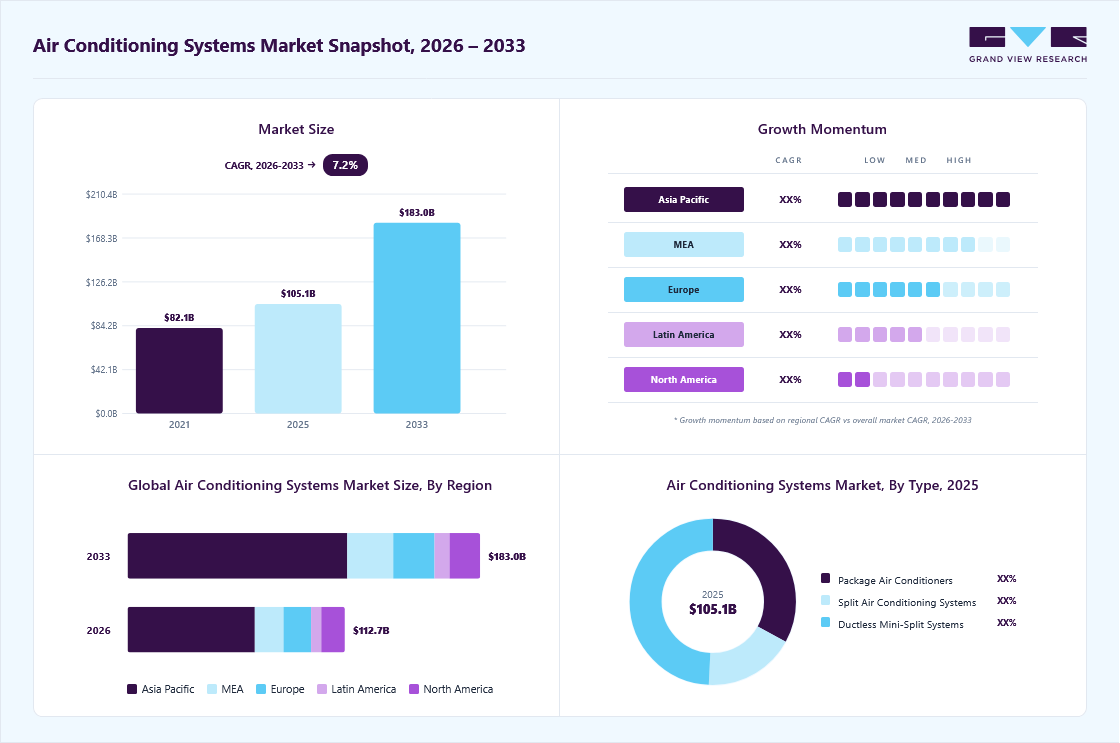
The global air conditioning systems market size was valued at USD 105.1 billion in 2025 and is projected to grow from USD 112.7 billion in 2026 to USD 183.0 billion by 2033, at a CAGR of 7.2% from 2026 to 2033. The market in Asia Pacific dominated with a revenue share of 58.0% in 2025. This growth is primarily driven by rapid urbanization and the rising adoption of smart infrastructure in both residential and commercial sectors.
 Source: Grand View Research, IR Documents, Primary Interviews, Paid DatabasesTo learn more about this report,
 Download Free Sample Report
 Key Market Trends & Insights
- By type: Ductless mini-split systems segment held the largest market share of 49.3% in 2025.
- By technology: Inverter air conditioner segment held the largest market share in 2025.
- By end use: Residential segment held the largest market share of 44.3% in 2025.
Regional Highlights
- Largest regional market: Asia Pacific (58.0% revenue share, 2025)
- By country: India held the largest market share in 2025
Market Size & Forecast
- Market size in 2025: USD 105.1 Billion
- Estimated market size in 2026: USD 112.7 Billion
- Projected market size by 2033: USD 183.0 Billion
- CAGR (2026-2033): 7.2%
Three ways to get this report
Buy it, customize it, or ask a question.Ask an Analyst
Analyst response in 1 business day
- AccessReport author, directly
- Reply timeWithin 1 working day
- No sales callDirect answer only
- FormatEmail reply
- CostFree, no cost
Get the Full Report
What the study covers
- FormatsPDF · Excel · Dashboard
- Timeline2025–2033 annual, 2024 base
- Coverage20+ countries, 5 regions
- Companies10+ key players profiled
Customize the Report
20% free customization
- IncludeCountries, segments, points
- TailorTo your product definition
- ExtendDeeper competitor detail
- OrA fully bespoke study
- Turnaround5–10 working days
The growing demand for energy-efficient, environmentally friendly cooling solutions is accelerating the shift toward inverter-based, solar-powered air conditioning systems. Technological advancements like AI-enabled climate control, IoT integration, and remote monitoring are reshaping the air conditioning industry. Consumers are increasingly opting for smart ACs that offer convenience, automation, and energy optimization. The expansion of construction activities, particularly in emerging economies, is also fueling market growth. Moreover, improving living standards and higher disposable incomes are encouraging spending on advanced air conditioning systems. To learn more about this report, Download Free Sample Report
 Market Concentration & Characteristics
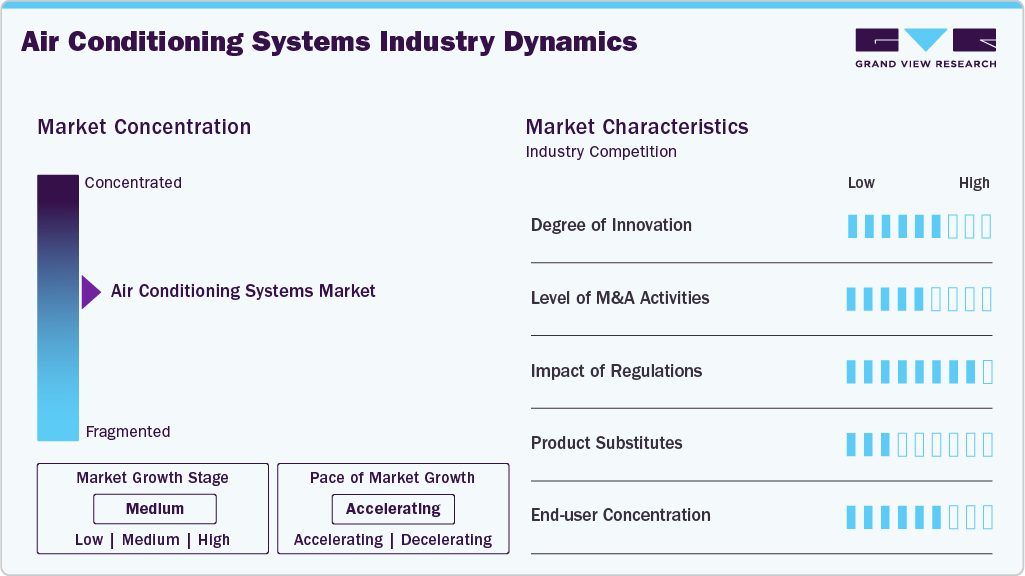
The air conditioning systems market exhibits a fragmented structure, with the presence of several global manufacturers alongside a large number of regional and local players. Leading companies such as Daikin Industries, Mitsubishi Electric Corporation, LG Electronics, and Carrier Global Corporation hold significant market shares due to strong brand recognition, advanced technology portfolios, and extensive distribution networks. However, the market remains fragmented overall as numerous smaller manufacturers compete in pricing, localized product offerings, and after-sales services, particularly in emerging economies.
The air conditioning industry is highly innovative, with companies focusing on energy efficiency, smart connectivity, and eco-friendly technologies. Advancements like AI-based climate control, IoT integration, and inverter systems are reshaping product development. Manufacturers are also investing in R&D to reduce environmental impact through sustainable refrigerants. Innovation is key to meeting evolving consumer preferences and regulatory demands.
 To learn more about this report, Download Free Sample Report
 The industry has witnessed moderate to high merger and acquisition activity, aimed at expanding market reach, technological capabilities, and product diversification. Leading players acquire regional firms to strengthen their presence in emerging markets. M&A also enables faster adoption of advanced technologies and cost synergies. This trend is expected to continue as companies seek competitive advantages.
Regulations play a significant role in shaping the air conditioning industry, particularly concerning energy consumption and refrigerant use. Governments globally are enforcing stricter efficiency standards and phasing out high-GWP refrigerants. Compliance with these policies pushes companies toward greener, compliant technologies. Regulatory frameworks thus drive both innovation and product differentiation in the market.
Drivers, Opportunities & Restraints
The air conditioning systems market is driven by rising global temperatures and growing urbanization, leading to increased demand for indoor cooling. Technological advancements in energy-efficient and smart ACs are also fueling market growth. Expanding commercial infrastructure and residential construction further support demand. In addition, rising disposable incomes are boosting consumer spending on premium air solutions.
The growing focus on sustainable cooling solutions presents significant opportunities for manufacturers. Emerging markets in Asia, Africa, and Latin America offer untapped potential due to rising urban development. Integration of IoT, AI, and solar power into AC systems can attract tech-savvy consumers. Government incentives for energy-efficient appliances also create room for product innovation and adoption.
The high initial costs of advanced air conditioning systems can limit adoption, particularly in low-income areas. Energy consumption and environmental concerns related to refrigerants pose challenges for the industry. Strict regulatory standards can increase production costs and limit market entry for smaller players. Besides, supply chain disruptions and fluctuations in raw material prices may hinder growth.
Type Insights
Ductless mini-split systems dominated the market and accounted for 49.3% of revenue share in 2025, due to their flexibility, energy efficiency, and ease of installation. They are ideal for homes and small commercial spaces without existing ductwork, offering zoned cooling. Growing demand for retrofitting solutions in urban areas further drives adoption. Inverter technology and smart features make them attractive to energy-conscious consumers.
Package air conditioners are expected to be the fastest-growing segment, driven by their suitability for large commercial and institutional buildings. These systems offer high-capacity cooling in a compact, pre-assembled unit, simplifying installation and maintenance. Increased construction of malls, offices, and healthcare facilities boosts demand. Their ability to handle large spaces efficiently makes them a preferred choice for centralized cooling.
Technology Insights
The inverter air conditioner segment held the largest share of the market in 2025, owing to its energy efficiency, variable-speed operation, and improved temperature control. They consume less power by adjusting compressor speed based on room temperature, reducing electricity bills. Rising environmental concerns and stricter energy regulations are pushing consumers toward inverter models. Additionally, manufacturers are expanding their inverter product lines to meet demand across residential and commercial sectors.
Non-inverter air conditioners are experiencing moderate growth at a CAGR of 3.8% over the forecast period, mainly in price-sensitive markets where affordability is a key factor. These systems operate at fixed speeds, leading to higher energy consumption but lower upfront costs. Demand persists in regions with lower usage duration or limited access to advanced technologies. However, their market share is gradually declining due to rising awareness of long-term energy savings.
End Use Insights
The residential sector dominated the air conditioning market and accounted for 44.3% share in 2025, due to rising urbanization, growing middle-class income, and increasing demand for home comfort. Consumers are opting for energy-efficient and smart ACs tailored for household use. Government incentives on energy-rated appliances further boost residential adoption. Additionally, changing climate conditions are driving year-round cooling needs in homes.
 To learn more about this report, Download Free Sample Report
 The commercial segment is expected to grow at a 6.3% CAGR over the forecast period, driven by expanding office, retail, hospital, and hospitality infrastructure. Demand for centralized and VRF systems is rising to efficiently meet large-scale cooling requirements. Businesses are investing in advanced HVAC systems management to improve energy efficiency and indoor air quality. Green building initiatives and regulatory standards are also encouraging the adoption of commercial AC systems.
Regional Insights
The North America air conditioning systems industry is projected to depict a CAGR of 3.9% over the forecast period, driven by rising demand for energy-efficient and smart HVAC systems. Aging infrastructure and the need for system upgrades in residential and commercial spaces are key contributors. Consumers are increasingly adopting inverters and eco-friendly technologies. Government regulations supporting sustainable cooling solutions further support market expansion.
U.S. Air Conditioning Systems Market Trends
The air conditioning systems industry in the U.S. dominated the North American market, supported by widespread adoption across residential and commercial sectors. Significant regional temperature variations sustain strong demand for both cooling and heating systems. Consumers are increasingly shifting toward smart, energy-efficient AC units, supported by favorable government policies and incentives. In addition, according to Federal Reserve Economic Data (FRED), total construction spending in manufacturing reached USD 220.2 billion in 2025, further supporting HVAC demand. The presence of leading manufacturers and well-established distribution networks strengthens the country’s market leadership.
The Canada air conditioning systems industry is growing steadily, driven by rising temperatures and increasing residential installations. As climate change leads to warmer summers, demand for ACs in previously cooler regions is rising. Energy efficiency and eco-friendly features are major purchasing factors for Canadian consumers. Government incentives and green building standards are also encouraging the adoption of modern HVAC systems.
Europe Air Conditioning Systems Market Trends
The air conditioning systems industry in Europe is witnessing gradual growth, fueled by rising temperatures and increased awareness of indoor air quality. Demand is particularly strong in Southern and Central Europe, where heatwaves are becoming more frequent. The push for green buildings and strict EU energy standards is influencing product adoption. Retrofitting of older buildings also supports the growing need for modern AC systems.
The Germany air conditioning systems industry is witnessing steady growth in its air conditioning market, driven by rising temperatures and the increasing need for enhanced indoor comfort across residential and commercial spaces. Demand is particularly strong in offices and data centers, where cooling requirements are critical. Energy efficiency and compliance with EU environmental regulations play a major role in shaping purchasing decisions. According to Statistisches Bundesamt, construction work completed in 2024 reached 161,682 units, supporting demand for HVAC installations. Additionally, government initiatives promoting green technologies are encouraging the adoption of advanced and energy-efficient systems.
The air conditioning systems industry in the UK is witnessing steady growth in air conditioning demand, driven by more frequent heatwaves and rising awareness of indoor air quality. Residential adoption is increasing, particularly in urban areas and modern housing developments. Energy-efficient and smart AC systems are gaining popularity amid growing environmental concerns. The shift toward sustainable construction practices further supports market expansion.
Asia Pacific Air Conditioning Systems Market Trends
The air conditioning systems industry in the Asia Pacific dominated the market and accounted for 58.0% share in 2025, due to rapid urbanization, population growth, and infrastructure development. Countries like China, India, and Japan are major contributors, with increasing demand in both residential and commercial sectors. Rising incomes and climate conditions further fuel AC adoption. The presence of major manufacturers and government energy-efficiency programs also drives market leadership.
 To learn more about this report, Download Free Sample Report
 The China air conditioning systems industry is experiencing rapid growth, driven by increasing urbanization, rising disposable incomes, and expanding residential construction. Government initiatives promoting energy-efficient appliances are encouraging the adoption of inverter and eco-friendly AC systems. The commercial sector, including offices and retail spaces, is also contributing significantly to demand. According to the National Bureau of Statistics of China, real estate development investment reached USD 1,152.4 billion in 2025, with residential buildings accounting for USD 884.1 billion. Additionally, domestic manufacturers are investing heavily in R&D and expanding smart AC offerings to meet the needs of tech-savvy consumers.
The air conditioning systems industry in India is experiencing strong growth, driven by rising temperatures, a growing middle class, and increasing urban housing. Demand is particularly high in Tier I and Tier II cities, with a shift toward inverter and energy-saving models. Government programs like the BEE star labeling system are encouraging the adoption of efficient cooling systems. Domestic and global brands are expanding their presence through local manufacturing and competitive pricing.
Middle East & Africa Air Conditioning Systems Market Trends
The air conditioning systems industry in the Middle East and Africa is experiencing significant growth in AC demand, driven by extreme heat and rapid infrastructure development. Urbanization and large-scale projects in countries like the UAE and Saudi Arabia are major contributors. Consumers prioritize powerful, durable systems suited to harsh climates. Increasing focus on energy conservation is also influencing product selection in this region.
The Saudi Arabia air conditioning systems industry is growing steadily due to its extreme climate and year-round cooling requirements. Large-scale infrastructure projects under Vision 2030, including smart cities and tourism hubs, are boosting HVAC demand. There is a rising preference for energy-efficient systems to reduce power consumption in both residential and commercial sectors. Government regulations promoting sustainable construction and energy conservation are further supporting market growth.
Latin America Air Conditioning Systems Market Trends
The air conditioning systems industry in the Latin America is growing due to expanding urban areas and higher temperatures across the region. Countries such as Brazil and Argentina are seeing rising demand for affordable, energy-efficient units. Improvements in construction and rising middle-class income support market penetration. However, economic instability and cost concerns still pose challenges in some areas.
The Brazil air conditioning systems industry is growing due to rising temperatures, increased urbanization, and expanding middle-class income. Residential demand is climbing, especially in major cities where heatwaves are becoming more frequent. Energy-efficient and affordable AC models are gaining popularity among consumers. Government programs promoting sustainable energy use are also encouraging the adoption of modern HVAC systems.
Key Air Conditioning Systems Company Insights
Some of the key players operating in the market include DAIKIN INDUSTRIES, Ltd., Carrier, and Haier Group.
-
Daikin specializes in advanced air conditioning systems, with a strong focus on inverter and energy-saving technologies. The company leads in environmentally responsible solutions, particularly through its early adoption of R-32 refrigerants. It heavily invests in R&D to develop smart and AI-enabled HVAC products. Daikin has a robust manufacturing and distribution presence across Asia, Europe, and North America. Its product strategy emphasizes performance, low environmental impact, and regulatory compliance.
-
Carrier is known for its high-efficiency HVAC systems tailored for both residential and large-scale commercial applications. The company emphasizes sustainable technologies, offering solutions that use low-GWP refrigerants and energy-optimization features. Its portfolio includes smart AC systems integrated with building automation platforms. Carrier is active in acquisitions to strengthen its digital and green HVAC offerings. The company leverages data-driven innovation to improve lifecycle performance and reduce carbon footprints.
Key Air Conditioning Systems Companies:
The following key companies have been profiled for this study on the air conditioning systems market.
- DAIKIN INDUSTRIES, Ltd.
- Carrier.
- Haier Group
- Johnson Controls - Hitachi Air Conditioning Company
- Lennox International Inc.
- LG Electronics.
- Midea.
- Mitsubishi Electric India Pvt. Ltd.
- Panasonic Corporation
- Samsung Electronics Co. Ltd.
- ALFA LAVAL
- Electrolux
- Trane Technologies plc
- Whirlpool
- Voltas, Inc.
Recent Developments
-
In February 2026, Panasonic Corporation launched a new range of smart, energy-efficient air conditioners in India, designed for improved performance and connected features. The models focus on durability and efficient cooling under varying climate conditions. The company is strengthening its portfolio with IoT-enabled solutions to meet evolving consumer demand. It is also targeting the expansion of its AC business to around 2 million units by FY2028.
-
In August 2025, Bosch completed a USD 8 billion acquisition of Johnson Controls' residential and light commercial HVAC business, including full ownership of the Hitachi joint venture. The deal adds North American ducted systems and strengthens Bosch's global HVAC footprint. With this move, Bosch’s Home Comfort division nearly doubles in size. It significantly boosts the company’s presence in the U.S. and Asia.
-
In February 2025, Haier launched its Kinouchi Limited Edition ACs in India, featuring unique color options like Black, Morning Mist, and Moonstone Grey. These models offer rapid cooling in 10 seconds, even at 60°C, with AI-based Supersonic Cooling. They include self-cleaning, HEXA Inverter, and Turbo Mode for long-range airflow.
Global Air Conditioning Systems Market Report Scope
Report Attribute
Details
Market size in 2025
USD 105.1 billion
Estimated market size in 2026
USD 112.7 billion
Projected market size by 2033
USD 183.0 billion
Growth rate
CAGR of 7.2% from 2026 to 2033
Base year for estimation
2025
Historical data
2021 - 2024
Forecast period
2026 - 2033
Quantitative units
Revenue in USD million/billion, volume thousand units, and CAGR from 2026 to 2033
Report coverage
Revenue forecast, company ranking, competitive landscape, growth factors, and trends
Segments covered
Type, technology, end use, region
Regional scope
North America; Europe; Asia Pacific; Latin America; Middle East & Africa
Country scope
U.S.; Canada; Mexico; UK; Germany; France; Italy; Spain; Turkey China; Japan; India; South Korea; Australia; Brazil; Argentina; Saudi Arabia; South Africa
Key companies profiled
DAIKIN INDUSTRIES, Ltd.; Carrier.; Haier Group; Johnson Controls - Hitachi Air Conditioning Company; Lennox International Inc.; LG Electronics.; Midea.; Mitsubishi Electric India Pvt. Ltd.; Panasonic Corporation; Samsung Electronics Co. Ltd.; ALFA LAVAL; Electrolux; Trane Technologies plc; Whirlpool; Voltas, Inc.
Customization scope
Free report customization (equivalent up to 8 analysts working days) with purchase. Addition or alteration to country, regional & segment scope.
Pricing and purchase options
Avail customized purchase options to meet your exact research needs. Explore purchase options
Global Air Conditioning Systems Market Report Segmentation
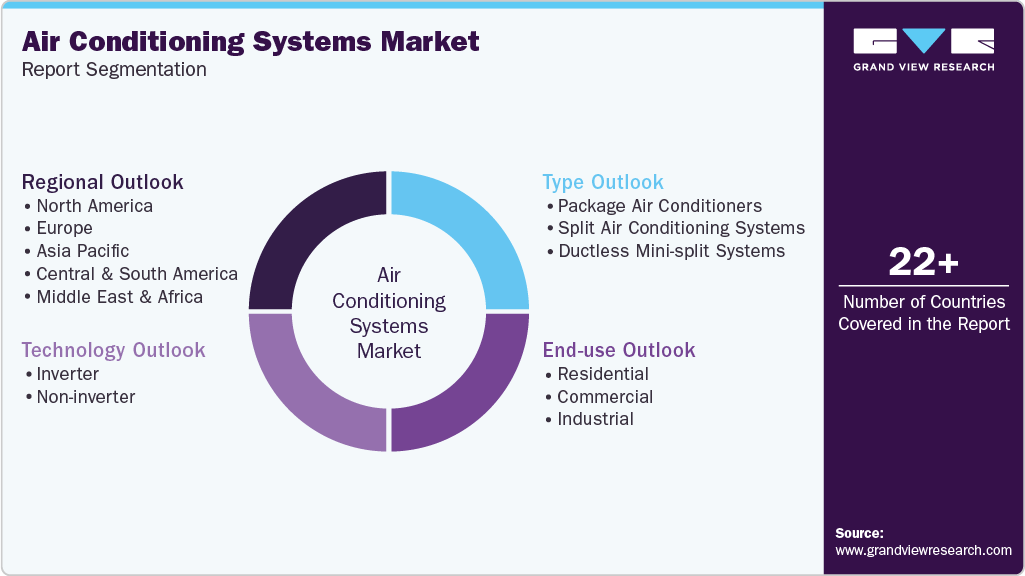
This report forecasts revenue growth at global, regional, and country levels and provides an analysis of the latest industry trends in each of the sub-segments from 2021 to 2033. For this study, Grand View Research has segmented the global air conditioning systems market report based on type, technology, end use, and region.
 To learn more about this report, Download Free Sample Report
 -
Type Outlook (Volume, Thousand Units; Revenue, USD Billion, 2021 - 2033)
-
Package Air Conditioners
-
Split Air Conditioning Systems
-
Ductless Mini-Split Systems
-
-
End Use Outlook (Volume, Thousand Units; Revenue, USD Billion, 2021 - 2033)
-
Residential
-
Commercial
-
Industrial
-
-
Technology Outlook (Volume, Thousand Units; Revenue, USD Billion, 2021 - 2033)
-
Inverter
-
Non-Inverter
-
-
Regional Outlook (Volume, Thousand Units; Revenue, USD Billion, 2021 - 2033)
-
North America
-
U.S.
-
Canada
-
Mexico
-
-
Europe
-
UK
-
France
-
Germany
-
Italy
-
Spain
-
Türkiye
-
-
Asia Pacific
-
China
-
India
-
Japan
-
South Korea
-
Australia
-
-
Latin America
-
Brazil
-
Argentina
-
-
Middle East & Africa
-
South Africa
-
Saudi Arabia
-
-
Frequently Asked Questions About This Report
The global air conditioning systems market size was valued at USD 105.1 billion in 2025 and is estimated at USD 112.7 billion for 2026.
The global air conditioning systems market is expected to grow at a CAGR of 7.2% from 2026 to 2033, reaching USD 183.0 billion by 2033.
Asia Pacific dominated with a 58.0% revenue share in 2025.
The ductless mini-split systems segment led with a 49.3% revenue share in 2025, while the package air conditioners segment is the fastest-growing.
The inverter air conditioner segment held the largest revenue share in 2025.
The residential segment led with a 44.3% revenue share in 2025.
The air conditioning systems market is driven by rising temperatures, urbanization, and growing demand for indoor comfort. Technological advancements in energy-efficient and smart ACs are boosting consumer adoption. Additionally, government incentives and green building initiatives are supporting market growth.
Key players include DAIKIN INDUSTRIES, Ltd.; Carrier.; Haier Group; Johnson Controls - Hitachi Air Conditioning Company; Lennox International Inc.; LG Electronics.; Midea.; Mitsubishi Electric India Pvt. Ltd.; Panasonic Corporation; Samsung Electronics Co. Ltd.; ALFA LAVAL; Electrolux; Trane Technologies plc; Whirlpool; Voltas, Inc.
About the Author(s)
HVAC & Construction Research Team
Technology · HVAC & ConstructionThis report was authored by the hvac & construction research team at Grand View Research - comprising two research analysts, one senior research analyst, and one industry expert - with specialized expertise in the hvac & construction segment of the technology industry. All findings are based on proprietary technology databases, executive interviews, and regulatory analysis, subject to internal peer review prior to publication.
Last Updated:
Speak to Analyst

Customize this report to your needs - add regions, segments, or data points, with 20% free customization.
Or view our licence options:


ISO 9001:2015 & 27001:2022 Certified
We are GDPR and CCPA compliant! Your transaction & personal information is safe and secure. For more details, please read our privacy policy.


