
- Home
- »
- Advanced Interior Materials
- »
-
Air Ionizers Market Size, Share & Trends Report, 2026-2033GVR Report cover

Air Ionizers Market (2026 - 2033)
Size, Share & Trends Analysis Report By Product (Integrated HVAC Ionizers, Standalone Ionizers, Portable Ionizers), By Distribution Channel (Offline, Online), By End Use, By Region, And Segment Forecasts
Market Size, 2025
$1.6BMarket Estimate, 2026
$1.7BMarket Forecast, 2033
$2.5BCAGR, 2026–2033
6.1%Air Ionizers Market Summary
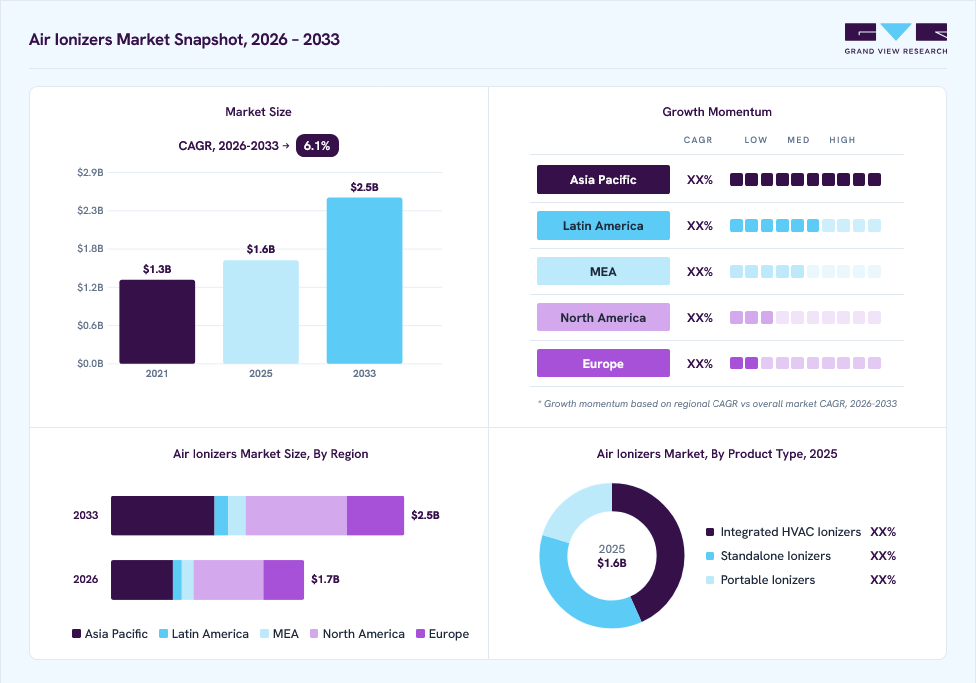
The global air ionizers market size was valued at USD 1.6 billion in 2025 and is projected to grow from USD 1.7 billion in 2026 to USD 2.5 billion by 2033, at a CAGR of 6.1% from 2026 to 2033. North America dominated the market, accounting for a revenue share of 36.5% in 2025. Growing concerns about airborne particulate matter, allergens, and other indoor pollutants are prompting households, offices, healthcare facilities, and commercial buildings to adopt air-cleaning technologies to reduce suspended particles.
 Source: Grand View Research, IR Documents, Primary Interviews, Paid DatabasesTo learn more about this report,
 Download Free Sample Report
 Key Market Trends & Insights
- Based on product: Integrated HVAC ionizers segment led the market with the largest revenue share of 43.2% in 2025.
- Based on distribution channel: Offline segment led the market with the largest revenue share of 71.6% in 2025.
- Based on end use: Industrial segment is expected to grow at 6.0% CAGR during the forecast period.
Regional Highlights
- Largest Regional Market: North America (36.5% revenue share, 2025)
- By Country: The U.S. held the largest market share in 2025
Market Size & Forecast
- Market Size in 2025: USD 1.6 Billion
- Estimated market size in 2026: USD 1.7 Billion
- Projected Market Size by 2033: USD 2.5 Billion
- CAGR (2026-2033): 6.1%
Three ways to get this report
Buy it, customize it, or ask a question.Ask an Analyst
A direct answer, usually in 1 working day
- AccessReport author, directly
- Reply timeWithin 1 working day
- No sales callDirect answer only
- FormatEmail reply
- CostFree, no cost
Get the Full Report
What the study covers
- FormatsPDF · Excel · Dashboard
- Timeline2026–2033 annual, 2025 base
- Coverage20+ countries, 5 regions
- Companies10+ key players profiled
Customize the Report
20% free customization
- IncludeCountries, segments, points
- TailorTo your product definition
- ExtendDeeper competitor detail
- OrA fully bespoke study
- Turnaround5–10 working days
Expansion of air-quality management in commercial and institutional buildings is fueling the market. Offices, schools, hospitality facilities, and healthcare environments are increasingly incorporating air-treatment equipment into broader indoor environmental management practices. Air ionizers can be integrated into existing heating, ventilation, and air-conditioning systems or deployed as standalone units, supporting their use across different building configurations.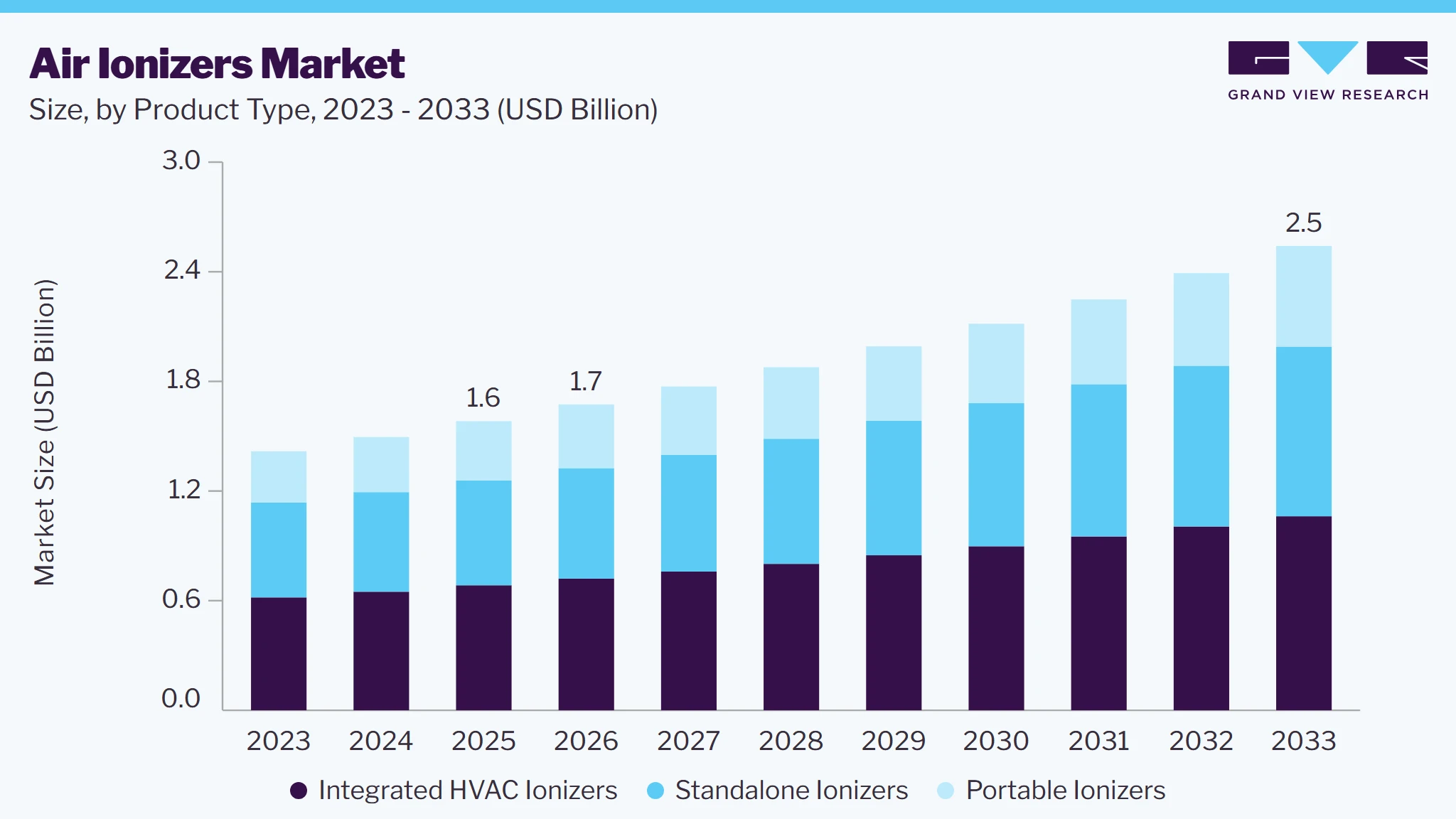 To learn more about this report, Download Free Sample Report
 Market Dynamics
The air ionizers market is influenced by evolving indoor air quality requirements, technological advancements, regulatory standards, and consumer preferences for air treatment solutions. Demand is supported by growing attention to airborne particulate matter and indoor environmental conditions across residential, commercial, and institutional spaces. At the same time, concerns regarding ozone generation, product effectiveness, and compliance requirements can affect adoption. Manufacturers are therefore focusing on improving ionization performance, integrating monitoring capabilities, and developing products compatible with different ventilation and air-treatment systems.
The integration of air ionizers with heating, ventilation, and air-conditioning systems is driving market expansion. Ionization modules can be incorporated into existing air-handling equipment, allowing treatment of air across larger indoor spaces without requiring separate standalone units. This integration is particularly relevant for offices, commercial buildings, healthcare facilities, and other centralized ventilation environments. Compatibility with existing infrastructure can simplify deployment and enable air ionization to be integrated into broader indoor air-treatment strategies, expanding its potential application base.
Concerns about ozone generation are a restraint on the air ionizers market. Certain ionization processes can produce ozone as a byproduct, creating concerns when equipment is operated in occupied indoor environments. Excessive ozone exposure can negatively affect indoor air quality, prompting increased attention to applicable safety standards and permissible emission levels. Manufacturers may therefore need to incorporate ozone-control mechanisms, conduct additional testing, and meet certification requirements. These considerations can increase product development costs and influence purchasing decisions among residential and commercial users.
Integration with smart air-quality monitoring systems presents an opportunity for air ionizer manufacturers. Ionizers can be combined with sensors that monitor particulate concentrations and other indoor air parameters, enabling automated operation according to detected air conditions. Connectivity with building-management platforms and mobile applications can further support remote monitoring and control. Such functionality allows manufacturers to develop more responsive air-treatment systems while providing users with real-time operating information. This creates opportunities for differentiated products in connected residential, commercial, and institutional environments.
Demonstrating consistent air-cleaning performance across different indoor environments remains a challenge for the air ionizers market. Effectiveness can vary depending on room size, ventilation rates, pollutant concentration, humidity, and equipment configuration. Manufacturers, therefore, need to validate performance under different operating conditions and communicate measurable results to customers. Limited understanding of ionization mechanisms among some users can further complicate product evaluation. Establishing reliable performance evidence while meeting safety and regulatory requirements can increase testing requirements and development costs.
Market Concentration & Characteristics
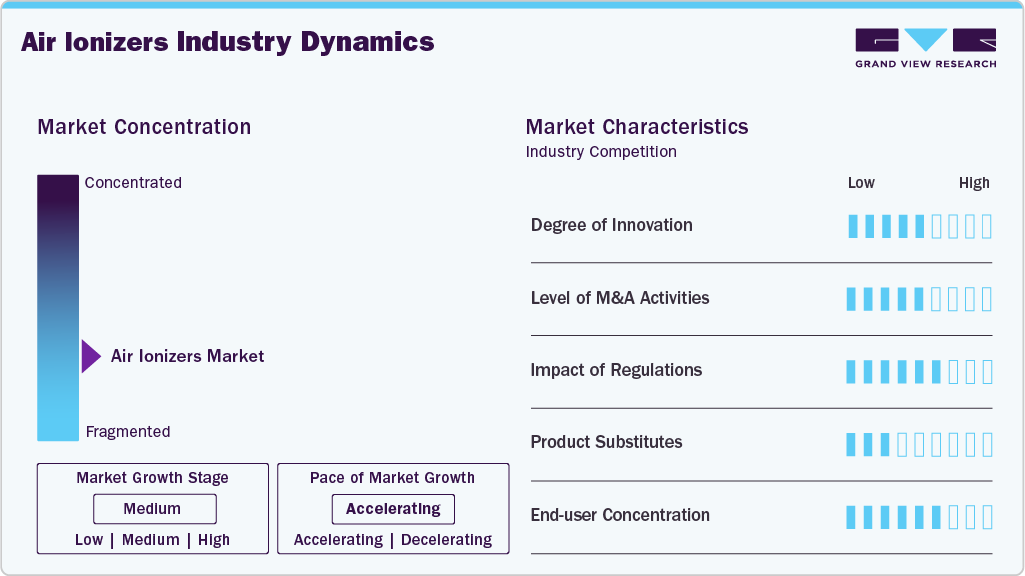
The air ionizers market is fragmented, with numerous international manufacturers, regional companies, and specialized air-treatment equipment providers competing across residential, commercial, and industrial applications. Market participants differentiate through ionization technology, product capacity, energy efficiency, filtration integration, and installation formats. Regional manufacturers often compete through application-specific products and pricing, while established companies focus on broader air-quality solutions and distribution networks.
Product development increasingly focuses on combining ionization with filtration, sensors, and automated air-quality monitoring. Compact designs and improved electronic controls are also supporting deployment across residential, commercial, and institutional environments. These developments are expanding functionality while addressing concerns related to operating efficiency and indoor air quality.
 To learn more about this report, Download Free Sample Report
 Regulations are shaping the air ionizers industry by establishing requirements related to indoor air quality, electrical safety, and emissions from air-cleaning equipment. Standards addressing ozone generation are particularly relevant because certain ionization technologies can produce ozone as a byproduct. Manufacturers increasingly design equipment to meet applicable ozone and safety limits while demonstrating product performance.
Analyst Perspective
The air ionizers market is influenced by increasing attention to indoor air quality, particulate control, and air-treatment requirements across residential, commercial, institutional, and industrial environments. Air ionizers are used to reduce airborne particles and support indoor air management in offices, healthcare facilities, educational buildings, hospitality establishments, and homes. Demand is also supported by integration with HVAC systems, development of standalone portable units, and improvements in ion-generation and ozone-control technologies. Asia Pacific and North America are expected to provide significant opportunities, supported by building modernization, commercial construction, and increasing adoption of indoor air-treatment technologies.
Product Insights
The integrated HVAC ionizers segment led the market in 2025 due to its ability to provide air treatment across large indoor spaces through existing ventilation infrastructure. Commercial buildings, offices, healthcare facilities, and institutional establishments increasingly use centralized air-handling systems, supporting demand for integrated ionization technology. Its broad coverage and compatibility with centralized ventilation make it suitable for continuous air-quality management.
The standalone ionizers segment is expected to grow at a 6.3% CAGR during the forecast period as demand for flexible air-treatment solutions in individual rooms and smaller spaces increases. Residential users, small offices, hospitality establishments, and localized commercial applications can install standalone units without modifying existing HVAC infrastructure. Compact designs, portability, straightforward installation, and lower deployment requirements are expected to support adoption across diverse indoor environments during the forecast period.
Distribution Channel Insights
The offline segment dominated the market in 2025 due to the importance of physical product evaluation, technical consultation, and installation support. Specialty retailers, HVAC distributors, appliance stores, and commercial equipment suppliers enable customers to compare products and receive guidance tailored to application requirements. Offline channels also support after-sales service and direct interaction, which remain important for commercial and institutional buyers.
The online segment is expected to grow at 7.1% CAGR during the forecast period as consumers increasingly use e-commerce platforms to research, compare, and purchase air-treatment equipment. Online channels provide access to a broader range of products, specifications, customer reviews, and pricing information. Improved delivery infrastructure and digital purchasing convenience are further supporting adoption. Manufacturers and distributors can also reach residential and small commercial customers beyond traditional physical retail networks.
End Use Insights
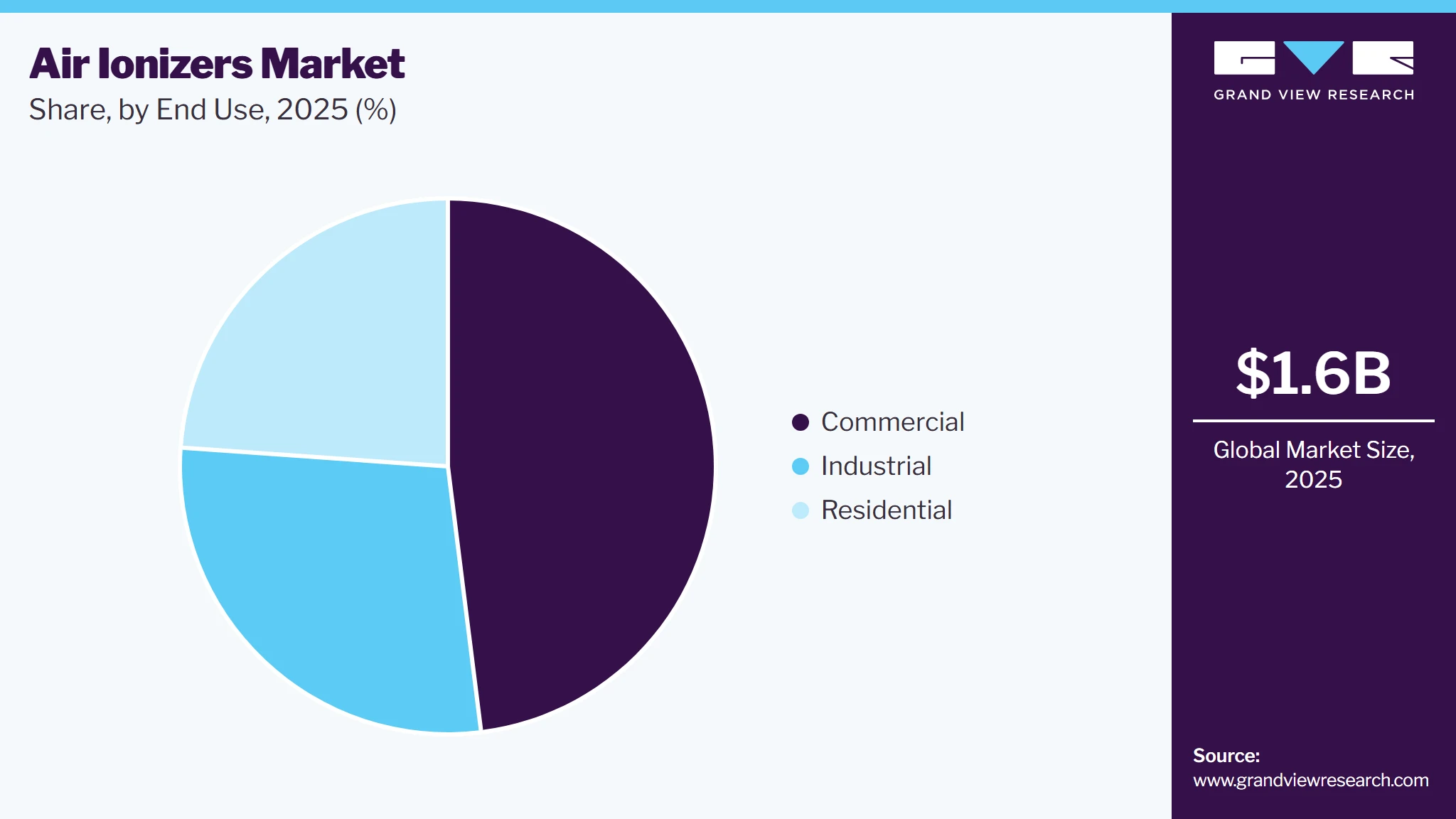
The commercial segment led the market in 2025, holding 48% market share, largely due to its widespread use in offices, retail spaces, hospitality facilities, schools, and healthcare buildings. These spaces require continuous management of indoor air quality due to high occupant density and extended operating hours. Integration with centralized HVAC systems also supports deployment across larger commercial spaces, increasing demand for air ionization solutions.
 To learn more about this report, Download Free Sample Report
 The industrial segment is expected to grow as manufacturing facilities increasingly address airborne particles and indoor environmental conditions within production and processing areas. Air ionizers can be deployed alongside existing ventilation and air-treatment systems to support localized air management. Expanding industrial facilities, modernization of ventilation infrastructure, and greater attention to workplace environmental conditions are expected to create additional demand for ionization technologies across industrial applications.
Regional Insights
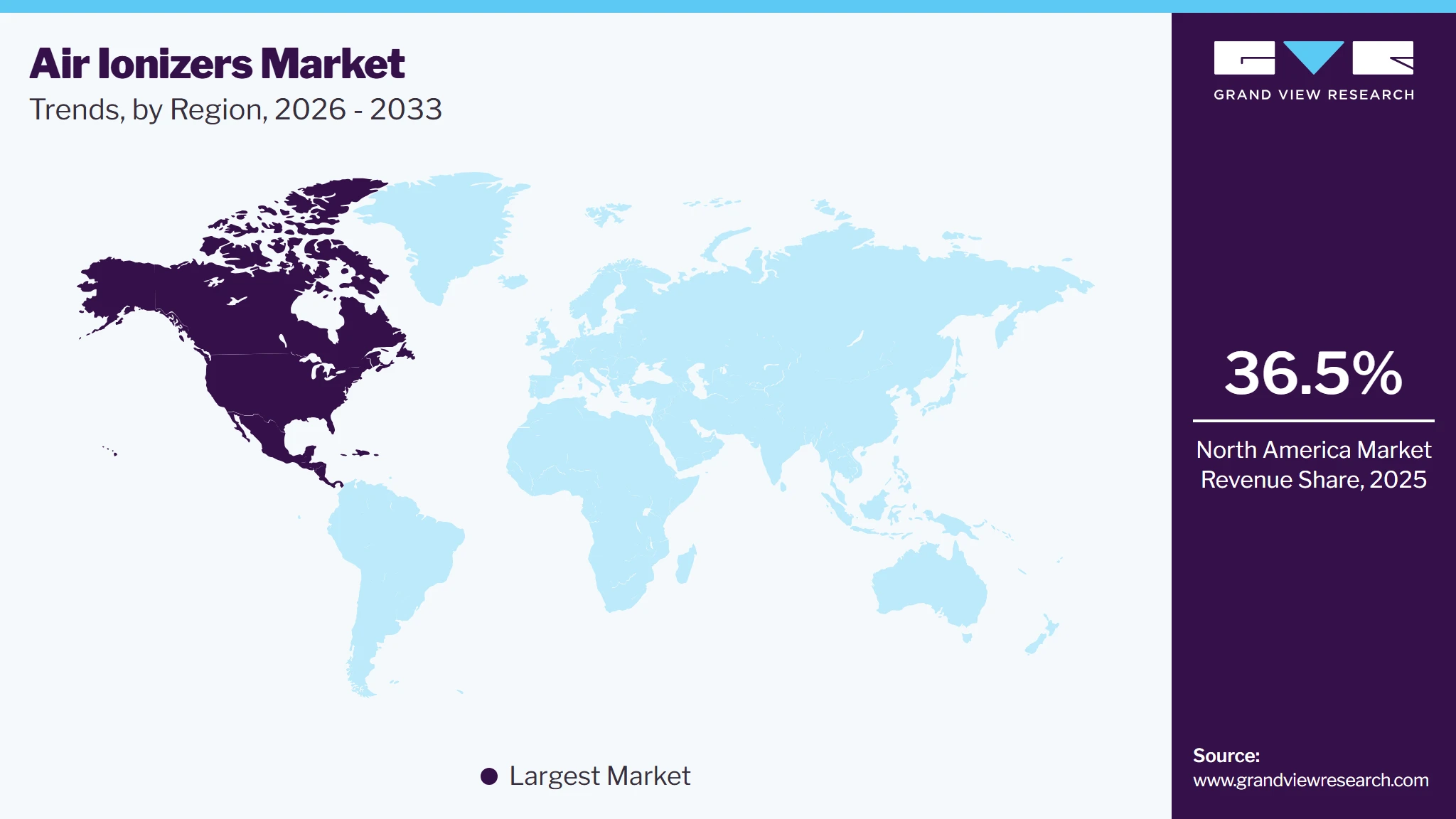
The air ionizers market in North America accounted for the largest market share of 36.5% in 2025 due to commercial building modernization. Aging office, healthcare, educational, and retail properties are undergoing upgrades to building systems, creating opportunities to incorporate air-treatment technologies into renovated ventilation infrastructure. Air ionizers can be installed as part of these modernization projects without requiring entirely new air-management systems.
 To learn more about this report, Download Free Sample Report
 U.S. Air Ionizers Market Trends
The air ionizers market in the U.S. is expected to grow primarily due to healthcare facility expansion and modernization. Hospitals, outpatient centers, and other healthcare facilities require controlled indoor environments and increasingly invest in upgraded ventilation and air-management infrastructure. These projects create opportunities to incorporate ionization systems into centralized HVAC installations or into specific indoor areas.
Asia Pacific Air Ionizers Market Trends
The air ionizers market in the Asia Pacific is expected to grow significantly at 7.6% CAGR during the forecast period due to the rapid expansion of data centers. The region is attracting substantial data-center development to support cloud computing, digital services, and information technology infrastructure. These facilities operate continuously and require controlled environmental conditions supported by sophisticated HVAC systems. The expansion of data-center capacity creates opportunities to incorporate specialized air-treatment technologies into facility ventilation systems, providing a distinct application base for air ionizers across major Asia Pacific technology markets.
The China air ionizers market is driven primarily by the expansion of cleanroom-intensive electronics manufacturing. Semiconductor, display, and advanced electronics production facilities require tightly controlled manufacturing environments where airborne particles can affect production processes. New and expanded facilities, therefore, require sophisticated air-management systems. Ionization technologies can be part of these systems to meet specific air-treatment requirements.
The air ionizers market in India is expected to grow due to the expansion of modern office buildings. The growth of information technology, business services, and corporate operations is increasing demand for contemporary office infrastructure in major cities. New office developments typically incorporate centralized HVAC systems and modern indoor-environment technologies. This building format creates opportunities to incorporate integrated air ionizers during construction or fit-out.
Europe Air Ionizers Market Trends
The air ionizers market in Europe is expected to grow due to building renovation initiatives. A significant portion of the region's building stock requires modernization to improve building performance and indoor environmental conditions. Renovation projects provide opportunities to upgrade ventilation and air-treatment systems simultaneously. Air ionizers can therefore be incorporated into refurbished commercial and institutional buildings as part of broader building-system improvements.
The Germany air ionizers market is driven primarily by industrial automation and facility modernization. Manufacturing facilities are increasingly upgrading production environments alongside automated equipment and modern building systems. These projects can include improvements to ventilation and localized air management in production areas. Air ionizers can be incorporated into such systems to address airborne particles within specific industrial environments.
The air ionizers market in the UK is expected to grow primarily due to school and educational-building refurbishment. Educational facilities are undergoing improvements to building infrastructure, including ventilation and indoor-environment systems. These refurbishment projects create opportunities to incorporate air-treatment technologies into classrooms and other enclosed areas. Air ionizers can be deployed as standalone equipment or integrated with existing ventilation systems, accommodating different building configurations.
Middle East & Africa Air Ionizers Market Trends
The air ionizers market in Middle East & Africa is driven primarily due to large-scale airport infrastructure development. New and expanded airports require extensive HVAC systems to manage indoor conditions across terminals, lounges, retail areas, and other enclosed spaces. The scale and continuous operation of these facilities create opportunities for centralized air-treatment technologies. Air ionizers can be integrated into terminal ventilation infrastructure during new construction or modernization projects, making airport development a distinct driver of application growth in the regional market.
The Saudi Arabia air ionizers market is expected to grow on the back of rapid data center development. The expansion of cloud computing, digital services, and artificial intelligence infrastructure is driving investment in new data centers across the country. These facilities require continuous HVAC operation and tightly controlled indoor environments to protect sensitive electronic equipment.
Latin America Air Ionizers Market Trends
The air ionizers market in Latin America is expected to grow primarily due to the modernization of healthcare infrastructure. Hospitals and medical facilities across major economies are upgrading buildings, equipment, and supporting infrastructure to accommodate changing healthcare requirements, such as improvements to ventilation and indoor air-management systems. Air ionizers provide an additional technology option for facilities seeking to enhance air-treatment capabilities.
The Brazil air ionizers market is expected to grow in the wake of the expansion of pharmaceutical manufacturing. Investment in domestic pharmaceutical production is increasing the need for controlled manufacturing environments, particularly in facilities handling sensitive products. Such facilities require specialized ventilation and environmental-control systems to maintain appropriate production conditions.
Key Air Ionizers Company Insights
Some of the key players operating in the market include Daikin Industries, Sharp Corporation, Honeywell International Inc., Panasonic Corporation, Airocide, and Alpine Air Products, among others.
-
Panasonic Corporation is a Japanese electronics company that develops consumer and commercial air-quality products, including air purifiers incorporating nanoe and other air-treatment technologies. Its air-purification portfolio addresses residential and commercial indoor environments, with products designed to reduce airborne particles and support indoor air-quality management. The company combines air-treatment technologies with sensors, electronic controls, and compact product configurations to support different room sizes and operating requirements.
-
Sharp Corporation is a Japanese electronics manufacturer offering air-purification products equipped with its Plasmacluster ion technology. Its air purifiers generate positive and negative ions to support the management of airborne contaminants in indoor environments. The company offers products for residential and commercial applications, featuring air-quality sensors, automated controls, filtration, and compact designs. Its product portfolio addresses different room sizes and indoor air-treatment requirements.
Key Air Ionizers Companies
The following key companies have been profiled for this study on the air ionizers market.
-
Alpine Air Products
-
Atmosphere Air Purifiers
-
Panasonic Corporation
-
Sharp Corporation
-
Honeywell International Inc.
-
LG Electronics Inc.
-
Samsung Electronics Co., Ltd.
-
Coway Co., Ltd.
-
IQAir AG
-
AtmosAir Solutions
-
Plasma Air International
-
Air Oasis LLC
-
Erlab, Inc.
-
Daikin Industries
-
Airocide
Competitive Benchmarking
Operating Strategies
Competitive Edge
Weaknesses
Mature Players: Alpine Air Products, Panasonic Corporation, Sharp Corporation, Honeywell International Inc., LG Electronics Inc., Samsung Electronics Co., Ltd., Coway Co., Ltd., Daikin Industries
Mature players focus on expanding standalone air-ionizer portfolios, improving ion-generation efficiency, developing compact and energy-efficient products, strengthening retail and online distribution, and incorporating air-quality sensors and controls.
They also emphasize ozone management and product safety to meet applicable standards across residential and commercial applications.
- Mature players benefit from established brand recognition, broad distribution networks, manufacturing capabilities, product-development expertise, and established customer support.
- Their experience in air-treatment technologies enables them to offer different ionizer capacities, configurations, and features for residential and commercial users.
- Established companies may face higher operating costs, complex organizational structures, and longer product-development cycles.
- Their broader portfolios can also reduce flexibility when responding quickly to specialized requirements or changing customer preferences in specific air-ionizer applications.
Emerging Players: Atmosphere Air Purifiers, Airocide, Erlab, Inc., IQAir AG, Air Oasis LLC, AtmosAir Solutions, Plasma Air International
Emerging players primarily compete through specialized standalone ionizers, compact designs, competitive pricing, direct-to-consumer sales, and application-specific products.
They increasingly focus on portable units, simplified controls, lower energy consumption, and products designed for residential and small commercial spaces.
- Emerging companies benefit from greater operational flexibility, focused product portfolios, faster product modifications, competitive pricing, and direct customer relationships through online channels.
- Their smaller organizational structures can enable quicker responses to demand for specific ionizer configurations, features, and price points.
- Emerging players generally have smaller geographic footprints, limited financial resources, narrower distribution networks, and lower brand recognition.
- Limited manufacturing scale and after-sales service infrastructure can restrict their ability to compete with established manufacturers across large commercial projects and international markets.
Recent Developments
-
In September 2026, Symphony expanded its product portfolio in India by entering the room air conditioner, BLDC ceiling fan, and air purifier segments. The company is adopting an asset-light approach to support diversification while leveraging its existing market presence. This expansion will also encourage competition, product diversification, and greater adoption of ionization-based air-treatment technologies.
-
In January 2025, LG Electronics launched the PuriCare AeroBooster, incorporating Dual Airflow and Clean Booster technologies to improve indoor air circulation. The system distributes purified air across a wider area while supporting efficient removal of larger dust particles. The launch reflects LG’s focus on advanced air-treatment and airflow management solutions.
Air Ionizers Market Report Scope
Report Attribute
Details
Market size in 2025
USD 1.6 billion
Estimated market size in 2026
USD 1.7 billion
Projected market size by 2033
USD 2.5 billion
Growth rate
CAGR of 6.1% from 2026 to 2033
Base year for estimation
2025
Historical data
2021 - 2024
Forecast period
2026 - 2033
Quantitative units
Revenue in USD billion and CAGR from 2026 to 2033
Report coverage
Revenue forecast, company market position analysis, competitive landscape, growth factors, and trends
Segments covered
Product, distribution channel, end use, region
Regional scope
North America; Europe; Asia Pacific; Latin America; Middle East & Africa
Country Scope
U.S.; Canada; Mexico; Germany; UK; Italy; Spain; France; China; Japan; India; Australia; South Korea; Brazil; Argentina; Saudi Arabia; UAE; South Africa
Key companies profiled
Alpine Air Products; Atmosphere Air Purifiers; Panasonic Corporation; Sharp Corporation; Honeywell International Inc.; LG Electronics Inc.; Samsung Electronics Co., Ltd.; Coway Co., Ltd.; IQAir AG; AtmosAir Solutions; Plasma Air International; Air Oasis LLC; Erlab, Inc.; Daikin Industries; Airocide
Customization scope
Free report customization (equivalent up to 8 analysts working days) with purchase. Addition or alteration to country, regional & segment scope.
Pricing and purchase options
Avail customized purchase options to meet your exact research needs. Explore purchase options
Global Air Ionizers Market Report Segmentation
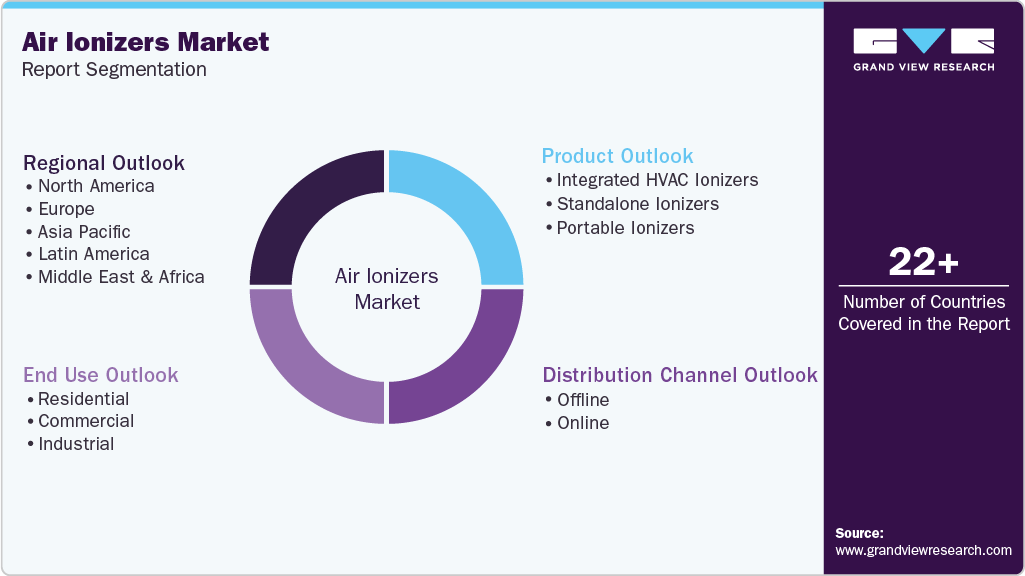
This report forecasts revenue growth at global, regional & country levels and provides an analysis on the industry trends in each of the sub-segments from 2021 to 2033. For this study, Grand View Research has segmented the global air ionizers market report on the basis of product, distribution channel, end use, and region:
 To learn more about this report, Download Free Sample Report
 -
Product Outlook (Revenue, USD Billion, 2021 - 2033)
-
Integrated HVAC Ionizers
-
Standalone Ionizers
-
Portable Ionizers
-
-
Distribution Channel Outlook (Revenue, USD Billion, 2021 - 2033)
-
Offline
-
Online
-
-
End Use Outlook (Revenue, USD Billion, 2021 - 2033)
-
Residential
-
Commercial
-
Industrial
-
-
Regional Outlook (Revenue, USD Billion, 2021 - 2033)
-
North America
-
U.S.
-
Canada
-
Mexico
-
-
Europe
-
Germany
-
France
-
UK
-
Spain
-
Italy
-
-
Asia Pacific
-
China
-
India
-
Japan
-
South Korea
-
Australia
-
-
Latin America
-
Brazil
-
Argentina
-
-
Middle East & Africa
-
Saudi Arabia
-
UAE
-
South Africa
-
-
Research Methodology
The air ionizers market figures in this report are based on a proven research process that combines executive interviews with secondary research from proprietary databases, company filings, and recognized regulatory and institutional sources. Market size is built through value-chain sizing - reconciling supply-side and demand-side estimates - and triangulated with bottom-up and top-down approaches. Every estimate passes multiple levels of expert validation before publication, with each air ionizers segment quantified using the revenue-capture definitions in the table below.
Segment Definition
Segment - Product
Revenue Capture Definition
Integrated HVAC Ionizers
Revenue is captured from ionization systems integrated into centralized HVAC equipment for large-scale indoor air-treatment applications.
Standalone Ionizers
Revenue is derived from standalone ionization units purchased for dedicated indoor air-treatment across residential and commercial spaces.
Portable Ionizers
Revenue is generated from compact, movable ionization devices designed for localized air-treatment across individual rooms and smaller enclosed spaces.
Segment -Distribution Channel
Revenue Capture Definition
Offline
Revenue is captured through physical retailers, specialty stores, distributors, dealers, and direct sales of air ionization equipment.
Online
Revenue is derived from e-commerce platforms, manufacturer websites, online retailers, and digital marketplaces selling air ionization products.
Segment -
End Use
Revenue Capture Definition
Residential
Revenue is generated from air ionizers purchased by households for indoor air-treatment in homes and individual living spaces.
Commercial
Revenue is captured from air ionizers installed across offices, hotels, retail facilities, schools, and healthcare buildings.
Industrial
Revenue is derived from ionization equipment deployed in manufacturing facilities and industrial environments requiring localized or controlled air-treatment.
Estimation Model
Layer No.
Layer Name
Key Question
Description
01
Indoor Air Quality Demand Layer
Which indoor environments generate demand for air ionizers?
The estimation begins by evaluating residential buildings, offices, healthcare facilities, educational institutions, hospitality establishments, retail spaces, and industrial facilities. Indoor occupancy, building size, ventilation conditions, air-quality requirements, and awareness of airborne particulate control determine the underlying demand for air ionization technologies.
02
Product & Distribution Channel Layer
Which air ionizer products and purchasing channels determine market demand?
This layer refines demand by assessing Integrated HVAC Ionizers, Standalone Ionizers, and Portable Ionizers across Offline and Online distribution channels. Product capacity, ionization technology, installation requirements, portability, pricing, purchasing preferences, and compatibility with existing ventilation infrastructure influence product selection and channel demand.
03
End-Use & Deployment Layer
What determines air ionizer utilization and deployment?
Market demand is estimated through deployment across Residential, Commercial, and Industrial end uses. Building occupancy, indoor air-treatment requirements, facility size, HVAC configuration, installation conditions, replacement cycles, new construction, renovation activity, and operational requirements influence new installations and replacement demand across different applications.
04
Revenue Layer
How is total market revenue calculated?
Revenue is estimated by aggregating spending on air ionizers across products, distribution channels, end-use applications, and regional markets. New installations and replacement demand are assessed using unit volumes, average selling prices, product specifications, installation requirements, purchasing activity, and channel pricing to validate the overall market size.
Delivered Customizations
This report has been delivered with the following In-depth customizations
Client Request
Customization Delivered
Value Adds
Regional Segmentation
Detailed regional analysis was conducted across North America, Europe, Asia Pacific, Latin America, and the Middle East & Africa, including country-level assessment for key markets such as the U.S., Germany, China, India, Brazil, and Saudi Arabia. The study evaluated indoor air-quality requirements, commercial building development, healthcare infrastructure, HVAC modernization, industrial facilities, and adoption of standalone air-treatment equipment.
Helped identify regional differences in air ionizer adoption, country-specific demand patterns, building infrastructure development, and markets with increasing requirements for indoor air-treatment technologies. The analysis also supported assessment of commercial construction, healthcare expansion, HVAC modernization, and application-specific demand across major markets.
Competitive benchmarking
Comprehensive benchmarking was carried out for major air ionizer market participants based on standalone product portfolios, ionization technology, product capacity, ion-generation performance, ozone-control capabilities, energy efficiency, product configuration, application coverage, customization capabilities, manufacturing capabilities, geographic presence, distribution networks, and aftermarket services.
Assisted clients in understanding competitor positioning, product differentiation, distribution channel capabilities, application coverage, geographic presence, product development activities, and technological developments within the air ionizers market.
Opportunity assessment
In-depth opportunity assessment was conducted across residential, commercial, institutional, healthcare, hospitality, educational, and industrial applications. The study evaluated opportunities related to standalone ionizers, integrated HVAC ionizers, portable products, smart air-quality monitoring, energy-efficient designs, and replacement of older air-treatment equipment.
Enabled clients to identify markets with increasing air-treatment requirements and evaluate opportunities across products, distribution channels, end-use applications, technologies, and geographic markets.
About the Author(s)
Advanced Interior Materials Research Team
Advanced Materials · Advanced Interior MaterialsThis report was authored by the advanced interior materials research team at Grand View Research - comprising two research analysts, one senior research analyst, and one industry expert - with specialized expertise in the advanced interior materials segment of the advanced materials industry. All findings are based on proprietary advanced materials databases, executive interviews, and regulatory analysis, subject to internal peer review prior to publication.
Last Updated:
Speak to Analyst

Customize this report to your needs - add regions, segments, or data points, with 20% free customization.
Or view our licence options:


ISO 9001:2015 & 27001:2022 Certified
We are GDPR and CCPA compliant! Your transaction & personal information is safe and secure. For more details, please read our privacy policy.


