
- Home
- »
- Communications Infrastructure
- »
-
Air Traffic Control Equipment Market Size Report, 2026-2033GVR Report cover

Air Traffic Control Equipment Market (2026 - 2033)
Size, Share & Trends Analysis Report By Product (Communications Equipment, Navigation Equipment, Surveillance Equipment), By Application (Commercial Aircraft, Private Aircraft), By Region, And Segment Forecasts
Market Size, 2025
$10.6BMarket Estimate, 2026
$11.5BMarket Forecast, 2033
$20.1BCAGR, 2026–2033
8.3%Air Traffic Control Equipment Market Summary
The global air traffic control equipment market size was estimated at USD 10.6 billion in 2025 and is projected to grow from USD 11.5 billion in 2026 to USD 20.1 billion by 2033, growing at a CAGR of 8.3% from 2026 to 2033. Asia Pacific dominated the market, accounting for a revenue share of 35.0% in 2025. Increased aircraft movements and passenger & freight traffic have led to the construction of new airports and the modernization and expansion of existing ones.
Key Market Trends & Insights
- By product: The communication equipment segment dominated the market, with a revenue share of more than 38.0% in 2025.
- By application: The commercial aircraft segment held the largest market share of approximately 40.0% in 2025.
Regional Highlights
- Largest regional market: Asia Pacific (35.0% revenue share, 2025)
- Fastest-growing regional market: Asia Pacific (highest CAGR, 2026-2033)
Market Size & Forecast
- Market size in 2025: USD 10.6 Billion
- Estimated market size in 2026: USD 11.5 Billion
- Projected market size by 2033: USD 20.1 Billion
- CAGR (2026-2033): 8.3%
Three ways to get this report
Buy it, customize it, or ask a question.Ask an Analyst
Analyst response in 1 business day
- AccessReport author, directly
- Reply timeWithin 1 working day
- No sales callDirect answer only
- FormatEmail reply
- CostFree, no cost
Get the Full Report
What the study covers
- FormatsPDF · Excel · Dashboard
- Timeline2026–2033 annual, 2025 base
- Coverage20+ countries, 5 regions
- Companies10+ key players profiled
Customize the Report
20% free customization
- IncludeCountries, segments, points
- TailorTo your product definition
- ExtendDeeper competitor detail
- OrA fully bespoke study
- Turnaround5–10 working days
Growth in air traffic, both passenger and cargo, is consistent and expected to continue over the coming years. Despite the global crisis, including wars, closure of the Strait of Hormuz, and rising fuel costs, the growth in air traffic is encouraging the aviation industry to expand its fleet . At the same time, the modernization of aircraft with advanced safety features and proportional upgrades to airport facilities and air traffic control are also evident. All these factors are contributing to the growing demand for air traffic control equipment.
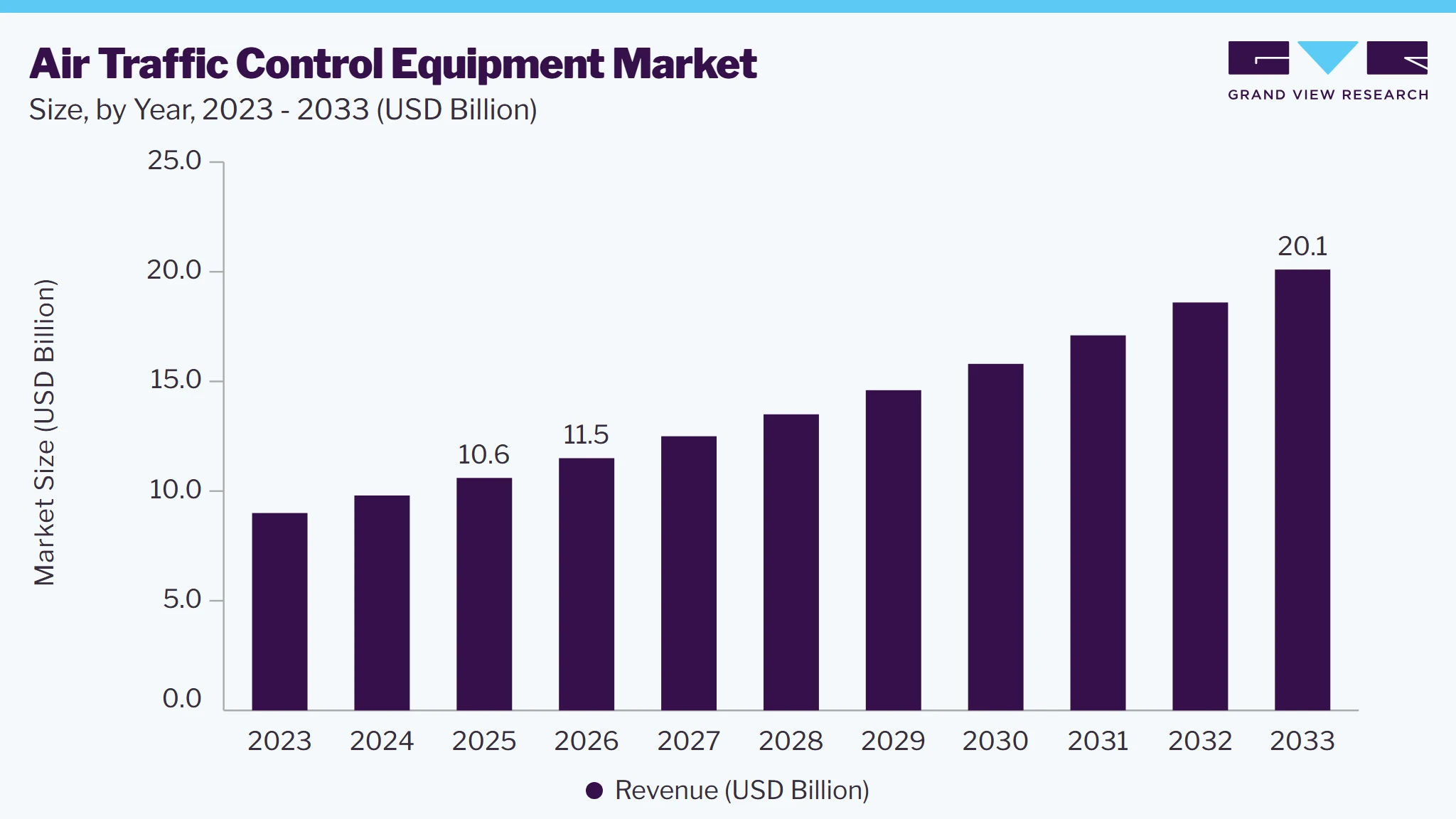 Source: Grand View Research, IR Documents, Primary Interviews, Paid DatabasesTo learn more about this report,
 Download Free Sample Report
Airport expansion and modernization require the deployment of air traffic control (ATC) equipment and its sub-systems, which are expected to boost market growth. Air traffic control, or ATC, regulates and manages the flow of incoming and outgoing flights, and any disruption in its operations can result in delays and serious accidents. Phasing out old air traffic control equipment is thus a gradual and continuous process in which newly installed systems are operated in parallel with the former systems. The ongoing process of upgrading ATC equipment and technological advancements in precision components are expected to augment demand for air traffic control equipment.
Market Dynamics
Growth in air traffic, for passengers and cargo, is the driving factor for the air traffic control equipment market. Airline companies are expanding their fleets. Similarly, governments worldwide are expanding and improving their airport networks to improve connectivity. The integration of advanced AI technologies into modern ATC equipment is offering significant growth opportunities for the ATC equipment market.
Industry experts worldwide are optimistic about air traffic growth over the coming years. According to the data published by the Airport Council International, the passenger traffic in 2024 exceeded the pre-pandemic level for the first time. ACI also predicted that the total number of air passengers will reach 7.5 billion by the end of 2025. The consistent increment in passenger flights demands the expansion of existing airport infrastructure. With a growing number of flights, governments worldwide are expanding their infrastructure for both domestic and international air traffic. For instance, the Indian aviation ministry announced plans to expand airport infrastructure from 163 airports in 2025 to 400 by 2047. Such aggressive expansion plans are evident across different countries globally. This is expected to boost the demand for air traffic control equipment
Similar to passenger traffic, air cargo is also expected to grow significantly. For instance, Satair, a leading aircraft component and service company, predicted that air cargo growth would increase by 26% in 2026 compared to 2025. This is expected to further add pressure to the existing infrastructure, thereby increasing demand for expansion of the airport network. All these factors are evidently supporting the growth of the air traffic control equipment market over the coming years.
Interoperability between existing ATC equipment and modern, advanced equipment poses a key challenge for airport management. Replacement of new ATC equipment with the legacy system is a gradual process that must be performed in parallel with the existing system. Shutting down the entire operation for upgradation is not possible, as it could disrupt air traffic at that airport or its section. Additionally, interoperability issues between old and new technologies create operational complexities. Ensuring continuous operation during upgradation, training existing staff on new systems, and high capital investment often delay implementation. Furthermore, interoperability gaps between existing and new systems invite additional cybersecurity threats. All such factors often discourage airport authorities from prioritizing equipment upgrades, thereby restraining market growth.
AI is gradually moving from the experimental stage to the core infrastructure of ATC. The technology is disrupting traditional operations, improving operational management, streamlining air traffic, and supporting critical decision-making, including routing, air safety, and air traffic congestion. This helps remove bottlenecks and manage complex traffic.
AI and ML technologies can support predictive maintenance of ATC equipment and identify potential system disruptions. This can help prevent downtime and avoid major mishaps. Additional features, such as natural language processing and speech recognition technologies, further enhance communications between ATC and aircraft and trigger early warning systems in the event of adverse weather conditions, emergencies, or peak traffic periods. All such factors are making modern ATC equipment more reliable and efficient, and are expected to encourage more airports to integrate AI-powered ATC equipment.
Many countries are already investing in upgrading their existing infrastructure with advanced AI-enabled equipment. For instance, the U.S. FAA announced its intention to invest approximately USD 6 billion in modernizing telecommunications and radar equipment for air traffic control by 2028. This modernization includes integrating AI and real-time sensors to improve operational execution. Furthermore, the DOT announced another USD 31.5 billion initiative to upgrade the air traffic control system using radar and digital technologies.
Analyst Perspective
The air traffic control equipment market is poised for steady growth, driven by rising global passenger and cargo traffic and increasing investments in airport infrastructure expansion. Governments worldwide are focusing on modernizing air navigation systems to accommodate higher flight volumes and improve operational efficiency. While interoperability challenges associated with legacy ATC systems may slow the pace of upgrades, the integration of AI-powered technologies is creating significant opportunities for market expansion. AI-enabled solutions that enhance traffic management, predictive maintenance, and decision support are expected to accelerate the transition toward next-generation ATC infrastructure, supporting long-term market growth.
Application Insights
The commercial aircraft segment dominated the market, accounting for approximately 40.0% of revenue in 2025. As global economies develop and disposable incomes rise, more people opt for air travel. It has led to higher demand for commercial flights, putting pressure on air traffic control systems to manage increased traffic efficiently. Airlines are continually expanding their fleets of aircraft for both passenger and cargo transportation. This results in growth in demand for commercial ATC equipment for commercial airports,
The private aircraft segment is estimated to register a significant CAGR of 8.4% over the forecast period. Private aircraft offer flexibility and convenience, and lure business executives, celebrities, and high-net-worth individuals who value the ability to travel on schedule and to destinations that might not be easily accessible by commercial airlines.According to Sherpa reports, the number of business jet flights worldwide increased up 5% in 2025 compared to 2024. Such growth in private air traffic is expected to encourage the growth of this segment.
Product Insights
The communication equipment segment held the largest market share of over 38.0% in 2025. The replacement rate of obsolete communications equipment has increased due to advances in digital data communication and the ubiquity of air traffic control systems. The increasing volume of air traffic, the need for continuous communication between ATC and aircraft, and the need to manage incoming and outgoing flights effectively encourage airport authorities to upgrade their communication equipment. Also, the integration of NLP and speech recognition into communication equipment is further boosting the segment's growth.
The surveillance equipment segment is estimated to register a significant CAGR over the forecast period. Surveillance equipment helps air traffic controllers manage the growing number of aircraft more effectively and safely. Identifying and notifying of potential threats in advance can help prevent disasters such as terrorist attacks, operational lapses, and security gaps. As a result, surveillance equipment is expected to grow steadily over the coming years.
Regional Insights
Asia Pacific accounted for the largest market share, exceeding 34.0% in 2025. The Asia-Pacific region has been one of the world's fastest-growing economic regions. This economic growth has increased business and leisure travel, increasing demand for air travel services. Expanding the middle class in countries across the region has increased disposable income and a greater ability to afford air travel. This has led to higher passenger numbers on both domestic and international flights. According to IATA, there has been significant growth in the number of passengers in the Asia-Pacific region as the international passenger traffic recorded 10.9% growth in 2025 compared to the previous year. In order to deal with the growth, many countries such as India and China have begun investing significantly in increasing their airports capacity and air traffic control system infrastructure. For instance, India has undertaken major projects to expand its airport network, which can grow up to 350 active airports by 2047.
Europe Air Traffic Control Equipment Market Trends
Europe accounted for a considerable share of the air traffic control equipment industry in 2025 due to the increased government efforts to secure air traffic and aircraft. According to Eurocontrol, Europe is advancing its Single European Sky initiative, which aims to modernize air traffic management through digital technologies, automation, and improved coordination among countries. Easy travel within the European Union, the availability of renowned tourist destinations, and growing trade between Europe and other regions are supporting the upgrade of air infrastructure across Europe. Thus, the region is expected to showcase consistent growth in the ATC equipment market.
Key Air Traffic Control Equipment Company Insights
The global market for air traffic control equipment comprises many players divided based on product offerings. The players are undertaking forecast launches, acquisitions, and collaborations to increase their global reach.
Key Air Traffic Control Equipment Companies:
The following key companies have been profiled for this study on the air traffic control equipment market
-
Cobham Limited
-
Advanced Navigation and Positioning Corporation
-
BAE Systems
-
Endeavor Business Media, LLC.
-
L3Harris Technologies, Inc.
-
Intelcan Technosystems Inc
-
Lockheed Martin Corporation
-
Indra
-
Northrop Grumman
-
Verdict Media Limited.
-
RTX
-
Thales
-
Searidge Technologies
Recent Development
-
In May 2026, RTX announced additional investments to expand the production capacity of its advanced air traffic control radar systems. The company is working closely with the FAA to support ongoing air traffic management modernization initiatives by deploying next-generation surveillance technologies.
-
In 2025, the U.S. Federal Aviation Administration (FAA) launched a comprehensive air traffic control (ATC) modernization initiative aimed at replacing aging infrastructure and legacy technologies across the national airspace system. The program includes upgrading radar systems, telecommunications networks, software platforms, and command-and-control facilities to enhance operational efficiency, safety, and system reliability. To support the implementation of this large-scale modernization effort, the U.S. Congress allocated an initial funding package of USD 12.5 billion.
Air Traffic Control Equipment Market Report Scope
Report Attribute
Details
Market size in 2025
USD 10.6 Billion
Estimated Market size in 2026
USD 11.5 Billion
Projected Market size by 2033
USD 20.1 Billion
Growth rate
CAGR of 8.3% from 2026 to 2033
Base year for estimation
2025
Actual data
2021 - 2024
Forecast period
2026 - 2033
Quantitative units
Revenue in USD billion, and CAGR from 2026 to 2033
Report coverage
Revenue forecast, company ranking, competitive landscape, growth factors, and trends
Segments covered
Product, application, region
Regional Scope
North America; Europe; Asia Pacific; Latin America; Middle East & Africa
Country scope
U.S.; Canada; UK; Germany; France; China; Japan; India; Australia; South Korea; Brazil; Mexico; Saudi Arabia; South Africa; UAE
Key companies profiled
Cobham Limited; Advanced Navigation and Positioning Corporation; BAE Systems; Endeavor Business Media, LLC.; L3Harris Technologies, Inc.; Intelcan Technosystems Inc; Lockheed Martin Corporation; indra; Northrop Grumman; Verdict Media Limited.; RTX; Thales; Searidge Technologies
Customization scope
Free report customization (equivalent up to 8 analysts working days) with purchase. Addition or alteration to country, regional & segment scope.
Pricing and purchase options
Avail of customized purchase options to meet your exact research needs. Explore purchase options
Global Air Traffic Control Equipment Market Report Segmentation
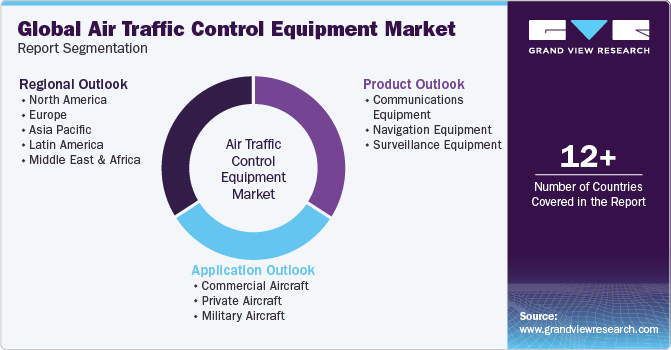
The report forecasts revenue growth at global, regional, and country levels and provides an analysis of the latest industry trends in each of the sub-segments from 2021 to 2033 For this study, Grand View Research has segmented the global air traffic control equipment market report based on product, application, and region:
 To learn more about this report, Download Free Sample Report
-
Product Outlook (Revenue, USD Billion, 2021 - 2033)
-
Communications Equipment
-
Navigation Equipment
-
Surveillance Equipment
-
-
Application Outlook (Revenue, USD Billion, 2021 - 2033)
-
Commercial Aircraft
-
Private Aircraft
-
Military Aircraft
-
-
Regional Outlook (Revenue, USD Billion, 2021 - 2033)
-
North America
-
U.S.
-
Canada
-
-
Europe
-
UK
-
Germany
-
France
-
-
Asia Pacific
-
China
-
Japan
-
India
-
Australia
-
South Korea
-
-
Latin America
-
Brazil
-
Mexico
-
-
Middle East and Africa
-
Saudi Arabia
-
South Africa
-
UAE
-
-
Frequently Asked Questions About This Report
The global air traffic control equipment market size was valued at USD 10.6 billion in 2025 and is estimated at USD 11.5 billion for 2026.
The global air traffic control equipment market is expected to grow at a CAGR of 8.3% from 2026 to 2033, reaching USD 20.1 billion
commercial aircraft dominated the air traffic control equipment market with a share of 40.0% in 2025.
Key players include Air Traffic Control (ATC) equipment market include Thales Group, Raytheon Company, Searidge Technologies Inc., Northrop Grumman Corp., NavAero Inc., Lockheed Martin Corp., Indra Sistemas SA, Harris Corp., Cobham Plc, and BAE Systems Plc.
Asia Pacific dominated with a 34.0% revenue share in 2025.
About the Author(s)
Communications Infrastructure Research Team
Technology · Communications InfrastructureThis report was authored by the communications infrastructure research team at Grand View Research - comprising two research analysts, one senior research analyst, and one industry expert - with specialized expertise in the communications infrastructure segment of the technology industry. All findings are based on proprietary technology databases, executive interviews, and regulatory analysis, subject to internal peer review prior to publication.
Last Updated:
Speak to Analyst

Customize this report to your needs - add regions, segments, or data points, with 20% free customization.
Or view our licence options:


ISO 9001:2015 & 27001:2022 Certified
We are GDPR and CCPA compliant! Your transaction & personal information is safe and secure. For more details, please read our privacy policy.


