
- Home
- »
- Plastics, Polymers & Resins
- »
-
Alcoholic Beverage Packaging Market Report, 2026-2033GVR Report cover
![Alcoholic Beverage Packaging Market (2026 - 2033)Report]()
Alcoholic Beverage Packaging Market (2026 - 2033)
Size, Share & Trends Analysis Report By Material (Plastic, Glass, Metal), By Product (Can, Bottle & Jars), By Region (North America, Europe, Asia Pacific, Latin America, MEA), And Segment Forecasts
Market Size, 2025
$89.3BMarket Estimate, 2026
$94.3BMarket Forecast, 2033
$136.8BCAGR, 2026–2033
5.4%Alcoholic Beverage Packaging Market Summary
The global alcoholic beverage packaging market size was valued at USD 89.3 billion in 2025 and is projected to grow from USD 94.3 billion in 2026 to USD 136.8 billion by 2033, at a CAGR of 5.4% from 2026 to 2033. Asia Pacific dominated the market with the largest revenue share of 32.7% in 2025. The industry is fueled by increasing consumption, innovative designs, sustainable focus, e-commerce growth, regulatory changes, and technological advancements, which are enhancing the demand for premium brands and catering to diverse demographic preferences.

Key Market Trends & Insights
- By product: Bottles & Jars segment led the market with the largest revenue share of 56.3% in 2025.
- By material: Plastic segment led the market with the largest revenue share of 32.5% in 2025.
Regional Highlights
- Largest regional market: Asia Pacific (32.7% revenue share, 2025)
- Fastest-growing regional market: North America (highest CAGR, 2026-2033)
- By country: The China held the largest market share in 2025
Market Size & Forecast
- Market size in 2025: USD 89.3 Billion
- Estimated market size in 2026: USD 94.3 Billion
- Projected market size by 2033: USD 136.8 Billion
- CAGR (2026-2033): 5.4%
Three ways to get this report
Buy it, customize it, or ask a question.Ask an Analyst
A direct answer, usually in 1 working day
- AccessReport author, directly
- Reply timeWithin 1 working day
- No sales callDirect answer only
- FormatEmail reply
- CostFree, no cost
Get the Full Report
What the study covers
- FormatsPDF · Excel · Dashboard
- Timeline2026–2033 annual, 2025 base
- Coverage20+ countries, 5 regions
- Companies10+ key players profiled
Customize the Report
20% free customization
- IncludeCountries, segments, points
- TailorTo your product definition
- ExtendDeeper competitor detail
- OrA fully bespoke study
- Turnaround5–10 working days
The market is witnessing a significant surge in demand, driven by a growing trend of increased consumption worldwide. This phenomenon is attributed to a shift in societal dynamics, high disposable income, and the rise of social activities such as parties where the consumption of alcohol is prevalent. Moreover, the growing popularity of craft beers and artisanal spirits has contributed to this trend, as consumers seek out unique and high-quality products.
To stand out in a competitive market, companies are focusing on creative packaging innovations that enhance the consumer experience. This includes the development of aesthetic and eco-friendly packaging solutions that incorporate novelty elements. For instance, the use of lightweight bottles, recyclable materials, and convenient cap designs have been identified as key innovations in the market. These innovations not only improve the consumer experience but also provide a competitive edge for companies.
In response to growing consumer and regulatory pressure in the beverage packaging industry, sustainability has become a critical area of focus for both manufacturers and consumers. Governments are implementing stricter standards on labeling, safety, and environmental factors of packaging materials, while companies are adopting strategies such as reusable materials, recyclable packaging, biodegradable materials, and minimal packaging use to reduce their environmental footprint. As the market continues to evolve, companies must prioritize sustainability to remain competitive and meet the growing demands of environmentally conscious consumers.
Market Dynamics
The alcoholic beverage packaging market is witnessing steady growth due to the rising consumption of beer, wine, spirits, and ready-to-drink alcoholic beverages across global markets. Packaging plays a crucial role in preserving product quality, extending shelf life, and enhancing brand appeal through innovative designs and premium formats. Growing demand for sustainable packaging solutions, including recyclable glass bottles and aluminum cans, is encouraging manufacturers to adopt environmentally responsible materials. Furthermore, increasing investments in product differentiation, premiumization, and packaging innovations are supporting the continued expansion of the market worldwide.
The growing consumer preference for premium alcoholic beverages and ready-to-drink (RTD) products is a major driver of the alcoholic beverage packaging market. Consumers are increasingly seeking products that offer convenience, unique flavors, and premium experiences, prompting beverage manufacturers to invest in attractive and high-quality packaging solutions. Premium spirits, craft beers, and RTD cocktails often utilize distinctive bottles, cans, labels, and closures that enhance brand identity and improve shelf visibility, thereby increasing demand for innovative packaging formats.
The rapid expansion of the RTD beverage segment is driving the adoption of lightweight, portable, and durable packaging materials such as aluminum cans and PET bottles. As consumers increasingly favor on-the-go consumption and convenient packaging formats, beverage companies are focusing on packaging designs that combine functionality with visual appeal. This trend is encouraging continuous innovation in packaging technologies, supporting higher packaging consumption across the alcoholic beverage industry and contributing significantly to market growth.
Stringent environmental regulations related to packaging waste, recycling requirements, and single-use materials represent a significant restraint for the market. Governments and regulatory bodies across various regions are implementing stricter sustainability standards, compelling manufacturers to invest in eco-friendly materials, recycling infrastructure, and packaging redesign initiatives. While these efforts support environmental goals, they often increase production costs and operational complexity for beverage producers and packaging manufacturers. Additionally, fluctuations in the availability and cost of sustainable raw materials can create further challenges, potentially impacting profit margins and slowing the adoption of certain packaging formats.
The increasing focus on sustainability and circular economy practices presents a significant opportunity for the market. Beverage manufacturers are actively seeking packaging solutions that reduce environmental impact while meeting consumer expectations for eco-friendly products. This is driving demand for recyclable glass bottles, aluminum cans, lightweight packaging materials, and reusable packaging formats. As brands strengthen their sustainability commitments and governments promote recycling initiatives, packaging companies have opportunities to develop innovative, low-carbon, and resource-efficient solutions that enhance brand value, improve regulatory compliance, and support long-term market growth.
Analyst Perspective
The alcoholic beverage packaging market is positioned for steady growth, supported by rising global consumption of beer, wine, spirits, and ready-to-drink (RTD) beverages, along with increasing demand for premium and sustainable packaging solutions. As beverage manufacturers focus on enhancing brand visibility, product differentiation, and consumer convenience, demand is growing for innovative packaging formats such as lightweight cans, premium glass bottles, and eco-friendly alternatives. The market is also experiencing a significant shift toward recyclable and low-carbon packaging materials, driven by stringent environmental regulations and evolving consumer preferences for sustainable products. Going forward, companies that can effectively combine packaging performance, visual appeal, cost efficiency, and sustainability through material innovation and advanced packaging designs will be well positioned to capitalize on emerging opportunities across the global alcoholic beverage industry.
Material Insights
Based on material, the plastic segment led the market with the largest revenue share of 32.5% in 2025. Plastic is cheaper to manufacture and ships as compared to glass or metal and it is easier to handle by the consumers. In addition to taking less time to produce, plastic is also cheaper to produce as compared to glass, which makes it a preferred commodity for manufacturers who want to cut on cost. Compared to glass, plastic is relatively more resilient in the distribution and handling stages and therefore results in fewer damages to the product.
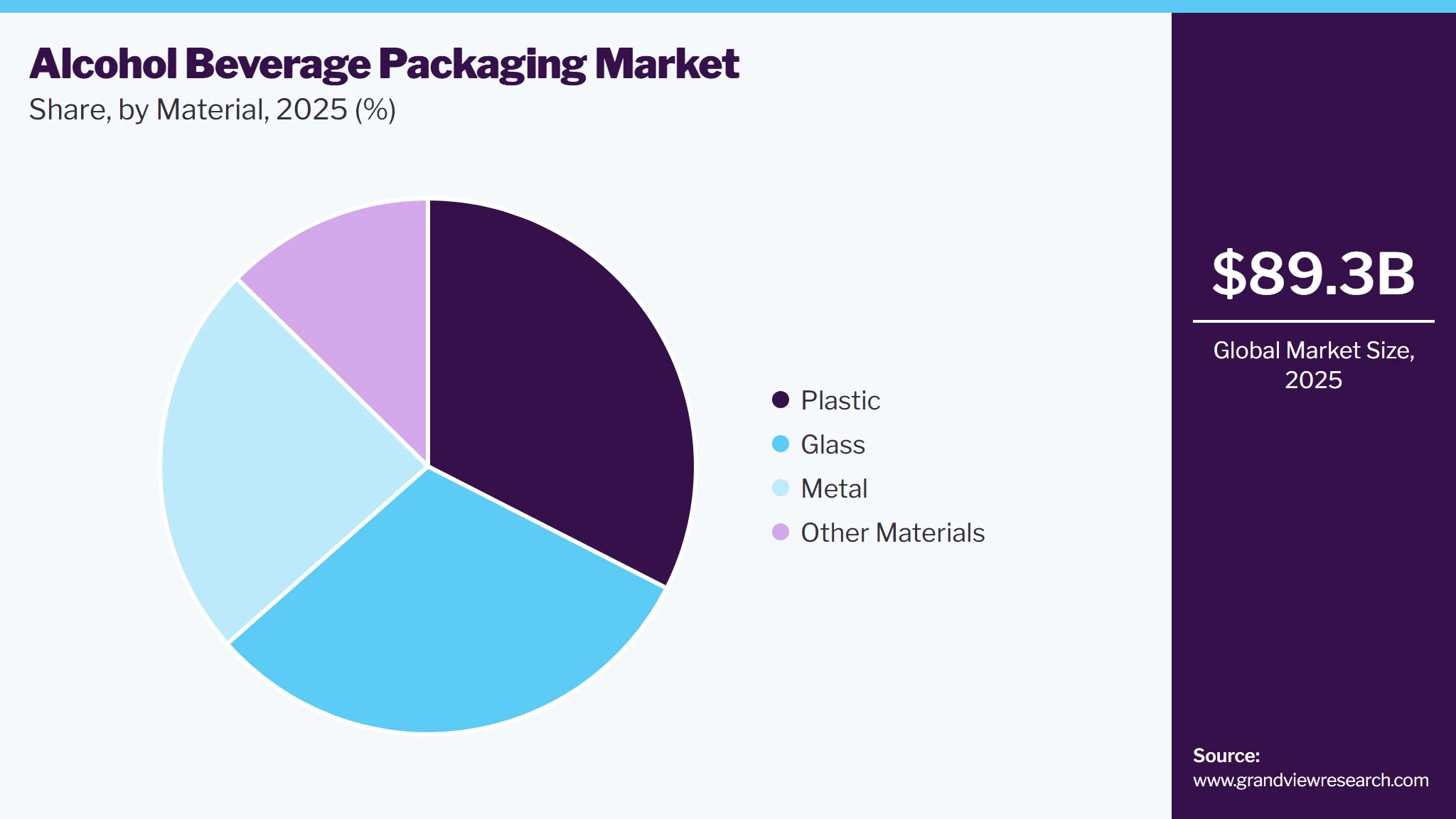
Metal packaging is expected to register the second-fastest CAGR of 6.2% over the forecast period. Aluminum and steel are favored materials for metal containers due to their exceptional strength, providing optimal protection for products against light, oxygen, and physical damage during transportation and handling. Their high strength-to-weight ratio and durability make them an ideal choice for preserving the integrity of packaged goods.
Product Insights
Based on product, the bottles & jars segment led the market with the largest revenue share of 56.3% in 2025. Glass bottles and jars remain the preferred choice for consumers in the alcoholic beverage packaging market, conveying a perception of high quality and exclusivity. Conventional norms, such as wine packaging in glass, also contribute to this perception. The aesthetic appeal of glass is a significant factor in consumer preference, driving demand for premium products.
Cans are expected to register a significant growth of 5.2% over the forecast period. Cans are a preferred packaging option for consumers seeking convenience, as they are easy to carry and less prone to breakage. Their resealable lids allow for slow consumption, reducing spoilage. The tight seal also protects contents from light and oxygen, preserving flavor quality. Cans are ideal for outdoor events and activities, offering a practical and convenient packaging solution.
Regional Insights
Asia Pacific dominated the alcoholic beverage packaging market with the largest revenue share of 32.7% in 2025. Rapid economic growth in countries such as China, India, and Southeast Asia has led to increased disposable incomes among consumers. Urbanization has also enabled access to a wider range of alcoholic products, driving shifts in consumer preferences for packaging and demand. As a result, there is a growing need for innovative packaging solutions that cater to changing consumer habits and preferences.

The alcoholic beverage packaging market in the China held the largest share in the Asia Pacific region in 2025. The country’s dominance in the market can be attributed to its large consumer base, government support, low labor costs, established manufacturing capacity, and advanced packaging techniques. These factors have enabled Chinese firms to capture significant market share, solidifying China’s position as a prominent global producer.
North America Alcoholic Beverage Packaging Market Trends
North America alcoholic beverage packaging market is expected to register the fastest CAGR of 7.4% during the forecast period. North America, comprising the U.S. and Canada, is a significant consumer of alcoholic beverages, driven by a strong and thriving economy. High per capita income enables consumers to indulge in premium and ultra-premium products. As a result, consumer awareness has driven the evolution of packaging in the region, with manufacturers adopting eco-friendly and sustainable solutions to meet changing demands.
U.S. Alcoholic Beverage Packaging Market Trends
The alcoholic beverage packaging market in U.S. held significant market share in 2025. The diverse population in the country demands tailored packaging for its various tastes in alcoholic beverages. Despite a complex regulatory framework, the U.S. offers a predictable business environment for alcohol production and sales. As a result, American brands catering to international markets must adapt to meet global packaging standards and requirements.
Europe Alcoholic Beverage Packaging Market Trends
Europe alcoholic beverage packaging market has a substantial market share in 2025. Alcohol beverages play a significant cultural role in Western Europe, particularly in regions such as Bordeaux and Tuscany. These areas not only produce high-quality wines but also embody the region’s rich history and heritage. As a result, consumers in these regions demand premium packaging that honors tradition while showcasing modern flair.
The alcoholic beverage packaging market in Germany is expected to grow substantially over the forecast period. Germany is at the forefront of European innovation, driving advancements in packaging technology. The country’s manufacturers have leveraged cutting-edge processes and materials, such as lightweight glass bottles, eco-friendly packaging, and advanced labeling techniques. This has enabled German companies to establish a unique market position and capitalize on growing demand for sustainable packaging solutions.
Key Alcoholic Beverage Packaging Company Insights
Some key companies in the alcoholic beverage packaging market include Amcor plc; Crown; Amber Packaging; and Berry Global Inc.; among others. Owing to increasing competition, market participants have been implementing tactics and strategies such as new product launches, enhanced distribution, new product launches, geographical expansion and more.
-
Sonoco functions in packaging solutions, serving diverse markets including consumer goods, industrial products, protective packaging, and paper and wood products. Committed to sustainability and innovation, Sonoco has established itself in the packaging industry, delivering high-quality solutions worldwide.
-
Mondi offers solutions tailored to meet the specific needs of the beverage industry. The company provides a broad range of products, specifically designed for various types of beverages, including beer, wine, spirits, and ready-to-drink cocktails. This expertise enables Mondi to deliver customized packaging solutions that meet the unique demands of each sector.
Key Alcoholic Beverage Packaging Companies:
The following key companies have been profiled for this study on the alcoholic beverage packaging market.
-
Amcor plc
-
Crown
-
Amber Packaging
-
Berry Global Inc.
-
Ball Corporation
-
Sonoco
-
Stora Enso
-
Graham Packaging
-
Mondi
-
Tetra Laval
-
WestRock Company
-
SIG
Competitive Benchmarking
Category
Operating Strategies
Competitive Edge
Weakness
Established Players (Amcor plc, Crown Holdings, Berry Global Inc., Ball Corporation, Sonoco, Stora Enso, Graham Packaging, Mondi, Tetra Laval, WestRock Company, and SIG)
- Focus on large-scale manufacturing, global supply chain integration, and long-term contracts with leading beer, wine, and spirits producers to ensure consistent volume growth.
- Invest heavily in sustainable packaging innovations, lightweight materials, recyclable solutions, and advanced production technologies to strengthen market leadership and regulatory compliance.
- Strong global production networks, diversified product portfolios, and established relationships with major alcoholic beverage brands provide significant market reach and customer retention advantages.
- High financial strength enables continuous investment in R&D, capacity expansion, and premium packaging solutions tailored to evolving consumer preferences.
- Large operational structures can reduce flexibility and slow responsiveness to niche market trends or rapidly changing customer requirements.
- High capital expenditure requirements and exposure to raw material price fluctuations can impact profitability during periods of market volatility.
Emerging Players (Amber Packaging, Rhea Distilleries Private Limited, and Blue Ocean Closures AB)
- Focus on specialized and differentiated packaging solutions, including sustainable closures, eco-friendly bottles, and customized packaging formats tailored to regional and premium alcoholic beverage brands.
- Pursue growth through strategic partnerships, pilot projects, innovation-led product development, and collaborations with beverage producers seeking sustainable packaging alternatives.
- Strong ability to innovate rapidly and commercialize emerging packaging technologies, particularly in sustainable and fiber-based packaging solutions aligned with evolving environmental regulations and consumer preferences.
- Greater flexibility in serving craft breweries, premium spirits producers, regional distilleries, and niche beverage brands with customized packaging designs and lower-volume production requirements.
- Limited production capacity, financial resources, and geographic reach compared with multinational packaging manufacturers may constrain large-scale contract opportunities.
- Lower market visibility and a relatively narrow customer base can create challenges in scaling operations and competing against established global suppliers with extensive distribution networks and long-term customer relationships.
Recent Developments
-
In May 2024, Sonoco announced the grand opening of its new Metal Packaging Technical & Engineering Center in Columbus, Ohio, demonstrating its commitment to sustainable metal packaging innovation and customer support.
-
In May 2024, Amcor plc launched its Bottles of the Year program on National Packaging Design Day 2024, celebrating responsible, innovative packaging designs that adhere to the evolving consumer trends in various industries, including beverage, spirits, and food.
-
In April 2024, SIG collaborated with Namaqua Wines, as its carton packaging supplies for its low alcohol wine range. The company invested in a SIG Slimline Aseptic filling machine, enhancing its production capacity and expanding its market presence.
-
In April 2024, Berry Global Inc. acquired F&S Tool Inc. in a strategic move to enhance its full plastic packaging lifecycle solutions, expanding its offerings to include design, production, and recycling capabilities for customers.
Alcoholic Beverage Packaging Market Report Scope
Report Attribute
Details
Market size in 2025
USD 89.3 billion
Estimated market size in 2026
USD 94.3 billion
Projected market size by 2033
USD 136.8 billion
Growth rate
CAGR of 5.4% from 2026 to 2033
Base year for estimation
2025
Historical data
2021 - 2024
Forecast period
2026 - 2033
Quantitative units
Revenue in USD million/billion and CAGR from 2026 to 2033
Report coverage
Revenue forecast, company ranking, competitive landscape, growth factors, and trends
Segments covered
Material, product, region
Regional scope
North America; Europe; Asia Pacific; Latin America; MEA
Country scope
U.S.; Canada; Mexico; Germany; UK; France; Italy; Spain; China; Japan; India; South Korea; Australia; Brazil; Argentina; Saudi Arabia; South Africa; UAE
Key companies profiled
Amcor plc; Crown; Amber Packaging; Berry Global Inc.; Ball Corporation; Sonoco; Stora Enso; Graham Packaging; Mondi; Tetra Laval; WestRock Company; SIG
Customization scope
Free report customization (equivalent up to 8 analysts' working days) with purchase. Addition or alteration to country, regional & segment scope.
Pricing and purchase options
Avail customized purchase options to meet your exact research needs. Explore purchase options
Global Alcoholic Beverage Packaging Market Report Segmentation
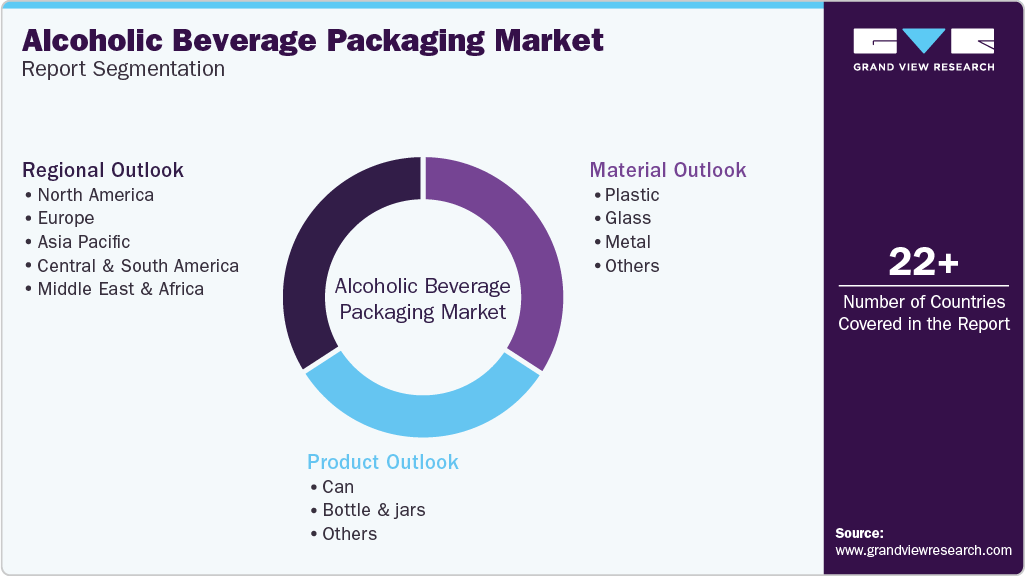
This report forecasts revenue growth at global, regional, and country levels and provides an analysis of the latest industry trends in each of the sub-segments from 2021 to 2033. For this study, Grand View Research has segmented the global alcoholic beverage packaging market report based on material, product, and region.
-
Material Outlook (Revenue, USD Million, 2021 - 2033)
-
Plastic
-
Glass
-
Metal
-
Others
-
-
Product Outlook (Revenue, USD Million, 2021 - 2033)
-
Can
-
Bottle & jars
-
Others
-
-
Region Outlook (Revenue, USD Million, 2021 - 2033)
-
North America
-
U.S.
-
Canada
-
Mexico
-
-
Europe
-
UK
-
Germany
-
France
-
Italy
-
Spain
-
-
Asia Pacific
-
China
-
India
-
Australia
-
Japan
-
-
Latin America
-
Brazil
-
Argentina
-
-
Middle East & Africa
-
South Africa
-
Saudi Arabia
-
UAE
-
-
Research Methodology
Segment Definition
Segment - Product
Revenue capture definition
Can
Revenue generated from the sale of aluminum and steel cans used for packaging beer, ready-to-drink (RTD) beverages, cider, and other alcoholic drinks. This segment includes standard beverage cans, slim cans, and specialty can formats designed to enhance portability, product protection, and shelf appeal.
Bottle & Jars
Revenue generated from the sale of glass and plastic bottles and jars used for packaging wine, spirits, beer, and other alcoholic beverages. This segment includes standard bottles, premium liquor bottles, wine bottles, and specialty containers that provide product preservation, brand differentiation, and consumer convenience.
Others
Revenue generated from the sale of alternative alcoholic beverage packaging formats, including cartons, pouches, kegs, bag-in-box systems, and other emerging packaging solutions. This segment includes packaging used for bulk distribution, on-premise dispensing, and innovative beverage packaging applications.
Segment - Material
Revenue capture definition
Plastic
Revenue generated from the sale of plastic-based alcoholic beverage packaging manufactured from materials such as PET, HDPE, and other polymers. This segment includes lightweight bottles, closures, and specialty packaging formats designed to improve durability, cost efficiency, and transportation performance.
Glass
Revenue generated from the sale of glass packaging used for alcoholic beverages, including bottles and specialty containers. This segment includes packaging solutions widely utilized for wine, spirits, premium beer, and craft beverages due to their superior barrier properties, premium appearance, and recyclability.
Metal
Revenue generated from the sale of metal-based alcoholic beverage packaging, primarily aluminum and steel cans. This segment includes packaging formats used for beer, RTD cocktails, and other alcoholic beverages that require lightweight, durable, and highly recyclable packaging solutions.
Other Materials
Revenue generated from the sale of alcoholic beverage packaging manufactured from alternative materials such as paperboard, cartons, composite materials, and bio-based substrates. This segment includes sustainable and innovative packaging solutions developed to reduce environmental impact and support evolving consumer and regulatory requirements.
Estimation Model
Layer Name
Key Question
Description
Alcoholic Beverage Consumption Layer
What forms the demand base?
Identify global consumption volumes of alcoholic beverages across major categories, including beer, wine, spirits, cider, and ready-to-drink (RTD) alcoholic beverages. This layer establishes the total beverage volume requiring packaging and serves as the foundation for market demand estimation across regions and product segments.
Packaging Penetration Layer
Where is packaging utilized?
Assess the adoption of different packaging formats across alcoholic beverage categories, including cans, bottles & jars, cartons, kegs, and other packaging solutions. Evaluate packaging preferences based on beverage type, consumer trends, distribution channels, sustainability requirements, and regional consumption patterns.
Packaging Material Intensity Layer
How much packaging material is consumed?
Analyze the average packaging material usage per unit of alcoholic beverage packaged, considering glass, metal, plastic, and other materials. Material intensity is influenced by packaging format, premiumization trends, product protection requirements, recyclability targets, transportation efficiency, and regulatory standards.
Revenue Layer
How is market revenue generated?
Market revenue is quantified through the sale of alcoholic beverage packaging products and materials, including cans, bottles, jars, closures, labels, and secondary packaging solutions. Revenue generation is driven by beverage production volumes, packaging replacement cycles, premium packaging adoption, sustainability initiatives, brand differentiation strategies, and growing demand for innovative packaging solutions across global alcoholic beverage markets.
Delivered Customizations
This report has been delivered with the following In-depth customizations
Client Request
Customization Delivered
Value Adds
Regional Segmentation Analysis
Detailed market sizing and forecasts for North America, Europe, Asia Pacific, Central & South America, and Middle East & Africa, including analysis of regional consumption patterns and packaging demand trends.
Enabled identification of high-growth regions, market maturity levels, and region-specific demand for alcoholic beverage packaging solutions.
Cross-Segmentation Analysis
Comprehensive analysis of market performance across Material (Plastic, Glass, Metal, Other Materials) and Product (Can, Bottle & Jars, Others) segments, with regional demand mapping.
Provided actionable insights into the most attractive segment combinations, helping stakeholders prioritize investments and product offerings.
Opportunity Assessment
Identification of growth opportunities across metal cans, premium glass bottles, lightweight packaging solutions, recyclable materials, and sustainable packaging innovations across key regions.
Supported strategic planning, product innovation initiatives, market expansion decisions, and investment prioritization in high-growth segments.
Frequently Asked Questions About This Report
Asia Pacific dominated dominated with a 32.7% revenue share in 2025.
Some key players operating in the alcoholic beverage packaging market include Amcor plc; Crown; Amber Packaging; Berry Global Inc.; Ball Corporation; Sonoco; Stora Enso; Graham Packaging; Mondi; Tetra Laval; WestRock Company; SIG
The global alcoholic beverage packaging market size was valued at USD 89.3 billion in 2025 and is estimated at USD 94.3 billion for 2026.
North America is the fastest-growing region over the forecast period.
The plastic segment led the market with a 32.5% revenue share in 2025.
Bottles & jars segment held the largest revenue share of 56.3% in 2025.Glass bottles and jars remain the preferred choice for consumers in the alcoholic beverage packaging market, conveying a perception of high quality and exclusivity.
The global alcoholic beverage packaging market is expected to grow at a CAGR of 5.4% from 2026 to 2033, reaching USD 136.8 billion by 2033.
Key factors driving the alcoholic beverage packaging market include increasing consumption of alcoholic beverages, growing demand for premium and sustainable packaging, rising popularity of ready-to-drink (RTD) products, packaging innovation, and expanding e-commerce alcohol sales.
About the Author(s)
Plastics, Polymers & Resins Research Team
Bulk Chemicals · Plastics, Polymers & ResinsThis report was authored by the plastics, polymers & resins research team at Grand View Research - comprising two research analysts, one senior research analyst, and one industry expert - with specialized expertise in the plastics, polymers & resins segment of the bulk chemicals industry. All findings are based on proprietary bulk chemicals databases, executive interviews, and regulatory analysis, subject to internal peer review prior to publication.
Last Updated:
Speak to Analyst


Customize this report to your needs - add regions, segments, or data points, with 20% free customization.
Or view our licence options:


ISO 9001:2015 & 27001:2022 Certified
We are GDPR and CCPA compliant! Your transaction & personal information is safe and secure. For more details, please read our privacy policy.


