
- Home
- »
- Consumer F&B
- »
-
Almond Milk Market Size, Share & Trends Report, 2026-2033GVR Report cover

Almond Milk Market (2026 - 2033)
Size, Share & Trend Analysis Report By Nature (Organic, Conventional), By Product (Plain, Flavored), By Packaging (Cartons, Bottles), By Distribution Channel (Retail, Foodservice), By Region, And Segment Forecasts
Market Size, 2025
$6.7BMarket Estimate, 2026
$7.3BMarket Forecast, 2033
$17.2BCAGR, 2026–2033
12.9%Almond Milk Market Summary
The global almond milk market size was valued at USD 6.7 billion in 2025 and is projected to grow from USD 7.3 billion in 2026 to USD 17.2 billion by 2033, at a CAGR of 12.9% from 2026 to 2033. North America dominated the market, accounting for the largest revenue share of 32.7% in 2025. The market is primarily driven by rising consumer demand for plant-based, dairy-free beverages.
 Source: Grand View Research, IR Documents, Primary Interviews, Paid DatabasesTo learn more about this report,
 Download Free Sample Report
 Key Market Trends & Insights
- By nature: Conventional segment held the largest market share of 86.3% in 2025.
- By product: Plain segment held the largest market share of 57.3% in 2025.
- By packaging: Cartons segment held the largest market share of 53.1% in 2025.
- By distribution channel: Retail channel segment held the largest market share of 64.8% in 2025.
Regional Highlights
- Largest regional market: North America (32.7% revenue share, 2025)
- Fastest-growing regional market: Europe (highest CAGR, 2026-2033)
- By country: The U.S. dominated North America with the largest revenue share in 2025
Market Size & Forecast
- Market size in 2025: USD 6.7 Billion
- Estimated market size in 2026: USD 7.3 Billion
- Projected market size by 2033: USD 17.2 Billion
- CAGR (2026-2033): 12.9%
Three ways to get this report
Buy it, customize it, or ask a question.Ask an Analyst
Analyst response in 1 business day
- AccessReport author, directly
- Reply timeWithin 1 working day
- No sales callDirect answer only
- FormatEmail reply
- CostFree, no cost
Get the Full Report
What the study covers
- FormatsPDF · Excel · Dashboard
- Timeline2026–2033 annual, 2025 base
- Coverage20+ countries, 5 regions
- Companies10+ key players profiled
Customize the Report
20% free customization
- IncludeCountries, segments, points
- TailorTo your product definition
- ExtendDeeper competitor detail
- OrA fully bespoke study
- Turnaround5–10 working days
Growing health awareness, lactose intolerance, and vegan lifestyles are boosting market growth. Rising product innovation and wider retail availability also support industry expansion.
 To learn more about this report, Download Free Sample Report
 Growing focus on environmental sustainability is encouraging consumers to choose almond milk as an alternative to traditional dairy products. Expanding distribution through supermarkets and online platforms, along with the introduction of flavored and fortified varieties, is further increasing consumer adoption worldwide. In February 2026, Blue Diamond Growers launched Blue Diamond Almond milk, a new premium almond milk line with four varieties, emphasizing simple ingredients, authentic almond taste, and a richer, creamier texture. The 48-oz range is now available nationwide and is positioned as an almond-first beverage designed for everyday uses like coffee, smoothies, cereal, and baking.
The almond milk industry is also benefiting from rising investments in product development and premium offerings that cater to evolving consumer preferences. Increasing demand for clean-label products with minimal ingredients and no artificial additives is encouraging manufacturers to expand their portfolios. In addition, the growing presence of almond milk in cafés, restaurants, and foodservice outlets is supporting steady market growth.
Moreover, technological advancements in processing and packaging are improving product quality, shelf life, and convenience, making almond milk more accessible to consumers. Increasing investments by leading manufacturers in emerging markets, supported by strategic partnerships and marketing initiatives, are further expanding the industry's global footprint. IN April 2024, Blue Diamond Growers partnered with Kagome Co., Ltd. to manufacture and distribute Almond Breeze in Japan, aiming to accelerate growth in the country's expanding almond milk industry. The partnership combined Blue Diamond's almond expertise with Kagome's strong local production and distribution network, and new Almond Breeze products were launched in Japan in September 2024.
Market Dynamics
The increasing preference for plant-based alternatives is significantly supporting the market growth. Consumers are shifting toward non-dairy beverages due to changing dietary habits and preferences for alternative nutrition sources. According to the Metabolic Support data, about 65% of the global population is affected by lactose malabsorption. Almond milk is gaining popularity among individuals seeking variety beyond traditional dairy products. The growing availability of plant-based beverage options is encouraging manufacturers to expand production. This trend is contributing to increased market penetration across different regions.
High production costs remain a major challenge for the almond milk industry due to the high costs of raw materials, processing, and specialized manufacturing requirements. Almond cultivation requires significant resources, which can influence overall product pricing. The need for advanced processing and packaging technologies further increases operational costs. Higher prices may limit adoption among cost-sensitive consumers. This factor creates pressure for manufacturers competing with traditional dairy milk products.
The growing focus on health and wellness creates opportunities for manufacturers to develop fortified almond milk with added vitamins, minerals, protein, and functional ingredients. Product innovation across unsweetened, flavored, barista, and specialized nutritional variants can cater to diverse consumer preferences. Expansion through e-commerce, specialty health stores, and foodservice channels can improve market reach, while sustainable sourcing, recyclable packaging, and transparent labeling can strengthen brand differentiation and consumer appeal.
Analyst Perspective
The global almond milk market is positioned for strong growth as consumers increasingly shift toward plant-based, lactose-free, and health-oriented beverage alternatives. Demand is expanding among consumers seeking lower-calorie, dairy-free options, while growing awareness of lactose intolerance, vegan and flexitarian lifestyles, and clean-label nutrition is supporting category adoption. Product innovation around fortified calcium, vitamin D, protein, organic ingredients, and flavored formulations is creating differentiated offerings across consumer segments. The expansion of ready-to-drink formats, café and foodservice applications, modern retail, and online grocery channels is improving accessibility and encouraging wider adoption of almond milk globally.
Nature Insights
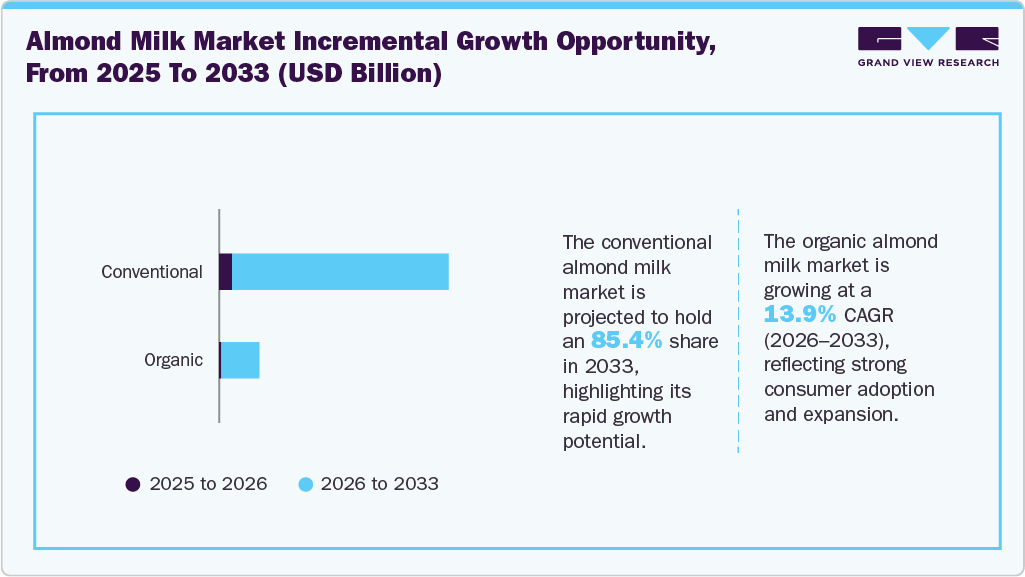
The conventional segment led the market with the largest revenue share of 86.3% in 2025. The conventional segment is supported by its wider availability and affordability across mainstream retail channels. Large-scale production capabilities enable manufacturers to meet high-volume consumer demand efficiently. Its longer presence in the market has helped build strong consumer familiarity and acceptance. Extensive distribution networks through supermarkets and grocery stores continue to strengthen segment growth.
 To learn more about this report, Download Free Sample Report
 The organic segment is projected to grow at the fastest CAGR of 13.9% from 2026 to 2033. The segment is driven by growing interest in naturally sourced, minimally processed food products. Consumers are increasingly willing to pay for products made without synthetic chemicals or genetically modified ingredients. Growing demand for premium beverages with transparent sourcing practices is supporting segment expansion. Improved availability of organic products through specialty stores and online platforms is further enhancing market adoption. In July 2025, MALK Organics launched a new shelf-stable Vanilla Almond Milk made with only four clean ingredients: filtered water, organic almonds, organic vanilla extract, and Himalayan pink salt.
Product Insights
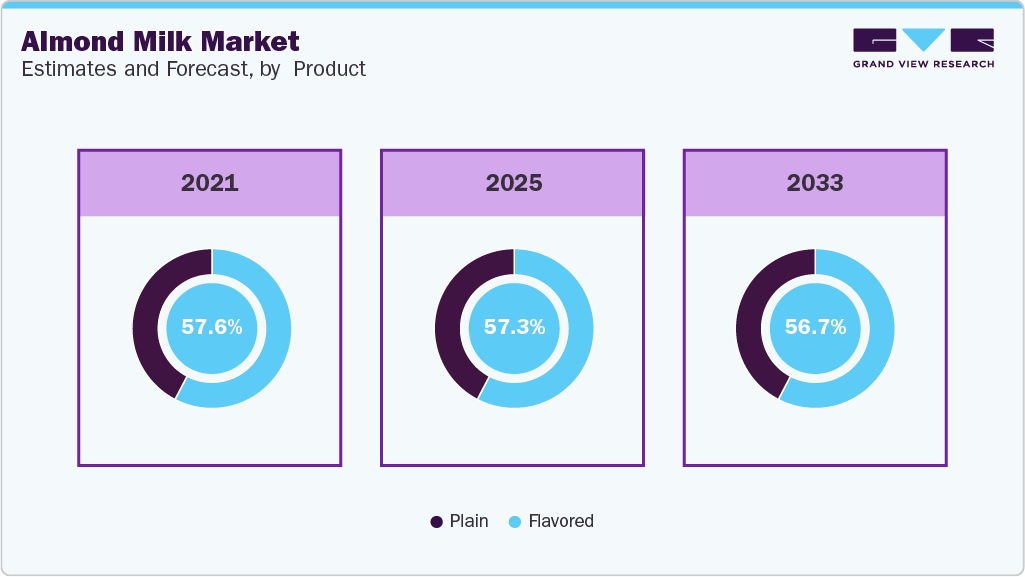
The plain segment led the market with the largest revenue share of 57.3% in 2025, supported by its versatility as an ingredient in everyday food and beverage applications. Its neutral taste makes it suitable for use in cereals, smoothies, coffee, and cooking recipes. Consumers seeking simple beverage options with fewer added ingredients often prefer plain variants. Its compatibility with various dietary preferences helps maintain steady demand across different consumer groups.
 To learn more about this report, Download Free Sample Report
 The flavored segment is projected to grow at the fastest CAGR of 13.2% from 2026 to 2033, driven by growing interest in diverse taste experiences and innovative beverage choices. Manufacturers are introducing varieties such as chocolate, vanilla, and fruit-inspired flavors to attract a broader customer base. These options particularly appeal to consumers seeking enjoyable alternatives to conventional sweetened drinks. Product innovation and attractive flavor profiles are helping expand the segment’s market reach.
Packaging Insights
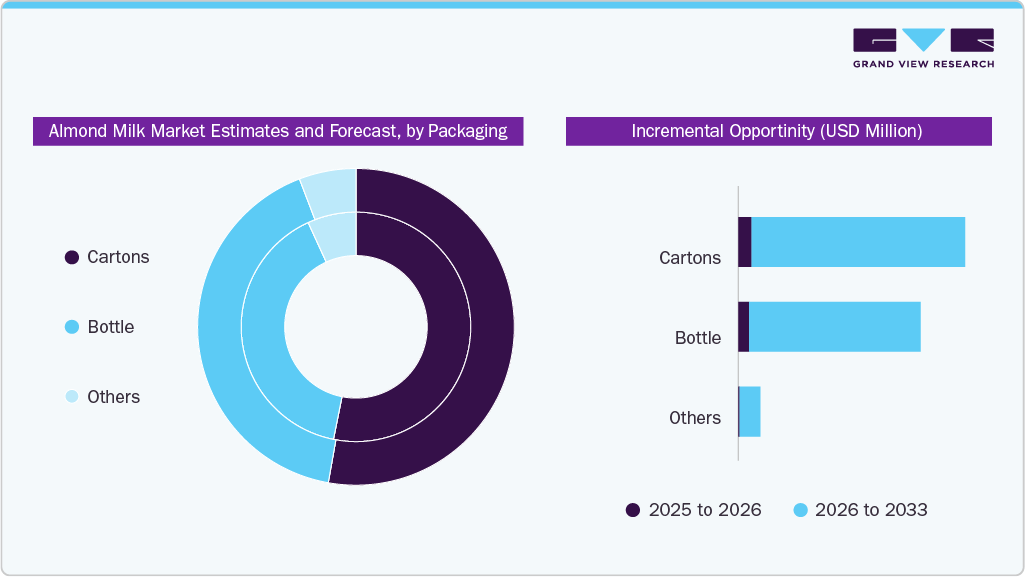
The cartons segment led the market with the largest revenue share of 53.1% in 2025. The cartons segment is driven by its convenience, lightweight structure, and suitability for large-scale retail distribution. Carton packaging helps protect almond milk from external factors and supports extended storage periods. Its efficient transportation and stacking advantages make it preferred by manufacturers and retailers. Increasing demand for portable, easy-to-store beverage formats is driving segment growth.
 To learn more about this report, Download Free Sample Report
 The bottles segment is projected to grow at the fastest CAGR of 13.4% from 2026 to 2033. The bottles segment is supported by consumer preference for resealable and convenient packaging options. Bottled almond milk offers ease of handling and is suitable for on-the-go consumption occasions. The visibility of the product through transparent packaging can enhance consumer appeal and brand differentiation. Growing demand for single-serve and premium packaging formats is contributing to segment expansion.
Distribution Channel Insights
The retail channels segment led the market with the largest revenue share of 64.8% in 2025, driven by the increasing presence of almond milk across supermarkets, convenience stores, and specialty food outlets. Easy access to products allows consumers to compare different brands, varieties, and price points. Retailers are expanding shelf space for alternative beverages due to rising consumer interest. Promotional activities and attractive product placements are further supporting sales growth. In July 2025, MALK Organics introduced a new shelf-stable almond milk product, offering consumers a simple, additive-free beverage available through Whole Foods Market and Amazon.
 To learn more about this report, Download Free Sample Report
 The foodservice segment is projected to grow at the fastest CAGR of 13.3% from 2026 to 2033, driven by increased use of almond milk in cafés, restaurants, and other hospitality establishments. It is widely incorporated into beverages, desserts, and culinary preparations to meet diverse customer preferences. Growing demand for customized and dairy-free menu options is encouraging foodservice operators to include almond milk. Partnerships between manufacturers and foodservice providers are also strengthening market expansion.
Regional Insights
The North America almond milk market held the largest revenue share of 32.7% in 2025, driven by strong consumer acceptance of alternative beverage products. Increasing demand for innovative dairy substitutes in households is supporting market expansion. The presence of established beverage companies and advanced retail infrastructure enhances product availability. Rising investments in marketing campaigns and brand development are strengthening consumer engagement. Growing adoption of almond milk in daily meal preparation is further supporting regional growth.
 To learn more about this report, Download Free Sample Report
 U.S. Almond Milk Market Trends
The almond milk market in the U.S. accounted for the largest market revenue share in North America in 2025, supported by a well-developed plant-based food industry and strong consumer interest in functional beverages. Increasing product launches with improved nutritional profiles are attracting a wider customer base. The expansion of private-label brands is creating more affordable options for consumers. Growing incorporation of almond milk into coffee shops, smoothies, and prepared foods is boosting demand. Strong innovation in beverage formulations continues to drive market development.
Europe Almond Milk Market Trends
The almond milk market in Europe is projected to grow at the fastest CAGR of 13.8% from 2026 to 2033. The European market is driven by increasing preference for sustainable food choices and evolving dietary patterns. Rising awareness about ingredient transparency and product quality is influencing purchasing decisions. Supportive regulations promoting food innovation are encouraging manufacturers to introduce new product formats. The growing demand for premium and specialty beverages is expanding market opportunities. The presence of diverse consumer groups is contributing to steady regional adoption. In August 2025, Alpro launched five new organic plant-based drinks, including almond, soy, oat, coconut almond, and barista oat varieties, with three options containing no added sugar.
The Germany almond milk market is supported by strong demand for health-oriented and environmentally conscious food products. Consumers are increasingly exploring alternative beverages as part of modern lifestyle choices. The growth of organic and specialty food retailers is improving access to products. Local manufacturers are focusing on product diversification to meet changing preferences. Increasing availability in supermarkets and convenience channels is strengthening market growth.
Asia Pacific Almond Milk Market Trends
The almond milk market in the Asia Pacific is driven by rising urbanization and changing consumption patterns. Growing exposure to international food trends is increasing awareness of alternative beverage options. Expanding middle-class populations are contributing to higher demand for premium food and beverage products. Improvements in cold-chain and distribution systems are enhancing market reach. Increasing investments by global and regional players are supporting industry expansion.
The China almond milk market is growing due to rising interest in modern nutrition products and a broader range of beverage choices. Rapid urban development is encouraging consumers to explore new categories of packaged beverages. The expansion of e-commerce platforms is improving access to almond milk products across regions. Domestic and international brands are introducing products tailored to local preferences. Rising disposable incomes are supporting demand for higher-value beverage options.
Central & South America Almond Milk Market Trends
The almond milk market in Central & South America is projected to grow at a significant CAGR of 12.3% from 2026 to 2033, driven by growing awareness of alternative nutrition products. Increasing retail modernization is helping brands reach a larger consumer base. Urban consumers are showing greater interest in diverse beverage categories and healthier lifestyles. Expanding foodservice applications are creating additional opportunities for demand. Improved product availability through supermarkets and digital channels is supporting regional growth.
Middle East & Africa Almond Milk Market Trends
The almond milk market in the Middle East & Africa is expected to grow at a substantial CAGR of 13.5% from 2026 to 2033, driven by rising demand for diversified beverage options. Growing urban populations and changing dietary preferences are creating new market opportunities. Expansion of modern retail outlets is improving consumer access to packaged almond milk products. Rising interest in premium imported food products is supporting market development. Increasing investments in food and beverage innovation are contributing to regional growth.
Key Almond Milk Company Insights
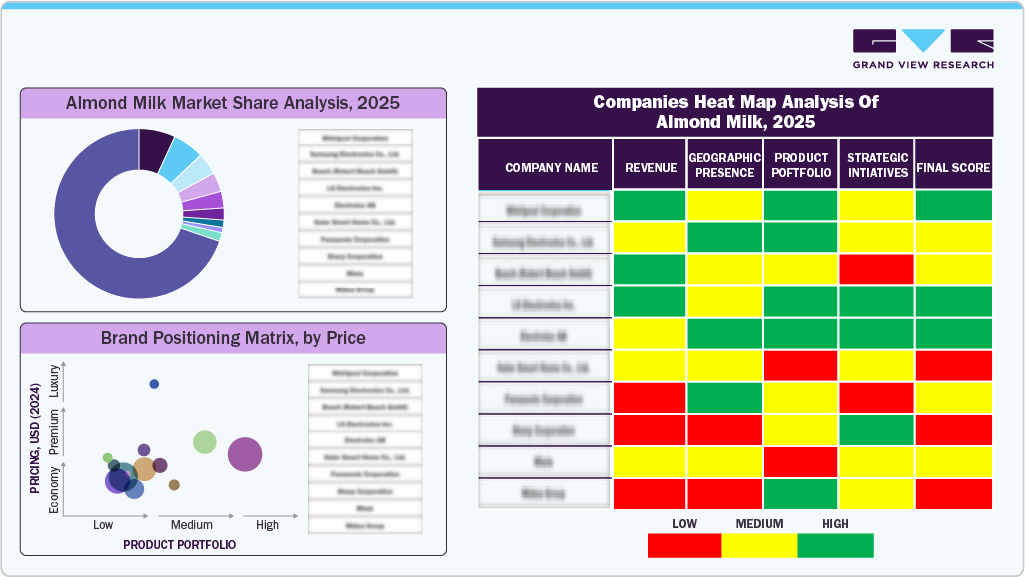
The almond milk industry is characterized by the presence of several global and regional players competing through product innovation, brand expansion, and market differentiation. Leading companies are focusing on expanding their product portfolios to address changing consumer preferences and emerging demand trends.
Market participants are investing in strategic partnerships, improved distribution networks, and new product launches to strengthen their positions. Premium, organic, and specialty almond milk offerings are gaining traction among consumers. Increasing competition is encouraging manufacturers to enhance product quality, pricing strategies, and customer engagement.
 To learn more about this report, Download Free Sample Report
 Key Almond Milk Companies
The following key companies have been profiled for this study on the almond milk market.
-
Blue Diamond Growers
-
Califia Farms LLC
-
Danone SA.
-
Life Health Foods
-
SunOpta.
-
Hain Celestial Ingredients
-
Earth’s Own
-
MALK Organics
-
Three Trees
-
The Alternative Company
Competitive Benchmarking
Category
Operating Strategies
Competitive Edge
Weakness
Established Players (Blue Diamond Growers, Danone SA)
Expand product ranges, strengthen retail partnerships, invest in production efficiency, and broaden plant-based offerings.
Strong distribution, brand recognition, established supply chains, and manufacturing scale.
High operating complexity, premium pricing pressure, and dependence on almond supply.
Emerging Players (Earth’s Own, Three Trees)
Target health-conscious niches, emphasize clean-label positioning, build e-commerce presence, and introduce differentiated formulations.
Agile innovation, focused positioning, and strong appeal among specialty consumers.
Smaller production scale, limited distribution, and lower brand visibility.
Recent Developments
-
In February 2026, Blue Diamond Growers launched Blue Diamond Almond milk, a new premium line with four varieties, emphasizing simple ingredients, authentic almond taste, and a richer, creamier texture. The 48-oz range is now available nationwide and is positioned as an almond-first beverage designed for everyday uses like coffee, smoothies, cereal, and baking.
-
In July 2025, MALK Organics introduced a shelf-stable Vanilla Almond Milk featuring four simple ingredients: filtered water, organic almonds, organic vanilla extract, and Himalayan pink salt. The launch strengthened MALK’s plant-based beverage portfolio with a clean-label, additive-free almond milk option.
Almond Milk Market Report Scope
Report Attribute
Details
Market size in 2025
USD 6.7 billion
Estimated market size in 2026
USD 7.3 billion
Projected market size by 2033
USD 17.2 billion
Growth rate
CAGR of 12.9% from 2026 to 2033
Base year for estimation
2025
Historical data
2021 - 2024
Forecast period
2026 - 2033
Quantitative units
Revenue in USD billion, and CAGR from 2026 to 2033
Report coverage
Revenue forecast, company ranking, competitive landscape, growth factors, and trends
Segments covered
Nature, product, packaging, distribution channel, region
Regional Scope
North America; Europe; Asia-Pacific; Central & South America; Middle East & Africa
Country scope
U.S.; Canada; Mexico; UK; Germany; France; Italy; Spain; China; Japan; India; Australia & New Zealand; South Korea; Brazil; South Africa
Key companies profiled
Blue Diamond Growers; Califia Farms LLC; Danone SA; Life Health Foods; SunOpta; Hain Celestial; Earth’s Own; MALK Organics; Three Trees; The Alternative Company
Customization scope
Free report customization (equivalent up to 8 analysts’ working days) with purchase. Addition or alteration to country, regional & segment scope.
Pricing and purchase options
Avail customized purchase options to meet your exact research needs. Explore purchase options
Global Almond Milk Market Report Segmentation
This report forecasts revenue growth at the regional and country levels and provides an analysis of the latest industry trends and opportunities in each of the sub-segments from 2021 to 2033. For this study, Grand View Research has segmented the global almond milk market report based on the nature, product, packaging, distribution channel, and region.
-
Nature Outlook (Revenue, USD Billion, 2021 - 2033)
-
Organic
-
Conventional
-
-
Product Outlook (Revenue, USD Billion, 2021 - 2033)
-
Plain
-
Flavored
-
Vanilla
-
Chocolate
-
Coffee
-
Others
-
-
-
Packaging Outlook (Revenue, USD Billion, 2021 - 2033)
-
Cartons
-
Bottle
-
Others
-
-
Distribution Channel Outlook (Revenue, USD Billion, 2021 - 2033)
-
Foodservice
-
Retail
-
Hypermarkets & Supermarkets
-
Convenience Stores
-
Online
-
Others
-
-
-
Regional Outlook (Revenue, USD Billion, 2021 - 2033)
-
North America
-
U.S.
-
Canada
-
Mexico
-
-
Europe
-
UK
-
Germany
-
France
-
Italy
-
Spain
-
-
Asia Pacific
-
China
-
Japan
-
India
-
Australia & New Zealand
-
South Korea
-
-
Central & South America
-
Brazil
-
-
Middle East & Africa
-
South Africa
-
-
Research Methodology
The almond milk marketfigures in this report are based on a proven research process that combines executive interviews with secondary research from proprietary databases, company filings, and recognized regulatory and institutional sources. Market size is built through value-chain sizing-reconciling supply-side and demand-side estimates-and triangulated with bottom-up and top-down approaches. Every estimate passes multiple levels of expert validation before publication, with each almond milk segment quantified using the revenue-capture definitions in the table below.
Segment Definition
Segment - Product
Revenue capture definition
Plain
Plain almond milk generates revenue through unflavored formulations positioned around natural taste, versatility, and everyday consumption. Brands can differentiate through almond content, nutritional fortification, texture, calorie profile, and clean-label attributes. Revenue is primarily captured through individual cartons, multipacks, household purchases, private-label offerings, and foodservice applications.
Flavored
Flavored almond milk generates revenue through formulations enhanced with flavors such as vanilla, chocolate, or other taste variants, appealing to consumers seeking greater taste variety. Brands can support higher-value positioning through distinctive flavor combinations, added nutritional benefits, premium ingredients, and attractive packaging. Revenue is captured through individual packs, multipacks, specialty retail, convenience purchases, and repeat consumption.
Estimation Model
Consumption Universe Layer
Access & Availability Layer
Purchase & Usage Layer
Revenue Conversion Layer
Who consumes almond milk globally?
Who can access almond milk?
Who regularly purchases almond milk?
How is revenue generated from almond milk consumers?
Broad consumer base seeking dairy alternatives, plant-based nutrition, and lactose-free beverages.
Consumers reached through supermarkets, hypermarkets, convenience stores, e-commerce, specialty retailers, and foodservice outlets.
Consumers buying almond milk for everyday drinking, breakfast, coffee, cooking, or nutritional needs.
Monetization through plain and flavored variants across cartons, multipacks, premium products, and foodservice formats.
Delivered Customizations
This report has been delivered with the following In-depth customizations
Client Request
Customization Delivered
Value Adds
Global Almond Milk Consumer & Need-State Analysis
Evaluated almond milk consumers by dietary preference, consumption occasion, nutritional priorities, purchase motivations, and willingness to trade up across different product formats.
Identifies distinct consumer need states and helps prioritize target segments, occasions, and product propositions.
Global Almond Milk Pricing & Pack-Format Analysis
Assessed pricing tiers, pack sizes, packaging formats, promotional strategies, and price differences across channels and consumer segments.
Identifies pricing opportunities, optimal pack architectures, and areas for premiumization or value-led positioning.
Global Almond Milk Distribution & Channel Opportunity Assessment
Evaluated the role of supermarkets, convenience stores, foodservice, specialty retailers, and e-commerce in driving category penetration and purchase frequency.
Helps prioritize high-potential channels, optimize route-to-market strategies, and identify opportunities to expand consumer reach.
Frequently Asked Questions About This Report
The global almond milk market size was valued at USD 6.7 billion in 2025 and is estimated at USD 7.3 billion for 2026.
Key players in the market include Blue Diamond Growers, Califia Farms, Danone, Nestlé, SunOpta Inc., The Hain Celestial Group, Inc., Ripple Foods PBC, MALK Organics, LLC, Three Trees Foods, and Milkadamia Pty Ltd. and others.
Asia Pacific dominated with a revenue share of approximately 32.7% in 2025.
Organic almond milk is projected to grow at the fastest CAGR during the forecast period
Key factors driving the almond milk market include growing health consciousness, rising demand for plant-based and lactose-free alternatives, increasing adoption of vegan and flexitarian diets, and growing awareness of the nutritional benefits of almond milk.
The global almond milk market is expected to grow at a CAGR of 12.9% from 2026 to 2033, reaching USD 17.2 billion by 2033
Retail channel held the largest market share of over 64.8% in 2025.
About the Author(s)
Consumer F&B Research Team
Consumer Goods · Consumer F&BThis report was authored by the consumer f&b research team at Grand View Research - comprising two research analysts, one senior research analyst, and one industry expert - with specialized expertise in the consumer f&b segment of the consumer goods industry. All findings are based on proprietary consumer goods databases, executive interviews, and regulatory analysis, subject to internal peer review prior to publication.
Last Updated:
Speak to Analyst

Customize this report to your needs - add regions, segments, or data points, with 20% free customization.
Or view our licence options:


ISO 9001:2015 & 27001:2022 Certified
We are GDPR and CCPA compliant! Your transaction & personal information is safe and secure. For more details, please read our privacy policy.


