
- Home
- »
- Next Generation Technologies
- »
-
Amphibious Aircraft Market Size & Share Report, 2026-2033GVR Report cover

Amphibious Aircraft Market (2026 - 2033)
Size, Share & Trends Analysis Report By Aircraft (Fixed-Wing, Rotary-Wing), By Propulsion (Piston Engine, Turboprop), By Seating Capacity, By End Use (Government & Public Sector, Commercial), By Region, And Segment Forecasts
Market Size, 2025
$251.2MMarket Estimate, 2026
$283.2MMarket Forecast, 2033
$718.6MCAGR, 2026–2033
14.2%Amphibious Aircraft Market Summary
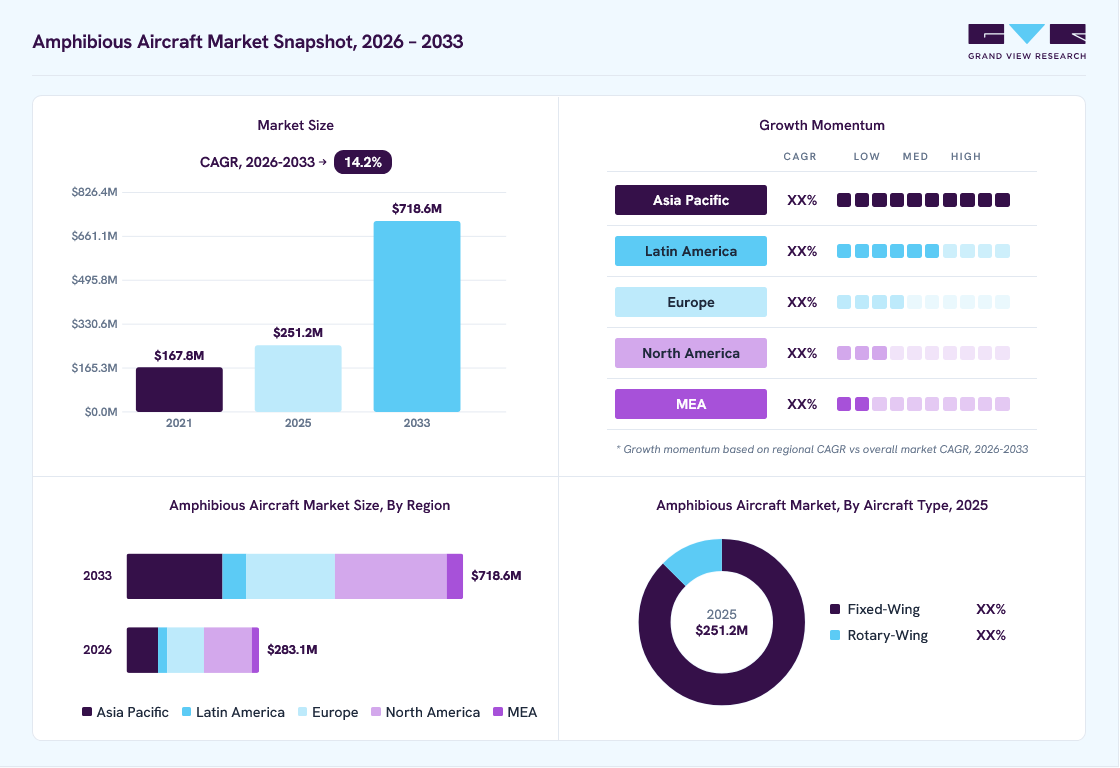
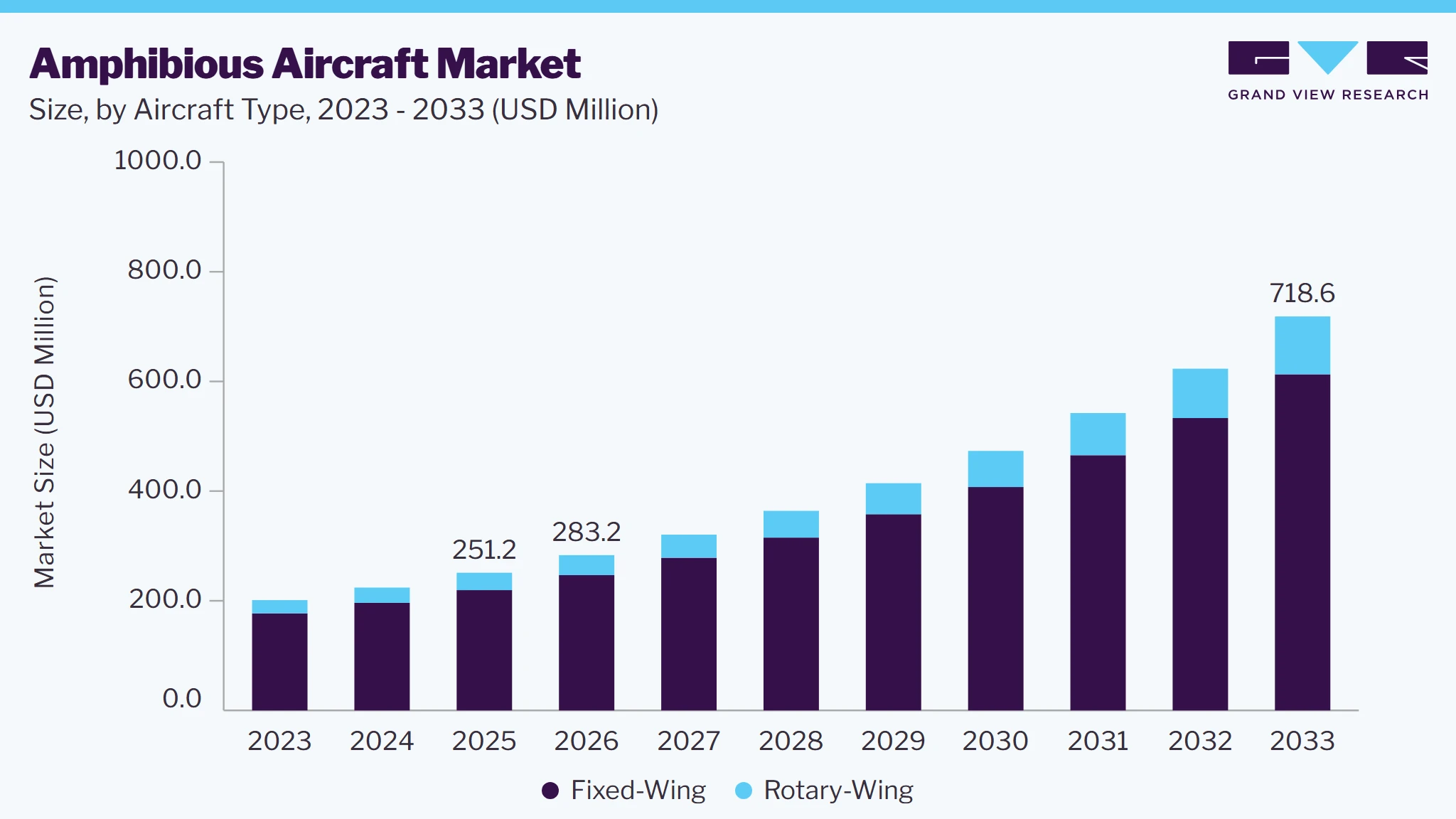
The global amphibious aircraft market size was valued at USD 251.2 million in 2025 and is projected to grow from USD 283.2 million in 2026 to USD 718.6 million by 2033, at a CAGR of 14.2% from 2026 to 2033. North America dominated the global market, accounting for the largest revenue share of 36.5% in 2025. The market growth is primarily driven by the increasing adoption of multi-role special mission platforms, rising demand for maritime surveillance and search-and-rescue, growing investments in island transport and eco-tourism, and increasing regulatory emphasis on remote region connectivity and disaster relief response.
 Source: Grand View Research, IR Documents, Primary Interviews, Paid DatabasesTo learn more about this report,
 Download Free Sample Report
Key Market Trends & Insights
- By aircraft: The fixed-wing segment held the dominant position and accounted for the largest revenue share of over 87% in 2025.
- By propulsion: The turboprop segment accounted for the largest revenue share of over 47% in 2025.
- By seating capacity: The less than 10 seats segment dominated the market in 2025.
- By end use: The government & public sector segment accounted for the largest revenue share in 2025.
Regional Highlights
- Largest regional market: North America (36.5% revenue share in 2025)
- Fastest growing regional market: Asia Pacific (highest CAGR, 2026-2033)
- By Country: The U.S. held the largest market share in 2025.
Market Size & Forecast
- Market size in 2025: USD 251.2 Million
- Estimated market size in 2026: USD 283.2 Million
- Projected market size by 2033: USD 718.6 Million
- CAGR (2026-2033): 14.2%
Prism AI by Grand View Research Free to tryAsk a question about the amphibious aircraft marketTry asking✓Every figure cited from GVR research Prefer the report? Download free sample →
The amphibious aircraft industry growth is driven by the increasing participation in maritime security and firefighting activities, the rising government spending on defense and coast guard equipment, and the growing popularity of island tourism and coastal transportation across all age groups. The adoption of modern amphibious platforms, hybrid propulsion systems, and advanced avionics technologies is accelerating as defense forces, civil protection agencies, commercial operators, and private flight schools seek versatile, durable, and cost-effective solutions to expand aerial reach, support emergency operations, enhance logistics efficiency, and elevate overall coastal mobility experiences.The increasing focus on coastal connectivity, fleet modernization, and mission versatility is accelerating demand for amphibious aircraft across civil and defense operational environments. Operators are increasingly deploying water-capable aviation platforms to execute search and rescue, aerial firefighting, island transport, maritime patrol, medical evacuation, and environmental monitoring without requiring extensive runway infrastructure or dedicated land bases. The growing adoption of special mission and humanitarian transport fleets is further supporting seaplanes market expansion, as amphibious planes provide flexible operational capabilities that complement conventional fixed-wing, helicopter, and marine vessel transportation networks.
 To learn more about this report, Download Free Sample Report
In addition, rapid advancements in composite hull materials, corrosion-resistant alloy coatings, glass cockpit avionics, digital fly-by-wire controls, and propulsion systems are driving innovation across the amphibious aircraft industry. Manufacturers are integrating high-durability hydrodynamic hulls, advanced turboprop engines, real-time weather radar, automated water-drop systems, and intelligent flight management software to improve water takeoff safety and operational efficiency.
Furthermore, growing enhancements in payload capacity, range performance, landing gear versatility, and rugged airframe architecture are enabling amphibious aircraft to be deployed across remote archipelagos, coastal zones, inland lakes, and austere landing strips. Integration with satellite communications, defense datalinks, electro-optical sensors, and maritime tracking systems is further enhancing the value of multi-role amphibious platforms, thereby driving amphibious aircraft industry growth.
Moreover, the increasing adoption of eco-tourism charters, inter-island passenger routes, and luxury private aviation is creating significant demand for amphibious aircraft in regional connectivity markets. Similar demand is emerging in defense, coast guard, forestry management, offshore energy, and emergency response, where government bodies are focusing on strengthening coastal sovereignty and disaster relief response. These factors are expected to further drive the amphibious aircraft industry growth in the coming years.
Market Dynamics
The amphibious aircraft market is experiencing significant growth, driven by increasing demand for multi-role maritime platforms, expanding adoption of aerial firefighting technologies, rising investments in island transport infrastructure, and growing regulatory support related to coastal safety and search-and-rescue capabilities. The increasing use of amphibious platforms in maritime surveillance, coastal defense patrol, disaster relief operations, environmental monitoring, and luxury tourist transport is creating strong demand for advanced amphibious flight solutions.
The growing emphasis on coastal defense, maritime domain awareness, and rapid emergency response is increasing the adoption of amphibious aircraft across naval forces, coast guards, forestry departments, operators, and civil protection agencies. Amphibious aircraft allow defense teams and operators to rapidly execute water landings, search-and-rescue sorties, aerial firefighting, troop insertion, medical evacuations, and remote cargo delivery.
The expansion of island connectivity initiatives and regional air mobility programs is further strengthening demand for amphibious transport platforms. Governments and private carriers are increasingly integrating amphibious aircraft with regional transport networks, coastal tourism hubs, isolated island communities, and disaster response logistics to improve territorial accessibility and mitigate transport bottlenecks. As civil authorities and military leaders increasingly focus on territorial security, climate resilience, emergency preparedness, and economic inclusion, demand for advanced amphibious flight platforms is expected to increase across developed and emerging markets.
Amphibious aircraft typically incorporate specialized hydrodynamic hull structures, retractable dual-land-water gear mechanisms, heavy-duty corrosion protection treatments, and high-performance turboprop or turbine engines, resulting in relatively high acquisition costs compared with conventional land-based aircraft. These costs can limit adoption among regional air taxi startups, small flight charter businesses with constrained capital, and municipal government agencies with limited procurement budgets. Additional expenses associated with specialized marine maintenance, saltwater washdown systems, pilot amphibious rating certification, insurance premiums, and specialized hangars can further increase the total cost of ownership.
The increasing integration of electric propulsion, hybrid powertrain architectures, carbon-fiber composite structures, and autonomous flight technology is creating new opportunities for amphibious aircraft manufacturers to develop eco-friendly and operational-efficient aviation solutions. Manufacturers are increasingly developing systems that can be deployed for routine island passenger charters, wildland fire suppression, wildlife surveys, border patrol, offshore oil rig logistics, and luxury personal flight. Integration with digital fleet management systems, predictive maintenance telemetry, remote glass cockpit avionics, and automated flight logging can enable fleet managers to track, maintain, and optimize aircraft health across multiple water bases and remote airfields. These developments are creating opportunities for recurring maintenance support contracts, flight training services, avionics retrofits, and fleet management software while supporting broader adoption of amphibious aviation technology.
Market Concentration & Characteristics
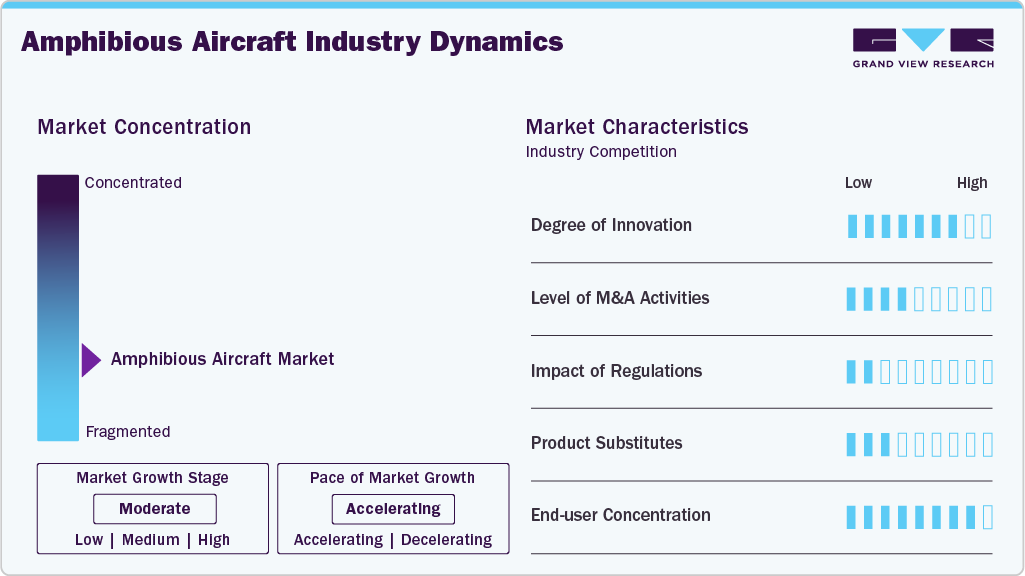
The amphibious aircraft market is fragmented, characterized by the presence of specialized seaplane manufacturers, aerospace defense prime contractors, utility aircraft builders, rotary-wing amphibious specialists, and aviation engineering companies competing across defense, government, commercial, passenger charter, and private utility applications. The market is characterized by a high degree of technological innovation, supported by continuous advancements in hydrodynamic airframe design, corrosion-resistant composite materials, digital avionics, hybrid-electric propulsion, and water-scooping efficiency.
 To learn more about this report, Download Free Sample Report
Strategic partnerships with defense procurement agencies, regional air carriers, forestry management departments, and flight training academies are enabling companies to expand mission capabilities and geographic reach. The market is expected to witness increasing adoption of modern turboprop and hybrid-electric amphibious platforms, while competition from conventional land-based regional aircraft, helicopters, fast marine ferries, and specialized patrol boats remains a moderate constraint. Growing demand for multi-mission availability, island connectivity, wildland fire fighting, and rapid coastal emergency transport is expected to continue strengthening product differentiation and competitive positioning across the global market.
Analyst Perspective
The amphibious aircraft market is shaped by advancements in composite airframe engineering and hydrodynamic hull designs, growing demand for multi-role maritime domain surveillance and aerial firefighting, increasing adoption of regional island mobility solutions, stricter environmental regulations driving hybrid-electric flight development, and expanding government investments in coastal safety and disaster response infrastructure.
Aircraft Insights
The fixed-wing segment accounted for the largest market share in 2025, propelled by growing demand for high-payload, long-range, and durable amphibious aircraft across commercial passenger transport, wildland firefighting, and military maritime patrol applications. These aircraft enable operators to transport higher passenger counts and heavy water payloads over extended distances, supporting their widespread adoption for scheduled island flight routes, forest fire suppression, and long-range coast guard surveillance.
The rotary-wing segment is expected to witness the highest CAGR of 16.4% from 2026 to 2033, supported by the rising integration of amphibious floats and emergency flotation landing systems into multi-mission helicopters for offshore oil and gas transport, search and rescue, and naval operations. These systems enable highly versatile point-to-point transport, vertical takeoff, and safe water emergency landings in rough sea conditions. Increasing offshore energy investments, naval fleet modernization, and demand for flexible rescue operations are expected to further drive the adoption of rotary-wing amphibious aircraft.
Propulsion Insights
The turboprop segment accounted for the largest market share in 2025, supported by its high fuel efficiency, excellent thrust-to-weight ratio, proven reliability in harsh maritime environments, and suitability for medium-to-large utility and firefighting amphibious airframes. Turboprop engines provide robust water-takeoff power while operating efficiently at lower altitudes, making them ideal for island commuter transport, water scooping, and coastal surveillance operations.
The hybrid/electric segment is expected to witness the highest CAGR of 27.3% from 2026 to 2033, fueled by increasing demand for low-emission regional aviation, reduced noise footprints near coastal resorts, and lower operating fuel costs. Next-generation electric and hybrid powertrains enable quieter water takeoffs and lower environmental impact on sensitive marine ecosystems. Advancements in energy-dense battery technology, lightweight electric motors, and hybrid flight power management are further expanding their development for short-haul island hops, eco-tourism charters, and flight training.
Seating Capacity Insights
The less than 10 seats segment accounted for the largest market share in 2025, driven by increasing demand for private utility aviation, pilot flight training, luxury eco-tourism, and personal sports seaplanes. Compact amphibious aircraft offer lower purchase barriers, exceptional maneuverability, and access to small lakes and rivers, making them popular among private owners, flight academies, and niche wilderness tour operators. Growing emphasis on personal aerial mobility and adventure travel is expected to support demand for small amphibious aircraft.
The more than 21 seats segment is expected to witness the highest CAGR from 2026 to 2033, fueled by growing demand for higher-capacity amphibious aircraft for inter-island passenger transportation, tourism, cargo logistics, and emergency services, along with increasing investment in water-aerodrome infrastructure and regional connectivity. Larger aircraft can accommodate more passengers while improving route economics on high-demand corridors, particularly in island and coastal regions.
End Use Insights
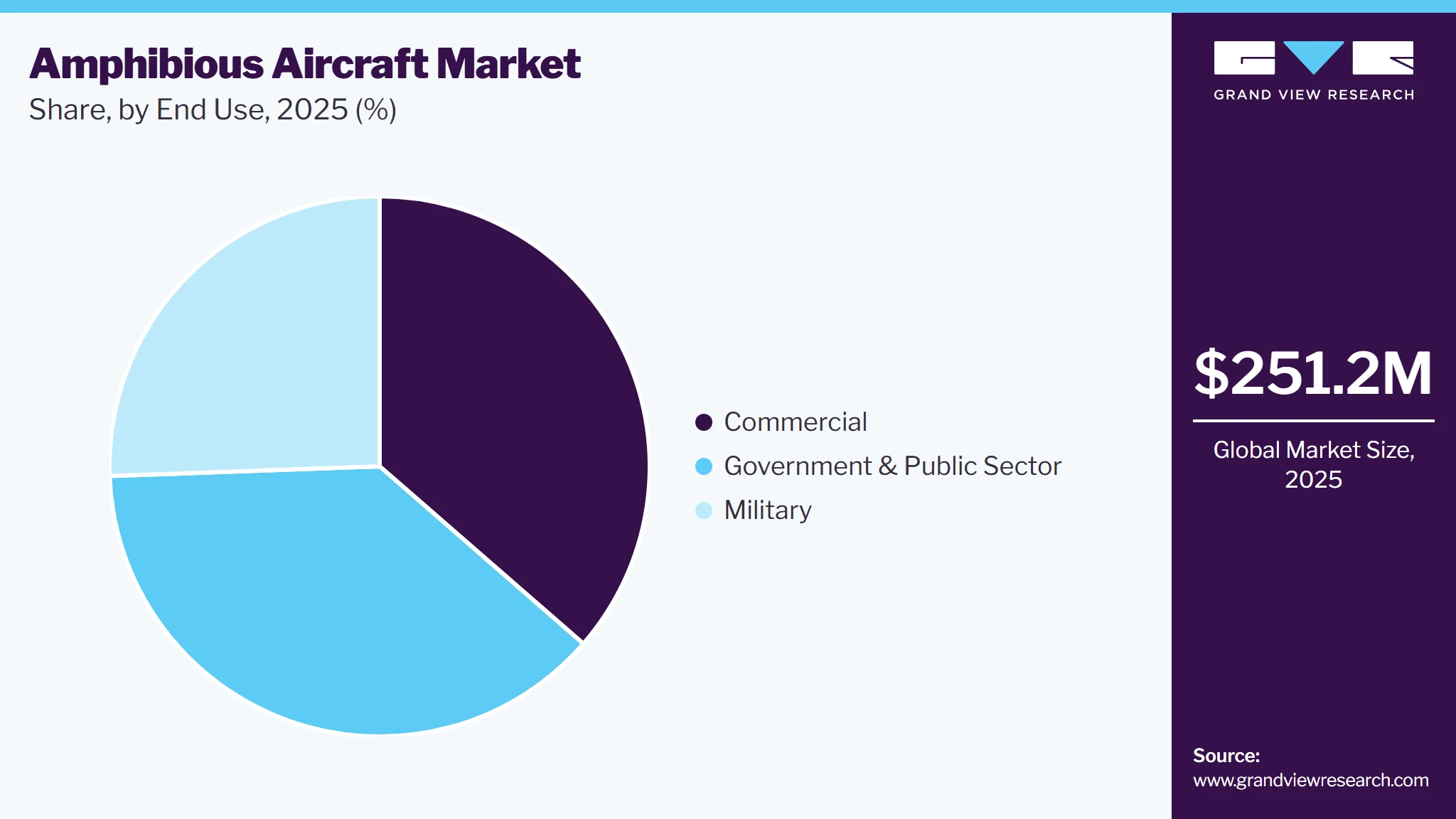
The government & public sector segment accounted for the largest market share in 2025, fueled by increasing national requirements to deploy specialized aerial firefighting fleets, conduct maritime search and rescue, deliver humanitarian relief, and enforce coastal border security. Amphibious aircraft provide governments with essential dual-use infrastructure, capable of scooping thousands of liters of water directly from lakes to fight forest fires or landing at sea to rescue stranded vessels without relying on land runways.
 To learn more about this report, Download Free Sample Report
The commercial segment is expected to grow notably from 2026 to 2033, driven by growing adoption of amphibious planes for resort transport, inter-island scheduled aviation, luxury flight charters, and cargo delivery to remote coastal communities. Commercial flight operators are increasingly expanding seaplane routes in regions such as the Asia Pacific, the Caribbean, and Europe to boost tourism connectivity. Expanding regional air transport networks, growing tourism spending, and the need for zero-runway transport links are expected to accelerate commercial amphibious aircraft adoption.
Regional Insights
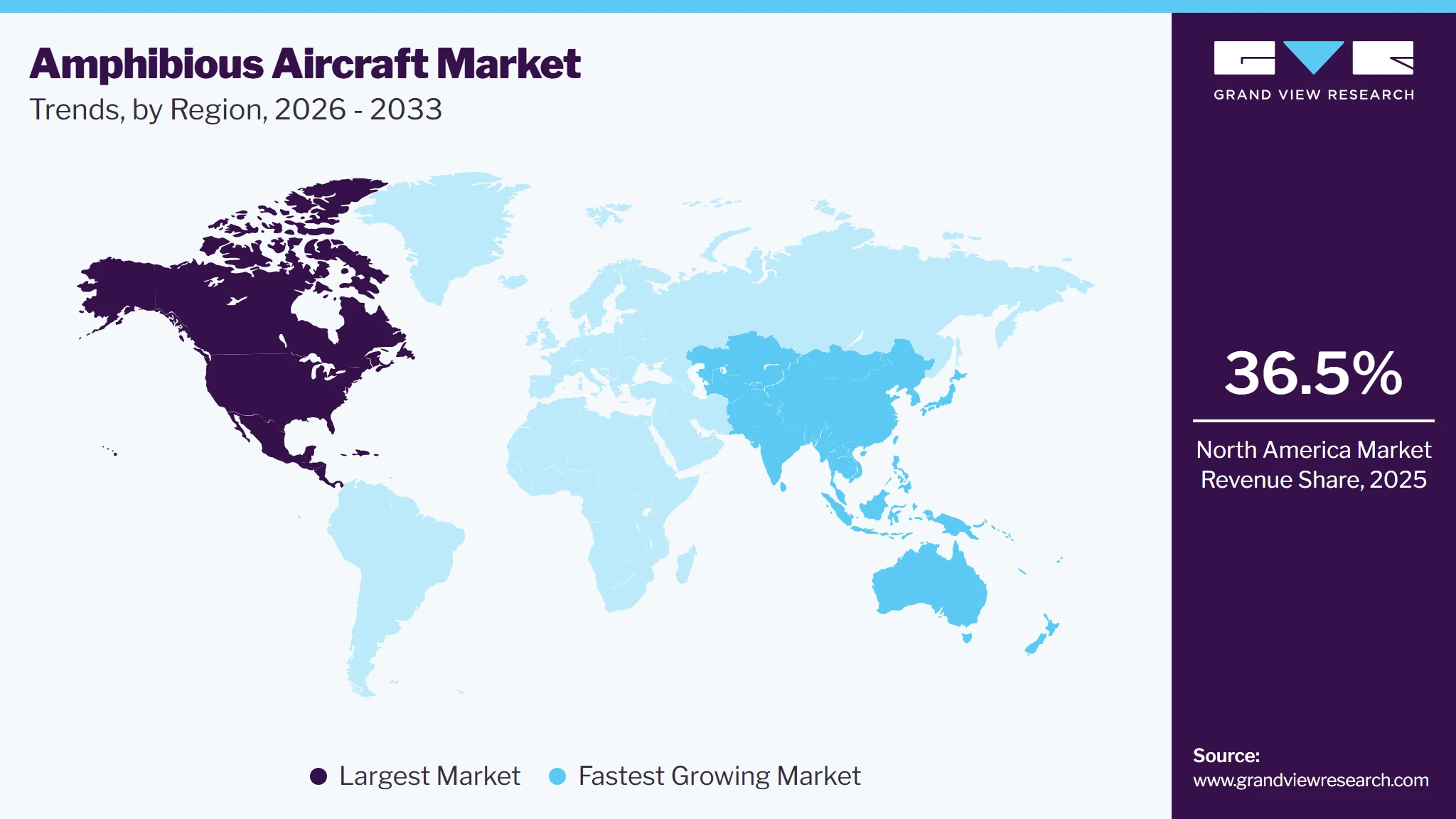
The North America amphibious aircraft industry held the largest share of 36.5% in 2025, supported by strong adoption across commercial seaplane charters, wildland firefighting fleets, military surveillance, search and rescue, and private utility aviation. Demand is being driven by increasing use of amphibious platforms for island transport in Alaska and coastal Canada, forest fire suppression in western regions, and naval utility support. The region benefits from established seaplane bases, extensive lake and coastal geography, high adoption of general aviation, and strong municipal investments in disaster response fleets.
 To learn more about this report, Download Free Sample Report
U.S. Amphibious Aircraft Market Trends
The amphibious aircraft industry in the U.S. dominated North America with a share of 81.9% in 2025, driven by strong demand from defense & coast guard, wildland firefighting agencies, commercial island air carriers, forestry management, and private seaplane pilots. The country's established aviation manufacturing base, vast coastal and lake geography, and high government funding for emergency response are supporting market expansion. The availability of modern turboprop utility seaplanes with advanced glass cockpits and amphibious floats is also increasing adoption among regional flight service operators.
Europe Amphibious Aircraft Market Trends
The amphibious aircraft industry in Europe is expected to grow at a CAGR of 13.4% from 2026 to 2033. The market growth is supported by expanding island tourism networks in the Mediterranean, stringent forestry protection programs requiring aerial firefighting, and increasing adoption of sustainable regional aviation technologies. The region has substantial demand for amphibious aircraft across inter-island passenger charters, coastal patrol, emergency medical response, and wildland firefighting.
The UK amphibious aircraft industry is expected to grow significantly in the coming years, supported by demand from island logistics, coastal search and rescue, defense patrol, environmental survey, and luxury tourism flight operations. Increasing attention to regional island connectivity in Scottish archipelagos, combined with investments in modern hybrid flight technology, is encouraging adoption. Amphibious aircraft are being increasingly used for coastal transport, maritime surveillance, environmental monitoring, and charter flight applications.
The Germany amphibious aircraft industry is driven by the country's strong aerospace engineering and manufacturing base, with amphibious technologies relevant to composite airframe manufacturing, electric propulsion R&D, specialized flight systems, and emergency rescue operations. Germany's focus on sustainable aviation technologies, precision manufacturing, and green flight mobility is expected to further support the amphibious aircraft market growth.
Asia Pacific Amphibious Aircraft Market Trends
The amphibious aircraft industry in the Asia Pacific is expected to grow at the highest CAGR of 17.2% from 2026 to 2033, driven by rapid archipelago infrastructure development, expanding island tourism, increasing naval defense spending, and government investments in amphibious search-and-rescue fleets. Growing island travel demand, increasing maritime security focus, and rising adoption of seaplane transportation networks are supporting demand across China, Japan, South Korea, India, and Southeast Asia.
The Japan amphibious aircraft industry is gaining traction, supported by its established aerospace capabilities, advanced search-and-rescue flying boat programs (such as the US-2), and extensive maritime territory. Amphibious aircraft are highly relevant for long-range maritime search and rescue, disaster relief, island transport, and naval defense. Continued government investment in disaster management and defense export capabilities is supporting market development.
The amphibious aircraft industry in China is expanding rapidly, with the country's large-scale development of indigenous heavy amphibious aircraft (such as the AG600), expanding island transport networks, and public investment in aerial firefighting. Increasing government focus on maritime domain awareness, emergency disaster relief, regional island logistics, and general aviation expansion is creating massive opportunities for amphibious flight technology across domestic operators.
Key Amphibious Aircraft Company Insights
Some of the key players operating in the market are Viking Air Limited (De Havilland Canada) and ShinMaywa Industries, Ltd., among others.
-
Viking Air Limited (De Havilland Canada) provides advanced utility aircraft and world-renowned twin-engine amphibious platforms (such as the Twin Otter Guardian and CL-415/515 water bombers) for commercial, defense, firefighting, and humanitarian applications. The company focuses on heavy-duty airframes, high-payload water scooping, rugged turboprop engines, and multi-mission avionics. Its established global operational footprint, proven airframe reliability, and strong relationships with civil protection and defense agencies support its competitive position in the global amphibious aircraft market.
-
ShinMaywa Industries, Ltd. offers ultra-large STOL (Short Takeoff and Landing) amphibious flying boats (such as the US-2) designed for long-range ocean search and rescue, emergency medical evacuation, and maritime patrol. The company is strengthening its position through advanced wave-suppression hull engineering, pressurized flight cabins, digital flight control integration, and international defense distribution partnerships. Its deep heritage in military amphibious flight engineering provides a significant competitive advantage.
Textron Aviation Inc. and Dornier Seawings GmbH are some of the emerging and established market participants in the Amphibious Aircraft Market.
-
Textron Aviation Inc. is a utility aviation company providing amphibious float options across iconic turboprop models such as the Cessna Caravan. The company focuses on high-capacity single-engine utility seaplanes, versatile amphibian landing gear, glass cockpit avionics, and widespread global maintenance support networks. Its extensive service network and popular airframe reliability support its strong position across commercial and private utility aviation.
-
Dornier Seawings GmbH is a specialized manufacturer of amphibious aircraft design, offering all-composite multi-role amphibious flying boats (such as the Seastar) for commercial passenger transport, VIP charter, governmental patrol, and emergency services. The company emphasizes corrosion-free carbon-fiber airframes, inline twin-engine safety configurations, advanced glass cockpits, and luxurious passenger cabins. Its innovative all-composite design and focus on high-efficiency island transport strengthen its position across specialized commercial and government applications.
Key Amphibious Aircraft Companies
The following key companies have been profiled for this study on the amphibious aircraft market:
-
De Havilland Aircraft of Canada / Viking Air Limited
-
ShinMaywa Industries, Ltd.
-
Textron Aviation Inc.
-
Dornier Seawings GmbH
-
Aviation Industry Corporation of China (AVIC)
-
Beriev Aircraft Company
-
ICON Aircraft, Inc.
-
Progressive Aerodyne, Inc.
-
Aviat Aircraft Inc.
-
Elbit Systems Ltd.
Competitive Benchmarking
Category
Operating Strategies
Competitive Edge
Weakness
Established Players (De Havilland Canada, ShinMaywa, Textron)
- Focus on heavy utility amphibious aircraft, turboprop water bombers, defense search-and-rescue flying boats, and globally certified utility airframes. Invest in glass cockpits and high-payload hull designs.
- Established global operational footprint, proven airframe durability, extensive government contracts, and certified global maintenance networks.
- Higher capital acquisition costs, longer manufacturing lead times, and substantial regulatory certification overheads for new airframe designs.
Emerging Players (Dornier Seawings, ICON Aircraft)
- Focus on composite amphibious airframes, light sport seaplanes, hybrid-electric propulsion prototypes, luxury VIP island charters, and niche utility applications.
- Innovative carbon-fiber corrosion-resistant hulls, lower operating fuel burn, modern cabin ergonomics, and agile design adaptation.
- Smaller production capacities, limited global service infrastructure, lower payload capacity, and brand building challenges in defense markets.
Recent Developments
-
In July 2026, De Havilland Aircraft of Canada announced that Spain would receive seven DHC-515 amphibious firefighting aircraft from 2028 to 2031, supporting the renewal of Europe’s aging aerial firefighting fleet amid rising wildfire risks.
-
In April 2026, ShinMaywa Industries’ US-2 amphibious aircraft conducted a water landing in the West Philippine Sea during a joint casualty-evacuation drill, demonstrating its capabilities for maritime search-and-rescue and emergency evacuation operations.
-
In June 2025, AVIC’s AG600 amphibious aircraft received certification, clearing it for mass production and market entry, marking a major milestone for one of the world’s largest amphibious aircraft and supporting its planned use in firefighting, maritime rescue, and disaster-response missions.
Amphibious Aircraft Market Report Scope
Report Attribute
Details
Market size in 2025
USD 251.2 million
Estimated market size in 2026
USD 283.2 million
Projected market size by 2033
USD 718.6 million
Growth rate
CAGR of 14.2% from 2026 to 2033
Base year for estimation
2025
Historical data
2021 - 2024
Forecast period
2026 - 2033
Quantitative units
Revenue in USD million and CAGR from 2026 to 2033
Report Product
Revenue forecast, company ranking, competitive landscape, growth factors, and trends
Segments covered
Aircraft, propulsion, seating capacity, end use, region
Region scope
North America; Europe; Asia Pacific; Latin America; Middle East & Africa
Country scope
U.S.; Canada; Mexico; UK; Germany; France; China; Japan; India; South Korea; Australia; Brazil; Saudi Arabia; UAE; South Africa
Key companies profiled
De Havilland Aircraft of Canada (Viking Air); ShinMaywa Industries; Textron Aviation Inc.; Dornier Seawings GmbH; AVIC; Beriev Aircraft Company; ICON Aircraft; Progressive Aerodyne; Aviat Aircraft, Inc.; Elbit Systems
Customization scope
Free report customization (equivalent to up to 8 analyst’s working days) with purchase. Addition or alteration to country, regional & segment scope.
Pricing and purchase options
Avail customized purchase options to meet you exact research needs. Explore purchase options
Global Amphibious Aircraft Market Report Segmentation
This report forecasts revenue growth at global, regional, and country levels and provides an analysis of the latest technological trends in each of the sub-segments from 2021 to 2033. For this study, Grand View Research has segmented the global amphibious aircraft market report based on aircraft, propulsion, seating capacity, end use, and region:
-
Aircraft Outlook (Revenue, USD Million, 2021 - 2033)
-
Fixed-Wing
-
Rotary-Wing
-
-
Propulsion Outlook (Revenue, USD Million, 2021 - 2033)
-
Piston Engine
-
Turboprop
-
Turbine
-
Hybrid/Electric
-
-
Seating Capacity Outlook (Revenue, USD Million, 2021 - 2033)
-
Less than 10 Seats
-
11-20 Seats
-
More than 21 Seats
-
-
End Use Outlook (Revenue, USD Million, 2021 - 2033)
-
Commercial
-
Government & Public Sector
-
Military
-
-
Regional Outlook (Revenue, USD Million, 2021 - 2033)
-
North America
-
U.S.
-
Canada
-
Mexico
-
-
Europe
-
UK
-
Germany
-
France
-
-
Asia Pacific
-
China
-
Japan
-
India
-
South Korea
-
Australia
-
-
Latin America
-
Brazil
-
-
Middle East and Africa (MEA)
-
Saudi Arabia
-
UAE
-
South Africa
-
-
Research Methodology
The amphibious aircraft market figures in this report are based on a proven research process that combines executive interviews with secondary research from proprietary databases, company filings, and recognized regulatory and institutional sources. Market size is built through value-chain sizing-reconciling supply-side and demand-side estimates-and triangulated with bottom-up and top-down approaches. Every estimate passes multiple levels of expert validation before publication, with each amphibious aircraft segment quantified using the revenue-capture definitions in the table below.
Segment Definition
Segment - Aircraft
Revenue capture definition
Fixed-Wing
Revenue is generated through the sale of fixed-wing amphibious aircraft designed for water and land takeoffs, multi-role utility, wildland firefighting, passenger transport, and maritime patrol.
Rotary-Wing
Revenue is generated through the sale of rotary-wing aircraft equipped with emergency amphibious flotation systems and specialized water landing capabilities for offshore transport and search-and-rescue.
Segment - Propulsion
Revenue capture definition
Piston Engine
Revenue is generated through the sale of piston-engine amphibious aircraft used in general aviation, flight training, light utility transport, and personal recreational flying.
Turboprop
Revenue is generated through the sale of turboprop-powered amphibious aircraft used in heavy utility, island passenger transport, aerial firefighting, and government surveillance.
Turbine
Revenue is generated through the sale of turbine/jet powered amphibious aircraft and heavy flying boats designed for high-speed long-range ocean search and rescue and military transport.
Hybrid/Electric
Revenue is generated through the sale of hybrid and electric amphibious aircraft designed for eco-friendly regional island mobility, low-noise flight, and flight training.
Segment - Seating Capacity
Revenue capture definition
Less than 10 Seats
Revenue is generated through the sale of small amphibious aircraft with under 10 seats for private owners, light charter tours, utility transport, and pilot training.
11-20 Seats
Revenue is generated through the sale of medium amphibious aircraft with 11-20 seats used for regional scheduled passenger flights, island hopping, and commuter services.
More than 21 Seats
Revenue is generated through the sale of large amphibious aircraft with over 21 seats used for high-capacity passenger transport, firefighting water bombers, and military transport.
Segment - End Use
Revenue capture definition
Commercial
Revenue is generated through commercial seaplane airline charters, island hopping passenger routes, resort shuttles, luxury tours, and private utility aviation.
Government & Public Sector
Revenue is generated through public protection fleets used for aerial firefighting, civil search and rescue, disaster relief logistics, and environmental protection.
Military
Revenue is generated through defense forces deploying amphibious aircraft for maritime domain surveillance, naval patrol, anti-submarine warfare, and special operations.
Estimation Model
Layer Name
Key Question
Description
End-User Adoption Layer
Who are the potential adopters?
Identifies commercial regional airlines, island charter operators, forestry and firefighting agencies, coast guards, naval defense forces, offshore energy providers, resort operators, and private flight schools seeking amphibious aviation solutions.
Product Enablement Layer
Who can provide amphibious aircraft?
Deployment depends on amphibious aircraft original equipment manufacturers (OEMs), float system developers, turboprop engine manufacturers, glass cockpit avionics providers, defense contractors, specialized flight training academies, and regional airframe distributors.
Application Deployment Layer
Where are amphibious aircraft currently being used?
Amphibious aircraft are used across aerial firefighting, island passenger transport, search and rescue, maritime domain patrol, coastal border security, disaster relief logistics, medical evacuation, luxury tourism charters, and wilderness utility flight.
Revenue Generation Layer
How is revenue generated?
Revenue is generated through new airframe platform sales, float kit conversions, turboprop engine maintenance and overhauls, flight avionics retrofits, spare parts distribution, flight simulator training, long-term government fleet maintenance contracts, and operational charter leasing.
Delivered Customizations
This report has been delivered with the following In-depth customizations
Client Request
Customization Delivered
Value Adds
Amphibious Aircraft Product Portfolio Optimization & Application Demand Assessment
Conducted detailed evaluation of amphibious aircraft platforms across fixed-wing, rotary-wing, piston, turboprop, turbine, and hybrid/electric propulsion systems, assessing seating capacity configurations, payload limits, water scooping capabilities, avionics suites, pricing strategies, and application demand across commercial, government, and military end uses to identify high-value fleet opportunities.
Improves fleet portfolio positioning, supports new aircraft development and planning, enhances application-specific operator targeting, and strengthens competitive market positioning.
Amphibious Flight Technology Integration & Innovation Strategy
Assessed the integration of composite hull structures, corrosion-resistant coatings, glass cockpits, automated water-dropping systems, hybrid-electric powertrains, digital fly-by-wire controls, short takeoff performance, and advanced marine navigation sensors to evaluate technology adoption, airframe reliability, flight safety, and opportunities for next-generation amphibious platform development.
Enhances water takeoff safety, improves range and payload performance, supports hybrid propulsion adoption, enables faster disaster response, and strengthens technology-driven fleet differentiation.
Government & Commercial End-Use Opportunity Assessment
Evaluated amphibious aircraft adoption across regional island transport, aerial firefighting, maritime search and rescue, coast guard patrol, disaster relief, luxury resort charters, and private utility flying, analyzing requirements for water scooping, remote island landing, payload capacity, and operating cost efficiency to identify high-growth market opportunities.
Enables aircraft manufacturers to prioritize high-potential end-use sectors, develop mission-specific airframe variants, optimize global sales networks, and capture emerging demand for zero-runway aerial transport.
Frequently Asked Questions About This Report
The global amphibious aircraft market size was valued at USD 251.2 million in 2025 and is estimated at USD 283.2 million in 2026.
The global amphibious aircraft market is expected to reach USD 718.6 million by 2033, at a compound annual growth rate (CAGR) of 14.2% from 2026 to 2033.
By aircraft type, the fixed-wing segment held the dominant position and accounted for the highest revenue share of over 87% in 2025.
North America accounted for 36.5% revenue share in 2025
The increasing adoption of multi-role special mission platforms, rising demand for maritime surveillance and search-and-rescue, growing investments in island transport and eco-tourism, and increasing regulatory emphasis on remote region connectivity and disaster relief response are the key factors driving the market growth.
De Havilland Aircraft of Canada (Viking Air), ShinMaywa Industries, Textron Aviation Inc., Dornier Seawings GmbH, AVIC, Beriev Aircraft Company, ICON Aircraft, Progressive Aerodyne, Aviat Aircraft, Inc., Elbit Systems are the key players in amphibious aircraft market.
By propulsion type, the turboprop segment accounted for the largest revenue share of over 47.0% in 2025.
By seating capacity, the less than 10 seats segment dominated the market in 2025.
By end use, the government & public sector segment accounted for the largest revenue share in 2025.
About the Author(s)
Next Generation Technologies Research Team
Technology · Next Generation TechnologiesThis report was authored by the next generation technologies research team at Grand View Research - comprising two research analysts, one senior research analyst, and one industry expert - with specialized expertise in the next generation technologies segment of the technology industry. All findings are based on proprietary technology databases, executive interviews, and regulatory analysis, subject to internal peer review prior to publication.
Last Updated:
Speak to Analyst

Customize this report to your needs - add regions, segments, or data points, with 20% free customization.
Or view our licence options:


ISO 9001:2015 & 27001:2022 Certified
We are GDPR and CCPA compliant! Your transaction & personal information is safe and secure. For more details, please read our privacy policy.


