
- Home
- »
- Medical Devices
- »
-
Anesthesia Monitoring Devices Market Size Report, 2033GVR Report cover

Anesthesia Monitoring Devices Market (2026 - 2033)
Size, Share & Trends Analysis Report By Product (Basic Anesthesia Monitor, Integrated Anesthesia Workstation, Advanced Anesthesia Monitor), By End use (Hospitals, Specialty Clinics), By Region, And Segment Forecasts
Market Size, 2025
$2.6BMarket Estimate, 2026
$2.8BMarket Forecast, 2033
$6.0BCAGR, 2026–2033
11.2%Anesthesia Monitoring Devices Market Summary
The global anesthesia monitoring devices market size was valued at USD 2.6 billion in 2025 and is projected to grow from USD 2.8 billion in 2026 to USD 6.0 billion in 2033, at a CAGR of 11.2% from 2026 to 2033. North America dominated the global market, accounting for the largest revenue share of 36.0% in 2025. This surge can be attributed to the rising number of surgical procedures worldwide. Geriatric patients suffering from chronic conditions, including heart disease and cancer often require general anesthesia, driving the widespread adoption of anesthesia monitoring devices. These devices help monitor physiological parameters such as heart rate, blood pressure, oxygen saturation, and end-tidal carbon dioxide levels, enhancing patient outcomes.
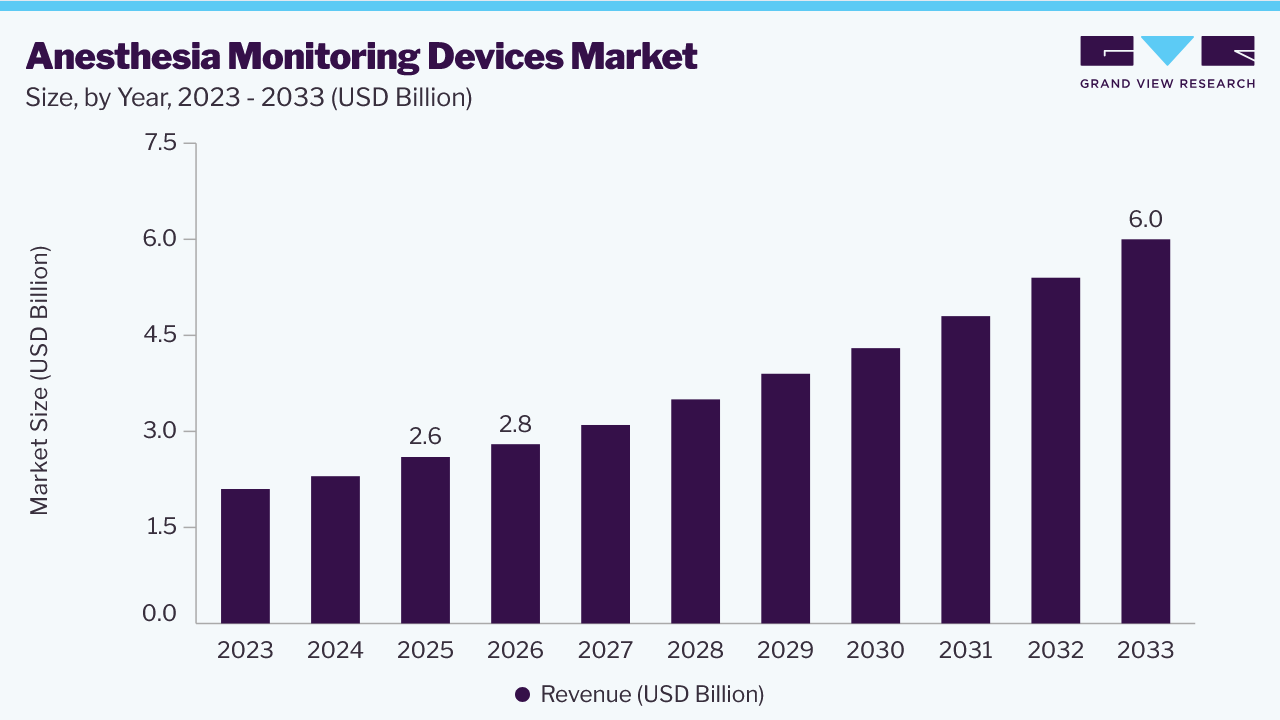 Source: Grand View Research, IR Documents, Primary Interviews, Paid DatabasesTo learn more about this report,
 Download Free Sample Report
Key Market Trends & Insights
- By product: The integrated anesthesia workstations (IAW) segment held the largest market share of over 40.0% in 2025.
- By end-use: The hospitals segment held the largest market share in 2025.
Regional Highlights
- Largest regional market: North America (36.0% revenue share, 2025)
Market Size & Forecast
- Market size in 2025: USD 2.6 Billion
- Estimated market size in 2026: USD 2.8 Billion
- Projected market size by 2033: USD 6.0 Billion
- CAGR (2026-2033): 11.2%
Three ways to get this report
Buy it, customize it, or ask a question.Ask an Analyst
Analyst response in 1 business day
- AccessReport author, directly
- Reply timeWithin 1 working day
- No sales callDirect answer only
- FormatEmail reply
- CostFree, no cost
Get the Full Report
What the study covers
- FormatsPDF · Excel · Dashboard
- Timeline2026–2033 annual, 2025 base
- Coverage20+ countries, 5 regions
- Companies10+ key players profiled
Customize the Report
20% free customization
- IncludeCountries, segments, points
- TailorTo your product definition
- ExtendDeeper competitor detail
- OrA fully bespoke study
- Turnaround5–10 working days
Furthermore, healthcare providers have increasingly prioritized patient safety, thereby significantly driving growth in the anesthesia monitoring devices market. Both medical practitioners and patients increasingly recognize the inherent risks associated with the administration of anesthesia. Modern anesthesia monitoring devices that provide detailed, continuous information on vital signs, depth of anesthesia, and other critical parameters can mitigate associated risks. They provide features such as advanced monitors that track heart rate, blood pressure, oxygen saturation, and end-tidal carbon dioxide levels.
In addition, continuous advancements in anesthesia technology contributed to the market expansion. Manufacturers have increasingly focused on developing innovative features to enhance the accuracy, usability, and data management capabilities of anesthesia monitoring devices. This included improvements in sensor technology and signal processing algorithms that led to reliable vital-sign measurements, while wireless connectivity, integration with hospital information systems, and touchscreen interfaces improved the user experience and data transfer. Such innovations resulted in more efficient, accurate patient monitoring, improved workflow efficiency, and enabled accurate, informed decision-making by specialists.
Furthermore, the rising volume of surgical procedures worldwide has substantially contributed to the growth of the anesthesia monitoring devices market. The increasing prevalence of chronic diseases such as cardiovascular disorders, cancer, and neurological conditions has led to a higher number of surgical interventions requiring anesthesia administration and continuous patient monitoring. In addition, the growing adoption of minimally invasive and outpatient surgical procedures has further increased the need for reliable anesthesia monitoring systems to ensure patient safety and optimize perioperative outcomes. This rising surgical burden has accelerated demand for advanced monitoring devices capable of delivering real-time physiological data and supporting effective clinical decision-making throughout surgical procedures.
Analyst Perspective
The anesthesia monitoring devices market is expected to grow steadily, driven by increasing surgical procedures, rising focus on patient safety, and adoption of advanced monitoring technologies. Growing healthcare infrastructure, chronic diseases, and minimally invasive surgeries are further supporting demand. Advances in real-time monitoring, AI integration, and portable devices are improving clinical efficiency and decision-making. The increasing focus on perioperative safety and precision medicine is expected to create significant opportunities for innovative, high-precision anesthesia monitoring solutions.
Product Insights
By product, the Integrated Anesthesia Workstations (IAW) segment held the largest market share of over 40.0% in 2025. The growth of this segment is driven by significant technological advancements that have made these systems more efficient and user-friendly. These advanced systems integrate multiple functions into a single platform, enabling anesthesiologists to manage anesthesia delivery, patient monitoring, and clinical workflow more effectively. Such integration minimizes manual interventions, optimizes drug administration, reduces procedural risks, and improves workflow efficiency, thereby enhancing patient safety and clinical outcomes. For instance, in October 2025, Getinge and Philips introduced an integrated anesthesia workstation solution combining Getinge’s Flow Family anesthesia machines with Philips IntelliVue patient monitoring technology. The connected platform enables real-time data exchange between anesthesia delivery and patient monitoring systems, supporting improved workflow efficiency and enhanced perioperative patient management in operating rooms.
The Advanced anesthesia monitors segment is expected to grow at the fastest CAGR over the forecast period. The market is witnessing growth owing to robust technological advancements that ensure patient safety. These monitors incorporate cutting-edge features, such as depth-of-anesthesia monitoring, goal-directed fluid therapy, and improved alarm systems. Anesthesiologists and other healthcare providers have relied heavily on these monitors for precise titration of anesthetic agents and for patient safety during surgery. Furthermore, advanced monitors provide objective pain assessment tools, allowing healthcare professionals to tailor pain management strategies effectively. These features helped reduce postoperative pain and improve patient satisfaction, thereby driving market demand.
End use Insights
The hospital segment dominated the market in 2025. As primary healthcare facilities, hospitals handle a substantial number of surgical procedures, ranging from routine to complex cases, which demand precise anesthesia monitoring methods. Furthermore, hospitals have the necessary infrastructure, skilled personnel, and financial resources to adopt and maintain anesthesia monitoring equipment. Their capacity to invest in advanced technology drives the adoption of sophisticated monitors, including integrated workstations and advanced anesthesia monitors. In addition, the growing emphasis on patient safety and perioperative risk management has encouraged hospitals to implement advanced anesthesia monitoring systems to provide continuous, real-time assessment during surgical procedures. The ongoing modernization of hospital infrastructure and the increasing integration of digital healthcare technologies have further supported the adoption of connected, data-driven anesthesia monitoring solutions, improving clinical workflows and patient outcomes.
Ambulatory surgery centers (ASCs) are projected to grow substantially at a significant CAGR over the forecast period. This can be credited to major shifts in patient preferences. Patients have increasingly favored these outpatient settings for cost-effectiveness and shorter hospital stays compared to hospitals. Moreover, ASCs handle a substantial number of surgical procedures, including both elective and minimally invasive surgeries, to prioritize patient comfort and convenience. They have increasingly integrated anesthesia monitoring devices into their workflows to streamline anesthesia delivery, monitoring, and data management. For instance, in January 2026, Mindray North America and Medtronic expanded their strategic partnership to extend advanced patient monitoring technologies beyond hospitals into ambulatory surgery centers (ASCs) across the U.S. The collaboration integrates monitoring technologies, including BIS brain monitoring, INVOS regional oximetry, capnography, and pulse oximetry into perioperative monitoring platforms.
Regional Insights
North America dominated the Anesthesia Monitoring Devices market, accounting for over 36.0% of revenue in 2025. It is attributable to the region’s highly developed healthcare infrastructure, which features numerous hospitals and surgical centers. In addition, North American healthcare facilities have emphasized patient safety during surgery, making anesthesia monitoring devices indispensable for assessing vital signs, depth of anesthesia, and patient stability. Furthermore, the growing number of surgeries and the uptake of technology have helped drive growth in this market in this region. Moreover, the presence of key medical device suppliers and ongoing technological innovation is anticipated to boost demand for anesthesia monitoring devices.
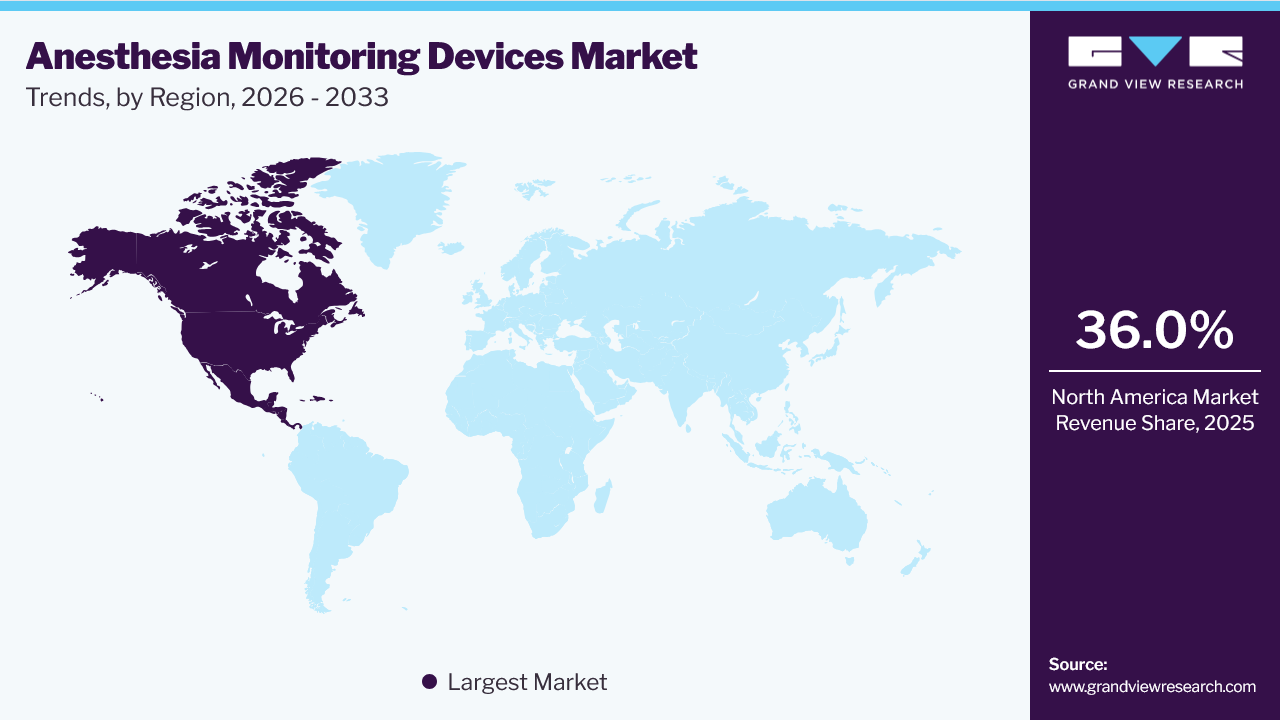 To learn more about this report, Download Free Sample Report
U.S. Anesthesia Monitoring Devices Market Trends
The U.S. anesthesia monitoring devices market dominated the North American market in 2025 due to technological advancements, robust innovation, and the use of artificial intelligence in healthcare technology. In addition, the ongoing trend towards less invasive surgery procedure has considerably increased the demand for anesthesia monitoring devices. Furthermore, the high volume of surgical procedures performed annually in the U.S., supported by the rising prevalence of chronic diseases such as cardiovascular disorders, cancer, and obesity, has significantly contributed to market growth. The presence of well-established healthcare infrastructure, favorable reimbursement frameworks, and strong healthcare expenditure has further accelerated the adoption of advanced anesthesia monitoring systems across hospitals and ambulatory surgical centers.
Europe Anesthesia Monitoring Devices Market Trends
The European anesthesia monitoring devices market secured over 32.0% of the share in 2025 owing to the rising prevalence of chronic illnesses, such as cardiovascular diseases, cancer, and diabetes. Furthermore, the European healthcare system has emphasized patient comfort, cost-effectiveness, and clinical efficiency, influencing the development of devices that can deliver advanced products and long-term economic benefits.
The UK anesthesia monitoring devices market is expected to grow rapidly in the coming years due to several government investments in upgrading medical technology, including anesthesia monitors, to improve surgical efficiency. The increased number of surgeries and the increased emphasis on patient safety are promoting the use of sophisticated anesthesia monitoring systems in hospitals.
Asia Pacific Anesthesia Monitoring Devices Market Trends
The Asia-Pacific anesthesia monitoring devices market held approximately 19.0% market share in 2025. The growth was propelled by significant government investments, which led to the introduction of new monitoring techniques, including depth-of-anesthesia monitoring, neuromuscular blockade monitoring, and integrated data management. These features enhanced patient care and safety during anesthesia administration. These factors have improved the safety and quality of patient treatment during anesthesia administration. In addition, the growing number of surgeries and the increasing demand for sophisticated healthcare solutions are other factors that will boost the use of anesthesia monitoring devices in this region. Companies are also taking significant steps to increase their services in the region. For instance, in April 2025, Dräger launched the Atlan A100 anesthesia workstation in India. The system includes advanced ventilation technologies, low-flow anesthesia capabilities, and integrated workflow features designed to improve operating room efficiency and patient safety.
Key Anesthesia Monitoring Devices Insights
Key players, including Medtronic, Philips, and others, have focused on expanding their customer base to gain a competitive edge in the industry. They have implemented several strategic initiatives, such as mergers and acquisitions, and partnerships with other major companies.
- Medtronic offers a wide range of innovative healthcare technology for the treatment of cardiac and vascular diseases and arrhythmias, helping to solve the most complex challenges. Their products treat 70 health conditions, including cardiac devices, cranial and spine robotics, insulin pumps, anesthesia monitoring aids, and surgical tools.
- Drägerwerk AG & Co. KGaA specializes in medical and safety technology; its products include anesthesia workstations, ventilators, patient monitoring systems, gas detection equipment, and personal protective equipment. Products mainly focus on patient safety and improving workflow efficiency.
Key Anesthesia Monitoring Devices Companies
The following key companies have been profiled for this study on the anesthesia monitoring devices market:
-
Medtronic
-
GE HealthCare
-
Koninklijke Philips N.V.
-
Danaher Corporation
-
Shenzhen Mindray Bio-Medical Electronics Co., Ltd.
-
Nihon Kohden Corporation
-
BD
-
Masimo.
-
Spacelabs Healthcare.
-
Penlon
Recent Developments
- In October 2025, GE HealthCare unveiled the Carestation 850 anesthesia delivery system at ANESTHESIOLOGY 2025. The system is designed to improve anesthesia delivery precision, enhance patient safety, and streamline clinical workflows in operating room settings.
- In May 2025, Mindray launched the BeneVision V Series patient monitoring solution at Euroanaesthesia 2025. The system includes advanced patient monitoring capabilities with enhanced connectivity, multimodal data integration, and improved workflow support for perioperative environments.
- In March 2024, Medtronic received FDA 510(k) clearance for the BIS Advance monitor. The device uses the clinically validated Bispectral Index (BIS) algorithm to monitor depth of anesthesia and provide clinicians with information to help personalize anesthetic dosing during surgical procedures.
Anesthesia Monitoring Devices Market Report Scope
Report Attribute
Details
Market size in 2025
USD 2.6 billion
Estimated market size in 2026
USD 2.8 billion
Projected market size by 2033
USD 6.0 billion
Growth rate
CAGR of 11.2% from 2026 to 2033
Base year for estimation
2025
Historical data
2021 – 2024
Forecast period
2026 – 2033
Quantitative units
Revenue in USD billion, and CAGR from 2026 to 2033
Report coverage
Revenue forecast, company ranking, competitive landscape, growth factors, and trends
Segments covered
Product, end use, region
Regional scope
North America; Europe; Asia Pacific; Latin America; MEA
Country scope
U.S.; Canada; Mexico Germany; UK; France; Italy; Spain; Sweden; Denmark; Norway; China; Japan; India; South Korea; Australia; Brazil; Argentina; UAE; South Africa
Key companies profiled
Medtronic; GE HealthCare; Koninklijke Philips N.V.; Danaher Corporation; Shenzhen Mindray Bio-Medical Electronics Co., Ltd.; Nihon Kohden Corporation; BD; Masimo.; Spacelabs Healthcare.; Penlon.
Customization scope
Free report customization (equivalent up to 8 analysts working days) with purchase. Addition or alteration to country, regional & segment scope.
Pricing and purchase options
Avail of customized purchase options to meet your exact research needs. Explore purchase options
Global Anesthesia Monitoring Devices Market Report Segmentation
This report forecasts revenue growth at global, regional, and country levels and provides an analysis of the latest industry trends and opportunities in each of the sub-segments from 2021 to 2033. For this study, Grand View Research has segmented the global anesthesia monitoring devices market report by product, end-use, and region:
-
Product Outlook (Revenue, USD Billion, 2021 - 2033)
-
Basic Anesthesia Monitor
-
Integrated Anesthesia Workstation
-
Advanced Anesthesia Monitor
-
Other Products
-
-
End Use Outlook (Revenue, USD Billion, 2021 - 2033)
-
Hospitals
-
Specialty Clinics
-
Ambulatory Surgery Centers
-
-
Regional Outlook (Revenue, USD Billion, 2021 - 2033)
-
North America
-
U.S.
-
Canada
-
Mexico
-
-
Europe
-
Germany
-
UK
-
France
-
Italy
-
Spain
-
Denmark
-
Sweden
-
Norway
-
-
Asia Pacific
-
China
-
Japan
-
India
-
South Korea
-
Australia
-
-
Latin America
-
Brazil
-
Argentina
-
-
Middle East and Africa (MEA)
-
Saudi Arabia
-
South Africa
-
Kuwait
-
UAE
-
-
Frequently Asked Questions About This Report
The global anesthesia monitoring devices market size was valued at USD 2.6 billion in 2025 and is estimated at USD 2.8 billion for 2026.
Key players include Medtronic; GE Healthcare; Philips Healthcare; Drägerwerk AG & Co. KGaA; Masimo Corporation; Mindray Medical International Limited; Nihon Kohden Corporation; Schiller AG; Becton, Dickinson and Company (BD)
The integrated anesthesia workstations (IAW) segment accounted for the largest revenue share of over 40.0% in 2025.
The global anesthesia monitoring devices market is expected to grow at a CAGR of 11.2% from 2026 to 2033, reaching USD 6.0 billion.
North America dominated with an over 36.0% revenue share in 2025.
About the Author(s)
Medical Devices Research Team
Healthcare · Medical DevicesThis report was authored by the medical devices research team at Grand View Research - comprising two research analysts, one senior research analyst, and one industry expert - with specialized expertise in the medical devices segment of the healthcare industry. All findings are based on proprietary healthcare databases, executive interviews, and regulatory analysis, subject to internal peer review prior to publication.
Last Updated:
Speak to Analyst

Customize this report to your needs - add regions, segments, or data points, with 20% free customization.
Or view our licence options:


ISO 9001:2015 & 27001:2022 Certified
We are GDPR and CCPA compliant! Your transaction & personal information is safe and secure. For more details, please read our privacy policy.


