
- Home
- »
- Medical Devices
- »
-
Aneurysm Clips Market Size And Share Report, 2026-2033GVR Report cover

Aneurysm Clips Market (2026 - 2033)
Size, Share & Trends Analysis Report By Material (Titanium Aneurysm Clip, Polymer), By Indication (Stroke, Cerebral Artery Stenosis, Cerebral Aneurysm), By End Use, By Region, And Segment Forecasts
Market Size, 2025
$79.2MMarket Estimate, 2026
$85.0MMarket Forecast, 2033
$139.8MCAGR, 2026–2033
7.4%Aneurysm Clips Market Summary
The global aneurysm clips market size was valued at USD 79.2 million in 2025 and is projected to grow from USD 85.0 million in 2026 to USD 139.8 million in 2033, at a CAGR of 7.4% from 2026 to 2033. North America dominated the market, accounting for the largest revenue share of 26.0% in 2025. The rising incidence of laparoscopic surgical procedures and the use of highly appropriate materials, including stainless steel alloys, pure titanium, titanium alloy, Elgiloy, and Phynox in aneurysm clips, are the factors promoting market growth.
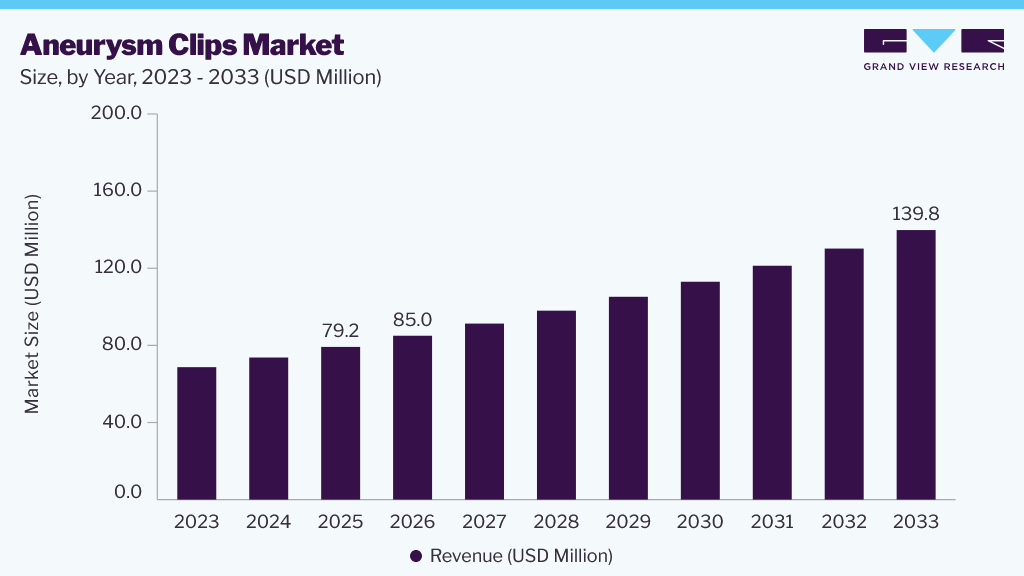 Source: Grand View Research, IR Documents, Primary Interviews, Paid DatabasesTo learn more about this report,
 Download Free Sample Report
Key Market Trends & Insights
- By material: The titanium aneurysm clips segment held the largest market share of approximately 82.0% in 2025.
- By indication: The stroke segment held the largest market share of over 57.0% in 2025.
- By end use: The hospital segment held the largest market share of approximately 66.0% in 2025.
Regional Highlights
- Largest regional market: North America (26.0% revenue share, 2025)
- Fastest-growing regional market: Asia Pacific (highest CAGR, 2026-2033)
Market Size & Forecast
- Market size in 2025: USD 79.2 Million
- Estimated market size in 2026: USD 85.0 Million
- Projected market size by 2033: USD 139.8 Million
- CAGR (2026-2033): 7.4%
Prism AI by Grand View Research Free to tryAsk a question about the aneurysm clips marketTry asking✓Every figure cited from GVR research Prefer the report? Download free sample →In addition, the market is expected to be driven by a rising geriatric population, rising incidence of intracranial aneurysm ruptures, and the accessibility of biocompatible aneurysm clips in various sizes and shapes. The global market for aneurysm clips is experiencing rapid technological advancements in portability and miniaturization, such as clip appliers and tipsters, which can be used endoscopically or laparoscopically without making significant incisions on a patient’s body surface. For instance, B. Braun's YASARGIL aneurysm clips are available in MRI-safe titanium and Phynox variants and are offered in a broad range of clip designs and appliers, enabling neurosurgeons to treat complex aneurysm anatomies with greater precision and procedural flexibility.
A rise in the prevalence of neurological disorders, such as cerebral aneurysms, epilepsy, and strokes, in several countries is expected to fuel market growth. Cerebral aneurysms are increasingly detected due to the growing use of advanced neuroimaging technologies and greater awareness of cerebrovascular diseases. According to the Brain Aneurysm Foundation, approximately 6.8 million people in the United States are estimated to have an unruptured brain aneurysm, representing about 1 in 50 individuals. In addition, around 30,000 people in the U.S. experience a brain aneurysm rupture each year. The increasing prevalence of risk factors such as hypertension, smoking, and excessive alcohol consumption contributes to the occurrence of cerebral aneurysms, thereby supporting demand for aneurysm clipping procedures and associated devices.
Furthermore, high cholesterol, diabetes, cigarette smoking, and high blood pressure increase the risk of atherosclerosis and cerebral aneurysm rupture. According to the World Health Organization, an estimated 1.4 billion adults aged 30–79 years worldwide have hypertension, a major risk factor for intracranial aneurysm development and rupture. The growing burden of hypertension and other lifestyle-related disorders is expected to increase the incidence of aneurysms globally, supporting the demand for aneurysm clips and neurosurgical interventions.
Market Dynamics
The market is experiencing steady growth, driven by the rising prevalence of intracranial aneurysms, the increasing incidence of cerebrovascular disorders, and the growing adoption of advanced neurosurgical procedures. Improved diagnostic capabilities through MRI, CT angiography (CTA), and magnetic resonance angiography (MRA) are enabling earlier detection of both ruptured and unruptured aneurysms, thereby increasing the number of patients eligible for surgical intervention. In addition, technological advancements in MRI-compatible titanium clips, low-artifact clip designs, and precision microsurgical instruments are improving treatment outcomes and encouraging adoption across hospitals and neurosurgical centers. Growing healthcare expenditure, expansion of neurosurgical infrastructure, and increasing awareness of stroke prevention further support market growth.
The rising incidence of cerebral aneurysms, hypertension, smoking-related vascular diseases, and aging populations is increasing demand for aneurysm clipping procedures. According to the Brain Aneurysm Foundation, aneurysm rupture occurs in approximately 8–10 per 100,000 people annually, creating sustained demand for effective surgical treatment solutions. Advancements in diagnostic imaging technologies, including computed tomography angiography (CTA), magnetic resonance angiography (MRA), and digital subtraction angiography (DSA), have improved detection rates for both ruptured and unruptured aneurysms. Earlier diagnosis enables clinicians to evaluate patients for preventive treatment options, including microsurgical clipping.
As healthcare systems expand neurovascular screening programs and improve access to specialized care, the number of patients undergoing aneurysm clipping procedures is expected to rise steadily, supporting market growth. Additionally, the growing adoption of advanced diagnostic imaging technologies, such as computed tomography angiography (CTA) and magnetic resonance angiography (MRA), is enabling earlier detection of cerebral aneurysms, thereby increasing the pool of patients eligible for surgical intervention.
Aneurysm clipping is a highly specialized procedure that requires experienced neurosurgeons, advanced operating microscopes, neuro-navigation systems, and dedicated neurovascular facilities. Many low- and middle-income countries continue to face shortages of trained neurosurgical professionals and limited access to sophisticated surgical infrastructure. These limitations restrict the availability of clipping procedures and reduce the adoption of aneurysm clip products in underserved regions.
Moreover, the high cost of establishing and maintaining neurosurgical centers poses challenges for healthcare providers operating under constrained budgets. Hospitals must invest substantially in equipment, staff training, and postoperative intensive care capabilities to support aneurysm clipping procedures. Consequently, patients in many regions face limited access to advanced neurovascular care, creating barriers to market growth despite the rising incidence of aneurysm-related disorders. For instance, according to the World Federation of Neurosurgical Societies, low- and middle-income countries continue to experience significant shortages of neurosurgeons, with many regions having fewer than one neurosurgeon per 100,000 people, limiting access to advanced procedures such as aneurysm clipping.
The growing integration of artificial intelligence (AI) into neuroimaging and clinical decision-making is creating significant market opportunities. AI-powered tools can analyze CT angiography (CTA), MR angiography (MRA), and MRI scans with high accuracy, helping radiologists identify small or difficult-to-detect aneurysms at earlier stages. Early detection increases the number of patients diagnosed before aneurysm rupture, enabling physicians to consider preventive treatment options, such as surgical clipping. As healthcare providers seek to improve diagnostic efficiency and reduce missed diagnoses, AI-enabled screening solutions are expected to become integral to neurovascular care.
In addition, AI is increasingly used for patient monitoring, risk stratification, and follow-up management of unruptured aneurysms. These technologies help healthcare providers identify high-risk patients more effectively and ensure timely intervention. As AI-supported neurovascular workflows expand across hospitals and imaging centers, the number of patients referred for aneurysm treatment procedures is expected to rise, creating long-term growth opportunities for aneurysm clip manufacturers. In November 2025, the Radiological Society of North America announced the results of its 2025 intracranial aneurysm detection AI Challenge, which drew more than 1,147 teams worldwide to develop AI models that detect aneurysms across CTA, MRA, and MRI scans. The initiative reflects growing industry investment in AI-assisted aneurysm diagnosis and screening.
Analyst Perspective
The market sits at the intersection of several long-term growth drivers, including the rising prevalence of intracranial aneurysms, the growing burden of cerebrovascular diseases, and ongoing advances in neurosurgical technologies. As healthcare systems expand access to specialized neurovascular care and adopt advanced imaging modalities for earlier diagnosis, the number of patients eligible for aneurysm intervention is expected to increase steadily. The competitive advantage will increasingly favor manufacturers that combine innovative clip designs, MRI compatibility, surgical precision, and integration with advanced visualization and microsurgical platforms. As treatment outcomes and procedural efficiency become key priorities for healthcare providers, companies offering comprehensive, technologically advanced aneurysm-clipping solutions will be best positioned to capture long-term market growth.
Material Insights
The titanium aneurysm clip segment dominated the market with approximately 82.0% market share in 2025 and is anticipated to grow at the highest CAGR in the forecast period. The features of titanium aneurysm clips include inertness, durability, high tensile strength, nonreactivity, and light weight. The compatibility with imaging modalities, namely MRI, CT, and X-rays, along with its ability to secure the closure of delicate vessels during procedures, makes it a preferred option as surgical equipment, thereby driving the segment growth. Furthermore, compared to other materials, titanium aneurysm clips have minimal interference with MRI and CT (tomography) scans.
According to the Brain Aneurysm Foundation, titanium clips are generally preferred because they are MRI-compatible and do not trigger metal detector alarms. In the field of medical equipment, titanium and its alloys are widely used due to their high biocompatibility. According to an article published by Medical Device News Magazine in September 2024, researchers from Kyungpook National University developed and evaluated a novel ceramic aneurysm clip integrated with a titanium spring. The study demonstrated that the titanium-based design provided reliable closing force, enhanced durability, and superior MRI compatibility with reduced imaging artifacts compared to conventional titanium alloy clips.
Indication Insights
The stroke segment dominated the market with a share of over 57.0% in 2025, owing to factors such as rising stroke prevalence, hypertension, and various other neurological disorders. According to the World Stroke Organization, stroke remains one of the leading causes of death and long-term disability worldwide, with more than 12 million new stroke cases occurring annually and over 100 million people living with the effects of stroke globally. The growing burden of stroke, particularly among aging populations and individuals with hypertension, diabetes, and cardiovascular diseases, continues to drive demand for neurovascular interventions, including aneurysm clipping procedures.
The cerebral aneurysm segment is anticipated to grow at the highest CAGR during the forecast period, primarily due to the rising incidence of intracranial aneurysms. Moreover, increasing demand for minimally invasive neurosurgical procedures and the adoption of advanced surgical technologies are supporting segment growth. Furthermore, growing clinical evidence continues to support the effectiveness of microsurgical clipping in achieving durable aneurysm occlusion. For instance, a 2024 international study published in the journal Neurosurgery established global benchmarks for outcomes following microsurgical clipping of unruptured intracranial aneurysms, highlighting the procedure's continued importance in aneurysm management and reinforcing demand for aneurysm clips in specialized neurosurgical centers.
End Use Insights
The hospital segment dominates the aneurysm clip market, accounting for approximately 66.0% of revenue in 2025. This is attributed to the rising number of surgical procedures, such as abdominal and neurosurgical laparoscopy, and the growing frequency of trauma. In developed countries, insurance companies pay for medical expenditures, including ligature costs. The rise in surgical procedures performed in hospitals equipped with clipping equipment has, as a result, a favorable effect on the segment's growth.
Ambulatory surgical centers (ASCs) are expected to have the highest CAGR during the forecast period. This can be attributed to lower out-of-pocket expenses, reduced facility costs, and better patient accessibility. Most of the Middle Eastern and Asian countries still lack the economic or infrastructure capacity to establish ambulatory centers; however, they are working towards this goal to minimize the burden of surgical operations in hospitals. In addition, ongoing advancements in minimally invasive neurosurgical techniques and improvements in perioperative care are enabling more procedures to be performed in outpatient settings, further supporting the adoption of ambulatory surgical centers for neurovascular interventions.
Regional Insights
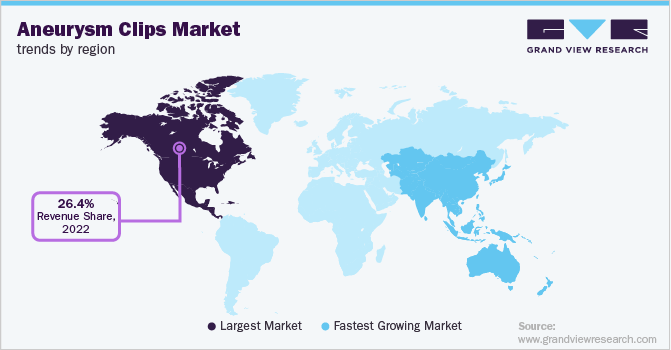
North America dominated the aneurysm clips market, accounting for over 26.0% of revenue in 2025. The rising prevalence of neurological disorders and the increasing demand for minimally invasive surgical procedures are driving market growth in this region. For instance, according to the CDC, in the US, more than 795,000 people suffer from stroke, with 87% identified as ischemic stroke.
 To learn more about this report, Download Free Sample Report
U.S. Aneurysm Clips Market Trends
The aneurysm clips market in the U.S. is growing significantly as an increasing number of initiatives are undertaken by various organizations. For instance, the Bee Foundation (TBF), a nonprofit organization, focuses on raising awareness and reducing deaths from cerebral aneurysms through innovative research. In September 2025, the Brain Aneurysm Foundation launched awareness initiatives during Brain Aneurysm Awareness Month to promote early diagnosis, patient education, and research funding for cerebral aneurysm treatment. Such initiatives are expected to support the adoption of neurovascular treatment procedures nationwide.
Asia Pacific Aneurysm Clips Market Trends
The aneurysm clips market in the Asia Pacific is anticipated to witness the fastest growth rate over the forecast period owing to factors such as the rising target disease burden, growing geriatric population, rising unhealthy lifestyle among youngsters, and increasing incidence of acute ischemic stroke. According to the Asian Development Bank's 2026 policy brief, Turning the Tide on Stroke in Asia and the Pacific, the Asia-Pacific region accounts for more than half of the global stroke burden. The increasing prevalence of cerebrovascular diseases across major countries such as China and India is expected to drive demand for aneurysm diagnosis and neurovascular interventions, supporting market growth in the region. In addition, emerging economies such as China, South Korea, and India are expected to witness considerable growth over the forecast period. Furthermore, the establishment of organizations such as the Asia-Pacific Center for Neuromodulation (APCN), founded to conduct research and raise awareness of the benefits of deep brain stimulation surgeries, is anticipated to boost market growth.
Key Aneurysm Clips Company Insights
Companies are focusing on developing novel medical devices, expanding, and pursuing technological innovations. Moreover, mergers and acquisitions for new product development and strengthening supply chain networks are among the strategic initiatives implemented by major players.
Key Aneurysm Clips Companies Insights
The following key companies have been profiled for this study on the aneurysm clips market:
- Aesculap, Inc. - a B. Braun company
- Rebstock Instruments GmbH
- Mizuho
- Adeor Medical AG
- Integra LifeSciences Corporation
- Lazic GmbH
- KLS Martin Group
- Shenzhen YKD Technology Co., Ltd.
- NARISHIGE Group
- Medicon eG.
Recent Developments
-
In September 2025, B. Braun SE acquired True Digital Surgery, a specialist in robotic-assisted 3D digital microscopy. The acquisition strengthened B. Braun’s Aesculap neurosurgery portfolio and expanded its capabilities in advanced microsurgical visualization technologies used in neurosurgical and cerebrovascular procedures, including aneurysm clipping.
-
In September 2024, Integra LifeSciences Corporation Holdings Corporation announced the acquisition of Acclarent from Johnson & Johnson for approximately USD 275 million. The acquisition expanded Integra’s portfolio of surgical technologies and strengthened its position in specialty surgical markets, supporting the company’s broader neurosurgery and cranial care business segments.
Aneurysm Clips Market Report Scope
Report Attribute
Details
Market size in 2025
USD 79.2 million
Estimated market size in 2026
USD 85.0 million
Projected market size by 2033
USD 139.8 million
Growth rate
CAGR of 7.4% from 2026 to 2033
Base year estimation
2025
Actual data
2021 – 2024
Forecast period
2026 – 2033
Quantitative units
Revenue in USD million, volume in kilotons, and CAGR from 2026 to 2033
Report coverage
Revenue forecast, company ranking, competitive landscape, growth factors, and trends
Segments covered
Material, indication, end use, region
Regional scope
North America; Europe; Asia Pacific; Latin America; MEA
Country scope
U.S.; Canada; UK; Germany; France; Italy; Spain; Denmark; Sweden; Norway; Japan; China; India; Australia; South Korea; Thailand; Brazil; Mexico; Argentina; South Africa; Saudi Arabia; UAE; Kuwait
Key companies profiled
Aesculap, Inc. - a B. Braun company; Rebstock Instruments GmbH; Mizuho; Adeor Medical AG; Integra LifeSciences Corporation; Lazic GmbH; KLS Martin Group; Shenzhen YKD Technology Co., Ltd.; NARISHIGE Group.; Medicon eG.
Customization scope
Free report customization (equivalent up to 8 analysts working days) with purchase. Addition or alteration to country, regional & segment scope.
Pricing and purchase options
Avail of customized purchase options to meet your exact research needs. Explore purchase options
Global Aneurysm Clips Market Segments
This report forecasts revenue growth and provides an analysis of the latest trends in each of the sub-segments from 2021 to 2033. For this study, Grand View Research has segmented the global aneurysm clips market based on material, indication, end use, and region:
-
Material Outlook (Revenue, USD Million, 2021 - 2033)
-
Titanium Aneurysm Clips
-
Polymer
-
Others
-
-
Indication Outlook (Revenue, USD Million, 2021 - 2033)
-
Stroke
-
Cerebral Artery Stenosis
-
Cerebral Aneurysm
-
Others
-
-
End Use Outlook (Revenue, USD Million, 2021 - 2033)
-
Hospitals
-
Ambulatory Surgical Centers
-
Others (Clinics, Neurology Centers)
-
-
Regional Outlook (Revenue, USD Million, 2021 - 2033)
-
North America
-
U.S.
-
Canada
-
-
Europe
-
UK
-
Germany
-
France
-
Italy
-
Spain
-
Denmark
-
Sweden
-
Norway
-
-
Asia Pacific
-
Japan
-
China
-
India
-
Australia
-
South Korea
-
Thailand
-
-
Latin America
-
Brazil
-
Mexico
-
Argentina
-
-
Middle East & Africa
-
South Africa
-
Saudi Arabia
-
UAE
-
Kuwait
-
-
Frequently Asked Questions About This Report
The global Aneurysm clips market size was valued at USD 79.2 million in 2025 and is estimated at USD 85.0 million for 2026.
Some of the key players operating in the aneurysm clips market include Aesculap, Inc. – Aesculap, Inc. – a B. Braun company, Datenschutz/Rebstock Instruments GmbH, Mizuho Medical Co., Ltd., Adeor Medical AG, and Integra LifeSciences
The global Aneurysm clips market is expected to grow at a CAGR of 7.4% from 2026 to 2033, reaching USD 139.8 million by 2033.
North America dominated with a revenue share of 26.0% in 2025.
The titanium segment accounted for the largest revenue share, approximately 82.0% in 2025.
About the Author(s)
Medical Devices Research Team
Healthcare · Medical DevicesThis report was authored by the medical devices research team at Grand View Research - comprising two research analysts, one senior research analyst, and one industry expert - with specialized expertise in the medical devices segment of the healthcare industry. All findings are based on proprietary healthcare databases, executive interviews, and regulatory analysis, subject to internal peer review prior to publication.
Last Updated:
Speak to Analyst

Customize this report to your needs - add regions, segments, or data points, with 20% free customization.
Or view our licence options:


ISO 9001:2015 & 27001:2022 Certified
We are GDPR and CCPA compliant! Your transaction & personal information is safe and secure. For more details, please read our privacy policy.


