
- Home
- »
- Semiconductors
- »
-
Application Specific Integrated Circuit Market Report, 2033GVR Report cover

Application Specific Integrated Circuit Market (2026 - 2033)
Size, Share & Trends Analysis Report By Product (Full Custom, Semi-Custom, Programmable), By Application (Telecommunication, Industrial, Automotive, Consumer Electronics), By Region, And Segment Forecasts
Market Size, 2025
$18.7BMarket Estimate, 2026
$19.8BMarket Forecast, 2033
$30.3BCAGR, 2026–2033
6.3%Application Specific Integrated Circuit Market Summary
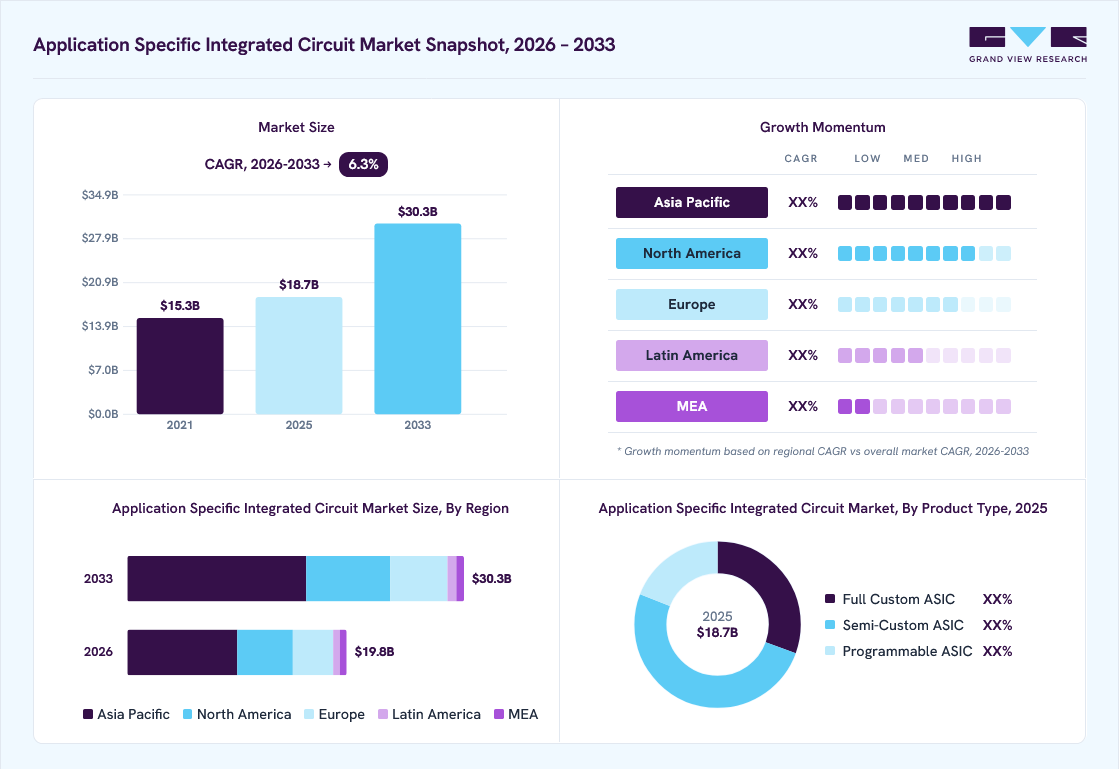
The global application specific integrated circuit market size was valued at USD 18.7 billion in 2025 and is projected to grow from USD 19.8 billion in 2026 to USD 30.3 billion by 2033, growing at a CAGR of 6.3% from 2026 to 2033. Asia Pacific dominated the global market, accounting for the largest revenue share of 49.7% in 2025. The region's dominance is primarily attributed to the presence of a strong semiconductor manufacturing ecosystem across China, Taiwan, South Korea, Japan, and India, supported by substantial investments in chip fabrication and packaging facilities.
 Source: Grand View Research, IR Documents, Primary Interviews, Paid DatabasesTo learn more about this report,
 Download Free Sample Report
 Key Market Trends & Insights
- By product: Semi-custom ASIC segment held the largest share of 50.3% in 2025.
- By application: Consumer electronics segment held the largest share of 36.4% in 2025.
Regional Highlights
- Largest regional market: Asia Pacific (49.7% revenue share, 2025)
- By country: China held the largest market share in 2025.
Market Size & Forecast
- Market size in 2025: USD 18.7 Billion
- Estimated market size in 2026: USD 19.8 Billion
- Projected market size by 2033: USD 30.3 Billion
- CAGR (2026-2033): 6.3%
Three ways to get this report
Buy it, customize it, or ask a question.Ask an Analyst
Analyst response in 1 business day
- AccessReport author, directly
- Reply timeWithin 1 working day
- No sales callDirect answer only
- FormatEmail reply
- CostFree, no cost
Get the Full Report
What the study covers
- FormatsPDF · Excel · Dashboard
- Timeline2026–2033 annual, 2025 base
- Coverage20+ countries, 5 regions
- Companies10+ key players profiled
Customize the Report
20% free customization
- IncludeCountries, segments, points
- TailorTo your product definition
- ExtendDeeper competitor detail
- OrA fully bespoke study
- Turnaround5–10 working days
Rapid adoption of consumer electronics, smartphones, automotive electronics, industrial automation, and AI-enabled devices is driving demand for customized integrated circuits. The global market is poised to experience a surge in demand primarily driven by the increasing utilization of Application-Specific Integrated Circuits (ASICs) in consumer electronics, including smartphones, smartwatches, and tablets, among other devices. The growing demand for tailored solutions that deliver maximum performance for specific applications has led to a rise in demand for ASICs. Industries are opting for ASICs to achieve optimal efficiency, speed, and reliability, which general-purpose chips cannot offer.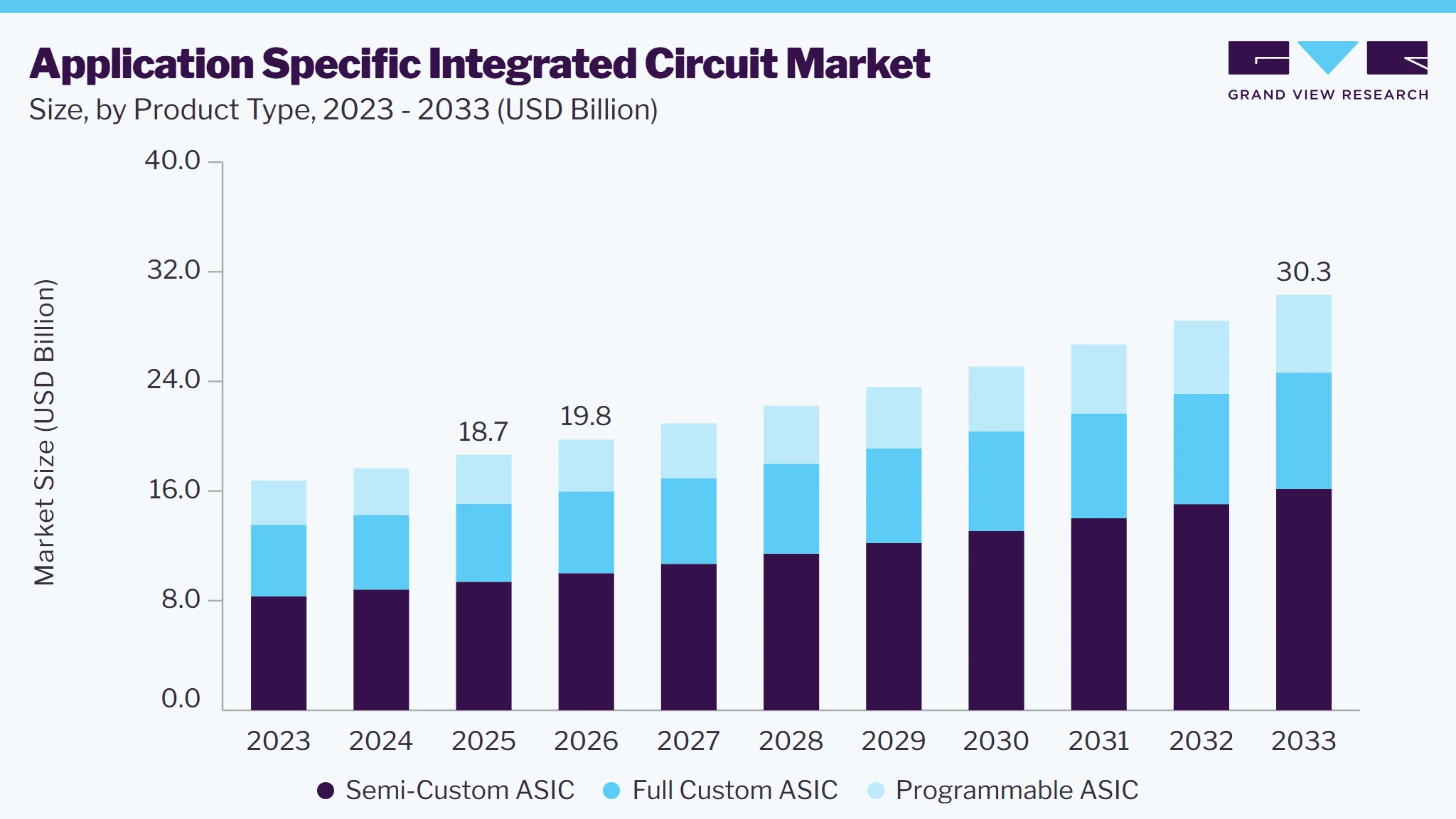 To learn more about this report, Download Free Sample Report
 The rapidly growing demand for smartphones and tablets is expected to drive market growth over the forecast period. According to GVR analysis, approximately 75% of the total mobile phone owners will own a smartphone by 2025. ASICs help in providing the high-bandwidth, smaller size & weight, low-cost, and long battery life requirements of next-generation smartphones. Also, with the advent of ‘smart’ devices, electrical products such as televisions, laptops, wearables, digital cameras, and gaming consoles offers various advanced technologies such as touch screen displays, flat screens, and Bluetooth functions are generating a demand for a larger number of ICs. Furthermore, due to the constantly growing adoption of mechatronics across industrial and automotive applications, the demand for electronic components with ASICs has witnessed massive growth over the forecast period.
Governments across the globe are investing heavily in semiconductor manufacturing to support ASIC production. For instance, the U.S. government’s CHIPS Act, passed in 2022, has allocated over USD 52 billion to semiconductor research and development, which is expected to benefit the ASIC sector significantly by encouraging domestic manufacturing and reducing dependency on overseas production. Furthermore, the automotive sector, particularly in North America and Europe, has seen significant investments in autonomous and electric vehicles. ASICs, with their low-power and application-specific features, are essential in processing data from sensors and ensuring energy efficiency in EVs, driving growth in this sector.
As the demand for compact devices increases, there is a shift towards smaller technology nodes in ASIC manufacturing. Such as 5nm and 3nm. This miniaturization allows for more powerful and efficient ASICs, as smaller nodes increase transistor density, leading to higher performance and energy efficiency. Moreover, 3D stacking and heterogeneous integration have become prominent technology trends in ASIC manufacturing. 3D stacking enables designers to place multiple layers of circuits on a single chip, improving performance and reducing latency. Heterogeneous integration allows for the contribution of different components on the same chip, supporting multifunctional applications in compact devices.
On the other hand, factors such as the high cost of manufacturing customized circuits, circuit designing costs, and functional reliability issues are anticipated to hinder market growth over the years. However, with technological advancements such as Internet of Things (IoT), blockchain, big data analytics, and machine learning, the unit cost for ASICs has been declining, which in turn led to a positive impact on the market across the globe. The above-mentioned advancements are being extensively used in connected devices, data center facilities, and public clouds that allow organizational data to move faster across the IT network. Thus, organizations are incorporating these ICs to support the functioning of advanced technologies in devices, resulting in less operational cost. Also, the continuous evolution of the electronics industry is generating a constant need for improvement in ASIC designs to cater to users’ exact requirements.
Market Dynamics
The Application Specific Integrated Circuit (ASIC) Market is witnessing significant growth, driven by the increasing demand for customized semiconductor solutions across consumer electronics, automotive, telecommunications, industrial automation, and data center applications. ASICs offer enhanced performance, lower power consumption, and higher integration compared to general-purpose integrated circuits, making them critical for emerging technologies such as artificial intelligence (AI), 5G, Internet of Things (IoT), and advanced driver-assistance systems (ADAS). Growing investments in semiconductor manufacturing and the rising need for application-specific processing capabilities are further accelerating market expansion.
The Application Specific Integrated Circuit Market is primarily driven by the growing deployment of AI workloads, 5G infrastructure, and high-performance computing systems that require highly optimized and energy-efficient chips. ASICs are increasingly being used in smartphones, networking equipment, cryptocurrency mining hardware, data centers, and automotive electronics due to their superior processing speed and lower power consumption. The proliferation of connected devices and increasing demand for customized semiconductor architectures are encouraging companies to develop application-specific chips tailored to particular functions. In addition, advancements in autonomous vehicles, edge computing, and machine learning accelerators are contributing to sustained market growth.
Despite strong growth prospects, the Application Specific Integrated Circuit Market faces challenges associated with high design and fabrication costs. Developing ASICs requires substantial investments in research and development, specialized design tools, and advanced manufacturing processes, which can limit adoption among smaller companies. Additionally, semiconductor supply chain disruptions, geopolitical tensions, and shortages of critical materials and wafer fabrication capacity can affect production schedules and increase manufacturing costs. The complexity of chip design and longer product development cycles also pose barriers to rapid market expansion.
The increasing integration of advanced electronics in vehicles and the rapid emergence of edge AI technologies present substantial opportunities for the Application Specific Integrated Circuit Market. Growing adoption of electric vehicles (EVs), autonomous driving systems, and ADAS is creating strong demand for customized chips capable of delivering high computational performance with low power consumption. Furthermore, the proliferation of edge devices, smart factories, and IoT ecosystems is driving the need for specialized processors optimized for real-time analytics and machine learning tasks. Government initiatives supporting domestic semiconductor production and increasing investments in next-generation chip technologies are expected to create lucrative growth opportunities throughout the forecast period.
Market Concentration & Characteristics
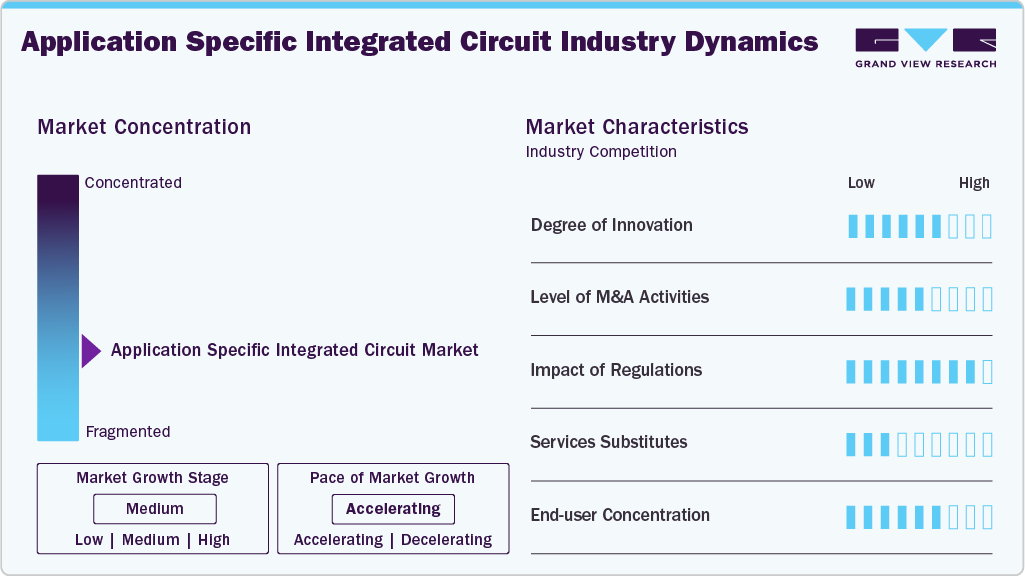
The Application Specific Integrated Circuit (ASIC) Market is moderately concentrated, with a mix of large global semiconductor companies and specialized ASIC design and manufacturing firms competing based on technological expertise, product performance, power efficiency, customization capabilities, and process node advancements. Market participants are increasingly investing in AI accelerators, automotive semiconductor solutions, edge computing processors, and high-speed networking chips to address the growing demand for application-specific processing. Strategic collaborations with foundries, expansion of design capabilities, and continuous innovation in low-power and high-performance architectures are key competitive factors shaping the market.
 To learn more about this report, Download Free Sample Report
 Key market participants include Broadcom Inc., STMicroelectronics, Faraday Technology Corporation, FUJITSU, Infineon Technologies AG, Comport Data, Intel Corporation, ASIX Electronics, OmniVision Technologies, Inc., Semiconductor Components Industries, LLC, Seiko Epson Corporation, DWIN Technology, Socionext America Inc., and Tekmos Inc. These companies are focusing on product innovation, advanced semiconductor technologies, strategic partnerships, and investments in next-generation ASIC solutions to strengthen their market position and capitalize on the increasing demand from consumer electronics, automotive, industrial automation, telecommunications, and data center applications.
Analyst Perspective
The Application Specific Integrated Circuit (ASIC) Market is driven by rising demand for high-performance, energy-efficient, and application-specific semiconductor solutions across telecommunications, automotive, consumer electronics, industrial automation, and data centers. Advancements in AI, 5G, edge computing, autonomous systems, and cloud infrastructure are increasing demand for specialized silicon architectures. Growing adoption of connected and electric vehicles, AI accelerators, network processors, image sensors, and customized computing platforms is further supporting market expansion. ASICs enable faster processing, lower latency, reduced power consumption, and improved system integration, strengthening their role in next-generation electronic systems.
Product Insights
Based on product, the semi-custom ASIC segment led the market with the largest revenue share of 50.3% in 2025. This growth can be attributed to its comparatively lower complexity and extensive range of applications in comparison to the other segments. Manufacturers in the ASIC market predominantly offer three distinct types of ASICs: semi-custom ASIC, full custom ASIC, and programmable ASIC. Within the semi-custom ASIC category, there are two sub-segments: cell-based ASIC and array-based ASIC.
Moreover, within the semi-custom ASIC segment, the cell-based ASIC sub-category held the largest share, accounting for more than 71.1% of the market in 2025. This can be attributed to its digital-logic and electrical features, which encompass attributes like inductance and capacitance. Such features enable improved electrical performance and high component density. In addition, cell-based ASICs offer versatility and can be utilized across various products, regardless of design complexity, owing to the integration of advanced static random-access memory and internet protocol cores, facilitating seamless system functionality.
The full custom ASIC segment is projected to register a considerable growth rate during the forecast period. These ICs deliver enhanced speed and reliability, accompanied by intellectual property protection, while consuming a lesser amount of electrical power. Designers benefit from the ability to customize logic cells, layouts, mechanical structures, and circuits and optimize memory cells on the IC, thereby reducing processing time and mitigating risks. However, the manufacturing time for full custom ASICs is comparatively longer, taking approximately eight weeks for a specific application, as opposed to semi-custom ASICs.
Application Insights
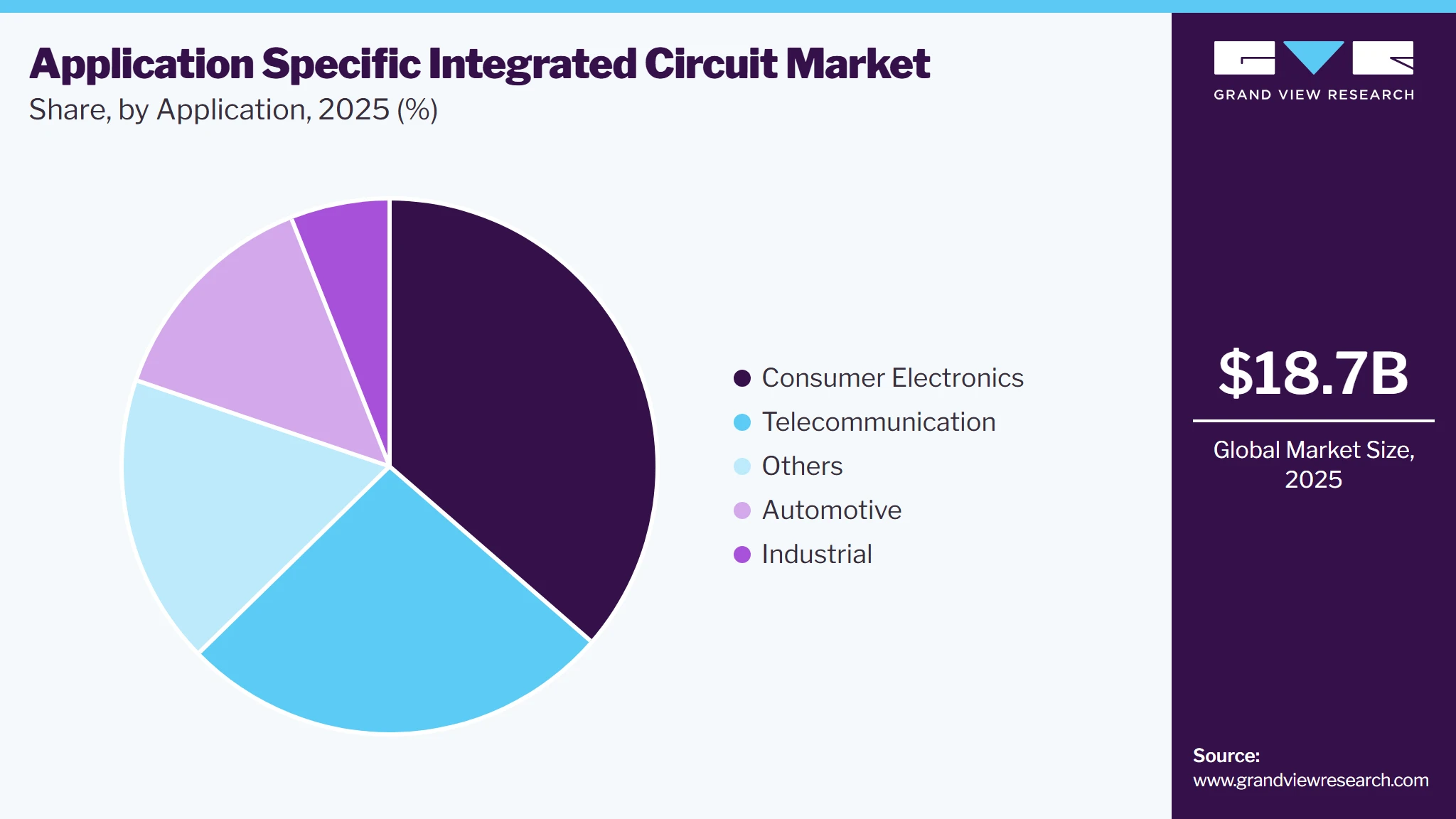
Based on the application, the consumer electronics segment led the market with the largest revenue share of 36.4% in 2025. The segment is poised to present lucrative growth prospects for all stakeholders within the value chain, primarily driven by the escalating utilization of Application-Specific Integrated Circuits (ASICs) in smartphones, tablets, and laptops worldwide. ASICs offer many advantages, including low power consumption, IP security, compact size, and enhanced bandwidth, thus fostering widespread adoption in the consumer electronics industry. Furthermore, the rapid advancements in electronic devices have enabled heightened stability and energy efficiency, further fueling the growth of the application-specific integrated circuit (ASIC) market. Beyond the consumer electronics vertical, these ICs find extensive applications across various sectors, such as telecommunications, industrial, and healthcare.
 To learn more about this report, Download Free Sample Report
 The industrial segment of the ASIC market is expected to witness considerable growth over the forecast period. ASIC chips replace traditional components such as solder joints, and PCB traces with one IC, which in turn helps to reduce the chances of failure and offer reliable industrial systems. Furthermore, the increasing adoption of various components such as programmable timers, microcontrollers, and thermal controllers in industrial applications is propelling the market growth. Besides, numerous manufacturers in the market offer IC chips specifically designed for industrial usage. For instance, Custom Silicon Solutions, Inc., a semiconductor company offering custom "Mixed Signal" technology. The company’s CSS555C industrial ASIC is an improved version of its 555 timers. This CSS555C industrial ASIC draws 10 percent less power than other 555 timer devices.
Regional Insights
North America application specific integrated circuit market is expected to grow at a CAGR of 6.1% during the forecast period. The growth is attributed to the significant presence of prominent players in the region, including Maxim Integrated Products Inc., Qualcomm Inc., Intel Corporation, and Texas Instruments Inc., among others. Furthermore, companies, particularly in the tech industry, are using ASICs for AI applications, where custom circuits provide the processing power and efficiency needed for real-time data analysis, predictive modeling, and machine learning.
U.S. Application-Specific Integrated Circuit Market Trends
The U.S. has remained at the forefront of ASIC innovation, primarily due to its robust technology sector and strong semiconductor manufacturing capabilities. With a growing focus on AI, IoT, and electric vehicles, U.S. companies are increasingly adopting ASICs to meet specific performance and power requirements. The demand for custom ASICs in advanced driver assistance systems (ADAS) and electric vehicle battery management is also gaining traction, positioning the U.S. as a significant country in automotive-specific ASIC applications.
Asia Pacific Application-Specific Integrated Circuit Market Trends
Asia Pacific dominated the application specific integrated circuit market with the largest revenue share of 49.7% in 2025. The application specific integrated circuit market in the China held the largest share in the Asia Pacific region in 2025. The regional growth can be attributed to several key factors propelling the demand for ASICs in the region. The growing need for energy-efficient devices is driven by the region's rapid economic growth and increasing industrialization. Moreover, the proliferation of smartphones in the Asia Pacific region has contributed significantly to market expansion. The rising penetration of these devices, especially in developing economies such as China, Japan, and India, has created a conducive environment for ASIC market growth. In addition, factors such as the ongoing process of digitization, the increasing adoption of high-tech gadgets, advancements in automotive electronics, and a rising demand for miniaturization have collectively bolstered the market.
 To learn more about this report, Download Free Sample Report
 Key Application Specific Integrated Circuit Company Insights
Some of the key players operating in the market include Broadcom, Inc., Intel Corporation, STMicroelectronics N.V., and Seiko Epson Corporation, among others.
-
Broadcom Inc. (Broadcom) is a technology firm specializing in the design, development, and provision of a diverse range of semiconductor and infrastructure software solutions. The company’s product lineup encompasses storage adapters, controllers, ICs, wireless and wired products, and optical products. In addition, it provides mainframe and enterprise software, along with cybersecurity software, focusing on automation, systematic cybersecurity, and factory automation. The company distributes its offerings through an extensive network, including distributors, contract manufacturers, original equipment manufacturers, and a direct sales force. It has a global business presence, spanning North America, Asia, Europe, the Middle East, and Africa.
DWIN Technology, Socionext America Inc., and Comport Data are some of the emerging market participants in the target market.
-
Socionext America Inc. is specializing in the design, development, and delivery of System-on-Chip (SoC) products. With a focus on innovation and customer-centricity, the company consistently strives to pioneer groundbreaking solutions that anticipate and address evolving market demands. Leveraging its expertise and commitment to excellence, the company is engaged in providing customers with cutting-edge SoC products tailored to meet future needs and expectations.
Key Application Specific Integrated Circuit Companies:
The following key companies have been profiled for this study on the application specific integrated circuit market.
-
Broadcom Inc.
-
STMicroelectronics
-
Faraday Technology Corporation
-
FUJITSU
-
Infineon Technologies AG
-
Comport Data
-
Intel Corporation
-
ASIX Electronics
-
OmniVision Technologies, Inc.
-
Semiconductor Components Industries, LLC
-
Seiko Epson Corporation
-
DWIN Technology
-
Socionext America Inc.
-
Tekmos Inc.
Competitive Benchmarking
Category
Operating Strategies
Competitive Edge
Weakness
Established Players: Broadcom Inc.; Intel Corporation; Infineon Technologies AG; STMicroelectronics; FUJITSU; Socionext America Inc.
- Focus on expanding ASIC portfolios across telecommunications, automotive, industrial automation, AI accelerators, data centers, and consumer electronics.
- Emphasize advanced process technologies, strategic partnerships with foundries and OEMs, investments in custom silicon design capabilities, and development of energy-efficient and high-performance ASIC solutions to strengthen market leadership.
- Strong global brand recognition, extensive R&D capabilities, broad product portfolios, established relationships with OEMs and foundries, advanced semiconductor design expertise, diversified customer bases, and strong presence across multiple end-use industries.
- High R&D and manufacturing costs, dependence on external foundries, exposure to semiconductor supply chain disruptions, rapid technological advancements, pricing pressure, and challenges associated with shrinking process nodes and increasing design complexity.
Emerging Players: Faraday Technology Corporation; ASIX Electronics; OmniVision Technologies, Inc.; Semiconductor Components Industries, LLC; Seiko Epson Corporation; Tekmos Inc.; DWIN Technology; Comport Data
- Focus on specialized ASIC solutions, niche applications, and regional market expansion. Invest in customized IC design services, image sensing, industrial electronics, connectivity solutions, and strategic collaborations with fabless companies and OEMs to enhance market penetration and technology capabilities.
- Strong flexibility, specialized expertise, faster design cycles, focused customer support, ability to address application-specific requirements, and agility in serving niche semiconductor markets.
- Limited global presence, smaller customer bases, lower economies of scale, narrower product portfolios, resource constraints compared with larger semiconductor manufacturers, and challenges in scaling operations and competing with established industry leaders.
Recent Developments
-
In October 2024, OpenAI, an artificial intelligence company, partnered with Broadcom, Inc., a provider of ASICs, to develop an artificial intelligence chip to enhance the efficiency of AI model inference.
-
In July 2023, Faraday Technology Corporation announced the launch of SerDes total solution. The newly launched solution comprises the SerDes IP design on UMC 28nm and the corresponding IP Advanced (IPA) service. In addition, it is designed to accelerate customer integration.
Application Specific Integrated Circuit Market Report Scope
Report Attribute
Details
Market size value in 2025
USD 18.7 billion
Market size value in 2026
USD 19.8 billion
Revenue forecast in 2033
USD 30.3 billion
Growth rate
CAGR of 6.3% from 2026 to 2033
Base year for estimation
2025
Historical data
2021 - 2024
Forecast period
2026 - 2033
Quantitative units
Revenue in USD billion/billion, and CAGR from 2026 to 2033
Report coverage
Revenue forecast, company ranking, competitive landscape, growth factors, and trends
Segments covered
Product, application, region
Regional scope
North America; Europe; Asia Pacific; Latin America; MEA
Country scope
U.S.; Canada; Mexico; UK; Germany; France; China; Japan; India; South Korea; Australia; Brazil; KSA; UAE; South Africa
Key companies profiled
Broadcom Inc; STMicroelectronics; Faraday Technology Corporation; Comport Data; FUJITSU; Infineon Technologies AG; Intel Corporation; ASIX Electronics; OmniVision Technologies, Inc.; Semiconductor Components Industries, LLC; Seiko Epson Corporation; DWIN Technology; Socionext America Inc.; Tekmos Inc.
Customization scope
Free report customization (equivalent up to 8 analysts' working days) with purchase. Addition or alteration to country, regional & segment scope.
Pricing and purchase options
Avail customized purchase options to meet your exact research needs. Explore purchase options
Global Application Specific Integrated Circuit Market Report Segmentation
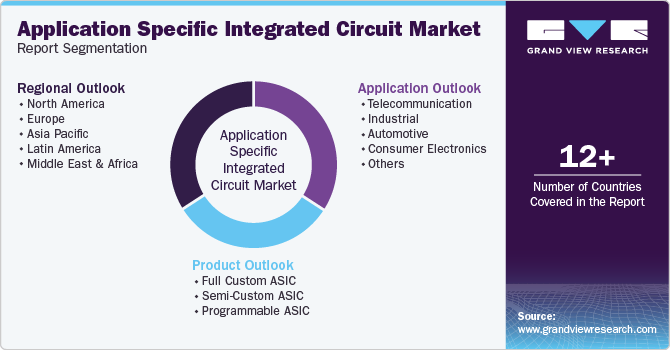
This report forecasts revenue growth at the global, regional, and country levels and analyzes the latest industry trends in each sub-segments from 2021 to 2033. For the purpose of this study, Grand View Research has segmented the global application specific integrated circuit market report on the basis of product, application, and region:
 To learn more about this report, Download Free Sample Report
 -
Product Outlook (Revenue, USD Million, 2021 - 2033)
-
Full Custom ASIC
-
Semi-Custom ASIC
-
Cell-Based
-
Array-Based
-
-
Programmable ASIC
-
-
Application Outlook (Revenue, USD Million, 2021 - 2033)
-
Telecommunication
-
Industrial
-
Automotive
-
Consumer Electronics
-
Others
-
-
Regional Outlook (Revenue, USD Million, 2021 - 2033)
-
North America
-
U.S.
-
Canada
-
Mexico
-
-
Europe
-
UK
-
Germany
-
France
-
-
Asia Pacific
-
China
-
India
-
Japan
-
South Korea
-
Singapore
-
-
Latin America
-
Brazil
-
-
Middle East & Africa
-
UAE
-
Saudi Arabia
-
South Africa
-
-
Research Methodology
The application specific integrated circuit market figures in this report are based on a proven research process that combines executive interviews with secondary research from proprietary databases, company filings, and recognized regulatory and institutional sources. Market size is built through value-chain sizing - reconciling supply-side and demand-side estimates - and triangulated with bottom-up and top-down approaches. Every estimate passes multiple levels of expert validation before publication, with each application specific integrated circuit segment quantified using the revenue-capture definitions in the table below.
Segment Definition
Segment - Product Type
Revenue capture definition
Full Custom ASIC
Revenue in this segment is generated through the design, development, and production of fully customized integrated circuits tailored to specific application requirements across consumer electronics, telecommunications, automotive, industrial automation, aerospace, and data center applications. These chips are optimized for performance, power consumption, area efficiency, and functionality, and include processors, AI accelerators, signal processing units, networking chips, and security ICs.
Semi-Custom ASIC
Revenue in this segment is generated through the design and commercialization of partially customized integrated circuits that utilize predefined logic cells and standard building blocks to reduce development time and cost. These chips are widely deployed across consumer electronics, telecommunications, automotive systems, industrial equipment, networking devices, and IoT applications.
Programmable ASIC
Revenue in this segment is generated through the sale and deployment of programmable application-specific integrated circuits that can be configured or reprogrammed after manufacturing to meet evolving application requirements. These devices are widely used across telecommunications, consumer electronics, industrial automation, automotive systems, aerospace and defense, and data center applications.
Segment - Application
Revenue capture definition
Telecommunication
Revenue in this segment is generated through the adoption of application-specific integrated circuits in telecommunications infrastructure and networking equipment used for data transmission, signal processing, and connectivity management. These ASICs are deployed in 5G base stations, routers, switches, optical transport systems, wireless communication devices, and network processors.
Industrial
Revenue in this segment is generated through the adoption of application-specific integrated circuits (ASICs) in industrial automation and control systems used for monitoring, processing, and managing manufacturing and operational processes
Automotive
Revenue in this segment is generated through the adoption of application-specific integrated circuits (ASICs) in automotive systems used for vehicle control, connectivity, safety, and electrification. These ASICs are deployed in advanced driver assistance systems (ADAS), infotainment systems, engine control units (ECUs), battery management systems, autonomous driving platforms, in-vehicle networking modules, and powertrain control applications.
Consumer Electronics
Revenue in this segment is generated through the adoption of application-specific integrated circuits (ASICs) in consumer electronic devices used for processing, connectivity, multimedia, and power management functions. These ASICs are deployed in smartphones, tablets, laptops, smart TVs, gaming consoles, wearable devices, smart home products, and digital camera
Others
Revenue in this segment is generated through the adoption of application-specific integrated circuits (ASICs) across diverse end-use industries, including healthcare, aerospace and defense, energy and utilities, and consumer appliances
Estimation Model
Layer Name
Key Question
Description
Addressable End-use Device Layer
Which devices and systems generate demand for ASICs?
Identify the global addressable base of electronic systems and equipment requiring application-specific integrated circuits. Include telecommunications infrastructure, consumer electronics, automotive systems, industrial automation equipment, data centers, healthcare devices, aerospace and defense systems, and other embedded applications. Consider deployments across 5G networks, AI accelerators, autonomous vehicles, smart factories, and IoT ecosystems.
Application Requirement Layer
Which functions and workloads require ASIC integration?
Assess ASIC demand across key application requirements including signal processing, network switching, AI inference and training, image processing, power management, security, memory control, and sensor interfacing. Consider performance requirements, power efficiency targets, miniaturization needs, latency constraints, and reliability standards influencing ASIC adoption.
ASIC Consumption Layer
How extensively are ASICs utilized?
Estimate ASIC consumption based on the number of chips required per device or system and their integration intensity across telecommunications equipment, smartphones, electric vehicles, industrial robots, servers, and specialized computing platforms. Consider variations in chip complexity, node technology, and adoption rates across OEMs and end-use industries.
Revenue Generation Layer
How much revenue is generated?
Calculate market revenue by multiplying ASIC shipment volumes by their respective average selling prices (ASPs). Revenue is generated through the design, manufacturing, and sale of full-custom, semi-custom, and programmable ASICs deployed across telecommunications, automotive, consumer electronics, industrial, and other end-use applications. Pricing is influenced by wafer fabrication costs, design complexity, process node technology, packaging requirements, and value-added engineering services.
Delivered Customizations
This report has been delivered with the following In-depth customizations
Client Request
Customization Delivered
Value Adds
Competitive Intelligence & Market Positioning Assessment
Performed an in-depth evaluation of major ASIC designers, semiconductor manufacturers, and fabless companies. Assessed market positioning, ASIC portfolios, process technology capabilities, strategic partnerships, foundry relationships, acquisitions, regional presence, and recent developments across the application specific integrated circuit market ecosystem.
Helps stakeholders identify leading market participants, evaluate competitive positioning, benchmark technology capabilities, uncover partnership and acquisition opportunities, and gain a deeper understanding of evolving competitive dynamics within the application specific integrated circuit market industry.
End-use Demand Patterns & Application-Specific Analysis
Analyzed ASIC demand trends across key applications including telecommunications infrastructure, consumer electronics, automotive systems, industrial automation, data centers, and healthcare devices. Evaluated adoption patterns, performance requirements, chip complexity, purchasing behavior, and growth drivers across major end-use industries.
Provides actionable insights into demand patterns, application-specific adoption trends, emerging opportunities, and high-growth end-use sectors, supporting informed decision-making for market entry, business expansion, product development, and commercialization strategies.
Technology Advancements & Future Growth Potential Evaluation
Assessed the impact of AI accelerators, 5G infrastructure, edge computing, advanced packaging technologies, heterogeneous integration, chiplet architecture, and low-power semiconductor designs on market development. Identified emerging innovation areas, untapped growth opportunities, and high-potential application segments across the ASIC value chain.
Supports long-term strategic planning by highlighting attractive investment opportunities, prioritizing technology innovation initiatives, identifying future revenue streams, and understanding the key trends shaping the evolution of the application specific integrated circuit (ASIC) market.
Frequently Asked Questions About This Report
The global application specific integrated circuit market size was valued at USD 18.7 billion in 2025 and is estimated at USD 19.8 billion in 2026
The global application specific integrated circuit market is expected to grow at a compound annual growth rate of 6.3% from 2026 to 2033 to reach USD 30.3 billion by 2033.
Asia Pacific dominated the application specific integrated circuit market with a more than 49.7% share in 2025. This is attributable to increasing demand for energy-efficient devices and rising exponential growth in smartphone sales in the region.
Some key players operating in the application specific integrated circuit market include Infineon Technologies AG, Semiconductor Components Industries, LLC, OmniVision Technologies, Tekmos Inc., Seiko Epson Corporation, Socionext America Inc., and Intel Corporation.
Key factors that are driving the market growth include growing use of ASICs in consumer electronics such as smartphones, smartwatches, tablets, and increasing adoption of mechatronics across the industrial and automotive applications.
Asia Pacific is the fastest growing region with CAGR 7.2% during forecast period 2026 to 2033 in the market
Semi-Custom ASIC leads the market with revenue share of 50.3% in 2025 and also the fastest growing product type segment in the market.
Consumer Electronics leads the market with revenue share of 36.4% in 2025 and also the fastest growing application segment in the market.
China leads the Asia Pacific region with revenue share of 51.0%, While India is the fastest growing country in the application specific integrated circuit market.
About the Author(s)
Semiconductors Research Team
Semiconductors & Electronics · SemiconductorsThis report was authored by the semiconductors research team at Grand View Research - comprising two research analysts, one senior research analyst, and one industry expert - with specialized expertise in the semiconductors segment of the semiconductors & electronics industry. All findings are based on proprietary semiconductors & electronics databases, executive interviews, and regulatory analysis, subject to internal peer review prior to publication.
Last Updated:
Speak to Analyst

Customize this report to your needs - add regions, segments, or data points, with 20% free customization.
Or view our licence options:


ISO 9001:2015 & 27001:2022 Certified
We are GDPR and CCPA compliant! Your transaction & personal information is safe and secure. For more details, please read our privacy policy.


