
- Home
- »
- Next Generation Technologies
- »
-
Artificial Intelligence As A Service Market Report, 2026-2033GVR Report cover

Artificial Intelligence As A Service Market (2026 - 2033)
Size, Share & Trends Analysis Report By Technology (Machine Learning, Computer Vision), By Service Type (Software, Services), By Organization Size, By Deployment, By Vertical, By Offering, By Region, And Segment Forecasts
Market Size, 2025
$22.5BMarket Estimate, 2026
$31.1BMarket Forecast, 2033
$256.8BCAGR, 2026–2033
35.2%Artificial Intelligence As A Service Market Summary
The global artificial intelligence as a service market size was valued at USD 22.5 billion in 2025 and is projected to grow from USD 31.1 billion in 2026 to USD 256.8 billion by 2033, at a CAGR of 35.2% from 2026 to 2033. North America dominated the market, accounting for a revenue share of 45.8% in 2025. The Artificial intelligence as a service (AIaaS) market is expanding as organizations increasingly adopt cloud-based AI solutions to improve operational efficiency and decision-making.
 Source: Grand View Research, IR Documents, Primary Interviews, Paid DatabasesTo learn more about this report,
 Download Free Sample Report
 Key Market Trends & Insights
- By technology: Machine learning (ML) segment held a significant 40.4% revenue share in 2025.
- By service type: Software segment held the largest revenue share in 2025.
- By deployment: Data Storage and Archiving segment held a significant 54.5% revenue share in 2025.
- By organization size: Large Enterprises segment held the largest revenue share in 2025.
- By vertical: BFSI segment held a significant 20.3% revenue share in 2025.
- By offering: SaaS segment held the largest revenue share in 2025.
Regional Highlights
- Largest regional market: North America (45.8% revenue share, 2025)
- Fastest growing regional market: Asia Pacific (highest CAGR, 2026-2033)
- By country: The U.S. held the largest market share in 2025.
Market Size & Forecast
- Market size in 2025: USD 22.5 Billion
- Estimated market size in 2026: USD 31.1 Billion
- Projected market size by 2033: USD 256.8 Billion
- CAGR (2026-2033): 35.2%
Three ways to get this report
Buy it, customize it, or ask a question.Ask an Analyst
Analyst response in 1 business day
- AccessReport author, directly
- Reply timeWithin 1 working day
- No sales callDirect answer only
- FormatEmail reply
- CostFree, no cost
Get the Full Report
What the study covers
- FormatsPDF · Excel · Dashboard
- Timeline2026–2033 annual, 2025 base
- Coverage20+ countries, 5 regions
- Companies10+ key players profiled
Customize the Report
20% free customization
- IncludeCountries, segments, points
- TailorTo your product definition
- ExtendDeeper competitor detail
- OrA fully bespoke study
- Turnaround5–10 working days
Growing digital transformation initiatives and the need for scalable AI capabilities are supporting market demand across industries. Advancements in machine learning, generative AI, and analytics technologies are expected to sustain market growth over the forecast period. The rise of cloud computing, the expansion of big data, and the increasing need for automation across sectors like healthcare, finance, retail, and manufacturing are major factors driving this trend. To learn more about this report, Download Free Sample Report
 Future opportunities lie in the development of more customizable AI solutions, improved data privacy, and integration with emerging technologies like the Internet of Things (IoT) and 5G. As businesses continue to seek innovative ways to leverage AI, the AIaaS market is expected to play a critical role in democratizing AI and driving digital transformation globally. AIaaS allows businesses to access AI technologies, such as machine learning, natural language processing, and computer vision, without the need for in-house expertise or infrastructure. This model is particularly appealing for small to medium-sized enterprises, as it reduces the costs and complexities of implementing AI.
Enterprises are investing extensively in AI services these days to unlock the power of their businesses. They are implementing solutions to execute activities ranging from forecasting, planning, and predictive maintenance to customer service chatbots and other applications. The growing advancement of technology in recent years has resulted in a new threat scenario, compelling firms to explore advanced defensive tactics. Security experts will have tremendous resources to secure sensitive networks and avoid future data breaches if AI is integrated into cybersecurity. As AI performs more enterprise activities, firms will see a massive transformation in their business activities. Such factors are likely to boost market growth during the forecast period.
Increasing demand for machine learning services in the form of application programming interfaces (API) and software development kits (SDK), along with the rising number of innovative startups, are factors expected to aid market growth. For instance, in April 2023, CHATCRYPTO, a blockchain enterprise, introduced its latest innovation, the ChatCrypto token, a deflationary AI token. This token serves as a key to access blockchain as a service (BaaS), AIaaS, and the rental of high-performance computing (HPC) power through their infrastructure as a service (IaaS). The ChatCrypto token aims to establish a sustainable and resilient ecosystem, fostering stability for both the platform and its users.
Market Dynamics
The Artificial Intelligence as a Service (AIaaS) market is experiencing strong growth driven by increasing adoption of cloud-based AI solutions across organizations. Demand is supported by the need to improve operational efficiency and enable better decision-making. Continuous improvements in AI capabilities are expanding the use of these solutions across various business functions. Growing digital transformation initiatives are further supporting market adoption across enterprises of all sizes. However, concerns related to data security, compliance, and system integration continue to influence overall adoption patterns.
Continuous advancements in artificial intelligence technologies are driving the growth of the Artificial intelligence as a service (AIaaS) market by making AI capabilities more accessible, scalable, and efficient for organizations. Improvements in machine learning algorithms, natural language processing, computer vision, and generative AI are enabling businesses to integrate advanced AI functionalities into their operations without the need for extensive in-house expertise or infrastructure. As AI technologies continue to evolve, organizations are increasingly adopting AIaaS solutions to enhance decision-making, automate processes, and improve customer experiences.
The growing availability of cloud-based AI platforms is further accelerating market expansion by allowing businesses to access the latest AI innovations through subscription-based models. AIaaS providers continuously enhance their offerings with improved accuracy, performance, and security features, enabling organizations to deploy AI applications more rapidly and cost-effectively. These technological developments are expanding the range of AI use cases across industries, supporting broader adoption of AIaaS solutions worldwide.
Integration challenges with legacy systems are restraining the growth of Artificial intelligence as a service (AIaaS) market. Many organizations continue to operate legacy infrastructure and applications that lack compatibility with modern AI platforms. As a result, integrating AIaaS solutions into existing IT environments can be complex and resource intensive. Organizations may need to modify workflows, upgrade systems, or restructure data management processes to support AI deployment.
These integration challenges can increase implementation costs and extend deployment timelines. Inconsistent data formats, limited interoperability, and outdated architecture may reduce the effectiveness of AI applications and hinder seamless data exchange. Organizations often face operational disruptions during the integration process, which can discourage adoption. Consequently, legacy system constraints remain a significant barrier to the widespread implementation of AIaaS solutions.
The increasing adoption of generative AI presents a significant opportunity for Artificial Intelligence as a Service (AIaaS) market. Organizations across industries are utilizing generative AI solutions to automate content creation, enhance customer interactions, improve software development, and support decision-making processes. The rising demand for advanced AI capabilities is encouraging businesses to adopt AIaaS platforms that provide scalable and cost-effective access to generative AI technologies.
AIaaS providers are expanding their offerings to include generative AI models, enabling organizations to deploy AI applications without substantial infrastructure investments. The growing use of generative AI in sectors such as healthcare, financial services, retail, and manufacturing is creating new revenue opportunities for service providers. As businesses continue to explore innovative AI-driven use cases, demand for AIaaS solutions is expected to increase. This trend is supporting market expansion and creating opportunities for further technological development.
Market Concentration & Characteristics
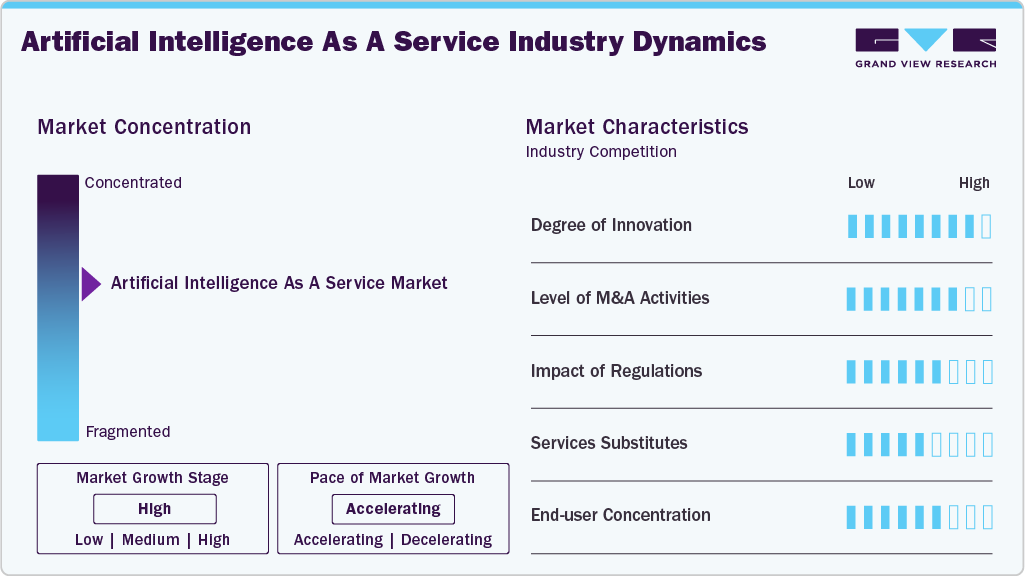
The AI as a Service (AIaaS) market is moderately concentrated, with a combination of large cloud service providers and specialized AI vendors competing across various application areas. Major technology companies benefit from established cloud infrastructure, extensive AI capabilities, and broad customer networks, while smaller providers focus on specific AI applications and industry requirements. The presence of both global and niche participants contributes to a competitive market environment.
 To learn more about this report, Download Free Sample Report
 The market is characterized by continuous technological advancements, subscription-based delivery models, and scalable deployment options. Service providers are expanding their AI portfolios through product development, strategic partnerships, and acquisitions to strengthen their market position. Growing demand for generative AI, automation, and data-driven decision-making is increasing competition among vendors. Organizations are increasingly seeking flexible and cost-effective AI solutions, further supporting market expansion.
Analyst Perspective
The Artificial Intelligence as a Service (AIaaS) market is expanding as organizations increasingly seek ready-to-deploy AI capabilities without the need to develop costly in-house infrastructure. Growth is primarily driven by rising cloud adoption, automation initiatives, and the increasing use of pre-trained models, APIs, and scalable AI platforms across industries. The key market opportunity lies in enabling enterprises to reduce costs, accelerate deployment timelines, and enhance decision-making efficiency. Large cloud service providers are expected to maintain a dominant position, while specialized vendors are likely to grow by offering industry-specific and compliance-focused solutions. However, concerns related to data privacy, governance, and vendor lock-in continue to influence adoption decisions across enterprises.
Technology Insights
Based on technology, Machine learning (ML) segment led the market with the significant revenue share of 40.4% in 2025, due to its ability to analyze vast datasets and deliver actionable insights, which has become crucial for businesses across sectors. Companies are increasingly leveraging ML algorithms for tasks like predictive analytics, recommendation systems, and fraud detection. The ease of integrating ML models with cloud-based platforms has further fueled its adoption, enabling businesses to deploy scalable, cost-effective solutions without the need for extensive infrastructure. In addition, advancements in automated machine learning (AutoML) have made it easier for companies to develop and deploy models, even with limited AI expertise.
The natural language processing (NLP) segment is predicted to foresee at a significant CAGR during the forecast period.Businesses are increasingly adopting NLP for customer service automation, sentiment analysis, and language translation, driven by the need to enhance user experiences and streamline operations. The rise of conversational AI, including chatbots and virtual assistants, has been a significant factor, as these tools rely on NLP to understand and respond to human language effectively. In addition, advancements in Large Language Models (LLMs) have improved the accuracy and versatility of NLP solutions, making them more accessible to companies of all sizes. This surge in demand is propelling rapid market growth within the NLP segment.
Service Type Insights
Based on service type, the Software segment led the market with the largest revenue share of 77.3% in 2025. Companies are investing in AI software to enhance data analytics, automate business processes, and improve decision-making across sectors like healthcare, finance, retail, and manufacturing. The growth of cloud-based software platforms has made it easier for businesses to deploy AI tools without the need for extensive infrastructure, driving widespread adoption. In addition, advancements in AI software development, such as AutoML and pre-trained models, have simplified the integration and customization of AI solutions, enabling businesses to implement and scale AI capabilities quickly.
The services segment is predicted to foresee at a significant CAGR during the forecast period. As businesses increasingly adopt AI, many lack the in-house expertise to implement and scale these technologies effectively. AI service providers offer critical consulting, integration, and maintenance services, helping companies navigate the complexities of AI deployment. In addition, the demand for custom AI solutions tailored to specific industry needs has led to a surge in professional services, including training, data management, and model tuning. This trend is further driven by the growing focus on AI ethics, data privacy, and compliance, where expert guidance is essential, fueling growth in the services segment.
Deployment Insights
Based on deployment, the Public segment led the market with a significant revenue share of 54.5% in 2025. Public cloud platforms enable businesses of all sizes to leverage AI technologies without significant investments in infrastructure, making it easier to experiment and scale AI solutions. Furthermore, the flexibility of public cloud environments allows companies to quickly deploy and manage AI models, adjust computing resources on demand, and integrate with other cloud-based applications. The increasing reliance on remote work and digital transformation is further driving the shift towards public cloud deployments.
The hybrid segment is anticipated to witness at a significant CAGR during the forecast period.Businesses are increasingly adopting hybrid solutions to maintain control over sensitive data by keeping it on private servers while leveraging the scalability and cost-efficiency of the public cloud for other AI workloads. This approach ensures greater flexibility, enhanced data security, and compliance with regulatory requirements, making it especially appealing for industries like healthcare, finance, and government. Moreover, hybrid models support seamless integration with existing on-premises infrastructure, enabling companies to gradually scale their AI initiatives without disrupting their core systems, which is driving their rapid adoption and growth.
Organization Size Insights
Based on organization size, the Large Enterprises segment led the market with a significant revenue share of 73.1% in 2025. Large enterprises have the resources to implement advanced AI solutions across various business functions, including customer service, supply chain optimization, and predictive maintenance. They are also adopting AI to gain a competitive edge by enhancing customer experiences, improving operational efficiency, and making data-driven decisions. In addition, large enterprises are more likely to seek customized, scalable AI solutions that can be integrated with their existing systems. The need for robust data security, compliance, and continuous innovation further drives their preference for AIaaS, as it allows them to leverage cutting-edge AI technologies without extensive in-house development.
The SMEs segment is anticipated to exhibit at the fastest CAGR over the forecast period. AIaaS enables SMEs to adopt AI technologies without the need for substantial investments in infrastructure or technical expertise. This has empowered SMEs to streamline operations, enhance customer engagement, and gain data-driven insights, helping them compete with larger companies. The flexibility of AIaaS allows SMEs to pay for services as needed, making it easier to experiment and scale AI deployments based on business growth.
Vertical Insights
Based on vertical, BFSI segment led the market with the significant revenue share of 20.3% in 2025, due to the sector's increasing focus on automation, risk management, and personalized customer experiences. Financial institutions are adopting AIaaS to streamline operations, detect fraud, enhance compliance, and improve decision-making through advanced data analytics. AI-powered chatbots and virtual assistants are also being used to provide efficient customer service and support. In addition, AIaaS solutions enable banks and insurers to analyze vast amounts of data for credit scoring, investment forecasting, and underwriting, leading to more accurate and timely insights. The ability to deploy scalable, cloud-based AI solutions without major infrastructure investments is driving rapid adoption in the BFSI sector.
Healthcare providers are increasingly leveraging AIaaS solutions for applications such as predictive analytics, medical imaging analysis, and personalized treatment plans. AI technologies facilitate the analysis of vast amounts of patient data, enabling early disease detection and improved clinical decision-making. In addition, AI-powered tools are being used to enhance patient engagement through chatbots and telemedicine services. The ongoing push for digital transformation in healthcare, coupled with the need for cost reduction and enhanced patient outcomes, is driving the rapid adoption of AIaaS solutions within the sector.
Offering Insights
Based on offering, the SaaS segment led the market with the largest revenue share of 61.7% in 2025. SaaS solutions allow businesses to access AI technologies without the need for significant upfront investments in hardware or software. This model enables companies to easily integrate AI capabilities into their existing workflows, enhancing productivity and efficiency. Furthermore, the growing demand for cloud-based applications and the rapid adoption of subscription-based pricing models make SaaS offerings particularly appealing for businesses of all sizes.
 To learn more about this report, Download Free Sample Report
 The infrastructure as a service (IaaS) segment is anticipated to exhibit at the fastest CAGR over the forecast period. IaaS enables organizations to access powerful virtual machines, storage, and networking capabilities without the need for significant capital investments in physical infrastructure. This flexibility allows businesses to experiment with AI technologies, scale their operations based on demand, and optimize resource allocation efficiently. As more organizations adopt AI solutions for applications such as machine learning, data analysis, and model training, the demand for robust IaaS platforms is increasing, driving significant market growth in this segment.
Regional Insights
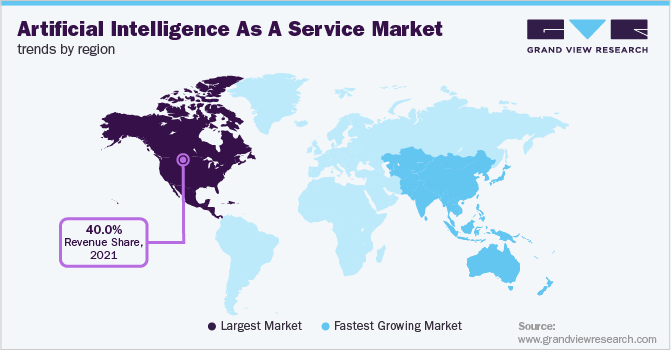
North America dominated the artificial intelligence as a service market with the largest revenue share of 45.8% in 2025. North American companies are at the forefront of AI adoption, leveraging AIaaS solutions to enhance operational efficiency, drive innovation, and improve customer experiences. The presence of major cloud service providers and AI startups fosters a competitive environment that accelerates the development and deployment of AI technologies. In addition, industries such as healthcare, finance, and retail are increasingly integrating AIaaS to streamline processes and gain insights from large datasets.
 To learn more about this report, Download Free Sample Report
 U.S. Artificial Intelligence As A Service Market Trends
The Artificial intelligence as a service market in the U.S. held the largest share in the North America region in 2025, driven by its strong technological ecosystem and significant investments in artificial intelligence research and development. U.S. businesses are increasingly leveraging AIaaS to enhance operational efficiencies, improve customer engagement, and derive insights from big data. In addition, a robust startup culture and ongoing government initiatives to promote AI innovation contribute to the rapid market growth in the U.S.
Europe Artificial Intelligence As A Service Market Trends
The artificial intelligence as a service (AIaaS) market in the Europe region is expected to witness at a significant CAGR over the forecast period. The European Union's commitment to promoting AI development through strategic initiatives and funding further supports the market growth. The emphasis on data privacy and ethical AI practices also drives organizations to seek AIaaS solutions that align with regulatory requirements, positioning Europe for significant growth in this sector.
Asia Pacific Artificial Intelligence As A Service Market Trends
The AIaaS market in the Asia Pacific region is anticipated to register at the fastest CAGR over the forecast period, driven by rapid industrialization and the increasing adoption of digital technologies across various sectors. Countries like China, India, and Japan are heavily investing in AI research and development, aiming to enhance productivity and innovation. The proliferation of startups and tech companies in APAC is accelerating the development and deployment of AIaaS solutions, making them more accessible to businesses of all sizes.
Key Artificial Intelligence As A Service Company Insights
Some key players in the global market, such as Amazon Web Services, Inc., Salesforce, Inc., IBM Corporation, and Intel Corporation. Companies operating in the market are implementing a variety of strategic initiatives, such as forming partnerships, pursuing mergers and acquisitions, fostering collaborations, and developing innovative products and technologies. This proactive approach not only enhances their market presence but also enables them to respond effectively to the evolving demands of security and compliance. By leveraging these strategies, these industry leaders are well-positioned to capitalize on growth opportunities, drive innovation, and maintain a robust competitive advantage in the rapidly evolving AIaaS landscape.
-
Amazon Web Services, Inc. (AWS) is one of the prominent players operating in the AIaaS market, offering a comprehensive suite of AI and machine learning services. AWS provides tools like Amazon SageMaker for building, training, and deploying machine learning models, alongside services for NLP, computer vision, and robotics. Its robust cloud infrastructure ensures scalability and reliability, making it accessible to businesses of all sizes. AWS continually innovates through regular updates and the introduction of new features, fostering an environment that encourages developers to integrate AI capabilities seamlessly.
-
Salesforce, Inc. is renowned for its innovative AI capabilities integrated into its Customer Relationship Management (CRM) platform. Through its Einstein AI, the company provides businesses with advanced analytics, predictive insights, and automation tools that enhance customer engagement and streamline operations. The platform allows users to leverage AI for tasks such as lead scoring, personalized marketing, and customer support optimization. Salesforce, Inc. actively invests in AI research and development, continuously expanding its offerings to meet the evolving needs of organizations.
Key Artificial Intelligence As A Service Companies:
The following key companies have been profiled for this study on the artificial intelligence as a service market.
-
Amazon Web Services, Inc.
-
Salesforce, Inc.
-
IBM Corporation
-
Intel Corporation
-
BigML, Inc.
-
Fair Isaac Corporation
-
Microsoft
-
Google LLC
-
SAP SE
-
Siemens
Competitive Benchmarking
Operating Strategies
Competitive Edge
Weaknesses
Mature Players: Amazon Web Services, Microsoft, Google LLC, IBM Corporation, Salesforce, Inc.
- Focus on expanding cloud-based AI ecosystems, enhancing AI model capabilities, integrating AI across existing product portfolios, forming strategic partnerships, and pursuing acquisitions to strengthen market presence and broaden customer reach.
- Extensive cloud infrastructure, comprehensive AI service portfolios, strong brand recognition, large global customer bases, significant R&D capabilities, and established partner ecosystems.
- Complex product portfolios, longer implementation timelines, higher solution costs, organizational complexity, and reduced flexibility in addressing highly specialized customer requirements.
Emerging Players: BigML, Fair Isaac Corporation
- Focus on specialized AI applications, industry-specific solutions, product innovation, flexible pricing models, and strategic collaborations to differentiate offerings and expand their customer base in targeted market segments.
- Specialized AI expertise, industry-focused solutions, greater flexibility, faster innovation cycles, customized offerings, and the ability to address specific customer requirements with targeted AI applications.
- Limited market presence, smaller customer bases, lower financial resources, restricted geographic reach, and challenges in scaling operations and competing with large technology providers.
Recent Developments
-
In October 2024, Singtel, a leading telecommunications conglomerate based in Singapore, officially launched RE:AI, a new AI cloud service aimed at enhancing the scalability, accessibility, and affordability of AI for enterprises and the public sector. With this AIaaS offering, Singtel is addressing the high costs and complexities typically associated with AI. By utilizing Singtel's patented 5G MEC orchestration platform, RE:AI enables customers to effortlessly deploy, manage, and scale AI applications, thereby facilitating smoother AI adoption across various sectors.
-
In September 2024, Deloitte Touche Tohmatsu Limited, a British multinational professional services network, announced the release of AI Factory as a Service. This scalable, comprehensive suite of GenAI capabilities is built on the NVIDIA AI platform and includes NVIDIA NIM Agent Blueprints, NVIDIA AI Enterprise software, and accelerated computing, along with Oracle’s enterprise AI technology. This integration enables a robust ecosystem of technology providers to deliver tailored GenAI workflows.
-
In September 2024, Salesforce, Inc. unveiled AI-powered innovations for its Service Cloud, designed to enhance the resolution of customer and employee cases. The company highlighted its ongoing efforts to expand its comprehensive suite of AI-driven Service Cloud solutions, ensuring that customers, employees, and HR professionals have access to essential information 24/7, allowing for faster and more cost-effective case resolutions. The latest innovations include step-by-step resolution plans for service representatives, tools to monitor customer sentiment, and AI-driven recommendations aimed at improving the overall customer experience.
Artificial Intelligence As A Service Market Report Scope
Report Attribute
Details
Market size in 2025
USD 22.5 billion
Estimated market size in 2026
USD 31.1 billion
Projected market size by 2033
USD 256.8 billion
Growth rate
CAGR of 35.2% from 2026 to 2033
Base year for estimation
2025
Historical data
2021 - 2024
Forecast period
2026 - 2033
Quantitative units
Revenue in USD million/Million and CAGR from 2026 to 2033
Report coverage
Revenue forecast, company ranking, competitive landscape, growth factors, and trends
Segments covered
Technology, service type, deployment, organization size, vertical, offering, region
Regional scope
North America; Europe; Asia Pacific; Latin America; MEA
Country scope
U.S.; Canada; Mexico; Germany; UK; France; China; Japan; India; Australia; South Korea; Brazil; KSA; UAE; South Africa
Key companies profiled
Amazon Web Services, Inc.; Salesforce, Inc.; IBM Corporation; Intel Corporation; BigML, Inc.; Fair Isaac Corporation; Microsoft; Google LLC; SAP SE; Siemens
Customization scope
Free report customization (equivalent up to 8 analysts' working days) with purchase. Addition or alteration to country, regional & segment scope.
Pricing and purchase options
Avail customized purchase options to meet your exact research needs. Explore purchase options
Global Artificial Intelligence As A Service (AIaaS) Market Report Segmentation
This report forecasts revenue growth at global, regional, and country levels and provides an analysis of the latest industry trends in each of the sub-segments from 2021 to 2033. For this study, Grand View Research has segmented the artificial intelligence as a service market report based on technology, service type, deployment, organization size, vertical, offering, and region:
-
Technology Outlook (Revenue, USD Billion, 2021 - 2033)
-
Machine learning (ML)
-
Computer Vision
-
Natural Language Processing (NLP)
-
Others
-
-
Service Type Outlook (Revenue, USD Billion, 2021 - 2033)
-
Software
-
Data Storage and Archiving
-
Modeler and Processing
-
Cloud and Web-Based Application Programming Interface (APIs)
-
Others
-
-
Services
-
-
Deployment Outlook (Revenue, USD Billion, 2021 - 2033)
-
Public
-
Private
-
Hybrid
-
-
Organization Size Outlook (Revenue, USD Billion, 2021 - 2033)
-
Large Enterprises
-
SMEs
-
-
Vertical Outlook (Revenue, USD Billion, 2021 - 2033)
-
BFSI
-
Healthcare and Life Sciences
-
Retail
-
IT & Telecommunication
-
BFSI
-
Manufacturing
-
Energy & Utility
-
Others
-
-
Offering Outlook (Revenue, USD Billion, 2021 - 2033)
-
SaaS
-
PaaS
-
IaaS
-
-
Regional Outlook (Revenue, USD Billion, 2021 - 2033)
-
North America
-
U.S.
-
Canada
-
Mexico
-
-
Europe
-
UK
-
Germany
-
France
-
-
Asia Pacific
-
China
-
India
-
Japan
-
Australia
-
South Korea
-
-
Latin America
-
Brazil
-
-
MEA
-
UAE
-
South Africa
-
KSA
-
-
Research Methodology
The artificial intelligence as a service market figures in this report are based on a proven research process that combines executive interviews with secondary research from proprietary databases, company filings, and recognized regulatory and institutional sources. Market size is built through value-chain sizing - reconciling supply-side and demand-side estimates - and triangulated with bottom-up and top-down approaches. Every estimate passes multiple levels of expert validation before publication, with each artificial intelligence as a service segment quantified using the revenue-capture definitions in the table below.
Segment Definition
Segment- Technology
Revenue Capture Definition
Machine Learning (ML)
Revenue generated from AIaaS solutions that enable predictive analytics, recommendation systems, forecasting, anomaly detection, and automated decision-making using machine learning algorithms.
Computer Vision
Revenue generated from AIaaS solutions that analyze and interpret visual data, including image recognition, object detection, facial recognition, video analytics, and quality inspection applications.
Natural Language Processing (NLP)
Revenue generated from AIaaS solutions that process, understand, and generate human language, including chatbots, virtual assistants, sentiment analysis, speech recognition, and language translation.
Others
Revenue generated from AIaaS solutions based on other AI technologies, including expert systems, reinforcement learning, knowledge graphs, robotic process automation, and emerging AI applications not categorized under ML, Computer Vision, or NLP.
Segment- Service Type
Revenue Capture Definition
Software
Revenue generated from AI-enabled software platforms and applications that provide artificial intelligence capabilities through cloud-based deployment models.
Services
Income derived from consulting, implementation, integration, customization, training, maintenance, and support services associated with AIaaS solutions.
Segment- Deployment
Revenue Capture Definition
Public
Income generated from AIaaS solutions delivered through publicly accessible cloud infrastructure shared among multiple users and organizations.
Private
Revenue captured from AIaaS solutions deployed within dedicated cloud environments designed exclusively for a single organization.
Hybrid
Earnings derived from AIaaS solutions operating across both public and private cloud infrastructures to support diverse operational and security requirements.
Segment- Organization Size
Revenue Capture Definition
Large Enterprises
Spending by large organizations on AIaaS platforms and services to support complex business operations, process automation, and enterprise-wide AI initiatives.
SMEs
Expenditure by small and medium-sized enterprises on AIaaS solutions to enhance operational efficiency, improve decision-making, and access AI capabilities through flexible deployment models.
Segment- Vertical
Revenue Capture Definition
BFSI
Revenue attributable to the adoption of AIaaS solutions by banking, financial services, and insurance organizations for risk assessment, fraud detection, customer service, and process automation.
Healthcare and Life Sciences
Revenue derived from the utilization of AIaaS platforms for clinical decision support, medical imaging, drug discovery, patient engagement, and operational management.
Retail
Revenue generated from the use of AIaaS solutions for customer analytics, personalized recommendations, inventory optimization, demand forecasting, and sales enhancement.
IT & Telecommunication
Revenue associated with AIaaS deployments for network optimization, predictive maintenance, cybersecurity, customer support, and service management applications.
Manufacturing
Revenue captured from AIaaS adoption for predictive maintenance, quality control, production planning, process optimization, and industrial automation.
Energy & Utility
Revenue stemming from AIaaS applications in energy management, asset monitoring, demand forecasting, grid optimization, and operational efficiency improvement.
Others
Revenue contributed by AIaaS implementations across sectors such as education, transportation, government, media and entertainment, and other industries not separately categorized.
Estimation Model
Layer Name
Key Question
Description
Artificial Intelligence as a Service End-User Layer
Who creates demand for AIaaS solutions?
Identifies the total base of organizations utilizing or requiring AI capabilities, including enterprises across BFSI, healthcare, retail, manufacturing, IT & telecommunications, government, and other sectors.
Adoption / Usage Layer
Who actively uses AIaaS platforms?
Filters the total addressable user base based on AI adoption maturity, cloud adoption levels, digital transformation initiatives, data-driven decision-making requirements, and demand for AI-powered automation and analytics.
Technology & Deployment Layer
What AIaaS solutions are deployed?
Estimates adoption across machine learning, natural language processing, computer vision, and other AI technologies delivered through public, private, and hybrid cloud environments.
Revenue Capture Layer
How is revenue generated in the AIaaS ecosystem?
Calculates revenue generated from software subscriptions, cloud-based AI platforms, API consumption, model development and processing tools, data storage services, consulting, implementation, integration, training, maintenance, and support services.
Delivered Customizations
This report has been delivered with the following In-depth customizations
Client Objective
Custom Research Modules Delivered
Strategic Value / Business Impact
Market Entry & Expansion Assessment
Regional AIaaS demand sizing and forecasting
Enterprise adoption and usage pattern analysis
Competitive landscape benchmarking
Regulatory and cloud compliance assessment
Identifies high-growth AIaaS opportunities across regions
Supports go-to-market strategy development
Highlights investment priorities and risks
Enables data-driven expansion planning
Product Positioning & Competitive Intelligence
AIaaS platform benchmarking and capability comparison
Pricing and subscription model analysis
Value proposition and enterprise preference study
Competitor strategy evaluation
Improves AIaaS product differentiation strategy
Supports pricing optimization
Identifies unmet enterprise AI needs
Strengthens competitive positioning
Investment Feasibility & Opportunity Analysis
AIaaS market attractiveness evaluation
Revenue and growth forecasting models
SWOT and risk assessment of AI providers
Scenario and trend analysis in AI adoption
Supports investment decision-making in AIaaS market
Identifies high-potential growth areas
Reduces market uncertainty
Enables strategic long-term planning
Frequently Asked Questions About This Report
Some key players operating in the AI as a service market include Amazon Web Services, Inc.; Salesforce, Inc.; IBM Corporation; Intel Corporation; BigML, Inc.; Fair Isaac Corporation; Microsoft; Google LLC; SAP SE; Siemens
Key factors driving the AI as a service market include the rising demand for machine learning services in the form of the software development kit (SDK) and application programming interface (API), as well as the growing number of innovative startups.
The data storage and archiving segment led with a 34.7% revenue share in 2025, while modeler and processing is the fastest-growing segment.
The global artificial intelligence as a service market size was valued at USD 22.5 billion in 2025 and is estimated at USD 31.1 billion in 2026.
The global artificial intelligence as a service market is expected to grow at a CAGR of 35.2% from 2026 to 2033, reaching USD 256.8 billion by 2033.
North America dominated the AI as a service market with a share of 45.8% in 2025. North American companies are at the forefront of AI adoption, leveraging AIaaS solutions to enhance operational efficiency, drive innovation, and improve customer experiences.
The Machine learning (ML) segment led with a 40.4% revenue share in 2025, while Natural Language Processing (NLP) is the fastest-growing segment.
The software segment led with a 77.3% revenue share in 2025, while services is the fastest-growing segment.
Asia Pacific is the fastest-growing region over the forecast period.
About the Author(s)
Next Generation Technologies Research Team
Technology · Next Generation TechnologiesThis report was authored by the next generation technologies research team at Grand View Research - comprising two research analysts, one senior research analyst, and one industry expert - with specialized expertise in the next generation technologies segment of the technology industry. All findings are based on proprietary technology databases, executive interviews, and regulatory analysis, subject to internal peer review prior to publication.
Last Updated:
Speak to Analyst

Customize this report to your needs - add regions, segments, or data points, with 20% free customization.
Or view our licence options:


ISO 9001:2015 & 27001:2022 Certified
We are GDPR and CCPA compliant! Your transaction & personal information is safe and secure. For more details, please read our privacy policy.


