
- Home
- »
- Advanced Interior Materials
- »
-
Asphalt Market Size, Share And Trends Report, 2026-2033GVR Report cover

Asphalt Market (2026 - 2033)
Size, Share & Trends Analysis Report By Product (Hot Mix Asphalt, Warm Mix Asphalt), By End Use (Residential, Commercial, Industrial), By Region (North America, Asia Pacific, Europe, Central & South America, MEA), And Segment Forecasts
Market Size, 2025
$68.4BMarket Estimate, 2026
$71.0BMarket Forecast, 2033
$93.2BCAGR, 2026–2033
4.0%Asphalt Market Summary
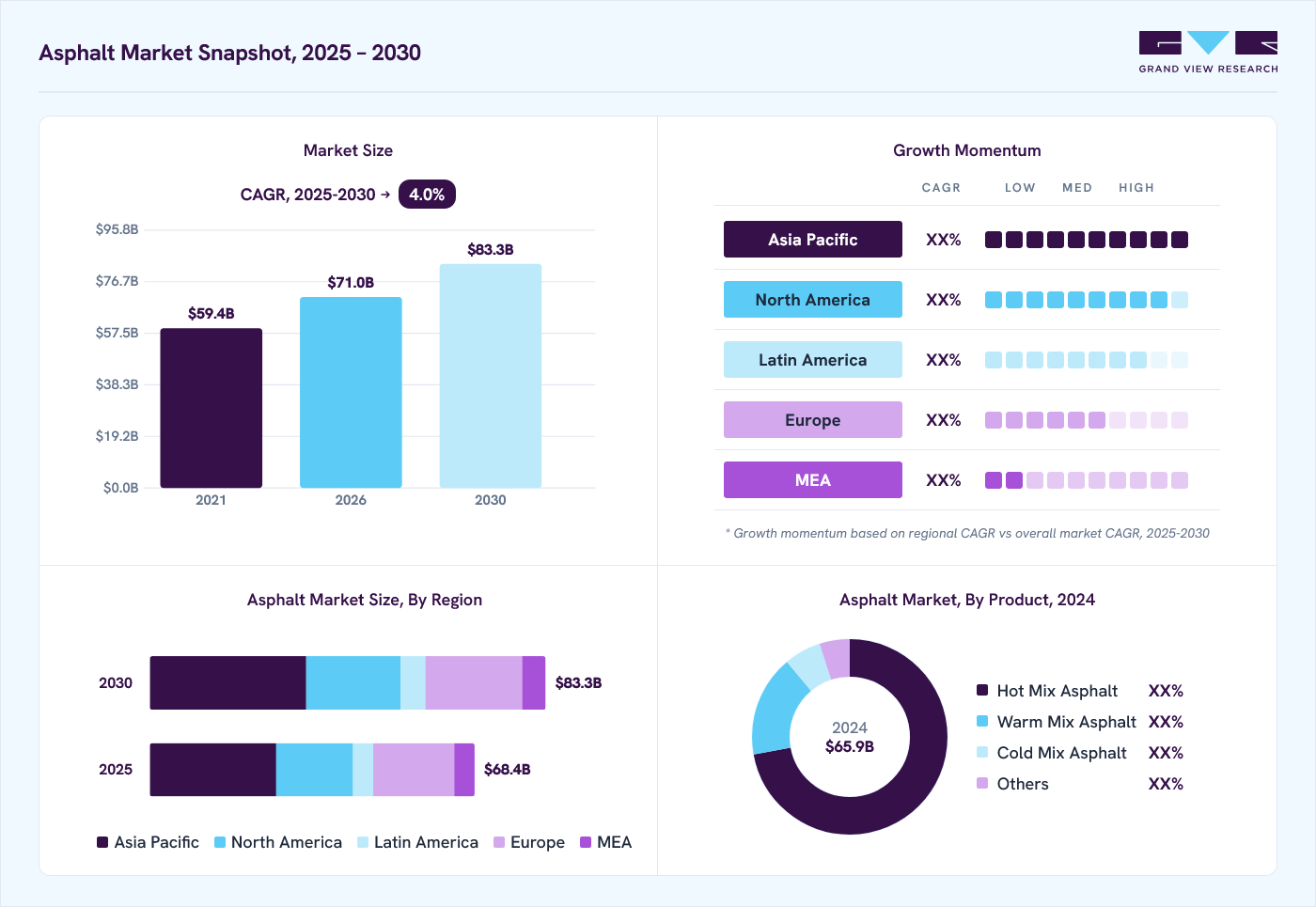
The global asphalt market size was valued at USD 68.4 billion in 2025 and is projected to grow from USD 71.0 billion in 2026 to USD 93.2 billion by 2033, at a CAGR of 4.0% from 2026 to 2033. The market in Asia Pacific dominated with a revenue share of 38.9% in 2025. The rising global air travel demand and international trade activities are fueling investments in airport and port infrastructure.
 Source: Grand View Research, IR Documents, Primary Interviews, Paid DatabasesTo learn more about this report,
 Download Free Sample Report
 Key Market Trends & Insights
- By product: Hot mix asphalt segment held the largest market share of 72.1% in 2025.
- By end use: Infrastructural segment held the largest market share of 70.3% in 2025.
Regional Highlights
- Largest regional market: Asia Pacific (38.9% revenue share, 2025)
- By country: China held the largest market share in 2025
Market Size & Forecast
- Market size in 2025: USD 68.4 Billion
- Estimated market size in 2026: USD 71.0 Billion
- Projected market size by 2033: USD 93.2 Billion
- CAGR (2026-2033): 4.0%
Three ways to get this report
Buy it, customize it, or ask a question.Ask an Analyst
Analyst response in 1 business day
- AccessReport author, directly
- Reply timeWithin 1 working day
- No sales callDirect answer only
- FormatEmail reply
- CostFree, no cost
Get the Full Report
What the study covers
- FormatsPDF · Excel · Dashboard
- Timeline2026–2033 annual, 2025 base
- Coverage20+ countries, 5 regions
- Companies10+ key players profiled
Customize the Report
20% free customization
- IncludeCountries, segments, points
- TailorTo your product definition
- ExtendDeeper competitor detail
- OrA fully bespoke study
- Turnaround5–10 working days
Asphalt plays a critical role in constructing runways, taxiways, container yards, and storage areas, owing to its load-bearing capacity and ability to withstand heavy traffic. This trend contributes significantly to the growth of the asphalt market, particularly in fast-developing economies and high-traffic regions. Advancements in asphalt production, such as warm mix asphalt (WMA), recycled asphalt pavement (RAP), and polymer-modified asphalt (PMA), are improving the material's performance, reducing emissions, and enhancing sustainability. Governments and industries are increasingly adopting eco-friendly asphalt variants to meet regulatory and environmental standards, thereby stimulating market growth. These innovations not only support environmental goals but also lower lifecycle costs, making asphalt more attractive to infrastructure developers.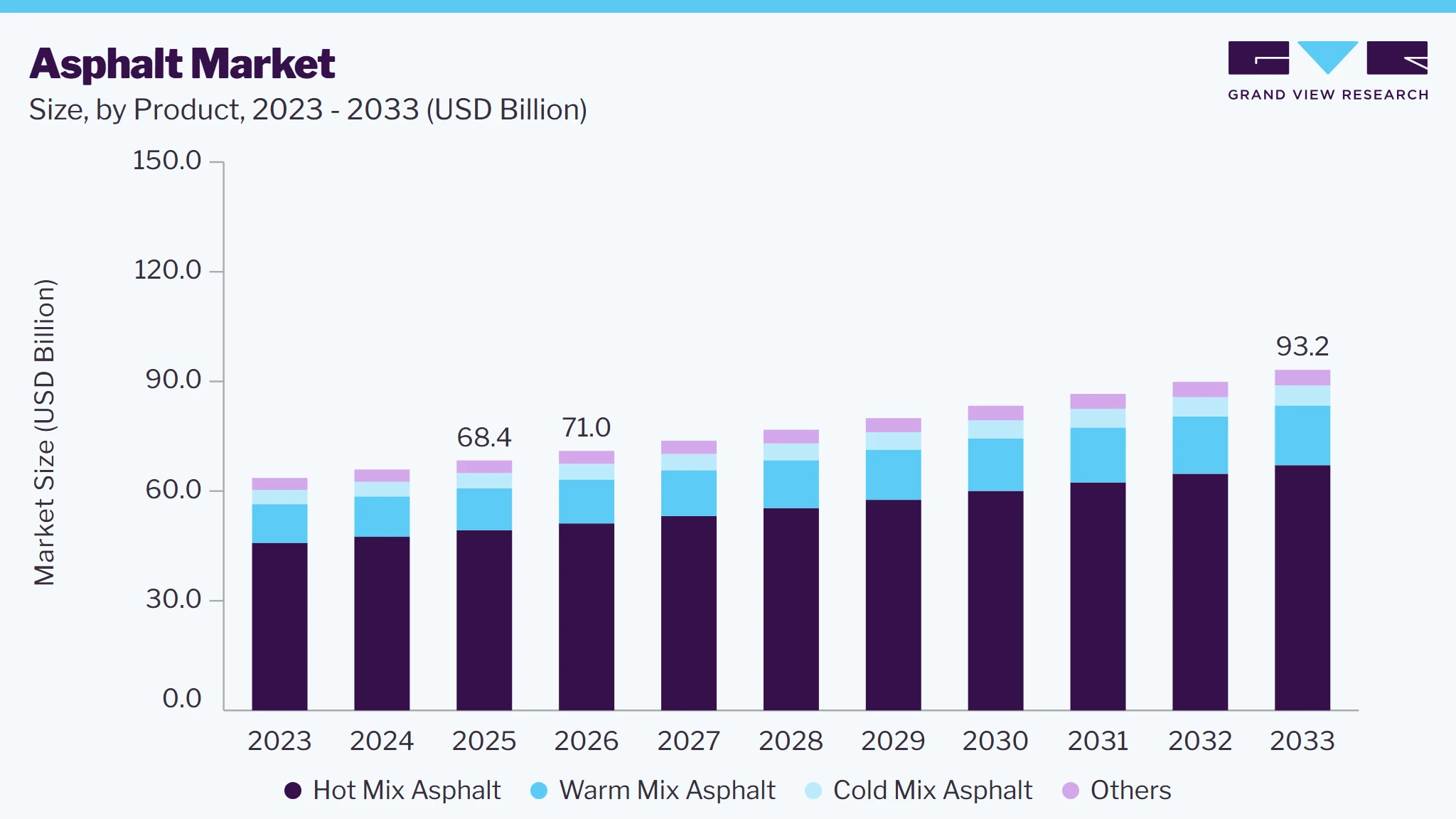 To learn more about this report, Download Free Sample Report
 Rapid urbanization, especially in regions like Asia-Pacific, Latin America, and parts of Africa, is leading to increased construction of residential and commercial buildings, roads, and airport runways. As populations shift to urban areas, the need for robust transportation infrastructure and urban mobility solutions grows, significantly driving the consumption of asphalt in both road and non-road applications such as roofing and waterproofing systems.
Market Dynamics
The asphalt market is witnessing steady growth, driven by increasing investments in road construction, highway maintenance, airport development, and urban infrastructure projects. Rising demand for durable and cost-effective paving materials, along with the growing adoption of modified asphalt and recycled asphalt pavement (RAP), is supporting market expansion. Sustainability initiatives and advancements in paving technologies are further enhancing market prospects. However, fluctuating crude oil prices and stringent environmental regulations remain key challenges. Despite these factors, ongoing infrastructure modernization efforts are expected to sustain market growth in the coming years.
The continued growth in road construction, highway expansion, and transportation infrastructure modernization projects worldwide is expected to drive the market demand. Governments are increasing investments in new highways, expressways, airport runways, and road rehabilitation programs to improve connectivity and support economic development. Asphalt remains the preferred paving material due to its durability, cost efficiency, and ease of maintenance, resulting in sustained demand from both public and private infrastructure projects.
Recent industry developments further validate this trend. In December 2025, Breedon Group secured a contract to supply and lay approximately 1,95,000 tons of asphalt for the Easton highway upgrade project in the United Kingdom, highlighting the strong demand generated by major road infrastructure investments. Subsequently, in February 2026, Breedon Group completed an upgrade of its Cloud Hill asphalt plant to enhance production efficiency and support infrastructure projects. These developments demonstrate how infrastructure spending is directly driving investments across the asphalt value chain.
A significant restraint for the asphalt market is the volatility in crude oil and bitumen prices, as asphalt is primarily derived from petroleum refining processes. Fluctuations in crude oil markets directly impact the cost of bitumen production, creating uncertainty for asphalt manufacturers, contractors, and infrastructure developers. Sudden increases in raw material prices can raise project costs, compress profit margins, and delay planned road construction and maintenance activities, particularly in price-sensitive markets. Moreover, supply chain disruptions, geopolitical tensions, and refinery capacity changes can further affect bitumen availability and pricing, posing challenges to stable market growth.
A major opportunity for the asphalt market lies in the increasing adoption of recycled asphalt pavement (RAP) and other sustainable paving technologies. Governments and infrastructure agencies worldwide are emphasizing circular economy practices, carbon reduction, and resource conservation in road construction projects. The use of recycled asphalt helps reduce raw material consumption, lower project costs, and minimize environmental impact while maintaining pavement performance. Furthermore, advancements in warm-mix asphalt, bio-based binders, and recycling technologies are enabling manufacturers and contractors to meet evolving sustainability requirements. As regulatory support for greener infrastructure continues to strengthen, demand for environmentally friendly asphalt solutions is expected to create significant growth opportunities across the market.
Market Concentration & Characteristics
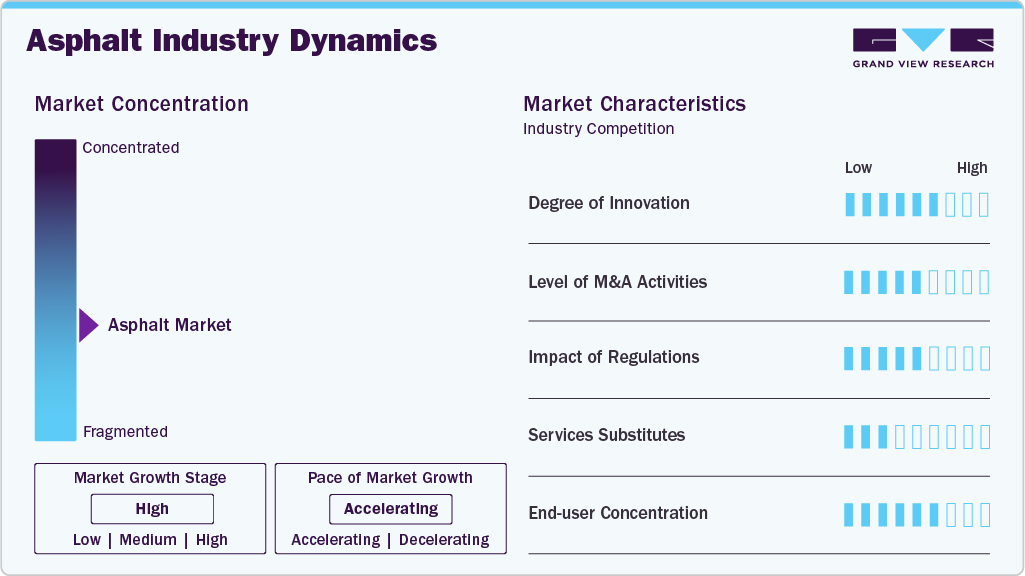
The global asphalt market demonstrates a moderately concentrated structure, characterized by the presence of several key players such as Shell Bitumen, ExxonMobil, BP, TotalEnergies, and CRH Plc, alongside a multitude of regional producers. The degree of innovation in the market is steadily evolving, particularly with the growing adoption of sustainable and performance-enhancing technologies like warm mix asphalt, polymer-modified asphalt, and recycled asphalt pavement. These innovations are aimed at improving durability, reducing emissions, and lowering lifecycle costs, making asphalt more environmentally friendly and efficient. The level of mergers and acquisitions (M&A) has been notably active in recent years, as companies pursue vertical integration strategies to strengthen supply chains, expand geographic reach, and enhance their technological capabilities. This M&A activity fosters competition and accelerates the transfer of innovation across global markets.
 To learn more about this report, Download Free Sample Report
 Regulations have a significant impact on the asphalt industry, particularly concerning environmental compliance and safety standards. Increasing pressure to reduce greenhouse gas emissions, manage stormwater runoff, and utilize recycled materials has pushed manufacturers to innovate and adapt production practices. In terms of service substitutes, asphalt faces moderate competition from concrete in some applications, especially in high-load or long-lasting infrastructure projects. However, due to its lower initial cost, ease of repair, and faster laying time, asphalt maintains a strong foothold in road construction. End-user concentration is prominent in the public sector, with governments and municipal bodies constituting the largest customer base due to their role in infrastructure development. Nonetheless, demand from private developers for commercial and residential construction also contributes significantly to market dynamics.
Analyst Perspective
The asphalt market is poised for steady long-term growth, supported by sustained investments in transportation infrastructure, including highways, roads, airports, and urban mobility projects. Beyond new construction, increasing emphasis on pavement rehabilitation and maintenance of aging infrastructure is emerging as a significant demand driver across both developed and developing economies. The industry is also witnessing a gradual shift toward sustainable paving solutions, with growing adoption of recycled asphalt pavement (RAP) and warm mix asphalt (WMA) to improve environmental performance and cost efficiency. In parallel, advancements in asphalt formulations are enhancing pavement durability and lifecycle value. In the coming years, infrastructure modernization initiatives, coupled with evolving sustainability requirements, are expected to create attractive growth opportunities for asphalt producers, contractors, and technology providers worldwide.
Product Insights
Based on product, the hot mix asphalt segment led the market with the largest revenue share of 72.1% in 2025, driven by its superior performance characteristics and widespread applicability in infrastructure development. One of the key drivers is the material's high durability and load-bearing capacity, which makes it the preferred choice for highways, airport runways, racetracks, and urban roads subjected to heavy vehicular traffic. The ability of hot mix asphalt to withstand varying climatic conditions, resist rutting, and provide a smooth, safe driving surface further reinforces its adoption in high-traffic zones and critical transportation routes.
The warm mix asphalt segment is expected to grow significantly at a CAGR of 4.5% over the forecast period, driven by its environmental benefits and energy efficiency. WMA is produced and applied at lower temperatures, which significantly reduces fuel consumption and greenhouse gas emissions during the manufacturing and paving process. This aligns closely with the global push toward sustainable infrastructure solutions and compliance with increasingly stringent environmental regulations.
End Use Insights
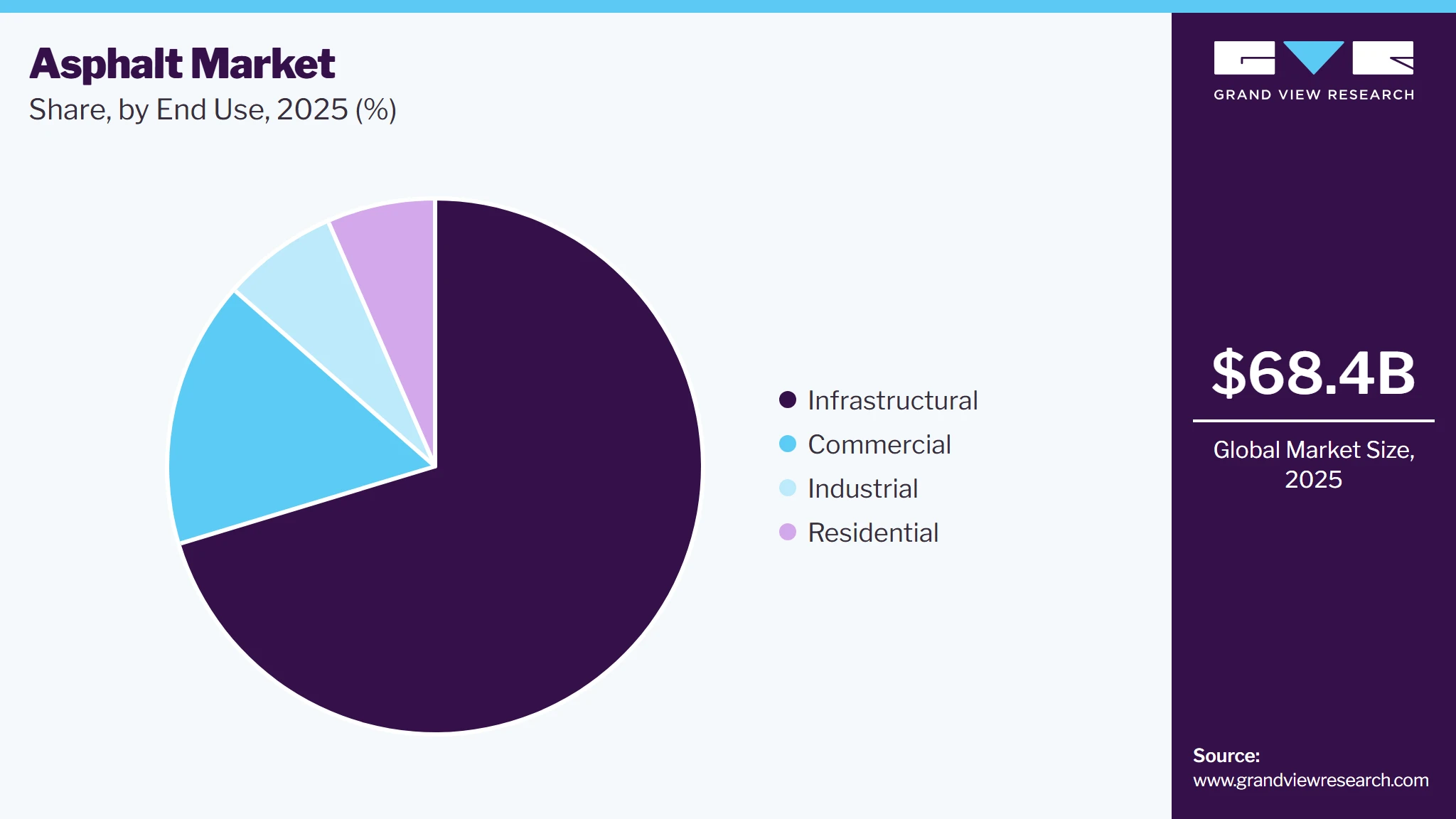
Based on end use, the infrastructural segment led the market with the largest revenue share of 70.3% in 2025, driven by the escalating demand for road and highway development across both developed and emerging economies. Governments are investing heavily in the construction, expansion, and maintenance of transportation networks to facilitate regional trade, reduce urban congestion, and enhance rural connectivity. Asphalt’s cost-effectiveness, durability, and adaptability make it the preferred material for constructing roads, bridges, airports, and urban transit systems. National infrastructure development programs such as the U.S. Bipartisan Infrastructure Law, China’s Belt and Road Initiative, and India's Bharatmala project are significant catalysts for asphalt consumption in this segment.
 To learn more about this report, Download Free Sample Report
 The commercial segment is expected to grow significantly at a CAGR of 3.9% over the forecast period, driven by the increasing development of commercial real estate and business infrastructure across urban and suburban regions. The expansion of office complexes, shopping centers, hotels, industrial parks, and logistics hubs has led to heightened demand for asphalt in the construction of parking lots, access roads, loading docks, and walkways.
Regional Insights
Asia Pacific dominated the asphalt market with the largest revenue share of 38.9% in 2025, driven by rapid urbanization and sustained infrastructure investments across major economies such as India, Japan, South Korea, and Southeast Asian countries. Massive government-led infrastructure development projects, including road expansions, smart cities, and airport modernization programs, are key contributors to rising asphalt demand. The region’s booming construction sector-fueled by population growth, industrial development, and increased mobility needs-further supports asphalt consumption. Additionally, favorable government policies and public-private partnerships are accelerating the development of transportation and utility infrastructure, positioning Asia Pacific as a high-growth market for asphalt products.
 To learn more about this report, Download Free Sample Report
 The asphalt market in China held the largest share in the Asia Pacific region in 2025. China asphalt market remains a central player in the global market, backed by extensive road-building and highway modernization initiatives under its Five-Year Plans and the Belt and Road Initiative. The country’s commitment to upgrading rural connectivity and urban infrastructure is a significant demand driver. Additionally, as China transitions toward greener infrastructure, there is rising investment in advanced asphalt technologies like warm mix asphalt and polymer-modified binders that reduce emissions and enhance road longevity. The increasing adoption of asphalt in urban redevelopment and smart city projects further strengthens market growth.
North America Asphalt Market Trends
The North America asphalt market is driven by strong public infrastructure spending and aging transportation networks that require constant maintenance and resurfacing. The U.S. Infrastructure Investment and Jobs Act, along with provincial and state-level initiatives in Canada, allocates substantial funds for road rehabilitation and expansion. Moreover, the growing emphasis on sustainable construction is encouraging the adoption of warm mix asphalt and recycled asphalt pavement (RAP), promoting environmentally responsible practices in the region’s asphalt production and application.
The U.S. asphalt market stands out due to its comprehensive federal funding for highway maintenance and transportation infrastructure development. The Bipartisan Infrastructure Law has earmarked billions of dollars for road construction, bridge repair, and transit projects, directly boosting asphalt demand. Additionally, the widespread use of private vehicles and the country’s expansive road network necessitate ongoing resurfacing and paving activities. The U.S. also leads in technological innovation and sustainability efforts, with widespread adoption of green asphalt solutions like warm mix and rubberized asphalt.
Europe Asphalt Market Trends
Europe asphalt market is driven by strict environmental regulations and an emphasis on sustainable infrastructure. The European Union’s Green Deal and circular economy principles are pushing member states to adopt eco-friendly asphalt solutions that reduce emissions and energy consumption. Furthermore, significant investments in cross-border transport corridors, railway upgrades, and airport refurbishments across Western and Eastern Europe are increasing asphalt consumption. The region’s high-quality standards and preference for durable, noise-reducing pavement materials also support the use of advanced asphalt formulations.
Germany asphalt market is a leader in Europe’s market, driven by robust transportation infrastructure initiatives and technological innovation. The country is known for its well-maintained autobahn system and continues to invest in its expansion and modernization. In addition, Germany’s strong commitment to environmentally friendly road construction is driving demand for warm mix asphalt and recycled asphalt pavement. The integration of smart road technologies and long-life pavement systems is also contributing to increased asphalt usage across commercial, municipal, and industrial projects.
Latin America Asphalt Market Trends
The Latin America asphalt market is being propelled by infrastructure deficits and increasing investments in road connectivity and urban development. Countries like Brazil, Mexico, and Colombia are focusing on road construction and maintenance to enhance economic integration and support growing populations. While political and economic volatility poses challenges, foreign investments and public infrastructure programs especially in urban transit, logistics corridors, and regional highways are creating new opportunities for asphalt demand across the region.
Middle East & Africa Asphalt Market Trends
The MEA asphalt market is witnessing rising asphalt demand due to ongoing infrastructure development in the Gulf Cooperation Council (GCC) countries and emerging African economies. Large-scale projects like Saudi Arabia’s Vision 2030, the UAE’s Expo 2020 infrastructure legacy, and pan-African transport corridor programs are driving asphalt consumption in road, airport, and commercial construction. Additionally, urbanization, population growth, and increasing foreign investments in transport and real estate sectors are creating sustained demand for asphalt products. The harsh climatic conditions in the region also necessitate the use of specialized, durable asphalt solutions.
Key Asphalt Company Insights
Some key players operating in the market includeCEMEX S.A.B. de C.V. and China Petroleum & Chemical Corporation (Sinopec)
-
CEMEX is a global building materials company that offers a range of construction products, including asphalt. Their asphalt solutions are designed to meet various performance requirements, with products like VIALOW, a low-temperature asphalt that allows quicker reopening of roads post-construction. VIALOW also offers reduced carbon emissions, aligning with sustainable construction practices.
-
Sinopec is a major integrated energy and chemical company in China, engaged in the production and supply of various petroleum products, including asphalt. Their asphalt products are used extensively in road construction and maintenance across China. Sinopec's asphalt offerings cater to different climatic and traffic conditions, ensuring durability and performance.
Exxon Mobil Corporation and Marathon Petroleum Corporation are some emerging market participants in the asphalt market.
-
ExxonMobil is a leading global energy company with a significant presence in the asphalt market. They produce a variety of asphalt products, including Performance Graded (PG) asphalts like PG 46-34, suitable for road construction. Their asphalt blendstocks are derived from selected crude oils through controlled refining processes, ensuring consistent quality for paving and industrial applications.
-
Marathon Petroleum is the largest asphalt producer in the United States, offering a comprehensive range of asphalt products. Their portfolio includes asphalt cements, polymer-modified asphalts, emulsified asphalts, and industrial asphalts. These products are utilized in various applications, from paving to roofing, and are distributed through an extensive network across the U.S.
Key Asphalt Companies
The following key companies have been profiled for this study on the asphalt market.
-
CEMEX S.A.B. de C.V.
-
China Petroleum & Chemical Corporation
-
Exxon Mobil Corporation
-
Marathon Petroleum Corporation
-
Royal Dutch Shell
-
United Refining Company
-
Boral
-
Valero Marketing and Supply Company
-
HEIDELBERGCEMENT AG
Competitive Benchmarking
Category
Operating Strategies
Competitive Edge
Weakness
Established Players (CEMEX S.A.B. de C.V., China Petroleum & Chemical Corporation, Exxon Mobil Corporation, Marathon Petroleum Corporation, Royal Dutch Shell, Valero Marketing and Supply Company, HEIDELBERGCEMENT AG)
- Focus on vertical integration across refining, production, and distribution networks to ensure stable asphalt supply, cost efficiency, and quality control.
- Investment in sustainable and high-performance asphalt technologies, including polymer-modified asphalt, warm-mix asphalt, and recycled asphalt solutions.
- Large-scale production capacity and extensive distribution infrastructure enable participation in major infrastructure and highway projects globally.
- Strong financial strength and technical expertise support continuous innovation, acquisitions, and expansion initiatives.
- High exposure to crude oil price fluctuations and environmental regulations, which can impact operating margins.
- Complex organizational structures may reduce responsiveness to regional market changes and customer-specific requirements.
Emerging Players (United Refining Company, Boral)
- Focus on regional market expansion and customer-centric solutions tailored to local infrastructure requirements.
- Utilization of strategic partnerships and selective capacity investments to strengthen market presence while controlling costs.
- Greater operational flexibility and faster decision-making compared to larger competitors.
- Strong local market knowledge and customer relationships that support project acquisition and customer retention.
- Limited financial resources and production scale compared to established global players.
- Dependence on regional demand and narrower product portfolios, increasing vulnerability to local economic and construction cycles.
Recent Developments
-
In August 2023, Cemex España took a strategic step to bolster its position in the asphalt market by acquiring two additional quarries near Madrid. This move significantly strengthens the company’s limestone reserves, a key raw material in asphalt production. With enhanced access to high-quality aggregates, Cemex aims to support infrastructure development and meet growing demand for road construction materials.
Asphalt Market Report Scope
Report Attribute
Details
Market size in 2025
USD 68.4 billion
Estimated market size in 2026
USD 71.0 billion
Projected market size by 2033
USD 93.2 billion
Growth rate
CAGR of 4.0% from 2026 to 2033
Base year for estimation
2025
Historical data
2021 - 2024
Forecast period
2026 - 2033
Quantitative units
Revenue in USD million/billion and CAGR from 2026 to 2033
Report coverage
Revenue forecast, company ranking, competitive landscape, growth factors, and trends
Segments covered
Product, end use, region
Regional scope
North America; Europe; Asia Pacific; Latin America; MEA
Country scope
U.S.; Canada; Mexico; Germany; UK; France; Italy; Spain; China; Japan; India; South Korea;
Key companies profiled
CEMEX S.A.B. de C.V.; China Petroleum & Chemical Corporation; Exxon Mobil Corporation; Marathon Petroleum Corporation; Royal Dutch Shell; United Refining Company; Boral; Valero Marketing and Supply Company; HEIDELBERGCEMENT AG
Customization scope
Free report customization (equivalent up to 8 analysts' working days) with purchase. Addition or alteration to country, regional & segment scope.
Pricing and purchase options
Avail customized purchase options to meet your exact research needs. Explore purchase options
Global Asphalt Market Report Segmentation
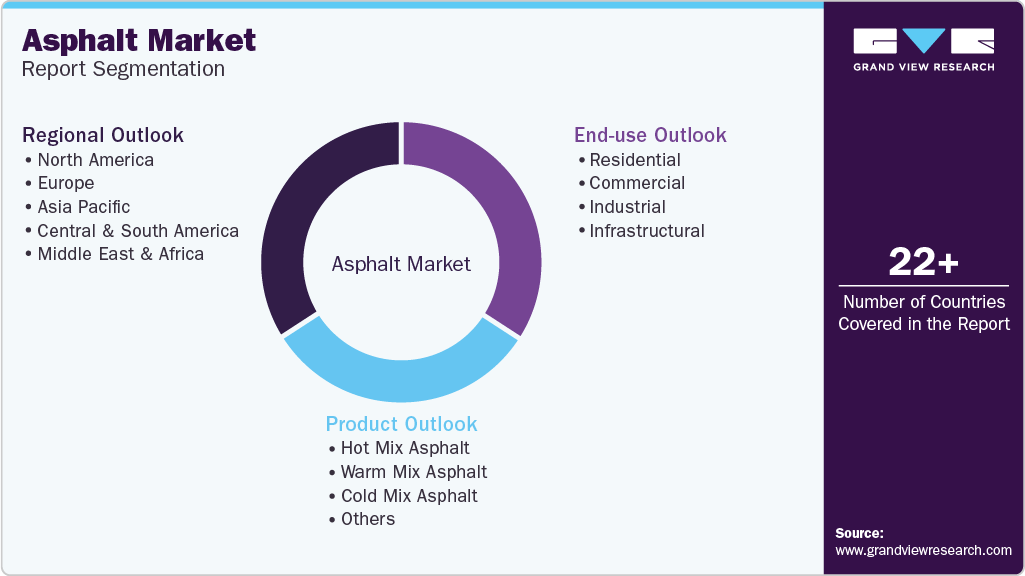
This report forecasts revenue growth at global, regional, and country levels and provides an analysis of the latest industry trends in each of the sub-segments from 2021 to 2033. For this study, Grand View Research has segmented the global asphalt market report based on product, end use, and region.
 To learn more about this report, Download Free Sample Report
 -
Product Outlook (Revenue, USD Billion, 2021 - 2033)
-
Hot Mix Asphalt
-
Warm Mix Asphalt
-
Cold Mix Asphalt
-
Others
-
-
End Use Outlook (Revenue, USD Billion, 2021 - 2033)
-
Residential
-
Commercial
-
Industrial
-
Infrastructural
-
-
Regional Outlook (Revenue, USD Billion, 2021 - 2033)
-
North America
-
U.S.
-
Canada
-
Mexico
-
-
Europe
-
Germany
-
UK
-
France
-
Italy
-
Spain
-
-
Asia Pacific
-
China
-
Japan
-
India
-
South Korea
-
-
Central & South America
-
Middle East & Africa
-
Research Methodology
The asphalt market figures in this report are based on a proven research process that combines executive interviews with secondary research from proprietary databases, company filings, and recognized regulatory and institutional sources. Market size is built through value-chain sizing - reconciling supply-side and demand-side estimates - and triangulated with bottom-up and top-down approaches. Every estimate passes multiple levels of expert validation before publication, with each asphalt segment quantified using the revenue-capture definitions in the table below.
Segment Definition
Segment - Product
Revenue capture definition
Hot Mix Asphalt (HMA)
Revenue generated from the sale of asphalt mixtures produced and laid at high temperatures, offering superior durability, strength, and resistance to heavy traffic loads. This segment includes asphalt used in highways, expressways, airport runways, urban roads, and large-scale infrastructure projects.
Warm Mix Asphalt (WMA)
Revenue generated from the sale of asphalt mixtures manufactured and applied at lower temperatures than conventional hot mix asphalt, reducing energy consumption and emissions. This segment includes warm mix products used in sustainable road construction, pavement rehabilitation, and environmentally compliant infrastructure projects.
Cold Mix Asphalt (CMA)
Revenue generated from the sale of asphalt mixtures produced without the need for heating, primarily used for road maintenance, pothole repairs, patching applications, and low-traffic roads. This segment includes ready-to-use and stockpile cold mix solutions for temporary and permanent repair works.
Others
Revenue generated from the sale of specialty asphalt products, including mastic asphalt, porous asphalt, polymer-modified asphalt, colored asphalt, and other customized paving materials designed for specific performance, drainage, safety, or aesthetic requirements.
Segment - End Use
Revenue capture definition
Residential
Revenue generated from the use of asphalt in residential construction projects, including driveways, private roads, walkways, parking areas, and community infrastructure within housing developments and residential complexes.
Commercial
Revenue generated from the use of asphalt in commercial properties such as office complexes, retail centers, shopping malls, hotels, educational institutions, and commercial parking facilities requiring durable and cost-effective paving solutions.
Industrial
Revenue generated from the use of asphalt in industrial facilities, including manufacturing plants, warehouses, logistics centers, ports, and heavy-duty operational areas where pavements must withstand high loads and frequent vehicle movement.
Infrastructural
Revenue generated from the use of asphalt in public infrastructure projects, including highways, roads, bridges, tunnels, airports, rail corridors, and other transportation networks funded by government agencies and private infrastructure developers.
Estimation Model
Layer Name
Key Question
Description
Road & Infrastructure Development Layer
What forms the demand base?
Identify global asphalt consumption across key end-use sectors, including highways, roads, airports, bridges, residential developments, commercial properties, industrial facilities, and public infrastructure projects. This layer establishes the total addressable demand for asphalt driven by construction activity, urbanization, transportation investments, and pavement maintenance requirements.
Product Penetration Layer
Which asphalt products are utilized?
Estimate the adoption and consumption share of Hot Mix Asphalt (HMA), Warm Mix Asphalt (WMA), Cold Mix Asphalt (CMA), and other specialty asphalt products across various applications and geographies. Assess penetration levels based on climatic conditions, sustainability requirements, project specifications, traffic intensity, and regulatory standards governing pavement construction.
Application Intensity Layer
How much asphalt volume is consumed?
Analyze asphalt usage intensity across residential, commercial, industrial, and infrastructural applications. Consumption is influenced by project size, pavement thickness, maintenance cycles, traffic load requirements, road network expansion, rehabilitation activities, and regional infrastructure development priorities.
Revenue Layer
How is market revenue generated?
Market revenue is quantified through the production, supply, and installation of asphalt products used in paving, resurfacing, maintenance, and rehabilitation projects. Revenue is generated from demand across transportation infrastructure, residential construction, commercial developments, industrial facilities, and government-funded public works projects, supported by value-added services such as asphalt recycling, pavement engineering, and construction contracting.
Delivered Customizations
This report has been delivered with the following In-depth customizations
Client Request
Customization Delivered
Value Adds
Regional Segmentation Analysis
Detailed market assessment across North America, Europe, Asia Pacific, Central & South America, and Middle East & Africa, including market size, growth forecasts, infrastructure spending trends, and asphalt consumption patterns. Country-level analysis was provided for key markets to evaluate regional demand drivers and investment opportunities.
Enables clients to identify high-growth geographic markets, optimize regional expansion plans, and align strategic investments with infrastructure development trends.
Cross-Segmentation Analysis
Comprehensive analysis of demand patterns across Hot Mix Asphalt, Warm Mix Asphalt, Cold Mix Asphalt, and Others by Residential, Commercial, Industrial, and Infrastructural end-use sectors. Cross-regional comparisons were conducted to identify the most attractive product-end-use combinations and growth pockets.
Provides actionable insights into high-potential market segments, supporting product positioning, capacity planning, and targeted business development initiatives.
Competitive Benchmarking
Benchmarking of key asphalt manufacturers based on product portfolio coverage across Hot Mix Asphalt, Warm Mix Asphalt, Cold Mix Asphalt, production capabilities, regional presence, strategic partnerships, sustainability initiatives, and market competitiveness across end-use industries.
Helps stakeholders evaluate competitor strengths, identify market gaps, benchmark operational performance, and develop effective competitive strategies.
Frequently Asked Questions About This Report
Asia Pacific dominated the asphalt market with a 38.9% revenue share in 2025.
Asia Pacific is the fastest-growing region in the asphalt market with a CAGR of 4.3% over the forecast period.
The infrastructural segment led the asphalt market with a 70.3% revenue share in 2025.
Warm mix asphalt is the fastest-growing product segment in the asphalt market with a CAGR of 4.5% over the forecast period.
The hot mix asphalt segment led the market and accounted for the largest revenue share of 72.1% in 2025, driven by its superior performance characteristics and widespread applicability in infrastructure development.
The global asphalt market size was valued at USD 68.4 billion in 2025 and is estimated at USD 71.0 billion for 2026.
The global asphalt market is expected to grow at a CAGR of 4.0% from 2026 to 2033, reaching USD 93.2 billion by 2033.
Some of the prominent companies in the asphalt market include CEMEX S.A.B. de C.V., China Petroleum & Chemical Corporation, Exxon Mobil Corporation, Marathon Petroleum Corporation, Royal Dutch Shell, Total, United Refining Company, Boral, Valero Marketing and Supply Company, and HEIDELBERGCEMENT AG.
Key factors driving the asphalt market include rapid urbanization and infrastructure development, particularly in emerging economies, which are increasing the demand for roads, highways, and airports.
About the Author(s)
Advanced Interior Materials Research Team
Advanced Materials · Advanced Interior MaterialsThis report was authored by the advanced interior materials research team at Grand View Research - comprising two research analysts, one senior research analyst, and one industry expert - with specialized expertise in the advanced interior materials segment of the advanced materials industry. All findings are based on proprietary advanced materials databases, executive interviews, and regulatory analysis, subject to internal peer review prior to publication.
Last Updated:
Speak to Analyst

Customize this report to your needs - add regions, segments, or data points, with 20% free customization.
Or view our licence options:


ISO 9001:2015 & 27001:2022 Certified
We are GDPR and CCPA compliant! Your transaction & personal information is safe and secure. For more details, please read our privacy policy.


